Influenza pandemics are regarded as among the most significant threats to public health. Their timing cannot be predicted, and they have the potential to cause significant morbidity and mortality.Reference Ryan1 After the rapid spread of the H5N1 (avian influenza) virus, the World Health Organization has advised developing pandemic preparedness plans.2 In some countries, these plans are incorporated in broader national security measures as part of an all-hazard concept. The all-hazard system-level approach, which emerged at the beginning of the 21st century, refers to plans that are designed for a broad range of emergency situations, integrating emergency activities at all governmental levels.Reference Moore, Mawji, Shiell and Noseworthy3
The state of pandemic preparedness in primary care has been investigated. Research concerning preparedness by general practitioners (GPs) showed that while GPs were willing to discharge their professional duty during a pandemic outbreak,Reference Shaw, Chilcott, Hansen and Winzenberg4, Reference Wong, Koh and Cheong5 they noted a number of barriers to their efficiency. These barriers included limited time that they could spend on pandemic preparationsReference Lauer, Kastner and Nutsch6 and dependence on the support from health authorities in terms of education, training, and supply of personal protective equipment (PPE).Reference Shaw, Chilcott, Hansen and Winzenberg4, Reference Lauer, Kastner and Nutsch6, Reference Anikeeva, Braunack-Mayer and Street7 In addition, an analysis of the national preparedness plans of different countries identified numerous deficiencies in the way GPs were incorporated in these plans.Reference Patel, Phillips, Pearce, Kljakovic, Dugdale and Glasgow8
In light of these deficiencies, a review of the literature on challenges that GPs have faced participating in responses to the virulent diseases that have caused public health crises might help to elicit strategies for an efficient response at the primary care level, and thus may help to improve the planning for such crises.
The aim of this integrative review has been to gain a broad perspective on barriers and challenges faced by GPs participating in the response to infectious disease public health crises. Quantitative, qualitative, and mixed-method studies have previously proved to be useful in policy planning, as they enhance the relevance of the review by decision makers.Reference Harden9 Different types of evidence have been integrated recently to review complex public health issues in generalReference Harkes, Brown and Horsburgh10 and public health issues in preparedness in particular.Reference Kohn, Eaton, Feroz, Bainbridge, Hoolachan and Barnett11, Reference Chaffee12
This review describes and analyzes evidence concerning the challenges that GPs faced participating in the response to infectious disease public health crises. Two questions guided this review: (1) what were the challenges and barriers experienced by GPs during public health crises caused by infectious diseases, and (2) did GPs in various countries experience similar challenges and barriers during different public health crises caused by infectious diseases? To this end, a systematic approach using the Preferred Reporting Items for Systematic Reviews and Meta-Analyses (PRISMA) guidelines was applied to the literature search, study selection, and data extraction.Reference Liberati, Altman and Tetzlaff13
Methods
Search Strategy
The literature search was performed in 3 phases. First, the Scopus database was searched using the initial key words “primary care physicians” and pandemic*. Titles, abstracts, and index terms of the relevant articles were analyzed to construct the list of search terms (Table 1).
Search Concepts

Next, database-specific searches using the search terms list were performed in the following databases: MEDLINE, PubMed, Scopus, EMBASE, PsycINFO, Cochrane Library, and ProQuest Dissertations and Theses. Finally, reference lists of all studies that were retrieved for appraisal were searched for additional relevant studies. The search was performed during November 2012 to January 2013.
Study Selection
Following the removal of duplicate entries, the abstracts and titles of all retrieved articles were screened by one of us (M.K.) for relevance. To minimize selection bias, the full text of the selected articles after this first round of screening was then independently screened by 2 reviewers (M.K. and S.T.) using the study inclusion and exclusion criteria. Disagreements were resolved by consensus after discussion.
Inclusion Criteria
This review considered empirical studies that involved primary data collection from GPs and drew on their experience during epidemics or pandemics. Studies with the following design were included: qualitative interviews (ie, in-depth, structured, semistructured, unstructured), focus groups, surveys (quantitative and qualitative), and mixed-method studies.
Research reports included peer-reviewed research articles, peer-reviewed research abstracts, and peer-reviewed summaries of research findings. The participants in these reports were GPs who were identified as physicians employed in primary care settings and who provide direct patient care. In some countries, primary care physicians include primary care pediatricians, family physicians, and general internal medicine physicians. Studies in which participants were not exclusively GPs and included, for example, health care workers in general, were included only if data relating to the experience of GPs were reported separately.
The phenomenon of interest was the experience of GPs working during epidemics or pandemics of contagious air or droplet borne diseases. The context was the management of epidemics or pandemics caused by contagious air or droplet-borne diseases in primary care.
Articles were excluded for the following criteria:
• nonempirical reports (did not involve primary data collection with primary care physicians);
• reports drew on the same data sets;
• Non-English language publications.
Data Extraction
The primary aim of the data extraction process was to capture the entire range of barriers and challenges that GPs encountered during the response to infectious disease public health crises. All factors reported to present barriers or challenges were coded according to the themes they represented. Different aspects of the main themes were coded as subthemes and were organized under the main theme. The theme tree provided details about the public health crises and the countries that were studied.
Results
The literature search of the databases yielded 522 potential sources (Figure). An additional 4 studies were identified from the reference lists of included articles that were added to the screening process. After duplicates were removed, 232 articles remained. During the initial round of title and abstract scanning, the primary reviewer (M.K.) excluded 257 citations. The most frequent reasons for study exclusion were studies that investigated pandemic preparedness rather than experience during a pandemic; epidemiological studies about the effect of a pandemic or epidemic on the overall population; studies about vaccine development or effectiveness; and studies about seasonal influenza outbreaks. The full texts of the remaining 37 articles were separately screened by 2 reviewers (M.K. and S.T.), and an additional 27 reports were excluded. The most frequent reasons for study exclusion in this phase were because the studies were not empirical; they were not about GPs; and their focus was on other phenomenon of interest, such as treatment effectiveness or ethical aspects.
Overview of Study Selection. Abbreviation: GP, general practitioner.

Of the 27 articles that were full-text screened, 3 were opinion reports written by GPs and describing GPs’ involvement in the response to the 2009 H1N1 influenza pandemic.Reference Eizenberg14-Reference Fitzpatrick16 Although they were excluded from the systematic review, these articles presented important evidence of personal experience, and key issues presented in them served as triangulation for data extracted from the reviewed studies.
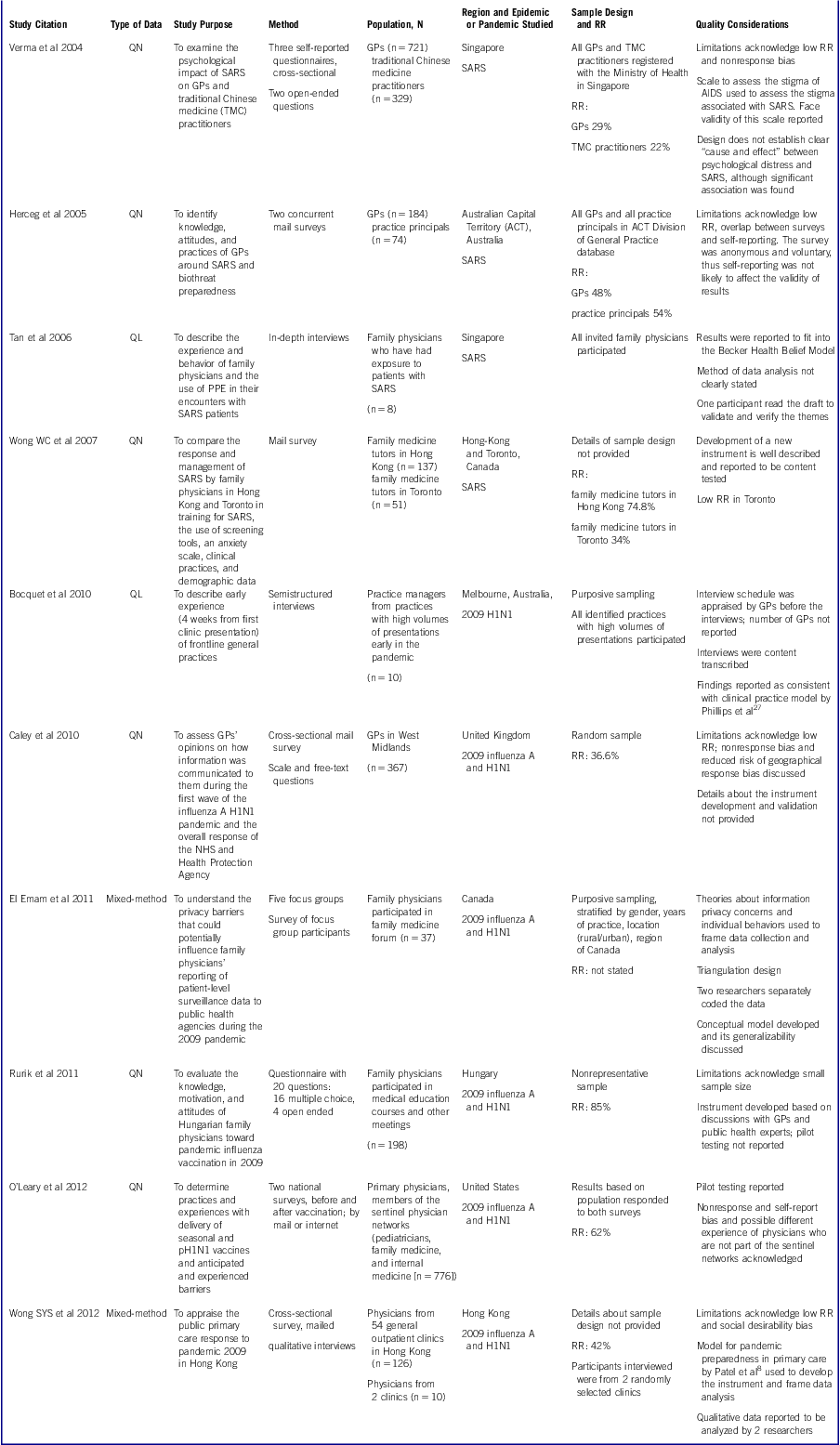
Six quantitative surveys,Reference Caley, Sidhu and Shukla17-Reference Rurik, Langmar, Marton, Kovacs, Szigethy and Ilyes22 2 mixed-method studies,Reference Wong, Kung and Wong23, Reference El Emam, Mercer, Moreau, Grava-Gubins, Buckeridge and Jonker24 and 2 qualitative studiesReference Bocquet, Winzenberg and Shaw25, Reference Tan, Goh and Lee26 met our inclusion criteria (Table 2). Of the 6 quantitative surveys, 4Reference Caley, Sidhu and Shukla17, Reference Herceg, Geysen, Guest and Bialkowski18, Reference Verma, Mythily, Chan, Deslypere, Teo and Chong20, Reference Rurik, Langmar, Marton, Kovacs, Szigethy and Ilyes22 included open-ended questions exploring the concerns of GPs during the pandemic or epidemic response and their suggestions for improvement. The mixed-method study of Wong etalReference Wong, Kung and Wong23 comprised a cross-sectional survey and 10 qualitative interviews with GPs. The mixed-method study of El Emam etalReference El Emam, Mercer, Moreau, Grava-Gubins, Buckeridge and Jonker24 presented the qualitative results of 5 focus groups and used descriptive statistics to present the results of the survey administered. The 2 qualitative studiesReference Bocquet, Winzenberg and Shaw25, Reference Tan, Goh and Lee26 employed qualitative in-depth interviews.
Overview of Studies in Chronological Order
Abbreviations: GP, general practitioner; NHS, National Health Service; PPE, personal protective equipment; QL, qualitative study; QN, quantitative study; RR, response rate; SARS, severe acute respiratory syndrome.
All studies that met inclusion criteria were published since 2003 and were dedicated to 1 of 2 infectious diseases that caused public health crises in the 21st century—severe acute respiratory syndrome (SARS) outbreak and the 2009 H1N1 influenza pandemic. The experience of GPs from 7 countries was presented in the reviewed studies. Four of the these studies investigated the experience of GPs during the SARS outbreak in Hong Kong.Reference Wong, Wong, Lee and Goggins19 Canada,Reference Wong, Wong, Lee and Goggins19 Singapore,Reference Verma, Mythily, Chan, Deslypere, Teo and Chong20, Reference Tan, Goh and Lee26 and Australia.Reference Herceg, Geysen, Guest and Bialkowski18 The other 6 focused on the experience of GPs during the 2009 H1N1 influenza pandemic in Australia,Reference Bocquet, Winzenberg and Shaw25 United Kingdom,Reference Caley, Sidhu and Shukla17 Canada,Reference El Emam, Mercer, Moreau, Grava-Gubins, Buckeridge and Jonker24 Hungary,Reference Rurik, Langmar, Marton, Kovacs, Szigethy and Ilyes22 United States,Reference O'Leary, Stokley and Crane21 and Hong Kong.Reference Wong, Kung and Wong23
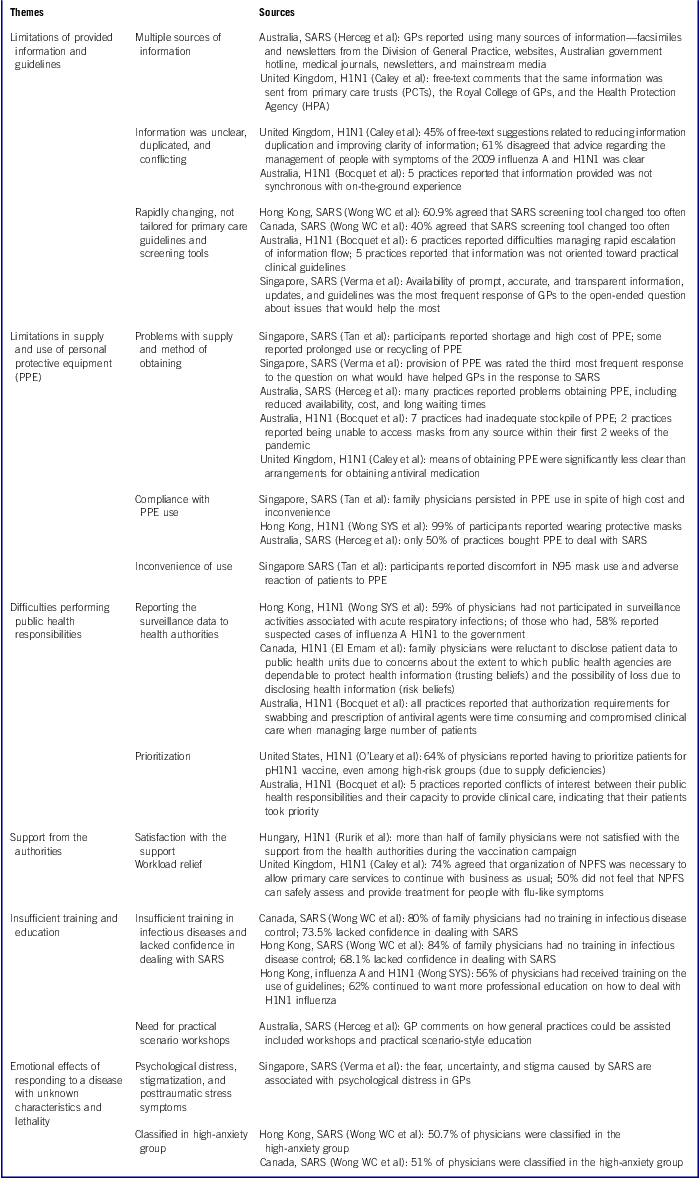
Evidence of various challenges and barriers to primary care management of public health crises caused by an infectious disease was found in the reviewed literature (Table 3).
Challenges and Barriers: Experience by Primary Care Physicians in Different Countries
Abbreviations: GP, general practitioner; NPFS, National Pandemic Flu Service; SARS, severe acute respiratory syndrome.
Limitations of Provided Information and Guidelines
Access to information and guidelines for treatment and infection control was discussed in relation to the SARS outbreak and the 2009 H1N1 pandemic in 4 countries, while in Australia the experience discussed included both of these crises. The opinion of GPs on this issue was measured in 4 quantitative studies and described as a theme in 1 qualitative study. Similar challenges included multiple sources of information (evidence from 2 countries during the SARS outbreak and the H1N1 pandemic); information was unclear, duplicated, and conflicting (evidence from 2 countries during the H1N1 pandemic); rapidly changing and guidelines not tailored for primary care; and screening tools (evidence from 3 countries during the SARS outbreak and the H1N1 pandemic).
Australian GPs in the study by Herceg etalReference Herceg, Geysen, Guest and Bialkowski18 reported being well informed about the SARS outbreak, but their suggestions, which were derived from open-ended questions, included the need for timely information and detailed guidelines appropriate for primary care. GPs from this study reported deriving information from multiple sources. Multiple sources of information and information that was unclear, duplicated, and conflicting were also reported by GPs regarding the information and advice provided by the health authorities in the United Kingdom.Reference Caley, Sidhu and Shukla17 Guidelines and screening tools that were rapidly changing and not tailored for primary care were reported in Hong Kong during the SARS outbreakReference Wong, Wong, Lee and Goggins19 and in Melbourne, Australia, during the H1N1 pandemic.Reference Bocquet, Winzenberg and Shaw25 Availability of prompt, accurate, and transparent information; updates; and guidelines was identified as the most frequent response by GPs to the open-ended question about what issues would help the most in the study by Verma etalReference Verma, Mythily, Chan, Deslypere, Teo and Chong20 about the SARS outbreak in Singapore.
Limitations in Supply and Use of Personal Protective Equipment
Problems with the supply of personal protective equipment (PPE) were reported in 4 studies.Reference Caley, Sidhu and Shukla17, Reference Verma, Mythily, Chan, Deslypere, Teo and Chong20, Reference Bocquet, Winzenberg and Shaw25, Reference Tan, Goh and Lee26 In SingaporeReference Tan, Goh and Lee26 and AustraliaReference Bocquet, Winzenberg and Shaw25 this issue was discussed in the context of shortage and the high cost of the PPE during the SARS outbreak and the H1N1 pandemic, respectively. In the qualitative study by Bocquet etal,Reference Bocquet, Winzenberg and Shaw25 inappropriate PPE supply was described as one of the factors that negatively influenced the decision of Melbournian primary clinics to maintain care of influenza patients. The qualitative study about the SARS outbreak in SingaporeReference Tan, Goh and Lee26 described difficulties in procuring PPE due to severe shortages and high costs. In another study, provision of protective gear was identified as the third most frequent response given by Singaporean GPs to the question about what factors would help in the primary care response during the SARS outbreak.Reference Verma, Mythily, Chan, Deslypere, Teo and Chong20
This same issue of PPE supply was addressed in the UK study in the context of the method of obtaining PPE during H1N1 pandemic,Reference Caley, Sidhu and Shukla17 and GPs reported that the means of obtaining the protective gear was not sufficiently clear.
Compliance with the advice to use PPE was measured in 2 survey studiesReference Herceg, Geysen, Guest and Bialkowski18, Reference Wong, Kung and Wong23 and discussed in 1 qualitative study.Reference Tan, Goh and Lee26 Differing inclinations to comply with the advice to use PPE were found. In Singapore during the SARS outbreakReference Tan, Goh and Lee26 and in Hong Kong during the H1N1 pandemic,Reference Wong, Kung and Wong23 GPs were reported to have high compliance with the guidelines to wear PPE. On the contrary, in Australia only one-half of the primary care clinics were reported as complying with the guidelines to buy PPE during the SARS outbreak.Reference Herceg, Geysen, Guest and Bialkowski18 GPs from this study suggested that PPE should be provided to primary clinics by the authorities.
Inconvenience of PPE use was discussed only in the qualitative study about the SARS outbreak in Singapore.Reference Tan, Goh and Lee26 That study reported that in spite of the discomfort, shortage, and cost, GPs persisted using PPE as they believed that its effectiveness outweighed these barriers.
Difficulties Performing Public Health Responsibilities
Performance of public health responsibilities by GPs was discussed in the reviewed studies only in the context of the H1N1 pandemic. Two aspects of this issue were addressed: reporting of the surveillance data to the health authorities and prioritization of the patients.
Reporting surveillance data to the health authorities was examined in 3 studies.Reference Wong, Kung and Wong23-Reference Bocquet, Winzenberg and Shaw25 The study about the H1N1 response in Hong KongReference Wong, Kung and Wong23 noted that 59% of GPs were not part of the surveillance activities; among those who were, only 58% reported suspected cases of H1N1 virus to the government. A qualitative study about the privacy barriers that influenced GPs’ reporting of surveillance data during the H1N1 pandemic in Canada found that GPs were reluctant to disclose patients’ data to public health units due to concerns that private health information may be disclosed to other agencies.Reference El Emam, Mercer, Moreau, Grava-Gubins, Buckeridge and Jonker24 In the qualitative study concerning GPs’ experience in Melbourne,Reference Bocquet, Winzenberg and Shaw25 compulsory surveillance reporting before providing antiviral drugs and viral swab tests was found to be time consuming and compromising the clinical care.
The aspect of prioritization of patients was included in 2 studies.Reference O'Leary, Stokley and Crane21, Reference Bocquet, Winzenberg and Shaw25 In the United States, the issue was discussed in relation to vaccine shortage during the vaccination campaign. O'Leary etalReference O'Leary, Stokley and Crane21 reported that GPs faced difficulties prioritizing patients for vaccination during the H1N1 pandemic in the face of a new influenza strain and inadequate supplies of the vaccine, and that the way GPs prioritized high-risk patients needed further exploration. In Melbourne, prioritization arose in the qualitative study concerning GPs’ experience during the H1N1 pandemic when the capacity to provide clinical care was being stretched.Reference Bocquet, Winzenberg and Shaw25 In that study, 5 of 10 GPs interviewed preferred to provide care to their own patients rather than other influenza patients who presented during the outbreak without prior history of attendance in that clinic.
Support From the Authorities
We looked for evidence of organizational or financial support provided by the authorities to GPs to help them cope with the difficulties of pandemic or epidemic response. In Hungary, low satisfaction with the support from the health authorities was reported during the H1N1 vaccination campaign.Reference Rurik, Langmar, Marton, Kovacs, Szigethy and Ilyes22 In another report, the opinion of GPs was presented regarding the special arrangement to provide them with workload relief in the United Kingdom during the H1N1 pandemic.Reference Caley, Sidhu and Shukla17 The United Kingdom organized the National Pandemic Flu Service (NPFS) to ease the pressure on primary care; all symptomatic patients were directed to seek advice and treatment through the NPFS. In general, the UK GPs supported this arrangement, but they raised reservations about its diagnostic ability and prescribing safety, as the NPFS provided advice over the phone or through the Internet.
Insufficient Training and Education
The issue of insufficient training in the field of infectious disease control was raised both in the context of the SARS outbreak and the H1N1 pandemic. Wong etalReference Wong, Wong, Lee and Goggins19 reported that most GPs in Hong Kong (68.1%) and Canada (73.5%) were not confident in dealing with SARS patients and had no training in infectious disease control (80%-84.6%, respectively). Also, 62% of the GPs in Hong Kong surveyed about their experience during the H1N1 pandemic expressed the desire for more training and education on dealing with the influenza pandemic.Reference Wong, Kung and Wong23 Moreover, GPs who participated in the study concerning the response to the SARS outbreak in Australia suggested that training and education in the field of infectious disease control would be beneficial for them in preparation for responding to future outbreaks.Reference Herceg, Geysen, Guest and Bialkowski18
Emotional Effects of Responding to a Disease With Unknown Characteristics and Lethality
Two studiesReference Wong, Wong, Lee and Goggins19, Reference Verma, Mythily, Chan, Deslypere, Teo and Chong20 assessed the emotional effect of participating in the response during the SARS outbreak and presented the experience of GPs in 3 countries. In all 3 countries, high levels of psychological distress and anxiety were presented.
Verma etalReference Verma, Mythily, Chan, Deslypere, Teo and Chong20 found that direct contact with SARS patients was associated with psychological distress, stigmatization, and posttraumatic stress symptoms in GPs in Singapore. Similarly, Wong etalReference Wong, Wong, Lee and Goggins19 reported that approximately 50% of each group of GPs surveyed in Canada and Hong Kong right after the SARS outbreak was classified in the high-anxiety group.
Discussion
This systematic review was conducted to identify literature about GPs’ experience during the response to an epidemic or pandemic. Although the search criteria had no time limitations, only 10 studies met the inclusion criteria; all were published since 2003 and investigated either the SARS outbreak or the 2009 H1N1 pandemic. No empirical studies were found that involved primary data collection with GPs about their experience during influenza pandemics of the 20th century (ie, Spanish flu of 1918-1920, Asian flu of 1957-1958, or Hong Kong flu of 1968-1969). Moreover, the 2009 H1N1 pandemic was a recent public health event that spread widely across the world, affecting 214 countries and causing more than 18 449 deaths.28 GPs were the main responders to this disease.Reference Eizenberg14, Reference Collins15 Even so, only 6 studies explored the experience of GPs during the response to this pandemic.
This scant scientific coverage of GPs’ experience is surprising, especially considering that in most countries GPs play an important role in such public health crises and learning from their experience is crucial for improving future prepandemic planning. One reason for this deficit may be that interest in planning for a pandemic response is a relatively new phenomenon. The global health community and national governments started to be concerned with the spread of a new virulent influenza virus in 1997,Reference Ryan29 when the death of a 3-year-old child in Hong Kong was proved to be caused by a highly pathogen avian influenza (H5N1).Reference Subbarao, Klimov and Katz30 Sporadic outbreaks of the H5N1 virus recorded in Southeast Asia and the Middle East in subsequent years have prompted the development of the pandemic preparedness field. The unexpected outbreak of SARS in 2003 revealed the vulnerability of front-line medical professionalsReference Emanuel31 and generated some interest in research into GPs’ role in the response. This trend was further developed with the analysis of GPs’ participation in the management of the 2009 H1N1 pandemic. Thus, the preparedness of GPs to respond during pandemics is an emerging field of research that has only recently begun to receive attention.
Another possible reason for the limited number of studies that involve primary data collection from GPs about their experience during epidemics or pandemics may be the difficulty in recruiting GPs to participate in such research. Most quantitative studies included in this review had low response rates. This issue has been addressed in the literature, and the barriers against the participation of GPs in surveys have been studied.Reference Rosemann and Szecsenyi32-Reference Bonevski, Magin, Horton, Foster and Girgis34
In spite of the small number of studies included in this review, the prominent role of GPs in the response to the SARS outbreak and the H1N1 pandemic has been evident. Participation in the response to the SARS outbreak was found to have an emotional impact on GPs, causing distress and anxiety. While no emotional effect was reported with regard to the H1N1 pandemic, it may have been because this issue was not investigated, analysis of the emotional effect of participating in the response was not the objective of the review, or a literature search was not attentive to this issue.
Identified Challenges and Barriers
This review identified important challenges and barriers experienced by GPs. All of the identified challenges were reported in more than one country and thus were broadly generalizable. These findings mean that, in spite of the differences in organization of primary care across nations and in spread of the disease, the experience of GPs in different countries constitutes transferable learning that can be used to improve preparedness planning. However, it also highlights the fact that some of the challenges were evident during the SARS and H1N1 outbreaks, even though planning for pandemic response was accelerated in the years between these events. This factor is probably because the data on the GPs’ role and involvement during SARS was as limited as the SARS epidemic itself, and the intensive efforts in preparedness toward pandemics regarding the GPs was not emphasized.
Communication with public health authorities was a difficult issue in both cases. Evidence from the reviewed literature indicated that multiple sources of information and frequent updates that were not oriented toward primary care presented operational challenges for GPs. The study by HercegReference Herceg, Geysen, Guest and Bialkowski18 that investigated the preferred ways GPs receive updates during SARS found that, amid multiple sources of information, Australian GPs preferred updates from the Division of General Practice, the midlevel organization with which most GPs in Australia were voluntarily affiliated. This finding, however, was not acted on during the H1N1 pandemic; GPs were confronted with duplicated information. Evidence about duplicated information and guidelines that were not tailored for primary care was also presented in an opinion paper about the experience of general practices in Melbourne during the H1N1 pandemic.Reference Eizenberg14
Access to PPE was another problem in different countries during the SARS and the H1N1 incidents. While the findings suggested that GPs are willing to use PPE in spite of the inconvenience associated with its use, operational problems of supply, shortage, and cost of PPE during the outbreak present a challenge for them. In one study, GPs compromised their safety by reusing masks.Reference Tan, Goh and Lee26 Another study reported that inadequate supply of PPE affected the decision of practices about consulting the patients suspected of being infected.Reference Bocquet, Winzenberg and Shaw25 Problems with the PPE supply were also highlighted in an opinion paper.Reference Eizenberg14
During the SARS outbreak, GPs felt a lack of confidence dealing with a new, virulent, and potentially life-threatening disease.Reference Wong, Wong, Lee and Goggins19 The study about the response to SARS in Australia indicated that GPs wanted more workshops and practical scenario-style education.Reference Herceg, Geysen, Guest and Bialkowski18 Still, during the management of the H1N1 pandemic, GPs indicated that they needed more professional education on how to deal with affected patients.Reference Wong, Kung and Wong23 This finding was surprising because GPs routinely consult seasonal flu patients and thus are very familiar with the disease. Perhaps, the complexity of infection control during the influenza pandemic presented a particular challenge in managing patients.
Problems associated with the performance of public health responsibilities were noted only in studies about the H1N1 pandemic. Different aspects of these responsibilities were highlighted. With respect to surveillance reporting to the health authorities, in Hong Kong low reporting rates were notedReference Wong, Kung and Wong23; in Canada, privacy concerns were citedReference El Emam, Mercer, Moreau, Grava-Gubins, Buckeridge and Jonker24; and in Australia, reporting was found to be time consuming.Reference Bocquet, Winzenberg and Shaw25 The issue of prioritization was investigated in the United States in the context of low supply of the vaccine,Reference O'Leary, Stokley and Crane21 and in surges of unwell patients in Australia.Reference Bocquet, Winzenberg and Shaw25 It was unclear whether the mixed evidence could be explained by the difference in organization of public health versus primary care in different countries, or whether the small amount of research dedicated to this important issue can construct only a partial picture.
Evidence relevant to the support of GPs by the health authorities also was reported only in the context of the H1N1 pandemic. While the GPs’ preparedness before the pandemic indicated that they rely on support from the health authorities,Reference Shaw, Chilcott, Hansen and Winzenberg4, Reference Lauer, Kastner and Nutsch6, Reference Anikeeva, Braunack-Mayer and Street7 this issue has been limited in the reviewed literature. Only 1 study reported the special arrangement with NPFS to provide workload relief in primary care during flu patient surges in the United Kingdom. This arrangement was supported by GPs, in spite of the expressed concerns about its safety.Reference Caley, Sidhu and Shukla17 In the study by Bocquet etal about the experience of GPs in Melbourne during the H1N1 pandemic, flu clinics were mentioned as places where some general practices decided to divert flu patients because of the inability to apply infection control in the general practice or the lack of PPE. Flu clinics, however, were organized to help emergency departments cope with the surges of flu patients after daytime working hours for primary care physicians. During regular daytime hours, the primary care physicians remained the first point of contact for the flu patients.35
Limitations
Although a comprehensive and systematic search of the published literature was conducted, it is possible that some articles were missed. Also, the review was limited to English language publications, thus excluding works published in other languages. Our search yielded only 10 reports that conformed to all of the criteria. While the reasons for a limited number of articles were discussed, the challenges encountered by GPs during past epidemics require additional research to be fully understood. Nevertheless, the difficulties identified to date may serve as a platform for re-evaluating and improving the response of GPs to a range of emergency events, including emerging infectious diseases, bioterrorism, and natural disasters.
Conclusions
The findings of this review answered the second research question about the similarities of challenges in response to past pandemics or epidemics for GPs from different countries. They found that GPs from different countries experienced similar difficulties, indicating that their experience may offer cases of transferable learning that could be used for future response planning.
The answer to the first research question about the challenges that GPs experienced responding to past epidemics or pandemics was not definitive because of the lack of relevant research. While important difficulties were identified, the evidence was mixed and the number of studies that were dedicated to this issue was limited, precluding a complete list of possible challenges of pandemic response in primary care.
The public health role of GPs started to receive attention only after the 2009 H1N1 pandemic. Further research is needed to analyze why issues of communication with health authorities and PPE provision still presented a challenge for GPs in 2009 after lessons learned from the SARS outbreak and extensive prepandemic planning were reported. Another area for study concerns what problems of infection control are specific to primary care and whether these problems could be solved by professional training. It is also important to investigate what types of support health authorities can provide to GPs during pandemics or epidemics. Moreover, learning from the experience of GPs in different countries may provide an important platform for improvement.