Introduction
Self-confidence, defined as a ‘feeling of trust in one’s abilities, qualities and judgement,’ is worsening among surgical trainees.1 Approximately one quarter worry they will not feel able to perform surgical procedures independently on completion of their training.Reference Fonseca, Reddy, Longo, Udelsman and Gusberg2 However, developing self-confidence is challenging in the pressures faced by the UK healthcare system and training pathways.
Surgical training curricula in the UK has expanded in recent years to cover not only the practical aspects of surgery and decision-making. An increasing emphasis has been placed upon non-technical skills, such as leadership training and involvement in research and quality improvement, which although this is important has decreased the time for trainees to develop self-confidence in decision-making and surgical skills. Additionally, the increasing need for service provision in understaffed healthcare systems negatively impacts on opportunities to develop self-confidence.Reference Beamish, Johnston, Harries, Mohan, Fitzgerald and Humm3 Restrictions on working hours over the past decade mean surgical trainees will have spent cumulatively less time operating when they complete their training than those who trained before them, which is an additional concern for trainees who lack confidence.Reference Khan, Jordan, Strange and Vig4
It is important that surgical trainees feel confident managing the variety and complexity of problems they will encounter throughout their consultant careers. Developing confidence in one’s decision making and surgical ability is difficult to map onto a curriculum. However, training programmes will need to adapt to ensure surgical trainees do feel confident in their surgical and decision-making abilities, even when faced with the increasing pressures of service provision, research and super-curricular activities.
In the specialty of ENT specifically, many medical graduates feel underprepared to manage conditions as the required specialist knowledge is not routinely taught at medical school or during foundation training in the UK.Reference Alabi, Hill, Walsh and Carroll5, Reference Smith, Trinidade and Tysome6 Doctors entering six-year ENT higher surgical training programmes in the UK also report lacking confidence in their roles.Reference Anmolsingh, Abrar, Chandrasekar, Salem, Edmitson and Advani7, Reference Hurreiz8 This lack of confidence, which is often accompanied by performance anxiety, can negatively impact both their surgical performance and overall well-being.Reference Engelhardt, Bilimoria, Johnson, Hewitt, Ellis and Hu9, Reference Miller, Hotton, Williamon, Kneebone, Goodacre and O’Leary10 Understanding the factors that affect the confidence of surgical trainees is particularly important in ENT, where airway emergencies require quick and confident decision-making.
There are many studies in the literature that examine specific elements surrounding trainee confidence. However, this systematic review and thematic analysis is the first to assimilate them with a specific focus on surgical trainees.
Objectives
The aim of this study was to systematically review the literature for factors that affect confidence among surgical trainees. Understanding these factors could guide surgical training programmes to better support trainees and improve their self-confidence.
Methods
Search strategy
This systematic review and thematic analysis was conducted in accordance with the Preferred Reporting Items for Systematic Reviews and Meta-Analyses (PRISMA) guidelines.Reference Moher, Liberati, Tetzlaff and Altman11 A comprehensive search strategy was carried out using Pubmed®, Embase™, Scopus and the online registry ClinicalTrials.gov (Supplementary Figure I), with searches conducted in June 2023. A grey literature search was performed with Google Scholar and forward citation searching.
Inclusion and exclusion criteria
Original research with available full text articles was included with no date restrictions. Articles involving surgical trainees’ confidence were considered. The full inclusion and exclusion criteria are detailed in Table 1.
Inclusion and exclusion criteria

CASP and STROBE scores for assessment of study quality

Title and abstract review
Following the exclusion of duplicate articles, two authors (C.P. and M.S.) independently reviewed titles and abstracts. After independently identifying articles suitable for full-text review, conflicts were resolved by mutual discussion.
Full text review and data extraction
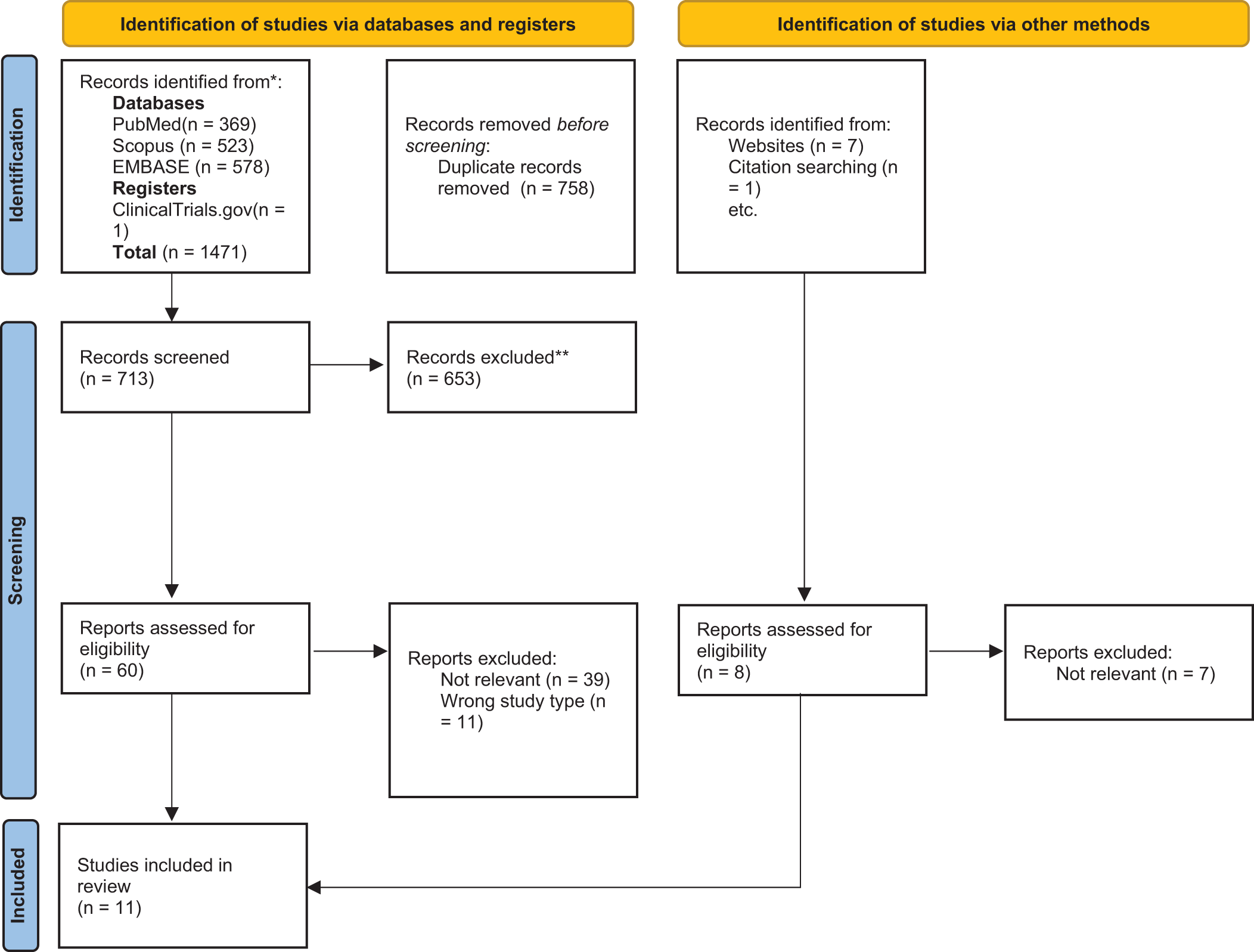
Eleven articles met the inclusion criteria and were eligible for data extraction (Figure 1). Data from eligible studies were extracted including country, study design, aims and outcomes (Table 3). Odds ratios and p-values were quoted where available.
PRISMA flow chart of search results and study selection.

Summary of study characteristics and findings

Discussion topics were extracted using BMC Medical Research Methodology on thematic analysis.Reference Thomas and Harden12 Phrases and concepts from each paper were translated into codes, and these codes were used to create overall meta-themes to synthesise the data (Table 4). The coding was performed independently by two researchers (C.P. and M.S.) and themes agreed by mutual discussion.
Codes and overall themes extracted from eligible studies

The three qualitative studies were assessed using the Critical Appraisal Skills Programme (CASP) tool for qualitative research and the eight observational studies were assessed using the Strengthening the Reporting of Observational studies in Epidemiology (STROBE) checklist. Both of these tools evaluate study quality. Higher scores indicate better methodological rigor and reporting quality.
Results
Ten studies were included from the literature search and one study from grey literature. Eight studies were observational studies performed using written surveys: seven of these were cross-sectional, and Flyckt 2018 was a cohort study.Reference Flyckt, White, Goodman, Mohr, Dutta and Zanotti13 Of the three qualitative studies, two used semi-structured interviews (Lees et al. 2019 and Kamali and Illing 2018) and one used a survey with open-ended questions (Babchenko et al. 2020).Reference Babchenko, Scott, Jung, Frank, Elmaraghi and Thiagarajasubramanian14–Reference Kamali and Illing16 The mean STROBE score for the eight observational studies was 17.5 (standard deviation 2.3) with a minimum score of 14 and a maximum of 20 (Table 2), indicating that the studies included were of moderate-to-high quality. Study characteristics and findings are presented in Table 3.
Coding identified several themes as influencing trainees’ confidence. These themes included gender, feedback, working environment, trainee preparation and trainee seniority (Table 4). Throughout the studies included, confidence was linked to improved perception of performance.
Gender
Six studies found female gender to be associated with lower confidence.Reference Fonseca, Reddy, Longo, Udelsman and Gusberg2, Reference Flyckt, White, Goodman, Mohr, Dutta and Zanotti13, Reference Medline, Grissom, Guissé, Kravets, Hobson and Samora17, Reference Fonseca, Reddy, Longo and Gusberg20–Reference Minter, Gruppen, Napolitano and Gauger22 In one study, this association did not reach statistical significance, possibly due to it being underpowered.Reference Minter, Gruppen, Napolitano and Gauger22 Three studies specifically mentioned that female trainees have lower confidence in their surgical ability compared to male trainees. One of these compared actual surgical performance between male and female trainees and found no significant difference.Reference Flyckt, White, Goodman, Mohr, Dutta and Zanotti13, Reference Minter, Gruppen, Napolitano and Gauger22 One study focused on imposter syndrome, defined as ‘the persistent inability to believe that one’s success is deserved or has been legitimately achieved as a result of one’s own efforts or skills.’ 23 This study found that female surgical trainees were more likely to experience imposter syndrome.Reference Iwai, Yu, Thomas, Fayanju, Sudan and Bynum24 Additionally, Babchenko et al. demonstrated a significant difference in the perception of the importance of confidence between male and female trainees. In this study, 94 per cent of male trainees stated confidence was ‘very important’ compared to less than half of female trainees.Reference Babchenko, Scott, Jung, Frank, Elmaraghi and Thiagarajasubramanian14
Feedback from trainer
Two studies found positive feedback from a trainer significantly improved trainees’ confidence, particularly when specific, constructive and regular.Reference Lees, Zheng, Daniels and White15, Reference Kamali and Illing16 One study found that positive feedback was the most important factor for increasing trainees’ confidence, offering reinforcement and encouragement.Reference Lees, Zheng, Daniels and White15 Trainees’ felt more confident starting and performing a task if they had received positive feedback for the same operation previously.Reference Kamali and Illing16
Inversely, negative non-constructive feedback was detrimental to trainees’ confidence, particularly if feedback was undermining and included victimisation and criticism.Reference Kamali and Illing16 A quote from a structured interview stated: ‘It became a very personal attack about a lack of interest, a lack of effort and lots of things which weren’t really particularly fair. At the same time as then to concentrate on operating and I just found that whole sort of case uncomfortable.’Reference Kamali and Illing16
Non-constructive, negative feedback hindered performance, stifled learning and discouraged improvement. Trainees’ felt afraid to ask questions or make mistakes.Reference Lees, Zheng, Daniels and White15
Environment
Four studies found that a supportive theatre environment positively impacted trainees’ confidence.Reference Babchenko, Scott, Jung, Frank, Elmaraghi and Thiagarajasubramanian14–Reference Kamali and Illing16, Reference Park, Ponnala, Fichtel, Tehranchi, Fitzgibbons and Parker25 One study highlighted the importance of factors such as good team dynamics, low time pressure and a respectful, encouraging supervisor. A total of 95 per cent of respondents in this study reported that their trainer’s mood influenced their performance.Reference Babchenko, Scott, Jung, Frank, Elmaraghi and Thiagarajasubramanian14 Lees et al. (2019) similarly found that a positive relationship between trainer and trainee was beneficial for trainee confidence.Reference Lees, Zheng, Daniels and White15
A good relationship included feeling comfortable, not intimidated and able to ask questions. Qualities of the trainer, such as mood, teaching style, being caring, compassionate and ‘human’, were all deemed important in creating a positive mindset for the trainee.Reference Babchenko, Scott, Jung, Frank, Elmaraghi and Thiagarajasubramanian14, Reference Lees, Zheng, Daniels and White15, Reference Park, Ponnala, Fichtel, Tehranchi, Fitzgibbons and Parker18
Support from other theatre staff was also beneficial to confidence. Stress in theatre, often from time pressures and negative supervisor behaviours, such as berating, led to a negative environment and reduced confidence.Reference Babchenko, Scott, Jung, Frank, Elmaraghi and Thiagarajasubramanian14, Reference Kamali and Illing16 One interviewee described a setting of ‘rushing’, ‘yelling’ and noise, which diminished their educational experience, confidence and performance.Reference Lees, Zheng, Daniels and White15
Additional themes
Prior preparation increased overall theatre confidence and operative performance.Reference Babchenko, Scott, Jung, Frank, Elmaraghi and Thiagarajasubramanian14 Most studies found senior trainees were more confident than juniors.Reference Fonseca, Reddy, Longo, Udelsman and Gusberg2, Reference Babchenko, Scott, Jung, Frank, Elmaraghi and Thiagarajasubramanian14, Reference Medline, Grissom, Guissé, Kravets, Hobson and Samora17, Reference Park, Parker and Safford19–Reference Bucholz, Sue, Yeo, Roman, Bell and Sosa21, Reference Park, Ponnala, Fichtel, Tehranchi, Fitzgibbons and Parker25 Interestingly, one study highlighted that age was more strongly associated than seniority, suggesting a direct link between age and confidence.Reference Bucholz, Sue, Yeo, Roman, Bell and Sosa21
Discussion
Confidence is important for surgeons to navigate the multifaceted nature of their job and to make complex, unexpected decisions in a timely manner. A lack of self-confidence can cause indecisiveness and panic in emergency situations.Reference Ahmad26 This is particularly important in ENT, where high-risk airway emergencies demand rapid and confident decision-making.
Conversely, increased confidence can lead to an improved perceived performance that does not translate to objective performance. Indeed, overestimation of skills may lead to worse patient outcomes.Reference Hall, Ellis and Hamdorf27 A study on bariatric surgery found those with the highest self-ratings of confidence also had the highest rates of anastomotic leaks.Reference Varban, Thumma, Carlin, Ghaferi, Dimick and Finks28
Our systematic review assimilates the current literature to provide insights regarding the factors that affect confidence in surgical trainees. It is essential that training programmes foster healthy self-confidence in trainees and find a balance between the indecisive, underconfident surgeon and the overconfident, overbearing one. Understanding the factors that influence confidence is crucial for the development of training programs that successfully meet this balance in trainees.
• Confidence is important for surgical trainees as it is required for decision-making and surgical skill development.
• However, confidence among surgical trainees is decreasing.
• This is the first systematic review to synthesise factors affecting the confidence of surgical trainees.
• Lower confidence is linked to undermining behaviour from trainers, time pressure, loud environments and female gender.
• Higher confidence is associated with positive feedback, supportive trainers, calm environments and positive relationships with other theatre staff.
• The findings highlight key areas for intervention to enhance trainee confidence and improve surgical training.
Gender
Our review highlighted differences in confidence between male and female trainees, with female trainees consistently reporting lower confidence than males. Despite increasing numbers, women remain underrepresented in surgery, comprising only 34.2 per cent of surgical registrars and 16.1 per cent of surgical consultants in the UK in 2020.Reference Newman, Parry, Zakeri, Pegna, Nagle and Bhatti29 The lack of female role models may contribute to imposter syndrome among female trainees. Additionally, studies highlight that female surgeons often face less respect from colleagues and patients, with incorrect assumptions about their roles and experiences of sexist comments.Reference Lim, Wong, Jain, Ng, Tai and Devi30 The 2024 GMC national training survey found that 41 per cent of female trainees had experienced stereotyping or derogatory remarks, compared to 25 per cent of males, and that 26 per cent felt they had been excluded from conversations or meetings, compared to 15 per cent of males.31 These experiences likely contribute to lower confidence among female surgical trainees.
However, the appropriateness of these confidence levels remains unclear. The only study in this review to assess objective surgical performance found no gender differences, which is supported by a large observational study.Reference Sharoky, Sellers, Keele, Wirtalla, Karakousis and Morris32 However, a large, matched cohort study reported a small but statistically significant lower 30-day mortality rate for surgeries performed by female surgeons, except in otolaryngology where the difference was not significant.Reference CJd, Ravi, Coburn, Nam, Detsky and Satkunasivam33 Other outcomes in this cohort study, such as complication and readmission rates, showed no significant gender differences. It is also unclear whether the within-group variation in outcomes exceeds the between-group differences in this study. As such, it cannot be concluded that an individual surgeon’s sex meaningfully predicts performance. If the goal is to improve surgical outcomes, it may be more productive for future research to identify and address modifiable variables that could contribute to any small gender-based differences in outcomes, rather than focusing on a non-modifiable variable such as gender.
The existing evidence does not support the notion that there are gender-differences in competence among trainees. It is therefore unlikely that the higher confidence observed among male trainees reflects greater ability. Addressing this gap in confidence is important to ensure female trainees feel equally supported in their surgical careers, particularly given the gender disparity in senior roles. A more confident, supported cohort of female trainees is important to developing a more inclusive, diverse and representative surgical workforce.
Feedback
Supervising trainers play a significant role in shaping trainees’ confidence, both through feedback and their overall demeanour in theatre. Positive feedback proved particularly effective, encouraging trainees to take on more responsibility during cases. Intra-operative feedback is widely recognised as a powerful tool for improving performance and reducing errors.Reference Trehan, Barnett-Vanes, Carty, McCulloch and Maruthappu34, Reference Boyle, Al-Akash, Gallagher, Traynor, Hill and Neary35 Our review suggested feedback is most impactful when given regularly and contemporaneously. However, evidence shows it is often sporadic and of low quality.Reference Bing-You and Trowbridge36, Reference Day, Grosso, JJ, Blank, Swanson and Horne37 Poorly considered, negative feedback has a particularly detrimental effect on trainees’ confidence. Trainees felt that personal or belittling remarks are unhelpful for their confidence and can inhibit learning by creating a tense environment where trainees are nervous to ask questions.
Unfortunately, undermining and bullying remain prevalent in healthcare, with 8 per cent of UK trainees reporting such behaviour, which rises to 12 per cent in surgical specialties, according to the 2023 GMC National Training Survey.38 In some departments, this behaviour has been viewed as acceptable or even a ‘rite of passage’ within surgical training.Reference Myers39 Fortunately, the culture is shifting, and such behaviour is increasingly being seen as unacceptable. In 2016, the Association of Surgeons in Training issued a statement that trainees should not be placed in departments with a history of bullying or undermining.40 Well delivered, constructive, corrective feedback is highly important in improving performance and technical skills, which are vital part of surgical training. However, our review found that receiving positive feedback was most important when it comes to improving trainees’ confidence. This is an important consideration for trainers, especially when working with trainees who lack confidence. A balanced approach combining corrective and positive feedback may be the most constructive.
Environment
The working environment is another factor that impacts trainees’ confidence. A stressful theatre with poor team dynamics creates a tense atmosphere that can undermine confidence and hinder skill development. Evidence shows that stress impairs manual dexterity and increases errors in surgical trainees,Reference Arora, Sevdalis, Aggarwal, Sirimanna, Darzi and Kneebone41 with time pressures and background noise commonly cited as contributors to stress, which negatively impacts surgical performance.Reference Moorthy, Munz, Dosis, Bann and Darzi42 The behaviour of the trainer and the trainer–trainee relationship were also important factors in shaping trainee confidence. When a trainer is undermining, rude or appears indifferent to training, the trainee’s confidence and performance suffer. Fear, often stemming from uncivil behaviour, stifles learning and curiosity. This is reflected in reports of trainees feeling nervous about asking questions or making mistakes under such circumstances.Reference Perry43
Conversely, a positive environment can enhance a trainee’s confidence and learning experience. Team dynamics emerged as an important factor in our review, with good relationships among all theatre staff, not just between trainer and trainee, fostering a supportive atmosphere that boosts confidence. A supportive, encouraging trainer is particularly crucial in helping trainees feel confident in theatre. The literature suggests that investing time in building a positive trainer-trainee relationship leads to more effective learning and feedback.Reference Sargeant, Lockyer, Mann, Armson, Warren and Zetkulic44 This may be because strong relationships foster trust and flatten hierarchy, which increases psychological safety.Reference Johnson, Keating and Molloy45 Learning in a psychologically safe environment allows trainees to ask questions and express themselves without fear of negative consequences.Reference Torralba, Jose and Byrne46 However, the frequent rotations between departments in surgical training make it difficult to form meaningful, long-term relationships with trainers.
Most of the included studies found that senior trainees had a higher degree of confidence than junior trainees. Although this may be expected, it is useful to know that a trainee’s confidence may improve over time, as this can help guide a trainer or mentor in giving reassurance. Interestingly, several of the included studies referred to increasing confidence with age rather than seniority. Although the two are often positively correlated, the findings of Bucholz’s study state that trainees who were married and older felt more confident.Reference Bucholz, Sue, Yeo, Roman, Bell and Sosa21 This shows that perhaps increased life experience in general, as opposed to simply greater operative experience, helps to improve confidence.
Additional themes
The concept of preparation by trainees was discussed in one of the included studies. It found that trainees’ confidence was improved when trainees prepared in advance for a case in theatre. Rehearsal of specific surgical skills has been shown to improve operative confidence, technique and anatomical knowledge when performed in a simulated setting,Reference Weber, Leland, Azadgoli, Minneti and Carey47 but mental preparation of a surgical case has also been shown to enhance physical practice and develop surgical training.Reference Rajaratnam, Rahman, Omar and Ng48
Strengths and limitations
This review contributes to the limited literature on confidence in surgical trainees. It is the only review to integrate multiple factors affecting confidence in surgical trainees. It therefore offers valuable insights for training programs and individual trainers on how to promote appropriate confidence in trainees and identify those who may need additional support to build self-confidence.
The relatively small number of papers in this review highlights the need for more research into this field. Additionally, most papers included are from the USA and therefore may limit the generalisability of the results to different training systems. Nevertheless, most of the themes emerging could provide valuable insights for surgical training programmes globally.
This review focused on analysing the key themes that affect confidence in surgical trainees. The limited amount of quantitative evidence in the literature prevented statistical analysis in this review. This highlights a need for future observational studies to quantitatively explore variables affecting surgical trainees’ confidence.
Conclusion
Our review provides a novel synthesis of the factors influencing confidence in surgical trainees, offering valuable insights for enhancing surgical training programs. We identified key elements that affect trainees’ confidence, particularly their trainer. A trainers’ attitudes and behaviours, along with frequency and type of feedback given, are crucial to instilling confidence. Supportive, calm trainers who offer regular positive feedback create a psychologically safe environment, boosting confidence and performance. In contrast, undermining or belittling remarks create a stressful environment that discourages trainees from asking questions or making mistakes, ultimately hindering confidence and skill development. A stressful theatre environment, characterized by excessive noise and time pressures, further reduces learning opportunities and confidence. These factors are entirely modifiable and should be a point of focus for surgical training programmes globally.
The review indicated that female trainees often underestimate their ability and report lower confidence than their male counterparts, despite no strong evidence of poorer performance. This highlights the need for a concerted effort to build the confidence of female trainees, who remain underrepresented in surgery. Further research into the factors that affect the confidence of female surgical trainees could help to uncover the specific reasons behind their decreased confidence, and whether these may be modifiable.
Training programmes need to focus on promoting confidence among trainees. This may include practical changes, such as planning training sessions with adequate time, fostering a culture of support and encouragement within departments and prioritising regular, constructive feedback. All trainers should be encouraged to give regular feedback to trainees, and to consider that trainees with lower confidence may benefit from increased positive feedback where appropriate.
Supplementary material
The supplementary material for this article can be found at https://doi.org/10.1017/S0022215125102788.
Author contribution
All authors contributed to this work. Each author agrees to be accountable for all aspects of the work, ensuring its accuracy and integrity.
Funding
This research received no specific grant from any funding agency in the public, commercial or not-for-profit sectors.
Declaration of interest
The authors have no competing interests.
Ethical approval
Ethical approval was granted by the University of Exeter College of Medicine & Health Research Ethics Committee (148/25/05/58).
Transparency declaration
The manuscript is an honest, accurate and transparent account of the study being reported. No important aspects of the study have been omitted.