

Introduction
Among the islands of the Philippines, Cebu was recorded as severely degraded as early as 1893 (Worcester and Bourns Reference Worcester and Bourns1893) and remained so (Rabor Reference Rabor1959, Colina and Jumalon Reference Colina and Jumalon1974). By 1998, less than 1% of the island was reportedly covered with forest (Collar et al. Reference Collar, Mallari and Tabaranza1999, Paguntalan and Jakosalem Reference Paguntalan and Jakosalem2008, Jakosalem et al. Reference Jakosalem, Collar and Gill2012). Forest loss and a high island endemism have resulted in a disproportionately large number of threatened species for its size (Brooks et al. Reference Brooks, Pimm and Oyugi1999, Collar et al. Reference Collar, Mallari and Tabaranza1999, Paguntalan and Jakosalem Reference Paguntalan and Jakosalem2008, Jakosalem et al. Reference Jakosalem, Collar and Gill2012). As of 2020, Cebu has two Critically Endangered, four Endangered, and three Vulnerable species of forest-dwelling birds (BirdLife International 2020), with a land surface less than 5,000 km2. Of the 56 forest birds resident on Cebu, 19 have been considered extinct including eight of the endemic bird taxa (Rabor Reference Rabor1959, Collar et al. Reference Collar, Mallari and Tabaranza1999, Kennedy et al. Reference Kennedy, Gonzales, Dickinson, Miranda and Fisher2000, Paguntalan and Jakosalem Reference Paguntalan and Jakosalem2008). Among the native forest birds that have survived is the Black Shama Kittacincla cebuensis.
The Black Shama is one of four known endemic Kittacincla taxa in the Philippines (Kennedy et al. Reference Kennedy, Gonzales, Dickinson, Miranda and Fisher2000, Collar Reference Collar, del Hoyo, Elliott, Sargatal, Christie and de Juana2020, Allen Reference Allen2020), and it is the most threatened, categorised as Endangered by the International Union for the Conservation of Nature (IUCN). It is a highly territorial medium-sized understorey bird (Collar Reference Collar, del Hoyo, Elliott, Sargatal, Christie and de Juana2020). The males are all black with a bluish gloss and the females are duller greyish-brown (Kennedy et al. Reference Kennedy, Gonzales, Dickinson, Miranda and Fisher2000). It is locally known as “siloy” and was once described as the rarest Shama in the Philippines (Hachisuka Reference Hachisuka1936, Collar et al. Reference Collar, Mallari and Tabaranza1999). It occupies a variety of habitats including shrub, tree plantations, secondary growth along steep ravines, and bamboo thickets (Magsalay Reference Magsalay1993, Collar et al. Reference Collar, Mallari and Tabaranza1999, Kennedy et al. Reference Kennedy, Gonzales, Dickinson, Miranda and Fisher2000). Its known distribution records are from five of the 10 forest patches known to persist on Cebu (Collar et al. Reference Collar, Mallari and Tabaranza1999, Paguntalan and Jakosalem Reference Paguntalan and Jakosalem2008, Malaki Reference Malaki2015), including a strip of degraded lowland forest of about 80 ha on karst in the Central Cebu Protected Landscape (CCPL), the much larger forest in Alcoy, and patches of degraded forest with tree plantations in Argao and Dalaguete (Paguntalan and Jakosalem Reference Paguntalan and Jakosalem2008, Paguntalan et al. Reference Paguntalan, Tabao, Jakosalem, Orolfo and Rica2015).
Estimates of the Black Shama population in recent decades have been highly optimistic, with a calculation of 6,650 individuals in Alcoy alone in 2004 (Jakosalem et al. 2005 unpublished, IUCN 2020). Here the density in valley-bottom forests was calculated at 1,750 individuals/km2 (17.5 individuals/ha) and 350 individuals/km2 (3.5 individuals/ha) in ridge-top forests (Jakosalem et al. 2005 unpublished). In 2012, a survey in the forest patches in Argao estimated the density of Black Shama at 5,200–5,300 individuals/km2 (52–53 individuals/ha) in forests and mixed plantations (Malaki et al. Reference Malaki, Cruz, Bantayan, Racelis, Buot and Florece2013). The same site was revisited in 2014 where Black Shama density was estimated at 2,600–3,600 individuals/km2 (26–36 individuals/ha) in both mixed-tree species plantations and 3,100 individuals/km2 (31 individuals/ha) in natural forests (Malaki et al. 2015). Around the same period, mist-netting surveys in four sites in Cebu recorded a total of 45 Black Shama territories and from these, density was estimated at 1,300 individuals/km2 (13 individuals/ha) (Parilla et al. Reference Parilla, Laude, de Guia, Espaldon and Florece2019). The aims of this survey were to assess habitat use and confirm or reassess the previous population density estimates and distribution of the Black Shama by covering a much wider geographical area looking for new sites and by revisiting sites previously surveyed.
Methods
Survey sites
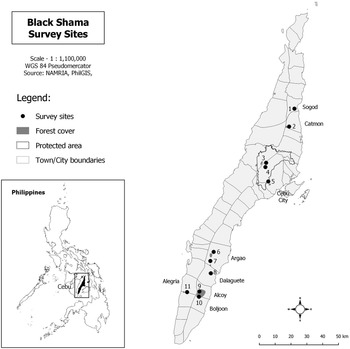
We conducted the survey across 27 localities within 11 sites. “Sites” are defined here as forest patch/es and “localities” are the specific areas within the forest patch/es (sites). We used the 28 sites known to harbour Black Shama (Collar et al. Reference Collar, Mallari and Tabaranza1999, Gonzalez et al. 1999 unpublished, Jakosalem et al. 2005 unpublished, Paguntalan and Jakosalem Reference Paguntalan and Jakosalem2008, Malaki et al. Reference Malaki, Cruz, Bantayan, Racelis, Buot and Florece2013, Malaki Reference Malaki2015, Paguntalan et al. Reference Paguntalan, Tabao, Jakosalem, Orolfo and Rica2015, Parilla et al. Reference Parilla, Laude, de Guia, Espaldon and Florece2019) as reference for choosing the 27 localities within the 11 sites in Cebu (Figure 1). We also compiled information on recent reports of Black Shama presence in sites where previously it had not been known to occur. Field surveys were conducted on 23–24 February 2018, 30 March 2019, 14 June 2019, and 4–7 March 2020.
Location map of the survey sites on Cebu Island, Philippines.
1: Brgy. Poblacion, Sogod; 2: Mt. Kapayas, Catmon; 3: Tabunan, CCPL, Cebu City; 4: Cantipla, CCPL, Cebu City; 5: Pamutan-Buhisan; 6: Mt. Lantoy, Argao; 7: Canbantug, Argao; 8: Malones, Lanao and Babayungan, Dalaguete; 9: Nug-as, Alcoy; 10: Nangka, Boljoon; 11: Mt. Lanaya, Alegria.

Bird observations
Prior to surveying, observers underwent 2–3 days field training in bird identification and survey methods with an emphasis on point count Distance sampling techniques. Each observation team had at least one assigned trained member. A total of 111 point count stations were visited covering 27 localities within 11 sites. Point count stations were set at least 250 m apart with a maximum radial distance of 50 m and marked in the field using Garmin GPSMAP 64s GPS. Observations were conducted from around 06h00 until 09h00. For every positive record, we noted a) whether it was an audio or visual record, b) the number of individuals, c) the sex, and d) their linear distance from the centre of the point count stations. Count duration at each point lasted eight minutes following Lee and Marsden (Reference Lee and Marsden2008). Point-to-object linear distance was estimated to the nearest metre (Howe et al. Reference Howe, Buckland, Després-Einspenner and Kühl2018), allowing our data to be analysed as point transects (Buckland et al. Reference Buckland, Anderson, Burnham, Laake, Borchers and Thomas2001). We also interviewed locals, and validated photographs and recordings of Black Shama in areas we had not visited. All records were mapped and compared by location to eliminate the possibility of double counting.
Habitat assessment
We established 30 × 30 m plots in each point count station for habitat preference assessment. A total of 34 plots were established across the 11 sites. The number of trees with heights of <10 m, 10–15 m, and >15 m, canopy cover, understorey cover, and vine cover were recorded. Canopy cover was estimated using a spherical densiometer while the rest of the variables were visually assessed through estimates.
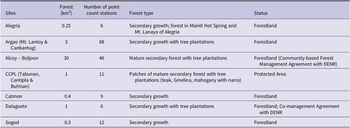
We used the National Mapping Resource Information Authority (NAMRIA) 2010 map and information from the National Greening Program of the Philippines (DENR-FMB 2013) to validate the island’s forest cover on the ground from 2017 to 2018. Efforts were also made to visit other remaining forest patches in Cebu (Table 1). Using QGIS 3.12, we calculated suitable habitat (lowland forest on karst, tree plantations, bamboo plantations, and advanced secondary growth) for Black Shama habitat. A description of the habitats in each site is provided in Table 1.
Description of the sites visited during the surveys from 2017 to March 2020. Alcoy & Boljoon forest is presented in this table as one as they form a contiguous forest patch between two towns. Other sites are lumped to the towns and protected area where they are part of. Source: NAMRIA 2010; DENR Region VII. DENR = Department of Environment and Natural Resources; NA = not applicable.

Analysis
Habitat associations
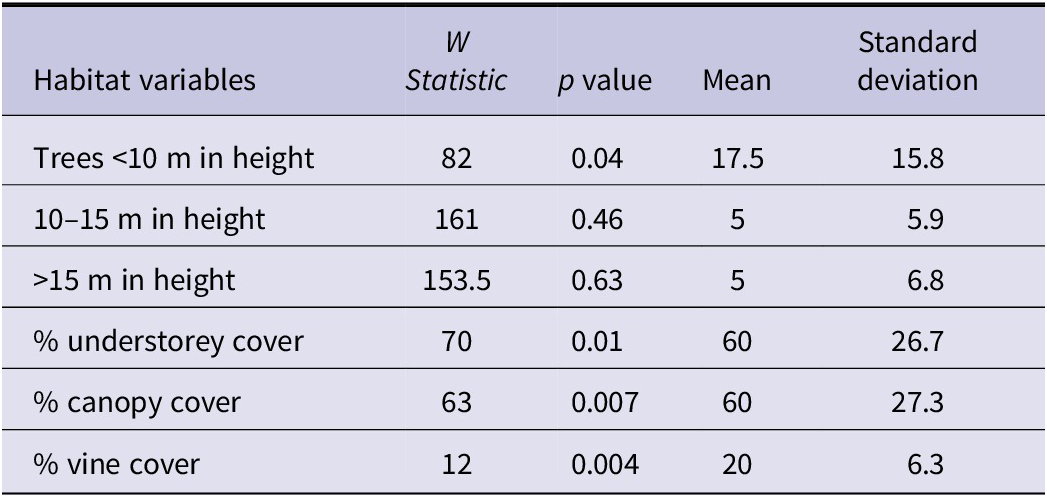
We compared six habitat variables on five selected sites (Table 2). As our data were not normally distributed, we used the Mann–Whitney test to determine differences for these parameters across sites. We used a logistic regression model with a logit link function in R Deducer 2.15.0 (R Core Team 2013) based on the general logistic regression formula:
 $$ Logit\,(Y=Black\ Shama\ occurrence)=\alpha +{\beta}_1{X}_1+{\beta}_2{X}_2+\cdots +{\beta}_k{X}_k $$
where Y = dependent variable (Black Shama occurrence), X = independent variables, α = intercept, and β = coefficient. In assessing our models, all six habitat variables were fitted in the global model and progressively removed until a minimum acceptable model was reached, where further removal of variables resulted in increase in the model’s Akaike Information Criterion (AIC) value.
Mann-Whitney U test result and summary of habitat variables (mean and standard deviation) across the five sites (Alcoy, Dalaguete, Argao, Catmon and CCPL).

Density and population estimate
A total of 111 point count stations was surveyed resulting in a total of 93 detections. We excluded sites that were surveyed only once to minimise bias and increase precision on density estimates thus limiting analysis to samples for Alcoy–Boljoon, Argao, Catmon, Dalaguete, and CCPL. Both visual and aural records were pooled to calculate densities (expressed as individuals/km2) using Distance version 7.3 (Thomas et al. Reference Thomas, Buckland, Rexstad, Laake, Strindberg, Hedley, Bishop, Marques and Burnham2010). All data were right-truncated at 50 m to remove observations with distances exceeding 30 m to improve model fit (Ekblom Reference Ekblom2010; Buckland et al. Reference Buckland, Marsden and Green2008).
Different models were assessed to select best fit and the model with the lowest AIC value and percentage confidence value was selected as the best fit (Buckland et al. Reference Buckland, Marsden and Green2008). Post-stratification of the data by each locality enabled comparison of density estimates and differences in detectability within each site. We then used the combined function for all five sites where the function was based on all 93 detections and post-stratified by site to obtain site-specific results (Buckland et al. Reference Buckland, Marsden and Green2008). Density estimates are presented as the number of individuals/km2.
Results
Habitat characteristics
The 11 survey sites showed characteristics typical of regenerating secondary forest. The forest was mostly composed of trees with heights of less than 10 m. Only Alcoy and sections of Cantipla in CCPL had trees taller than 10 m. Results from comparing the habitat variables between points with and without records using the Mann–Whitney U test showed that there was a significant difference in the number of trees with heights of <10 m (p = 0.04) and percentage understorey cover (p = 0.01). A highly significant difference between percentage canopy cover (p = 0.007) and percentage vine cover (p = 0.004) was also observed (Table 2). As most of the sites surveyed had smaller trees, canopy coverage allowed for light to penetrate the forest floor increasing understorey cover and vine coverage.
Our logistic regression model showed that understorey cover was positively correlated with the probability of Black Shama occurrence (β estimate = 0.041; p <0.009). In areas with dense understorey, the probability of encountering the bird was increased by 0.181 (18.1%) compared with areas of sparse understorey cover.
Density and population estimate
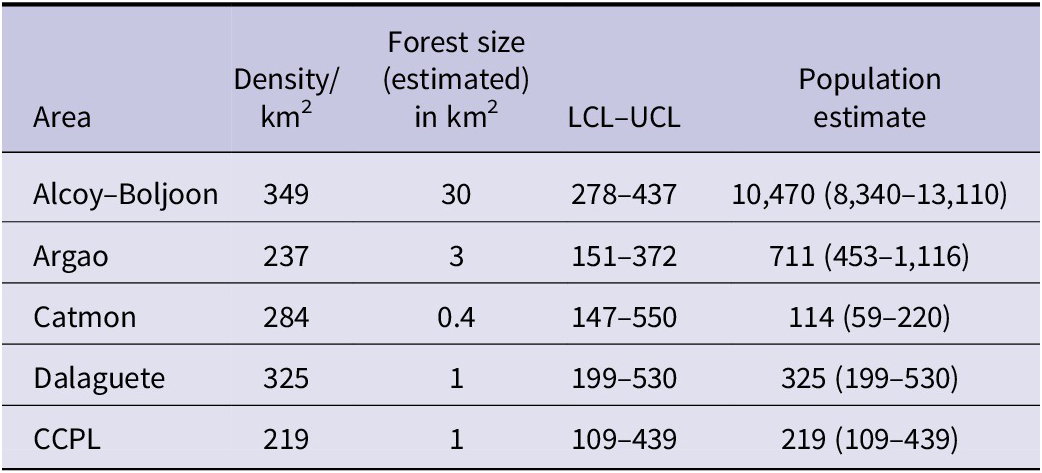
The population density of Black Shama varied across the 11 sites. The highest density was recorded in Alcoy with 349 individuals/km2 followed by Dalaguete (325 individuals/km2), Catmon (284 individuals/km2), and Argao (237 individuals/km2), while the CCPL recorded 219 individuals/km2 (Table 3).
Black Shama density at each site based on Distance estimates. LCL = lower confidence limit; UCL = upper confidence limit.

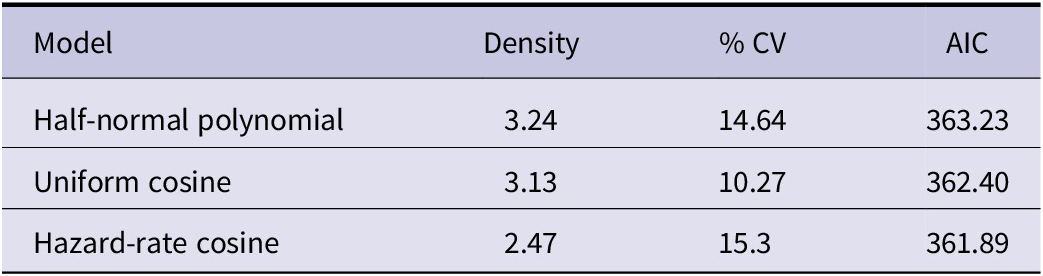
The hazard-rate cosine model showed the lowest AIC but we used the uniform cosine model as this had the lowest percentage confidence value among the three models (Table 4).
Comparison of models based on three detection functions fitted to our dataset. AIC = Akaike Information Criterion; CV = coefficient of variation.

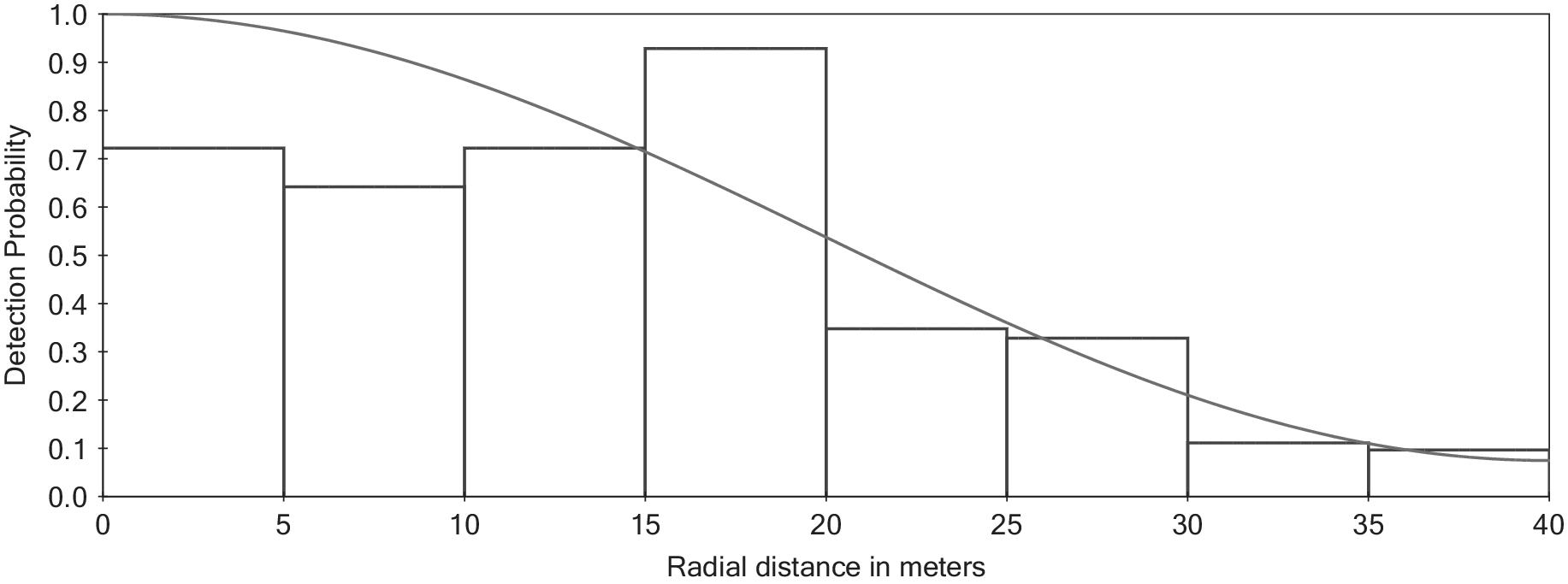
The empirical distribution function showed a good fit and was supported by the Kolmogorov–Smirnov goodness-of-fit test. The effective detection radius was 26 m with most records within 15–20 m distance and very few records beyond 40 m (Figure 2).
Uniform cosine detection probability function model.

About 80% of the detection records were based on vocalisations. We expected fewer Black Shama to be detected as distance from the point increased. However, most of the records fell within 15–20 m distance. This departure from the expected result was largely because a significant number of point count stations were either positioned on ridge tops or dry riverbeds along gullies. It was likely that because of the position of the observers, inaccurate estimation of distances could have happened rather than bird movements (Pyke and Fletcher Reference Pyke and Fletcher1985, Nalwanga et al. Reference Nalwanga, Pmeroy, Cickery and Atkinson2012). We have discounted the possibility that the birds were reacting to the presence of the observers when we tested using only sighting records. It would be wise to keep this in mind when interpreting the results.
Alcoy–Boljoon: the estimated suitable habitat for Black Shama was 30 km2. A total of 46 point count stations was established in Alcoy and Boljoon. The bird was encountered in a variety of habitats from plantations of mixed-tree species, advanced secondary growth, and mature secondary forest on karst. Black Shama density estimates from Distance were 349 individuals/km2. This is the highest density on Cebu Island. Further, based on Distance, the total population for Alcoy and Boljoon was estimated at 10,470 individuals (8,340–13,110 range).
Alegria: a total of six point count stations were distributed in patches of native trees along the headwaters of the Badian River. The Black Shama was encountered in mixed-tree species plantations and in patches of advanced secondary growth along riverbanks estimated to have 0.3 km2 of suitable habitat. Counts were only conducted once and were deemed insufficient to estimate populations using Distance.
Argao: it was estimated that there was around 3 km2 of suitable remaining habitat. A total of 68 point count stations were established and surveyed but in the Distance analysis we excluded several stations that were positioned < 250 m in between to avoid double counting. Black Shama was recorded in mixed-tree species plantations, advanced secondary growth along riverbanks, secondary forests on karst, and in bamboo thickets. The 3 km2 of suitable habitat is broken into three fragments excluding the Canbantug forest. The Black Shama density estimated from Distance was 237 individuals/km2. The total population based on Distance was 711 individuals (453–1,116 range). This was the second highest number of Black Shama recorded in Cebu.
CCPL: it was estimated that there was around 1 km2 of suitable remaining habitat. A total of 16 point count stations were established (six in the Buhisan watershed, eight in Cantipla, and three in Tabunan). We combined the records from the Buhisan watershed with Tabunan and Cantipla to generate density and population estimates using Distance. The bird was observed inside patches of degraded forests and mature mixed-tree species plantations composed of Shorea contorta, S. astylosa, Anisoptera sp., Ficus sp., Artocarpus sp., Tectona grandis, Swietenia macrophylla, and Gmelina arborea with Pterocarpus indicus. Using Distance, we calculated the Black Shama population to be 219 individuals/km2 with a total population estimated at 219 individuals (109–439 range), including those from the Buhisan watershed.
Catmon: it was estimated that there was around 0.4 km2 of suitable habitat remaining. A total of nine point count stations were established in a patch of secondary growth forest with mixed-tree species plantations. Almost all the point count stations established had territories of the Black Shama recorded during every count made. The population density estimate from Distance was 284 individuals/km2 with an estimated Black Shama population of 114 individuals (59–220 range).
Dalaguete: it was estimated that there was around 1 km2 of suitable habitat remaining. We established 15 point count stations located inside tree plantations and secondary growth in Canbantug (Argao), and Babayungan and Bulak areas in Dalaguete. We included Canbantug as the forest is continuous with Babayungan and Bulak. The density estimate from Distance was 325 individuals/km2 while the total population was 325 individuals (199–530 range).
Sogod: a total of 12 point count stations was established along dry river beds surrounded by advanced secondary growth and in patches of native trees on karst. A total of 12 Black Shamas was counted. The lack of distance information limited us from estimating density estimates using Distance.
Malabuyoc: secondary growth along the river banks in Mainit Hot Spring was surveyed and a total of six Black Shamas were encountered in the area. The lack of distance information again limited us from estimating density estimates using Distance.
Carmen: the forests reported in 2008 in Mt. Kapayas and Mt. Poog (Paguntalan and Jakosalem Reference Paguntalan and Jakosalem2008) had been converted to agricultural farmland except for patches of trees on steep karst outcrops. The patches of exotic tree plantations were not visited during the survey.
Among the sites, Alcoy had the highest sub-population at 10,470 followed by Argao with 711 individuals, Dalaguete with 325 individuals, the CCPL with 219, and Catmon with 114. We were also aware of the presence of Black Shama in other localities, e.g. Badian, Malabuyoc, Oslob, Campo 7, and Ayala Land, but most of the sites were narrow strips of forests along steep riverbanks or mature exotic tree plantations with patches of mixed species of native trees. The total population estimate from all sites calculated using Distance was 11,839 individuals.
Distribution
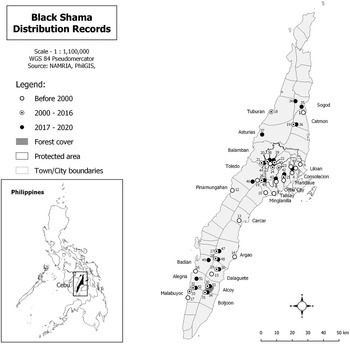
The Black Shama was previously known to occur in 35 localities in Cebu including six records in highly urbanised areas (Collar et al. Reference Collar, Mallari and Tabaranza1999, Paguntalan and Jakosalem Reference Paguntalan and Jakosalem2008, Malaki et al. Reference Malaki, Cruz, Bantayan, Racelis, Buot and Florece2013, Malaki Reference Malaki2015, Parilla et al. Reference Parilla, Laude, de Guia, Espaldon and Florece2019). A total of eight new localities was added to the distribution range of the Black Shama. This included Asturias, Busay in Cebu City, Nangka in Boljoon, Bagacay and Poblacion in Sogod, Sohoton in Badian, and Toledo and Valencia in Alegria. The northernmost record of the bird was in Sogod while the southernmost record was in Malabuyoc (Figure 3).
Distribution records of the Black Shama on Cebu Island, Philippines.
1 – Catmon; 2 – Tabunan, Cebu City; 3 – Cabangahan and Sacsac, Consolacion; 4 – Liloan; 5 – Danglag and Tolotolo, Consolacion; 6 – Casili, Consolacion and Cubacub, Mandaue; 7 – Guadalupe, Cebu; 8 – Buhisan Dam, CCPL, Cebu City; 9 – Mohon, Talisay; 10 – Minglanilla; 11 – Camp 7, Toledo; 12 – Pinamungahan; 13 – Carcar; 14 – Argao; 15 – Mantalongon, Dalaguete; 16 – Kawasan Falls, Badian; 17 – Malabuyoc; 18 – Tuburan; 19 – Mt. Kapayas, Carmen and Catmon; 20 – Mt. Manunggal, Balamban; 21 – Gaas, Balamban; 22 – Tabunan, Cebu City; 23 Ayala heights, Cebu City; 24 – Cantipla, Cebu City; 25 – Talamban, Cebu City; 26 – Camp 7, Minglanilla; 27 – Mt. Lantoy, Argao; 28 – Canbantug, Argao; 29 – Malones, Lanao, Bulak and Babayungan, Dalaguete; 30 – Nug-as, Alcoy; 31 – Nangka, Lower and Upper Beceril, Boljoon; 32 – Mt. Lanaya, Alegria; 33 – Mainit, Malabuyoc; 34 – Bagakay, Sogod; 35 – Poblacion, Sogod; 36 – Mt. Kapayas, Catmon; 37 – Asturias; 38 – Manunggal, Balamban; 39 – Tabunan, Cebu City; 40 – Cantipla, Cebu City; 41 – Sacsac, Consolacion; 42 – Busay, Cebu City; 43 – Pamutan, Buhisan; 44 – Gaas, Balamban; 45 – Camp 7 – Minglanilla; 46 – Toledo; 47 – Mt. Lantoy, Argao; 48 – Canbantug, Argao; 49 – Sohoton, Badian; 50 – Malones, Lanao and Babayungan, Dalaguete; 51 – Valencia, Alegria; 52 – Mt. Lanaya, Alegria; 53 – Nug-as, Alcoy; 54 – Nangka, Boljoon.

Eight of the former distribution sites of the species identified by Collar et al. (Reference Collar, Mallari and Tabaranza1999) have been converted into highly urbanised areas dominated by subdivisions. This includes Casili, Sacsac, Tolotolo, Tumilhao, Cabacub, Guadalupe, Guba, and Minglanilla (Figure 3). Casili in Consolacion recorded 50 individuals in 1999 (Collar et al. Reference Collar, Mallari and Tabaranza1999) and was among the sites converted into housing development. Five male birds were mist-netted in a wooded area close to a subdivision in Casili in 2013 (Parilla et al. Reference Parilla, Laude, de Guia, Espaldon and Florece2019). We also recorded the bird in a university campus in Talamban in 2014 and in a high-end subdivision in Apas, Cebu City from 2011 to 2014.
Discussion
Of the 35 sites known to have the Black Shama, six are local Key Biodiversity Areas (KBAs) in Cebu Island (Paguntalan et al. Reference Paguntalan, Tabao, Jakosalem, Orolfo and Rica2015), and three were included in the national list of KBAs (Ambal et al. Reference Ambal, Duya, Cruz, Coroza, Vergara, de Silva and Tabaranza2012). Most of the sites were in advanced secondary growth on karst with significant variations in the number of trees >10 m in height, the percentage understorey cover, and the percentage vine cover.
The forest habitats with thick understorey cover showed strong correlation with Black Shama presence, whereas canopy cover and number of trees with height of >10 m did not. Malaki et al. (Reference Malaki, Cruz, Bantayan, Racelis, Buot and Florece2013) reported that Black Shama density has a strong correlation with forest canopy cover in Argao. The difference in our results could be partly attributed to a wider coverage and representation of the habitats sampled.
BirdLife International estimated the total mature population of the Black Shama to be from 670 to 3,300 individuals with a total population estimate of 6,650 individuals (BirdLife International 2020). Our estimate based on Distance analysis was significantly higher than that of IUCN and BirdLife with a total of 11,839 individuals. The species occurred in at least 20 more sites (Paguntalan and Jakosalem Reference Paguntalan and Jakosalem2008, Malaki Reference Malaki2015) compared with the 15 known localities in the 1990s (Collar et al. Reference Collar, Mallari and Tabaranza1999).
The number of individuals in the sub-populations ranges from 112 to 10,470, which is also significantly higher than the 2–50 individuals estimated by BirdLife International (2020). The largest subpopulation of the Black Shama was in Alcoy–Boljoon with 10,470 estimated individuals in a 30 km2 forest. This was higher than the 2004 population estimates of Jakosalem et al. (2005 unpublished) in valley-bottom forests but closer to the estimates of 349 individuals/km2 on ridge-top forests.
The population estimate for the sub-population in Argao was 711 individuals with 237 Black Shama/km2 of suitable habitat. This was significantly lower than the estimated density of 5,200–5,300 individuals/km2 (52–53 individuals/ha) in forests and mixed plantations in 2012 (Malaki et al. Reference Malaki, Cruz, Bantayan, Racelis, Buot and Florece2013), and the 2014 estimates at 2,600–3,600 individuals/km2 (26–36 individuals/ha) in both mixed-tree species plantations and 3,100 individuals/km2 (31 individuals/ha) in natural forests (Malaki Reference Malaki2015). Parilla et al. (Reference Parilla, Laude, de Guia, Espaldon and Florece2019) mist-netted birds using playback of Black Shama calls in four of the sites surveyed in this study. The use of Black Shama calls during point counts in breeding seasons violates the most important assumptions of the Distance sampling method (Buckland et al. Reference Buckland, Anderson, Burnham, Laake, Borchers and Thomas2001). Using playback of vocalisations introduces bias and will overestimate bird records (Buckland et al. Reference Buckland, Anderson, Burnham, Laake, Borchers and Thomas2001, Fuller et al. Reference Fuller, Akite, Amuno, Fuller, Ofwono, Proaktor and Ssemmanda2012) as the birds are drawn nearer to the observer leading to an unnaturally high number of records in the short distance bands. This then will sharply skew the detection function to the left and increase density estimates. There was a large overlap in the count sites reported by Malaki et al. (Reference Malaki, Cruz, Bantayan, Racelis, Buot and Florece2013) and Malaki (Reference Malaki2015) in Argao where a 0.25 km2 area was fitted with 26 count sites spaced at 200 m apart (Malaki et al. Reference Malaki, Cruz, Bantayan, Racelis, Buot and Florece2013, Malaki Reference Malaki2015). Nevertheless, these studies did not provide the relevant information (i.e. AIC values, detection models, number of Black Shama detections, and the introduced biases) to allow the records to be validated. Consequently, we believe that Malaki (Reference Malaki2015) and Parilla et al. (Reference Parilla, Laude, de Guia, Espaldon and Florece2019) overestimated the population density of the Black Shama.
The distribution records of the species now include eight more localities in Cebu indicating an increased area of occupancy. The wooded areas in highly urbanised sites, e.g. Casili in Consolacion, and Talamban and Maria Luisa subdivision in Cebu City reported in 1999 (Collar et al. Reference Collar, Mallari and Tabaranza1999, Paguntalan and Jakosalem Reference Paguntalan and Jakosalem2008), still recorded the Black Shama. The bird was originally thought to inhabit primary forests but has since occupied a variety of degraded habitats (Rabor Reference Rabor1959, Magsalay et al. Reference Magsalay, Brooks, Dutson and Timmins1995, Collar et al. Reference Collar, Mallari and Tabaranza1999, Paguntalan and Jakosalem Reference Paguntalan and Jakosalem2008, Malaki Reference Malaki2015), although in much smaller numbers.
The fragmentation of the remaining forest has also separated the populations of Black Shama into at least three clusters: north, central, and south. The largest sub-population is found in the southernmost forest of Alcoy while the northernmost population was found in Sogod. Here there are also patches of tree plantations mixed with native tree species and advanced secondary growth in gullies and on hilly karst landscape that can serve as stepping stones for birds to move from one forest patch to another. The continuing efforts of the DENR, local government units, corporations, and organisations in replanting trees on the island should be directed towards an effort to facilitate movement of Black Shama between populations. The use of native tree species in plantations would not only benefit the Black Shama but also the other threatened endemic bird species of Cebu such as the Critically Endangered Cebu Flowerpecker Dicaeum quadricolor, Cebu Brown Dove Phapitreron frontalis, the Endangered Cebu Boobook Ninox rumseyi, and the Streak-breasted Bulbul Hypsipetes siquijorensis.
The remaining forests on Cebu are highly fragmented and subject to various threats. The survival of the Black Shama largely depends on the presence of the forests and thus, the protection of the remaining forest habitats requires urgent action. Local government units should enact specific regulations for the protection of the Black Shama and enhancement of lowland forest restoration programmes. We also strongly urge the DENR to institutionalise Black Shama monitoring in protected areas and for the Provincial Government of Cebu to make this an island-wide programme using point count distance sampling with Distance analysis to continually monitor the population.
Acknowledgements
We thank the Philippines Biodiversity Conservation Foundation Inc., Provincial Government of Cebu through the Provincial Environment and Natural Resources Offices, Department of Environment and Natural Resources Region 7, Biodiversity Research Centre of Cebu Technological University – Argao Campus, Philippines Science High School – Central Visayas, UP Cebu CENVI, University of San Carlos, STEP Philippines, Eco-Explorations, local government units of Alcoy, Alegria, Argao, Boljoon, Catmon, Sogod, and Dalaguete, Central Cebu Protected Landscape PASu Office, KMYLBNA, BASKET, BALAK, and the Cebu Birdlife Watch. We also thank the following: Cebu Governor Gwendolyn Garcia, Hilario Davide Jr, Rodel Bontuyan, Paquito D. Melicor Jr, Gilbert Gonzales, Ronald Allan Cesante, Jeffrey D. Belciña, Michael Sestoso, Verna Magallon, Merlou Derama, Felix G. Villacorta, Expedizitas Lenares, Felix Omilig, Almar Villahermosa, Gerrie Mae Flores, Shiella Mae Olimpos, Orlyn O. Roxas, Sherry Paul Ramayla, Reginaldo Bueno, Hemres Alburo, Bernadette Esmero, Percival Fel, Rafaella Villegas, Evelyn Sy, Ma. Jennen Llena, Sofronio Encontro, Pablo Adlaw, Pedro Villarta, Teodoro Amaca, James Getaruelas, Joel Carulasan, Fernando Anore and Fe Anore, Shera Mae Cardajena, Mr Benjamin, Ladeslao Mejares, R. D. Rodriguez, R. Bentazal. R. C. Moreto, F. L. Cuaresma, M. A. Velos, A. L. Cando, J. Yang, C. Benabente, C. Gesalan, A. Dicdican, R. Villahermosa, A. Sigue, R. Rupina, L. Coronel, J. Nieves, L. Gil, S. Tacmo, B. Apas, C. R. Apas, C. Casio, A. Dayoha, L. Ecua, H. Monteza, M. J. Castillo, F. Camello, E. Gacis, A. Bonghanoy, V. Carzano, R. M. Enopia, S. Basilisco, S. Dangdang, M. Gabucan, F. Villacorta, J. P. R. M. Igot, H. J. Huyo, J. Tuyak, G. J. Aradillos, Quito, Stephanie, Ed Mark, Bobbie, and Joel.