Anxiety disorders are among the most common mental disorders that persist for life (Kessler, Berglund, Demler, Jin, & Walters, Reference Kessler, Berglund, Demler, Jin and Walters2005) and are often characterized by extreme functional impairment (Balazs et al., Reference Balazs, Miklosi, Kereszteny, Hoven, Carli, Wasserman and Cosman2013). A dominant feature of such disorders is a familial aggregation (Hettema, Neale, & Kendler, Reference Hettema, Neale and Kendler2001), reflecting strong evidence of an association between parents and children (Lawrence, Murayama, & Creswell, Reference Lawrence, Murayama and Creswell2018; Sydsjo, Agnafors, Bladh, & Josefsson, Reference Sydsjo, Agnafors, Bladh and Josefsson2018) as well as between siblings (Daniel, Rodrigues, & Jenkins, Reference Daniel, Rodrigues and Jenkins2019; Olino, Lewinsohn, & Klein, Reference Olino, Lewinsohn and Klein2006). The resemblance between parents and children could be explained by two mechanisms: one is genetic (i.e. anxious children inherit genes from their parents), while the other is environmental (i.e. children are raised in anxious family environments created by anxious parents). Likewise, the resemblance between siblings could be explained by these two mechanisms. Siblings in the same family may share some anxious genes inherited from the same pair of parents (a genetic mechanism) and may also be exposed to similar anxious environments (an environmental mechanism). By disentangling the genetic v. environmental sources of familial resemblance in anxiety, we may be able to help prevent within-family transmission of anxiety disorders and/or subclinical anxiety symptoms. However, studies adopting a regular family design were not able to do this, as genetic and environmental factors are intertwined with each other in such samples. Thus, genetically informed designs, such as twin studies, are needed.
Most research using a genetically informed design to examine genetic and environmental influences adopted the classical twin (CT) design, and there is a stream of such literature on trait anxiety. Trait anxiety can be defined as an individual's predisposition to perceive stressful situations as threatening and is often seen as a predictor of anxiety disorders (Gidron, Reference Gidron, Gellman and Turner2013). Generally, CT studies have revealed both genetic and environmental factors that contribute to trait anxiety (Chen, Yu, Li, & Zhang, Reference Chen, Yu, Li and Zhang2015; Eley & Stevenson, Reference Eley and Stevenson1999; Garcia et al., Reference Garcia, Tully, Tarantino, South, Iacono and Mcgue2013; Lau, Eley, & Stevenson, Reference Lau, Eley and Stevenson2006; Legrand, Mcgue, & Iacono, Reference Legrand, Mcgue and Iacono1999). However, the estimates of the proportions of variance attributed to genetic and environmental influences vary widely across these studies, with estimates of additive genetic influences (A) ranging from 15% (Eley & Stevenson, Reference Eley and Stevenson1999) to 63% (Chen et al., Reference Chen, Yu, Li and Zhang2015), common environmental influences (C) ranging from 0% (Legrand et al., Reference Legrand, Mcgue and Iacono1999) to 35% (Eley & Stevenson, Reference Eley and Stevenson1999), and non-shared environmental influences (E)Footnote 1 ranging from 24% (Chen et al., Reference Chen, Yu, Li and Zhang2015) to 62% (Eley & Stevenson, Reference Eley and Stevenson1999).
Although fruitful, the conclusions drawn from these CT studies have been usually rough and indirect due to a lack of parent anxiety data. As such, information is missing for a comprehensive understanding of the familial resemblance of anxiety. For example, for parent–offspring transmission, CT studies have revealed a mild role of C, accounting for the underlying environmental mechanisms, i.e. where parents create anxious environments for their children (Chen et al., Reference Chen, Yu, Li and Zhang2015; Garcia et al., Reference Garcia, Tully, Tarantino, South, Iacono and Mcgue2013; Lau et al., Reference Lau, Eley and Stevenson2006). However, the C component contains all environmental factors shared by the two twins, including those inside the family (e.g. parents' rearing environments) and outside (e.g. school and class). Hence, this information is not sufficient to conclude that parents transmit their anxiety via family environments. Moreover, CT studies have often failed to control for the confounding effect of gene–environment correlations (rGE), which refers to the associations between the child's genes and the rearing environment provided by their parents. Thus, even if the effect of the familial environment is valid, we would not be able to rule out the possibility that the environmental factors are the result of genes.
In terms of within-generational resemblance, the knowledge gained through CT studies has been limited and biased. As children grow up, their need for independence and autonomy becomes gradually stronger (Steinberg, Reference Steinberg2019), and siblings become more exposed to shared environmental factors that parents are not involved in, such as school, classes, and peers (Daniel et al., Reference Daniel, Rodrigues and Jenkins2019). These environmental factors contribute to similarities between siblings but do not exist in the family. Unfortunately, CT studies are not able to discriminate between these two components of C (familial v. sibling specific); however, this remains crucial for identifying the potential environmental risk factors of anxiety.
Moreover, genetic factors accounting for within-generational resemblance are not identical to those accounting for the parent–offspring resemblance. Genetic influences observed in CT studies have been mostly A, while the dominant genetic influences (D) have been largely ignored in these studies. Dominant genetic influences reflect non-additive interactions between two alleles at a single genetic locus. These increase similarities between siblings but do not increase parent–offspring similarity, since each parent provides only one of the two alleles to each child. Dominant genetic influences have been overlooked in previous CT studies because the CT model has been unable to estimate D and C simultaneously. However, notably, the effects of D and C do not contradict each other and can thus co-exist. Hence, both D and C need to be considered simultaneously (Polderman et al., Reference Polderman, Benyamin, De Leeuw, Sullivan, Van Bochoven, Visscher and Posthuma2015).
The phenomenon of assortative mating adds complexity to the familial resemblance of anxiety. Assortative mating refers to the tendency of people to choose mates who are more similar to themselves in phenotype traits than would be expected by chance (Luo, Reference Luo2017). This contributes to the familial resemblance of anxiety by increasing similarity between spouses (Maes et al., Reference Maes, Neale, Kendler, Hewitt, Silberg, Foley and Waves1998). Moreover, assortative mating leads to an increased similarity between dizygotic (DZ) twins, which, in turn, exaggerates the estimation of shared environments and underestimates the influence of genes.
Generally, CT studies have not been sophisticated enough to disentangle genetic and environmental effects on familial resemblance in anxiety. Thus, in this study, we adopted a nuclear twin family (NTF) model (Keller, Medland, Duncan, Hatemi, & Eaves, Reference Keller, Medland, Duncan, Hatemi and Eaves2009) with data from both twins and parents to solve the abovementioned problems. To the best of our knowledge, our study is the first to investigate the genetic and environmental sources of familial resemblance in trait anxiety by using data from both twins and their parents. By gathering four sources of information (i.e. the covariance between monozygotic [MZ] twins, dizygotic [DZ] twins, parents, and between parents and children), our design can estimate more parameters of interest than the traditional CT model (Keller, Medland, & Duncan, Reference Keller, Medland and Duncan2010). In addition to A and E, which have been regularly estimated in CT studies, NTF studies can estimate D together with other parameters, and further, decompose C into familial environmental factors shared by all family members (F) and sibling environmental factors shared by the twins (S).
As A is a candidate genetic factor and F is a candidate environmental factor for explaining the between-generational resemblance in anxiety, a significant effect of A will suggest genetic influence, whereas a significant effect of F will suggest environmental influence, on the between-generational transmission of anxiety. Similarly, as A and D are candidate genetic factors, and S and F are candidate environmental factors for explaining the within-generational resemblance in anxiety, significant effects of the former will suggest genetic influence, whereas significant effects of the latter will suggest environmental influence, on the within-generational transmission of anxiety. In addition, we controlled for assortative mating and passive rGE for more reliable results.
Methods
Study participants
We examined data from 991 families with same-sex twins who participated in the Beijing Twin Study (BeTwiSt; Bi, Li, Chen, Jiang, & Zhang, Reference Bi, Li, Chen, Jiang and Zhang2019). From these families, 724 (73.06%) participated in Wave 2 ~1.5 years later [mean (s.d.) = 1.37 (0.44)]. In Wave 1, the adolescents who consented to participate in the project completed the assessment in their classrooms after school. Subsequently, they were asked to provide saliva samples using the Oragene DNA self-collection kit (DNA Genotek Inc., Ontario, Canada). Questionnaires for parents were taken home by children and then mailed back to our laboratory. In Wave 2, two research staff members visited each family to conduct one-on-one surveys. During the process, children provided informed consent for themselves, while parents provided informed consent for themselves and their children. Study approval was obtained from the relevant Institutional Review Board. Stepfamilies, adoptive families, and all families with divorced or separated parents were excluded from the study to comply with the basic assumptions of the NTF model (i.e. clear rearing and genetic relationships).
The participating twins in Wave 1 were 52.57% female, and ranged in age from 10 to 18 years, with a mean (s.d.) of 13.67 (2.23) years. Rearing biological fathers ranged in age from 30 to 64 years [mean (s.d.) = 41.86 (4.79)], and rearing biological mothers ranged in age from 27 to 62 years [mean (s.d.) = 40.28 (4.41)]. Twin zygosity was determined using a method combining DNA analysis and genotyping questionnaires (Chen et al., Reference Chen, Li, Chen, Yang, Zhang, Duan and Ge2010). In Wave 1, MZ twins constituted 72.35% of the pairs (n = 717 pairs) and same-sex DZ twins constituted 27.65% (n = 274 pairs). In Wave 2, MZ twins constituted 66.71% of the pairs (n = 483 pairs), and same-sex DZ twins constituted 33.28% (n = 241 pairs). The detailed recruitment process, zygosity determination, and sample representativeness are shown in online Supplementary.
Measures
We used the trait subscale of the State-Trait Anxiety Inventory (STAI-T, Form Y) (Spielberger, Gorsuch, Lushene, Vagg, & Jacobs, Reference Spielberger, Gorsuch, Lushene, Vagg and Jacobs1983) to measure differences in individuals' stable proneness to anxiety. Two representative items are ‘I feel nervous and restless’ and ‘I worry too much.’ Twins were asked to rate each item on a 4-point Likert scale (1 = almost never to 4 = almost always) to describe their mood/thoughts most closely. The Chinese version of the STAI has demonstrated good reliability, validity, and applicability in children and adolescents aged over 7 (Li & Lopez, Reference Li and Lopez2004). In our study, confirmatory factor analysis indicated that a single-factor model fit the data well, χ2/df = 2.72, CFI = 0.96, NNFI = 0.95, SRMR = 0.04, and RMSEA = 0.04. Cronbach's alpha of the STAI-T was 0.87 in Wave 1 and 0.88 in Wave 2.
The original STAI-T items were reworded for parents, namely the STAI-T parent form (PF) to rate their children's anxiety symptoms. For instance, ‘I worry too much’ was rephrased as ‘My child worries too much.’ The psychometric properties of the STAI-T PF were supported by a study by Southam-Gerow, Flannery-Schroeder, and Kendall (Reference Southam-Gerow, Flannery-Schroeder and Kendall2003). In our study, Cronbach's alpha of the STAI-T PF was 0.87 in Wave 1 and 0.86 in Wave 2. Parents also rated their own anxiety by completing the STAI-T. Maternal and paternal self-reported data were, respectively, available for 94.8 and 96.9% of the twin families in Wave 1 and 92.3% and 89.3% in Wave 2. Cronbach's alpha for mothers' and fathers' STAI-T was 0.90 and 0.88 in Wave 1, and 0.82 and 0.83 in Wave 2, respectively.
Statistical analysis
OpenMx, a structural-equation modeling program (Neale et al., Reference Neale, Hunter, Pritikin, Zahery, Brick, Kirkpatrick and Boker2016), was used for model-fitting analyses. Full-information maximum-likelihood (FIML) raw data techniques were used to deal with missing data. This method has been reported to produce less biased, more efficient, and more consistent estimates than pairwise or list-wise deletion (Little & Rubin, Reference Little and Rubin2014). Age and sex may impact the covariance between family members and bias the estimates of genetic and environmental contributions. Thus, prior to our main analyses, we used regression techniques to correct the raw scores for age and sex differences (McGue & Bouchard, Reference McGue and Bouchard1984). Separate NTF models were run using self-reported and parent-reported data.
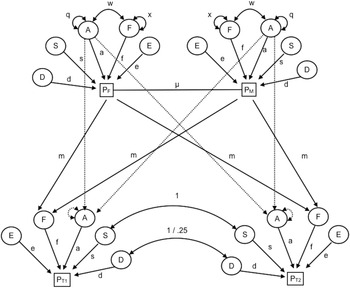
The full NTF model for both MZ and DZ twin families is depicted in Fig. 1. In the NTF model, both types of genetic effects can be estimated in the presence of a number of shared and non-shared environmental effects. The NTF model allows for estimates of additive genetic effects that are shared by all relatives, depending on their genetic relatedness. Additive genetic effects are assumed to be completely correlated between MZ twins (r = 1.00) and half correlated (r = 0.5) between DZ twins and in parent–offspring dyads. Dominant genetic effects can be estimated as well, taking into account significant interactions of alleles on the same gene loci. They are assumed to be completely correlated in MZ twins (r = 1.00) and correlated to a certain degree in DZ twins (r = 0.25), but not correlated in parent–offspring dyads. The NTF model also allows for estimates of familial environmental effects that are transmitted from parents to children (m), sibling environmental effects that are completely correlated between twins (r = 1), and non-shared environmental effects. Finally, it allows for estimates of assortative mating (μ; covariation between parents) and passive rGE (w), which act as potential sources of variance if both A and F matter (Keller et al., Reference Keller, Medland and Duncan2010). Details on the covariance decomposition for variances of interest can be found in online Supplementary Table S1.
Path diagram of nuclear twin family model. Note. A: additive genetic variance; D: dominant genetic variance; S: sibling environmental variance; F: familial environmental variance; E: non-shared environmental variance; P: phenotype variance; a: additive genetic effects; d: dominant genetic effects; s: sibling environmental effects shared by twins; f: familial environmental effects passed from parents to offspring; e: non-shared environmental effects include measurement errors; m: familial environmental transmission from parents to offspring; μ: assortative mating between the twin parents; w: covariance between A and F; x: expected variance of latent variable F; q: variance of latent variable A.

A and E are assumed to influence all phenotypes and are included in every model, while D, S, or F must be fixed to zero, as there is not enough information in a given model to simultaneously estimate the effects of all parameters. To begin, variances, covariances, and means were freely estimated to obtain a baseline index of fit. Then, we estimated three alternative NTF models (i.e. ADFE, ASFE, and ADSE). Model fit was evaluated using two information-theoretic indices: Akaike's information criterion (AIC; Akaike, Reference Akaike1987) and Bayesian information criteria (BIC; Raftery, Reference Raftery1995). From a series of models, the model with the lowest AIC and BIC is considered the best.
Results
Descriptive statistics and phenotypic correlations
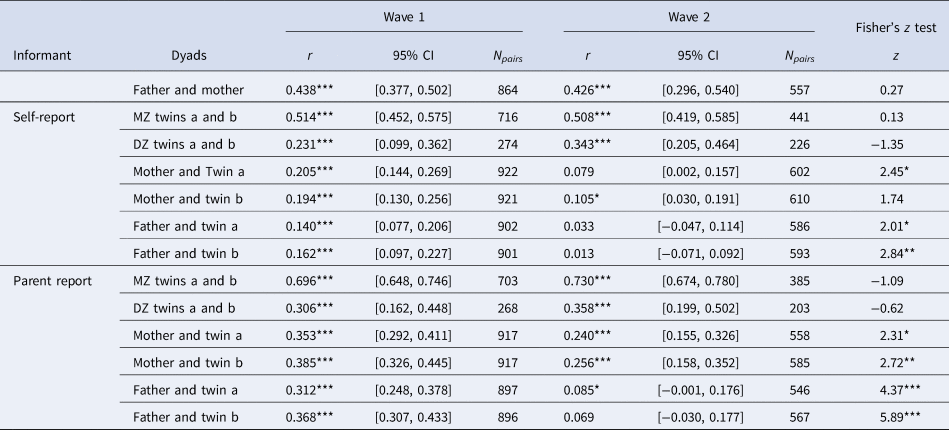
Descriptive statistics for trait anxiety are presented in Table 1. Anxiety correlations in dyads of family members provided initial indications of genetic and environmental contributions, as shown in Table 2. First, we found familial similarity in trait anxiety, as indicated by almost all significant correlations between family members, especially in Wave 1. Second, we found that the correlations for MZ twins were higher than those between all other family members sharing 50% of their genetic material (i.e. parents and children, DZ twins; Fisher's z = 2.46–12.97, ps < 0.01), which indicated significant genetic effects. Moreover, MZ twin correlations were all lower than 1, which generally indicated non-shared environmental effects.
Descriptive statistics for trait anxiety

Note. Twin a: first-born twin; twin b: second-born twin.
Trait anxiety correlations between dyads of twin family members

Note. Familial correlations are shown for scores corrected for age and gender differences. The p value of the r is the significance of a particular correlation between twin family members. The bootstrapping method based on 1000 sampling was used to estimate the confidence interval of correlations. Fisher's z test was conducted between correlations in the two waves. The p value of the z is the significance between correlations in two waves. MZ: monozygotic twins; DZ: dizygotic twins; twin a: first-born twin; twin b: second-born twin; CI: confidence interval. Self-report: Twins' trait anxiety was reported by twins themselves; Parent report: Twins' trait anxiety was reported by parents. *p < 0.05, **p < 0.01, ***p < 0.001.
Despite these common features, some differences in family correlations between the two waves might imply possible changes in various effects. In Wave 1, MZ correlations were more than twice as high as DZ correlations (Fisher's z = 4.67–7.53, ps < 0.001), which indicated both additive and non-additive genetic effects. In Wave 2, although the MZ correlations were no longer twice as high, they were still greater than the DZ correlations in the self-report data (Fisher's z = 2.46, p < 0.05), indicating the presence of shared environmental effects, whereas, in the parent-report data, they were more than twice as high as the DZ correlations (Fisher's z = 6.35, p < 0.001), indicating the absence of shared environmental effects. Additionally, almost all parent–child correlations tended to decrease (Table 2) and were much lower than the DZ correlations in Wave 2, especially in the self-report data (Fisher's z = 3.22–4.39, ps < 0.01), which probably indicates increasing environmental effects shared only by twins.
NTF model
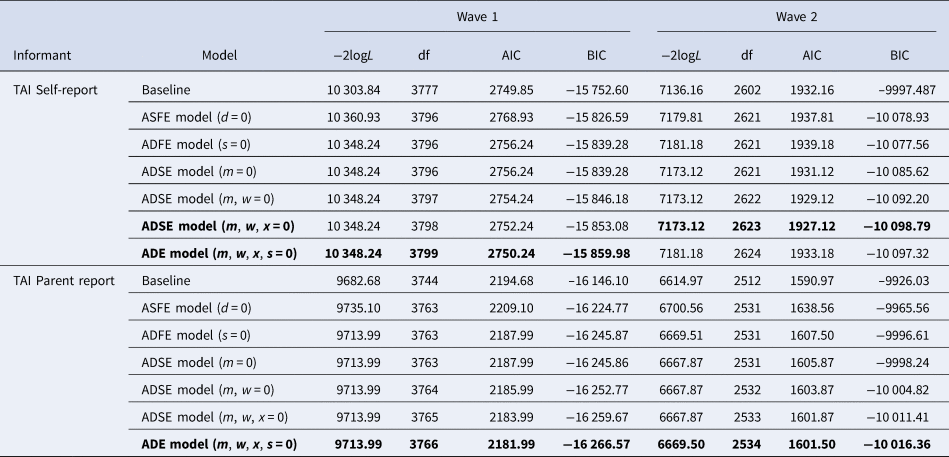
The model-fitting results for the NTF models are presented in Table 3. Passive rGE (w) and the expected variance of latent variable F (x) were not significant and could be fixed to zero gradually for a more concise ADSE model. In Wave 1 and Wave 2, ADSE (m = x = w = 0) was the best baseline NTF model with the lowest AIC and BIC for all informants. Because S was not always significant in the ADSE (m = x = w = 0) model (Table 4), we constrained it to zero to estimate the nested sub-model, ADE, to see whether it would fit better. After that, in the self-reports, ADE was the optimal model in Wave 1, while ADSE (m = x = w = 0) was the optimal model in Wave 2. In the parent-reported data, ADE was the optimal model in both Wave 1 and Wave 2. These results indicated that additive genetic, dominant genetic, and non-shared environmental influences significantly contributed to trait anxiety, whereas familial environmental influences and passive rGE did not. Sibling environmental influences only contributed to trait anxiety in the self-report data in Wave 2.
Nuclear twin family (NTF) design: fit indices of NTF models for trait anxiety via self-report and parent report in Wave 1 and Wave 2

Note. The best-fitting model via each informant in each wave (as indicated by the lowest AIC and BIC) is highlighted in bold. Additive genetic, dominant genetic, sibling environmental, familial environmental, and non-shared environmental influences are denoted as A, D, S, F, and E, respectively. d = 0: no dominant genetic effects; s = 0: no sibling environmental effects; m = 0: no environmental transmission from parents to offspring; w = 0: no covariance between A and F; x = 0: no expected variance of the latent variable F − 2logL: − 2 log-likelihood; df: degrees of freedom; AIC: Akaike's information criterion; BIC: Bayesian information criteria; TAI: trait anxiety inventory.
Nuclear twin family design: parameter estimates for ADSE (m, w, x = 0) model

Note. Additive genetic, dominant genetic, sibling environmental, and non-shared environmental influences are denoted as A, D, S, and E, respectively, and they are all standardized variance components. μ: assortative mating. 95% confidence intervals are presented in square brackets.
To compare the relative contributions between the two waves and different informants, we calculated parameter estimates for the best fitting baseline NTF model, ADSE (m = x = w = 0), as presented in Table 4. The model showed that both additive and dominant genetic influences contributed to trait anxiety. Non-shared environmental influences steadily accounted for the largest environmental influences in the two waves. Although passive rGE was negligible, trait anxiety was substantially influenced by assortative mating, which confirmed the necessity of including it in the model. In the self-reports, the total genetic variance components (i.e. the sum of A and D) tended to decrease (from 51 to 30%) and sibling environmental influences tended to increase. Finally, compared with self-report data, additive genetic influences tended to be higher, while environmental influences tended to be lower, in the parent-report data.
Discussion
We found that additive genetic effects, rather than shared family environments, accounted for the parent–offspring anxiety resemblance, revealing a genetic mechanism in the between-generational transmission of anxiety. In addition to additive genetic effects, dominant genetic effects and sibling-specific environmental effects also contributed to the similarity between siblings, revealing both a genetic mechanism and an environmental mechanism in within-generational resemblance. The contributions of our study include the use of the NTF model, multiple raters, and two measurement occasions with a non-Caucasian sample.
Consistent with previous research (Chen et al., Reference Chen, Yu, Li and Zhang2015; Eley & Stevenson, Reference Eley and Stevenson1999; Garcia et al., Reference Garcia, Tully, Tarantino, South, Iacono and Mcgue2013; Lau et al., Reference Lau, Eley and Stevenson2006; Legrand et al., Reference Legrand, Mcgue and Iacono1999), our study suggests a stable genetic foundation for familial similarity. However, we found dominant genetic influences in addition to additive genetic influences. This finding provides evidence for ‘broad-sense’ heritability (including both additive and dominant genetic effects) in trait anxiety, rather than ‘narrow-sense’ heritability (including the additive genetic effect only) (Visscher, Hill, & Wray, Reference Visscher, Hill and Wray2008). It also suggests that some genes play their role interactively with other genes, which has important implications for future molecular studies detecting anxiety-related gene loci.
A notable finding is that there was no evidence of familial environmental influence contributing to parent–offspring transmission of anxiety. This may imply that between-generational familial resemblance is primarily due to genetic rather than environmental transmission. Although a previous study found significant environmental associations between parent and offspring independent of genetic confounds (Eley et al., Reference Eley, Mcadams, Rijsdijk, Lichtenstein, Narusyte, Reiss and Neiderhiser2015), the transmission direction of anxiety between parents and children (i.e. from parents to children or from children to parents) was not clarified. Our study extends previous evidence by showing that trait anxiety might not be environmentally transmitted from parents to children. This is in line with an adoptive study, which demonstrated that there were no mother-to-child and non-stable father-to-child environmental effects (Ahmadzadeh, Eley, Leve, Shaw, & Mcadams, Reference Ahmadzadeh, Eley, Leve, Shaw and Mcadams2019). One possible explanation for the absence of familial environmental influences in our study is that twins may perceive and interpret the objectively similar parental environment differently (Plomin, Asbury, & Dunn, Reference Plomin, Asbury and Dunn2001), so some parental factors would not be shared by twins and might be detected as non-shared environmental influences. Even if the environments were perceived similarly by twins, if only confined to the twins' generation, they would be classified as sibling environmental influences in twin studies.
Our study found a decrease in genetic influences and an increase in sibling environmental influences in the self-report data. The dynamic change in genetic effects that we found is consistent with previous studies. For example, in behavioral genetic studies on adolescent anxiety, a decreased heritability with age has been frequently observed: from 74 to 31% from 8–9 to 14–15 years in Gjone, Stevenson, Sundet, and Eilertsen (Reference Gjone, Stevenson, Sundet and Eilertsen1996); from around 60–70% to 40–50% from childhood to adulthood in Nivard et al. (Reference Nivard, Dolan, Kendler, Kan, Willemsen, Van Beijsterveldt and Bartels2015); from 15 to 1% from 8–10 to 14–16 years in Topolski et al. (Reference Topolski, Hewitt, Eaves, Silberg, Meyer, Rutter and Simonoff1997); from 43 to 25% for 8- to 16-year-old girls in Topolski et al. (Reference Topolski, Hewitt, Eaves, Meyer, Silberg, Simonoff and Rutter1999). In Chinese samples, the decrease in heritability is even more dramatic—from ~20% to negligible in a 3-year time window (Zheng, Rijsdijk, Pingault, Mcmahon, & Unger, Reference Zheng, Rijsdijk, Pingault, Mcmahon and Unger2016). This dynamic change in genetic influences might be explained by a larger genetic attenuation in adolescence (Kendler, Gardner, & Lichtenstein, Reference Kendler, Gardner and Lichtenstein2008). Another possible explanation is the increase in environmental variance, leading to a relatively smaller proportion of genetic influences (Nivard et al., Reference Nivard, Dolan, Kendler, Kan, Willemsen, Van Beijsterveldt and Bartels2015).
Although S has not been specified, a pattern of decreased heritability accompanied by an increased C has been reported in many Western studies: from 7 to 12 years in Boomsma, van Beijsterveldt, and Hudziak (Reference Boomsma, van Beijsterveldt and Hudziak2005); from 0–5 to 6–10 years in a meta-analysis by Burt (Reference Burt2009); from late childhood to adolescence in Gjone et al. (Reference Gjone, Stevenson, Sundet and Eilertsen1996) and Topolski et al. (Reference Topolski, Hewitt, Eaves, Silberg, Meyer, Rutter and Simonoff1997, Reference Topolski, Hewitt, Eaves, Meyer, Silberg, Simonoff and Rutter1999); and from 3 to 7 years in Van der Valk, van den Oord, Verhulst, and Boomsma (Reference Van der Valk, van den Oord, Verhulst and Boomsma2003). In Chinese samples, shared environmental influences increased dramatically from 20–27 to 57–60% within 3 years (Zheng et al., Reference Zheng, Rijsdijk, Pingault, Mcmahon and Unger2016). The sharp increase in China is explained possibly by frequent school transitions in adolescence. Although school transitions also exist in Western populations, they usually lead to greater changes in China, including changes in school and classroom settings, classmates and teachers, a more structured curriculum, and higher academic stress (Chen, Reference Chen and Bond2010; Chen, Cen, Li, & He, Reference Chen, Cen, Li and He2005). It is possible that these changes exert more adaptive pressure on Chinese adolescents and gradually contribute to anxiety symptoms among Chinese students (Zheng et al., Reference Zheng, Rijsdijk, Pingault, Mcmahon and Unger2016).
Our work, extending previous twin studies on anxiety (Gjone et al., Reference Gjone, Stevenson, Sundet and Eilertsen1996; Topolski et al., Reference Topolski, Hewitt, Eaves, Silberg, Meyer, Rutter and Simonoff1997, Reference Topolski, Hewitt, Eaves, Meyer, Silberg, Simonoff and Rutter1999; Zheng et al., Reference Zheng, Rijsdijk, Pingault, Mcmahon and Unger2016), showed that an increased shared environmental influence exists mainly in sibling-specific environments, but not in family environments. This finding not only provides new insight into the etiology of adolescent anxiety but also offers a detailed target for prevention and intervention, i.e. treatments based on sibling-shared environments may be more effective.
There is some discrepancy between the parent reports and self-reports in the current study. According to existing evidence, children's anxiety reported by their parents might not be as reliable as children's self-reports. In our study, parents tended to underestimate their children's anxiety (t = 10.66–12.61, ps < 0.001), indicating a positivity bias, as parents usually hold more optimistic views of their children. Another type of bias lays in the fact that parents' emotional symptoms influence how they perceive and report on their children's emotions (Lagattuta, Sayfan, & Bamford, Reference Lagattuta, Sayfan and Bamford2012). When parents are anxious, they are more likely to perceive higher anxiety levels in their children, indicated by higher correlations between parent-reported children's anxiety and parents' anxiety, especially in Wave 1 (Fisher's z = 3.44–4.71, ps < 0.001). These two types of bias have been found frequently in studies using parent-reported children's anxiety (Achenbach, McConaughy, & Howell, Reference Achenbach, McConaughy and Howell1987; Briggs-Gowan, Carter, & Schwab-Stone, Reference Briggs-Gowan, Carter and Schwab-Stone1996; Lagattuta et al., Reference Lagattuta, Sayfan and Bamford2012; Rapee, Barrett, Dadds, & Evans, Reference Rapee, Barrett, Dadds and Evans1994). Additionally, parental perceptions of children's anxiety usually occur in the context of the home, reflecting serious situational constraints (Bartels, Boomsma, Hudziak, van Beijsterveldt, & van den Oord, Reference Bartels, Boomsma, Hudziak, van Beijsterveldt and van den Oord2007). Parents tended to perceive higher MZ similarity compared with that indicated on the self-reports (Fisher's z = 5.27–5.48, p < 0.001), making anxiety more heritable and less environmental within parental contexts. Though plenty of evidence (Comer & Kendall, Reference Comer and Kendall2004; Lagattuta et al., Reference Lagattuta, Sayfan and Bamford2012) have supported the privileged status of self-report when it comes to evaluating their personal emotions in adolescence, including multi-informant data to get the awareness of these informant discrepancies may help clinicians improve treatment outcomes for children and families (De Los Reyes, Reference De Los Reyes2011). For example, based on our research results, parents should be encouraged to communicate more with their children to understand their own feelings and unique experiences outside of the family.
Despite its contributions, several limitations of the current study should be kept in mind. First, the NTF model is not able to model all types of gene-environment interplay, especially the possible evocative rGE (i.e. children's anxiety might exert an influence on parenting style; Hale, Klimstra, Branje, Wijsbroek, & Meeus, Reference Hale, Klimstra, Branje, Wijsbroek and Meeus2013; Rapee, Reference Rapee, Vasey and Dadds2001; Rubin, Nelson, Hastings, & Asendorpf, Reference Rubin, Nelson, Hastings and Asendorpf1999). Future studies adopting other biometric models are needed to address this issue.
Second, although our study has some implications for the dynamic change trend of anxiety etiology in adolescence, the large age range in our sample makes it difficult to attribute these changes to specific ages. To shorten the age range, we conducted exploratory analyses with an early adolescence group (10–13 years) and a late adolescence group (14–18 years; shown in online Supplementary Table S2). In self-reports, both groups showed a trend similar to that of the whole sample: total genetic influences decreased, while sibling environmental influences increased. In parent reports, sibling effects were also not found, but the genetic change was slightly inconsistent. Future longitudinal studies using an age cohort design are necessary to confirm our results.
Third, we did not have sufficient data for adequate power to detect sex effects. As inconsistent results were observed in previous studies (e.g. null finding on sex differences in Lau et al. (Reference Lau, Eley and Stevenson2006) v. significant sex differences in Chen et al. (Reference Chen, Yu, Li and Zhang2015) and Eley and Stevenson (Reference Eley and Stevenson1999)), future studies with larger samples are needed to capture the effects of sex on anxiety.
In summary, our study highlights the importance of broad-sense heritability in family resemblance of anxiety. The sibling-specific shared environment, rather than environments shared by all family members, needs further investigation. These findings are of theoretical significance for understanding the underlying mechanism of the familial resemblance of anxiety, while also having practical significance for prevention and interventions regarding anxiety disorders. Age cohort designs incorporating the gene–environment interplay and sex differences are needed to further improve our understanding.
Supplementary material
The supplementary material for this article can be found at https://doi.org/10.1017/S0033291721001197.
Acknowledgements
The authors thank all participating twins, families, and schools for making this work possible.
Financial support
This study was supported by the National Natural Science Foundation of China (31530031).
Conflict of interest
None.
Ethical standards
The authors assert that all procedures contributing to this work comply with the ethical standards of the relevant national and institutional committee on human experimentation with the Helsinki Declaration of 1975, as revised in 2008. The authors assert that ethical approval for publication of this research paper has been provided by their local Ethics Committee.