Introduction
Nearly 30 years ago, McPherson (Reference McPherson1984) argued the importance of studying the influence of socialisation on older people's engagement in physical activities, and of increasing our understanding of the relationship between older people's various resources, particularly income, education and socio-economic status, and their past, present and potential levels of involvement in these activities. Until now, however, few empirical studies have followed up his suggestions. Most research on socialisation and physical activity has focused on children and younger adults and has used a ‘social learning’ theoretical framework (e.g. Amon, Shamai and Ilatov Reference Amon, Shamai and Ilatov2008; Curtis, McTeer and White Reference Curtis, McTeer and White1999; Kenyon and McPherson Reference Kenyon and McPherson1974). The limited research on socialisation and physical activity among older people has also adopted the social learning paradigm as the main theoretical reference (e.g. Chogahara, Cousins and Wankel Reference Chogahara, Cousins and Wankel1998; Curtis, White and McPherson Reference Curtis, White and McPherson2000; Martínez del Castillo et al. Reference Martínez del Castillo, Rodríguez, Jiménez-Beatty and Graupera2005).
Critical reviews of the literature on the factors that influence physical activity among older adults have argued the need to extend this theoretical framework (Berger et al. Reference Berger, Der, Mutrie and Hannah2005; Donnelly Reference Donnelly and Houlihan2003), by integrating complementary ideas about the complex processes of socialisation and social learning, as with, for example, continuity theory (Lefrancois, Leclerc and Poulin Reference Lefrancois, Leclerc and Poulin1998; Rhodes et al. Reference Rhodes, Martin, Taunton, Rhodes, Donnelly and Elliot1999); lifecycle re-socialisation models (Chogahara and Yamaguchi Reference Chogahara and Yamaguchi1998); social stratification and socialisation theories (Bourdieu Reference Bourdieu1978, Reference Bourdieu1979, Reference Bourdieu1989); syntheses of social action and social systems theories (Donnelly Reference Donnelly and Houlihan2003); and a fuller integration of the main theories of socialisation (Hurrelman Reference Hurrelmann2002). Learning from the debate and these reviews, the conceptual framework adopted in this study rests on three propositions:
1. Participation in physical activity early in life promotes participation late in life (cf. Chogahara and Yamaguchi Reference Chogahara and Yamaguchi1998; Cohen-Mansfield, Marx and Guralnik Reference Cohen-Mansfield, Marx and Guralnik2003; Lefrancois, Leclerc and Poulin Reference Lefrancois, Leclerc and Poulin1998; Martínez del Castillo et al. Reference Martínez del Castillo, Rodríguez, Jiménez-Beatty and Graupera2005; Rhodes et al. Reference Rhodes, Martin, Taunton, Rhodes, Donnelly and Elliot1999).
2. The higher an individual's socio-economic status, the greater their opportunities to be physically active in old age (Berger et al. Reference Berger, Der, Mutrie and Hannah2005; Bourdieu Reference Bourdieu1978, Reference Bourdieu1979, Reference Bourdieu1989; Donnelly Reference Donnelly and Houlihan2003; Gray Reference Gray2009; Hurrelmann Reference Hurrelmann2002).
3. People who are physically inactive throughout their lives but who participate in activities that dispose towards exercise in old age have an above-average probability of taking up physical activity (Berger et al. Reference Berger, Der, Mutrie and Hannah2005; Chogahara, Cousins and Wankel Reference Chogahara, Cousins and Wankel1998; Chogahara and Yamaguchi Reference Chogahara and Yamaguchi1998; Graupera, Martínez del Castillo and Martín Reference Graupera, Martínez del Castillo and Martín2003; Gray Reference Gray2009; Lian et al. Reference Lian, Gan, Pin, Wee and Ye1999; Rhodes et al. Reference Rhodes, Martin, Taunton, Rhodes, Donnelly and Elliot1999).
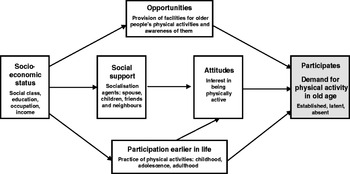
The hypothesised links between these three propositions are shown in Figure 1. The rationale is that actual participation in physical activity in old age is influenced by many factors but particularly socio-economic status, participation earlier in life (upbringing or socialisation), current social support, and attitudinal and opportunity factors. In this study, the term ‘physical activity’ refers to leisure activities that involve physical exertion, exercise and sports.Footnote 1Jiménez-Beatty et al. (Reference Jiménez-Beatty, Graupera, Martínez del Castillo, Campos and Martín2007: 245) recognised three ‘types of demand’ or levels of actual and potential participation that differentiate the population:
• Established demand (ED): individuals who currently engage in some physical activity.
• Latent demand (LD): individuals who do not engage in any physical activity but would like to do at least one activity and are interested in becoming active.
• Absence of demand (AD): individuals who do not engage in any physical activity and are not interested in doing so.
Linkages among factors and variables in the process of socialisation to be engaged in physical activity among older adults.

Research questions
The specific aims of this study were to examine the following research questions with reference to older adults in the Comunidad Autónoma de Madrid [Madrid Autonomous Region], Spain:
1. Does a significant relationship exist between the practice of physical activity earlier in life and the type of demand for physical activity in old age?
2. Are there significant relationships between social class, economic status, educational status, occupational status and the type of demand for physical activity in old age?
3. Are there significant relationships between the attitudes of the people closest to an older person, being most often spouse, children, friends and neighbours (the effective ‘agents of socialisation’), about being physically active in later life and their encouragement of participation and social support, and the older person's level of physical activity or ‘type of demand’?
4. Is there a significant relationship between an older person's knowledge of physical-activity facilities in the area where they live and their participation or type of demand for physical activity in old age?
The Madrid region: population and facilities for physical activity
The Autonomous Region of Madrid is located in the centre of the Iberian peninsula and extends across 8,023 square kilometres. It comprises 179 ayuntamientos (towns, or large administrative units that are further divided into boroughs) and is highly urbanised (Martinez del Castillo Reference Martínez del Castillo, Latiesa, Martos and Paniza2001), especially in the City of Madrid, the capital of both the region and Spain, and its surrounding areas. In 2009, the population of Madrid was 6.39 million, and 921,347 (14.4%) were aged 65 or more years. Regarding the facilities for physical activity in the region, over recent decades Madrid has experienced, like other European metropolitan areas, a substantial redistribution of its population from the central city to suburban areas (Pociello Reference Pociello1999). In this process, there has been a general tendency for the central districts to acquire more ‘cultural’ amenities and services but not more sports and exercise facilities, while the suburban municipalities have tended to develop more sports facilities, although with great differences between the affluent and working-class suburbs.
The supply of facilities for sports and exercise in the Madrid region at the beginning of the century has been summarised by Martínez del Castillo (Reference Martínez del Castillo, Latiesa, Martos and Paniza2001).Footnote 2 The capital city had 19 activity areas or facilities per 10,000 people (including 0.23 per 10,000 indoor swimming pools (ISP); 3.4 fitness and exercise rooms (or gymnasia) (FEC); and 1.8 individual tennis-courts (TC), with greater provision in affluent districts and less in working-class suburbs. The northern and western metropolitan zones had 80 activity areas per 10,000 people (0.9 ISP; 8.5 FEC; 16 TC), and most of the 23 golf courses in the entire region. The eastern and southern metropolitan zones had more provision than the central city but considerably less than the northern and western suburbs, namely 28 activity areas per 10,000 people (0.18 ISP; 4.8 FEC; 2.4 TC).
Design and methods
Sampling methods
A cross-sectional study was carried out during 2005 by means of face-to-face interviews with a random sample of 630 people aged 65–94 years resident in the Madrid region. Multi-stage probability sampling was used (Bryman Reference Bryman2004). At Stage 1, the sampling units were the region's towns; that is, there was a random selection of 22 of the 179. The number of interviews in each town was to be proportional to the number of older residents. In Stage 2, the sampling units were the boroughs; that is, there was a random selection of boroughs in each sampled town. Altogether 63 were selected. In Stage 3, the sampling units were randomly-selected streets at the start of each interviewer's route in each of the sampled boroughs. Each interviewer assignment was to administer the questionnaire to 10 respondents, four men and six women (reflecting the age-group sex ratio in the Madrid region). The addresses were randomly selected, and the 190 refusals replaced. Only one older adult was interviewed at each address. The overall result was that 603 older adults were interviewed in their own homes.
Sample characteristics
The inclusion criteria were being aged 65 or more years and resident in the sampled streets. Nearly two-thirds (62%) of the respondents were aged between 65 and 74 years, and 38 per cent were aged 75 or more years (mean 73.4, range 65–94). Concerning gender, 40 per cent were men. Concerning social class, 9.4 per cent declared themselves to be upper or upper-middle class, 47.2 per cent middle-class and 43.4 per cent lower-middle or lower class. The socio-demographic profiles are consistent with those observed in a recent study of the older population of the Madrid region (Blanes Reference Blanes2004).
Questionnaire and measures
The questionnaire was designed to implement the goals of the study and drew on a broader questionnaire compiled a few years ago that was administered to a small, targeted sample of older adults (Graupera, Martínez del Castillo and Martín Reference Graupera, Martínez del Castillo and Martín2003). The new questionnaire was piloted by an experienced sociologist and pre-tested (details later). The instrument has questions about socio-demographic attributes and that relate to the research questions (Bryman Reference Bryman2004).
Socio-demographic variables
Age in years was a continuous variable, and gender a dichotomy (‘1’=male, ‘2’=female). Completed educational level was an ordinal variable (‘1’=university, ‘2’=secondary school/occupational training, ‘3’=primary school, ‘4’=primary school not completed). Main occupation during working life was a nominal variable (‘1’=housewife, ‘2’=middle/senior managers, ‘3’=services, ‘4’=manual labourer, ‘5’=agricultural worker). Present level of income was a dichotomy (‘1’=sufficient, ‘2’=financial problems). Present perceived social class was an ordinal variable (‘1’=upper/middle-upper class, ‘2’=middle class, ‘3’=middle-lower/lower class).
Type of demand for physical activity
This nominal variable has three categories as defined above: ED, LD, AD. To classify the respondents, the responses to two dichotomous questions were used. First, all the respondents were asked if they currently practised any type of leisure, exercise or sporting physical activity (‘1’=yes, ‘2’=no). If the subjects answered affirmatively, they were classified as ED; if they answered negatively, they were asked a follow-up question, whether they wished to carry out any leisure, exercise or sports physical activity. Those who said ‘yes’ were coded LD, and those who said ‘no’ as AD.
Lifecycle variables
Participation in physical or sports activities during the lifecycle was measured using three dichotomies. For each of three earlier lifecourse stages, childhood, adolescence and adulthood, they were asked if they had engaged in any leisure, exercise or sporting physical activity (‘1’=yes, ‘2’=no).
Socialisation agents
The perceptions of the desirability of physical activity in old age on the part of four groups of current agents of socialisation, children, neighbours, friends and spouse, were coded from the responses to four group-specific questions. For each one of the groups of agents, they could respond ‘1’ yes, ‘2’ no, ‘3’ I don't have any, and ‘4’ I don't know or I don't want to answer.
Provision of physical activity variable
The respondents were asked if there were facilities for older adults' physical activity in the area in which they were living. The responses were coded ‘1’ yes or ‘2’ no.
Validity and reliability of questionnaire
With regard to content validity (Kerlinger and Lee Reference Kerlinger and Lee2000; Latiesa Reference Latiesa, García, Ibáñez and Alvira2000), the survey questions were validated by four experienced sociologists who were not members of the research team. In a subsequent pre-test, before the field work, the questionnaire was administered to 30 older adults from the target population to test its comprehensibility. All the subjects understood the questions and response alternatives and there were no missing values. With regard to tests for convergent validity, given that the variables were categorical, with different survey response alternatives, the phi coefficient was used (Latiesa Reference Latiesa, García, Ibáñez and Alvira2000). With reference to the status items (occupation, education, income, and social class), the coefficients obtained were between 0.26 and 0.73, and all were statistically significant (p<0.001). Thus, the convergence among the status items was consistent and acceptable.
With regard to the items concerning the practice of physical activity during the stages of the lifecycle (childhood, adolescence, adulthood, and old age), phi varied between 0.13 and 0.66, and all four values were statistically significant (p⩽0.001). Only the relationship between physical activity in childhood and old age revealed a low and not significant coefficient (0.07, p=0.09). The relationships were stronger between adjacent than more separated lifecourse stages. With reference to the attitudes of the agents of socialisation (children, neighbours, friends and spouse), phi ranged between 0.51 and 0.99, and all four values were statistically significant (p<0.001). Therefore convergence among the status items was consistent and high.
A retest procedure was used to determine the stability and reliability of the survey question items. Two weeks after completing the field work, 63 (10%) respondents were asked the same survey questions by different interviewers under the same conditions as in the first interview.Footnote 3 Given that the variables are categorical, the alternative responses were compared using Cramer's V correlation coefficients (Cea Reference Cea2004). The estimated values ranged from 0.83 to 1.0. According to Cea (Reference Cea2004), when the correlation coefficient between the two sets of responses is 0.8 or greater, the question or indicator can be taken as reliable.
Results
Being physically active earlier in lifecycle and the current demand
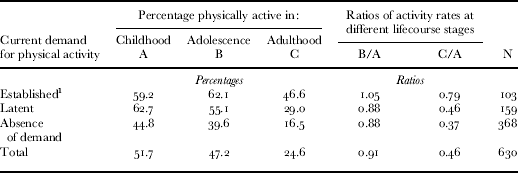
Table 1 shows the current type of demand for physical activity by whether the respondents engaged in physical activity at previous stages in their lives. Older adults who currently participated in (ED) or who wished to practise (LD) physical activity were more likely to have been engaged in physical activity at earlier stages of life than those who did not wish to engage (AD). Taking first the childhood variable (column A), among the older adults who participated or wished to participate in physical activity, 60 per cent had engaged in physically activities as children, compared to 44.8 per cent of those who did not wish to participate. The relationship is relatively weak but statistically significant (Φ=0.16; χ2=16.91 (degrees of freedom (df) 2), p<0.001). Turning to being active in adolescence, among the older adults who currently participated in physical activity, 62 per cent had been physically-active adolescents, compared to 55 per cent of those who wished to participate, and 40 per cent of those who did not wish to participate. The relationship is relatively weak but statistically significant (Φ=0.19; χ2 df 2, 21.58; p<0.001). Finally, as for being physically active in earlier adulthood, among the older adults who currently participated in physical activity, 46.6 per cent had been physically-active adults, but only 29 per cent of those who wished to participate had been so, and only 16.5 per cent of those who did not wish to participate. The relationship is moderately strong and statistically significant (Φ=0.26; χ2 df 2, 12.62; p<0.001).
Physical activity during earlier life by type of current demand, 65+-year-olds resident in the Madrid Autonomous Region, Spain, 2005
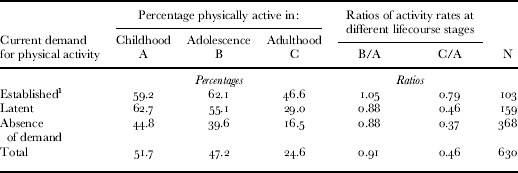
Note: Columns on the left show the percentages of affirmative answers, and the two columns to the right show the ratios of the affirmative answers in different lifecourse stages. 1. Currently engages in physical activities. Significant differences are detailed in the text.
Source of data: Authors' survey. For details, see text.
Socio-economic status and the type of demand
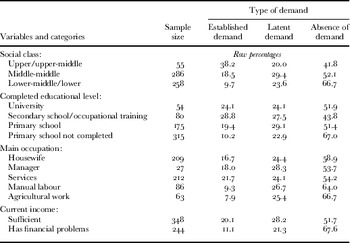
Table 2 shows the three types of demand for physical activity by present social class, completed educational level, main former occupation and present income. Beginning with social class, there was a positive relationship with being physically active (upper class 38.2%, middle class 18.5%, and lower class 9.7%). There was a complementary relationship with not wishing to participate (upper class 41.8%; middle class 52.1%; lower class 66.7%). The relationship is moderate and significant (Φ=0.24; χ2 df 2, 33.74; p<0.001). Turning to completed educational level, we can see a significant difference between older adults who did not complete primary education (only 10.2% currently participated, and 67% did not wish to participate), and those with any higher level of education. The relationship is relatively weak but significant (Φ=0.21; χ2 df 6, 28.62; p<0.001).
Older people's social class, education, occupation and income by type of demand for physical activities, Madrid, 2005

As for main occupation before retirement, there were differences between the older adults who had been engaged in manual labour or agricultural work (most did not currently participate in physical activity) and those with other former occupations, including housewives, managers or in services (with more cases of current participation), but there was not a significant overall relationship (χ2 df 8, 11.65; p=0.168). There was, however, a relationship with present income. Around one-half of the respondents with sufficient income currently participated or wished to do so, but among those with financial difficulties, most did not wish to participate. The relationship is weak but highly significant (Φ=0.17; χ2 df 2, 16.05; p<0.0001). Overall, therefore, for three of the four socio-economic status variables, the lower the status, the less the older person's current participation in physical activities.
Views of social contacts and type of demand
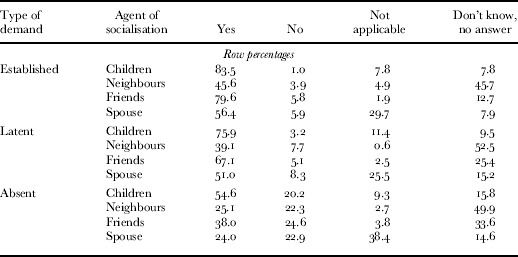
Table 3 shows the views and advice of the respondents' social contacts about the advisability of being physically active and the older respondents' current participation. Beginning with the spouse, among those who currently participated or wished to participate, more than half had spouses who considered it desirable to engage in physical activity, but among those who did not wish to participate, only 24 per cent of spouses thought one should. The relationship is moderate and significant (Φ=0.33; χ2 (df 8) 67.8; p<0.001). With regard to children, among those who participated or wished to participate, large majorities (83.5 and 75.9%, respectively) had children who thought it desirable that their parent engaged in physical activity, but among those who did not wish to participate, only 54.6 per cent had such children. The relationship is moderate and significant (Φ=0.31; χ2 (df 8) 61.2; p<0.001).
Older people's participation in and demand for physical activities by having social contacts or agents of socialisation with supportive attitudes, Madrid, 2005
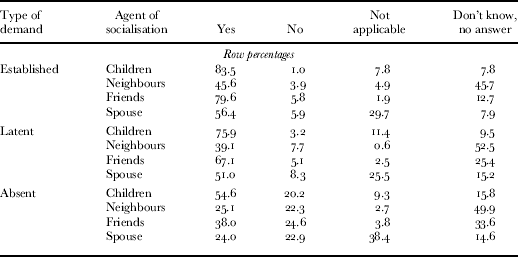
Note: The sample sizes were: 103 for established demand, 159 for latent demand, and 368 for absent demand.
With regard to friends, among those who participated or wished to participate, the majority (76.6 and 67.1%, respectively) had friends who considered it desirable that they engaged in physical activity, but among those who did not wish to participate, this figure was only 38 per cent. The relationship is moderate and significant (Φ=0.37; χ2 (df 8) 84.2; p<0.001). Finally, with reference to neighbours, among those who participated, 45.6 per cent had neighbours who considered it desirable that they engaged in physical activity, and among those who wished to participate, the figure was 39.1 per cent. By comparison, among those who did not wish to participate, only 25.1 per cent said they had neighbours who thought they should. The relationship is moderate and significant (Φ=0.27; χ2 (df 8) 46.4; p<0.001). Overall the findings indicate that those who participated or wished to participate received more encouragement from their social contacts or agents of socialisation than the respondents who did not wish to practise physical activity.
Local facilities, or the opportunity factor, and type of demand
There was a clear positive relationship between reports of specific provision for physical activity in the local area and participation. Among the respondents who currently participated, 82.4 per cent were aware of facilities, while among those who wished to participate 71.6 per cent made such reports, and among those who did not wish to participate, only 50.6 per cent did so. Clearly the relationship can be both ways: those who participated were more likely to know about facilities, and good local provision can encourage participation. The relationship is moderate and significant (Φ=0.27; χ2 (df 2) 33.2; p<0.001).
Discussion
The influence of participation earlier in life
The presented findings support the proposition that ‘participation in physical activity early in life promotes participation late in life’ and confirm the results of several previous studies (e.g. Berger et al. Reference Berger, Der, Mutrie and Hannah2005; Curtis, McTeer and White Reference Curtis, McTeer and White1999). The older adults who currently participated (ED) or wished to participate (LD) in physical activity were relatively likely to have practised physical activity during the earlier stages of the lifecourse. It is interesting to note, however, that among those who were not currently participating, the rates of being physically active fell steeply from childhood to adulthood, most particularly among those with no interest in becoming active (see right-hand columns of Table 1). The longitudinal series also provide some support for the validity of lifecourse continuity theory (Lefrancois, Leclerc and Poulin Reference Lefrancois, Leclerc and Poulin1998).
The influence of socio-economic status
The findings also provide strong evidence of the influence of socio-economic status on older people's participation in physical activity, in line with earlier findings by Rudman (Reference Rudman1989) and Rhodes et al. (Reference Rhodes, Martin, Taunton, Rhodes, Donnelly and Elliot1999). In general, higher social status increased the likelihood of physical activity being an element of a respondent's lifestyle. Taking note of the propositions about social stratification and socialisation formulated by Bourdieu (Reference Bourdieu1979, Reference Bourdieu1989) and Hurrelmann (Reference Hurrelmann2002), it is expected that relationships between social class and participation in physical activity are very complex. To exemplify, some respondents of low social status in this study practised physical activity even though they had not been engaged at earlier stages of their lives. Other factors like the encouragement of others and good local opportunities appear to have been influential.
The influence of social contacts and support
Among those who were physically active in old age, around 15 per cent had been active in childhood but not in earlier adulthood, and so had become active again. Moreover, the indications are that up to 38 per cent had not been active at any lifecourse stage.Footnote 4 So while the overall pattern was continuity, there was also evidence of many people stopping, starting for the first time, and re-starting physical activities. Among the factors that might explain why some older adults who were previously sedentary had incorporated physical activity in their lifestyles are, firstly, that after retirement they generally had more free time (Bryant et al. Reference Bryant, Trew, Bruce, Kuisma and Smith2005), and secondly, that some found themselves immersed in new environments that socialised towards physical activity – through various combinations of social support or encouragement and local opportunities.
Our findings show that older adults who participated in physical activity had above-average social support and encouragement, particularly from children and friends, and to a lesser extent from spouse and neighbours, and that older adults who did not participate had below-average social support for engagement. Some of the active older adults may have completed the process of socialisation described by Chogahara and Yamaguchi (Reference Chogahara and Yamaguchi1998). Other authors have also suggested that support from family and friends increases older adults' confidence to engage in exercise (Ostir et al. Reference Ostir, Cohen-Mansfield, Leveille, Volpato and Guralnik2003). The findings also support the third proposition, that older people who have been physically inactive throughout their lives but who are encouraged to become active by their ‘socialisation agents’ are likely to add physical activity to their lifestyles. For this to take place, however, the availability and knowledge of local opportunities promote actual engagement.
The influence of local opportunities
According to Elling and Claringbould (Reference Elling and Claringbould2005), apart from inequalities in the objective availability and accessibility of specific sports facilities for specific groups, the dissemination of information about them is a secondary inclusion–exclusion mechanism. The survey data have shown that among those who participated or wished to participate in physical activity, many were aware of physical activity facilities in their local area. For a better understanding of the operation of this opportunity factor, future studies should specify the variation in local knowledge using more refined measures (Benjamin, Edwards and Caswell Reference Benjamin, Edwards and Caswell2009; Li et al. Reference Li, Fisher, Bauman, Ory, Chodzko-Zajko, Harmer, Bosworth and Cleveland2005). There is a need to determine the availability and accessibility of facilities and services for specific groups of older adults differentiated by social status (because of the variable ability to pay for club fees and session charges) and by physical fitness and capabilities. It would also be of great interest to trace the relationships between participation in different physical-activity organisations and the likelihood of continuing to be physically active and, more particularly, to resocialise into physical activity (cf. Chogahara and Yamaguchi Reference Chogahara and Yamaguchi1998).
Extending this theme and bearing in mind the notable variability in the level of physical activity among nations, with southern Europeans being significantly less active than northern Europeans, it would also be profitable to examine the role of cultural and policy factors. As pointed out by Thogersen-Ntounami (Reference Thogersen-Ntoumani2009), differences among societies in the adherence to individualism or collectivism may be influential. It is also known that some countries have been more active and successful in providing local sports and recreation facilities (for all age groups). It seems likely that private-sector provision for older adults is greatest in the most affluent western countries (notably in United States retirement communities), and that by contrast public-sector provision of facilities in working-class suburbs was a feature of some East European countries before 1989 and may characterise large cities with left-wing administrations.
The complexity of physical activity socialisation at different life stages
As has been discussed in the literature (Berger et al. Reference Berger, Der, Mutrie and Hannah2005; Donnelly Reference Donnelly and Houlihan2003), socialisation into physical activity is a complex process that is far from well understood. A better understanding needs to elaborate the theoretical framework of social learning by drawing from other theories, not least those concerning the role of the agents of socialisation. According to Donnelly (Reference Donnelly and Houlihan2003), the complexity of socialisation into physical activity arises from its biographical and longitudinal dimensions, and the multiple circumstances and interactive contexts which influence the process. As proposed by Donnelly (Reference Donnelly and Houlihan2003), individuals choose to participate only if the particular and current circumstances of their lives permit the course. And even if the choice is feasible, a multitude of circumstances from the person's past and present affect the decision.
Figure 1 is a schematic representation of the complexity of the socialisation processes. The influences begin during the first stages of the lifecourse. Almost all individuals are born into a family and into a social and residential environment with a particular socio-economic status that generates more or less social support for the practice of physical activity, and that conditions more or less opportunities for participation (Amon, Shamai and Ilatov Reference Amon, Shamai and Ilatov2008; Bourdieu Reference Bourdieu1979, Reference Bourdieu1989; Donnelly Reference Donnelly and Houlihan2003; Hurrelmann Reference Hurrelmann2002; Pociello Reference Pociello1999). If, later, the individual's socio-economic status changes, he or she will have more or less social support and more or less opportunities for practising physical activity (Bourdieu Reference Bourdieu1979, Reference Bourdieu1989; Donnelly Reference Donnelly and Houlihan2003; Hurrelmann Reference Hurrelmann2002). On reaching old age, in line with the precepts of continuity theory, those individuals that participated earlier in life are more likely to continue to be active (Lefrancois, Leclerc and Poulin Reference Lefrancois, Leclerc and Poulin1998; Rhodes et al. Reference Rhodes, Martin, Taunton, Rhodes, Donnelly and Elliot1999). More particularly, older people who have high socio-economic status, many members of their social networks that support the principle of being physically active, and good local opportunities or facilities are the most likely to engage.
Conclusions
The main empirical findings can be summarised as follows. Among the studied sample of older adults in the Madrid Autonomous Region, significant relationships have been identified between socio-economic status, whether or not they participated at earlier life stages, the encouragement and support of spouse, children, friends and neighbours, and their knowledge of the availability of facilities in the local area, and two outcomes: of currently participating in physical activity or of being interested in becoming engaged. The analysis has confirmed previous findings and extended current understanding, but the subject remains poorly understood and under-theorised. It is clear, however, that variations in the participation of older people in physical activity are the net outcome of multiple and complex learning, experiential, lifecourse and lifestyle-choice processes. A fuller understanding of these processes requires an elaboration of the current theoretical framework of social learning, with particular attention to the role of social support by the agents of socialisation. More attention needs to be given to the influences of social stratification and socialisation and to the insights that can be gained from continuity theory and lifecycle resocialisation models.
Acknowlegements
The research was supported by the Polytechnic University of Madrid and Alcalá University, Spain. The authors would like to thank the research participants for their co-operation and the reviewers for their valuable advice.