Introduction
For children who commence school having suffered toxic levels of stress from experiences of family violence, dysfunctional home environments, attachment disruption, sexual, psychological, emotional, and/or physical abuse, cruelty, neglectful parenting, abandonment, multiple medical procedures and other forms of stress and trauma-inducing developmental experiences, their capacity to settle into school life, and function effectively in school is considerably challenged. Sources of prolonged, severe, unpredictable stress during a child's early years can alter brain development and result in negative impacts on a child's physical, cognitive, emotional and social growth (Child Welfare Information Gateway, 2001). Toxic stress disrupts brain architecture and stress response systems, leading to long-term problems in learning and behaviour (Centre on the Developing Child, 2016).
Within the literature addressing the impact of childhood maltreatment and trauma inducing experiences on children's school-related functioning, there is an emphasis on impairments in their emotional, social and cognitive abilities. Evidence suggests that maltreated and traumatised children experience difficulties with regulating their emotions and behaviours, sustaining attention and relating with others; and present with impaired memory systems, executive functioning deficits, language delays, and distortions in social-emotional processing and self-concept (Andrea, Ford, Stolbach, Spinazzola, & van der Kolk, Reference Andrea, Ford, Stolbach, Spinazzola and van der Kolk2012; Cook et al., Reference Cook, Spinazzola, Ford, Lanktree, Blaustein, Cloitre and van der Kolk2005; McLean, Reference McLean2016; Perry & Hambrick, Reference Perry and Hambrick2008; Tobin, Reference Tobin2016; Veltman & Browne, Reference Veltman and Browne2001).
The cognitive, emotional and social competencies required by a child to keep up with teacher expectations, maintain equivalence with peers and function effectively in the school environment, are compromised in maltreated and traumatised children. The brains of maltreated children become focused on survival and responding to environmental threats, rather than building the foundation for future growth (Child Welfare Information Gateway, 2001; Perry & Hambrick, Reference Perry and Hambrick2008). Maltreated and traumatised children become motivated to meet safety needs at the expense of engaging in growth-promoting activities (Bath, Reference Bath2008). The result can be a cascade of negative effects across multiple domains for the developing child's psychological and social functioning with neurological changes potentially impacting upon academic success and social relationships (Wilson & Widom, Reference Wilson and Widom2010).
Three decades of child maltreatment research has indicated that school students with histories of maltreatment and abuse experience lowered readiness for school and behavioural and educational problems during the school years (Veltman & Browne, Reference Veltman and Browne2001). Traumatised children and young people's difficulties are especially problematic in schools as these are the places they spend most of their time outside of home, and where they have to rely on other adults, engage with other students, focus and pay attention, sit still and regulate their levels of physiological arousal. These tasks are challenging for students with highly reactive stress response systems and brains wired for specialising in threat detection; physiology antagonistic to exploring, learning and creating.
A child's potential for meaningful school experiences and school-based academic progress and success is strongly influenced by their capacities for developing meaningful and satisfying relationships with peers and educators, sense of self efficacy and competency, self-regulation of attention, emotions and behaviours, executive functioning capabilities and language and communication skills (Cole et al., Reference Cole, O'Brien, Gadd, Ristuccia, Luray, Wallace and Gregory2005). Integrating with one's peers, performing academically, being motivated to achieve, controlling one's emotions, showing empathy, and responding to increasingly demanding cognitive challenges are all requisite competencies for school aged children; competencies in which maltreated children have been found to be disadvantaged (Veltman & Browne, Reference Veltman and Browne2001).These developmental capabilities are all potentially impacted upon by trauma and toxic stress (ACF, 2010; Cole et al., Reference Cole, O'Brien, Gadd, Ristuccia, Luray, Wallace and Gregory2005; van der Kolk, Reference van der Kolk2014).
The demands of engaging with, and learning in, a formalised, structured setting, require these prerequisite skills to be developed within children at a level consistent with their chronological, rather than their developmental, age. Maltreated and traumatised children can lack these essential ingredients for navigating and meeting the demands of school life, thus, encountering an added layer of disadvantage from the moment they commence school.
When the stress and trauma inducing experiences are relationally based, or involve adults, the child can interpret the world as an unsafe place, develop a view of grown-ups as dangerous and unpredictable, lack trust in others and become prematurely self-reliant (Cole et al., Reference Cole, O'Brien, Gadd, Ristuccia, Luray, Wallace and Gregory2005). The brains of traumatised children appear to learn to associate adults with negative emotions, resulting in behaviours characterised by suspicion, avoidance and hostility. Yet, commencing school life requires of children to trust in adults, take direction from adults, seek assistance and support from adults and engage in relationships with adults.
The broad range of psychological, emotional and physical characteristics of maltreated children, as recognised in the literature, means these children are potentially problematic for teachers and make school a challenge for maltreated children. In addition, these children have little, if any, opportunity to experience what is necessary for successful school adjustment (Veltman & Browne, Reference Veltman and Browne2001). Their executive functioning difficulties, including both regulations of self as well as metacognitive abilities, sustaining attention and shifting from task to task, result in challenges when negotiating the social relationships and educational environments within schools (DeGregorio & McLean, Reference DeGregorio and McLean2013).
Yet, school environments are one of the most influential places for maltreated children, and can have a modifying effect on adverse experiences in early childhood. Schools have the potential to ameliorate undesirable developmental outcomes or enhance later psychopathology if they have adequate child protection practises and policies (Veltman & Browne, Reference Veltman and Browne2001). Schools can potentially provide opportunities for their traumatised students to experience meaningful and satisfying relationships, feel internal and external safety and establish a sense of self and competency (ACF, 2010; Cole et al., Reference Cole, O'Brien, Gadd, Ristuccia, Luray, Wallace and Gregory2005; Downey, Reference Downey2007). These possibilities can develop within school-based experiences of belonging, connecting, relating, feeling, experiencing, dreaming, achieving, trusting and learning.
The extent to which schools embed trauma informed and sensitive practises and policies can influence both the educational and life experiences and accomplishments of students impacted by trauma (Bomber & Hughes, Reference Bomber and Hughes2013; Downey, Reference Downey2007). Basic, yet practical day to day routines and approaches that are trauma focused can transform the entire culture of a school (van der Kolk, Reference van der Kolk2014).
The school environment is one of the most important places where maltreated children could find support and positive influences on their lives, leading to feelings of optimism about their futures. It may provide positive and secure relationships with adults and peers and a place where teachers may foster accomplishments, boost self-esteem, and provide new opportunities for personal development (Veltman & Browne, Reference Veltman and Browne2001, p. 231).
School students attend school for a considerable period of time during their critical developmental years – post early childhood through to mid-adolescence. During this period of time, schools can offer many opportunities for students to be meaningfully and positively experienced through the eyes of a trusting, caring, adult. There are chances to develop effective, rewarding relationships with peers and adults; chances to experience consistency, dependability and safety; chances to have their concealed talents revealed and developed and chances to experience being cared about and being acknowledged. These repetitive, positive, nurturing interactions with trustworthy teachers and peers can provide a traumatised child with what they need to regain functioning (Perry & Hambrick, Reference Perry and Hambrick2008).
Van der Kolk (Reference van der Kolk2014) asserts the importance of the students being seen, heard and being known, through small things such as face to face contact, greetings by name and daily check-ins:
The greatest hope for traumatised, abused and neglected children is to receive a good education in schools where they are seen and known, where they learn to regulate themselves, and where they can develop a sense of agency. At their best schools can function as islands of safety in a chaotic world. They can teach children how their bodies and brains work and how they can understand and deal with their emotions. Schools can play a significant role in instilling the resilience necessary to deal with the traumas of neighbourhoods or families (p. 351).
The implications for school-based practise from 30 years of child maltreatment research are that teachers are in a position to provide positive, secure relationships with these students; teachers can foster accomplishments thereby boosting self-esteem, and schools overall can provide new opportunities and hopefulness (Veltman & Browne, Reference Veltman and Browne2001). Yet, traumatised children are often noticed for their problem behaviours, punished and frequently excluded for these behaviours.
In the school environment, students displaying problem behaviours related to past trauma become re-traumatised through punishment of these behaviours, embedding the trauma further and continuing the cycle of behavioural problems rather than lessening them (Kezelman & Stavropoulos, Reference Kezelman and Stavropoulos2012). Their challenging behaviours prompt controlling, punitive reactions from adults involved (Bath, Reference Bath2008). Behaviour management can become the focus when attending to these students in schools, although it does not facilitate development of necessary relationships (Bomber & Hughes, Reference Bomber and Hughes2013).
These students frequently find themselves in Paediatricians’ offices, referred by schools to determine their problems and their ‘diagnosis’. With this practise, the focus remains on what is wrong with the student, and not what has been done wrong to the student. Schools are ‘. . .choosing to label these children with pejorative diagnostic labels rather than to understanding their developmental difficulties as very predictable consequences of their chaotic, relationally distorted and impoverished early lives’ (Perry, Reference Perry2006, p. 47).
Van der Kolk (Reference van der Kolk2014) tells us that attempting to control a student's behaviour whilst failing to address the underlying issue of abuse results in ineffective and potentially harmful treatments: ‘children who act out their pain are often diagnosed with “oppositional defiant behaviour”, “attachment disorder” or “conduct disorder” but these labels ignore the fact that the rage and withdrawal are only facets of a whole range of desperate attempts at survival’ (p. 282). When we attempt to evaluate the behaviour without ever trying to understand the behaviour, we give up opportunities to know the child, connect with the child and be that one person that mattered for the child.
What these students require is positive, supportive relationships with adults in which their good qualities and special uniqueness is communicated to them (Golding & Hughes, Reference Golding and Hughes2012). Recovery from trauma and neglect is about relationships – rebuilding trust, regaining confidence, returning to a sense of security (Perry & Szalavitz, Reference Perry and Szalavitz2007).
School-Based Experiences, Practises and Requirements
The focus on the impact of childhood maltreatment and trauma inducing experiences on children's social, emotional and cognitive development and functioning in the literature demonstrates the collective, wide-ranging difficulties for these children during their school years. The descriptions of the issues in the literature parallels the frequent day to day experiences in schools in which I work with maltreated and traumatised students and their educators. It highlights and reinforces the overwhelming and devastating costs to students, educators and schools, and the need to respond with trauma informed and sensitive approaches.
Trauma sensitive schools aim to prevent re-injury or re-traumatisation by acknowledging trauma and its triggers, and avoiding stigmatising and punishing students (Kezelman & Stavropoulos, Reference Kezelman and Stavropoulos2012). This can be tricky in a child-raising culture shaped more by social learning theory and behaviour management principles and less by attachment theory, trauma theory and brain development.
During the process of becoming a trauma informed School Counsellor and Psychologist, I have become conscious that school life for maltreated and traumatised children can make the difference between whether they access enough meaningful, reparative experiences, and opportunities for recovery and growth, or whether their damaging beliefs about themselves which are developed from early life experiences of fear, rejection, abandonment, worthlessness, and invisibility are reinforced and strengthened, intensifying the terror and hopelessness of their trauma experience. For maltreated and traumatised students, the teachers they have, the executive members who support these teachers and the Principal leading the school will ultimately determine whether they access developmentally enhancing, or developmentally detrimental, experiences through their school years.
Working in NSW Department of Education schools, confronted with considerable numbers of maltreated and traumatised children and a caseload across schools constantly comprising a sizable number of children with complex presentations and considerable histories of maltreatment, I have observed patterns in these children's presentations, frequently including
-
• multiple domains of impairment – cognitive, language, social, emotional, relational and behavioural;
-
• multiple domains of need – food, sleep, basic care, housing, routine, safety; and
-
• multiple barriers to support – lack of engagement by parents/carers, poor understanding by parents/carers, complex needs within the family, including mental illness, drug and alcohol abuse, sporadic attendance at school and chaotic home life.
Comprehending these difficulties, I have been able to conceptualise what is going on for these children. Both the literature, and my own experiences and observations in schools, suggest that these students' school-based difficulties stem from struggles with self-regulation, and from being understood, being seen, being supported, being cared for, being connected and being engaged. These difficulties repeatedly result in maltreated and traumatised children being excluded and experiencing punitive disciplinary actions. For example, loss of social and play time, loss of positive experiences in school such as extra-curricular activities, exclusion through suspension and being sent away from the classroom, and withholding of rewards.
Additionally, practise in schools has seen considerable numbers of children with histories of maltreatment, who present with obvious difficulties regulating their emotions and behaviours, or focusing their attention and meeting the demands of the learning and social environments, sent to Pediatricians for diagnoses. This often results in them being given medication, managed through the school's discipline procedures, and held to blame for their difficulties with limited support for their trauma-based needs, whilst adults involved in their care remain unaware of, or disregard, the impact of the child's developmental experiences on their current difficulties.
Contained within the culture and reality of our traditional school systems and settings, maltreated and traumatised students’ behaviours are not being recognised as highly adaptive survival strategies for meeting their needs and increasing their safety, or as the skill set they have developed from years of observing others around them; nor as the outcome of altered neurological systems. Whilst professionals with knowledge and understanding of maltreatment and trauma can comprehend the link between behavioural difficulties and neurodevelopmental vulnerabilities, educators without this knowledge view the difficulties with frustration; often believing they are conscious attempts to muck up, cause mischief, avoid work or be lazy.
It has been difficult when working with these children to witness that systems designed to protect and support these children can intensify their difficulties through traditional, harmful practises, lack of understanding of the child's difficulties and inadvertently placing of blame on the child. Without understanding trauma-based behaviours, schools are regularly preserving and repeating practises that are re-traumatising for students. Bomber and Hughes (Reference Bomber and Hughes2013) emphasise the need for schools to shift their reliance and insistence on traditional methods and behaviourist interventions for dealing with all students, towards whole school policies that include provision for individual needs and developmental vulnerabilities.
Schools are places for children and young people to learn and grow and educators play a critical role in what is learned and how this growth occurs. To be sensitive to the needs of maltreated and traumatised children in schools requires educators and other school personnel; to consider the student's world through the student's eyes. The way educators think about, try to understand and then respond to maltreated and traumatised children and young people in their care – their actions, emotions, thoughts and bodies – matters because it influences how they feel, behave and react or respond towards the student; their meaning is conveyed to the student through their actions, postures, body language and tone of voice.
Many students who are deeply impacted by trauma have no voice to express their hopelessness and helplessness. Whilst they are in daily contact with mandatory reporters in schools they are not necessarily identified in this way, and are at risk because of the lack of understanding of behavioural signals of distress. They are then also at risk of being re-traumatised because of school practises that are based on persistent and simplistic behaviour management approaches, and used to attempt to control and address their sets of behaviours.
Confronting these difficulties necessitates school interventions to support these children to be regulated, be seen, be understood, be supported, be connected and be engaged. Responses which
-
• support children to learn to regulate;
-
• support educators to understand and conceptualise what is going on for these children;
-
• support schools to develop engagement strategies; and
-
• support educators to connect with these students.
In my practise, I have come to recognise the significance in working to support traumatised students within the school, and to support the school to support these traumatised students. Working to support these children within the school without the school supporting them did not achieve required responses. I also comprehended the vital significance of supporting the wellbeing of everyone within the school. The high number of children with complex presentations placed considerable demands on the school's resources; while reactive management is fatiguing and adverse.
Consequently, I developed and led a process to assist a school to support its high numbers of traumatised students.
This practise paper presents this School Counsellor-led model for supporting an NSW Department of Education school to support its high numbers of traumatised students. It provides a framework for
-
• identifying and addressing traditional school system challenges and limitations that maltreated and traumatised students and their educators face;
-
• supporting and encouraging the development of a trauma sensitive environment to achieve a school culture supportive of trauma informed practise; and
-
• implementing a systematic, whole of school support model for trauma informed and sensitive practise and care to support the students and their educators. This model is titled REWIRE (regulate, educate, wellbeing framework, informed, relational, engagement).
Identifying and Addressing Challenges and Limitations
Early experiences attempting to support traumatised students and their educators within a traditional education system, and through continued efforts to advocate for these children to be understood and supported, revealed wide-ranging difficulties placing pressures on traumatised students and their educators. Identified and experienced challenges and limitations within the traditional education system include
-
• limited understanding of the impact of trauma on student's development, behaviour, functioning and learning;
-
• at times unrealistic expectations of the student's social, emotional and cognitive abilities, and of their capacity to function;
-
• traditional beliefs about child development and behaviour management that underpin practises for dealing with student behaviour;
-
• school behaviour management practises developed in response to the school's ‘meaning making’ of the difficulties and challenges these students present with;
-
• multiple school-based trauma triggers including frequent changes to routine, staff changes, other traumatised students and traditional classroom practises;
-
• limited resources and capacities to understand these students as well as to meet and support their needs – both within schools and within agencies that are in contact with schools; and
-
• unhelpful and harmful practises including reactive management style, exclusionary behaviour management practises and discipline approaches which can damage developing connections and relationships.
These challenges and limitations impact directly on the maltreated and traumatised students, intensifying their negative experiences, and on the school personnel who are endeavouring to educate them.
Engendering a Culture Ready to Shift
Facilitating an environment conducive to vital shifts in principles and practises through the school, called for these challenges and limitations to be addressed. Specifically, shifting from traditional ideas to trauma informed ideas, in the ways that educators
-
• interact and connect with students;
-
• develop relationships with students;
-
• understand and support students;
-
• consider and approach behaviour;
-
• think about children and young people developmentally;
-
• understand traumatised students’ complexities;
-
• move from practises based on exclusion to practises based on inclusion; and
-
• from practises based on behaviour management to practises based on relational influence.
Bringing about a culture prepared to reflect on traditional, potentially harmful practises, and to challenge long-standing practises required
-
• continuous professional development to increase levels of trauma awareness and promote trauma informed care and practise;
-
• promoting neurobiological understanding of what is happening for the students to increase understanding, empathy and connection and reduce frustration, avoidance and disconnection;
-
• persistent awareness raising of and advocating for each student case by case across the school to highlight the magnitude of the issue, and link professional development knowledge to existing examples; and
-
• promoting the readily available school-based trauma care resources.
Following the process and progression of recognising, highlighting and addressing the challenges and limitations to supporting traumatised students and their educators, and bringing about an environment of understanding and readiness for shifts in principles and practises, it was possible to create and utilise a systematic and whole of school model of support.
The Model: R.E.W.I.R.E.
The REWIRE practise model encompasses:
Regulate attention, emotions and behaviours,
Educate to promote knowledge, awareness and practise,
Wellbeing Framework focus for learning and support,
Informed on the students and informing appropriate agencies,
Relational approach as a priority,
Engagement of resources, supports and with appropriate services.
The practise model's name REWIRE reflects the need for
-
• making new connections through increased knowledge, understanding and awareness;
-
• renovating school systems through identifying and addressing challenges and limitations; and
-
• neurological rewiring through trauma-informed practise and care of traumatised students.
The model is set out and expanded on below with specific detail of how it can work day to day in schools.
Regulate
Regulate signifies the need for a whole-of-school approach to understanding, developing and supporting student's self-regulation of attention, emotions and behaviour, and responding to dysregulated states. It is agreed within the literature that the most far-reaching and damaging impact from childhood maltreatment and trauma is loss of, or lack of development of, capacity to regulate one's emotions and behaviours (Cook et al., Reference Cook, Spinazzola, Ford, Lanktree, Blaustein, Cloitre and van der Kolk2005; Schore, Reference Schore2001; van der Kolk, Reference van der Kolk2014). Emotional regulation is the critical issue in managing the effects of trauma and neglect. ‘In addition to reading, writing and arithmetic all kids need to learn self-awareness, self-regulation and communication as part of their core-curriculum’ (van der Kolk, Reference van der Kolk2014, p. 354).
Regulation of emotions is one of the primary keys to success and, therefore, should be advocated for as a primary target of all interventions (Bomber & Hughes, Reference Bomber and Hughes2013). Traumatised children need help from teachers to recognise and label their emotions and reactions as a precursor to learning new strategies for regulating their stress responses (Tobin, Reference Tobin2016). Once there is improvement in a child's self-regulation, relating with others can be addressed (Perry & Hambrick, Reference Perry and Hambrick2008).
With knowledge of the detrimental impact maltreatment and traumatising experiences can have on a child's capacity for self-regulation of attention, emotions and behaviours, and practise with the struggles and challenges for emotionally and behaviourally dysregulated children in schools, I recognised the importance of introducing a whole of school approach to consistently understanding, approaching, developing, supporting and responding to students’ self-regulation of emotions, behaviours and attention.
This was addressed through the embedding of The Zones of Regulation – A Curriculum Designed to foster Self-Regulation and Emotional Control (Kuypers, Reference Kuypers2011) as part of the whole school's curriculum. The Zones of Regulation provides a framework for understanding children's physiological, feeling, action and cognition states, and a plan for how to respond to the energy, emotion, behaviour and attention states that are not consistent with the demands of school environments and expectations. The Zones of Regulation provides educators with a framework for responding to children's dysregulated arousal states which offers sensitive and supportive strategies for maltreated and traumatised children and young, including sensory supports, calming and mindfulness tools and thinking strategies.
The curriculum has given educators an understanding of the role of regulation of attention, emotions and behaviours in successful school functioning, and the importance of supporting regulated behaviour and emotions in children and in themselves. It has offered an approach for communicating about the difficulties maltreated and traumatised children can have in managing and regulating their different arousal states with the demands of varying environments and situations, and supportive and sensitive options for developing and increasing students’ regulated states. The curriculum has provided all students with explicit teaching and support of their development of self-regulation of emotions and behaviours.
Additionally, it has enabled the school to develop consistent shared language, dialogue and understanding of this area of development. With increased self-regulation of emotions and behaviours, schools can decrease their reliance on external regulatory approaches (Bomber & Hughes, Reference Bomber and Hughes2013).
The Zones of Regulation curriculum is taught weekly in every classroom, for 17 weeks, annually, reinforcing the lessons and tools. The Zones of Regulation is emphasised with daily practise of strategies and tools, and location of visual reminders throughout main areas of the school outside classrooms. Students in need of more intensive support have The Zones of Regulation visual supports on their desks, and interact with educators and support staff more frequently about their arousal states and what they need – for example, through regularly ‘checking-in’, referring to their chart and accessing what they need to maintain an optimal arousal state for the environment and expectations.
Students determine and negotiate their individual needs and this is supported. For example, children who require movement breaks may bounce a ball, access a calming space, a sensory tool box, a quiet area, or use calming breathing. ‘Adults have the freedom to seek out whatever helps them self-regulate, but children do not always have this freedom, therefore adults need to provide them opportunities as well as activities to help them maintain an optimal arousal state’ (Paediatric Development Centre, 2016).
Educate
Educate signifies the need to provide educators and other school personnel with access to information to develop a thorough and shared knowledge and understanding of the needs of maltreated and traumatised children; to raise awareness of the magnitude of the problem within schools, the need for whole of school approaches and supports, and to enhance educators’ capacity to create trauma sensitive learning environments.
Everyone involved in the school community needs to be taught to recognise and understand the effects of trauma and maltreatment on children, and work together to focus on the importance of promoting safety and predictability (van der Kolk, Reference van der Kolk2014). Adults involved in the care of maltreated and traumatised children require explanations for the difficulties they may be encountering to help maintain a sensitive supportive approach in the presence of challenging behaviours (McLean, Reference McLean2016).
To achieve this, in practise, three objectives were determined
-
1. formation of a school-based trauma care team;
-
2. continuous delivery of professional development on childhood trauma and trauma informed and sensitive care; and
-
3. ongoing advocacy for and communication of the needs of maltreated and traumatised children.
Supporting the needs of maltreated and traumatised children requires a team approach, and educators must be supported to enhance their capacity and practise. As a prerequisite to increasing the capacity of key personnel within the school it was essential to create a team of people holding influential positions who would be able to affect and support changes through the school and drive the trauma informed practises and processes as a team. The selected personnel were given professional development, continued access to resources and knowledge and continued advocacy for the difficulties and needs of maltreated and traumatised children within the school by the School Counsellor.
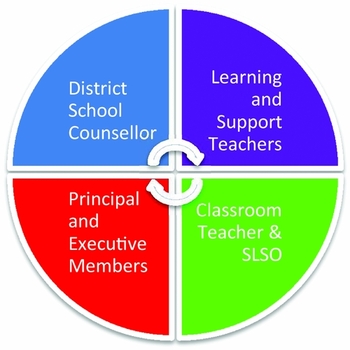
This school-based trauma care team includes the Principal and supportive Executive members, the District School Counsellor/Psychologist and the Learning and Support Co-coordinator. The team exists as a group of supportive school personnel with influential and/or leadership positions, who meet weekly through the school's Learning and Support Team, and, in addition, as needed informally to
-
• remind educators to recognise trauma-based behaviours and respond sensitively to trauma presentations in children;
-
• advocate for the difficulties of maltreated and traumatised children and reinforce their needs with educators; and
-
• support educators in their role with supporting and educating maltreated and traumatised students.
In practise, these personnel promote the necessary understanding and support required to meet the needs of traumatised students throughout the school and, in doing so, maintains and sustains the goal of increased school capacity.
Illustration 1 displays the school-based trauma care team structure.
School-based trauma care team.

With a team of knowledgeable people available to advocate for, and support the needs of, maltreated and traumatised students and their educators in a sustainable way, the next goal was to begin providing continuous professional development across the school to increase levels of trauma awareness, develop understanding of their complexities and explain the link between their difficulties as they relate to their vulnerabilities, and promote trauma informed and sensitive care and practise. This has been facilitated by the provision of continual professional development for all staff throughout the school, including the Principal, Executive Members, Educators and Support Staff.
In practise, this has included professional development on staff development days by the School Counsellor, presentations by external personnel at staff meetings and, simultaneously, distributing and promoting the readily available school-based trauma care resources. These resources have included Calmer Classrooms (Downey, Reference Downey2007) and Making Space for Learning (ACF, 2010). The online training available on the Australian Childhood Foundation's website SMART – Strategies for Managing Abuse Related Trauma has also been promoted and included in educators’ plans for professional development.
The book, The Boy Who was Raised as a Dog: What Traumatised Children Can Teach Us About Loss, Love and Healing (Perry & Szalavitz, Reference Perry and Szalavitz2007), has been circulated throughout the school and feedback has been positive with those educators who have read the book saying that they are developing an understanding of the devastating impact that maltreatment can have on children.
The professional development sessions have included psycho-education to develop a neurobiological understanding of what is happening for the students and this has functioned to develop understanding, empathy and connection, and consequently reduce frustration, avoidance and disconnection. With this knowledge being presented at regular intervals throughout the school year, reminders can be given when discussing, planning for and advocating for individual students. These reminders – persistent awareness raising and advocating for each student – on a case by case basis across the school helps to highlight the magnitude of the issue for the students and for the school and helps to keep a trauma sensitive environment in mind.
Wellbeing Framework
Wellbeing Framework signifies the school's responsibility to provide personalised and differentiated learning and support for students to succeed, as well as the availability of targeted support at the system and school levels. The NSW Department of Education Wellbeing Framework's Connect, Succeed, Thrive theme (NSW DEC, 2015) emphasises
-
• connection to learning, positive and respectful relationships and sense of belonging to school and community;
-
• success through personalising student learning, supporting students to achieve, providing opportunities to succeed in ways that are meaningful to the student and a positive and supportive learning environment; and
-
• thriving, from an environment, which fosters and develops choice, accomplishment, positive relationships, enjoyment, growth, health and safety.
Each of these points support the differentiated needs of maltreated and traumatised students in schools. The Wellbeing Framework specifies the Department's position on helping children who need help, and reinforces the importance of respectful relationships, personalised learning and positive supportive environments.
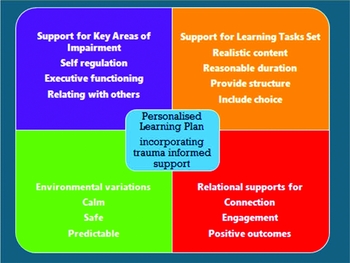
At a practise level, these needs can be addressed within individual Personalised Learning Plans designed and supported through the school's Learning and Support Team. Illustration 2 above sets out a Personalised Learning Plan structure which can address the specific needs of traumatised students in schools and assist them to engage with learning at school.
Personalised Learning Plan incorporating trauma informed support.

The Personalised Learning Plan structure, incorporating trauma informed and sensitive supports, gives a framework to the school's Learning and Support Team when planning and organising for necessary supports that address key areas of impairment. When the school is met with resistance or confusion about its role and responsibility for these children, the Wellbeing Framework can be a pivotal tool when implementing and advocating for change, and when trying to establish appropriate and necessary supports. Structured learning support can help traumatised children re-engage in learning activities and reduce stress (Tobin, Reference Tobin2016). Within the ‘engagement’ component of the model, it sets out what is needed to gain access to additional supports.
Informed
Informed signifies the need to be informed concerning maltreated and traumatised students. There are three parts to becoming and remaining informed in schools:
-
1. Being continuously informed on each traumatised student's strengths, interests, difficulties, needs and trauma triggers to be able to relate to and support the student.
This information comes from previous schools and preschools, in the forming of a relationship with the student, in contact with the student's family, School Counsellor/Psychologist assessments where appropriate (cognitive, academic, functional, behavioural, social, emotional domains assessment – with consideration and representation of results through a trauma lens), and information from government and non-government agencies. Cole et al. (Reference Cole, O'Brien, Gadd, Ristuccia, Luray, Wallace and Gregory2005) emphasise the importance of educators identifying and focusing on strengths and islands of competence for the child in order to facilitate experiences of success and mastery. In practise in schools, this is about regular, open communication between everybody involved in supporting the student and this is driven through the school-based trauma care team within the Learning and Support Team. Teachers report valuing the information that helps them best understand and, therefore, plan to support the student.
-
2. Being informed on potential signals of childhood maltreatment and trauma reactions that may be underlying a student's persistent behavioural and/or learning challenges.
This opens up dialogue within the school and takes into consideration the students’ persistent challenging behaviours and/or learning difficulties that may be potential signals of distress. These children and young people are often without capability and without opportunity to express what is happening, or has happened, for them. As mandatory reporters, it is essential that schools have an approach to thoughtfully identify and monitor school-based concerns for students. Enabling a system that more adequately identifies children who are being maltreated and living traumatising existences, but are not being recognised by the authorities, has facilitated a greater understanding of these students’ difficulties and has increased recognition of the need for the school to identify, support and advocate for these children to the appropriate agencies.
The Child Development and Trauma Specialist Practise Resource (VIC DHS, 2007), developed to assist practitioners to understand typical developmental pathways of children and recognise indicators of trauma at different ages and stages, is a useful tool to help identify and understand the indicators of maltreatment and trauma (https://www.dhs.vic.gov.au/for-service-providers/children,-youth-and-families/child-protection/specialist-practice-resources-for-child-protection-workers/child-development-and-trauma-specialist-practice-resource).
-
3. Informing, as a priority, appropriate government and non-government agencies for child protection issues, monitoring and support processes, as well as being informed by these agencies.
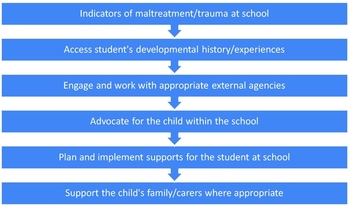
Children and young people attend school for significant amounts of time and the way they present to school and function within schools provides valuable insights. Educators play a vital role in identifying and reporting cases of child maltreatment. Schools are uniquely placed to notice difficulties and changes as they occur for the child in the school context and, therefore, can valuably contribute knowledge of the child. Being able to establish a consistent practise of engaging effectively with appropriate external agencies ensures appropriate support in advocating for traumatised students. This is achieved through developing relationships with personnel within these agencies, presenting the information through a trauma lens, and making bulk cumulative harm notifications, where there are chronic child protection issues. The necessity for this process is set out in the Keep Them Safe Legislation: A shared approach to child wellbeing (NSW Gov., 2009), which sets out the new way for government and non-government organisations working together to support and protect vulnerable children through stronger relationships being built and sustained to help organisations trust each other.
Illustration 3 displays the flow of this process at a practice level.
Process for supporting identified cases of potential maltreatment and trauma at school.

Relational
Relational signifies the central component of school-based relationships as foundational to working with maltreated and traumatised students across the school and the need for a secure relational context for these students. Within the literature there is widespread agreement for the advantage of developing positive interpersonal connections for maltreated and traumatised children (Bath, Reference Bath2008; Cook et al., Reference Cook, Spinazzola, Ford, Lanktree, Blaustein, Cloitre and van der Kolk2005; McLean, Reference McLean2016; Tobin, Reference Tobin2016).
The Australian Childhood Foundation voices the significance of relationships as key to recovery and change, stating that when the damage occurs in relationships the reparation occurs in relationships (ACF, 2010). Being able to feel safe – to experience safe connections with other people – is fundamental (van der Kolk, Reference van der Kolk2014). Perry (Reference Perry2006) promotes the use of healthy and invested people in the child's life, including teachers, to help provide therapeutic opportunities in the form of quality relational interactions.
Schools can provide opportunities for children to receive intense, regular and safe positive social interactions with both educators and peers. Educators have the potential to play an active role in helping children who have been maltreated relate to other children (Veltman & Browne, Reference Veltman and Browne2001).
Promoting a neurobiological understanding of the role and importance of relationships within the school at a practise level has assisted educators to understand the purpose of relationships with students, and what is trying to be achieved through these relationships. It is also useful for guiding educators in setting goals with how they can endeavour to bring about a supportive relationship as an educator.
At a neurobiological level relationships within schools can provide three functions:
Provision of Attachment and Connection
A quality relationship can provide the continuous safe base, and the safe haven, to allow the student to feel safe, ready to learn and explore, and help the student develop positive feelings associated with forming relationships (Golding & Hughes, Reference Golding and Hughes2012). These quality relationships can develop from positive, meaningful connections with calm, consistent adults within the school.
Bomber and Hughes (Reference Bomber and Hughes2014) suggest that schools should promote opportunities for relational repair where necessary, for example, after there has been an exclusion or a rupture in the relationship. This is important for communicating to the student following a relationship breakdown, that the school is a safe place to be and that the student is welcome and accepted. In practise, this approach is promoted and used within the school when there have been exclusions, particularly suspensions.
Activating Our Social Engagement System
When adults speak calmly to students, offer support and comfort, and remain in a calm physiological state, a student's social engagement system can be activated, thus inhibiting a nervous system response. Humans are biologically driven to respond to distress first by social engagement; that is, when overwhelmed by their internal or external environment human beings first use their social engagement system – calling out for help, support and comfort from available supporting people (ACF, 2011). When adults use harsh, aggressive, threatening voices and fearful physical states, a student's social engagement system is shut off and a nervous system response follows (ACF, 2011). Humans cannot help but respond to these indicators of safety or danger – it is hardwired into our brains (van der Kolk, Reference van der Kolk2014).
In practise in schools, educators sometimes use loud, intimidating, threatening voice tones and words when addressing students. Informing educators where possible of the negative impact this can have on maltreated and traumatised children has assisted in developing reflection on this practise and the working towards finding alternatives to this relationship disrupting practise. Bringing about a calm manner to approaching and speaking with dysregulated students has been part of the focus of the cultural change within the school. The Zones of Regulation curriculum has provided support for bringing about this approach through the school by developing educators’ understanding of their own arousal states when engaging with dysregulated students, and the school considering ways to support situations before these incidences occur.
Co-regulation of Attention, Emotions and Behaviours
Relationships within the school can support students to feel safe and supported when they are overwhelmed by remaining within their proximity to assist them to calm down, rather than excluding them or leaving them on their own. When overwhelmed by their internal or external environment children require the presence of another adult to help them regulate – this is co-regulation. Van der Kolk (Reference van der Kolk2014) suggests that teachers first acknowledge that the student is upset, and then help calm the student before exploring causes and discussing possible solutions and subsequent outcomes. Achieving this within the school has also been possible through The Zones of Regulation curriculum.
To be able to provide the kind of relationship traumatised students need requires awareness of school-based relationship promoting practises and school-based relationship disrupting practises. At a practical level, this knowledge is fostered within the professional development sessions and through regular discussion concerning the needs of the student. Sometimes relationships with these students need to be developed with other school personnel, for example educators running special interest lunch groups, supportive executive members, the Community Liaison Officer and the Aboriginal Community Liaison Officer.
Engagement
Engagement signifies the need for engaging resources, appropriate services and supports for the students, their educators and their families. Multiple trauma informed education resources are available for NSW schools to access, providing information relating to both knowledge and practise. As set out above, these resources for educators form an important part of the knowledge development and capacity building for all school personnel. These resources are useful as tools for awareness raising, psycho-education and practise direction. Examples include the Australian Childhood Foundation's Making Space for Learning (2010) and The Office of the Child Safety Commissioner's Calmer Classrooms (2007).
Putting into place recommended supports for traumatised students in the school can be achieved, initially, internally through the school's Learning and Support Team, school programes and resources, and subsequently, where necessary, externally through departmental funding. This practise model presents an approach for applying for departmental funding without the immediate need for diagnoses; thus enabling the school to access additional funding for implementing trauma informed supports without having to push for the provision of disruptive behaviour diagnoses. Van der Kolk (Reference van der Kolk2014) reminds us of the difficulties presented by these diagnoses because they do not clarify what is wrong for the child and do not describe the child meaningfully. ‘Children who act out their pain rather than locking it down are often diagnosed with ‘oppositional defiant behaviour’, ‘attachment disorder’ or ‘conduct disorder’. But these labels ignore the fact that the rage and withdrawal are only facets of a whole range of desperate attempts at survival’ (van der Kolk, Reference van der Kolk2014, p. 282). Departmental funding can be applied for under a Mental Health Consultation, where there is not a mental health diagnosis yet in place.
Frequently in schools there is misunderstanding of what a diagnostic label means for a student and what it describes about a student. For example, where there is a maltreated and traumatised child diagnosed with oppositional defiant disorder, the practise in schools is to design a Behaviour Management Plan, which may have limited concern for the purpose of the child's behaviour and what needs the child is trying to meet. For maltreated and traumatised children, this can represent precocious independence where there has been neglect or maltreatment and intense needs for safety promotion and threat avoidance. Behaviour Management Plans often become concentrated on primarily managing the child's behaviour, when a context is needed, which educates the child whilst supporting the child's needs.
Engaging with multi-disciplinary, trauma-competent services can provide support to the student, the school and, where appropriate, the family. School Counsellors are able to refer students to these services, for example, the Child and Adolescent Mental Health Team and the Child and Family Health Team, and the school together with these services can form a care team for working through how to best support the needs of the student. At a practical level, this is driven by the School Counsellor, and highlights the importance of developing and maintaining regular contact with services best able to provide appropriate support for the child as well as communicate with the school.
Discussion
The REWIRE practise model systematically addresses the expansive elements required to thoroughly and holistically address the needs of maltreated and traumatised students within NSW Department of Education schools. It addresses the need to, first, identify the school's unique challenges and limitations to supporting its maltreated and traumatised students and their educators; second, address prerequisites to creating a school culture ready to shift from traditional to trauma-informed practises and, third, implement a well-defined, structured model for support. Without addressing the first and second steps, the ability to put the model into practise is compromised because of the challenges posed by traditional system beliefs and practises, as set out earlier.
REWIRE addresses the central objective of The National Child Traumatic Stress Network Service Systems Brief (2007), which sets out that creating a trauma-informed school system involves increasing awareness about the impact of trauma among school staff, educators and administrators, to identify and address the needs of traumatised children in a primary setting where they spend a significant amount of time.
The early experience in schools of attempting to support maltreated and traumatised students within the school, through the provision of knowledge and professional development alone, was not effective. It was recognised that there were other issues that needed to be addressed and changes in order to develop receptiveness to trauma knowledge and professional development, from which trauma-informed and sensitive practises and supports could flow. A whole of school support model has been necessary to be able to address these issues and provide systematic supports across the school.
This became achievable through the REWIRE model. REWIRE provides in-house, directed capacity building and strengthening to initiate, develop and progress a whole of school approach to comprehensively and systematically support its maltreated and traumatised students and their educators. School Counsellors and school-based Psychologists are uniquely placed for understanding the impact of trauma on student learning, development and wellbeing, as well as how this affects their functioning at school, and what is required to be put in place at a school level. Schools have professionals who are potentially able to actively and competently contribute to each of the six components of practise – Regulate, Educate, Wellbeing framework, Informed, Relational and Engagement.
Traditional school practises have needed to be challenged, and to do this has required ongoing and regular provision of professional development on childhood maltreatment and trauma, and trauma-informed and sensitive care, provision of a range of resources for educators, promoting awareness of these students’ difficulties case by case, and promoting an understanding of the neurobiology of what is happening for the child through developing understanding of brain development and promoting behaviour as a form of communication.
REWIRE provides a practise framework to guide schools to move towards sensitive and supportive strategies for interaction with maltreated and traumatised students. It maps out a plan for both addressing challenges/barriers and promoting enhancements for
-
• interacting and connecting with students;
-
• developing relationships with students;
-
• understanding and supporting students;
-
• considering and approaching behaviour;
-
• thinking about children and young people developmentally;
-
• understanding traumatised students’ complexities;
-
• moving from practises based on exclusion to practises based on inclusion; and
-
• from practises based on behaviour management to practises based on relational influence.
School-wide participation, practises and supports have been essential to ensuring vulnerable students are not further segregated and isolated, and to enable supports to embrace those maltreated students impacted by trauma but not identified as such at school. Veltman and Browne (Reference Veltman and Browne2001) note the advantage of whole of school programs for all students providing help for maltreated children in a non-stigmatising way.
In practise, there has been a constant need to advocate for these children case by case, identify barriers to progress and evaluate. There is an obvious need to continuously reinforce trauma knowledge and awareness to sustain a sensitive culture and set of practises. Having the School Counsellor regularly available for consultation regarding maltreated and traumatised students has supported this process, together with the trauma care team promoting helpful practises.
Understanding the neurobiology of relationships; what relationships provide at a neurobiological level for the child has provided a context for understanding the significance of the relationship at school. How to use the relationship successfully with students in the school setting and strengthening the relational base for students has also been a focus. At a practise level, sometimes what is needed is for the teacher to spend one on one time with the student to establish a foundation for their developing relationship.
The Zones of Regulation has provided opportunity to discuss schools’ options for students achieving and maintaining optimal arousal states, the significance of supporting students to develop self-regulation and offering co-regulation, and the role that external regulation plays in schools. Educators are also reporting that students are starting to actively regulate their behaviours and emotions. Within the school, educators are reporting that they now have an approach to use, particularly when students are distressed, and that they are experiencing being able to help students calm down.
The experience in schools has recently been of many educators now being able to collaborate and think of ways to best support the students they understand. Frequently, a major barrier to achieving these goals is personnel resources, for example needing to supervise and keep students safe who require time away from the classroom and being overwhelmed and dysregulated by noise and activity; and needing to provide one to one attention for students in great need of connection. Being able to provide the school with targeted resources to achieve this frequently results in supportive approaches being promptly put into place and positive changes beginning to occur, which then reinforces the importance of these kinds of supports.
At a practise level, being informed is time consuming. Reporting takes up considerable amounts of time, case closure frequently leads to nothing changing for the child and reporting does not erase the harm for the child. However, utilising the process of regular contact with the necessary agencies can help to formulate a plan for the child at school, and having external agency involvement with the school highlights case complexity and can contribute to the willingness of educators to stay actively supportive for the child.
The process of supporting a school to support its traumatised students proves continual. This kind of transformation requires having a solid understanding of the extent and nature of the existing problem and having time, dedication, persistence and resilience. It necessitates commitment to a process repeatedly thwarted by challenges naturally inherent in working within large systems, particularly traditional systems. This commitment mandates ongoing development of related competencies, connections with other professionals working in trauma, professional confidence and a conviction to continue to lead and support in this way.
Conclusion
When working as professionals supporting maltreated and traumatised children and young people it is easy to imagine the possibilities that can develop within school-based experiences of belonging, connecting, relating, feeling, experiencing, dreaming, achieving, trusting and learning. It is also recognisable that for maltreated and traumatised students, the teachers they have, the executive members who support these teachers, and the Principal leading the school will ultimately determine how much of their schooling provides these meaningful, reparative experiences and opportunities for recovery and growth. Comprehending this has driven the development and implementation of this School Counsellor-led model set out in this practice paper.
It has been the literature as well as widespread reading in the experiences of maltreated and traumatised children in education settings, and school-based trauma-informed and sensitive practise in Australia and overseas that has strengthened my standpoint in my work in schools, developed my understanding, steered my progression towards becoming a trauma informed School Counsellor and guided my goals and work in schools supporting maltreated and traumatised students.
Schools have the potential to lead the way as educating systems in advancing recovery and growth for their traumatised students. The NSW Department of Education's Wellbeing Framework for Schools asserts a commitment to “Developing and fostering wellbeing. . .”, and states:
The school environment is pivotal to the growth and development of our most important assets – our children and young people. . .Our schools strive for excellence in teaching and learning, connect on many levels and build trusting and respectful relationships for students to succeed. . . (NSW DEC, 2015, p. 5).
The School Counsellor-led practise model REWIRE set out in this practice paper has highlighted the challenges and limitations facing maltreated and traumatised students and their educators within schools, the need for whole of school shifts to address these, the importance of access to information to develop understanding and knowledge of maltreated and traumatised children within schools and the necessary systematic and whole of school practise components.
It is hoped that the presentation of this School Counsellor led practise model for supporting NSW Department of Education schools to support their traumatised students, as a systematic, comprehensible, ‘how to’ model will contribute to the advancing and enhancing of school-based trauma informed practises, and to the promoting of schools to develop the trauma conscious cultures, competencies and confidences, to lead the way as educating systems in advancing recovery and growth for their students.