I wish that I could commend William Stacy Johnson's book, A Time to Embrace,Footnote 1 as a rigorous and fair assessment of Christianity and homosexuality from a homosexualist perspective.Footnote 2 Unfortunately, Johnson so regularly violates scholarly standards for honesty and accuracy in representing secondary literature, conceals from readers the most important counter-arguments to his position and shows gaps in logic, that I cannot embrace A Time to Embrace. Given space constraints, it is impossible to give a systematic presentation of the book's errors in fact or argumentation. I refer readers to my website for material that could not fit here and for a rejoinder to Johnson's response (http://robgagnon.net/ArticlesOnline.htm).
Johnson's book is organised into an introduction and two major parts. The introduction consists of brief discussions of analogies to racism and misogyny (pp. 5–12), homosexual relationships in history (pp. 13–19), and socio-scientific study of homosexuality (pp. 20–36). In Part One: Religion, Johnson develops his scheme of seven theological viewpoints (pp. 39–108), where he discusses biblical issues in an organisationally choppy fashion, and then continues the same under the rubrics of companionship, commitment and community (pp. 109–55). In a smaller Part Two Johnson treats law and politics. This essay focuses on Part One.
The tone of Johnson's book
Johnson trumpets his tone: ‘I try to positively engage people from across the spectrum’ (p. 3). Homosexualist ‘advocates need to maintain a consistently affirming posture themselves’ and not ‘demonize those who disagree by accusing them of bigotry’ (p. 224; cf. p. 207). Despite such remarks, Johnson often charges those who disagree with bigotry, as well as hypocrisy, hatred and irrationality. He compares opposition to homosexual practice with racism and sexism (pp. 7–12). Laws which prevent a special privileging of homosexual practice among other practitioners of immoral sexual behaviour ‘are motivated only by irrational prejudice and animosity’ (p. 168). To deny gay marriage or civil unions ‘is irrational’ (p. 186), nothing more than ‘traditional prejudice’ and ‘a narrow brand of conservatism’ (p. 214). ‘The truth is that there are no cogent legal arguments of a secular nature for refusing to grant some form of relationship rights to gay couples’ (p. 189). Those who disagree with his views are ‘anti-gay polemicists’ (pp. 22, 125, 278 n. 30). Those who allow membership for homosexually active persons, but not ordained office, do so merely to ‘appease the prohibitionists’ (p. 54). Efforts by the PCUSA majority to support a ‘byzantine’ two-sexes prerequisite for sexual relations in the Book of Order have been ‘harshly hypocritical’ (pp. 265–6 n. 26). ‘Prohibitionists’ take only a ‘textualist approach’ to the Bible rather than a ‘contextualist’ one. They do only a ‘strict’ and ‘literal’ reading of the ‘face of the text’ of scripture and take no account of the historical and literary contexts (pp. 56, 129). ‘Rarely do prohibitionists acknowledge biblical or historical facts that would call into question their premises or conclusions. . . . They pay little attention to empirical or scientific study’ (p. 52). ‘Non-affirming’ persons do not offer any ‘distinctively theological’ argument; rather, they merely offer ‘a selective quoting of Scripture’ (p. 101).
Johnson has a right to make such statements – but only if he can prove his accusations. As it is, they are far more accurate of Johnson's work in relation to affirming the homosexualist agenda. Johnson and others feel that when the kinds of attack which they direct at others are directed at them it is not in the spirit of ‘dialogue’ and use this as a pretence for excluding from ‘dialogue’ the persons who make them. Apparently the same rules do not apply to themselves.
To claim, as Johnson does, that all this amounts to a ‘positive engagement’ with opposing views is doubly abusive. If this is positive engagement, give me negative.
Johnson's misrepresentation of scholarly work
The most serious charge which can be levelled at Johnson is that he repeatedly misrepresents the work of others or misleads readers into thinking things about the work of others that is inaccurate. In most of these instances it appears highly unlikely that Johnson was unaware of what he was doing. Space does not permit an exhaustive enumeration.
First, Johnson has worked hard to conceal from readers the fact that most of the best scholars who have studied the biblical texts on homosexual practice in their historical context disagree that the Bible condemns only exploitative forms of homosexual practice such as pederasty, prostitution or sex with slaves (what I call the exploitation argument). Revealing this fact would have devastated the credibility of his exploitation argument, given that Johnson is not a specialist in biblical studies or the Graeco-Roman world. Yet this would have been better than risking his scholarly integrity. Two, of many examples, suffice to make the point.
Johnson cites Louis Crompton's 500-page Homosexuality and Civilization as ‘the single best book-length introduction to the subject’ of how ‘same-gender relationships have meant very different things . . . in divergent times, places, and social contexts’ (pp. 12, 252 n. 46). Johnson makes this the key pillar of his exploitation argument. Yet Johnson neglects to tell readers that Crompton comes to a radically different conclusion:
According to [one] interpretation, Paul's words were not directed at “bona fide” homosexuals in committed relationships. But such a reading, however well-intentioned, seems strained and unhistorical. Nowhere does Paul or any other Jewish writer of this period imply the least acceptance of same-sex relations under any circumstance. The idea that homosexuals might be redeemed by mutual devotion would have been wholly foreign to Paul or any other Jew or early Christian.Footnote 3
Johnson puts the Crompton book at the top of a list of ‘must-reads’ so he must have read these remarks. His unwillingness to disclose them contrasts sharply with his zeal to cite an evangelical preacher, John Stott, who says that ‘the biblical prohibitions by themselves say nothing about [committed same-sex] partnerships’ (pp. 50, 264 n. 17).
Similarly, Johnson calls Bernadette Brooten's Love Between Women ‘the definitive work on female homoeroticism in antiquity’ (p. 271 n. 35).Footnote 4 He cites her favourably for his own treatment of the meaning of ‘nature’ (pp. 82, 268 n. 11). Yet Johnson fails to tell readers of Brooten's rejection of an exploitation argument. Brooten, a New Testament scholar and self-identified lesbian, states: ‘The sources on female homoeroticism’ in antiquity indicate that the early church ‘opposed homosexual behavior per se’, ‘regardless of age’ and ‘mutuality’. Johnson does mention that Brooten interprets Rom. 1:26 as a reference to lesbianism but Johnson, who declares this to be only a ‘possible’ reading (p. 90), keeps readers ignorant of the overwhelming case for it.Footnote 5 Such a referent would devastate Johnson's exploitation argument since lesbianism in antiquity did not normally emulate male exploitative practices. Johnson also ignores what Brooten and I have to say about Graeco-Roman orientation theories concerning tribades (the active female partners in a female homosexual bond) and kinaidoi (the passive male partners in a male homosexual bond)Footnote 6 and claims falsely that the New Testament writers could not even have ‘anticipate[d] the category of sexual orientation’ (p. 64).
Second, Johnson misrepresents John R. Clarke's Roman Sex: 100 B.C. to A.D. 250 Footnote 7 when he says it confirms his exploitation argument (pp. 18, 255 n. 72). What Johnson doesn't tell readers is that Clarke's chapter on ‘Gay Sex’ (pp. 76–93) focuses almost exclusively on two pictorial representations that Clarke himself views as illustrating ‘equal, reciprocal, male-to-male sex’: the famous ‘Warren Cup’ (15–30 ce) and a lesser-known, large agate gemstone housed in Leiden (1st century bce). The Leiden gemstone offers a particularly powerful image, showing a man anally penetrating another man, with the man on the bottom having a large erection and both men gazing directly into each other's eyes.
Third, Johnson misrepresents work done on Gregory of Nyssa when he claims that two articles show that Gregory understood the implications of Gal. 3:28c for eliminating any significance to gender complementarity, which for Johnson includes the allowance of homosexual relations. So, Johnson claims, ‘the “it's-always-been-read-that-way” argument . . . is not true’ (pp. 152, 295 n. 115).Footnote 8 Yet both articles show that Gregory understood ‘no male and female’, when applied to sexual behaviour, as meaning abstinence from sexual relations, not the allowance of homosexual relations. So long as humans have sexually differentiated bodies and engage in sexual relations a male–female prerequisite remains binding.
Fourth, as regards my work, Johnson follows a strategy of mostly ignoring and occasionally misrepresenting it. Johnson shows no awareness of the arguments in 80 percent or more of my first book, The Bible and Homosexual Practice: Texts and Hermeneutics,Footnote 9 or in virtually any of the hundreds of pages that I wrote afterward. This is especially stunning in view of the fact that he wrote a review of my first book in Theology Today that appeared a couple of months after his book came out.Footnote 10
On the rare occasion when Johnson treats my work there is a tendency toward misrepresentation. For example:
(1) Johnson reduces my complementarity argument to ‘the body parts fit’ (pp. 115, 120, 275–6 nn. 14, 16; Review 390) even though I repeatedly state that complementarity is to be taken in a holistic sense involving not only anatomy but also physiology and psychology – the whole package of what it means to be male and what it means to be female.Footnote 11 He also claims that there is no evidence for the idea of anatomical complementarity in antiquity despite the fact that I provide just such evidence. As Hubbard rightly states, ‘basic to the heterosexual position [in the first few centuries ce] is the characteristic Stoic appeal to the providence of Nature, which has matched and fitted the sexes to each other’.Footnote 12
(2) Johnson claims that by ‘sleight of hand’ I ‘omit to tell the reader’ how tôʿēbâ (‘abomination’) is used outside the Levitical Holiness Code (p. 285 n. 59). Yet I devote a full three pages to this in a section entitled ‘The Meaning of tôʿēbâ’ (pp. 117–20). Two of the texts that Johnson emphasizes (Gen. 43:32–4; Exod. 8:26) I mention only in passing because they report what Egyptians, not Israelites, considered to be ‘abominations’.
(3) Johnson states: ‘Gagnon gives us no persuasive reason why we should break with tradition and ordain women but at the same time genuflect to tradition in being anti-gay [read: anti-homosexualist]’ (p. 294 n. 107). Johnson omits to tell readers the main arguments that I raise briefly in my first book (p. 443) and expand on elsewhere.Footnote 13 Simply put, affirmation of homosexual practice represents a radical break with scripture whereas the ordination of women merely carries further a process already begun in scripture. Already in the Old Testament and especially in the New Testament there are a number of women-affirming texts. We see nothing like this kind of openness in scripture's stance toward homosexual practice; indeed, we see the opposite. Moreover, while Old Testament and New Testament writers were generally more affirming of women than was the norm for the ancient Near East and Graeco-Roman world, respectively, they were much less accommodating to homosexual practice. Finally, an attempt at equating sex or gender with a homosexual impulse confuses categories. Being a woman, unlike a homosexual impulse, is 100 percent congenitally determined and essentially immutable. Moreover, it is not a direct or primary desire for behaviour that is incompatible with embodied structures and strongly prohibited in scripture. Homosexual desire is. Scripture rightly views sex or gender as closer to the condition of ethnicity than to persistent sexual desires. As we shall see, a more appropriate analogy to affirming committed homosexual unions would be an argument to support committed adult incest or sexual bonds involving three or more persons.
(4) In his Review, Johnson makes explicit what in his book is implicit; namely, that ‘he [Gagnon] assumes that there is one monolithic thing called homosexuality, which is the same yesterday, today, and always’ (pp. 388, 390). Johnson implies, ridiculously, that I am unaware of the existence of pederasty or coercive sex with slaves in the ancient world.Footnote 14
Johnson's main argument (exploitation-hedonism) and his lack of first-hand knowledge of graeco-roman primary sources
Johnson's main thesis is that:
the biblical prohibitions [that refer to homosexual practice] were addressed specifically to hedonistic or exploitative forms of sexual conduct, such as prostitution or the sexual exploitation of slaves, in which mutuality and concern for the other were absent. These biblical passages are silent about mutually and exclusively committed same-gender love. (p. 225 and often)
A favourite example of Johnson's is that of ‘a Roman soldier exploiting his boy-slave sexually’ (pp. 12, 49–50; Review, p. 392). It never occurs to Johnson that Rom. 1:27 refers to males ‘inflamed with yearning for one another’, which stresses mutuality of affections rather than a coercive master–slave relationship. For Johnson's argument to be valid, one would have to suppose the historically absurd theory that, had two men or two women approached Paul and expressed their desire to be in a committed, egalitarian sexual relationship, Paul would have responded, ‘Yes, I support that kind of sexual union.’
Although Johnson alleges that ‘prohibitionists’ and I do not understand the Graeco-Roman milieu, it is Johnson who gives no indication that he has worked directly with the primary source material, let alone translated relevant texts. He hasn't even bothered to use Hubbard's convenient Sourcebook.
Johnson claims in his Review that my citations from Aristophanes’ speech in Plato's Symposium (c.380 bce) and the speech of Callicratidas in the pseudo-Lucianic Affairs of the Heart (c.300 ce) are irrelevant because they are too distant from Paul's time and because ‘both are satirical’ and non-egalitarian (p. 390).Footnote 15 The Symposium, however, was well known in the first century. Philo of Alexandria cites it but still dismisses all forms of homosexual practice as unnatural: ‘Nearly the whole of Plato's Symposium is about love, not merely about men mad after [i.e. madly in love with] men – for these desires pay tribute to the laws of nature – but about men (mad) after males, differing from them only in age’ (Contemplative Life, 59).Footnote 16
Johnson ignores my point that even if Aristophanes’ speech were taken as satire it would still ‘reflect or play off of the positive view of same-sex eroticism expressed by Phaedrus and Pausanias and current among some in antiquity’ (compare 181D, 183E with 192A–B, E).Footnote 17 As for Callicratidas’ speech, one may charge Callicratidas (the defender of male-male love) with falling short of the philosophical ideal in his personal conduct but not with attempting to lampoon loving same-sex male relationships. Were it otherwise, Lycinus, the arbiter of the debate with Charicles (the defender of male–female love), would not have declared Callicratidas the winner (51).
The space constraints of this essay permit here only a few examples of loving homosexual relationships in the Graeco-Roman world. In Plutarch's Dialogue on Love (late 1st–early 2nd century ce) Protogenes argues that man–male love is superior, not because it is more hedonistic but because, instead of having ‘as a net result the reaping of the fruits of pleasure (hēdonēn)’, it ‘comes through friendship to the end and goal of virtue’ (750D; 4). Pisias infers that while ‘it is doubtless fitting (for women acting) with discretion and moderation neither to love passionately nor to be loved passionately’, it is a different matter with a male beloved (752C; 6). Daphnaeus, defending the superiority of male–female love, concedes that homosexual relationships are not necessarily exploitative, for ‘sexual intercourse that is contrary to nature with males does not do away with, nor damage, a lover's kindness [or: amorous goodwill]’ (751C; 5). Yet, he declares, even when ‘the (intercourse) that comes about from (the joining of) males’ is done ‘willingly’, it remains ‘shameful’ (aschēmōn) since males are, ‘with softness (malakia) and effeminacy (thēlutēs), surrendering themselves, according to Plato, “to be mounted in the custom of four-footed animals” and to be sowed as if to produce children (paidosporeisthai), contrary to nature’ (para phusin; 751D–E; 5; my translations).
Two second-century ce romances – Xenophon of Ephesus’ An Ephesian Tale (3.2) and Achilles Tatius's Leucippe and Clitophon (1.7–8, 12–14, 33–4) – both include tragic love stories about similar-aged male lovers. Relationships of a different sort but still attesting to commitment are reported in Rome by the epigrammatist Martial (c.40–104 ce; 1.24; 12.42) and by the satirist Juvenal (early 2nd century ce; Satire 2): effeminate men who willingly commit themselves as ‘brides’ to another man. For example, Gracchus, ‘a man renowned for his family background and his wealth’, became the ‘bride’ to a common cornet-player and signed semi-official documents (Satire 2.119, 125, 129).Footnote 18 Lucian of Samosata (mid-2nd century ce) tells of two rich women who regard themselves as married, the masculine Megilla of Lesbos and her ‘wife’ Demonassa the Corinthian (Dialogues of the Courtesans, 5). The astrologer Ptolemy of Alexandria (2nd century ce) refers to manly women born under a certain constellation who are ‘lustful for sexual relations contrary to nature’ and take the active sexual role with women whom they sometimes call their ‘lawful wives’ (Tetrabiblos 3.14; §§171–2). Several rabbinic texts forbid marriage of a man to a man; one referring to Egyptian practices even forbids marriage of a woman to a woman (Sifra on Lev. 18:3).Footnote 19 Clement of Alexandria likewise referred to ‘women . . . contrary to nature . . . marrying women’ (Paidagōgos 3.3.21.3). These marriage texts presume that some in the ancient world are seeking a committed same-sex relationship.
Hubbard notes that Graeco-Roman ‘literature of the first century c.e. bears witness to an increasing polarisation of attitudes toward homosexual activity, ranging from frank acknowledgment and public display of sexual indulgence on the part of leading Roman citizens to severe moral condemnation of all homosexual acts’.Footnote 20 If even sectors of the ‘pagan’ world were beginning to develop absolute opposition to all forms of homosexual practice, what is the likelihood that any Jew or Christian would have made exceptions for committed homosexual unions, given the absolute opposition of Jewish scriptures?
Johnson on Genesis 1:27 and 2:18–24
Johnson argues that ‘male and female’ in Gen. 1:27 refers only to the fact that ‘both male and female are created in God's image’, connoting ‘inclusivity and not sexuality per se’ (pp. 116, 277 n. 20). Johnson cites thirty-eight other times in the Old Testament where the phrase allegedly has only this inclusive sense. It turns out that only five of these use the precise formula  (zākār ûnĕqēbâ): Gen. 5:2 and 6:19; 7:3, 9, 16. The last four appear in the story of the Flood and refer to the animals going into the ark by twos, ‘male and female’, whereas 5:2 introduces a genealogy from Adam to Noah's children that fulfils the command in Gen. 1:28 to ‘be fruitful and multiply’ (5:3–32; cf. 6:1). The reference to sexual pairing can scarcely be denied. In fact, Johnson unknowingly admits as much when he declares that Gal. 3:28c alludes to Gen. 1:27 and overturns ‘not just one's status as male or female’ but ‘the pairing of male and female’ (p. 150).
Johnson misreads things when he argues that ‘reducing “image of God” to sexuality’ is wrongheaded because animals too are characterised by sexual differentiation or gender complementarity (p. 275, n. 16). It is not a question of reducing the ‘image of God’ to sexual differentiation but rather of recognising that in Gen. 1:27 human sexual differentiation and pairing are uniquely integrated into God's image. This integration makes it possible for humans to enhance or to efface that image through their sexual behaviour in a way that is not possible for animals. Also misguided is Johnson's argument that connecting the ‘image of God’ with sexual differentiation leaves out single persons, including Jesus (pp. 115–16, 276, n. 16). It is legitimate to speak of the two sexes as complementary, and so incomplete, representations of God's image in the restricted sphere of sexuality without denying the broader integrity of an individual's creation in God's image. Both Jesus and Paul viewed the single state as a non-moral deficit, not a sin (Matt. 19:10–12; 1 Cor. 7:7–8, 25–40). However, active entrance into a structurally incongruous union is a moral violation which assaults the image of God stamped on humans. The logic of a same-sex sexual bond is that each partner is only half his or her own sex, which unites to form a whole male or a whole female. Such a union dishonours the integrity and completeness of one's maleness, if male, or femaleness, if female.
Jesus obviously predicated his opposition to after-divorce remarriage and, by implication, polygyny on the ‘twoness’ or binary/dimorphic character of human sexuality (contra Johnson, p. 139). There is no other reason for Jesus to cite from Gen. 1:27 just the clause ‘male and female he made them’. Two and only two, Jesus insisted, become one flesh: ‘so they are no longer two but one flesh’ (Mark 10:8). That Jesus derived the number two from the God-ordained twoness of the sexes given at creation is evident from a similar move by the Essene community at Qumran. It rejected ‘taking two wives in their lives’ because ‘the foundation of creation is “male and female he created them”’ (Gen. 1:27) and because ‘those who entered (Noah's) ark went in two by two into the ark’ (Gen. 7:9) (CD 4.20–5.1).Footnote 21 For Jesus the twoness of the sexes in sexual pairing, ‘male and female’, was prior to and foundational to any insistence that sexual bonds be limited to two persons.
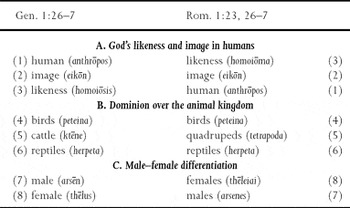
Paul clearly had Gen. 1:27 in view behind his main indictment of homosexual practice in Rom 1:24–7. There are eight points of correspondence, in a similar tripartite order, between Rom. 1:23, 26–7 and Gen 1:26–7: human, image, likeness; birds, cattle, reptiles; male, female (see
Table 1).

This intertextual echo back to Gen 1:26–7 is reinforced by the fact that the context emphasises God's role as ‘Creator’ (1:25) and the knowledge about God and ourselves culled from observation of ‘nature’ (1:19–20, 26–7). What is the point of this echo? Idolatry and same-sex intercourse constitute an assault on the work of the Creator in nature. Those who suppress the truth about God transparent ‘since the creation of the world’ are more likely to suppress the truth about the complementarity of the sexes, male and female, transparent in nature. This echo also makes clear that Paul's main problem with homosexual practice was not that it was typically exploitative or promiscuous, as Johnson claims, but that it was a violation of God's will for male–female pairing established in creation.Footnote 22
As regards Gen. 2:18–24, Johnson argues that the ’ādām's exclamation at the creation of woman (2:23) ‘does not celebrate her otherness but her sameness’ (p. 120): ‘This one at last is bone from my bones and flesh from my flesh! To this one shall be given the name “woman” ( , ʾiššâ) for from man (
 , ʾîš) this one was taken’.
Johnson's argument makes an either–or out of a both–and. The first half of Gen. 2:23 does stress, in part, human sameness in contrast to the animals, among which God had not found ‘a helper as [the ʾādām’s] counterpart’. Yet Johnson ignores the repeated references in 2:21–3 to woman being formed by a ‘taking from’ ʾādām. As a ‘counterpart’ or ‘complement’ to man ( , kĕnegdô), woman is both similar as human (‘corresponding to him’) and different as a distinct sex extracted from him (‘opposite him’). There is also some basis for translating Hebrew [
 (tsēlāʿ) as ‘side’ rather than ‘rib’Footnote 23 or at least as an indeterminate amount of bone and flesh on one of ādām's sides, from which is formed man's sacred side or complement, woman.Footnote 24 The principle of two sexes becoming one flesh is correlated with the picture of two sexes being formed from one flesh. It is not another man that is the missing part or sexual complement of a man but rather a woman, a point reflected in several early Jewish texts (Philo of Alexandria, Allegorical Interpretation 2.19–21 and Creation 152; 4 Macc 18:7; Apocalypse of Moses 29:9–10).
Johnson argues that ‘one flesh’ in Gen. 2:24 has the asexual meaning ‘the same family’ since the formula ‘you are my bone and my flesh’ is ‘more about kinship than sexuality’ (Gen. 29:14; et al pp. 145–7). In response:
First, introducing a sexual dimension in some covenantal relationships violates the covenant. An obvious case in point is the very example that Johnson uses to validate homosexual unions, Ruth and Naomi. Had Ruth and Naomi engaged in sexual intercourse they would have committed a capital offence of incest between parent and daughter-in-law, irrespective of their loving commitment (Lev. 18:15; 20:12). Sexual bonds have their own distinct set of requirements.
Second, context dictates meaning. When we use the comparable phrase ‘you are my flesh and blood’, it means something different when spoken by a husband to his wife (a sexual context) than when spoken by a parent to a child, a brother to a sister, or a friend to a friend.
Third, the specific expression ‘one flesh’ does not appear anywhere else in the Old Testament or in early Jewish or early rabbinic texts apart from a reference to Gen. 2:24. This makes it unlikely to have been an expression for denoting covenant bonds outside a context of man–woman marriage.
Fourth, it takes a determined effort to ignore the fivefold reference in 2:21–3 to forming woman by taking from the ʾādām a part of him. The ʾādām declares not merely that the woman ‘is my bone and my flesh’ but, more, that the woman ‘is bone from my bones and flesh from my flesh . . . for from man this one was taken’ (2:23). What is missing from the ʾādām (human), who is now an ʾîš (man), is the part that God has built into a woman. In this context ‘one flesh’ clearly implies the restoration of the two divisible parts into an indivisible whole, not just ‘the same family’.
This is certainly how Jesus and Paul understood Gen. 2:24. The meaning ‘same family’ would not restrict the number of participants to two, since families are not limited to two members. Yet both Jesus and Paul (1 Cor. 6:16) understood ‘one flesh’ unions as properly restricted to two. Having additional sexual partners violates the principle that a man–woman sexual bond creates a self-contained whole which ought to admit of no third parties. In this context talk of ‘cleaving’ must have its deepest sense of reuniting through a committed sexual bond what was once a single entity: the two, ‘male and female’ or ‘a man’ and ‘his woman/wife’.
Johnson on Galatians 3:28c: ‘there is no “male and female”’
According to Johnson Gal. 3:28, which alludes to Gen. 1:27c, makes sexual differentiation irrelevant in the sphere of sexual relations (pp. 147–52). Problems for Johnson's interpretation arise not just from the fact that the early church would have unanimously abhorred any link between this baptismal formula and homosexual practice; or from the fact that not even Johnson takes the parallel antinomy ‘there is no Jew nor Greek’ absolutely. The chief problem is that applying ‘no “male and female”’ to sexual relations spells the end of such relations altogether, not the irrelevance of a male–female prerequisite.
Jesus defined Gen. 1:27 and 2:24 as foundational for sexual relations. One could choose to opt out of a male–female marital bond. But then the only other option would be to become like ‘eunuchs who were born thus from their mother's womb’ or ‘eunuchs who were made eunuchs by humans’; that is, as people who are not having any sexual relations (Matt. 19:11–12). Similarly, those who opt out of male–female marriage would be like the angels who ‘neither marry nor are given in marriage’ (Mark 12:25; cf. Luke 20:34–6).
The Corinthians probably understood ‘no “male and female”’ to mean not only a greater openness to women's roles in the church (a point with which Paul partly agreed) but also a celibacy requirement (cf. 1 Cor. 7).Footnote 25 There is also evidence that later proto-gnostic circles similarly interpreted an alleged saying of Jesus about making the two sexes one so that there is no longer any male and female (Gospel of Thomas 22:1–4; Gospel of the Egyptians 5b, cited in Clement of Alexandria, Strom. 3.92; and 2 Clement 12:2–3).Footnote 26 Paul agreed that, if applied to sexual relations ‘no “male and female”’ would mean ‘no sexual intercourse’. Indeed, this view may have influenced Paul's choice of celibacy. Paul disagreed with the Corinthian pneumatics, however, that application to sexual relations was mandatory this side of the eschaton; that is, prior to receiving sexually undifferentiated resurrection bodies.
As William Loader argues, for Paul, Gal. 3:28c ‘is not a negation of either gender or sexuality [in the present], but a statement of equal worth before God in Christ’.Footnote 27 ‘Ultimately, . . . when marriage and sexual relations, which belong to the order of the present age, pass away (as in Mark 12:25) . . . maleness and femaleness . . . will also cease to play a role’.Footnote 28 Allowance of male–female marriage and encouragement of sexual relations within marriage represented for Paul an abeyance or temporary suspension of ‘no “male and female”’ in the sphere of sexual relations, not an implementation. Consequently, Paul can contend with perfect consistency that ‘men who lie with males’ risk not inheriting the kingdom of God (1 Cor. 6:9–10).
Johnson's rejection of formal or structural prerequisites for sexual relations
Although Johnson rejects analogies between adult-committed homosexual practice on the one hand and adult-committed incest and polyamory on the other, his own arguments pave the way for such an analogy by eliminating any consideration of prerequisites for sexual intercourse based on formal or structural bodily correspondences. A centrepiece of his thesis is his claim that ‘gay couples are just as capable as straight couples of embracing all three’ of the ‘fundamental realities’ that marriage is designed to promote: ‘companionship, commitment, and community’ (p. 110; cf. pp. 111–13, 121–3, 136–7). Johnson likes the repetition of three Cs but unfortunately leaves out one: ‘complementarity’, understood as formal compatibility or congruence in the embodied structures of the participants. Johnson's main problem lies in treating ‘companionship, commitment, and community’ not only as necessary but also as sufficient for sexual relationships.
Faithful polyamorous sexual bonds and adult incestuous bonds would also qualify under Johnson's truncated test for valid sexual relationships. Indeed, faithful polyamorous bonds provide a greater amount of companionship and bring the community into the covenanted relationship through a larger number of committed sexual partners, while incestuous bonds tie a double family knot by combining blood ties with sexual union. When Johnson cites the covenant relationship between Ruth and Naomi as a paradigm for same-sex sexual bonds (pp. 143–7), he appears not to realize that had Ruth and Naomi introduced sex into their adult-committed covenant relationship, they would have manifested covenant disloyalty (even though no procreative problems could have arisen from the incest). Homosexual relations similarly violate structural prerequisites for a complementary other. Two men or two women can enter into a covenant bond as siblings (in the case of David and Jonathan; cf. 2 Sam. 1:26: ‘my brother Jonathan’Footnote 29) or as parent–child (in the case of Naomi and Ruth) but not as sexual lovers.
Many other arguments used by Johnson could easily be applied to acceptance of committed, adult polyamory and incest. According to Johnson: ‘To posit a single “order” [of creation] that is supposed to hold true for all time . . . is at best a quixotic dream’ (pp. 50–1). ‘To reduce the relationship . . . to the sexual intimacy they may (or may not) be sharing is just as offensive and wrong-headed as declaring that heterosexual marriage is all about sex and nothing else’ (p. 63). ‘[O]ne cannot learn about the meaning of sexuality merely from examining nature’ or ‘merely from examining the sex act’ (p. 100). ‘Sin does not reside in orientation or behavior per se but in whether one's life is rightly ordered’ (p. 108; cf. p. 101). ‘God defies our ordinary religious categories’ and ‘acts contrary to what seems natural’ to accept those who are ‘sexually unclean’, asking them only to put aside ‘sexual hedonism’ (pp. 98–9). ‘We know that Jesus’ way of keeping the law defied convention’ (p. 105). One has ‘the right to marry the person one loves’ (p. 182).
It is important to note here that I am not making just a ‘slippery slope’ argument, though Johnson is providing both the slope and the grease. The argument that I am making is that, if Johnson finds the acceptance of adult-committed polyamory and incest offensive, he should find adult-committed homosexual bonds even more offensive. The twoness of the sexes ordained by God at creation was the foundation for Jesus’ limitation of the number of persons in a sexual bond to two. Similarly, the prohibition of incest is analogically derived from the prohibition of same-sex intercourse. Incest involves an attempted sexual merger with someone who is already too much of a formal or structural same on a familial level. The degree of formal or structural sameness is felt even more keenly in the case of homosexual practice because sex or gender is a more integral component of sexual relations, and more foundationally defines it, than is and does the degree of blood-relatedness.
Johnson makes only sparse and convoluted attempts at explaining why committed adult incest and polyamory do not deserve to be validated on the same grounds that he is validating homosexual unions. Counting endnotes he gives no more than three paragraphs to the question of incest (p. 258 n. 107, pp. 282–3 n. 52, p. 289 n. 69) and two paragraphs to the question of polygamy (pp. 169–70, 301 n. 51). Johnson appears to be opposed to incest only where a non-adult is involved or where conception is possible, for these are the only circumstances that his discussion addresses. By this test any adult homosexual-incestuous union should be allowable (cf. Johnson's analogy of Ruth and Naomi). As regards polyamory, he ignores its roots in a male polysexual orientation and claims, falsely, that polygamy is intrinsically harmful. Johnson's naïveté about the disproportionately high rates of harm that attend homosexual practice is in inverse proportion to his hyper-criticism of harm attending committed polyamorous bonds.
Johnson's scheme of seven theological viewpoints
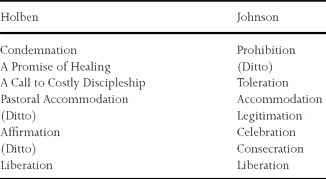
Johnson puts forward a scheme of ‘seven theological viewpoints’ on same-gender relationships in chapters 1 and 2 (pp. 39–108) which consists of three ‘non-affirming viewpoints’ (prohibition, toleration, accommodation), three ‘welcoming and affirming viewpoints’ (legitimation, celebration, liberation), and, not surprisingly, his own viewpoint, which he calls the ‘welcoming, affirming, and ordering viewpoint’ (consecration) and presents as the ideal Hegelian synthesis of the best of the thesis and antithesis.Footnote 30 The scheme is essentially a reworking of a typology developed by L. R. Holben seven years earlier (see
Table 2
One can see some doubling-up on each side. Holben's unlikely attempt at distinguishing between ‘condemnation’ and ‘a promise of healing’ is combined in Johnson's ‘prohibition’ viewpoint. Johnson splits Holben's ‘pastoral accommodation’ into ‘accommodation’ and ‘legitimation’ but these two categories in Johnson's scheme amount to essentially the same thing, despite Johnson's protests to the contrary. The same applies to Johnson's failed attempt to split Holben's ‘affirmation’ position into a ‘celebration’ viewpoint and a ‘consecration’ viewpoint.
Johnson discusses how each viewpoint intersects with the themes of creation, reconciliation and redemption (pp. 41–3). He regards this as the particularly innovative element of his approach (ibid., p. 262 n. 3). However, Johnson is merely asking: (1) how does homosexual orientation originate; and what does (2) repentance and (3) transformation look like? This doesn't strike me as particularly innovative. Nor are the terms ‘creation’, ‘reconciliation’, and ‘redemption’ accurate. ‘Creation’ is not an apt designation for a sinful impulse. As for ‘redemption’, Johnson applies it in a way which differs from the two primary New Testament uses (past and future-eschatological senses). It also bears little practical difference from the way he interprets ‘reconciliation’. Reconciliation and redemption in the New Testament are also things that God does whereas Johnson frames these concepts as something that humans do. It would be better to replace these three terms with what Johnson really means: origination and repentance/transformation, with the latter two elements understood as flipsides of the same coin.
Johnson claims that ‘in presenting this typology’ he simply wants ‘to promote understanding’ and to take ‘something of value’ from each (p. 41). Yet what Johnson really wants is to undermine the notion that there are only ‘two views on the subject, a biblical view and a nonbiblical view’ (p. ix), so that he can take the main focus off the anti-scriptural character of all homosexualist readings. Indeed, by placing the ‘prohibition’ view at one end of a seven-view spectrum he creates the illusion for readers that this view represents an extreme position even though, properly understood, it not only embodies the scriptural position but also remains the dominant position of the worldwide church. By contrast, Johnson treats his own view (consecration) as a category distinct from the ‘welcoming and affirming viewpoints’ and falsely claims that it takes the best from both the non-affirming and affirming views (pp. 95, 97, 108).
A person who buys into this scheme could be brought to a position on homosexual practice similar to Johnson's without ever having to give serious consideration to numerous arguments against a homosexualist interpretation. Such a person will not want to appear to hold an ‘extreme’ view on the subject and so will choose what the scheme itself treats as centrist, namely, Johnson's own ‘welcoming, affirming, and ordering’ ‘consecrationist’ viewpoint. But Johnson's scheme is all smoke and mirrors. Here are the five main problems with this scheme.
First, various forms of sexual immorality, including adult-committed incest and polyamory, could be made to look reasonable by the adoption of this kind of tendentious scheme, which artificially stretches out the number of viewpoints from two basic ones to seven, places the scriptural and historic position of the church at an extreme end, and offers a ‘rightly ordered’ viewpoint as embracing the best of all possible worlds.
Second, Johnson's so-called ‘consecration’ viewpoint should not be treated as a ‘new’, distinct and bridge-building seventh viewpoint but rather as the usual mode for expressing any of the other homosexualist viewpoints. Few in the mainline denominations have been advocating for ‘hedonistic’ homosexual behaviour over the past decades so there is nothing new or distinctive in Johnson's position. Nor is it any more bridge-building than an ‘ordered’ stance on polyamory or incest would be bridge-building between pro- and anti- positions. Espousing faithful polyamory, incest and homosexual practice does not ‘preserve the best’ of a stance against these behaviours, as if the need for formal or structural prerequisites were not essential to such opposition.
Third, Johnson's attempts at characterising differences between so-called ‘prohibitionist’ and ‘tolerationist’ positions lead to absurdities (see
Table 3).

None of these positions make sense as alternative views. The causes of homosexuality are multifactorial and can include: congenital influences (usually indirect), micro- and macrocultural influences (family, peers, broader society), personal psychology and incremental choices (some blind and some deliberate). Neither a total ‘free will’ model nor a total ‘predestination’ model accurately reflects current scientific evidence. Furthermore, the idea that one must repent for the mere experience of sinful desire is as absurd as the idea that one need not repent of entertaining sinful desire in one's thought life. Equally absurd are the alternatives ‘all homosexuals must become heterosexuals’ or ‘no homosexuals can ever experience any shift in same-sex attractions’.
There are indeed differences among those who uphold a male–female prerequisite for sexual relations regarding such things as membership, ‘homophobia’, ‘gay rights’ and how serious a sin homosexual practice is. However, these differences cannot be traced to identifiable groups which follow their own distinct pattern of interconnected positions on ‘creation’, ‘reconciliation’ and ‘redemption’. Certainly so-called ‘tolerationists’ do not dispense with an argument from creation/nature (contra Johnson). Nor is it the case, as Johnson supposes, that the more opposed to homosexual practice one is the more ignorant one must be of the literary and historical contexts for scripture or of what science tells us. In addition, the labels ‘non-affirming’, ‘prohibition’, and ‘toleration’ are all in different ways skewed to advance Johnson's argument. Finally, if Johnson is going to pretend that most ‘affirming’ positions do not have ‘ordered’ relationships in view, he could just as well add a ‘God-hates-homosexuals’ viewpoint on the extreme end of ‘non-affirming’ (read: complementarian) views. The ‘prohibitionist’ approach can then be correctly viewed as taking a moderate, loving approach to homosexual persons which rejects the living out of same-sex attractions as harmful and self-dishonouring to the participants.
Fourth, Johnson's ‘accommodation’ viewpoint is neither significantly distinct from his ‘legitimation’ viewpoint nor rightly listed as a ‘non-affirming’ view. A position which offers support for committed homosexual relationships and permits the ordination of homosexually active candidates is functionally little different from any other homosexualist position.
Fifth, Johnson's attempt at distinguishing a ‘celebration’ view from a ‘liberation’ view purely on the basis of an essentialist versus social-constructionist distinction is unjustified. No material difference exists between ‘celebration’ and ‘liberation’ in Johnson's ‘reconciliation’ and ‘redemption’ vectors; only ‘creation’ is affected. Moreover, both essentialists and social constructionists can be found among the ‘accommodation’, ‘legitimation’ and ‘consecration’ viewpoints.
In short, Johnson's scheme of seven viewpoints is too tendentious and flawed to be of any heuristic value.
Conclusion
In this short review essay I have not come close to delineating all the problems with Johnson's book. However, the subjects that I have covered – the inconsistency of Johnson's rhetoric and tone, his frequent misrepresentations of secondary literature, his lack of knowledge about committed homosexual relationships in Graeco-Roman primary source material, his misunderstandings about the creation texts and Gal. 3:28, his apparent rejection of the concept of formal or structural prerequisites for sexual relationships and his tendentious scheme of seven theological viewpoints – raise serious issues regarding Johnson's scholarship.