




No CrossRef data available.
USING STIMULATED RECALL TO INVESTIGATE NATIVE SPEAKER PERCEPTIONS IN NATIVE-NONNATIVE SPEAKER INTERACTION
Published online by Cambridge University Press: 21 April 2006
Abstract
Implicit negative feedback has been shown to facilitate SLA, and the extent to which such feedback is given is related to a variety of task and interlocutor variables. The background of a native speaker (NS), in terms of amount of experience in interactions with nonnative speakers (NNSs), has been shown to affect the quantity of implicit negative feedback (namely recasts) in a classroom setting. This study examines the effect of experience and uses stimulated recall to attempt to understand the interactional patterns of two groups of NSs (with greater and lesser experience) interacting with second language (L2) learners outside of the classroom context. Two groups of NSs of English each completed an information exchange task with a L2 learner: The first group consisted of 11 preservice teachers with minimal experience with NNSs, whereas the second group included 8 experienced teachers with significant teaching experience. Immediately after the task, each NS participated in a stimulated recall, viewing a videotape of the interaction and commenting on the interaction. The quantitative results did not show a strong difference in the number of recasts used by the two groups, but it did show a difference in the quantity of NNS output between the two groups. This finding was corroborated by the stimulated recalls, which showed that those with experience—who clearly saw themselves as language teachers even outside of the classroom—had strategies for and concerns about getting the learners to produce output. Additionally, the experienced teachers showed greater recognition of student comprehension, student learning, and student problems. Those with little experience were more focused on themselves, on student feelings, and on procedural and task-related issues.
Information
- Type
- Research Article
- Information
- Copyright
- © 2006 Cambridge University Press
The role of feedback in SLA has long been an issue of importance because of its potential role as a mechanism for learning. Within SLA, different approaches make greater and lesser use of the concept of feedback. For example, from the perspective of Universal Grammar (UG), the role of feedback receives scant attention given that the focus is on the learner's knowledge base; the attainment of new knowledge or the modification of existing knowledge through feedback is of little concern. The interactionist approach can be contrasted to this position in that it ascribes a high level of importance to feedback through interaction as a driving force for learning.
Traditionally, the SLA literature deals with positive evidence and negative evidence.1
Within the UG literature, a third type of evidence used for learning is known as indirect negative evidence—an “indirect means of letting the learner know that a feature is not possible because it is never present in the expected environment” (Plough, 1994, p. 30). A discussion of this type of evidence goes beyond the scope of this paper.
We distinguish between negative evidence, which is considered from the perspective of the learner, and negative feedback, which is what is provided to the learner. Examining negative evidence entails considering what evidence a learner uses to construct a L2 grammar; examining negative feedback considers what is provided to the learner and might focus on how the learner uses that feedback. Focusing on what the learner does with the feedback would be the next step.
Negative evidence occurs as a result of feedback; in nonclassroom settings, the feedback provided is most commonly implicit feedback. Generally speaking, implicit feedback occurs in interaction, as in (1). (All examples are from the current study, and the transcription key can be found in Appendix A.)

In this instance, the learner receives feedback on her utterance in the form of a signal of noncomprehension on the part of the native speaker (NS) in lines 2 and 4. Note that in this case, the learner corrects the misused comparative form in line 3.
Another common form of implicit feedback is a recast, which is the focus of this paper. Recasts have generated a significant amount of research in recent years, ever since Bohannon and Stanowicz (1988) initiated a discussion of their significance for child language acquisition. Recasts are simultaneously a form of positive evidence and negative evidence (cf. Carpenter, Jeon, MacGregor, & Mackey, this issue; Leeman, 2003) because they occur adjacent to an incorrect form. It is precisely because of their potential dual role that they form an interesting area of investigation for learning. An example from the current study is given in (2).

In this instance (lines 3 and 5), the NS provides subtle indications that there is a problem with the nonnative speaker's (NNS) utterance. In the first recast, the NS simply rephrases the utterance with the correct article added. In the second recast, he correctly pronounces “rug,” but also adds more information. Whether the NS intends either or both to be a correction and whether the NNS perceives them as implicit feedback is unknown (see Mackey, Gass, & McDonough, 2000). Regardless, a positive model in direct contrast to a learner error is available in the input. With regard to SLA, there is evidence of the effectiveness of recasts (Doughty & Varela, 1998; Iwashita, 2003; Leeman, 2003; Long, in press; Mackey & Philp, 1998; Philp, 2003), although acceptance of this conclusion is not uniform (Lyster, 1998a, 1998b, 2004; Lyster & Ranta, 1997).
The importance of feedback is central to the interactionist perspective (see, e.g., Gass, 2003; Long, 1996; Mackey, 1999, in press), with the emphasis on the role of negotiated interaction between NSs and NNSs or between NNSs. Long succinctly expressed this when he wrote “… negotiation for meaning, and especially negotiation work that triggers interactional adjustments by the NS or more competent interlocutor, facilitates acquisition because it connects input, internal learner capacities, particularly selective attention, and output in productive ways” (pp. 451–452).
Thus, in this and other recent work (cf. Gass & Alvarez Torres, 2005; Gass, Svetics, & Lemelin, 2003; Robinson, 2003; Schmidt, 2001), attention is a crucial factor in understanding the function of negotiation. In fact, Schmidt made the strong claim that attention “is necessary in order to understand virtually every aspect of second language acquisition” (p. 3). In this view, attentional resources are directed to a gap between a learner's knowledge and information present in the target language input.3
We are agnostic in this paper as to the nature of attention; that is, it is not relevant to consider whether attention is a limited-capacity system or whether we are looking at an interference system whereby there is an involuntary attention shift. (See Robinson, 2003, for further elaboration on these positions.)
VARIABLES RELATED TO FEEDBACK
Provision of feedback is dependent on a number of variables, including, for example, the interlocutor. Additionally, task type (e.g., Robinson, 2001) and task context (e.g., Oliver & Mackey, 2003) are important variables, although neither will be considered here. If feedback is important or even essential to learning, one must have a clear understanding of the role of the interlocutor and other variables in this equation.
Interlocutor variables such as familiarity with one's partner, age, anonymity, gender, language proficiency, and experience with NNSs were studied first with regard to the amount of negotiation and later with a focus on the type and amount of feedback that NNSs receive. For example, Pica, Lincoln-Porter, Paninos, and Linnell (1996) found that NNS interlocutors provided their NNS partners with less modified input than did NSs, and Gass and Varonis (1986) found more negotiation in mixed-gender dyads than in same-gender dyads. Later, the focus moved to feedback on learners' nontargetlike utterances in the form of negotiation and recasts. Mackey, Oliver, and Leeman (2003) found that although there were no differences in the amount of feedback in child-child dyads and adult-adult dyads, NSs gave more feedback than NNSs in the adult-adult dyads. Hangui (2004) studied the provision of feedback in synchronous computer-mediated communication (i.e., chatting) in both anonymous and nonanonymous conditions. Although she hypothesized that more feedback would be provided in the anonymous condition because feedback might be seen as aggressive or threatening behavior, she found no differences in the two conditions.
The interlocutor variable under examination in this study is NS experience talking with NNSs. Few studies have looked specifically at this issue. One such study by Pica and Long (1986) compared the amount and type of input and interactional modifications provided by experienced and novice teachers. They found no significant differences in the number of confirmation checks, clarification requests, or comprehension checks used by the two groups. They concluded that the similarities between these two groups outweighed the differences and, thus, that classroom context has a greater effect than experience on the quantity and quality of interactional modifications in classroom discourse. Mackey, Polio, and McDonough (2004) compared preservice and experienced teachers' implementation of lesson plans with regard to incidental focus on form, including recasts and negotiation as well as explicit feedback, a feature not normally studied or found in dyadic studies. They found that experienced teachers were more likely to provide recasts and explicit feedback but were not necessarily more likely to negotiate. They completed a follow-up intervention study and found that preservice teachers were only somewhat successful in giving feedback after being taught strategies for doing so. Mackey et al. did not complete stimulated recalls with the participants in the study and, as a result, were only able to speculate on the reasons for the differences and lack thereof between the two groups. For example, although there was no difference quantitatively in the amount of negotiation—defined as an indication of noncomprehension to the learner—two competing forces might have been at work. On one hand, experienced teachers' familiarity with NNSs can lead to increased comprehension and, consequently, less need to negotiate (Gass & Varonis, 1984). On the other hand, teaching experience can cause one to value the importance of indicating to learners that their output needs to be modified in order to be comprehensible.
Although L2 teacher education is not the direct focus of this paper, studies from that field are relevant and informative. Some studies have attempted to probe preservice and novice teachers' perceptions of implicit and explicit feedback through observations and diary studies. Johnson (1992) found that inexperienced teachers' primary concern was maintaining the flow of instructional activities and that they were likely to regard prolonged student interaction negatively because it could interfere with classroom management. Thus, they were likely to ignore student interaction in order to maintain control. In a diary study of 26 novice English as a second language (ESL) teachers, Numrich (1996) found that novice teachers were reluctant to correct student errors in the belief that it would make their students feel uncomfortable. Brinton and Holten (1989) and Holten and Brinton (1995) suggested that novice teachers were most concerned with issues of classroom management and lesson organization and delivery. One interpretation of this finding is that preservice and novice teachers might be less likely to even notice student errors, much less feel comfortable dealing with them.
This paper extends this line of research by considering the relationship between interactional feedback and level of experience talking with NNSs. It does so not only by examining discourse between NNSs and NSs with different levels of experience but also by using stimulated recall, a technique not used in any of the previously mentioned studies, to understand NSs' perception of their provision of feedback (or lack thereof) to L2 learners as well as their general perception of the interaction.
ISSUES OF METHODOLOGY
In the history of interactionist research going back to the 1980s (e.g., Long, 1983; Pica, 1987, 1988; Varonis & Gass, 1985), the typical way to elicit data was through oral production within a task-based context. (See Foster, 1998; Gass, Mackey, & Ross-Feldman, 2005; Nicholas, Lightbown, & Spada, 2001; Nunan, 1991 for a discussion of differences in classroom versus lab contexts.) This approach was useful in the early stages of this research paradigm, but it had some notable weaknesses. For example, Aston (1986) argued against the interpretation of some early research studies (e.g., Long; Varonis & Gass), in which it was claimed that instances of negotiation were beneficial for learning. Rather, he asserted that in many instances, learners feign understanding and that these routines—rather than benefiting learning—are a source of frustration and, thus, “pedagogically undesirable” (p. 128) for learners.
Hawkins (1985) recognized the importance of collecting retrospective data from participants, which challenged the conventional means of data collection. In her study, NSs and NNSs participated in a grab-bag game in which one participant knew what an item was and the other, through questioning, had to guess it. Either 1 or 2 days later, each participant commented on the interaction, which provided the researcher with evidence that suggested that interpretations of interactions must proceed with caution. In (3) is an example of an original exchange from Hawkins (cited in Gass, Sorace, & Selinker, 1998, pp. 13 & 15), followed by the posttask commentary.

As can be seen, the NNS provided all of the correct responses (possibly feigning understanding) but in any event did not understand the interaction despite all of the appropriate signals suggesting that he or she did.
Because so much of interactionist research depends on appropriate interpretation of responses from learners and their partners, it is important to gather data that allow us to have a high level of confidence in our generalizations. This paper does precisely that by utilizing a stimulated recall methodology (see Gass & Mackey, 2000; Mackey et al., 2000), a subset of a wider variety of introspection methodologies.
The idea behind stimulated recall is that one can prompt participants to recall thoughts that they had while performing a recently completed task. A visual reminder of the event, such as a video or a piece of paper (e.g., for a writing task), is presented, and this visual reminder can jog one's recall of the mental processes of the original event. As Gass and Mackey (2000) noted, “the theoretical foundation for stimulated recall relies on an information processing approach whereby the use of and access to short-term memory is enhanced, if not guaranteed, by a prompt that aids in the recall of information” (p. 17). An important consideration when conducting stimulated recalls is recency. A recall, even with a stimulus, must be conducted relatively close to the event for maximum accuracy. Bloom (1954) claimed that “a subject may be enabled to relive an original situation with great vividness and accuracy if he is presented with a large number of the cues or stimuli which occurred during the original situation” (p. 25). He also assumed that “the recall of one's own private, conscious thoughts approximates the recall of the overt, observable events” (p. 26).
Two other somewhat competing introspective methodologies have been used in L2 research—namely posttask interviews and think-alouds. Interviews rely on memory without the prompts, hence making the results less accurate. Think-alouds are often used in research (see Leow & Morgan-Short, 2004, for an overview) but are dependent on specialized training and require a learner to do two tasks simultaneously (i.e., carry out a task and talk about it). To what extent thinking aloud affects the completion of the task is not straightforward.4
It appears that thinking aloud might affect some portions of a task and not others. This topic is beyond the scope of this paper, but see Stratman and Hamp-Lyons (1994) for one study that addresses this issue.
Stimulated recall is also a way of tapping into a learner's focus of attention, which is central to the interactionist approach to SLA. In other words, the extent to which someone notices something in an interaction is an indication of what the participant's attention was focused on during that event. This is not to say that commenting on something is the equivalent of noticing, with the implication that what is not commented on is not noticed. Instead, what we argue is that the methodology used in this study allows us to gain an understanding of what is noticed.
Unlike Mackey et al. (2000), who probed learners' interaction during a dyadic task using stimulated recall, this study probes NSs' perceptions about interaction, specifically about feedback in the form of recasts and negotiation. Furthermore, two groups of NSs (preservice and experienced ESL teachers) were compared for their quantity of feedback in addition to their perceptions of such feedback. The research questions for this study are as follows.
- Does the amount of experience a NS has interacting with L2 learners affect the amount of implicit feedback provided to learners in a dyadic task?
- How does the amount of such experience affect NSs' perceptions of learner errors and more general perceptions of interacting with NNSs in a dyadic task?
The first question is addressed quantitatively and the second is addressed qualitatively.
METHODOLOGY
Participants
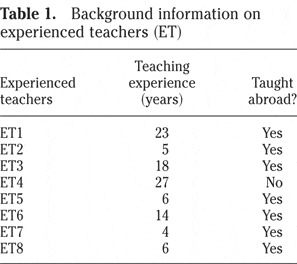
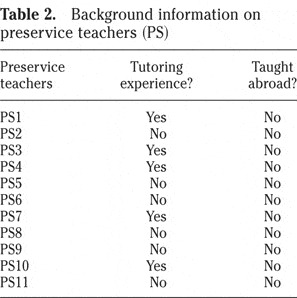
This study examines the relationship between experience with NNSs and interactional feedback. We operationalized experience in terms of teaching background. Two groups of participants, preservice teachers and professional teachers with a minimum of 4 years of teaching experience, provided the data for this study. The preservice group consisted of 11 undergraduates enrolled in a required course on English grammar for a minor in ESL teaching. The students' majors varied greatly and included English, German, Spanish, special education, elementary education, and math. None had classroom teaching experience, but a few had done private tutoring. About half had either taken or were taking at the time of the study the undergraduate ESL teaching methodology course. The second group included eight experienced teachers currently teaching in an ESL program at the same university. All but one had taught ESL for 5 years or more; the one exception had taught for 4 years. All but one had experience living and teaching abroad. Finally, all but one held a master's degree in TESOL; ET7, the one exception, was in her penultimate semester of her master's degree in TESOL. Table 1 provides background information for the experienced teachers and Table 2 presents background information for the preservice teachers.
Background information on experienced teachers (ET)

Background information on preservice teachers (PS)

Procedure
The preservice and experienced teachers were each paired with an ESL student (from level four of a four-level intensive English program or from an academic speaking and listening class5
Students in the academic speaking-listening class who did not have test scores equivalent to those in the intensive program were excluded from the study.
Given that our focus was on NS feedback and perceptions of that feedback, the second phase of the study involved only the NSs. Immediately following the interaction, the videotape was played back to each NS by the researcher. Before playing the tape, she gave instructions to each participant, telling them that they were about to watch a video of their interaction and that they could pause the tape at any time to describe their thoughts at that point in the interaction. She also informed them that she would stop the tape at certain times and ask them to reflect on their thoughts during that point of the interaction. The researcher paused the tape when a serious error went uncorrected, when a communication breakdown occurred, or when the teacher recast.6
What constituted a serious error was somewhat subjective. Furthermore, the researcher was not able to stop the tape after every recast.
Coding of Transcripts
To answer the first research question, the transcripts of the interactions between the teachers and learners were coded as follows. First, each instance of a learner utterance that contained a phonological, lexical, or morphosyntactic error was marked. Then the teacher's response to that error was coded as recast, negotiation, or ignore. Recast was a complete or partial correction of a learner's erroneous utterance. Negotiation was some indication of noncomprehension. Recasts with rising intonation can be considered an indication of noncomprehension but they were coded only as recasts, following the rationale that the response has the effect of a recast whether the NS is seeking confirmation of comprehension or not. If the teacher did not negotiate or recast, the response was marked as ignore. Two researchers coded 25% of the data, and the remaining data were coded by one of the researchers. The researchers achieved 94% agreement on error identification7
We calculated this by taking the total number of utterances identified by at least one researcher as containing an error and finding the percentage of that number that both researchers agreed were malformed.

RESULTS
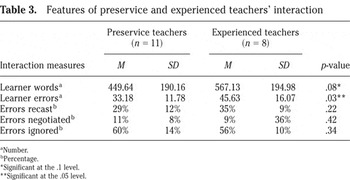
Responses of both groups to the learners' utterances are quantified in Table 3. Additionally, the number of words and errors produced by learners with the two types of interlocutors (preservice or experienced) were compared.
Features of preservice and experienced teachers' interaction

As shown in Table 3, the experienced teachers used, on average, more recasts (35% vs. 29%), but not more negotiation (9% vs. 11%). However, a nonparametric Mann-Whitney test indicates that the difference in the number of recasts is not statistically significant. The difference in the number of learner errors between groups (45.63 vs. 33.18) was significantly higher in the learner/experienced-teacher dyads (p < .05), whereas the difference in the number of learner words when talking to one type of teacher or the other (567.13 for experienced vs. 449.64 for preservice) approached significance (p = .08).
DISCUSSION
The lack of a clear difference between the two groups with regard to quantity of recasts is somewhat surprising in light of Mackey et al.'s (2004) study, which found that experienced teachers were more likely to provide recasts in a classroom setting.8
Neither the preservice nor the experienced teachers in Mackey et al.'s (2004) study were familiar with the students; that is, neither were teaching classes that they normally taught and they met the students for the first time during the study. In this study, none of the experienced teachers was paired with a current student, yet they might have had that student in a prior semester.
Upon examining the quantitative data and the stimulated recall data, it became clear that learners produced more language when speaking with the experienced versus preservice teachers. The instructions indicated that the NS should try to get the learner to talk, but only the experienced group used question patterns that led learners to produce more language. Indeed, when the number of learner words and errors were counted, there was a statistically significant difference between the two groups. We now turn our attention to a more in-depth discussion of differences between the preservice and experienced teachers.
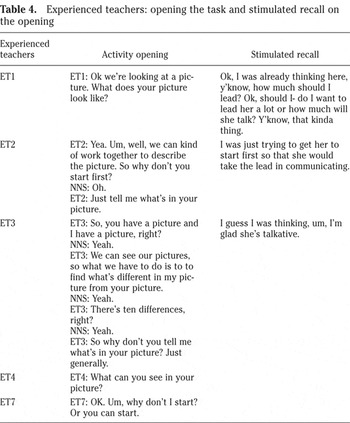
A few interesting differences emerged. First, we note the way the two groups began their task, which, we argue, is related to how the participants perceived their roles. Four of the eight experienced teachers began the task with some sort of general statement, or a general question, or both, as can be seen in the examples provided under the heading “Activity opening” in Table 4. This puts the burden on the learner to produce language.
Experienced teachers: opening the task and stimulated recall on the opening

Thus, in each of these exchanges, the experienced teacher appears to put the onus on the learner to talk, with a focus on getting the learner to produce language. It is conceivable that their goal was to get the learners to produce language as a way of learning. For most studies, one can only speculate that this is the case, but, as shown for ET1, ET2, and ET3 in Table 4, we were able to support this supposition through the teachers' recall comments.9
ET4 had no recall comments on the opening sequence.
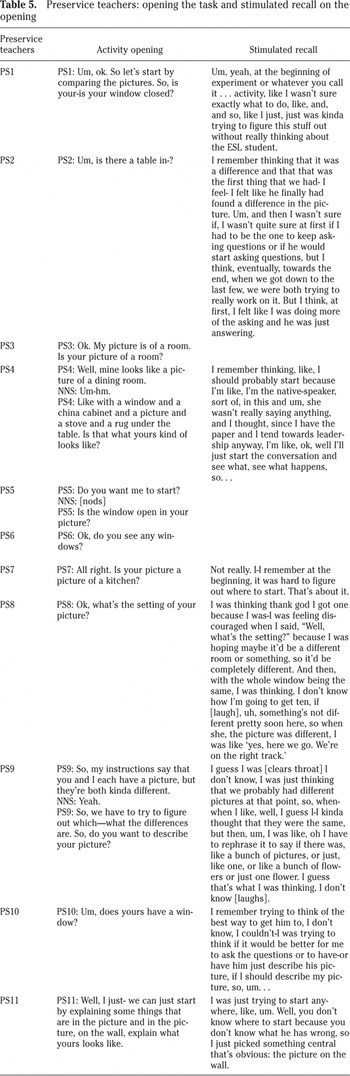
The beginning of the task was quite different for the preservice group. Their tendency was to begin with something quite specific, rather than with a general question that asked what was in the picture. This was the case with all of the preservice teachers with the exception of PS8, PS9, and, to some extent, PS11. The initial part of each interaction is given in Table 5.
Preservice teachers: opening the task and stimulated recall on the opening

What is interesting about these exchanges is that the preservice group often focused on procedural or task-related issues such as who would start or how they should proceed to complete the task. This was strongly reflected in the stimulated recall comments in which they overwhelmingly commented on the nature of the task at hand or their strategies (or lack thereof) for completing the task. Stimulated recall comments from most of the preservice teachers are also given in Table 5. Only one of the NSs in the preservice group evidenced the same concern regarding the need for learners to produce language. This can be seen in (7).

Given the methodological focus of this paper, we turn to ways in which stimulated recalls were able to reveal patterns that could not be discerned through an inspection of the primary data alone. As we noted earlier, there were few differences on the surface between the two groups with regard to feedback on learner errors. On all feedback measures examined—percent of errors recast, percent of errors negotiated, and percent of errors ignored—the results showed no significant differences between the two groups.10
We recognize that the lack of significant differences might, in part, be due to the small number of participants in this study.
A basic difference between these two groups can be seen in their attitudes and perceptions of their role in this task and how their language reflects those attitudes and perceptions. In general, NSs in the experienced group emphasized student learning, whereas those in the preservice group focused on themselves, the ESL students' feelings, and procedural and task-related issues. We first discuss the recall comments from the experienced teachers, focusing on (a) their role as teacher, (b) their recognition of the importance of output, (c) their focus on student learning, and (d) their focus on student comprehension and student problems. Second, we contrast those results by discussing comments from the less experienced teachers, focusing on their concern with (a) themselves and their own performance, (b) student feelings, and (c) procedures and strategies for task completion.
Experienced Teachers
Role as Teacher
The experienced teachers saw their role as that of a teacher despite the laboratory setting of the study. Although one could speculate that this was the case on the basis of the interaction alone, it was only through the recall data that this became obvious. For example, in reflecting upon the interaction in (8), in which the experienced teacher and the NNS were negotiating an appropriate word, the teacher emphasized her role as a teacher in her recall comment.

Language Production
In the previous subsection, we discussed opening routines and demonstrated the experienced teachers' strong tendency to want the NNSs to produce language. This is emphasized in the recall comments by these teachers throughout the entire interaction. For example, often the words get him/her, have him/her, ask him/her were used, which indicated that the experienced interlocutor was focusing on the NNS's performance. This can be seen in the examples provided in (9).

Focus on Student Learning
Another area of emphasis evident from the experienced teachers' recall comments was a focus on student learning. In the exchange in (10), the teacher emphasized the importance of the task as a language learning experience for the student.

The teacher in (11) had the learner focus his attention on a particular part of language, in this case the vocabulary item shade, thereby demonstrating her sensitivity to the relevance of this approach for learning.

Focus on Student Comprehension and Student Problems
Not only do interlocutors experienced in talking with NNSs focus on how interactions aid learning, they also show awareness of the need to focus on learner comprehension, as shown in (12) and (13). Both examples suggest ways of facilitating comprehension—in the first case, by slowing speech and in the second, by using simpler vocabulary.

Thus, in general, the experienced teachers could not shed their normal teacher role and demonstrated this quite clearly through their interactive styles (as noted earlier in their ability, for example, to get learners to use language), but much more so through their recall comments. On the other hand, preservice teachers, although they did not ignore their potential teacher role, were more inclined to be concerned about issues related to themselves, students' feelings, procedures, and the strategies that they could use for task completion.
Preservice Teachers
Focus on Self
In contrast to the experienced teachers, preservice teachers often expressed their own feelings about the interaction. This is illustrated in the recall comments in (14). In the first three examples, the preservice teachers—unlike what was seen with the experienced teachers who focused on NNS comprehension—are concerned with their own comprehension. In the fourth example, the teacher expresses confusion; in the fifth, feelings of discouragement; and in the sixth, a feeling of desperation.

Students' Feelings
The preservice teachers expressed empathy for the students. For example, in (15), PS3 recalls giving the student a word because the student was struggling. This is in contrast to the experienced teachers, who saw the benefits of students' struggles with words. PS4 also shows that she wants to be helpful in (16).

Correction is, of course, a delicate issue, and what might appear to be part of a normal conversation might in fact be interpreted as criticism. Preservice teachers appeared to be sensitive to this possibility, as illustrated in (17).

In her stimulated recall comment, this preservice teacher noted that she corrected the NNS without making it seem obvious that she was correcting him. Similarly, in (18), the stimulated recall comment reveals that the preservice teacher showed empathy to the student.

Procedures and Strategies
Some NSs in the less experienced group were focused on the procedures of the task. For example, PS9 expressed this focus in the first comment in (19). PS7 was concerned about how to start (second comment), whereas PS2 wondered about who was to ask questions (third comment).

Faced with a difficult conversation and the need to sustain the conversation for a prolonged period of time, the preservice teachers often thought about their strategies for completing the task, as seen in the recall comments in (20).

Experienced and Preservice Teachers: Commonalities
In planning this study, we expected to find differences in the two groups of teachers in terms of corrective feedback, including, in particular, the use of recasts. As noted earlier in this paper, there were no significant differences in the use of recasts. This lack of difference in use is further corroborated by the recall comments; only two of the experienced teachers and four of the preservice teachers mentioned recasting, modeling, or correction. Recasts from each group are given in the following examples. In (21), the preservice teacher provided a recast and then commented on it following the exchange, even using the word recast.

In another example, following an exchange in which there was a sequence of recasts, the preservice teacher commented on her role as a language provider.

In (23) and (24), examples of similar language from the experienced teachers are provided.

Although both groups used recasts, they were differentiated by the fact that even when dealing with corrections, the preservice teachers (as noted previously) were often concerned with the learners' feelings, whereas the experienced teachers did not mention such concerns.
In sum, both groups participated in and recognized the corrective function of task-based interaction. It might be that this corrective function is basic to nonclassroom interaction with NNSs; that is, the concept of correction might not require a sophisticated understanding of language learning or language teaching.11
We reemphasize the fact that the preservice teachers were enrolled in an undergraduate course in which concepts such as feedback and recasts were discussed.
Although not part of the original study, the issue of foreigner talk discourse became important as we considered the stimulated recall comments. Briefly, early studies on foreigner talk (see Gass & Selinker, 1994, and Larsen-Freeman & Long, 1991, for reviews) suggested that when addressing NNSs (particularly those with limited proficiency), NSs adjust their speech (e.g., by slowing down, using simpler language, enunciating more clearly, or adding gestures). What emerges from the stimulated recall data in this study are comments that suggest deliberate attempts at speech modification by NSs—something that the earlier literature was unable to address.
Thus, the stimulated recall part of the data gives us a window on the NS-NNS interactions, which provides data that cannot be gleaned from the interaction alone. Furthermore, we argue that what is revealed is important as one attempts to understand the relationship between interaction and experience and the development of an ability to interact with learners in a way that promotes learning.
LIMITATIONS
This study revealed certain limitations of the methodology, and we now turn to suggested refinements that need to be taken into account in future research. As noted in Gass and Mackey (2000), stimulated recalls have to be done carefully lest the results not be an accurate representation of actual thoughts during the original process. These authors provided a sample set of instructions for participants, which state, in part:
I'm going to put the remote control on the table here and you can pause the video any time that you want. So if you want to tell me something about what you were thinking, you can push pause. If I have a question about what you were thinking, then I will push pause and ask you to talk about that part of the video. (pp. 59–60)
Who stopped the tape in this study might have resulted in different types of comments. In Mackey et al. (2000), the researchers told participants that the researcher would stop the tape or the participants could stop the tape if they wanted to make a comment. In the vast majority of the cases, it was the interviewer who stopped the tape. In this study, the same pattern did not hold. In many cases, particularly with the experienced teachers, it was the participant rather than the researcher who stopped the tape. This did not allow the researcher to ask the lead question “What were you thinking about right then?” which is a crucial part of the directions as specified in Gass and Mackey. This is made clear in the following examples, in which the participants stopped the tape.

As can be seen, the teacher in both instances gave the interviewer no opportunity to pose the lead-in question and, furthermore, there had been no error on the part of the student so that this would not be a relevant moment for recall comments.12
A reviewer suggested that further researcher training might have alleviated the problem. Of course, that is a possibility. However, it seemed that the lack of opportunity (without rudely interrupting) was the primary issue.
One of the difficulties with stimulated recalls, as Gass and Mackey (2000) noted, is that it is easy to get off track and do a reflection on the episode rather than voicing one's thoughts about the interaction. This was more likely to happen in the comments for which the teacher stopped the tape than when the interviewer stopped the tape at the target points and asked specifically about the person's thoughts. An example of this contrast is seen in (27), in which the teacher stopped the tape, and (28), in which the interviewer stopped the tape.

In this example, it is not at all clear if ET2 is referring to her thoughts at the time she paused the tape or to her thoughts at the time of the exchange. From the same teacher comes the following example.

Unlike (27), in this comment it can be more convincingly argued that the NS' thoughts relate to her thoughts at the time of the interaction.
Finally, for the sake of comparison, we present an example from this same teacher in which the recall comments appear to reflect what she was thinking about both at the time of the exchange and at the time of the recall comment. In the example provided in (29), the tape was stopped by the teacher.

The beginning of the recall statement seems to reflect ET2's thoughts at the time of the recall, but embedded in the entire statement is a specific comment that refers to the time of the exchange.
CONCLUSION
The goal of this study was to use stimulated recall to investigate the relationship between experience with NNSs and interactional feedback. We hypothesized, based on the findings of Mackey et al. (2004), that less experienced interlocutors would not recast and we hoped, through stimulated recall, to determine if this was because they did not notice errors, did not know how to deal with the errors, or felt it was simply impolite to correct the learner. The quantitative findings, however, did not reveal a significant difference in feedback behaviors, nor did the majority of participants from either group comment on giving feedback. Even though there was a trend in the direction of the experienced group recasting more, the difference was not robust. One very likely reason for this unexpected similarity is that those in the preservice group, who had only a brief introduction to the importance of feedback in language learning, were able to some extent to provide that feedback in a dyadic context even though they were focused on their own performance, as revealed in the stimulated recall. Without the stimulated recall data, one might inappropriately conclude that the lack of difference was due to the experienced teachers' providing relatively less feedback in a nonclassroom setting. We cannot say, however, that the lack of classroom context caused the experienced teachers to recast less often; the experienced teachers clearly saw themselves as teachers, even in the context of a research-oriented laboratory task, and were trying to help the learners throughout the task. A more appropriate conclusion is that being outside of the classroom context helped the preservice teachers to recast more because they did not have to focus on classroom management and lesson issues.
The other important finding is that different levels of teacher experience had an effect on learner production. The quantitative data revealed that the experienced teachers were able to get learners to produce more output, thus making more errors for which there was an opportunity for them to give feedback. The stimulated recall confirmed that the experienced teachers were consciously aware of the importance of output (see Swain, 1985, 1995, 2005; Swain & Lapkin, 1995), particularly in terms of helping learners notice features of the L2 and testing hypotheses. What was not clear in the stimulated recall was how the experienced teachers came to their beliefs about output; that is, whether such beliefs developed intuitively from teaching experience or whether they were familiar with Swain's writing and research. Furthermore, although much research on variables related to feedback exists, we know of no research that examines interlocutor variables on the quantity of a learner's output.
There are implications from this study for language teacher education as well as L2 research methodology. Inexperienced teachers are aware of the importance of feedback but simply need more practice in how to implement it in the classroom. What they might not be aware of is the importance of the various functions of output in language learning, nor are they skilled in how to generate output. Finally, this study has illustrated how stimulated recall can confirm findings and reveal additional findings in L2 research.
APPENDIX A: TRANSCRIPTION KEY

APPENDIX C: INSTRUCTIONS GIVEN TO PARTICIPANTS
Difference Discovery: Student
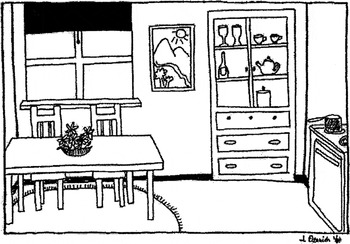
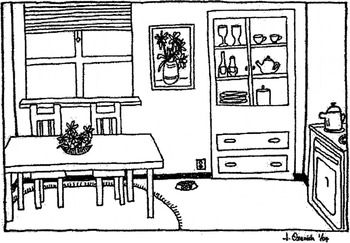
This is an activity that teachers and students might do in language classes. You and the teacher have similar pictures. You may not look at each other's picture. Your task is to discover the 10 differences between your pictures by speaking and asking questions in English. Try to describe your picture. When you and the teacher agree that you have found a difference, the teacher will write it down. The activity will be videotaped.
Example differences:
Your picture has a door and the teacher's picture does not.
Your picture has a bird in the window and the teacher's picture has a squirrel.
Difference Discovery: Teacher
This is an activity sometimes done in foreign or second language classes. You and the student have similar pictures. You may not look at each other's picture. Your task is to discover the 10 differences between your pictures by listening, speaking, and asking questions in English. You should write down each difference discovered. Encourage the student to talk as you would in class. The activity will be videotaped.
References
REFERENCES
Aston, G.
(1986).
Trouble-shooting in interaction with learners: The more the
merrier?
Applied Linguistics,
7,
128–143.Google Scholar
Bloom, B.
(1954).
The thought processes of students in discussion. In
S. J. French (Ed.),
Accent on teaching: Experiments in general education (pp.
23–46).
New York:
Harper.
Bohannon, J. N., &
Stanowicz, L.
(1988).
The issue of negative evidence: Adult responses to children's
language errors.
Developmental Psychology,
24,
684–689.Google Scholar
Brinton, D., &
Holten, C.
(1989).
What novice teachers focus on: The practicum in TESOL.
TESOL Quarterly,
23,
343–350.Google Scholar
Doughty, C., &
Varela, E. M.
(1998).
Communicative focus on form. In
C. Doughty &
J. Williams (Eds.),
Focus on form in classroom second language acquisition (pp.
114–138).
New York:
Cambridge University Press.
Doughty, C., &
Williams, J.
(1998).
Pedagogical choices in focus on form. In
C. Doughty &
J. Williams (Eds.),
Focus on form in classroom second language acquisition (pp.
197–262).
New York:
Cambridge University Press.
Foster, P.
(1998).
A classroom perspective on the negotiation of meaning.
Applied Linguistics,
19,
1–23.Google Scholar
Gass, S. M.
(1997).
Input, interaction, and the second language learner.
Mahwah, NJ:
Erlbaum.
Gass, S. M.
(2003).
Input and interaction. In
C. Doughty &
M. H. Long (Eds.),
The handbook of second language acquisition (pp.
224–255).
Oxford:
Blackwell.
Gass, S. M., &
Alvarez Torres, M.
(2005).
Attention when? An investigation of the ordering effect of input and
interaction.
Studies in Second Language Acquisition,
27,
1–31.Google Scholar
Gass, S. M., &
Mackey, A.
(2000).
Stimulated recall methodology in second language research.
Mahwah, NJ:
Erlbaum.
Gass, S. M.,
Mackey, A., &
Ross-Feldman, L.
(2005).
Task-based interactions in classroom and laboratory settings.
Language Learning,
55,
575–611.Google Scholar
Gass, S. M., &
Selinker, L.
(1994).
Second language acquisition: An introductory course.
Mahwah, NJ:
Erlbaum.
Gass, S. M.,
Sorace, A., &
Selinker, L.
(1998).
Second language learning: Data analysis.
Mahwah, NJ:
Erlbaum.
Gass, S. M.,
Svetics, I., &
Lemelin, S.
(2003).
Differential effects of attention.
Language Learning,
53,
495–543.Google Scholar
Gass, S. M., &
Varonis, E. M.
(1984).
The effect of familiarity on the comprehensibility of non-native
speech.
Language Learning,
34,
66–85.Google Scholar
Gass, S. M., &
Varonis, E. M.
(1986).
Sex differences in nonnative speaker-nonnative speaker
interactions. In
R. R. Day (Ed.),
Talking to learn: Conversation in second language acquisition
(pp.
327–351).
Rowley, MA:
Newbury House.
Hangui, Y.
(2004)
The effect of anonymity on native-nonnative speaker interaction in
computer-mediated communication.
Unpublished master's thesis,
Michigan State University,
East Lansing.
Hawkins, B.
(1985).
Is an “appropriate response” always so
appropriate? In
S. M. Gass &
C. Madden (Eds.),
Input in second language acquisition (pp.
162–178).
Rowley, MA:
Newbury House.
Holten, C., &
Brinton, D.
(1995).
‘You shoulda been there’: Charting novice teacher growth
using dialogue journals.
TESOL Journal,
4,
23–26.Google Scholar
Iwashita, N.
(2003).
Negative feedback and positive evidence in task-based interaction:
Differential effects on L2 development.
Studies in Second Language Acquisition,
25,
1–36.Google Scholar
Johnson, K.
(1992).
Learning to teach: Instructional actions and decisions of preservice
ESL teachers.
TESOL Quarterly,
26,
507–534.Google Scholar
Larsen-Freeman, D., &
Long, M.
(1991).
An introduction to second language acquisition research.
London:
Longman.
Leeman, J.
(2003).
Recasts and second language development: Beyond negative
evidence.
Studies in Second Language Acquisition,
25,
37–63.Google Scholar
Leow, R., &
Morgan-Short, K.
(2004).
To think aloud or not to think aloud: The issue of reactivity in SLA
research methodology.
Studies in Second Language Acquisition,
26,
35–57.Google Scholar
Long, M. H.
(1983).
Native speaker/non-native speaker conversation and the
negotiation of comprehensible input.
Applied Linguistics,
4,
126–141.Google Scholar
Long, M. H.
(1996).
The role of the linguistic environment in second language
acquisition. In
W. C. Ritchie &
T. K. Bhatia (Eds.),
Handbook of research on language acquisition: Vol. 2. Second
language acquisition (pp.
413–468).
San Diego, CA:
Academic Press.
Long, M. H. (Ed.),
(in press).
Problems in SLA.
Mahwah, NJ:
Erlbaum.
Lyster, R.
(1998a).
Negotiation of form, recasts, and explicit correction in relation to
error types and learner repair in immersion classrooms.
Language Learning,
48,
183–218.Google Scholar
Lyster, R.
(1998b).
Recasts, repetition, and ambiguity in L2 classroom discourse.
Studies in Second Language Acquisition,
20,
51–81.Google Scholar
Lyster, R.
(2004).
Differential effects of prompts and recasts in form-focused
instruction.
Studies in Second Language Acquisition,
26,
399–432.Google Scholar
Lyster, R., &
Ranta, L.
(1997).
Corrective feedback and learner uptake: Negotiation of form in
communicative classrooms.
Studies in Second Language Acquisition,
19,
37–66.Google Scholar
Mackey, A.
(1999).
Input, interaction, and second language development: An empirical
study of question formation in ESL.
Studies in Second Language Acquisition,
21,
557–587.Google Scholar
Mackey, A.,
(in press).
Interaction and second language development: Perspectives from SLA
research. In
R. DeKeyser (Ed.),
Practice in second language learning: Perspectives from linguistics
and psychology.
New York:
Cambridge University Press.
Mackey, A., &
Gass, S. M.
(2005).
Second langauge research: Methodology and design.
Mahwah, NJ:
Erlbaum.
Mackey, A.,
Gass, S. M., &
McDonough, K.
(2000).
How do learners perceive interactional feedback?
Studies in Second Language Acquisition,
22,
471–497.Google Scholar
Mackey, A.,
Oliver, R., &
Leeman, J.
(2003).
Interactional input and the incorporation of feedback: An
exploration of NS-NNS and NNS-NNS adult and child dyads.
Language Learning,
53,
35–66.Google Scholar
Mackey, A., &
Philp, J.
(1998).
Conversational interaction and second language development: Recasts,
responses, and red herrings?
Modern Language Journal,
82,
338–356.Google Scholar
Mackey, A.,
Polio, C., &
McDonough, K.
(2004).
The relationship between experience, education, and teachers'
use of incidental focus-on-form techniques.
Language Teaching Research,
8,
301–327.Google Scholar
Nicholas, H.,
Lightbown, P. M., &
Spada, N.
(2001).
Recasts as feedback to language learners.
Language Learning,
51,
719–758.Google Scholar
Numrich, C.
(1996).
On becoming a language teacher: Insights from diary studies.
TESOL Quarterly,
30,
131–153.Google Scholar
Nunan, D.
(1991).
Methods in second language classroom research: A critical
review.
Studies in Second Language Acquisition,
13,
249–274.Google Scholar
Oliver, R., &
Mackey, A.
(2003).
Interactional context and feedback in child ESL classrooms.
Modern Language Journal,
87,
519–533.Google Scholar
Philp, J.
(2003).
Constraints on “noticing the gap”: Nonnative
speakers' noticing of recasts in NS-NNS interaction.
Studies in Second Language Acquisition,
25,
99–126.Google Scholar
Pica, T.
(1987).
Second-language acquisition, social interaction, and the
classroom.
Applied Linguistics,
8,
3–21.Google Scholar
Pica, T.
(1988).
Interlanguage adjustments as an outcome of NS-NNS negotiated
interaction.
Language Learning,
38,
45–73.Google Scholar
Pica, T.,
Lincoln-Porter, F.,
Paninos, D., &
Linnell, J.
(1996).
Language learners' interaction: How does it address the input,
output, and feedback needs of language learners?
TESOL Quarterly,
30,
59–84.Google Scholar
Pica, T., &
Long, M.
(1986).
The linguistic and conversational performance of experienced and
inexperienced teachers. In
R. Day (Ed.),
Talking to learn: Conversation in second language acquisition
(pp.
85–98).
Rowley, MA:
Newbury House.
Plough, I.
(1994).
A role for indirect negative evidence in second language
acquisition.
Unpublished doctoral dissertation,
Michigan State University,
East Lansing.
Robinson, P.
(2001).
Task complexity, cognitive resources, and syllabus design: A
triadic framework for examining task influences on SLA. In
P. Robinson (Ed.),
Cognition and second language instruction (pp.
287–318).
New York:
Cambridge University Press.
Robinson, P.
(2003).
Attention and memory during SLA. In
C. Doughty &
M. H. Long (Eds.),
Handbook of second language acquisition (pp.
631–678).
Oxford:
Blackwell.
Schmidt, R.
(2001).
Attention. In
P. Robinson (Ed.),
Cognition and second language instruction (pp.
3–32).
New York:
Cambridge University Press.
Stratman, J. F., &
Hamp-Lyons, L.
(1994).
Reactivity in concurrent think-aloud protocols: Issues for
research. In
P. Smagorinsky (Ed.),
Speaking about writing: Reflections on research methodology
(pp.
89–112).
Thousand Oaks, CA:
Sage.
Swain, M.
(1985).
Communicative competence: Some roles of comprehensible input and
comprehensible output in its development. In
S. M. Gass &
C. Madden (Eds.),
Input and second language acquisition (pp.
235–256).
Rowley, MA:
Newbury House.
Swain, M.
(1995).
Three functions of output in second language learning. In
G. Cook &
B. Seidlhofer (Eds.),
Principles and practice in applied linguistics (pp.
125–144).
Oxford:
Oxford University Press.
Swain, M.
(1998).
Focus on form through conscious reflection. In
C. Doughty &
J. Williams (Eds.),
Focus on form in classroom second language acquisition (pp.
64–82).
New York:
Cambridge University Press.
Swain, M.
(2005).
The output hypothesis: Theory and research. In
E. Hinkel (Ed.),
Handbook of research in second language teaching and learning
(pp.
471–483).
Mahwah, NJ:
Erlbaum.
Swain, M., &
Lapkin, S.
(1995).
Problems in output and the cognitive processes they generate: A step
towards second language learning.
Applied Linguistics,
16,
371–391.Google Scholar
Varonis, E. M., &
Gass, S. M.
(1985).
Non-native/non-native conversations: A model for negotiation of
meaning.
Applied Linguistics,
6,
71–90.Google Scholar
Background information on experienced teachers (ET)
Background information on preservice teachers (PS)
Features of preservice and experienced teachers' interaction
Experienced teachers: opening the task and stimulated recall on the opening
Preservice teachers: opening the task and stimulated recall on the opening
 You have
Access
- 37
- Cited by