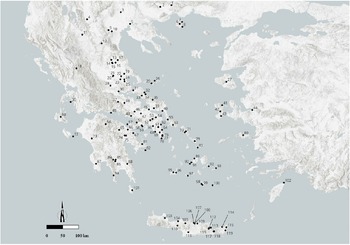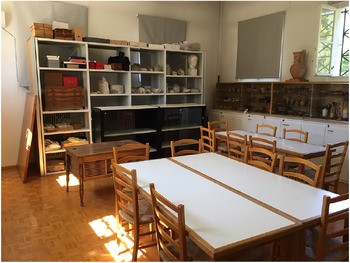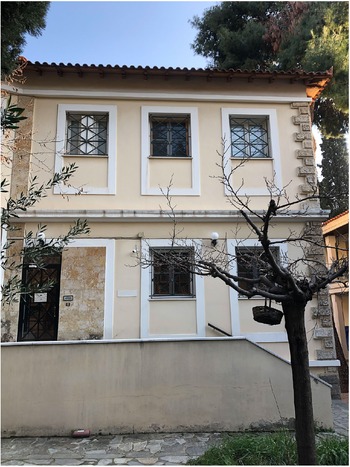


Since the late nineteenth century, the British School at Athens has housed a museum study collection: an important and wide-ranging collection of objects available for study and research by the institution’s members (Figs 9.1–9.2 ). Beginning life as a modest group of sherds, stone tools, and coin reproductions, and curated by a succession of assistant directors, the collection expanded until the mid-1960s. Donations were made to the BSA mainly by its directors, students, and members, and these bequests have been recorded both in the Minutes of the Managing Committee and in the Annual Reports of the British School at Athens. The result is that there are now some 4,000 individual artefacts and over 46,000 sherds of pottery comprising the collection from some 120 different sites (Map 9.1). This collection has been housed and/or displayed in different parts of the premises over the past 130 years, and various small sections, organized by primary material type and studied by object specialists, have been published in the BSA (Wilhelm Reference Wilhelm1901; Lamb Reference Lamb1924; Cook Reference Cook1935; Boardman Reference Boardman1954; Waywell Reference Waywell1970; Betts Reference Betts1971; Phelps et al. Reference Phelps, Varoufakis and Jones1979; Catling and Jones Reference Catling and Jones1989; Arnott Reference Arnott1990; Catling Reference Catling1990; Lambert Reference Lambert2000; Tomlinson Reference Tomlinson2000; Coldstream Reference Coldstream2003; Smith Reference Smith2003; Pisani Reference Pisani2006; Smith Reference Smith2009). What has been lacking, however, is a narrative of the collection itself –although many of its details have been part of unwritten institutional memory. Therefore, this brief history represents that overview of the Museum Study Collection, following a project conducted in 2019–2020 to compile its first complete inventory and digital documentation (BSA Collections Digitisation Project). This overview does not aim to be comprehensive in its coverage, but to acquaint the reader with the general shape of the Museum Study Collection’s history, pointing them in the direction of further sources and information.
Map showing sites with objects of known provenance in the BSA Museum Collection (excluding Sherd Collection): 1) Karamani; 2) Photolivos; 3) Vardino Toumba; 4) Armenochori; 5) Toumba Polichni; 6) Thasos; 7) Panagia; 8) Aliki; 9) Veroia; 10) Aigai (Vergina); 11) Boubousta; 12) Servia; 13) Tirnavo; 14) Dendra; 15) Argissa; 16) Souphli Magoula; 17) Rachmani; 18) Pramanta; 19) Velestino; 20) Ambelia; 21) Vasilis; 22) Rini; 23) Palaiochori; 24) Bash Mylos; 25) Almiros; 26) Sporades; 27) Lesbos; 28) Xynias; 29) Skopelos; 30) Avlaki; 31) Nisiotissa; 32) Agios Vasileios Penninsula; 33) Mandanika; 34) Kerinthos; 35) Ayia Sophia; 36) Kalamos; 37) Souvala; 38) Drachmani Magoula; 39) Kamarion; 40) Aliveri Magoula; 41) Marmaro; 42) Provatos; 43) Kini; 44) Smyrna (Izmir); 45) Aulis; 46) Aliartos; 47) Thebes; 48) Dombrena; 49) Xeronisi; 50) Kephalonia; 51) Kato Alepochori; 52) Phyle; 53) Mount Parnitha; 54) Aphidnai; 55) Styra; 56) Kalyvrita; 57) Perachora; 58) Nisaia; 59) Megara; 60) Ilissia; 61) Spata; 62) Rafina; 63) Karystos; 64) Rafti Island; 65) Mount Arapiza; 66) Acrocorinth; 67) Sophiko; 68) Vari; 69) Keratea; 70) Palaiopolis; 71) Andros; 72) Kalogeros; 73) Olympia; 74) Mycenae; 75) Berbati Mastos Hill; 76) Thorikos; 77) Lavrion; 78) Sounion; 79) Tenos; 80) Samos; 81) Troezen; 82) Hydra; 83) Delos; 84) Mystras; 85) Menelaion; 86) Amyklai; 87) Koumbes; 88) Mount Taygetus; 89) Sanctuary of Delian Apollo, Paros; 90) Despotiko; 91) Antiparos; 92) Keros; 93) Amorgos; 94) Diros Caves; 95) Adamantas; 96) Komia; 97) Chrissopilia; 98) Nea Kameni; 99) Megalochori; 100) Anafi; 101) Kastri; 102) Rhodes; 103) Aptera; 104) Pangalochori; 105) Axos; 106) Herakleion; 107) Mount Juktas; 108) Knossos; 109) Anapolis; 110) Patsos; 111) Kritsa; 112) Lato; 113) Agios Nikolaos; 114) Sitia; 115) Palaikastro; 116) Gortyn; 117) Vassiliki; 118) Cha Gorge; 119) Zakros. © BSA.

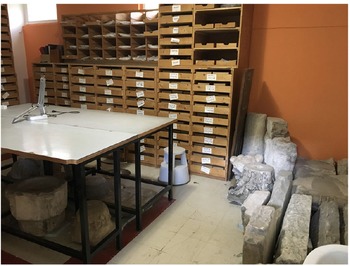
The Museum Study Collection in the ‘Museum room’ (library extension wing), where the collection is located today. © BSA.

The ‘Museum room’ on the first floor of the library extension wing, located directly above the library offices. © BSA.

Before beginning that history, though, it is important to give a brief note on the inventory and reference numbers used in the present text. All reference numbers highlighted in bold in this overview refer to items held in the BSA. Items whose catalogue number begins ‘MUS.’ are part of the Museum collection; all other numbers refer to the BSA Archive.
Prior to the 2020 digitization project, roughly 40% of the Museum collection had been assigned inventory numbers, some of which appear in the various object specialist publications. However, it was necessary at the start of the project to reconcile the existing catalogue, dealing with vacant and duplicate numbers and with objects that had been assigned multiple numbers. All ‘new’ inventory numbers can be distinguished by the prefix ‘MUS.’; although similar to inventory numbers used previous to 2020, some renumbering has had to take place, for example MUS.A355 was previously published as A350 by Tyler Jo Smith (Reference Smith2003). A summary and quantification for each part of the collection is available in Appendix 1 (online supplementary material).
An archive of documents and correspondence was also inventoried during the 2020 project, known as the ‘British School at Athens Museum Papers’. These have been catalogued down to series-level according to International Standard Archival Description guidelines, and a finding aid for this collection is available in Appendix 2 (online supplementary material).
The start of the BSA Museum Study Collection
The first objects entered the collection in 1892, as recorded by Director Ernest Gardner in the Annual Report of the British School at Athens (Reference Gardner1893: 17–8):
We have formed this year in the School library the nucleus of a collection of antiquities which will, I hope, be useful both to our students and to others working in Athens. We shall not attempt to acquire any rare or valuable objects, but merely to collect and classify for the purpose of study fragments of pottery and other articles that throw light on the history and technique of ancient art. We have been helped in this matter by Professor Petrie, who very kindly sent us a series of specimens of “Mycenaean” pottery found by him at Tel-el-Amarna in Egypt, together with decorated fragments of the sculptured columns. To these I have added some characteristic fragments of the various styles of pottery found at Naucratis gathered from the superfluous products of my excavations. The usefulness of such specimens in Athens is shown by the fact that students of other foreign Schools have repeatedly applied for leave to see even the small collection we have started, and I hope that if this project be successfully developed, we may, at very small expense, meet a real need in Athens.
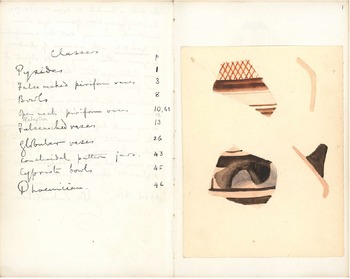
Gardner makes clear that the original purpose of the BSA’s collection was for study, as a reference collection of primary material to be consulted in Athens. In 1892, the library in which the collection was first housed was in the Upper House of the BSA, now the Saloni or lecture room (Plan of ‘The British School at Athens 1896’, BSA Corporate Records-London, uncatalogued). Unfortunately, it is not clear whether the pieces that Gardner describes are still in Athens. Although there are two groups of sherds in the ‘X: Sherd collection’ that are from Tel-el-Amarna (MUS.XX010.01 and MUS.XX010.02), these are not the Petrie sherds. First, the sherds do not match the sketches made by Petrie in an 1892 notebook (WMFP 1/1, Fig. 9.3 ); second, there is a note with these two boxes indicating that they were collected in 1932 by John Pendlebury. One group of five sherds in the ‘A: Pottery and glass vessels’ collection is from Naukratis (MUS.A645), but these objects seem too few to include both the Petrie and the Gardner material.
Watercolour of Mycenaean sherds from the 1892 notebook of William Flinders Petrie (WMFP1/1). © BSA.

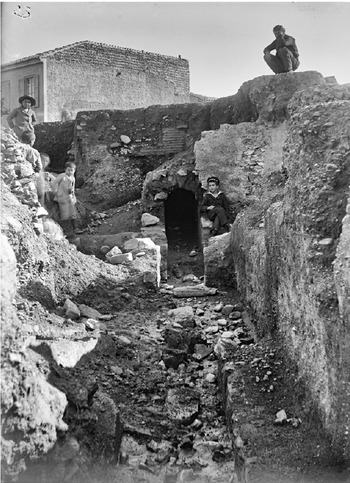
Eighty-one objects in the collection (primarily Geometric period pottery, lamps, and architectural fragments) originated from the BSA excavations at Kynosarges, 1896; these are now in the ‘K: Kynosarges Excavation’ collection, and parts of this group have been studied and published by Nicolas Coldstream (Fig. 9.4 ). Excavations at Kynosarges, led by then Director Cecil Harcourt Smith, aimed to contribute towards knowledge of Athenian topography (Smith Reference Smith1896: 23), locating the remains of a gymnasium and bathhouse, along with a Geometric period cemetery (see also KYN1, KYN2, and KYN 3, available digitally at https://digital.bsa.ac.uk/). The Kynosarges excavations also provided a training opportunity for students participating in BSA excavations at Melos (1896–99), a campaign on which Cecil Smith purchased various objects for the BSA’s collection including one Archaic amphora A1 (which was returned to the local Ephorate on 24 March 1992, BSA MUS 02/02/03).
‘Kynosarges: progress of excavation’, 1896. From the BSA SPHS Image Collection, BSA SPHS 01/0080.0652. © BSA.

The ‘X: Sherd collection’ also seems to have begun around this time. The earliest group of sherds for which a collection date has been registered are MUS.XX001.03 and MUS.XX001.04. Both groups come from Cyprus (Alambra and Politiko respectively) and were collected by John Myers in 1899.
George Finlay (with contributions from Christina Koureta, Esther Laver and Kathryn Robb)
Along with a collection of his books and personal papers, the antiquities of the philhellene George Finlay (1799–1875) came into the possession of the BSA in 1899 through agreement with Finlay’s executor and nephew, Mr W.H. Cooke. The report of the managing committee in 1896 indicates that negotiations were already underway to obtain this material (Smith Reference Smith1897: 224). In 1897, the managing committee were not satisfied by the price offered by Finlay’s executors (Smith Reference Smith1898: 104), but an agreement was eventually reached (Mowat, Leaf and Macmillan Reference Mowat, Leaf and Macmillan1900: 131). Thereafter, there came into the possession of the BSA ‘the library and bookshelves, together with various antiquities and portraits collected by Mr Finlay during his long residence in Greece’ (Mowat, Leaf and Macmillan Reference Mowat, Leaf and Macmillan1900: 131). It is possible that these antiquities were displayed in the hostel (that had recently been opened in 1896) alongside Finlay’s collection of books.
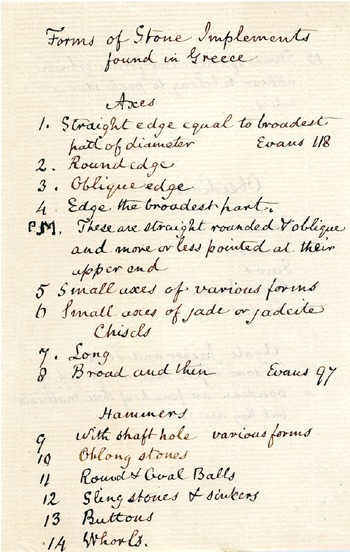
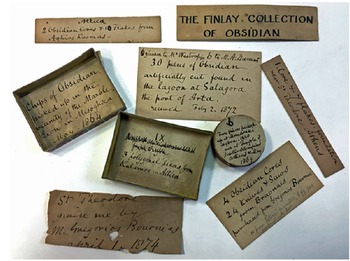
The cornerstone of Finlay’s donation was his prehistoric stone collection, a collection on which he (Finlay Reference Finlay1869a; Reference Finlay1869b) and others (Dumont Reference Dumont1872) had published. According to handwritten inventories of stone tools kept by Finlay (FIN/GF/C/15 and a later [updated and expanded] FIN/GF/C/02), Finlay had 730 pieces in his possession, the earliest acquired in the 1830s and the last in 1874. Many of these stone tools were purchased or given as gifts, but Finlay also had an academic interest in these stones. A set of handwritten notes in FIN/GF/C/08 indicates that Finlay was interested in establishing a typology for his collection (based on the work of Evans Reference Evans1872; Fig. 9.5 ), and pencil annotations to FIN/GF/C/02 indicate that Finlay consulted Professor Escher, professor of geology at Zurich, to learn more about his objects. More than 1,500 prehistoric stone flakes and tools (MUS.L297–MUS.L527) are kept at the BSA in a wooden chest and table that had once belonged to Finlay. A ‘Key to the Catalogue’ of stone objects from Finlay’s papers (FIN/GF/C/02) indicates that these objects represent only part of his collection, and inventoried objects ended up in at least nine separate locations: given to the Archaeological Society of Athens; given to his cousin Alexander Finlay’s son, Campbell; sent to the Society of Antiquaries of Zurich; given to Mr Westropp; given to Albert Dumont; sent to Sir John Lubbock, given to Blackmore Museum, Salisbury; given to the BSA; and given to the Manchester Museum. Conversely, not all of the pieces contained in the chest and table are attributable to Finlay: the dates on handwritten notes kept with some stones in this set indicate that their corresponding objects entered the BSA later (mainly in the 1910s–1930s) and got mixed with the Finlay material (Fig. 9.6 ; cf. Laver Reference Laver2021). Moreover, at least 176 of the larger stone tools that originally belonged to Finlay (attributed by Finlay’s handwriting on object labels) seem to have been removed from the wooden chests and placed elsewhere in the collection, possibly by David Clarke during his reorganization of the collection in the 1950s (see below). Other stones – or, rather, rock samples – belonging to Finlay are part of ‘W: Geological collection’ in the Annexe 1 sherd room, attributable to Finlay based on the handwriting of the object labels.
Handwritten typology notes on the ‘Forms of Stone Implements found in Greece’. From the Finlay collection, loose insert from FIN/GF/C/08. © BSA.

Various labels found with the prehistoric stone tools from the ‘Finlay chest’. © BSA.

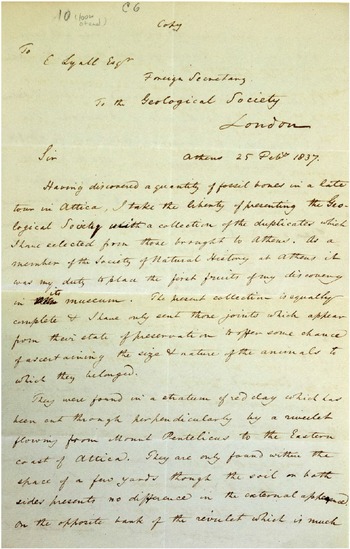
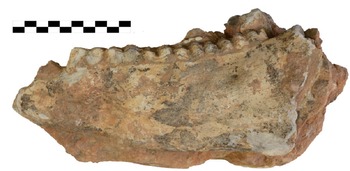
In addition to his prehistoric stone collection, Finlay’s bequest included a collection of fossils (‘V: Bone and fossil collection’), long neglected on a back-shelf in the BSA hostel’s overflow ‘Annexe’, in a wooden crate labelled ‘Bones misc.’. This material was documented for the first time in 2020 as part of the digitization project. In 1836, while investigating the nearby temple sites of Brauron and Oropos, Finlay discovered a fossil bed at Pikermi in Attica. He promptly reported this find to the Society of Natural History at Athens (Φυσιογραφική Eταιρεία) (FIN/GF/C/11), writing also to Charles Lyall of the Geological Society of London (FIN/GF/C/06; Fig. 9.7 ). In this letter, he promised to send representative specimens from his discovery to London; it is possible that the crate of fossils at the BSA includes a similar set of samples as those packaged for Lyall. MUS.V023 is labelled ‘First fossil bone found by me at Pikermi, November 1836’, seeming to confirm that this group of fossils is from Pikermi (mixed with other fossils, for example MUS.V033 from Aegina and MUS.V045 from Livadeia). The assemblage also contains the remains of a Hipparion (an extinct genus of horse, MUS.V001; Fig. 9.8 ), the maxilla (with teeth) of a pygmy rhinoceros (MUS.V005), and a number of fossilized bones on which cancellous bone had been replaced artificially with quartz (MUS.V022, MUS.V025, MUS.V026, MUS.V027, MUS.V051, MUS.V059).
Letter dated 25 February from George Finlay to Charles Lyall, on his discovery of a fossil bed at Pikermi. From the Finlay collection, FIN/GF/C/06/10. © BSA.

Hipparion mandible with teeth, catalogued as MUS.V001 in the ‘V: Bone and fossil’ collection. © BSA.

A collection like this reminds us that Finlay had an eclectic and curious personality (Wace Reference Wace1916: 130; Hussey Reference Hussey1975: 8), collecting a large, rather random collection of objects that interested him – though not always academically, which he himself states in his memoir to the Society of Natural History of Athens in relation to the fossils. One also notes the lack of volumes on either geology or palaeontology in Finlay’s library collection. Finlay’s explorations at Pikermi – along with his interests in deep (European [including Swiss]) prehistory and a Three-Age system (cf. Runnels Reference Runnels2008) – were the subject of a virtual exhibition on George Finlay written by Deborah Harlan and Michael Loy in Winter 2020/2021 (see Digitization, Study, and Outreach below).
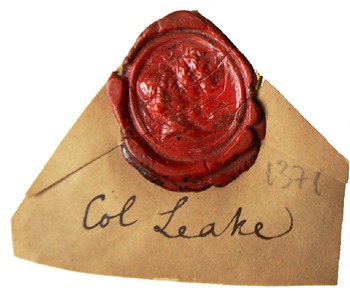
Most of the objects in the Museum Study Collection’s ‘I: Casts and impressions’ series are thought to have belonged to Finlay. This includes a set of 797 Roman and Byzantine coin replicas (MUS.I401–MUSI.1197) originally stored in the back drawers of the Finlay table, but rehoused by Kathryn Robb in September 2020 to improve accessibility to and conservation of the objects; the Finlay catalogue of antiquities (FIN/GF/C/15) gives extensive descriptions of this set of objects, along with a set of gem plaster casts (MUS.I1198–MUS.I1258), wax seals (MUS.I1259–I.1384), and medal reproductions (MUS.I1385–MUS.1404), also housed in the Finlay table. The wax seals comprise principally the impressions of Roman gems, and of these wax seals, it is possible (based on a note kept with MUS.I1371 that simply says ‘Col. Leake’, Fig. 9.9 ) that some of these objects once belonged to Colonel Leake, with whom Finlay corresponded frequently, particularly during his journeys around the Greek islands in August and September 1837 in the company of Ludwig Ross (Ross Reference Ross1840).
Note in George Finlay’s handwriting indicating ‘Col. Leake’, found with MUS.I1371, I: casts and impressions collection. © BSA.

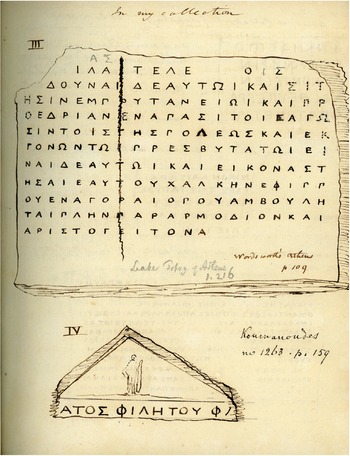
Finlay’s catalogue of antiquities (FIN/GF/C/15) lists a small number of other types of objects once belonging to Finlay, including terracottas (pp. 229 and 239; cf. Pisani Reference Pisani2006: 269–70), Egyptian material culture (pp. 229 and 233–35), ceramics (p. 237), bronzes (p. 239), and ‘antique gems’ (pp. 243–47; cf. Betts Reference Betts1971, removed from the BSA to the Manchester Museum). A number of stone inscriptions were also part of Finlay’s collection (cf. FIN/GF/C/10), one of which was published by Wilhelm (Reference Wilhelm1901) (MUS.E001: this piece joins with the British Museum’s BM 1816,0610.187; cf. Lambert Reference Lambert2000: 486–89). Some of the objects are labelled in BSA MUS 02/02/03 as ‘from my [Finlay’s] collection’ (Fig. 9.10 ).
Handwritten page from George Finlay’s notebook (FIN/GF/C/12) indicating stones ‘[i]n my collection’. The top image is a drawing of MUS.E001. © BSA.

It is difficult to quantify the extent of the original Finlay inscribed stone collection, as no known inventory of sculpture and stone was kept by the BSA before the Second World War. FIN/GF/C/10 contains objects owned by Finlay and others he had seen in the field or were owned by friends; it is not always clear which is which and, moreover, what subset of that collection came to the BSA.
The collection in the early twentieth century (with contributions from Deborah Harlan)
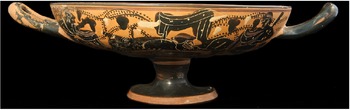
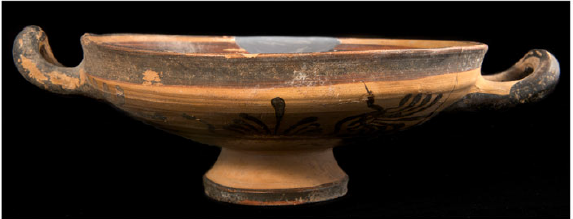
The Museum Study Collection had one of its most rapid periods of growth from the start to the middle of the twentieth century. The sherd collection continued to grow at great pace, and between 1930 and 1949 the collection went from comprising nine boxes of sherds to 96 boxes. Many sherds were acquired by Theodore Burton Brown arriving from Turkey and the Middle East in the 1930s (for example MUS.XX008.01). Three large donations of ceramics, mainly from individuals connected with the BSA, expanded the collection further: one donation, given by Doreen Dunbabin, the widow of Thomas Dunbabin, contained several terracotta figurines (Hood Reference Hood1956: 6–7). The largest bequest came from Giorgos Empedokles of the Greek Archaeological Council (Hood Reference Hood1956: 6–7): some 80 ceramics, mainly pieces dated as Late Helladic II, Geometric, and both Corinthian and Attic Archaic (Fig. 9.11 ).
Attic black-figure kylix (500–480 BC) from the Empedokles collection, MUS.A328. © BSA.

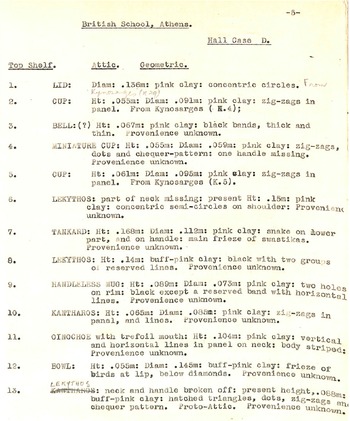
At the turn of the century there was a period of consolidation and organization. Around the years of the First World War (BSA 23, 1919, viii–xiii; Clogg Reference Clogg, Llewellyn Smith, Kitromilides and Calligas2009) there were few students at the BSA, and so resident members dropped their usual programmes and undertook to study and rearrange both the library and the antiquities collection. Alan Wace worked on the antiquities, cataloguing collections (along with John Myres) and studying in detail any Mycenaean pottery (Waterhouse Reference Waterhouse1986: 24). Between 1923 and 1932 a catalogue was compiled by Walter Heurtley (then assistant director) of all objects that had entered the museum and sherd collections until that point (BSA MUS 02/01.01; Fig. 9.12 ). An accompanying card catalogue (BSA MUS 02/02/01) was also produced around this time. This was an incomplete and unfinished document: there are multiple pencil additions, corrections, and erasures in the catalogue, including a set of handwritten notes on pottery that must have been added at a later date.
Collection catalogue with pencil annotations from the ‘Heurtley Catalogue’, BSA MUS 02/01.01. © BSA.

The ‘Heurtley Catalogue’ also confirms that in the 1930s (pre-Clarke’s reorganization of the collection) there were no catalogue numbers attached to objects, save for the Kynosarges collection. Entries in the document indicate that objects were displayed in the ‘Hall’ and in numbered cabinets and drawers in the new Museum/Map Room (the number and description of the cabinets seem similar to the cabinets currently still in use in the BSA Museum). Objects were mainly grouped together first according to date and then ware or region of production. The sherd collection filled the drawers of 10 of the 12 museum cabinets (one cabinet was used for stamped amphora handles and another was used for metals found at Kynosarges).
Furthermore, around this time the first publications formally studying material of the BSA collections were undertaken. Winifred Lamb (Reference Lamb1924) published a series of stamped pithos fragments. A series of photographs used in the production of plates for this article is housed in BSA MUS 03/01/24 and BSA MUS 03/01/25 which, until the 2020 digitization project, had been stored in the Archive Room of the BSA inside the box of BSA MUS 02/02/07 along with BSA MUS 03/01/23.
Concerning the other ceramics, both the ‘A: Ceramic and glass vessels’ and ‘X: Sherd collection’ series contain a large number of sherd groups, in which many separate objects are accessioned together under the same group inventory number (MUS.A501–MUS.A687; and 1,469 MUS.X objects; Fig. 9.13 ). Although ‘X groups’ are arranged according to region and site and ‘A groups’ are chronological or fabric samples, there does seem to have been some exchange of material between the two sets, possibly in the 1960s during the reorganization of museum material by Hugh Sackett (see below). Footnote 1 Sackett’s catalogue details the collection to the level of the box in which sherds were kept; an item-level documentation of the sherds was completed 2019–20 by Katerina Argyraki, Esther Laver, Michael Loy, Kathryn Robb, and Ermioni Vereketi. Deborah Harlan and Anastasia Vassiliou undertook the time-consuming tasks of locating precise map co-ordinates from the place names written on sherd box labels and attaching the ceramic records to a fully geo-referenced sites database.
The Museum Study Collection in the ‘Sherd room’ (Annexe 1), where the sherd collection is located today. © BSA.

One of the most obfuscated issues about the Museum Study Collection from this period is how and where objects were displayed. For the early twentieth century, much of this information has to be reconstructed by reading between the lines, and in fact some of the most useful information comes from a most surprising source: a set of checklists (FIN/GF/C/01) mixed in with the Finlay papers (curiously including a number of documents that date after Finlay’s time). These comprise older notes on the collection that were ‘re-purposed’ in 1948 to check the inventory of the collection after the BSA premises’ closure of the Second World War. Pencil ticks were added to the documents indicating whether objects were still present, following fears that some objects from the BSA (including the museum and library collections, but also artworks including the Penrose watercolours) had gone missing during the war. One annotated document is written by Humfry Payne and dated to 1926, indicating that objects were moved around during his tenure as director; the paper is headed ‘Vases in Hall + Corridors’, but ‘Corridors’ is crossed out and rewritten as ‘Salonaki’; locations he refers to are ‘Ladies Room’, ‘on case of front office’, ‘on case in Library’ (all three of which are crossed out and replaced with ‘Salonaki’), and ‘in Library case A’ (crossed out and replaced with ‘Hall’). Another note in the same set, which is undated and unsigned but filed in front of the Payne itinerary (so presumably earlier in date), mentions objects stored in the lower section of the ‘Kynosarges case’ and a list of other numbered cabinets in the hostel.
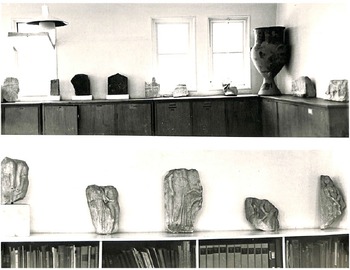
In 1938, along with the construction of the Payne Room, what is now the Topography Room was added to the library, then a room for storing maps and the antiquities collection; one photograph of this room survives in the museum archives in BSA MUS 03/01/06 (Fig. 9.14 ) and two others in BSAA6 (ca. 1947). Based on description and shelf numbers in BSA MUS 02/01.01, it seems likely that a special set of shelves and drawers were constructed for this room to house parts of the collection – but not all of the collection made it to this room. Some objects were left in the hostel and library, based on published descriptions of the premises from the 1950s (Hood 1956: 6–7; Reference Hood1957: 10). Moreover, the handwritten card catalogue dating to the mid twentieth century (BSA MUS 02/02/07) lists ‘P. room’ (presumably ‘Penrose Room’ or ‘Payne Room’ of the library) and ‘Dining Room’ as object locations. Waterhouse (Reference Waterhouse1986: 70) indicates that, prior to moving objects around, a large number were kept together ‘in a small room off the entrance hall’, kept alongside the photographic collection. Other objects appear to have been moved to the Upper House. A number of the photographs and negatives (BSA MUS 03/03/01) taken in the 1950s during the production of the ‘Clarke Catalogue’ (on which see below) were produced in what is now the Dining Room of the Upper House. Objects were moved to their present location in the library extension wing’s ‘Museum’ (formerly called ‘sherd and seminar room’ on early plans) in 1966.
Various objects from the Museum Study Collection on display in the Map Room (library extension wing), March 1972. BSA MUS 03/01/06. © BSA.

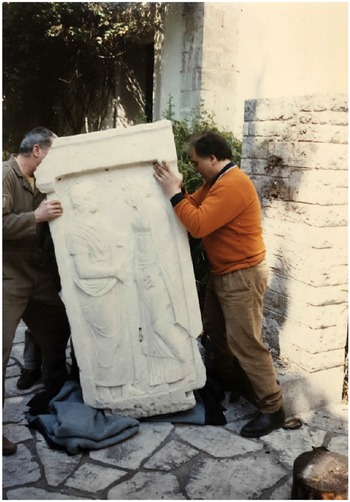
While this movement was underway, the Finlay collection at least seems to have been kept together, given that the stone objects and impressions as described above were found together in the Finlay chest and table in 2019. However, it is also possible that there was at one stage another piece of Finlay furniture that came to the BSA that no longer exists; the catalogues of FIN/GF/C/01 and FIN/GF/C/10 refer to various labelled drawers (drawers K–R) that cannot be located among any of the BSA furniture. Finlay’s stone collection (and sculptures donated by others) were not catalogued before the Second World War and were kept in the gardens of the BSA. A few pieces had been published (Waywell Reference Waywell1970), but more full documentation on the location and condition of stones was made in 1998 (BSA MUS 01/03/03 and BSA MUS 03/01/14), alongside work carried out by conservator Irit Narkiss as stones were moved into the BSA ‘Glyptothiki’ (now the ‘TV room’). Stone pieces were moved to their present locations in the BSA Museum room and Annexe 1 sherd room in September 2007 (Fig. 9.15 ; pers. comm. Amalia Kakissis; cf. BSA MUS 03/01/14 and BSA MUS 03/01/20).
Moving the stones inside from the BSA garden. Pictured here is MUS.S026, BSA MUS 03/01/20. © BSA.

David Clarke and the ‘Clarke Catalogue’ (with contributions from Antonis Chaliakopoulos)
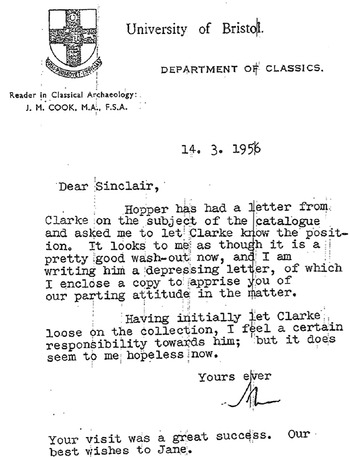
In 1948, David Clarke, BSA Student and scholar of Gonville and Caius College, Cambridge, was in Greece to take part in the excavations at Old Smyrna. Clarke was also resident for some time in Athens; during this stay, he began indexing and re-cataloguing the antiquities collection ‘with a view to eventual publication’ (Cook Reference Cook1948: 2, 7). In completing this work, it was suggested to Clarke to produce a full catalogue of the collection (BSA MUS 01/02/01.01, BSA MUS 02/03/07), which would both aid him in his own work and also be a useful research tool for other scholars. Clarke worked on this document for the following academic years (Cook Reference Cook1949: 8; BSA MUS 01/02/01.02, BSA MUS 01/02/01.03), but correspondence in 1956 between successive directors, John Manuel Cook and Sinclair Hood (BSA MUS 01/02/01.04; Fig. 9.16 ), indicates that the project had to be abandoned and Clarke’s work remained unpublished. This development was down to two main reasons: first, around this time the BSA received two large donations of ceramics by former Director Thomas Dunbabin and Giorgos Empedokles of ASA, necessitating the rewriting by Clarke of large sections of his ceramics chapters; second, Clarke had not been able to catalogue and describe the coins and impressions collections, and the BSA was resistant to publishing his catalogue without this final chapter as the document would be otherwise ‘incomplete’.
Letter from John Manuel Cook to Sinclair Hood on the ending of the Clarke cataloguing project, BSA MUS 01/02/01. © BSA.

In preparing the BSA collection for publication, David Clarke sorted through and indexed objects according to material types, designating collections by letters. This letter-based classification system has been used as the basis for the current museum catalogue. The unpublished manuscript of Clarke, held in the BSA Museum Papers (BSA MUS 02/03/02), contains draft commentaries and inventories for the following collections: pottery, glass and lamps (A series), metal (B series), Egyptian antiquities (D series), inscriptions (E series), the Kynosarges collection (K series), stone objects (L series), sculpture (S series), terracottas (T series), and the sherd collection (X series). The three-page introduction to Clarke’s text extols how extensive and rich is the BSA Museum, and offers his own potted-history of the Finlay bequest and first items to arrive in Athens. Ironically for a text that ultimately never saw publication within Clarke’s lifetime, the opening lines of the text criticize the practice of museums failing to publish their material:
There must be few, if any, archaeologists who have not, at some time in their lives, expressed regret that some object is not published. The sacred duty of publication is neglected and is still being neglected in every Museum in Europe. (BSA MUS 02/03/02)
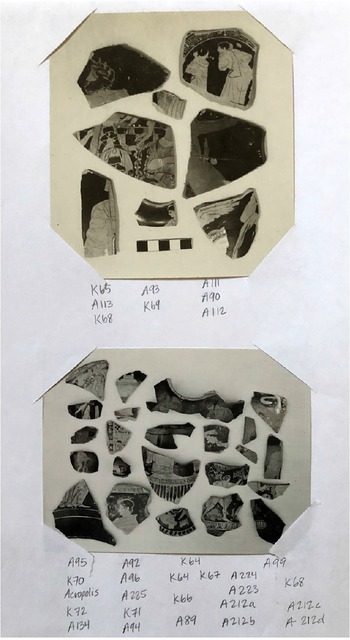
Alongside producing the text of his catalogue, David Clarke had a large part of the museum collection photographed (BSA MUS 03/01/01–13, BSA MUS 03/03/01). It is possible that groups of objects assembled for photography reflected groups of objects that were on display together, and these photographs might give some clue as to how the collection was displayed in the 1940s and 1950s. A set of photographs mounted on A4 sheets of paper and annotated with object numbers were also produced by Clarke (BSA MUS 03/01/07–13), intended to show the publishers of the BSA’s Annual how he would have liked the plates accompanying his catalogue text to have been arranged (BSA MUS 02/03/08; Fig. 9.17 ). These photographs were removed from their archival context in 2009 and placed together in a drawer of photographs (BSA MUS 03/01/19). In order to research and better understand the history of the Clarke publication, Antonis Chaliakopoulos helpfully reunited these photographs with the mounts during August and September 2020. Some of the old paper mounts had become damaged and were replaced in the early 2000s by new mounts corresponding to Clarke’s original layout. In fact, photographing the collection was an important element of Clarke’s project, given that he was doing large portions of his work remotely from the UK, writing to the BSA with requests for photographs or for further information to enhance his writing (BSA MUS 01/02/01). It also appears that large sections of his catalogue were based off the Heurtley card catalogue (BSA MUS 02/02/01), perhaps a set of cards that he took back to work on from the UK, therefore basing some of his descriptions not on direct autopsy of the collection but on secondary descriptions. There was, in fact, some precedent for taking archival documents out of the BSA during its early history. Robert Carr Bosanquet took FIN/GF/C/02 away, presumably (as he states he used this document) during the preparation of his publication (Bosanquet Reference Bosanquet and Atkinson1904) on Phylakopi. Duly, FIN/GF/C/02 has recorded on its first pages ‘presented [returned to the BSA] by R.C. Bosanquet, April 1930’.
Sample paper template to indicate the layout of images and captions for the publication of the Clarke catalogue in the Annual of the BSA, BSA MUS 03/01/12. © BSA.

Also stored with the Clarke papers is a duplicate copy of the manuscript annotated and updated by John Boardman when he began his work on the museum collection in 1955 and 1956 (BSA MUS 02/03/05). This script has been annotated to reflect some of the changes in the collection involved in the major donations received between 1950 and 1960.
The museum from the 1950s to the 1990s (with contributions from Salvatore D’Errico and Eleni Krikona)
The 1950s and 1960s are well documented in the BSA Museum Papers, and these decades represent a florescence of work undertaken by successive assistant directors, Sinclair Hood, John Boardman, Hugh Sackett, and others. Boardman was responsible for ‘tidying up’ Clarke’s catalogue and for bringing together many of the separate strands of museum documentation produced up to that point: his handwriting appears ubiquitously as annotation on the museum record cards and notes. Sackett compiled the catalogue and synthesis of the sherd collection (BSA MUS 02/01.03–06), which had by that stage grown quite considerably in size to at least 585 boxes. Although quite precise information was left with each box of sherds indicating where the assemblage originated, in many instances no name or date of the collector was noted; a large bundle of notes from Sinclair Hood working on the sherds indicates that much of the information we now have had to be pieced together retrospectively through individual correspondence with various past BSA students (BSA MUS 01/02/03–06). Sadly, as many of these early BSA students have now passed, it is unlikely that we can recover any further information for this part of the collection, as many of those facts were never written down and circulated only by word-of-mouth. Correspondence from this period (BSA MUS 01/02/03–06) indicates that the sherd collection was used for study by a number of BSA scholars, including Vincent Desborough, Richard Hope-Simpson, and Winifred Lamb. In the 1960s many rock samples were deposited in the sherd collection. These included a large number of obsidian pieces, which had been collected by Colin Renfrew during his time as a BSA student between 1962 and 1965 (cf. Renfrew et al. Reference Renfrew, Cann and Dixon1965; Renfrew and Springer Peacey Reference Renfrew and Springer Peacey1968): in the 2020 digitization project, these groups were moved to ‘W: Geological collection’ (MUS.W134–44, MUS.W148, MUS.W152, MUS.W152–60, MUS.W167–70).
The Museum Study Collection received some of its last accessions in the 1960s (cf. BSA MUS 01/01.01), including the donation of four Euboean vases from Annie Ure (BSA MUS 01/02/02.02–08, MUS.A421, MUS.A438, MUSA.440, MUS.A442; Fig. 9.18 ; Smith Reference Smith2003; D’Errico Reference D’Errico2021). Further study of the collection was undertaken during this period, resulting in a series of new publications (Boardman Reference Boardman1954; Waywell Reference Waywell1970; French Reference French1971; Phelps et al. Reference Phelps, Varoufakis and Jones1979; and later studies by Catling and Jones Reference Catling and Jones1989; Arnott Reference Arnott1990; Catling Reference Catling1990). The first scientific analyses were conducted on BSA collection objects (stone axes) at this time, which resulted in a published study (Phelps et al. Reference Phelps, Varoufakis and Jones1979) and the production of unpublished notes kept with various objects, mainly in the sherd collection (MUS.XV020.01, MUS.XV020.02, MUS.XV031.01, MUS.VX035.03, MUS.XW001.02, MUS.XW012.01).
Euboean cup donated to the British School at Athens by Annie Ure, MUS.A421. © BSA.

In 1983 a condition report on the Museum Study Collection was written by Roger Cocking (BSA MUS 01/04/01), in which he gave recommendations for the repacking of objects – a preventative conservation strategy – and in which he urged the curators of the museum to return to the task of compiling a full inventory and photographic record. This recommendation was followed up with various projects of shelf-checks and inventorying (BSA MUS 02/05), the most extensive of which was led by Lisa French as director. Negative collections were compiled at this time (BSA MUS 03/03/06–08) with accompanying registers (BSA MUS 02/05/08), and significant progress was made on the database by Nicola Wardle. This work covered significant parts of the collection, but excluded (among other individual objects) the sherd, geological, and fossil collections, the casts and impressions collection, the Finlay stone artefacts, and the coins acquired both from Finlay and from former BSA Student Roger Heath (BSA MUS 02/01.02).
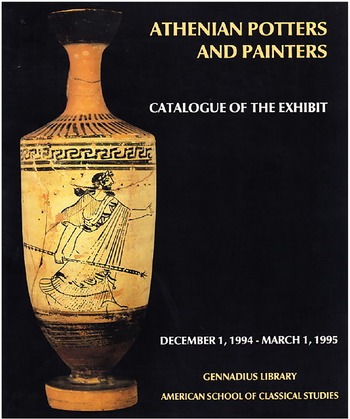
The final 20 years of the 20th century saw various major events in the life of the Museum Study Collection that are well documented in its archive. 1986 saw the centenary celebrations of the BSA, during which time the collection was packed and moved into Annexe 2 (BSA MUS 02/05/04). In 1994–95 the ASCSA organized an exhibition entitled Athenian Potters and Painters, a display at the Gennadius Library that included 33 objects from the BSA ‘A series’ and seven from the ‘K series’ (alongside ceramics from elsewhere) (Oakley and Langridge-Noti Reference Oakley and Langridge-Noti1994; Fig. 9.19 ). In 1998 some of the stone pieces previously located within the gardens of the BSA were moved inside, giving opportunity for their full documentation (BSA MUS 02/02/05), study and publication (Lambert Reference Lambert2000; Tomlinson Reference Tomlinson2000). Finally, two objects were damaged during the 1999 Athens earthquake; Ann Brysbaert – at that time a conservator at the Athenian Agora – was invited by assistant director Lesley Beaumont to undertake repairs and to improve storage conditions for a further six objects (BSA MUS 01/03/04). The museum had been running a rolling programme of conservation in the preceding years, undertaken by Wendy Walker mainly on the ceramics (BSA MUS 01/03/02 and BSA MUS 02/02/04).
Front cover of the catalogue volume accompanying the exhibition Athenian Potters and Painters, 1994–95. © BSA.

Cataloguing projects of the BSA Museum
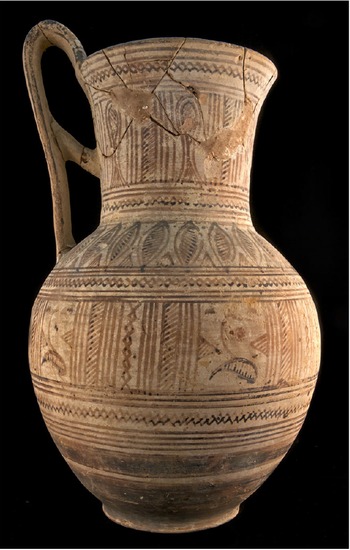
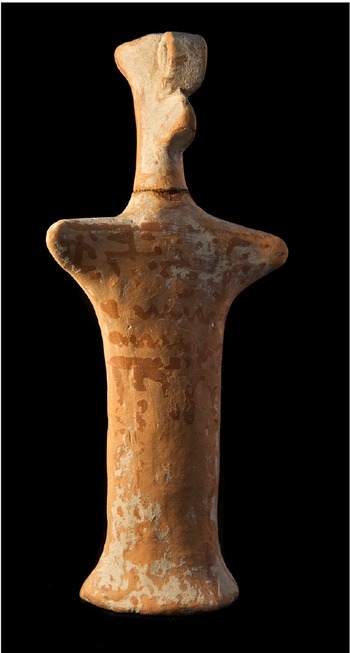
From the early 1990s there was momentum to publish sets of objects in the Museum Study Collection. Martin Price joined the BSA in 1994 as director, coming from the British Museum and bringing with him a vision to publish a complete catalogue of the museum collection. Whereas Clarke’s ambition had been to publish the collection together in its entirety, the intention now was for relevant specialists to publish section by section. Various scholars were invited to contribute to the project, and much of the correspondence organizing visits for study and the practicalities of publication (managed by successive assistant directors, Lesley Beaumont and Rebecca Sweetman) is kept in the museum archive (BSA MUS 01/02/07–10) along with the working documents and photographs produced during study (BSA MUS 03/01/17–8 and BSA MUS 03/03/02–03). Some studies remain unpublished, while some parts of the collection were assigned later (or re-assigned) to other scholars. Tragically, Martin Price died just six months into his term as director and never saw his vision realized, but the groundwork was set and a number of catalogues have appeared since the early 1990s in the BSA. In addition to projects by Lambert and Tomlinson mentioned above, Nicolas Coldstream (Reference Coldstream2003) published a set of Geometric pots and at a similar time rearranged the contents of the display cabinets in the museum to their present configuration (Fig. 9.20 ). Tyler Jo Smith published the black-figure pottery (2003) and East Greek pottery (2009), and Marcella Pisani published the terracotta figurines (2006; Fig. 9.21 ). Projects on other parts of the collection were undertaken, but were sadly never completed: files associated with these studies are stored on the BSA file servers.Footnote 2
Late Geometric Attic oinochoe (from the Empedokles collection), studied and published by Nicolas Coldstream, MUS.A311. © BSA.

‘Pappas’ standing figurine, 575–525 BC, studied and published by Marcella Pisani, MUS.T015. © BSA.

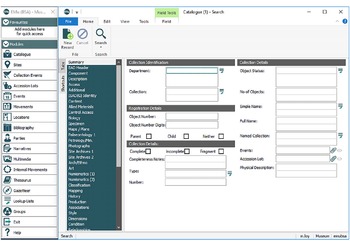
The 2000s also saw the integration of museum inventory data into various digital databases. Separate typed catalogues of objects-based collections had been produced up to this point (BSA MUS 02/06); the intention was to create one single database that included all collections together. Substantial work on achieving this aim had been begun under Lisa French’s directorship (1989–94), but the work of specialists undertaken in the late 1990s and 2000s had not yet been integrated. In 2009 the BSA purchased and configured the KE EMu (Electronic Museum) database system (subsequently Axiell’s EMu), a package that allowed for powerful relational cross-linking not only between collections but also between departments, to link together museum objects with documents from the archive, with pieces of bibliography from the library, and with records of people (excavators, the donators of material, specialists who studied objects) kept by the Administration department (Morgan Reference Morgan2009: 8). Museum records were migrated along with the digitization of a few collections by other departments (BSA MUS 02/07), but the task of uploading, cleaning, and linking records proved more ambitious than had first been conceptualized (cf. the optimistic timetable for the project’s completion in The British School at Athens Strategic Plan for Research 2015–2020: https://www.bsa.ac.uk/wp-content/uploads/2018/07/Strat.Plan_.Res-2015-2020.pdf, p.16). Following the migration of a set of museum records to the EMu system in 2009 (Fig. 9.22 ), work continued in parallel by specialists and interns both directly on EMu records and on static Excel spreadsheets and in Access databases. Footnote 3 The result was that, within a few years of the creation of the integrated database, the information stored in the EMu system was no longer correct, and the most up-to-date information on the collection (particularly on object locations) was spread across a series of unlinked documents.
Screenshot of the Axiell EMu interface, with the Catalogue module displayed. © BSA.

Digitization, study, and outreach (with contributions from Deborah Harlan and Anastasia Vassiliou)
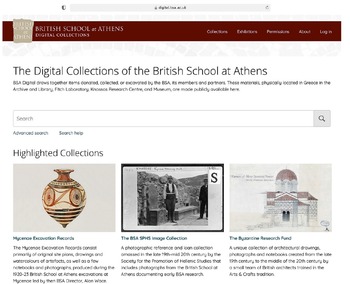
In 2019, IT Officer Chavdar Tzochev (in consultation with Deborah Harlan, Archivist Amalia Kakissis, and Michael Loy – and further developed in 2020 by successive IT officers, Hallvard Indgjerd and Nathan Meyer) designed ‘BSA Digital Collections’ (digital.bsa.ac.uk), a collections management system (CMS) for visualizing data held within the EMu database in a web browser (Fig. 9.23 ). This platform provided a facelift to Museums and Archives Online (MAO) – a previous CMS designed almost a decade earlier by IT Officer George Bruseker (Morgan Reference Morgan2009: 8) – while also providing greater connectivity between collections and map-based visualization of objects for which spatial data had been attached. The provision of a custom-built CMS helped to re-focus attention on the curation of digital data in the BSA Museum Study Collection, and metadata could be cleaned and entered with a clear idea of how that information would ultimately be served to the public.
Screenshot of the Digital Collections website, www.digital.bsa.ac.uk. © BSA.

Development on ‘Digital Collections’ continued throughout the 2019–20 academic year, and on 17 March 2020 the platform launched publicly; the launch was a few weeks ahead of the original schedule, but this coincided with the first coronavirus pandemic national lockdown and an international effort by research institutions and museums to make collections available online. Archive collections were made immediately available, with further material added over the coming months, while work on unreleased museum collections continued behind the scenes. At the time of writing, the entire museum catalogue is now available online, along with nine archival collections and two library collections; the museum collection can be viewed via secure sign-in with a password obtainable from the assistant director.
In order to make the Museum Study Collection data available on ‘Digital Collections’, and to allow for the objects in the collection to be used in a greater number of analogue and digital venues, for both research and teaching it was decided that the inventory and photographic documentation of all objects must be completed once and for all. This work was completed as part of the digitization project in July–September 2020 (Fig. 9.24 ), during which time the final uninventoried collections were tackled (‘I: Casts and impressions’; ‘V: Bone and fossil collection’; ‘W: Geological collection’; ‘Y: Miscellaneous pottery’). The ‘X: Sherd collection’ was inventoried to the object level (previous catalogues had only documented to the box level). The whole inventory was checked against objects in the collection (and the location inventory verified and corrected), and pre-existing digital records were studied, cleaned, and mapped to a standardized format, making greater use of thesauri and fixed vocabulary lists. Substantial work was undertaken to complete the photographic record, taking in both newly inventoried collections and objects from other collections for which photographs had not previously been taken; and the BSA Museum Papers were organized and documented to the file level, with a few select folders being documented and scanned at the item level. Moreover, a number of collections were rehoused and stabilized, following the design of a preventative conservation programme by Salvatore D’Errico (cf. Bennet Reference Bennet2021: 10 and www.bsa.ac.uk/wp-content/uploads/2020/12/2020_December_newsletter_WEB.pdf).
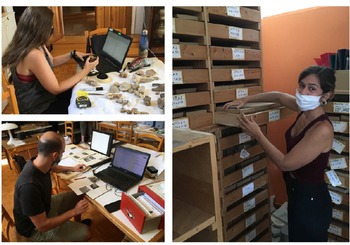
Volunteers at work during the summer 2020 BSA Collections Digitisation Project: a) Christina Koureta, b) Katerina Argyraki, c) Antonis Chaliakopoulos. © BSA.

Following the formal ‘end’ of the digitization project and the start of the academic year 2020–21, Deborah Harlan, Michael Loy, and Anastasia Vassiliou continued to clean and import to EMu data generated during the project, and by early October 2020 the complete inventory was integrated onto the EMu system. Deborah Harlan and Matthew Evans undertook image post-processing on photographs taken in the summer, and Michael Loy took the final photographs for any antiquities that been previously catalogued without an image record. In January 2021, Orsolaina Felago was due to work in the museum on an Erasmus+ training placement, but, owing to a six-month full lockdown in Greece, she completed instead a remote-working project on BSA corporate data. The task that she had been originally assigned – photographing the casts and impressions collection – was begun in June 2021 by Katie Harman and Evi Kourti and finished in October by Michael O’Ryan and Conor Walker (who also did batch post-processing on all images of this collection). From January 2022, Phoebe Brereton (joined in March 2022 by Jessica Scott) proceeded to catalogue the Museum Papers to item level, a task continued in May 2022 by Camilla Lindegaard and variously undertaken in small parts in 2020 and 2021 by Antonis Chaliakopoulos, Salvatore D’Errico, Eleni Krikona, Michael O’Ryan, and Conor Walker.
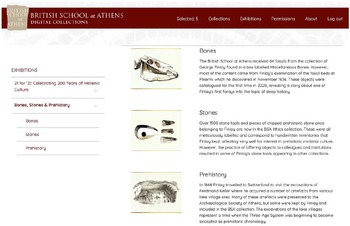
Ever since the basic documentation of the collection has been completed, the focus has turned towards outreach and public engagement. The construction by Hallvard Indgjerd of an ‘Exhibition’ module for ‘Digital Collections’ allowed for the development of an exhibition in 2021 by Deborah Harlan and Michael Loy on George Finlay’s interest in prehistory, entitled Bones, Stones and Prehistory (Fig. 9.25 ), framing 21 objects from the museum, archive, and library collections within a narrative about Finlay’s encounters with ideas of prehistory in Greece (1830s) and in Switzerland (1868–74). A thriving volunteer programme has been developed for the museum, with former students of the collection contributing blog posts either on the collection or on ideas inspired by their time in Athens (https://www.bsa.ac.uk/join-us-2/volunteers-and-interns/intern-stories/). Furthermore, a number of in-person and virtual sessions have already taken place since the reorganization of the museum (Fig. 9.26 ). In many ways, it is hoped that the next phase of the museum’s life will see the collection as a more accessible teaching and research resource.
Screenshot on the Digital Collections website of the forthcoming exhibition Bones, Stones and Prehistory. © BSA.

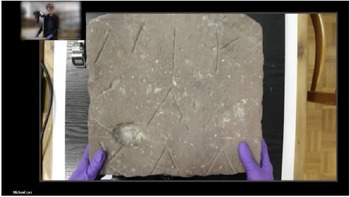
Still image from live ‘virtual handling session’ for MA students of the University of Manchester (March 2021), showing MUS.E011. © BSA.

The future of the BSA Museum Study Collection
As this, necessarily brief, overview has illustrated, for the incredibly rich and wide-ranging BSA Museum collection, the full, extensive, and detailed work of the past 130 years only just scratches the surface. The study and publication of object groups will continue – and with the digital catalogue now making this material more accessible than ever before, it is hoped that this work will continue apace. Moreover, for a collection whose contents comprise principally decontextualized objects, it is indeed a priority for the BSA as a forward-thinking 21st-century institution to publish and to curate the collection in a socially responsible way.
On another track, one area in which the collection has real potential is for the insights it offers for the intellectual history of British archaeology in Greece. As noted above, the names of those who donated or studied objects in the BSA’s collection are familiar as the protagonists who shaped our discipline; the collection and its archive, therefore, offer a rare first-hand insight into the formation of Wace, Lamb, Payne, Ure, and others by providing material evidence of their collecting habits, their scholarly interests, and their recording practices. A recent project initiated to transcribe and study the catalogues of George Finlay has embarked upon this path, laying the foundation for learning more about the relationship between the studies and travels of Finlay and about how his ideas of Greek antiquity were woven into the early scholarly tapestry of the BSA. The museum provides a wealth of data into early British scholarship.
Through close study of its collection and its archive, both the development of Classical archaeology as a discipline in Britain and, more specifically, the role played by the BSA can be better understood – but, first and foremost, the museum remains a reference collection. Helping to fulfil the BSA’s mission to facilitate and promote research into Greek cultural history, it offers provision for in-person and virtual handling sessions and exhibitions. Now it does so in a way more accessible than ever before, open to the next generation of scholars for research and study – as Ernest Gardner had originally intended with the acquisition of the first modest group of sherds.
Acknowledgements
I would like to thank all previous assistant directors and museum volunteers who have been involved in the organization and documentation of the collection, but a special vote of thanks goes to the 2019–20 team (all mentioned by name in the text) who contributed to finally ‘finishing off’ the inventory. Drafts of this article were read by John Bennet, Deborah Harlan, Amalia Kakissis, Tyler Jo Smith, and Rebecca Sweetman. I thank the editors of AR for the smooth collaboration throughout the whole publication process. Most sincere thanks go to Tania Gerousi for advising at all stages regarding documentation and publication.
Supplementary material
To view supplementary material for this article, please visit https://doi.org/10.1017/S0570608422000035.
Competing interests
Michael Loy compiled his contribution when assistant director at the British School at Athens.