INTRODUCTION
The Athenian decree (with rider) of 347/346 bc for the sons of Leukon is so well known, and has been so often discussed, that it may seem superfluous to revisit it yet again.Footnote 1 However, there remain various aspects of this important document which, in my view, have still not been dealt with in an entirely satisfactory fashion. In this paper I wish to look particularly at the substantial relief which stands at the top of the impressively tall stele. This relief has been given much less attention than the inscribed text below. In fact, the inscription is routinely quoted and discussed without much or any mention of the relief. The underlying assumption seems to be that the relief has nothing to say that is not already clear in the inscription itself, as if its function is simply decorative and it cannot contribute at all to our understanding of the text or of the object in its entirety. However, since it is characteristic of the study of the ancient world that we must strive to extract every smidgeon of information and interpretation from the little that has survived for us, this is clearly not the way to treat a rare and contemporary image of rulers of the Bosporan kingdom.
My intention here is primarily to bring the relief (back) together with the inscribed text (and accompanying painting, which has not survived) above which it proudly stands. This will involve a range of general remarks on the relationship between Athens and the Bosporus, in which grain was part of a much wider set of interests, not least the Bosporan rulers’ very considerable wealth. By considering the stele as a whole, we find an interesting example of the different ways in which a public decree may be expressed in text and in image, a theme which has become rather topical in more recent scholarship. My central claim in what follows is that both the relief and the text of our inscription place particular emphasis on continuity and, more specifically, a continuity which will persist into the future and will not be altered by Leukon's replacement in the Bosporus by his ruling sons, Spartokos and Pairisades. At the same time, in advancing that argument I offer a new interpretation of the relief itself, which turns upon the identification of its standing figure. I argue that this is in fact Leukon himself, not (as routinely supposed) Apollonios, a third son of Leukon. The deceased Leukon, I contend, gazes across a (missing) sceptre at the sons who now sit on the Bosporan throne and look out to the viewer with a gaze that seems also to include their father. In consequence of my discussion of ‘Leukon and his sons’ at Athens and specifically in the text and image of this stele, the historical significance of an inscribed fragment from Mytilene (IG XII 2 3, also mentioning Leukon and his sons) becomes uncertain, so that we must be at least very cautious in supposing that Leukon ever ruled in any formal sense together with any of his sons.
CONTEXTS: HISTORICAL, ECONOMIC AND METHODOLOGICAL
The Crimean Bosporus emerges in Athenian history in the closing decades of the fifth century, though there are slight indications of Athenian concern there and thereabouts much earlier. Pericles’ Pontic expedition of c.437 bc was a milestone in the development of Athenian interests in the region, pursuant to Athens’ suppression of Byzantium's revolt a few years earlier. The establishment of a new centralising power in the Crimean Bosporus seems also to have begun in the 430s, very possibly with some Athenian involvement, however indirect.Footnote 2 Athens had begun to establish a Black Sea presence in direct conflict with the Persian interests which had prevailed in the Bosporan kingdom and Black Sea at large. Persia had been ceded military control in the Black Sea under the Peace of Callias.Footnote 3 Although the Pontic region stood very much at the margin of the focus of Thucydides and our other authorities on the history of the period, we should include Athenian irruption into the Black Sea within any attempt to appreciate the causes and nature of ‘Sparta's fear of Athens’ growing power’ (Thucydides 1.88.1) at the outbreak of the Peloponnesian War in 431. The settlement of Athenians at Sinope and perhaps elsewhere in the region coincided with a substantial list of Pontic cities assessed for contributions in 425 to demonstrate at least a statement of Athenian imperial intent and ambition.Footnote 4 We cannot know how far Spartokos I's foundation of a new dynasty in the Bosporus in the 430s should be understood in terms of the broader shift from Persia to Athens in the Black Sea in these years. However, it is clear enough that the new dynasty had every reason to support positive relationships with the Athenians, who were at once distant and near at hand. So much was still more true, if, as has often been suspected, Spartokos I had his beginnings in Thrace.Footnote 5 Accordingly, under Spartokos I and through the long reigns of his successors, Satyros and Leukon I (his son and grandson respectively), the kingdom built a substantial relationship with Athens, though we can only glimpse it. During Athens’ slow defeat by Sparta and the awkward years that followed, some Athenians took refuge with the Bosporan ruler, Satyros.Footnote 6 Unfortunately, our information is couched overwhelmingly in political and judicial disputes, so that we are in no position to construct any detailed narrative of these movements. We can, however, observe something of the continuity and extension in these Pontic connections of the Athenians, whether in the Bosporus or elsewhere, for example with regard to Heraclea Pontica or Sinope, whence Diogenes the Cynic famously came to Athens.Footnote 7 As Isokrates’ speech for a young man of the Bosporan elite demonstrates, there was a community of Bosporans resident in Athens already in the 390s.Footnote 8 This community forms part of a picture of busy interaction between the city and the kingdom, which Isokrates’ speech largely assumes as a contemporary reality. We see a matrix of political, financial and trading activities involving groups and individuals based at both ends of this geographically challenging relationship. In this speech the Bosporan king, Satyros, is said to play a key role not only in his kingdom, but also in Athens itself, where Bosporans are said closely to follow his instructions.
Modern interest in the Bosporan kingdom has been dominated by grain and its supply to Athens.Footnote 9 In view of the importance of shipments of grain from the kingdom (and from elsewhere in the Black Sea and Hellespont) in the course of the fourth century, that modern focus is reasonable enough. The Bosporan speaker of Isokrates’ oration asserts that he himself had brought two shiploads of grain to Athens. He also makes much of Bosporan favour towards Athens in the shipment of grain, which is not to be dismissed, though the assertion suits his case and is hard to test, as it was for the jurors of the day. At the same time, however, in order to underline that favour, the young Bosporan also states that grain might not be readily available in the kingdom:Footnote 10 the region was by no means immune from failed harvests, the consequences of military upheavals and also strategies by the rich and powerful to corner the market. We should observe too that there is nothing in any of our sources about the shipment of grain from the Bosporus to Athens in the fifth century, while there is little enough too about shipment of grain from the entire Black Sea and Hellespontine region before the close of the Peloponnesian War.Footnote 11 It seems clear enough that these regions, in whole or in some parts (including the Bosporus), might provide important and even vital supplies of grain, but the very nature of grain-supply in the ancient world was shifting and in various degrees unreliable across time.Footnote 12 Accordingly, when later Polybius provides our only overview of exchange between the Black Sea and the Aegean worlds, with reference to goods passing Byzantium around 220 (Polybius 4. 38; 50), he presents grain as a commodity traded in both directions. For Polybius, it is slaves, preserved fish and livestock products that routinely come out of the Pontus. In sum, while grain from the Bosporus clearly might be significant, we should avoid reductive arguments which limit the relationship between Athens and the Bosporus to the latter's participation in the shipping of grain out of the Black Sea. We shall see that the decree of IG II3 1 298 shows a relationship in which grain is of prime significance at this juncture, but also where it is not the only interest of the Athenian state, while the interests of individual Athenians were clearly wider still, as we shall see. The fundamental point is that the elite of the kingdom commanded spectacular wealth, as illustrated by archaeological remains. Much of the political in-fighting at Athens through the fourth century seems to have turned on attempts to obtain that wealth, as has plausibly been seen as the explanatory context for Gylon's ability to find good Athenian marriages for his daughters, half-Scythian as hostile voices might insist (Badian Reference Badian and Worthington2000, 13–14; cf. Davies Reference Davies1971, 141–2). We shall see that the wealth of the Bosporans is of prime relevance to our relief, and also to the decree that accompanies it. Grain may best be understood as an important feature of the wealth and resources that were at the disposal of the masters of the Bosporan kingdom.
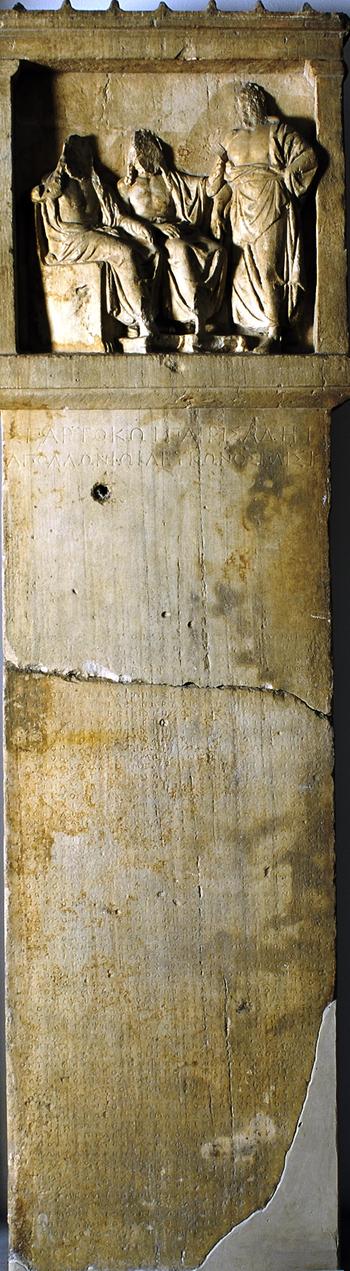
As for methodology, we are faced with a prime example of the problems (and hermeneutic opportunities) entailed in seeking to understand the processes by which such a relief was designed, made and paid for. At the same time, we face too the key, related, question of how the monument was viewed after its erection. We shall see in the present instance that – as usual – our inscribed decree says not a word about the overall design of the stele. There is nothing about the scale of the monument, which is tall (2.17m) and broad enough (0.55m). No word either about the inclusion of a relief, and nothing about the image to appear there, nor indeed about the painting which will have occupied the large, empty space we now have at eye level, between the heading of the text and its main body. Such silence is entirely normal in the monumentalisation of Athenian public documents, but it is especially striking in a case where (as here) the decree demonstrates specific concern with location, and an unusual location at that.Footnote 13 These are abiding problems in any attempt at a holistic understanding of these monuments, and they will not be solved here. However, consideration of this particular Bosporan case may contribute to our understanding of more wide-ranging issues of process and payment, and also to exploring the broad relationship of text and image in such monuments. For it will be argued that examination of the relief shows that its relationship with the accompanying text, while entirely rational, is less straightforward than seems often to have been assumed. Meanwhile, it must be acknowledged that our ignorance of the lost painting (sometimes imagined as three crowns, perhaps rightly) is an abiding difficulty for any attempt to consider the stele as a whole.Footnote 14
Some further general issues are also worth stressing before we turn to the relief and its text in more detail. First, the dynamic relationship between image and text, to which Blanshard in particular has drawn important attention. As he has stressed, two principal discourses are at play on monuments which bear both text and image, as in the case of our stele. As he puts it, the ‘oblique relationship between image and text draws the viewer into an exercise in constructing meaning’.Footnote 15 This is because there is a key difference between the language of the text and the ‘language’ of the image. That difference creates a particular set of problems in understanding and interpretation for the viewer, faced with two kinds of ‘picture’ (image and text). The relationship created is especially hard to grasp, because its two parts operate in different modes. While the priority of one over the other may be claimed and contested in different ways (e.g. what was sculpted first, what was looked at first and so on, with scope for difference from case to case), the more important matter is that the resulting monument – the stele placed on display – contained and projected both kinds of discourse. It is entirely appropriate that we consider gaps and all manner of disconnect between text and image here, but the coexistence of these profoundly different discourses must also be appreciated in a constructive sense. The presentation of two discourses might in principle be a source of uncertainty and, conceivably, may even have been deliberately used in that way, as has been suggested (especially, Elsner Reference Elsner2015). However, we might see here instead a presentation of two congruent ways towards the viewer's understanding and interpretation of the monument. In short, for all the problems that might be generated by the use of these different discourses in ‘oblique relationship’ on the same stele, it was entirely possible that much the same interpretation was encouraged by both. By and large, as I shall argue in our Bosporan case, the Athenian state (with its officers and other principal stakeholders in the creation of such monuments) had more to lose than to gain by creating monuments which were incoherent, slippery or even disruptive in any strong sense.Footnote 16
In the case of documentary reliefs, two kinds of ‘picture’ were put on show together, in a relationship that was neither explained nor obvious. While the word-picture of the text is explicit enough (however problematic in its own right), the image (as with the relief of our stele) is more open to the viewer's interpretation and, at the same time, can evoke and express much more than words, often in a way that is more attractive to the gaze and more immediately interesting for the uncommitted majority, not least through its snapshot brevity. The main issue here, I suggest, is not whether text illustrates image or vice-versa, or how far it does so (Blanshard has taken us well beyond such questions), but the fact that image and text combine on the monument to address and express the same decree in very different modes. In result, for example, a stele may bear an image which shows figures who appear nowhere in the accompanying text of a decree.Footnote 17 In the discourse of the image, their appearance is (or at least is often) nevertheless entirely appropriate to the decree and expressive of its central concerns. As we shall see in our Bosporan case, relief and text together constitute a single monument, and in their different discourses contribute to its broad message and record. Secondly, there are evidently at least two different creative forces at work in regard to the monument.Footnote 18 While, in broad terms at least, the text of the decree was established in public debate, the image was almost certainly not, however much there may have been informal discussions among key individuals. Indeed, there is no indication that the presentation of the text was debated much either, for example with regard to scale and decisions about where larger or smaller lettering might be used. The most important figure here is the secretary of the Boule, who – as in our Bosporan case – is given the responsibility for the creation of the monument as a whole and its erection at the place specified.Footnote 19 It is not hard to appreciate the advantages of that procedure: to decide collectively on details of the stele would have been a potentially lengthy process, with limited benefit. It was enough to set out key factors – total cost to the state, fund to be used, kind of stone, location – and leave the rest to an official who could be held responsible. In what follows, we shall look especially closely at the role of this individual and also consider possible influences upon him, both in ideas and in practical matters, especially costs. As far as we can guess, it must usually have been the secretary's decision (under whatever pressures and influences) whether to have a relief or other image at all.Footnote 20
We may have sympathy for the secretary. To design a relief was no simple matter. Any attempt to present – in whatever sense - a complex set of decisions (the decree) in a single image could only raise issues of selection (omission as well as inclusion), emphasis, appropriateness, and more besides. The decree was established first (though not necessarily made first in stone), so that the relief must be substantially a response to that decision. At the same time, the relief and the whole representation constituted by the monument, letters and all, were of prime importance to all stakeholders, including the state, its officials, the honorands and their associates, and (no doubt in different degrees) the viewing public, whether Athenian, Bosporan or other. The fact that our relief stood forth at the head of the tall monument, drawing the viewer's gaze, and could be taken in at a glance – however imperfectly – further indicates its importance to the function of the monument and thus the publication and memorialisation of the state's act and (in our case) the recipients’ honours, and their relationship more generally with Athens. Therefore, given the huge importance of presentation here, especially in the relief, and the power in this regard handed to the secretary of the Boule in particular, it is remarkable that we hear nothing about the contesting of his choices or any attempt at his prosecution in regard to design or cost. Contemporary silence on these issues, such as we find in our extant data, is all the more noisy in view of the importance and controversy surrounding the whole phenomenon of public honours in the fourth century.Footnote 21 In principle, explanation of this silence might be sought in terms of a measure of general tolerance or insouciance about such reliefs and monuments: after all, it was the text, not the relief or any painting, that formally monumentalised the decisions taken by the state, as laid down in the decree. However, the importance of the secretary's choices was considerable, even so.Footnote 22 We are left to wonder how secretaries avoided formal attacks, though we need not assume that they managed to escape informal criticism of one kind or another. Possibly we have here a cause of the tendency to artistic conservatism that has been observed in these reliefs (Palagia Reference Palagia and Palagia2006, 148–9). Nor should we underestimate the secretary's scope for taking advice and consulting, not least with his chosen craftsmen. This was especially important in the case of honorands, for there had to be some care to ensure that the monument pleased them, or at least did not give offence and so torpedo the very decision it sought in its way to represent, all the more so where honorands gave money for the relief and more. These public documents show time and again how far cost was a prime concern to the state, including the control and management of this public expenditure. Significant criticism of any kind was likely to be forestalled if the secretary provided money from his own resources, or brought to bear money from honorands or their supporters (possibly including those who proposed honours). A secretary with disposable wealth or the ability to raise such funds, and perhaps strike a good deal with his chosen craftsmen, had an opportunity to use honours for others as a means to monumentalise himself in a fashion that proclaimed his own achievement, which might in due course be honoured by the state in turn.Footnote 23
Our Bosporan case is characterised by unusual wealth, so that it is not hard to imagine the provision of funds by the rich honorands or their envoys, agents, friends and would-be associates. There was a real opportunity here for an ambitious secretary. His office had given him a place in the network of the rich and influential through whom Athens’ dealings with the Bosporus, its rulers and envoys, were mediated. An able secretary might well seek to turn that advantage into a means of future success in whatever ways he chose, not least financial. Only the boldest of secretaries is likely to have resisted pressures from these Bosporan circles. While we have no direct details about how such matters were played out in this case or more widely, the potential is considerable, a further context for our stele and its relief. There was every reason for the secretary to make choices about the relief, as all else, in a way that would satisfy the priorities and desires of the Bosporans. We may have some doubts, of course, about the extent to which the rulers of the Bosporus cared about the stele itself, but such indications as we have suggest that they will have had a keen interest. Clearly the Athenians believed that the specific act of creating and displaying such an inscribed record would inspire honorands to further benefit them, as is made explicit in honours for Pellana inscribed at much this time.Footnote 24 It has been well observed that the bestowal of honours meant little if it was not accompanied by publication, so that the event and the nature of the honours might be better known (Lambert Reference Lambert and Lambert2011, 200). We should observe too that honours may well have entailed the oral announcement of honouring at public gatherings, and the show of crowning, as in our example.Footnote 25 After the initial decision to inscribe the decree (by no means automatic), the finished stele was itself among the honours bestowed on the honorand.Footnote 26 In our Bosporan case, we shall see that this was also the augmentation of an earlier monument, near which the stele was to be placed. In Athens at least, the Bosporan elite was more than happy to accede to the Athenians’ high opinion of themselves, when it suited. We see the Bosporan aristocrat of Isokrates’ speech doing that half a century earlier, albeit under different circumstances.
THE STELE: TEXT AND IMAGE(S)
The large stele (Fig. 1) is divided physically into two parts. At its head we see the large relief, whose substantial frame has several functions. The ‘tiled’ roof above takes us into an interior, perhaps a palace, where two figures are seated side-by-side and a third stands, at the right side, from the viewer's perspective, an imposing presence as he leans over the seated pair. The frame barely contains this scene. However, its lower portion sets the (high) relief apart from the rest of the stone below, which has a flat surface. Of course, this flat surface is not featureless. This large, lower portion of the stele consists of three sections, made visually distinct. From the top downwards, the viewer first sees a short text, whose letters are significantly larger than the other letters on the stone, located further down. This short text constitutes a kind of heading, which names (in the dative) three sons of Leukon, all of whom will be honoured in the subsequent text, but – importantly – in different ways and under different circumstances. The fact that this heading sits beneath the frame of the relief may well have encouraged scholars to treat it as a kind of caption to the relief above, especially as this heading names the three honorands and there are three individuals to be seen in the relief. However, we have seen that the relationship between relief and text does not work in so simple a fashion, while further problems are also to be addressed in this instance. The placing of the names in the heading bears no relation at all to the location of the figures in the relief. Apollonios’ name appears (in the second line of the heading) beneath the seated Spartokos and Pairisadaes, whose names occupy all the heading's first line. Moreover, the dative case used in this heading hardly accords with any caption-like association with the relief: ‘For Spartokos, Pairisades and Apollonios, sons of Leukon’.Footnote 27 The prominent heading points downwards to the second and so also the third section of the flat surface of the stele, which expanded upon its meaning. In the second part of the flat stone, we see nothing now, but it was evidently painted in antiquity. It seems likely enough that (as has often been claimed) three substantial crowns were depicted, one for each of the honorands. While the nature of the image remains uncertain, we must recognise the existence of this second ‘picture’ on the stele: it was not a large void.
The great stele

Below this second (painted) image, the third part of the flat stone bears the text of the decree, which incorporates another distinct feature, for the decree had with it a rider. The detailed information of the initial decree and its rider offer a particular challenge in the design of any visual representation, since there is a considerable complexity here. That may help to account for the inclusion of a further image below the relief: there is no suggestion of crowns in the relief itself. In fact, this monument may seem to be a striking case of a disconnect between relief-image and text for, at first sight, the relief seems to have scant connection with the specifics of decree and rider. But what kind of connection should we expect or hope to find? As stressed above, the two discourses of relief-image and inscribed text(s) represent their subjects in different modes. Their function is not a matter of the illustration of one by the other: this is a monument in which the two representations (with the painted image besides) are complementary and, it may be added, coalesce as a sum that is rather greater than its diverse parts.
The text of the decree, sitting at the bottom of the stele, presents the viewer with a mass of smallish letters, much less appealing to the eye than the relief, the larger letters of the heading and the painted image. This is in many ways the most important portion of the stele in that it gives the decision(s) of the state that have generated the monument. However, it does little to arrest the attention of the uncommitted. Even for those who really wanted the detail, and had the time and skills to tackle it, the compact and unrelieved mass of smallish letters will have been a challenge. We may suspect, therefore, that the overwhelming majority of those who saw the monument and perhaps stopped to give it a second glance, spent little time on this portion of the stele. If that is right (and we cannot know for sure), the importance of the secretary's practice becomes all the more clear. In effect, it is he (and such others as may have been involved by and with him) who has crafted the parts of the monument that seem to dominate the viewer's attention. This is a public document, certainly, but the secretary has overseen a design that has caused the decree and rider to be overshadowed, to say the least, by the relief, the heading and the lost painting. In terms of law, rights and honours, it was the mass of smallish letters that mattered, but in terms of presentation, perception and engagement by the public in the Piraeus (Athenians, Bosporans and others) it was the rest that mattered much more, we may infer, with the relief in pride of place.Footnote 28
When committed ancient viewers took the trouble to work through the mass of lettering, they encountered a dense set of events (past and present), details and decisions, all entailing allusion to larger matters that are explained only in part. There is considerably more in this text than many other decrees about honours, where familiar formulae recur. After the usual preamble, Androtion's proposal begins with a letter from the two Bosporan rulers (Spartokos II and Pairisades I) who have succeeded their father (Leukon). Their letter has been brought by two Bosporan envoys, whose oral contribution supported their rulers’ missive. We see that these are men of distinction in the Bosporus, no doubt with their own interests and ambitions, but Androtion's proposal maintains its focus on the two new rulers themselves, and on the message they have sent. Androtion's proposal appears as a response by the Athenians to this message from the royal Bosporans, written and oral. The initiative is reported as coming from the Bosporan rulers, who have reached out to Athens with a declaration of intent. However, since we know (and see in what follows) that there has been ongoing interaction between the Bosporus and Athens, we may retain some suspicion that this presentation is an expression of Athenian amour propre. We read further that the Athenian response to this Bosporan ‘initiative’ is to praise the two rulers as good menFootnote 29 and for the key point in their missive (and the principal basis for Athenian talk of their goodness, no doubt), namely continuity in their behaviour towards Athens from their father Leukon and even their grandfather, Satyros. That continuity is expressed in a series of more specific positions. First, the Bosporans declare that they will take care of the provision of grain for Athens ‘as their father (Leukon) took care of it’, and energetically will see to whatever else the Athenians require. Our questions are left unanswered, for those involved were well aware and the decree needed no more detail: what manner of provision was this? Only or substantially a gift? A special price? An unlimited amount? Is it significant that Leukon's previous care in these matters is specified, but not Satyros’? Had Leukon been more generous perhaps? Or was it deemed superfluous (whether in the proposal or in the version inscribed) to hark back all the way to Satyros some four decades and more before? The Athenian reply is short on detail, but clear in its overall position that, if the Bosporans do this, the Athenians will give them whatever they ask. There was a shared benefit in the open-ended commitment to support from both sides, which need never be tested to breaking point. The envoys are tasked with reporting back to their masters, whether or not they also carried a letter with them to the Bosporan palace, and a text of the decree perhaps. A similar reciprocal spirit appears again in the subsequent statement that the Athenians will continue for the Bosporan rulers the privileges that they had given to Satyros and Leukon, since the Bosporans undertook to continue the privileges bestowed by their predecessors upon the Athenians.Footnote 30 Both Spartokos and Pairisades will be crowned regularly at the Great Panathenaea in Athens with crowns of 1,000 drachmas each: it is unclear here whether Satyros or Leukon had been crowned in the same way. We may notice, however, how repeated mention of the two named predecessors assists the sense of continuity in the new privileges for the two Bosporan rulers. The terms of the proclamation (which are specified in the decree, unlike the relief and much else) are a familiar masterpiece of studied vagueness: they crown ‘Spartokos and Pairisades, the sons of Leukon, on account of their goodness and good will towards the people of Athens’. The details did not matter in this oral and dramatic form of public presentation, rather as we have inferred about the details on the stele. For the uncommitted, the overwhelming majority, the headline was enough. It is all the more interesting, therefore, that Leukon is named in the proclamation. The Bosporus itself is not named, as if Leukon's name evokes his realm sufficiently. At the same time, although the proclamation does not unpack the detail, it too evokes the key continuity from Leukon to his sons, which emerges as ever more personal and familial.
The same tendency is repeated immediately after. The Bosporan recipients of the crowns have asked (we are told) that they be dedicated to Athena Polias. The decree specifies (with or without Bosporan consultation) the formula to be inscribed then: ‘Spartokos and Pairisades, sons of Leukon, dedicated (these) to Athena, having been crowned by the people of Athens.’ As with the proclamation, Leukon's paternal presence is large in the text to be used. And here too the decree troubles to specify these words. In that sense the actions of the athlothetai and the apodeiktai are laid down, whereas the secretary of the Boule is allowed a freer hand. The decree lays down for him, ‘This decree shall be written up by the secretary of the Boule on a stone stele and placed near the stele of Satyros and Leukon, and for the writing-up the treasurer of the people shall give 30 drachmas.’ The sum is not out of line with the usual amounts expended on such decrees, which tend to be 20–30 drachmas at this time.Footnote 31 Of course, the cost here is dwarfed by the value of the crowns, but these will remain with Athena. However, we can only observe the collective insouciance about the stele, except that it must be of stone, whatever its size, design and so on, and it must be given a specific location. Once again, a concern with continuity may be seen, here in the placing of the new stele for the pair of brothers near the old one of the old pair (father and son). Otherwise, the state is concerned only to limit its expenditure to 30 drachmas: there is (as usual) nothing said to prevent the use of further funds from non-state sources. With the writing-up of the decree and the stele we reach the end of the more general concerns of Androtion's proposal. The focus has been tightly upon the two Bosporan rulers, as sons of Leukon and engaged in the continuation of his dealings with Athens, with Satyros also in the deeper hinterland of the relationship between Bosporus and Athens.
Now we are taken back to the envoys of Spartokos and Pairisades. They have been mentioned earlier, but only in passing. Suddenly they are named, as Sosis and Theodosios. As their oral contribution had suggested, these were significant figures, much more than the bearers of a letter. Androtion's proposal lays down that they are to be praised (and dined), ‘because they take care of those arriving from Athens in the Bosporus’. Their actions at home are presented in terms of effective care (epimeleia), echoing the earlier statement of their rulers’ care for the despatch of grain for Athens. At the same time, they exemplify the broader relationship between Athenians and the Bosporan elite that emerges also from Isokrates’ aforementioned speech and occasionally elsewhere. It hardly needs saying that the rulers of the Bosporus were the main power in the land (and a potentially harsh and effective one, on this Isokratean account), but it is no less clear that other relationships between the broader elite and Athenians were also very significant. The fragmented geography and different civic traditions of the kingdom not only made cohesion a fundamental problem for the kingdom, but also encouraged and facilitated all manner of interactions over which the rulers in Panticapaeum could not exercise close control even if they wished to do so.Footnote 32
The decree also makes very clear that we should not take a reductive approach to understanding the broad relationship between the Bosporan rulers and the Athenian state, quite apart from their individual and family entanglements in the city. For the decree indicates, however briefly, that there was a lot in play. Having dealt with the envoys, the decree moves on to a set of specific issues, which are unlikely to encompass all that mattered to those involved in 347/346, let alone at other times and periods. First, there is a significant debt, owed by the Athenians to Spartokos and Pairisades, who are at this point not named but identified as ‘the sons of Leukon’. Most likely they had inherited this debt from Leukon's reign, though details escape us: we need not imagine that other sons of Leukon are involved (though some possibility abides), since the decree has mentioned only the two ruling brothers so far. And they soon appear again: they had asked for naval personnel, which the Athenians were ready to provide. This is unusual and has proved controversial among scholars. For our present purposes, however, the key detail is the role of the secretary of the Boule again: ‘The envoys shall report the names of whichever personnel they take to the secretary of the Boule.’ This is especially interesting because the envoys are actually required to have dealings with the secretary, the very official who has also been tasked with the creation and erection of the stele itself. That can only offer some support for the various inferences we have drawn about the possible involvement of honorands and their associates (here Bosporan envoys) in the making of the monument, relief and all. In concluding the proposal, the naval personnel are tasked with service to, yet again, ‘the sons of Leukon’.
Androtion's proposal has been very specific in its talk of Leukon's sons. From first to last, these have been Spartokos and Pairisades, for no other son has been named: it was their letter, their envoys, their declaration of care, their privileges, their crowns, their proclamations, their dedications, their debts and their request for naval personnel to serve in the Bosporus. However, a final addition, a rider, broadens the perspective somewhat: ‘Polyeuktos, son of Timokrates of Grioa, proposed: in other respects in accordance with Androtion; but crown also Apollonios the son of Leukon from the same source.’ The introduction of another son can only remain a mystery on present evidence, for we know nothing of this Apollonios otherwise. Reasons for his omission and sudden, final addition with regard to a crown are wholly obscure. It has been asserted, for example, that his omission was a simple blunder, corrected by the rider,Footnote 33 but can we imagine so colossal an error duly commemorated on our stele? We must observe that the decree (including its rider) does not give him anything else, for he is not included in the inter-state reciprocity that precedes the bestowal of crowns in the proposal by Androtion, and that is not addressed by the rider. There is no indication at all that Apollonios had been involved in the Bosporan mission: the letter and envoys are not said to have come from him. He is not apparently involved in ruling in the Bosporus, for his omission would then be inexplicable. At the same time, however, his belated inclusion must be taken to show that he was not overtly at odds with his ruling brothers: otherwise the rider would not have been accepted. Moreover, he too is to receive a crown, under the rider, whether or not with all the performance laid down for his ruling brothers. His name appears, too, in the heading, above the painted image and subsequent text: he is named third, but nevertheless included among the sons of Leukon (a filiation repeated also in the rider). We may speculate, if we wish, about the reasons for his initial omission and belated inclusion. For example, we may wonder whether he was resident in Athens and so significant to the city's Bosporan dealings, whether public or private. That would go some way towards accounting for the lateness of his inclusion, since he would have been separate from the mission from the Bosporus, as is indicated by his absence from Androtion's proposal. However, we cannot know that, nor can we produce convincing tales of his activities more generally in view of our lack of data.
In sum, the mass of letters that features on the lower portion of the monument offers detail and diversity, but also a dominant theme. Amid all the detail, it is continuity that stands out (from past to present and actively into the immediate future),Footnote 34 the continuation of previous arrangements, privileges and attitudes in the relationship between the Athenian democracy and rulers of the Bosporus. The father–son pair of Satyros and Leukon are to be continued in the persons of the ruling pair, Spartokos and Pairisades, brothers and sons of Leukon and, most importantly, his successors on the throne. While Satyros comes and goes in the text, Leukon is ever-present even though he has died, for he is the main anchor in the central notion of continuity, to be carried on by his ruling sons. Apollonios’ arrival in the text is something of an intrusion, and not only because he comes very late indeed and in the separate rider. It is only after the rider that he can be brought into the heading and perhaps evoked by a third painted crown below it. His inclusion threatens to disturb the neat movement from one pair of Bosporan rulers to another. He is in that sense a gooseberry, however warm his relationship may have been with his ruling brothers. He evidently had no role in the letter that the envoys brought from the Bosporus, for otherwise he would have been named from the first. There must also be a question about his relationship with the elite envoys who had been sent with the letter, and who had evidently presented orally without giving significance to him. They had at least to tolerate him, for their ruling masters did, but they had shown no great interest in him, as far as we can judge. Apollonios was brought into discussion by an Athenian, Polyeuktos, who could at least point to his being a son of Leukon, whatever else might have been said for him. Crucially, however, Apollonios was not among the principal Bosporan figures of the decree, who were his two brothers, their deceased father Leukon and, in a lesser way, their grandfather Satyros. Meanwhile, the decision to specify that the stele should be located near that of Satyros and Leukon (evidently a single stone, possibly two conjoined parts) not only confirms the centrality of continuity, but also the overwhelming significance of Leukon in that continuity.
THE RELIEF: IDENTIFYING THE THIRD MAN
What kind of image might form a relief that would express (in the discourse of sculpture) the diverse set of concerns and decisions of this decree? That was the issue for the secretary of the Boule and those around him. Of course, he might have avoided the problem by not including a relief at all. However, relations with the Bosporus were no small matter. A relief was inescapable and potentially beneficial. And additional money could be found, whether from Athenians linked with the region through business, family or friendship, from Bosporans in Athens, or from the rulers and their envoys besides. Meanwhile, we have noted contacts between the envoys (important men in their own right) and the secretary with regard to the sailors. It would have been at least prudent of him to bring these men into his planning for a monument which would certainly be of prime interest to them, as also to Bosporans of the Piraeus and elsewhere. The envoys were not likely to have rushed home from Athens: they at least will have wished to return to the Bosporus with the monies owed to their masters, and that matter was postponed to the next meeting of the assembly.Footnote 35 If Apollonios was indeed in Athens, he too would be another plausible source of funds and guidance. Conceivably, his involvement might explain his name in the heading of the text and, as it seems, his crown with those of his brothers, painted immediately beneath. Meanwhile, such a painting would remove any need to show crowns in the relief: none is in the sculpture.
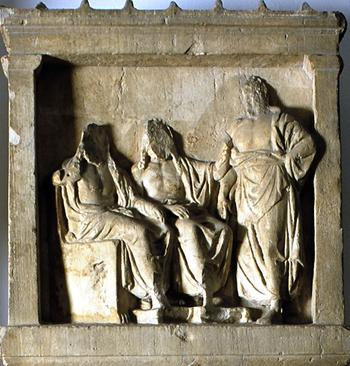
The relief-scene seems to be set in the Bosporan palace (Fig. 2). It shows, I suggest, the continuity that was central to the decree and the thinking around it. In the Bosporan palace, the succession to Leukon was fundamental. It was also key to the Bosporan relationship with Athens, which was to proceed without change from Leukon's reign to that of his sons, Spartokos II and Pairisades. We see three male figures, a seated pair and a standing figure who leans over them. The faces are missing, unfortunately, but their necks and body-positions tend to indicate that the standing figure is looking (mostly) towards the seated pair. Their angle suggests that they look back at him: the nearest of the pair has his face turned slightly more towards the standing figure.Footnote 36 At the same time, however, the seated pair gaze forward out of the frame towards any external viewer before them. All three are taken to be members of the family that ruled the Bosporan kingdom from the 430s, and I see no reason to doubt that they are indeed such.Footnote 37 Carol Lawton's clear description of the image offers a good starting-point for further inquiry. Comments and some additional detail will follow:
The relief of the huge stele is unusual in its strong characterization of the honorands and the deferential absence of any representative of Athens. The two figures on the left, probably the rulers Spartokos and Pairisades, are seated together on a large, claw-footed throne. The standing figure leaning on a staff would be Apollonios, who did not share in the rule. The brothers are depicted with beards, and Spartokos and Pairisades have long hair falling over their shoulders, an attempt at characterising them as foreigners … (Lawton Reference Lawton1995, 99)
The relief

Here Lawton displays an admirable caution about the identification of the three figures. However, she infers from the inevitable identification of the seated figures as Spartokos and Pairisades that the third figure is Apollonios. Only the most careful of scholars allow a measure of uncertainty on the matter, notably Stephen Lambert in Attic Inscriptions Online, who writes of ‘a standing figure, perhaps Apollonios’. Far more commonly, we find Apollonios identified in the relief without any hint of doubt.Footnote 38 My contention here is that this third figure is not in fact Apollonios, but Leukon, the recently deceased father of the seated Bosporan rulers.
However, we should pause to address several of the points which Lawton raises in her description, especially in view of her experience in the close study of reliefs on Athenian documents. The unusual characterisation that she observes may be explained, at least in some degree, by the fact that (as the accompanying inscription shows) two experienced Bosporan envoys have come to Athens not only as bearers of communication from their new rulers, but also to settle specific matters in the dealings between Athens and the Bosporus (notably, the debt and the sailors). We have seen that the envoys are to deal specifically with the secretary of the Boule (line 63), the office also responsible for creating the monument, and so its relief (line 45). The influential and well-connected envoys were clearly active at Athens, engaged with the democratic state as it created this stele, so that we may perhaps understand how the images of the Bosporan rulers on the stone might be unusually characterising.Footnote 39 Moreover, in the Piraeus, where the monument was placed, it would be likely enough that the relief would be seen by many (including Bosporans) who knew or had seen the men depicted. Meanwhile, we know something of the Bosporans’ concern with monuments in their own lands, where we could wish to know more about the so-called Monument of Satyros in particular.Footnote 40 The admixture of autocracy and great disposable wealth meant that the Bosporans had both the means and the desire to monumentalise themselves and their achievements. Accordingly, we should anticipate that Sosis and Theodosios the envoys, and perhaps also Apollonios, would have been enthusiastic participants in creating our stele, no doubt with a view to its nearby forerunner, substantially conversant with current practice in relief sculpture and the making of monuments. There was every reason why the Bosporans of our relief were shown in a manner that, to the experienced eye of the modern specialist, was notably characterising.
Lawton also observes the absence of an image representative of Athens in the relief, which she considers ‘deferential’, very possibly rightly in a sense. For, as we survey the business to be handled by the envoys (as set out in the accompanying inscription), we find that the Athenians not only have much to gain from the Bosporans, but also have an outstanding debt to them. While we are in a poor position to assess the balance of benefits to the two sides of this relationship, it is very clear that the Athenians benefited substantially on their side, not least in the Bosporans’ declaration that they will continue the privileges that their father Leukon had bestowed upon Athens. Overt deference need not be imagined, especially as there is no sign of that in the language of the decree, where we have also noted signs of the Athenians’ amour propre. But we may be sure that the Athenians wished to handle the Bosporan rulers and their envoys with every show of consideration and honour. Meanwhile, it is worth noting that the absence of an Athenian figure from the relief also struck Koumanoudes, who produced the first serious publication of the stone, pursuant to reports in the Greek press (Koumanoudes Reference Koumanoudes1877, 152–7). He was largely interested in the inscription itself, but chose to express some disquiet about the identification of the three figures in the relief. He even advanced (very tentatively) an alternative possibility, that the two seated figures are Leukon and his father Satyros (both named in the inscription of course), with the third figure representing an aged Athenian demos. The notion had little to recommend it, and was soon quashed by Schaefer in his report on Koumanoudes’ publication (Schaefer Reference Schaefer1878, esp. 418). However, the notion lingers (cf. Moreno Reference Moreno2007, 265 n.253), and negatives are often hard to prove. In our relief, we may note that the standing figure lacks the grandeur and scale of Demos: he is only a little bigger than the seated Bosporans. He is also too similar in type to the seated pair for Demos. Moreover, his relationship with them surely looks more familial than we should expect of Demos. While the sceptre held between the standing figure and his sons presents the passage of power, there is nothing to suggest that the standing figure is crowning or otherwise doing anything to the seated pair, as we might expect of Demos. The standing figure is imposing in his familial manner, but he lacks the importance that might be expected of Demos.Footnote 41 At the same time, however, Koumanoudes’ instinct is not to be ignored: we shall have cause to return to his sense that this third figure is somehow a figure of authority in the image.
Lawton's remarks on the two seated figures are very appropriate, though we may look harder at their interaction with the problematic third figure. They can only be Spartokos and Pairisades, whose succession to Leukon and initiative in sending the envoys to Athens on continuing his arrangements and other matters have given rise to the decree. There is little in the image or inscription to distinguish between the two brothers, though Spartokos, who is named first, may well be the elder: he died before Pairisades, leaving the latter as sole ruler. Lawton is right that they share the same seat, whose claw feet show a degree of grandeur and might suggest a throne. While its feet may evoke the griffin as well as the lion (both were important in Bosporan iconography), the very fact of a single shared seat may be taken to show the two brothers ruling together, side-by-side, a vision of harmony.Footnote 42 That was not to be assumed: a few decades later, the death of Pairisades would be followed by full-blown civil war between his sons.Footnote 43 This sense of harmony was vital to the Bosporans and hardly less important to the Athenians, for their interests in the northern Black Sea required stability. For that reason we should perceive this vision of the brothers’ harmonious joint rule (however (un)realistic it may have been) as part of the larger and central theme of continuity in the relations between Athens and the Bosporus, as well as in the Bosporan succession itself. As anthropologists know very well, a principal weakness of monarchical structures is their (mis)management of succession: the relief proclaims in text and image that the Bosporans have handled this potential crisis and proceeded beyond it to the benefit of both states and of the relationships between them and their citizens. The inclusion of Apollonios on the monument, however belated and rather marginal, might be taken to reinforce that celebration of harmony and the avoidance of conflict after the death of the mighty Leukon.
However, the third figure of the relief was not part of this joint rule between Spartokos and Pairisades: he does not sit beside them on their shared throne. Nor does he engage with the viewer, but gazes instead at the seated pair, leaning towards and over them. This marginality may seem to suit the recurrent modern view that this figure is Apollonios. Moreover, there is an alluring simplicity in seeing the three figures as the three brothers, however we may make sense of the distinction between the ruling pair and Apollonios. However, there are two immediate problems with such a view. First, it is by no means obvious why Apollonios should be depicted in this way on the relief, or at all. Second, and still more fundamentally, we have observed the methodological need to consider the different discourse of a relief, which does not illustrate its inscription in any simple way and may contain figures who are not even mentioned in such a text. If Apollonios were wanted on the relief (his marginality makes such a desire particularly uncertain), why is he shown in this pose? More importantly, what would such an image present to the world in its visual discourse? Answers might be constructed, in terms perhaps of brotherly harmony, but further questions would proliferate, first among which is what interest Athens would have in Apollonios’ interaction with his brothers. The inscribed text says nothing at all about the interaction of the three brothers, beyond stating that all are sons of Leukon. Accordingly, an image with so prominent an Apollonios would be taking the viewer in a very different direction. The difference would not reside in types of discourse, but in the identification of the key topic(s).
Lawton comments on the abundant, shoulder-length hair and the beards of the seated brothers. She and others have supported the idea that the hairstyles indicate the foreignness of these Bosporans (Lawton Reference Lawton1995, 33; cf. Allen Reference Allen2003). Inevitably so, in a sense, but we must consider what the Athenians might hope to gain from portraying their honorands as foreign. Especially so, given the grant of Athenian citizenship to the Bosporans, which is part of the continuity from Leukon's privileges. The Bosporans were foreign, certainly, but not alien: quite possibly a case was made for their Athenian blood, through the Milesian foundation of Panticapaeum and most of the rest of the Bosporus.Footnote 44 Everything we know about the rulers of the Bosporus indicates that they saw themselves as Greeks and were eager to be acknowledged as such by other Greeks. The simple view must surely prevail: this was indeed the hairstyle of these bearded Bosporans. And there is nothing strongly unGreek about it, though such hair was not the dominant fashion in Athens. Certainly, flowing locks were controversial within the democracy, bringing suggestions of elitism and oligarchy or worse,Footnote 45 but that was an issue among Athenians themselves; the Bosporans were substantially outside that ideological controversy. In any case their oligarchical-monarchical tendencies could hardly be clearer. Meanwhile, there is no sign that they flaunted their monarchy (which Athenian democracy could accommodate in any event).Footnote 46 There is a striking lack of monarchical vocabulary in this inscription. Some years earlier in 355, Demosthenes had used the standard title for a Bosporan ruler among Greeks of this period, archon.Footnote 47 While other Athenians might prefer to call them tyrants, it is evident that at a formal level the Athenian democracy found it convenient to avoid all such titles and terminology. At the same time, there is no indication that the Bosporan rulers were in any way troubled by that: the Athenian state would not have followed this practice in the face of Bosporan discomfiture or displeasure. While the flowing locks of the Bosporan brothers will have been noted by Athenian viewers (one imagines), they carried no immediately negative connotations. Meanwhile, the Bosporans who passed through or resided in Piraeus, some in close touch with their homeland and its rulers (as Isokrates 17 insists at length), presumably recognised the general likeness of the honorands as the Bosporan envoys too.Footnote 48
What is striking is the lack of such hair on the third figure. While the two seated brothers are largely indistinguishable from one another (we might consider the possibility that names were painted in the void above them), this third figure is significantly different in his hair and in some other respects. Crucially, he cuts a rather imposing figure as he stands over the brothers, leaning a little in their direction and gazing upon them. He seems a little bigger in physique, which contributes to the effect. Similarly, as his arm breaks the line of the frame of the image, he seems rather too large to be contained by it. Presumably it was a general impression of this sort that made Koumanoudes seek an authority figure here. Although powerfully built, this standing figure may well be elderly, for we see (with Lawton) that he is resting some of his weight on a long stick. While a stick in itself is no indicator of age, it combines with his lack of long hair (possibly even his baldness) and imposing stance to suggest a man of advanced years. It is perhaps worth recalling Lysias’ client Mantitheus, who says that he was sent to the Bosporus (specifically to Satyros, Leukon's father) around the end of the Peloponnesian War by his unnamed father (Lysias 16.4), for in Mantitheus’ presentation of the issue of hair and ideology, long hair was very much the style of youth.Footnote 49 In sum, our standing figure seems to be a man of mature adulthood, powerful in physique and attitude. However, that conclusion sits most awkwardly with the standard view (usually repeated as fact) that the third figure is Apollonios, for, although we know nothing about him beyond this document, his marginality to power has caused scholars to imagine him as a younger brother, not a significantly older man. Should an Apollonios not have long hair, like his brothers? In any event, it is at least troubling that this marginal brother should seem to appear in the relief in such a powerful guise.
There is no doubt that in the inscribed decree the third most important figure is in fact Leukon himself, and by some considerable distance. It is not Apollonios. From beginning to end, Spartokos and Pairisades (and Apollonios) are identified through the text as sons of Leukon. The whole cause of the mission that has generated the Athenian decree has been the death of Leukon and the succession of his sons, whose claims to rule must rest substantially upon the fact that their father was Leukon, whatever other issues may have been in play. And perhaps most important from an Athenian perspective, the Bosporans (Apollonios aside) announce that they will continue the privileges for Athens as maintained by Leukon. Turning to the relief, the identification of the imposing male now seems to be much clearer. He is not the young (?) and marginal Apollonios, but the patriarchal Bosporan and constant friend of the Athenians, Leukon.
Once we realise that the third figure is Leukon, the composition of the relief makes immediate sense. Hitherto it has not. The two ruling brothers who have succeeded Leukon, are shown in harmony and equality, seated on the same extended piece of furniture, which we may regard as a kind of double throne. Their father stands over them, mature and imposing, gazing upon them as they look out at the viewer. The nearest of the brothers raises his left hand towards his father, while his brothers hands are relaxed and low. The raised hand of the brother nearest to the standing Leukon has its palm facing forward towards the viewer, evidently with its fingers on top of what is most likely a sceptre. The use of the hand in this pose is familiar in relief sculpture, as Carol Lawton has very generously pointed out to me.Footnote 50 The sceptre-holder is most likely Spartokos, the first-named and probably senior of the pair of brothers. By placing his holding of the sceptre close beside his father, with his relaxed brother at his other side, the image not only radiates harmony, but neatly represents the succession to power in visual discourse, with Leukon watching over his sons and successors. All is stable continuity under the tiled roof of the Bosporan palace. We may also begin to appreciate why there is no figure to represent the Athenian state, for it was not Athens who had caused the succession and continuity from which the Athenians would benefit and which they were happy to support. This was a Bosporan continuity which had direct consequences of continuity in the Bosporan relationship with Athens too. In creating the relief, the continuity that is key to the inscription – centred upon the pair of brothers and their father – is picked out again and represented in visual form. The third brother, Apollonios, was also a son of Leukon, but he had no part in this continuity of rule, even if he had some practical part in the continuity of the Bosporan–Athenian relationship. He was acknowledged in the heading of the text, in large lettering, with his brothers, as well as, most likely, in the painting, even if his inclusion had needed a rider. However, he was at best superfluous and at worst disruptive in the relief vision of the passage of Bosporan rule from Leukon to his two brothers.
The decision to locate our stele near that of Satyros and Leukon seems to confirm the importance of continuity, but it may also have a bearing on the design of our relief. That would be especially important if the two were connected, though the sculpting of the sides of our stone suggests that it was not actually connected: the rectangular cuttings on its right side are probably more modern work. However, we may wonder whether the earlier relief (presuming that there was one, as seems most likely in view of the importance of the relationship) had set a precedent in some way for our relief. We may speculate that the earlier relief had featured Leukon and his father Satyros in a manner similar to that of the sons with Leukon, the sceptre poised between them. The fact that the two stelai were to be located in proximity and the overall focus on continuity would support such speculation. While there is no room for certainty here, it seems plausible to suppose that the secretary of the Boule and those around him (not least the Bosporans) responded in some sense to the earlier stele, and a positive response seems more likely than a negative one, given the success of the relationship and the reference to the earlier stele in the decree's decision to create the second.
Finally, on our relief we should note Lambert's salient (if impressionistic) point that the relief has the air of a tombstone, especially in its – wholly unnecessary – portrayal of seated and standing figures together, with some interaction: ‘In its combination of seated and standing family members the relief recalls rather strongly the style of a relief on that other major genre of inscribed stele, the funerary monument’ (Lambert Reference Lambert2018, 37–9, with quote at 37). Here, in writing of family members, Lambert means three brothers, in line with previous orthodoxy. However, given that the members of the family are, on the present argument, a deadFootnote 51 father and his two sons and successors, the funerary associations are all the more powerful and relevant. At the same time, we must consider matters of practicality. The stones of Athens, taken as a whole, suggest that sculptors were most regularly employed in the production of funerary monuments, including reliefs. Even the Athenian democracy did not produce enough decrees and the like to keep many sculptors in reliable employment. The fact that our stele was to be located in Piraeus might suggest that it would have been carved in that general vicinity. If so, the sculptor of its relief will have been far more familiar with the carving of funerary images than with work of this kind, so that evocations of a funerary scene may owe something to the sculptor's craft as well as to its inherently funerary connection.
As for broader politics, it is also worth emphasising that the Athenian democracy gave ample scope for dispute and in-fighting of all kinds. We glimpse some of that in the Bosporan case, largely around Demosthenes, but, as our decree demonstrates, there were also other Athenians who sought to benefit from the rich and powerful masters of much of the northern Black Sea.Footnote 52 The existence of several sons of Leukon, in a kingdom which tended to fragmentation, can only have generated more complexity in competition among Athenians. We do not know how many sons there may have been beyond the three of our decree. The Against Leptines of Demosthenes, about a decade before our decree, refers to Leukon and his sons in a way which has encouraged the modern view that Leukon ruled jointly with them in a formal sense. However, there is no hint of that in the inscriptions of Leukon's reign that have survived in the Bosporus, while our decree shows how a son (Apollonios) might have some significance for the Athenians, at least, without primacy in the Bosporan state.
A small and very problematic fragment of an inscription from Mytilene has been taken to show that Leukon and his sons jointly gave privileges (on duties and possibly more) in the purchase of Bosporan grain in the later years of Leukon.Footnote 53 The fragment is important in showing that it was not only to the Athenians that the Bosporans gave privileges. While we cannot know how many states may have benefited in similar ways, it is worth reflecting on the Bosporan desire to attract merchants to its distant shores at times when grain (in particular) was not hard to find more conveniently, quite apart from any more complex Bosporan agenda.Footnote 54 In any event, our Athenian decree tends to undermine the apparent support of the Mytilenian fragment for the notion of a period of joint rule by Leukon and his sons for the decree allows the real possibility that the privileges mentioned in the fragment were not a single gift by father and sons ruling together, but instead a set of privileges granted by Leukon and later continued by his successors after his death, precisely as we find in our Athenian decree. On that revised interpretation, the fragment from Mytilene (which would be a notably early koine text on the usual view)Footnote 55 would be dated rather later, to a period after Leukon's death and the confirmation of their continuation by his sons, Spartokos and Pairisades. In other words, while Demosthenes shows that Leukon's sons might be treated as key figures during his reign (we can only speculate as to which of them may have come to Athens), the fragment from Mytilene can only be used as evidence for his shared rule in the Bosporus with considerable caution, if at all.
ACKNOWLEDGEMENTS
I am grateful to the National Museum in Athens for access to the stone and photos, and also to Robert Pitt for helpful discussion. Carol Lawton has been exceptionally generous with her time and expertise. Both she and Stephen Lambert have made important improvements to an early version of this paper. Of course, all responsibility remains with the author, as usual, for the use he has made of this kindness.