Implications
This study examines nutritional sub-fertility from the perspective of the cow’s natural adaptations for coping with the twin challenges of milk production and reproduction. We show that this perspective is useful for understanding the underlying physiology and for devising robust management strategies.
Introduction
The significant decline in the reproductive performance of dairy cattle in recent decades is now well documented (Royal et al., Reference Royal, Darwash, Flint, Webb, Woolliams and Lamming2000; Berry et al., Reference Berry, Roche and Coffey2008). Cows are taking longer to return to oestrus after calving, they frequently have abnormal postpartum cyclicity, less expression of oestrus, and poorer conception rates (Butler, Reference Butler2000; Dobson et al., Reference Dobson, Walker, Morris, Routly and Smith2008). This problem is the focus of an increasingly intensive research effort to elucidate the mechanisms involved and how the different factors in the genotype-production-nutrition complex influence reproductive physiology and reproductive performance. There are a number of excellent studies that summarise this research providing both overviews (Thatcher et al., Reference Thatcher, Bilby, Bartolome, Silvestre, Staples and Santos2006; Chagas et al., Reference Chagas, Bass, Blache, Burke, Kay, Lindsay, Lucy, Martin, Meier, Rhodes, Roche, Thatcher and Webb2007; Rodriguez-Martinez et al., Reference Rodriguez-Martinez, Hultgren, Båge, Bergqvist, Svensson, Bergsten, Lidfors, Gunnarsson, Algers, Emanuelson, Berglund, Andersson, Håård, Lindhé, Stålhammar and Gustafsson2008) as well as studies of specific areas such as: endocrinology and metabolic status (Butler, Reference Butler2003; Diskin et al., Reference Diskin, Mackey, Roche and Sreenan2003; Lucy, Reference Lucy2003), metabolite – oocyte interactions (Leroy et al., Reference Leroy, Van Soom, Opsomer and Bols2008b), follicular signalling (Webb et al., Reference Webb, Garnsworthy, Campbell and Hunter2007), embryo survival (Diskin et al., Reference Diskin, Murphy and Sreenan2006), reproductive problems (LeBlanc et al., Reference LeBlanc, Duffield, Leslie, Bateman, Keefe, Walton and Johnson2002; Rhodes et al., Reference Rhodes, McDougall, Burke, Verkerk and Macmillan2003), body condition and energy balance (Berry et al., Reference Berry, Roche and Coffey2008; Roche et al., Reference Roche, Friggens, Kay, Fisher, Stafford and Berry2009), genetic effects and genomics (Veerkamp et al., Reference Veerkamp, Beerda and van der Lende2003; Beerda et al., Reference Beerda, Wyszynska-Koko, te Pas, de Wit and Veerkamp2008), and modelling of reproductive performance (Blanc et al., Reference Blanc, Martin and Bocquier2001).
In this study, nutritional sub-fertility is defined as the depression in reproductive performance arising from the antagonism between (milk) production and reproduction. We examine nutritional sub-fertility from the perspective of identifying the emergent properties associated with this condition, that is we focus more on the overall biological patterns, or conserved phenomena, that emerge when the underlying multiplicity of physiological interactions are viewed at a more holistic level. These phenomena are important because they represent the natural adaptations of the animal for dealing with variations in the nutritional environment. As such they are central to addressing the ‘why’s of nutritional sub-fertility: Why should production impair reproductive performance? Why has this only recently become evident? Finally, a very important question is: Does further selection for production imply a worsening of reproductive performance?
If we wish to answer the above questions in terms that will allow the development of improved and sustainable management and selection strategies, we need a better understanding of the cow’s natural adaptations. We need a better understanding of the underlying biology of reproduction and the life functions that either support it or compete with it. It is expected that the same adaptations play a central role in both nutritionally and genetic selection provoked depressions in reproductive performance. These conserved phenomena that link nutrition and fertility may also provide simple means to monitor and modulate reproductive performance on-farm. The latter part of the study summarizes some examples where they have been incorporated into new management tools and feeding strategies.
Why should production impair the reproductive performance?
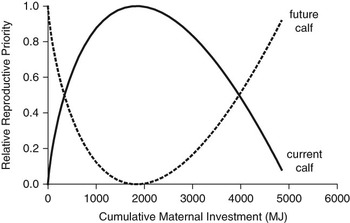
In order to be successful in evolutionary terms, the animal needs to reproduce as intensively as possible (number of viable young per unit time) whilst surviving for as long as possible (number of units of time). Different combinations of reproductive intensity and survival can result in the same level of fitness but because both processes require resources (e.g. energy) there is a trade-off between them when resources are limiting. If you expend all your energy on production there will be nothing left for reproduction, and vice versa. This notion of trade-offs can explain why artificial selection for milk production (one aspect of reproduction) has resulted in decreased conception rates (another aspect of reproduction). In this case, the trade-off is between two aspects of reproduction: investment in the viability of the current calf and investment in future offspring (Figure 1). Although lactation is a key adaptation in mammals (Pond, Reference Pond1977; Blackburn, Reference Blackburn1993; Hayssen, Reference Hayssen1993), milk becomes the central aspect of the parent-offspring conflict (Trivers, Reference Trivers1974). The calf gains most by stimulating prolonged milk production and the cow gains most by minimising milk production once the calf has attained an adequate level of viability. As the calf becomes less dependant on milk supply, the priority for the current calf can be reduced without putting at risk the maternal energy investment in the current reproductive effort (Friggens, Reference Friggens2003). In this context, we can expect that level of milk production per se has effects on subsequent reproductive performance. Even though dairy cows have undergone relatively intense artificial selection we can still expect this effect to exist because cows still have to reproduce, and also because this selection has been primarily on milk yield. Indeed, adverse effects of high milk yield on reproductive performance have been reported in a number of studies (Nebel and McGilliard, Reference Nebel and McGilliard1993) and it is clear that there is a negative genetic correlation between milk production and both calving interval and conception rates (Pryce et al., Reference Pryce, Nielsen, Veerkamp and Simm1999; Pryce et al., Reference Pryce, Coffey, Brotherstone and Woolliams2002).
The reproductive priority accorded to the current calf (solid line) relative to cumulative maternal energy investment as the cow progresses through gestation and lactation (energy used to grow the foetus and then produce milk). The reproductive priority accorded to the future calf is also shown (dashed line). This is calculated as 1 minus the priority accorded the current calf. The derivation of these curves is described by Friggens (Reference Friggens2003). Reproduced with permission.

When trying to understand the trade-off between investment in current and future reproductive effort, and how selection has affected it, two additional factors need to be considered. Once the cow has conceived, she is ‘committed’ to a considerable investment, a fitness cost in terms of both time and energy. Further, the fitness cost of a reproductive cycle that does not result in a viable calf is considerable, precious time and energy is wasted. In other words, although reproduction is vitally important it is a high-risk venture. In this context, it is not surprising that the great majority of conceptus losses occur very early in gestation, that is well before the reproductive investment is too big (Sreenan et al., Reference Sreenan, Diskin and Morris2001), or that ovulation and oestrus are suppressed under harsh nutritional conditions (Bronson, Reference Bronson1989). Not surprisingly, mammals have evolved ways to safeguard this venture, in large part through the strategic use of body reserves. (Other adaptations such as seasonality and maternal behaviour are not discussed here).
The adaptive role of body reserves for safeguarding the reproduction
The adaptive use of body reserves in support of reproduction is evident in the characteristic pattern of change in body fatness through the reproductive cycle of pregnancy and lactation. During pregnancy (in most mammals) there is an increase in body fatness and during the first part of lactation there is a decrease in body fatness. There are orchestrated endocrine changes in pregnancy and lactation that facilitate these changes in body lipid. The lipolytic response to adrenergic challenge decreases in late lactation and pregnancy and increases in the periparturient period and early lactation (Metz and van den Bergh, Reference Metz and van den Bergh1977; Chilliard et al., Reference Chilliard, Ferlay, Faulconnier, Bonnet, Rouel and Bocquier2000; Theilgaard et al., Reference Theilgaard, Friggens, Sloth and Ingvartsen2002). Lipid re-esterification rates show the opposite pattern through lactation (Chilliard et al., Reference Chilliard, Ferlay, Faulconnier, Bonnet, Rouel and Bocquier2000). These patterns are underpinned by the homeorhetic changes in the somatotropic axis (Etherton and Bauman, Reference Etherton and Bauman1998; Lucy et al., Reference Lucy, Verkerk, Whyte, Macdonald, Burton, Cursons, Roche and Holmes2009) interacting with the homoeostatic regulation of energy metabolites, primarily through insulin (Bauman, Reference Bauman2000). Leptin and other signalling molecules are also implicated (Ingvartsen and Boisclair, Reference Ingvartsen and Boisclair2001; Vernon et al., Reference Vernon, Denis and Sørensen2001). As a result, partition of dietary energy shifts progressively from favouring milk production in early lactation to favouring body reserves in late lactation (Yan et al., Reference Yan, Mayne, Keady and Agnew2006). This evidence, together with the evolutionary basis for the strategic use of body reserves, strongly suggests that the observed patterns of change in body fatness through the reproductive cycle have a major genetic component (Friggens, Reference Friggens2003; Roche et al., Reference Roche, Berry, Lee, Macdonald and Boston2007). Recently, direct evidence for genetically driven mobilisation of body energy reserves in dairy cows in early lactation has been provided (Friggens et al., Reference Friggens, Berg, Theilgaard, Korsgaard, Ingvartsen, Løvendahl and Jensen2007). Genetically driven body energy change is defined as that which would occur in cows when kept in an environment that was in no way constraining (Friggens et al., Reference Friggens, Ingvartsen and Emmans2004b). (It then follows that environmentally driven body energy change is defined as that which occurs in response to an environment that is constraining, that is it limits the energy intake).
Not only is there a genetically driven, cyclic, pattern of change in body fatness through pregnancy and lactation but also there is a strong evidence that the trajectory of body fatness through lactation is defended. Cows that have been forced off their trajectory by nutritional insult respond with compensatory changes in body fatness in early lactation (Garnsworthy and Topps, Reference Garnsworthy and Topps1982; Broster and Broster, Reference Broster and Broster1998). Decreasing the energy supply of pregnant cows in late lactation usually causes a drop in milk production rather than a mobilisation of body reserves (Friggens et al., Reference Friggens, Emmans, Kyriazakis, Oldham and Lewis1998), and cows are also resistant to overfeeding in late lactation (Ingvartsen et al., Reference Ingvartsen, Friggens and Faverdin1999). This emphasises the priority accorded to achieving the level of reserves needed to safeguard reproduction.
What happens when the cow fails, or is failing, to accumulate the reserves she needs to safeguard reproduction? The seemingly logical answer to this question is that the cow should delay committing to further reproductive investment and this seems to be the case (Knight, Reference Knight2001; Diskin et al., Reference Diskin, Mackey, Roche and Sreenan2003) but how does the physiology of the cow ‘know’ that she has failed or is failing in energy terms? We have argued that the cow does this by ‘monitoring’ body fat mobilisation and body fatness (Friggens, Reference Friggens2003). Excessive body fat mobilisation will arise in situations where environmental limitations are forcing the cow to deplete reserves faster than (genetically) planned in order to maintain desired levels of, for example, milk production. Excessive mobilisation indicates that current conditions are worse than expected and presumably it would be worth delaying further reproductive commitment. It may also be that the increased mobilisation of high-genetic merit cows is also ‘perceived’ as being excessive mobilisation. Likewise, it seems reasonable to propose that body fatness indicates the future ability of the cow to safeguard her reproductive investment. If the cow is too thin she will be entirely reliant on environmental sources of energy.
In summary, three emergent properties have been identified: milk production as an index of maternal investment, body fatness as an index of ability to safeguard reproductive investment and body fat mobilisation as an index of the current nutritional environment. In the following sections the relationship between each of these and reproductive performance is examined, in so far as this is possible given the inherent correlations between these factors, and the available literature.
Milk production and reproductive performance
In the literature, the effects of milk production on the different aspects of reproductive performance are not always easy to interpret. High production is a consequence of both high-genetic merit and good nutritional management in order to achieve this merit. Given that genetic selection for higher milk production is associated with a greater loss of body reserves (Pryce et al., Reference Pryce, Coffey, Brotherstone and Woolliams2002; Berry et al., Reference Berry, Buckley, Dillon, Evans, Rath and Veerkamp2003) the cows that have higher milk production frequently also have important differences in body fatness and body mobilisation. In this part, we will focus on the effect of milk yield per se.
The effect of milk production on delay to first ovulation is well documented but there are some discrepancies. Although delayed first ovulation is clearly related to body condition score at calving and energy balance of early lactation, it is not as clearly related to milk production. Depending on the experiment but not on herd yield, greater milk yield increased the delay to first ovulation and/or to the day of commencement of luteal activity (C-LA) (Petersson et al., Reference Petersson, Gustafsson, Strandberg and Berglund2006), decreased it (Fonseca et al., Reference Fonseca, Britt, McDaniel, Wilk and Rakes1983; Garbarino et al., Reference Garbarino, Hernandez, Shearer, Risco and Thatcher2004) or had no effect (Staples et al., Reference Staples, Thatcher and Clark1990; Darwash et al., Reference Darwash, Lamming and Woolliams1997; Gumen et al., Reference Gumen, Rastani, Grummer and Wiltbank2005; Lopez et al., Reference Lopez, Caraviello, Satter, Fricke and Wiltbank2005; Pedernera et al., Reference Pedernera, Garcia, Horagadoga, Barchia and Fulkerson2008). The effect of milk yield may also be approached by breed differences. There are significant differences between breeds in the distribution of the beginning of corpus luteum activity (Fonseca et al., Reference Fonseca, Britt, McDaniel, Wilk and Rakes1983; Disenhaus et al., Reference Disenhaus, Cutullic, Blanc and Agabriel2009). Compared with other breeds, a higher proportion of Holstein cows have a very short delay in C-LA (<20 days postpartum (pp)) or a very long delay in C-LA (>80 days pp), leading to discrepancies from the average C-LA value. As studied by Royal et al. (Reference Royal, Pryce, Woolliams and Flint2002) C-LA has a good heritability and is genetically related mainly to fat yield in Holstein cows, which is consistent with the effect of body reserves and body mobilisation on the beginning of luteal activity. In beef cows, C-LA is related to poor (<2) body condition score at calving but not to milk yield (Blanc and Agabriel, Reference Blanc and Agabriel2008), Based on this literature, it seems that milk yield has no major direct effect on C-LA but has an indirect effect through management of body reserves and nutritional balance (see later).
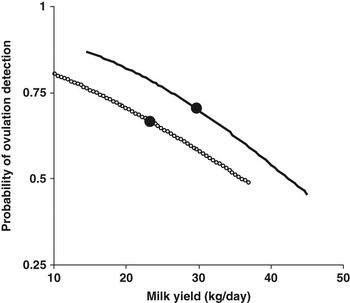
Ovulation is only the first step for investing in future reproduction. Cows also need to have associated oestruses. Using a 24/24 h survey, Kerbrat and Disenhaus (Reference Kerbrat and Disenhaus2004) have shown that only around 50% of Holstein cows actually have standing oestruses and that the duration of oestruses is strongly decreased compared with that of cows 20 years ago. Duration of oestrus was clearly related to milk yield as was likelihood of standing to be mounted (Lopez et al., Reference Lopez, Satter and Wiltbank2004) relative to walking activity (Yaniz et al., Reference Yaniz, Santolaria, Giribet and Lopez-Gatius2006). However, in these studies, milk yield and energy balance were strongly positively correlated. In a recent study, we have demonstrated that – independent of body condition loss – high milk yield was associated with fewer standing oestruses and more oestruses that had only slight behavioural expression (Cutullic et al., Reference Cutullic, Delaby, Causeur, Michel and Disenhaus2009a). In this study, two feeding strategies were used before mating, a high one leading to high milk yield and moderate loss of body condition and a low one leading to low milk yield and high loss of body condition. In a second experiment, we observed that ovulation detection rate was higher in the low group v. the high group (77% v. 60%, N = 254 and 282; P < 0.001; Cutullic et al., Reference Cutullic, Delaby, Michel and Disenhaus2009b). Ovulation detection rate was related to milk yield during the week of oestrus (Figure 2). One underlying mechanism for the negative effect of milk yield on oestrus behaviour was explored by Wiltbank et al. (Reference Wiltbank, Lopez, Sartori, Sangsritavong and Gumen2006). As high milk yield is supported by high-dry matter intake and consequently high-blood flow in the liver, oestrogen and progesterone catabolism may be increased in high-milk yielding cows. Lower circulating oestrogen concentrations would decrease behavioural expression. This provides evidence for a mechanism by which higher milk yields (investment in the current calf) delay investment in the future calf that is commencement of a new reproductive cycle. There may also be effects at the level of oestrogen production by the ovary and receptivity to oestrogen at the level of the brain (Leroy et al., Reference Leroy, Van Soom, Opsomer, Goovaerts and Bols2008c).
Probability of detecting ovulation by œstrous behaviour according to average milk yield in the week of oestrus in Holstein (—, n = 255 ovulations) and Normande (°°°, n = 332) dairy cows submitted to a either high or low feeding level. Probabilities were predicted in a model accounting for the presence of a herdmate in oestrus, oestrus observation period (breeding period or before), body condition score over the week of oestrus centred within breed, breed, milk yield over the week of oestrus and the interaction between these two variables. The milk yield effect is highly significant (P < 0.0001). Data from Cutullic, Delaby and Disenhaus (unpublished).

A high occurrence of abnormal postpartum cyclic activity (Opsomer et al., Reference Opsomer, Coryn, Deluyker and De Kruif1998; Opsomer et al., Reference Opsomer, Grohn, Hertl, Coryn, Deluyker and de Kruif2000; Petersson et al., Reference Petersson, Gustafsson, Strandberg and Berglund2006) is observed in modern dairy cows. More than 25% of cows show a prolonged luteal phase. This is consistent with a higher incidence of short C-LA as the cows experiencing a shorter interval to C-LA are more likely to experience a longer first luteal phase (Royal et al., Reference Royal, Pryce, Woolliams and Flint2002; Grimard and Disenhaus, Reference Grimard and Disenhaus2005; Horan et al., Reference Horan, Mee, O’Connor, Rath and Dillon2005; Petersson et al., Reference Petersson, Berglund, Strandberg, Gustafsson, Flint, Woolliams and Royal2007; Pollott and Coffey, Reference Pollott and Coffey2008). The extent to which this effect has a genetic basis is not clear. Royal et al. (Reference Royal, Pryce, Woolliams and Flint2002) has shown that prolonged luteal phases occurring at the first cycle has a quite important heritability (0.13) but concluded that there was a phenotypic effect of milk production on prolonged luteal phase incidence. Feeding strategies as described previously (Cutullic et al., Reference Cutullic, Delaby, Michel and Disenhaus2009b) have no effect on prolonged luteal phase incidence and breed has a strong impact (Horan et al., Reference Horan, Mee, O’Connor, Rath and Dillon2005; Disenhaus et al., Reference Disenhaus, Cutullic, Blanc and Agabriel2009).
The relationship between milk genetic merit and conception rate has been clearly demonstrated (Boichard and Manfredi, Reference Boichard and Manfredi1994). Quantitative trait loci for female fertility have been characterized on chromosome 3 (Druet et al., Reference Druet, Fritz, Boussaha, Ben-Jemaa, Guillaume, Derbala, Zelnika, Lechner, Charon, Boichard, Gut, Eggen and Gautier2008; Jemaa et al., Reference Jemaa, Fritz, Guillaume, Druet, Denis, Eggen and Gautier2008). Dairy heifers carrying the ‘fertil +/+’ had better non-return rates than those carrying the ‘fertil −/−‘ haplotype (Coyral-Castel et al., Reference Coyral-Castel, Ramé, Fabre-Nys, Monniaux, Monget, Dupont, Eggen, Fritz, Malafosse, Faverdin, Disenhaus, Le Mézec and Dupont2009), which clearly demonstrates that there is a genetic component to fertility even in non-lactating animals. In the same way, fertilisation of oocytes from high- compared to medium-genetic merit cows resulted in significantly lower blastocyst yield in vitro, irrespective of milk production as such (Snijders et al., Reference Snijders, Dillon, O’Callaghan and Boland2000). However, the environmental factors have at least an equivalent importance to the genetic ones. When comparing cows with similar genetic merit but with different milk yield due to different milking frequency or feeding strategies, higher milk yield leads to lower conception rates (Rémond and Pomiès, Reference Rémond and Pomiès2005; Blevins et al., Reference Blevins, Shirley and Stevenson2006; Garcia-Ispierto et al., Reference Garcia-Ispierto, Lopez-Gatius, Santolaria, Yaniz, Nogareda and Lopez-Bejar2007; Delaby et al., Reference Delaby, Faverdin, Michel, Disenhaus and Peyraud2009) mainly due to a decrease in early embryo survival as studied by Santos et al. (Reference Santos, Thatcher, Chebel, Cerri and Galvao2004). In our recent experiment (Cutullic et al., Reference Cutullic, Delaby, Michel and Disenhaus2009b), we compared 2 feeding groups: a high feeding level leading to high milk yield and moderate body condition loss and a low level leading to low milk yield and high-body condition loss. The high group had better fertilisation rates (P < 0.01) and higher late embryonic mortality rates (P < 0.05) than the low group. In this study, the effect of milk yield on conception rate and embryo survival was not related to energy deficit and thus it may be assumed to be a direct effect of milk yield. Although the underlying mechanisms are not well elucidated, some authors have suggested that this effect of milk yield is via prolactin which has modulating effects on both corpus luteum growth and estradiol follicular synthesis (Dieleman et al., Reference Dieleman, Bevers, Van Tol and Willemse1986; Ayad et al., Reference Ayad, Sousa, Sulon, Hornick, Watts, Lopez-Gatius, Iguer-Ouada and Beckers2007). Lopez-Gatius et al. (Reference Lopez-Gatius, Hunter, Garbayo, Santolaria, Yaniz, Serrano, Ayad, de Sousa and Beckers2007) has found a negative relationship between the milk yield and pregnancy-associated protein. So we can assume that body reserves and milk yield may both affect this specific stage of the reproduction process.
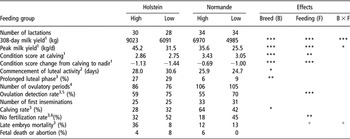
In conclusion, milk yield has an effect per se on reproductive performance, which is independent of body fatness and mobilisation (Table 1). At a genetic level, more research is needed to achieve a good knowledge. At a phenotypic level, milking frequency has a strong influence on the reproductive process. Cows milked once a day have better reproductive performance than those milked twice than thrice or four times a day regarding ovarian recovery, normality of cyclic profiles, heat expression, conception rate and embryo survival (Dransfield et al., Reference Dransfield, Nebel, Pearson and Warnick1998; Disenhaus et al., Reference Disenhaus, Kerbrat and Philipot2002; Rémond and Pomiès, Reference Rémond and Pomiès2005; Blevins et al., Reference Blevins, Shirley and Stevenson2006; Clark et al., Reference Clark, Phyn, Tong, Collis and Dalley2006; Patton et al., Reference Patton, Kenny, Mee, O’Mara, Wathes, Cook and Murphy2006; Garcia-Ispierto et al., Reference Garcia-Ispierto, Lopez-Gatius, Santolaria, Yaniz, Nogareda and Lopez-Bejar2007; Windig et al., Reference Windig, Beerda and Veerkamp2008). With feeding strategies resulting in decreased milk yield but increased loss of body condition, cows have the same overall re-calving rate following a 3 month breeding period but better oestrus expression, lower conception rate and better embryo survival (Table 1).
Summary of effects of two feeding levels with opposite effects on milk yield and body condition loss in Holstein and Normande multiparous cows (from Cutullic E. et al., Reference Cutullic, Delaby, Michel and Disenhaus2009b, and Cutullic et al., unpublished data)

1Continuous variable were analysed by variance-covariance analysis.
2Commencement of luteal activity was loge-transformed before variance analysis; given means were predicted for no genital health problem at/following calving.
3Categorical variables were analysed by logistic regression.
4Total number of ovulations of rank ⩾2, (determined by progesterone profiles analysis).
5Defined as number of detected heats/number of ovulatory periods.
6No fertilization or early embryo mortality.
+P < 0.10; *P < 0.05; **P < 0.01; ***P < 0.001.
Body fatness and reproductive performance
The proposed role of body fatness as an affector of reproduction has in the past been disputed, partly because the physiological link between the adipose cells and brain was missing and partly because it is difficult to manipulate body fat content independently from body fat mobilisation. The discovery of leptin, a hormone produced by the adipose cells that has been implicated in control of appetite (see Ingvartsen and Boisclair, Reference Ingvartsen and Boisclair2001) that is also linked to reproductive function (Hoggard et al., Reference Hoggard, Hunter, Trayhurn, Williams and Mercer1998; Spicer, Reference Spicer2001), was an important step towards understanding the physiological significance of fat reserves. This is not meant to imply that leptin explains everything, far from it. It is becoming increasingly clear that leptin is only one component of a sophisticated physiological control system by which the cow modulates follicular development, sensitivity to reproductive hormones, and the feedback to the hypothalamic-pituitary axis (Leroy et al., Reference Leroy, Van Soom, Opsomer and Bols2008b). The complexity of this physiological control system suggests that the strategic use of body reserves to safeguard reproductive function is an important adaptation of mammals.
Although there are many studies showing effects of body fatness – usually expressed as condition score – on reproductive parameters, in the vast majority of cases these changes are confounded with differences in body mobilisation and/or milk yield. There are very few experiments in cows where differences in body fatness are independent of body mobilisation (Villa-Godoy et al., Reference Villa-Godoy, Hughes, Emery, Enright, Ealy, Zinn and Fogwell1990; Wright et al., Reference Wright, Rhind, Whyte and Smith1992). However, there is evidence to be gleaned from other studies and other species. Across species, there is a general consensus that thin individuals have depressed reproductive performance (Gunn et al., Reference Gunn, Doney and Russel1972; Frisch et al., Reference Frisch, Hegsted and Yoshinaga1977; Bronson, Reference Bronson1989; Woodroffe, Reference Woodroffe1995; Adamczewski et al., Reference Adamczewski, Fargey, Laarveld, Gunn and Flood1998), although whether body fatness is the direct cause has been questioned (Bronson and Manning, Reference Bronson and Manning1991; Wade et al., Reference Wade, Schneider and Li1996).
Using beef heifers that were relatively thin at calving (condition score of 1.9; in the following all scores have been converted to a 0 to 5 scale for comparison), Lalman et al. (Reference Lalman, Williams, Hess, Thomas and Keisler2000) fed four diets of differing energy density ranging from sub-maintenance (7.5 MJ/kg) to super-abundant (11.3 MJ/kg) in early lactation. Interestingly, increasing energy density from sub-maintenance towards super-abundant, promoted greater increases in milk production than in body energy gain. Because the heifers were thin at calving, they were in positive energy balance on all treatments. Nonetheless, there was a linear decline in the length of postpartum anoestrus with increased dietary energy density. Heifers that were thin and stayed thin took longer to resume ovarian cyclicity than heifers that were able to increase their body reserves. Higher leutinizing harmone (LH) pulse frequencies have also been reported in fatter cows (score 2.95 relative to score 2.35; Wright et al., Reference Wright, Rhind, Whyte, Smith, McMillen and Prado1990). Meikle et al. (Reference Meikle, Kulcsar, Chilliard, Febel, Delavaud, Cavestany and Chilibroste2004) observed that lean dairy heifers (score 2.3) also took longer to resume cyclicity than fatter heifers (score 3.3) even though the lean heifers had lower body mobilisation in early lactation. However, this effect was not observed in multiparous cows. In both these studies, insulin-like growth factor-1 was increased in the fatter animals. In the study of Lalman et al. (Reference Lalman, Williams, Hess, Thomas and Keisler2000), increased insulin levels were associated with shorter postpartum anoestrus. Chagas et al. (Reference Chagas, Rhodes, Blache, Gore, Macdonald and Verkerk2006) reported a significant increase in C-LA for thin heifers (score 1.7) and an associated decrease in insulin and LH pulse frequency. Gong et al. (Reference Gong, Lee, Garnsworthy and Webb2002) also reported a strong negative correlation between insulin level and length of postpartum anoestrus with the differences in insulin resulting from both differences in diet composition and genetic merit of the dairy cows. In multiparous cows, Ponsart et al. (Reference Ponsart, Leger, Dubois, Charbonnier, Freret and Humblot2006) found a delayed interval from calving to first insemination for thin cows (score 2.6) as compared to adequate condition cows (score 3.5) with the same profile of condition score change in early lactation.
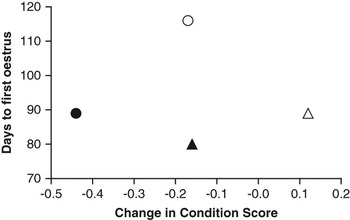
The strongest direct evidence for an effect of body fatness independent of body mobilisation in cattle comes from the study of Wright et al. (Reference Wright, Rhind, Whyte and Smith1992) who carried out an experiment with beef cattle which was designed to break the correlation between body fatness and rate of mobilisation. They applied two feeding levels in lactation to cows that had previously been made fat or thin (condition score at calving 2.85 and 2.23, respectively). As can be seen in Figure 3, this resulted in 2 of the 4 groups of cows having identical rates of condition score loss, that is body energy mobilisation, but different levels of body fatness. Despite having the same rate of mobilisation, there was a significant difference between the two levels of body fatness in the length of the postpartum anoestrus. At the same level of energy mobilisation, fat cows commenced oestrus cycling 36 days earlier than thin cows. The fat cows had significantly higher LH pulse frequencies 3 weeks post-calving than the thin cows. Using nulligravid dairy heifers, Villa-Godoy et al. (Reference Villa-Godoy, Hughes, Emery, Enright, Ealy, Zinn and Fogwell1990) also obtained differences in body mobilisation (positive v. negative energy balance) in heifers that were either moderately thin or fat (body condition score of 2.3 v. 3.3). Although the results are less clear, fat heifers in negative energy balance tended to have both a smaller area under the progesterone profile (during the first 10 to 12 days post oestrus) and a smaller luteal weight than the thin ones. Negative energy balance suppressed the subsequent progesterone response to LH of luteal cells (measured in vitro) and this suppression was more pronounced in the thinner heifers. Interestingly, for the heifers in positive energy balance the opposite effects were observed.
The effect of body fatness on the relationship between days to first oestrus and energy mobilisation measured as change in condition score. Thin cows (open symbols, condition score 2.23) have longer days to first oestrus than fat cows (solid symbols, condition score 2.85). Drawn from data of Wright et al. (Reference Wright, Rhind, Whyte and Smith1992) with 22 cross-bred beef cows per group.

Unfortunately, neither of these studies examined effects on conception rates. However, significant, positive, effects on conception rate in dairy cows of condition score at the time of insemination (Moreira et al., Reference Moreira, Risco, Pires, Ambrose, Drost, DeLorenzo and Thatcher2000) and after the period of body mobilisation have been reported (Berry et al., Reference Berry, Roche and Coffey2008). Berry et al. (Reference Berry, Roche and Coffey2008) summarised the literature reporting associations between body reserves and reproduction in terms of both phenotypic and genetic effects. The favourable correlation between condition score during lactation and conception rate was present at both phenotypic and genetic levels. Given that genetic correlations between condition scores at different time-points in lactation are close to unity and the pattern of change in condition score is highly repeatable across genotypes (Berry et al., Reference Berry, Buckley, Dillon, Evans, Rath and Veerkamp2003; Roche et al., Reference Roche, Berry and Kolver2006; Berry et al., Reference Berry, Roche and Coffey2008), this implies that a significant proportion of the effects on fertility are attributable to differences in body fatness.
Taking all this evidence together, and accepting that there is a need for further studies that explicitly break the correlation between body fatness and body mobilisation, it seems increasingly clear that body fatness should be considered a factor that can modulate reproduction independently of body mobilisation. Recognising this is important if predictions of reproductive performance are to be made in situations where cows may become thin and/or where feeding strategies provoke differences in body mobilisation independently of body fatness (e.g. Blanc and Agabriel, Reference Blanc and Agabriel2008)
Body energy mobilisation and reproductive performance
The negative effects of body energy mobilisation on reproductive performance in dairy cows are well recognised (Butler et al., Reference Butler, Everett and Coppock1981; Butler and Smith, Reference Butler and Smith1989; Butler, Reference Butler2003; Leroy et al., Reference Leroy, Opsomer, Van Soom, Goovaerts and Bols2008a). This is also a ubiquitous feature of reproduction in other mammals (Bronson, Reference Bronson1989; Schneider and Wade, Reference Schneider and Wade2000; Blanc et al., Reference Blanc, Bocquier, Agabriel, D’Hour and Chilliard2006). Numerous studies have shown a negative effect of body energy mobilisation in early lactation on days to first oestrus and conception rates (Berry et al., Reference Berry, Roche and Coffey2008). It is also clear that these effects occur independently of body fatness (Manning and Bronson, Reference Manning and Bronson1990; Wright et al., Reference Wright, Rhind, Whyte and Smith1992). However, as pointed out by Leroy et al. (Reference Leroy, Opsomer, Van Soom, Goovaerts and Bols2008a): ‘the energy required to develop, mature and ovulate a follicle, to form a corpus luteum and to maintain early pregnancy is negligible compared to the energy demands of milk production and maintenance of lactation. Thus, it is more reasonable to assume that the ‘pollution’ caused by the side products of this heavy energy traffic from the digestive tract and body reserves towards the udder, rather than a net energy shortage, is responsible for the deteriorating reproductive function in high yielding dairy animals’. Rather than viewing this as ‘pollution’ we would argue that it should be seen as an adaptive mechanism by which body energy mobilisation indexes the adequacy of current nutritional environment. Either way, substantial research effort has gone into unravelling these linkages between body energy mobilisation and reproductive function.
During early lactation, the period of greatest negative energy balance, excessive lipid mobilisation from body reserves induces an increase in plasma (NEFA) uptake by the liver and can result in a greater fatty acid (FA) esterification than FA oxidation. Circulating NEFA concentrations are absorbed by the liver where some are re-esterified to triglycerides (TG) before being secreted in blood as very low density lipoproteins (VLDLs; Herdt, Reference Herdt1988). However, when the intra-hepatic NEFA concentrations increase very rapidly, as a result of intensive lipolysis, the liver cannot increase the production of VLDL to match the rate of re-esterification of TG. This leads to TG accumulation and the development of fatty liver, inadequate gluconeogenesis (for review see Drackley, Reference Drackley1999), and decreased ureagenesis (Strang et al., Reference Strang, Bertics, Grummer and Armentano1998). The concentration of NEFA is a major determining factor of TG accumulation in the ruminant liver. Glucose supply is also an important factor to improve the ability of the liver to cope with the influx of NEFA. Moreover, recent data indicate that supplementing dry cows with a saturated source of FA is a positive strategy for priming dairy cows for body fat mobilisation in the following lactation (Andersen et al., Reference Andersen, Ridder and Larsen2008). Aberrant hepatic function has been linked to lower productivity, reduced feed intake, and poor reproductive performance in dairy cows (Herdt, Reference Herdt1988). Moreover, circulating ketones increase when the ability of the liver to oxidise NEFA and store triacylglycerol is exceeded. Walsh et al. (Reference Walsh, Walton, Kelton, LeBlanc, Leslie and Duffield2007) has shown that both the relative circulating concentration of β-hydroxybutyrate and the duration of elevated circulating β-hydroxybutyrate were negatively associated with the probability of pregnancy at first service. Elevated β-hydroxybutyrate, urea and NEFA have been shown to have detrimental effects on oocyte competence as has lowered glucose concentrations in follicular fluid (Leroy et al., Reference Leroy, Opsomer, Van Soom, Goovaerts and Bols2008a and Reference Leroy, Van Soom, Opsomer and Bols2008c).
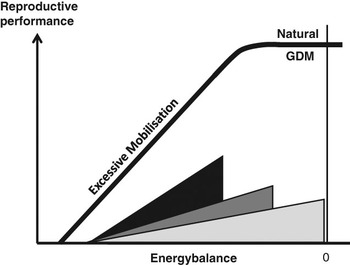
It is useful to consider that the metabolic and hormonal linkages between body lipid mobilisation and reproduction are adaptive, that they are part of the mechanisms by which the animal copes with harsh environments. In this context, the notion that any body energy change we observe, including that which occurs in early lactation, has both genetically driven and environmentally driven components is important. When genetically driven mobilisation has arisen as a natural adaptation to safeguard investment in reproduction it seems reasonable to assume that it does not affect fertility. Thus, negative energy balance is expected to have little effect on fertility until it is predominantly environmentally driven (Table 1, Figure 4). (As described earlier, environmentally driven mobilisation has a clear negative effect on subsequent reproduction). However, in modern dairy cattle a very significant portion of genetically driven mobilisation is due to artificial selection and is not as such a natural adaptation. Selection for milk production has been strongly associated with increased body mobilisation (Koenen et al., Reference Koenen, Veerkamp, Dobbelaar and De Jong2001; Dechow et al., Reference Dechow, Rogers and Clay2002; Berry et al., Reference Berry, Buckley, Dillon, Evans, Rath and Veerkamp2003). Highly selected strains of dairy cattle, for example, North American type Holstein Friesian, have a genetically greater loss of body condition in early lactation, ending up thinner at the nadir (of the condition score profile) which is usually later compared to less intensively selected strains (Koenen et al., Reference Koenen, Veerkamp, Dobbelaar and De Jong2001; Pryce and Harris, Reference Pryce and Harris2006). This selection for milk yield has skewed the trade-off between investment in current and future calf such that although the body mobilisation that occurs is genetically driven it is experienced as excessive in terms of the physiological linkages between energy metabolism and reproduction (Gong et al., Reference Gong, Lee, Garnsworthy and Webb2002; Gutierrez et al., Reference Gutierrez, Gong, Bramley and Webb2006)., It can be seen as moving the normal range of mobilisation into the zone where fertility is being shut down (as a response to a harsh environment). Comparisons of New Zealand v. North American type Holstein Friesians have shown significantly decreased pregnancy rates in the highly selected, more excessively mobilising, North American strains (Horan et al., Reference Horan, Mee, O’Connor, Rath and Dillon2005; Macdonald et al., Reference Macdonald, Verkerk, Thorrold, Pryce, Penno, McNaughton, Burton, Lancaster, Williamson and Holmes2008). These findings are supported by the reported negative genetic correlations between condition score change and fertility (Pryce et al., Reference Pryce, Coffey, Brotherstone and Woolliams2002; Royal et al., Reference Royal, Pryce, Woolliams and Flint2002; Berry et al., Reference Berry, Buckley, Dillon, Evans, Rath and Veerkamp2003; Berry et al., Reference Berry, Roche and Coffey2008).
Schematic representation of the effect of negative energy balance, that is, body energy mobilisation, on reproductive performance. Natural levels of moderate negative energy balance, that is genetically driven mobilisation (GDM), do not a priori affect reproductive performance. However, severe negative energy balance that is excessive, environmentally driven, mobilisation depresses reproductive performance. The range of negative energy balances experienceable in early lactation is shown for different genotypes by the shaded triangles representing: unselected (light), moderately selected (medium), and intensively selected (dark) genotypes, where selection is solely on milk production.

Although there is strong evidence for the effects of selection on fertility, it would be inappropriate to attribute them solely to excessive body mobilisation. Gutierrez et al. (Reference Gutierrez, Gong, Bramley and Webb2006) found delayed first ovulation in cows with high breeding values for milk production even though there were no differences in body weight change or milk production during the experiment. Likewise, Pollott and Coffey (Reference Pollott and Coffey2008) still found negative effects of selection line on C-LA after adjustment for differences in energy balance. Despite this, a major component of the negative effect of selection on fertility is due to the associated effects of selection on body mobilisation (Pryce et al., Reference Pryce, Coffey and Brotherstone2000; Pollott and Coffey, Reference Pollott and Coffey2008) even when adjusted for differences in milk yield (Pryce et al., Reference Pryce, Coffey, Brotherstone and Woolliams2002).
FAs, antioxidants and reproductive performance
Use of supplemental fats and oils in diets of dairy cows has become a standard practice in North America to potentially improve the energy balance and thus the return to normal cyclicity as soon as possible. In general, fat supplementation increases production or decreases feed intake, thus resulting in little effect on the energy balance. This is not surprising given that, as discussed above, a significant portion of energy mobilisation in early lactation is genetically driven. Although Staples et al. (Reference Staples, Burke and Thatcher1998) indicated that fat supplementation had no effect on the energy status of dairy cows, beneficial effects of feeding fat on reproduction have been reported. These supplemental fats affect reproduction by modulating the role of NEFA acting as a ‘signal’ between nutritional status and reproduction (see preceding section). In this context, the types of FA involved have been found to be important. Many studies have shown that feeding omega 3 compared to omega 6 FA improves the fertility of cows through a decrease in embryo mortality (Ambrose et al., Reference Ambrose, Kasyelic, Corbett, Pitney, Petit, Small and Zalkovic2006; Petit and Twagiramungu, Reference Petit and Twagiramungu2006). Feeding omega 3 FA such as fish oil increases the amount of omega 3 FA found in uterine lipids (Burns et al., Reference Burns, Engle, Harris, Enss and Whittier2003), which may have direct effects on reproduction. However, feeding omega 3 and omega 6 FA results in similar length of the first luteal phase, days to first rise in milk progesterone concentration, days to first luteal phase, length of first luteal phase, peak milk progesterone concentration at first oestrus cycle, area under the curve of milk progesterone at first oestrous cycle, mean milk progesterone concentration at first oestrus cycle and the number of short and normal luteal phases (Petit and Twagiramungu, Reference Petit and Twagiramungu2006).
It is largely recognised that the type of FA and not fat itself is responsible for the effects on reproduction (Lucy et al., Reference Lucy, Savio, Badinga, De la Sota and Thatcher1992). For example, feeding fishmeal, which is a source of omega 3 FAs, decreases the synthesis of series 2 prostaglandins (Thatcher et al., Reference Thatcher, Binelli, Burke, Staples, Ambrose and Coelho1997). Similar results have been observed when feeding flaxseed, another source of omega 3 FA although cows receiving a mixture of flaxseed and fish oil had higher series 2 prostaglandin secretion than those fed only flaxseed following an oxytocin challenge on day 15 of the oestrus cycle (Petit et al., Reference Petit, Dewhurst, Scollan, Proulx, Khalid, Haresign, Twagiramungu and Mann2002). Discrepancies among experiments may depend on the day of the oestrus cycle where concentrations of prostaglandins were measured. For example, Childs et al. (Reference Childs, Lynch, Hennessy, Stanton, Wathes, Sreenan, Diskin and Kenny2008) reported higher concentrations of the series 2 prostaglandin metabolite in response to an oxytocin challenge for cows fed a source of omega 6 FA (soybeans) than for those fed with fish oil on day 15 of the oestrus cycle while there was no difference on day 16 of the oestrus cycle. Grass is rich in omega 3 FAs relative to other forages (e.g. corn silage). However, following the more intensive management of dairy cows over the last decades, there has been a decreased dependence on grass as forage and a subsequent increase in omega 6 to omega 3 FA ratio in the diet (Pike and Barlow, Reference Pike and Barlow2000), which may lead to sub-fertility in dairy cows. Supplementation with omega 3 FA contributes also to enhance the reproduction through better immunity as shown by the decrease in the proliferative response of mononuclear cells transiently at the time of embryo implantation in dairy cows fed whole flaxseed (Lessard et al., Reference Lessard, Gagnon and Petit2003), which decreases embryo mortality in cows (Petit and Twagiramungu, Reference Petit and Twagiramungu2006). As Robinson et al. (Reference Robinson, Pushpakumara, Peters, Abayasekara and Wathes2002) demonstrated that dietary FA can influence both ovarian and uterine function in cows, the type of FA present in the diet will modify the composition of the membrane phospholipids of the reproductive tract, thus affecting directly the reproduction via the synthesis of different series of prostaglandins.
A high proportion of embryonic losses in establishment of early pregnancy in cattle are coincident with the period of embryonic inhibition of uterine prostaglandin F2α (PGF2α) secretion (days 15 to 17), suggesting that some losses may be occurring because certain embryos are unable to inhibit secretion of PGF2α. Therefore, strategies to further inhibit secretion of series 2 prostaglandins may result in increased embryonic survival and pregnancy rates. The production of endometrial series 2 prostaglandins is mainly governed by the rate-limiting enzyme cyclooxygenase (COX)-2, which mediates embryo implantation in the mouse (Lim et al., Reference Lim, Gupta, Ma, Paria, Moller, Morrow, DuBois, Trzaskos and Dey1999; Huang, Reference Huang2008). The most potent COX-2 inhibitor is an omega 3 FA, eicosapentanoic acid (Ringbom et al., Reference Ringbom, Huss, Stenholm, Flock, Skattebøl, Perera and Bohlin2001). In a recent study, we have shown that the expression of different genes involved in the establishment of pregnancy in embryo and endometrial tissue is strongly modified by the supply of omega 3 FA in the diet (Palin et al., Reference Palin, Brochu-Gaudreau, Beaudry, Small and Petit2005). In this experiment, 39 Holstein primiparous cows were fed one of two diets containing 10% whole flaxseed or no added fat from week 2 postpartum until day 17 of gestation. On day 17 of gestation, the uterine horns were flushed to collect embryos and biopsy samples of endometrial tissue were taken. Our results have shown that mRNA levels of COX-2 and peroxisome proliferator-activated receptors (PPARs) γ genes in the endometrial tissue were reduced by feeding flaxseed, which may indicate that the decreased synthesis of series 2 prostaglandins observed when feeding omega 3 FA may be mediated through a down regulation of COX-2 mRNA levels (Palin et al., Reference Palin, Brochu-Gaudreau, Beaudry, Small and Petit2005). Our results suggest that sources of omega 3 FA such as flaxseed can act directly on reproductive tissues to modulate expression of genes involved in FA metabolism and embryo development and survival, which may contribute to enhance fertility of cows fed with omega 3 compared to omega 6 FA (Ambrose et al., Reference Ambrose, Kasyelic, Corbett, Pitney, Petit, Small and Zalkovic2006).
Moreover, emerging evidence suggests that transcription facilitating factors such as PPAR may also play a key role in the reproduction. It was demonstrated that PPARγ and PPARδ/β are key mediators of normal blastocyst implantation and elongation in early gestation and it has been shown that COX2 mediates embryo implantation in the mouse via PPARδ/β (Lim et al., Reference Lim, Gupta, Ma, Paria, Moller, Morrow, DuBois, Trzaskos and Dey1999; Huang, Reference Huang2008). Taken altogether, these results indicate a link between the type of omega (3 v. 6) FA present in the diet, the type of prostaglandins synthesised (series 2 v. 3), and the expression of genes involved in reproduction.
Studies on the pathophysiology of unexplained infertility in humans have indicated that oxidative stress may also be one of the underlying factors of sub-fertility (Agarwal et al., Reference Agarwal, Gupta and Sharma2005). Therefore, it is highly likely that one cause of infertility in dairy cows is associated with oxidative stress. It is known that oxidative stress can damage molecules and structures with deleterious effects on cellular function (Agarwal et al., Reference Agarwal, Saleh and Bedaiwy2003). Under normal conditions, scavenging molecules known as antioxidants convert products from stress oxidation (free radicals and reactive oxygen species) to H2O to prevent their overproduction and consequent intra-cellular damage (Agarwal et al., Reference Agarwal, Gupta and Sharma2005). Some antioxidants (e.g. sesamin lignan) increase the expression of genes involved in β-oxidation of rats (Kiso, Reference Kiso2004), which may contribute to lower oxidative stress. Flaxseed hulls are rich in plant lignans, which are recognised as strong antioxidants (Prasad, Reference Prasad2000). They enhance endogenous level response by upregulating the expression of genes encoding the enzymes such as superoxide dismutase, catalase and peroxidase (Rajesha et al., Reference Rajesha, Kotamballi, Murthy, Kumar, Madhusudhan and Ravishankar2006). Our recent results (Petit et al., Reference Petit, Côrtes, Gagnon, Palin, Tao, Benchaar and Lacasse2009) have also shown that flaxseed hulls increase the activity of the enzyme superoxide dismutase in the mammary gland that is responsible for the removal of free radicals leading to oxidative stress. This may contribute for improving the reproduction. Indeed, there is a good correlation between superoxide dismutase and catalase levels in follicular fluid of women, and fertilisation and cleavage rates (Pasqualotto et al., Reference Pasqualotto, Agarwal, Sharma, Izzo, Pinotti, Joshi and Rose2004). Supplementation with antioxidants before the beginning of months of heat-stress and also during the stress period may correct the infertility due to heat-stress through decreased cortisol secretion and oxidative stress, resulting in enhanced pregnancy rates (Megahed et al., Reference Megahed, Anwar, Wasfy and Hammadeh2008).
Leroy et al. (Reference Leroy, Vanholder, Mateusen, Christophe, Opsomer, de Kruif, Genicot and Van Soom2005) has shown that even a very short (24 h) exposure to elevated NEFA levels just prior to ovulation can be detrimental to the developmental capacity of the pre-ovulatory oocyte. Moreover, Rukkwamsuk et al. (Reference Rukkwamsuk, Geelen, Kruip and Wensing2000) have shown that intensive lipolysis results in increased concentrations of linoleic acid in blood. Because linoleic acid leads to series 2 prostaglandin secretion (Abayasekara and Wathes, Reference Abayasekara and Wathes1999), this may suggest that greater availability of linoleic acid in blood following a negative energy balance (i.e. lipolysis) may contribute to increase the secretion of series 2 prostaglandins, thus resulting in poorer fertility due to the negative relationship between series 2 prostaglandin secretion and the maintenance of pregnancy. Moreover, increased body fat mobilisation will likely increase the oxidative stress of dairy cows and the susceptibility of dairy cattle to a variety of health and reproduction disorders (Leroy et al., Reference Leroy, Van Soom, Opsomer and Bols2008b). The FA and antioxidant requirements of cows will likely increase as production demands continue to escalate within the dairy industry.
Managing reproductive performance: applying biological insight
Given that the cow uses milk yield, body mobilisation and fatness as indicators, why not make use of these indicators in reproductive management? Despite the now considerable body of research on energy balance and reproduction, there have been surprisingly few initiatives to include these indicators directly in reproductive management tools. However, in recent years, some positive developments with regard to incorporating dairy cow biology into reproductive management tools have emerged that offer the potential to monitor and modulate reproductive status, two examples of these are discussed below: real-time milk progesterone monitoring and glucogenic-lipogenic feeding sequences. Although the biological principles involved are universal, the place of such tools depends on the production system being used. This is an important aspect that is frequently overlooked when discussing new applications for reproductive management. Although space precludes a full treatment of this aspect, it would be remiss of us not to evoke diversity of dairy production systems and the biological insights that are relevant. From this perspective, dairy systems may schematically be divided into three groups: intensive, intermediate, and extensive systems.
Intensive systems, represented all over the world by predominantely Holstein cows, are based on high levels of feeding with a large part of concentrates in the ration, and high levels of milk yield. For these systems, future reproductive management innovations ought to reconsider the targets in reproductive performance. It’s time to work with the cow rather than working against her (e.g. blanket use of oestrus induction). We would suggest that a short inter-calving interval (12 months) cannot be a consistent target with an increasingly high-yielding and poor body condition dairy cow, especially given that in intensive systems costs per insemination are relatively high due to use of high-genetic value bulls. The increased weight put on reproductive traits in the latest dairy cow selection indicies (Sørensen et al., Reference Sørensen, Lawlor and Ruiz2008) is one way to achieve a better balance between production and reproduction. From the management perspective, extending lactation lengths would permit rebreeding to occur later when the negative effects of early lactation on fertility have passed (Knight, Reference Knight2008). However, this approach is probably only suitable when feeding is not dependant on seasonal considerations and currently the economic benefits are not clear-cut.
Intermediate systems, frequently found in Western Europe, are based on lowering feeding cost with maximum use of forages (maize and/or pasture). In these systems, intervals to conception have to be moderate, they must not exceed 15 months, and conception rates over 50%. As the cow in these systems is mainly a Holstein cow with a high yield potential it is appropriate to manage the first weeks in lactation in order to ensure a good reproduction. The biological perspective on factors that depress reproduction has led to the proposal of some strategies to limit the peak yield and the body condition loss. It is well known that limiting nitrogen supply at the beginning of lactation limits the peak yield but this also depresses dry matter intake (DMI) (Faverdin et al., Reference Faverdin, M’hamed and Verite2003). Conversely, it has been clearly demonstrated that reducing the milking frequency at the beginning of lactation decreases milk yield (Rémond and Pomiès, Reference Rémond and Pomiès2005) without any changes in DMI, if the treatment lasts less than 4 weeks (Disenhaus et al., Reference Disenhaus, Kerbrat and Philipot2002; Patton et al., Reference Patton, Kenny, Mee, O’Mara, Wathes, Cook and Murphy2006). Cows milked once daily had shorter delay to C-LA (4 weeks, Patton et al., Reference Patton, Kenny, Mee, O’Mara, Wathes, Cook and Murphy2006) and a higher proportion of normal ovarian activity (3 weeks, 86% v. 72%; P = 0.10, Disenhaus et al., Reference Disenhaus, Kerbrat and Philipot2002). Consequently, decreasing milking frequency at the very beginning of lactation can be a good way to improve reproductive performance of dairy cows. However, the effect of once milking a day on milk yield is stronger in primiparous cows (and economically acceptable for 3 weeks postpartum (−150 kg/lactation; Disenhaus et al., Reference Disenhaus, Kerbrat and Philipot2002) but not 4 weeks (Rémond and Pomiès, Reference Rémond and Pomiès2005; Patton et al., Reference Patton, Kenny, Mee, O’Mara, Wathes, Cook and Murphy2006).
Extensive systems, common in New Zealand and Ireland, are based on the maximisation of grass resources, with no or few concentrates added. These systems are on the increase elsewhere in Europe driven by pressure for increase sustainability. They characteristically have a short calving and/or breeding season at pasture. Calving intervals have to be of 12 months and conception rates greater than 55%. Numerous studies (Horan et al., Reference Horan, Mee, O’Connor, Rath and Dillon2005; Walsh et al., Reference Walsh, Buckley, Pierce, Byrne, Patton and Dillon2008; Delaby et al., Reference Delaby, Faverdin, Michel, Disenhaus and Peyraud2009; Cutullic et al., Reference Cutullic, Delaby, Michel and Disenhaus2009b) have clearly shown that the high-yielding North American Holstein cow is relatively unsuccessful in these systems. Local Holstein types that have lower milk production potential, or other breeds and crosses, are more successful. This is likely to be due in part to the reduced milk yield at the time of insemination – and so to better oestrus detection – and in part to direct genetic differences in fertility (Cutullic et al., Reference Cutullic, Delaby, Causeur, Michel and Disenhaus2009a).
Identifying the ‘rate limiting steps’ in reproductive management according to different production systems and genotypes is clearly not a trivial task but is one that can be fruitfully addressed by developing biological models that are sensitive to changes in the environment (see also Blanc et al., Reference Blanc, Martin and Bocquier2001; Blanc and Agabriel, Reference Blanc and Agabriel2008). Such models can also serve to evaluate the benefits of new reproductive management tools in different farm types (Østergaard et al., Reference Østergaard, Friggens and Chagunda2005).
Real-time milk progesterone monitoring
Milk progesterone profiles have long been used as a research tool to detect the C-LA, occurrence of oestrus, and prevalence of abnormal oestrus cycles (Bulman and Lamming, Reference Bulman and Lamming1978; Waldmann, Reference Waldmann1993; Opsomer et al., Reference Opsomer, Coryn, Deluyker and De Kruif1998). More recently, automated in-line measurement of milk progesterone on-farm has become commercially available (Løvendahl and Friggens, Reference Løvendahl and Friggens2008) and has been shown to provide an extremely reliable means of oestrus detection as well indicating other aspects of reproductive status such as postpartum anoestrus, abnormal follicular and luteal phases, and embryonic loss (return to oestrus cycling after insemination) (Friggens et al., Reference Friggens, Bjerring, Ridder, Højsgaard and Larsen2008). It has also been estimated that this tool can be economically advantageous for the dairy producer (Østergaard et al., Reference Østergaard, Friggens and Chagunda2005).
To convert a time-series of progesterone measurements into useful information for the producer a biometric model is required to filter and smooth the data, and a biological model is required to interpret the time-series in terms of providing indications of reproductive status and diagnoses of reproductive problems. If we can detect the reproductive status of the cow we can avoid making ill-timed interventions. Further, if we take into account what the cow is trying to do, we can make more appropriate interventions – working with the cow rather than against her. The biological model is designed to do this by incorporating not only progesterone information but also other biologically relevant information such as body fatness and body mobilisation (Friggens and Chagunda, Reference Friggens and Chagunda2005). For example, when the model detects that a cow is coming into oestrus it also provides the end-user with an estimate of the likelihood of a prospective insemination succeeding, that is, is it worth inseminating the cow to the current oestrus? This is done by combining information about prior body mobilisation, prior reproductive disorders, urea status, and the features of the preceding oestrus cycle (Friggens and Løvendahl, Reference Friggens and Løvendahl2008).
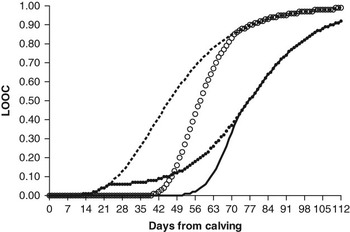
Another aspect of the model, which uses additional biological information is the diagnosis of whether the postpartum anoestrus is abnormally prolonged. Using data from closely monitored populations we constructed a function describing the likelihood of onset of oestrus cycling (LOOC) for any given cow (see base function in Figure 5). We use this (with appropriate adjustments for breed and parity) to assess on any given day postpartum the risk of prolonged anoestrus for a cow, which has shown no rise in progesterone. However, we can do better than this if we invoke the biological basis of postpartum anoestrus.
The effects on likelihood of onset of oestrus cycling (LOOC) of energy mobilisation (EMob) and body fatness (BFat). The baseline relationship between LOOC and days from calving, that is unaffected by EMob or BFat, is shown by the stippled line. The combined effects of EMob and BFat on LOOC are shown by the solid line. The separate effects of EMob and BFat are shown by the open and solid circles, respectively. In this example, the cow was assumed to mobilise a total of 2 units of body condition (0 to 5 scale) in the first 80 days from calving with the greatest rate of energy mobilisation at the start of lactation (after Friggens et al., Reference Friggens, Ingvartsen and Emmans2004b). From day 73 onwards EMob was not greater than the expected normal mobilisation and therefore ceased to affect LOOC. The cow was assumed to have a condition score of 3.5 at calving, by day 24 this had declined to below the assumed optimum of 2.5 causing a depression in LOOC due to suboptimal body fatness.

A prolonged postpartum anoestrus can arise for one of two reasons: as a perfectly natural biological response to safeguard reproductive investment or because of a failure in reproductive function (e.g. an ovarian cyst). These two conditions will respond differently to any particular treatment. They require different types of management intervention so differentiating between the two causes is potentially useful. Therefore, in the calculation of the risk of prolonged postpartum anoestrus at the individual level we make allowance for body mobilisation and body fatness. As shown in Figure 5, if the cow has less body fat than the optimum then the LOOC function is shifted ‘horizontally’ further away from parturition, the bigger the deficit in body fatness the greater the shift. Likewise, if the cow has excessive body mobilisation the LOOC function is also shifted (Figure 5). This means that the predicted risk of prolonged postpartum anoestrus is adjusted for the energetic circumstances the cow is in. Calculated in this way, the risk of prolonged anoestrus is indicating those cows that are likely to have a pathological failure in reproductive function rather than the cows that are exercising the option to delay investment in future reproduction. The latter reason for prolonged anoestrus is indicative of shortcomings in (current or past) nutritional management. As changes in nutritional management are generally made at group level, the prediction system stores the actual length of postpartum anoestrus (progesterone determined) and the corresponding calculated risk to allow evaluation at group level. By taking a biologically meaningful viewpoint we are able to derive added value from our monitoring.
Glucogenic-lipogenic feeding sequences
In addition to monitoring tools, new strategies for managing nutritional inputs to improve reproductive performance have been proposed. These strategies focus on the roles of lipogenic and glucogenic nutrients. The end products of ruminal fermentation, the volatile FAs, can be grouped into those that split readily into 2-carbon atom moieties (chiefly acetate and butyrate) and those that yield 3-carbon atom moieties (chiefly propionate). Acetate, butyrate and long-chained FA (i.e. 2-C moiety yielding) are classed as lipogenic. Propionate and those sugars and starch that escape rumen degradation (i.e. 3-C moiety yielding) are classed as glucogenic. The effects of glucogenic or lipogenic feeding (relative to control diets) were studied by van Knegsel et al. (Reference van Knegsel, van den Branda, Dijkstra, Tamminga and Kemp2005). Although there was no difference between glucogenic and lipogenic feeding in terms of milk energy output and dietary energy intake, there were significant effects on insulin and glucose, which were both increased by glucogenic feeding. As indicated previously, and in accordance with the notion of genetically driven mobilisation, lipogenic feeding does not generally alter the level of body energy mobilisation (relative to controls) even though there is decreased insulin and often elevated growth harmone (van Knegsel et al., Reference van Knegsel, van den Branda, Dijkstra, Tamminga and Kemp2005; van Knegsel et al., Reference van Knegsel, van den Brand, Dijkstra, Van Straalen, Heetkamp, Tamminga and Kemp2007a). On the glucogenic feeds, the anti-lipolytic effect of insulin usually results in a small decrease in body energy mobilisation. Because these diets affect body mobilisation and hormones and metabolites implicated in some reproductive effects (Gong et al., Reference Gong, Lee, Garnsworthy and Webb2002; van Knegsel et al., Reference van Knegsel, van den Brand, Graat, Dijkstra, Jorritsma, Decuypere, Tamminga and Kemp2007c; Leroy et al., Reference Leroy, Van Soom, Opsomer and Bols2008b) effects on reproductive performance were anticipated. However, across the limited number of feeding trials that reported reproductive performance no clear-cut general effects of glucogenic or lipogenic feeding were found (van Knegsel et al., Reference van Knegsel, van den Branda, Dijkstra, Tamminga and Kemp2005).
One reason for the lack of a clear-cut effect could have been that there may be opposing effects of glucogenic feeding on different aspects of reproductive function. Gong et al. (Reference Gong, Lee, Garnsworthy and Webb2002) found, at equal levels of milk production and energy balance, that the increased insulin from a glucogenic diet significantly increased the proportion of cows ovulating at 50 days postpartum. However, there is also evidence that high concentration of blood insulin has negative effects on oocyte quality (Fouladi-Nashta et al., Reference Fouladi-Nashta, Gutierrez, Garnsworthy and Webb2005). These observations led to the proposal of a strategy of glucogenic feeding to give a high insulin level and thereby reduce the length of the postpartum anoestrus, followed by more lipogenic feeding to lower insulin levels and improve oocyte developmental quality (Garnsworthy et al., Reference Garnsworthy, Sinclair and Webb2008c). In this context, dietary fat supplementation increases the size and estradiol secreting capacity of pre-ovulatory follicles and provides the substrates for enhanced progesterone secretion (Leroy et al., Reference Leroy, Van Soom, Opsomer and Bols2008b). Lipogenic diets may reduce insulin (Garnsworthy et al., Reference Garnsworthy, Lock, Mann, Sinclair and Webb2008b) as well as improving blastocyst development rate (Fouladi-Nashta et al., Reference Fouladi-Nashta, Gutierrez, Gong, Garnsworthy and Webb2007). Using synchronised multiparous Holstein cows (n = 30), Garnsworthy et al. (Reference Garnsworthy, Lock, Mann, Sinclair and Webb2008a) showed that glucogenic diets tended to be detrimental for oocyte quality. Increasing levels of FA supplementation did not markedly affect oocyte quality although progesterone post-ovulation was depressed with zero FA inclusion (Garnsworthy et al., Reference Garnsworthy, Lock, Mann, Sinclair and Webb2008b). Van Knegsel et al. (Reference van Knegsel, van den Brand, Dijkstra, Van Straalen, Jorritsma, Tamminga and Kemp2007b) offered 3 diets from 3 weeks before calving until 9 weeks after calving: glucogenic, lipogenic, and a 50 : 50 mix of the two. They found no effect of diet on reproductive parameters in primiparous cows (n = 21). However, they reported a tendency for the postpartum anoestrus period to be shorter in multiparous cows (n = 55). Interestingly, the glucogenic diet did not affect insulin concentration in the primiparous cows.
The results of testing glucogenic-lipogenic feeding strategies (van Knegsel et al., Reference van Knegsel, van den Brand, Dijkstra, Van Straalen, Jorritsma, Tamminga and Kemp2007b; Garnsworthy et al., Reference Garnsworthy, Fouladi-Nashta, Mann, Sinclair and Webb2009) do not yet, on their own, make an overwhelming case for this approach to be applied. We currently lack larger studies and demonstration of clear-cut differences. However, the glucogenic-lipogenic approach does build on a solid basis of physiological evidence (Leroy et al., Reference Leroy, Opsomer, Van Soom, Goovaerts and Bols2008a and Reference Leroy, Van Soom, Opsomer, Goovaerts and Bols2008c) and fits well with the emergent biological phenomena described above. (It has previously been shown that emerging research results can be given added value if they concord with an underlying biological rationale (Friggens et al., Reference Friggens, Andersen, Larsen, Aaes and Dewhurst2004a)). In early lactation, excessive body lipid mobilisation causes increased circulating NEFA and β-hydroxybutyrate, lipogenic diets also do this (van Knegsel et al., Reference van Knegsel, van den Brand, Graat, Dijkstra, Jorritsma, Decuypere, Tamminga and Kemp2007c) and both are associated with delayed return to oestrus cyclicity. Glucogenic diets, as well as moderating energy mobilisation in early lactation, can be seen as mimicking a situation of nutritional adequacy and/or lower milk production (Lucy, Reference Lucy2007) that is favourable for re-commencing reproduction. That the metabolic signals coming from glucogenic diets become progressively less favourable and those from lipogenic diets more favourable as the animal gets further from calving, and has commenced oestrus cycling, fits with the proposed effects of body fatness playing a more prominent role as an index of ability to safeguard future reproductive investment. However, it should be noted that the physiological mechanisms for such an effect are far from clear (Leroy et al., Reference Leroy, Van Soom, Opsomer, Goovaerts and Bols2008c).
Conclusions
Examining nutritional sub-fertility from the perspective of the animal’s natural adaptations for optimising the use of resources in support of reproduction permits us to better understand the relative importance of driving forces such as milk production, body fat content and body energy mobilisation on reproductive performance. This understanding can provide a framework for structuring our knowledge of the detailed physiological mechanisms involved, for devising management strategies that accommodate the reproductive drives of the animal relative to the nutritional constraints imposed by different production environments. These driving forces also provide us with biologically meaningful indexes of the reproductive status that are being incorporated into reproductive management tools.
An example of this is the combination of biological insight about milk production and body mobilisation in early lactation with recent knowledge of the effects of specific nutrients, particularly specific FA and antioxidants. This has resulted in a proposed approach of modulating the major energy metabolite pathways by glucogenic and lipogenic feeding that is likely to be one aspect used for tackling the steady decline in reproductive performance.
At present it is too soon to know to what extent the application of new reproductive management tools such as in-line progesterone monitoring and glucogenic-lipogenic feeding will improve reproductive management and outcomes in the field. What is certain is that these new approaches have great potential for further development. In-line progesterone measurement offers the potential of collecting precise data of reproductive performance on a large-scale. The widespread availability of this type of data, free of the uncertainties associated with traditional oestrus detection methods, will provide considerable benefits for future research, herd management and breeding. In this context, heritability estimates for fertility traits based on traditional measures tend to be less than 0.05 whereas when based on measures such as progesterone they may be 3 or 4 times greater (Friggens and Løvendahl, Reference Friggens and Løvendahl2008).
For such tools to fully realise their potential, they need to be applied not only to management of today’s cows but also to the development of future management and selection strategies. Some fundamental questions about reproduction and production goals still need to be addressed in the context of improving the sustainability of dairy systems. What is the optimal trade-off between, for example, reproductive longevity and production in a given type of farming system? Tackling this type of question requires an integrated, multi-disciplinary, modelling approach extending and combining biological and genetic perspectives with new physiological knowledge, and with newly available technologies.