INTRODUCTION
Several mollusk species provide valuable archives for palaeoenvironmental research (Richardson et al. Reference Richardson2001; Schöne and Gillikin Reference Schöne and Gillikin2013; Prendergast et al. Reference Prendergast, Versteegh and Schöne2017). The longevity of bivalves extends from several decades (e.g. ~44 years, Callista chione; Ezgeta-Balić et al. Reference Ezgeta-Balić, Peharda, Richardson, Kuzmanić, Vrgoč and Isajlović2011), to several centuries (e.g. ~200 years, Glycymerios glycymeris; Reynolds et al. Reference Reynolds, Butler, Williams, Scourse, Richardson, Wanamaker, Austin and Cage2013) to over half a millennium (e.g. 507 years, Arctica islandica; Butler et al. Reference Butler, Wanamaker, Scourse, Richardson and Reynolds2013). External surface rings and internal growth lines are periodically formed and clearly visible in many species (Richardson Reference Richardson2001). Therefore, in addition to being used to estimate organism age, these growth increments can provide temporary aligned data on past environmental conditions (Richardson Reference Richardson2001; Schöne and Gillikin Reference Schöne and Gillikin2013). Over the past two decades, the field of sclerochronolology has been developing rapidly, focusing on the analysis of growth (increment widths and corresponding chronology construction) and the geochemical composition of shell carbonate (e.g. stable isotopes, elements) in bivalve shells and other marine organisms, including the otoliths of fish and corals (Morrongiello et al. Reference Morrongiello, Tresher and Smith2012; Schöne and Gillikin Reference Schöne and Gillikin2013).
Several studies have successfully combined radiocarbon (14C) analysis and sclerochronological techniques. Bomb-produced 14C data has been used to validate age, growth, depositional rates and growth-increment crossdating in bivalves (e.g. Turekian et al. Reference Turekian, Cochran, Nozaki, Thompson and Jones1982; Kilada et al. Reference Kilada, Campana and Roddick2007; Kastelle et al. Reference Kastelle, Hesler, Black, Stuckey, Gillespie, McArthur, Little, Charles and Khan2011; Shirai et al. Reference Shirai, Kubota, Murakami-Sugihara, Seike, Hakozaki and Tanabe2018). Wanamaker et al. (Reference Wanamaker, Heinemeier, Scourse, Richardson, Butler, Eiríksson and Knudsen2008) used live-collected Arctica islandica shells to estimate the 14C reservoir ages of north Icelandic shelf waters. 14C data obtained from several studies of A. islandica shells were compiled by Scourse et al. (Reference Scourse, Wanamaker, Weidman, Heinemeier, Reimer, Butler, Witbaard and Richardson2012) in the analysis of the bomb-pulse in the temperate North Atlantic. Furthermore, the 14C method was successfully applied to date dead-collected Arctica islandica shells to extend chronologies based on live-collected shells (Butler et al. Reference Butler, Wanamaker, Scourse, Richardson and Reynolds2013; Holland et al. Reference Holland, Schöne, Lipowski and Esper2014) and to construct floating chronologies (e.g. Scourse et al. Reference Scourse, Richardson, Forsythe, Harris, Heinemeier, Fraser, Briffa and Jones2006; Helama et al. Reference Helama, Nielsen, Nielsen, Hanken and Evison2014; Beierlein et al. Reference Beierlein, Salvigsen, Schöne, Mackensen and Brey2015; Leesen et al. Reference Leesen von, Beierlein, Scarponi, Schöne and Brey2017). Reynolds et al. (Reference Reynolds, Butler, Williams, Scourse, Richardson, Wanamaker, Austin and Cage2013) applied 14C analysis for validating the chronology of Glycymeris glycymeris from the Sea of the Hebrides.
Despite the great possibilities for combining 14C analysis and sclerochronological research, to the best of our knowledge, this approach has not yet been applied using bivalves from the Mediterranean Sea. Previous 14C studies conducted on bivalves from this region include the application of 14C analysis on fossil shells of the date mussel Lithophaga lithophaga to date changes in relative sea level in the Mediterranean (Antonioli and Oliverio Reference Antonioli and Oliverio1996). Sivan et al. (Reference Sivan, Potasman, Almogi-Labin, Bar-Yosef Mayer, Spanier and Boaretto2006) obtained 14C dated Glycymeris nummaria shells from the Israeli coast. 14C ages have been determined in corals, bryozoans and the bivalve Lithophaga lithophaga from western Crete with the objective of interpreting recent earthquake and tectonic histories (Shaw et al. Reference Shaw, Jackson, Higham, England and Thomas2010). The bivalve mollusk museum collection from the Muséum National d’Histoire Naturelle in Paris was examined by Siani et al. (Reference Siani, Paterne, Arnold, Bard, Métivier, Tisnerat and Bassinot2000) to determine the 14C reservoir ages for the Mediterranean Sea, Black Sea and the Red Sea coasts. This includes data for four species collected in the Adriatic Sea between 1867 and 1950, i.e., Irus irus, Leda commutata, Glycymeris glycymeris and Chamelea gallina. Faivre et al. (Reference Faivre, Bakran-Petricioli, Barešić and Horvatinčić2015) provided 14C data analyzed in four bivalve species, including Mytilus galloprovincialis, Mytilaster lineatus, Mytilaster minimus and Callista chione. The samples analyzed in that study were all pre-bomb, known-age specimens from museum collections.
Our study was conducted using live- and dead-collected specimens of the infaunal bivalve Glycymeris pilosa and two dead-collected specimens of Glycymeris sp. from the North Adriatic. Although several previous studies (e.g. Legac and Hrs-Brenko Reference Legac and Hrs-Brenko1999; Peharda et al. Reference Peharda, Ezgeta-Balić, Vrgoč, Isajlović and Bogner2010) list Glycymeris glycymeris as a resident species in the Adriatic Sea, a recent study determined that this species is in fact G. pilosa and not G. glycymeris (Purroy et al. Reference Purroy, Šegvić-Bubić, Holmes, Bušelić, Thébault, Featherstone and Peharda2016). According to sclerochronological studies, G. pilosa is a long-lived bivalve (>70 years) that forms distinct annual growth lines (Peharda et al. Reference Peharda, Black, Purroy and Mihanović2016, Reference Peharda, Vilibić, Black, Markulin, Dunić, Džoić, Mihanović, Gačić and Puljas2018). These growth lines are visible both in the shell section and on the outer shell surface. Due to its longevity, G. pilosa has great potential for paleoclimate reconstructions (Peharda et al. Reference Peharda, Black, Purroy and Mihanović2016, Reference Peharda, Thébault, Markulin, Schöne, Janeković and Chauvaud2017, Reference Peharda, Vilibić, Black, Markulin, Dunić, Džoić, Mihanović, Gačić and Puljas2018).
The objectives of this study were to (1) evaluate possibilities for combining results of 14C analysis and growth increment cross-matching, (2) reconstruct the bomb curve in the northern Adriatic Sea and determining the modern reservoir age and reservoir correction, and (3) evaluate possibilities for using sub-fossil shells in absolute and floating bivalve chronologies.
MATERIAL AND METHODS
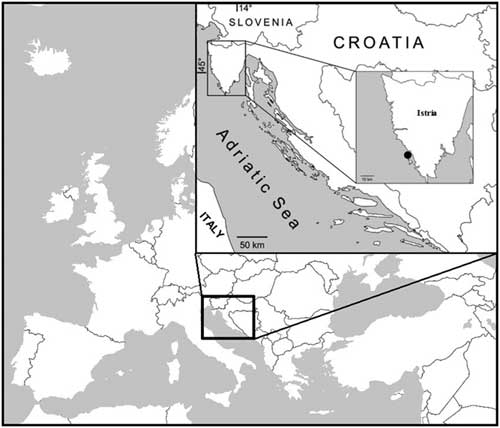
Live and dead Glycymeris pilosa shells and dead Glycymeris sp. shells were collected by SCUBA diving at 10–11 m water depth from a coastal location near Barbariga off the Istrian Peninsula, northern Adriatic Sea (44°59'7.47''N, 13°44'19.22''E; WGS84, Figure 1). Sampling was conducted in May 2015 and in March and August 2016, and samples were archived frozen. Five live-collected (S3P3, S3P7, S3P10, S3P73, S3P89), and three dead-collected shells (S3F3, S3F5, S3FP11) were selected for 14C analysis.
Map of the study area in the northern Adriatic Sea with sampling site marked by a black dot.

A chronology of live-collected specimens was prepared as part of a previous study (Peharda et al. Reference Peharda, Vilibić, Black, Markulin, Dunić, Džoić, Mihanović, Gačić and Puljas2018). Acetate peels of two dead-collected shells (S3F3 and S3FP11) were prepared using the same methodology. Specifically, the hinge area of one valve was cut and embedded in epoxy resin. The resin blocks were then cut along the axis of maximum shell growth. The surface of the cross-sections was then grinded and polished, and the polished surface was etched in 0.1 M HCl for 2.5 min. Acetate peel replicas were made by dropping ethyl acetate on the exposed cross-section followed by the application of an acetate sheet (35 µm). Hindge area of shell S3F5 was partly damaged due to boring organisms and it was not possible to prepare acetate peel of this specimen. Images of acetate peels were made using an Axio Lab A1 microscope equipped with a Zeiss AxioCam ERc 5s camera. Images of the acetate peel from individual specimens were stitched together in Image-Pro Premier.
The age of specimen S3F5 was roughly estimated by counting growth rings on the external shell surface, while the age of specimens S3F3 and S3FP11 was estimated by counting the number of increments in the acetate peel composite images. Growth increment widths for S3FP11 were measured from the margin (last deposited growth increment) toward earlier growth years using Image-Pro Premier software. Qualitative verification of cross-dating of the dead-collected specimen S3FP11 with growth increment measurement time series of live-collected shells (Peharda et al. Reference Peharda, Vilibić, Black, Markulin, Dunić, Džoić, Mihanović, Gačić and Puljas2018) was conducted using COFECHA software (Holmes Reference Holmes1983; Grissino-Mayer Reference Grissino-Mayer2001). Time series data were fitted with a cubic smoothing spline with a 15-year 50% frequency cutoff. COFECHA was also used to calculate series intercorrelation of dead-collected shells, i.e. to give an overall average comparison between individual time series for the shell S3FP11 and the average of all live-collected shells (Fritts Reference Fritts1976).
Shell material for 14C analysis was drilled using a Dremel Fortiflex drill equipped with a tungsten carbide drill bit (Komet/Gebr. Brasseler GmbH and Co. KG, model no. 835104010) at the Institute of Oceanography and Fisheries. Approximately 0.03 g of shell material was obtained for each sample. Prior to drilling, the periostracum was carefully removed from the outer shell surface by hand grinding with silicon carbide paper. Drilling was conducted parallel to the clearly visible growth lines on the outer shell surface. Samples drilled near the umbo area integrated 1–2 growth increments (1–2 years), while those near the shell margin, due to the ontogenetic reduction in shell growth, integrated between 5 and 10 growth increments. The obtained 14C data were assigned a mean calendar year of the integrated samples. Results were compared with the modeled surface ocean mixing-layer bomb curve (Reimer et al. Reference Reimer, Baillie, Bard, Bayliss, Beck, Blackwell, Ramsey, Buck, Burr, Edwards, Friedrich, Grootes, Guilderson, Hajdas, Heaton, Hogg, Hughen, Kaiser, Kromer, McCormac, Manning, Reimer, Richards, Southon, Talamo, Turney, van der Plicht and Weyhenmeyer2009) using Pearson correlation.
Powdered CaCO3 samples were prepared at the Ruđer Bošković Institute, Zagreb (Croatia), first in the form of CO2. An aliquot of the CO2 was sealed in a pyrex tube for 13C composition analysis on the isotope ratio mass spectrometer (IRMS) and another aliquot of the CO2 was transformed to graphite via zinc reduction for 14C accelerator mass spectrometry (AMS) analysis (Krajcar Bronić et al. Reference Krajcar Bronić, Horvatinčić, Sironić, Obelić, Barešić and Felja2010; Sironić et al. Reference Sironić, Krajcar Bronić, Horvatinčić, Barešić, Obelić and Felja2013). The sample 14C/13C ratio was measured on a 0.5 MeV AMS and 13C/13C ratio (δ13C) on IRMS, at the Center for Applied Isotope Studies, University of Georgia (USA). δ13C values are expressed in per mil relative to VPDB. Measured 14C/13C ratios were corrected for isotope fractionation using the corresponding δ13C values measured by IRMS and normalized to –25‰ VPDB and presented as the 14C age before present (BP) or F14C (Stuiver and Polach Reference Stuiver and Polach1977; Reimer et al. Reference Reimer, Brown and Reimer2004). For samples with a known calendar year of shell growth increment formation, F14C was corrected for the 14C decay for the time of formation and expressed as Δ14C in per mil (‰) (Reimer et al. Reference Reimer, Brown and Reimer2004; van der Plicht and Hogg Reference van der Plicht and Hogg2006). The reservoir age could be calculated only from one data point (sample Z-6169): from a shell growth increment of a live-collected specimen S3P3 which was assigned to AD 1950 by sclerochronological analysis. It was calculated as the difference between the measured 14C age (BP) of the shell growth increment from 1950 and the 14C age at AD 1950 obtained from the IntCal13 (Reimer et al. Reference Reimer, Bard, Bayliss, Beck, Blackwell, Bronk Ramsey, Buck, Cheng, Edwards, Friedrich, Grootes, Guilderson, Haflidason, Hajdas, Hatté, Heaton, Hoffmann, Hogg, Hughen, Kaiser, Kromer, Manning, Niu, Reimer, Richards, Scott, Southon, Staff, Turney and van der Plicht2013) curve. The regional offset (ΔR) was calculated as the difference between the Marine13 curve age at AD 1950 (469±23 14C yr; Reimer et al. Reference Reimer, Bard, Bayliss, Beck, Blackwell, Bronk Ramsey, Buck, Cheng, Edwards, Friedrich, Grootes, Guilderson, Haflidason, Hajdas, Hatté, Heaton, Hoffmann, Hogg, Hughen, Kaiser, Kromer, Manning, Niu, Reimer, Richards, Scott, Southon, Staff, Turney and van der Plicht2013) and the conventional 14C age for the pre-bomb sample (at 1950 AD). The calibrated dates for the sub-fossil specimens were determined using the Marine13 14C calibration curve (Reimer et al. Reference Reimer, Bard, Bayliss, Beck, Blackwell, Bronk Ramsey, Buck, Cheng, Edwards, Friedrich, Grootes, Guilderson, Haflidason, Hajdas, Hatté, Heaton, Hoffmann, Hogg, Hughen, Kaiser, Kromer, Manning, Niu, Reimer, Richards, Scott, Southon, Staff, Turney and van der Plicht2013) with the calculated ΔR value (Stuiver et al. Reference Stuiver, Pearson and Braziunas1986; Stuiver and Brazuinas Reference Stuiver and Braziunas1993).
For the two sub-fossil individual shells S3F3 and S3F5 which could not be dated by sclerochronology, Bayesian-based 14C wiggle-matching were applied for 14C data of three increments with different ontogenic ages (Bronk Ramsey et al. Reference Bronk Ramsey, van der Plicht and Weninger2001). For 14C calibration of these sub-fossil shells (S3F3 and S3F5), ΔR of –37±51 yr was used. This ΔR was calculated by applying the method described in Diaz et al. (Reference Diaz, Macario, Gomes, Álvarez-Lajonchere, Aguilera and Alves2017) on the ΔR calculated in this study (–6±32 yr) and the ΔR reported by Siani et al. (Reference Siani, Paterne, Arnold, Bard, Métivier, Tisnerat and Bassinot2000) for a bivalve shell sampled at Rovinj (–61±50 yr), which is the only other location in Istria having reported a ΔR value.
RESULTS
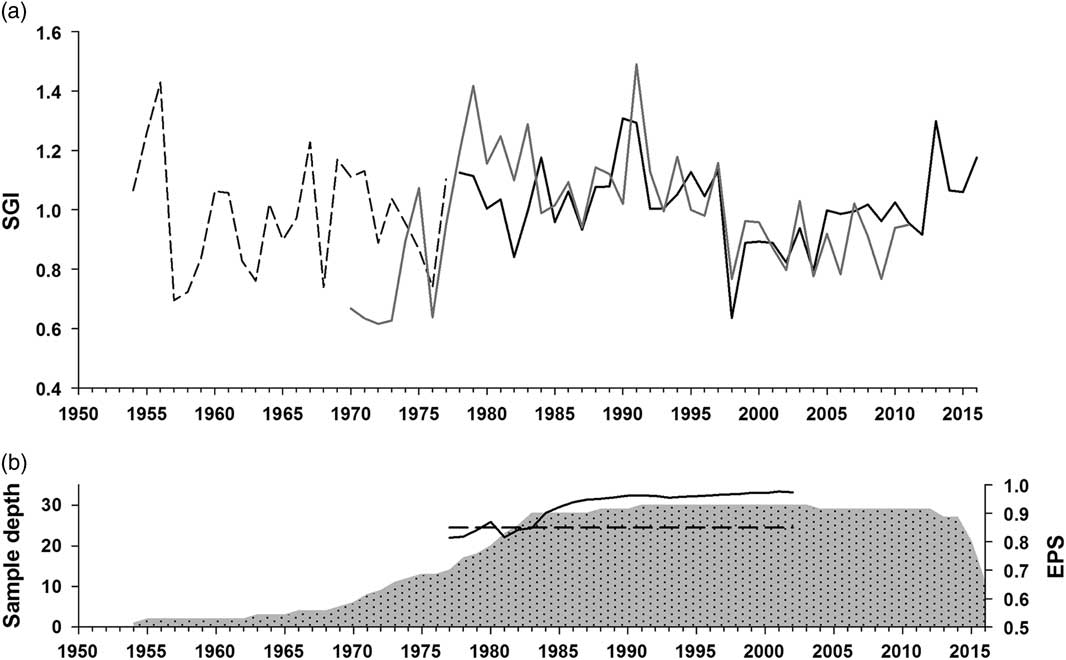
The growth increment time series obtained from acetate peels of the dead-collected shell S3FP11 covers a period of 42 years, from its sixth year of life to four years preceding its death. Based on crossdating with a master chronology constructed from live-collected individuals (Peharda et al. Reference Peharda, Vilibić, Black, Markulin, Dunić, Džoić, Mihanović, Gačić and Puljas2018), this corresponds to the time period from 1970 to 2011 (COFECHA, correlation with masters 0.511, p<0.01). The longevity of this shell is estimated at 52 years, and it was born in 1963. The standardized growth increment time series from this shell and the chronology based on live-collected individuals are shown in Figure 2.
(a) Detrended growth time series of the sub-fossil S3F11 specimen (in grey, this study) and chronology based on live-collected Glycymeris pilosa from Istria adopted from Peharda et al. (Reference Peharda, Vilibić, Black, Markulin, Dunić, Džoić, Mihanović, Gačić and Puljas2018). Statistically robust chronology back to 1978 in black solid line, prior to 1978 chronology is not statistically robust and is indicated with a dashed line. (b) Sample depth (grey area) and expressed population signal (EPS; with indicated arbitrary value of ≥0.85) associated with the chronology from Peharda et al. (Reference Peharda, Vilibić, Black, Markulin, Dunić, Džoić, Mihanović, Gačić and Puljas2018).

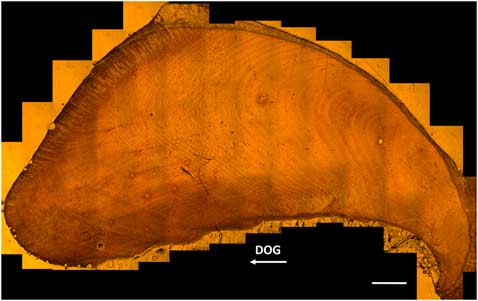
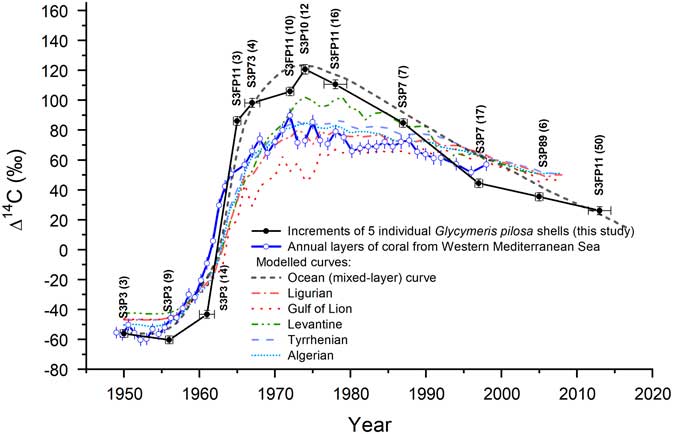
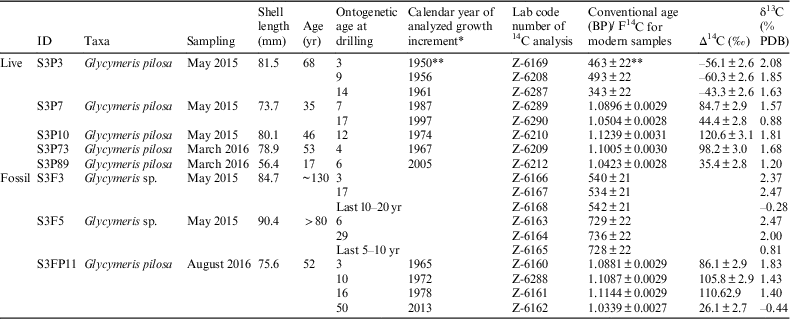
According to the analysis of acetate peels, the estimated life span of the dead-collected shell S3F3 (Glycymeris sp.) is ~130 years (Figure 3). Based on the count of growth rings on the external shell surface, the longevity of specimen S3F5 (Glycymeris sp.) was estimated at over 80 years. Data on corresponding shell lengths, and data for live-collected specimens are presented in Table 1. In the live-collected shells, samples for 14C analysis were taken from early ontogeny (in the first 17 growth increments). The corresponding calendar year was assigned on the basis of age estimated from crossdating the acetate peel replicas and the obtained data cover the period from 1950 to 2005 (Table 1, Figure 2). These data are supplemented with 14C data from the dead-collected shell S3FP11 and calendar years were assigned to samples according to results of cross-dating in COFECHA and compared to the modeled surface ocean (mixed layer) curve (Reimer et al. Reference Reimer, Baillie, Bard, Bayliss, Beck, Blackwell, Ramsey, Buck, Burr, Edwards, Friedrich, Grootes, Guilderson, Hajdas, Heaton, Hogg, Hughen, Kaiser, Kromer, McCormac, Manning, Reimer, Richards, Southon, Talamo, Turney, van der Plicht and Weyhenmeyer2009) and the annually resolved 14C record obtained by Tisnérat-Laborde et al. (Reference Tisnérat-Laborde, Montagna, McCulloch, Siani, Silenzi and Frank2013) for the coral Cladocera caespitosa from the Western Mediterranean Sea (Figure 4). The highest ∆14C values obtained correspond to the calendar year 1974. The marine 14C curve obtained from G. pilosa correlate well with the modeled surface ocean mixed-layer bomb pulse (r2=0.966, p<0.001). Based on sclerochronological and 14C analyses of live-collected material, the prebomb (AD 1950) surface ocean reservoir age and reservoir correction are estimated as 264±23 yr and ΔR is –6±32 yr, respectively, calculated as stated above from the data on sample Z-6169.
Acetate peel image of the sub-fossil specimen S3F3 (Glycymeris sp.), which has an estimated ontogenetic age of ~130 years. DOG=direction of growth. Scale bar 500 µm.

14C data for five live-collected Glycymeris pilosa shells (S3P3, S3P7, S3P10, S3P73, and S3P89) and one sub-fossil specimens of G. pilosa (S3FP11) compared with 14C record from the annual layer of coral from the Western Mediterranean Sea (Tisnérat-Laborde et al. Reference Tisnérat-Laborde, Montagna, McCulloch, Siani, Silenzi and Frank2013) and modeled curves: for surface ocean (mixed layer) (Reimer et al. Reference Reimer, Baillie, Bard, Bayliss, Beck, Blackwell, Ramsey, Buck, Burr, Edwards, Friedrich, Grootes, Guilderson, Hajdas, Heaton, Hogg, Hughen, Kaiser, Kromer, McCormac, Manning, Reimer, Richards, Southon, Talamo, Turney, van der Plicht and Weyhenmeyer2009) for Ligurnian, Levantine, Tyrrenian and Algerian Seas and the Gulf of Lyon (Ayache et al. Reference Ayache, Dutay, Mouchet, Tisnerat-Labore, Montagna, Tanhua, Siani and Jean-Baptiste2017). Labels mark shell sample, numbers in brackets mark the ontogenic year of increment growth.

Data for the analyzed Glycymeris specimens including specimen ID, taxa, collection date, shell length, longevity, ontogenetic age of drilled samples and the corresponding calendar dates, shell 14C age or F14C with 1σ, age corrected. Δ14C, for the samples with known age (σ for δ13C is±0.1 ‰) and δ13C data.

* For samples integrating several growth increments the mean calendar year value is presented. For the specimen S3FP11, calendar year was assigned based on crossdating.
** Increment used for the calculation of R and ΔR.
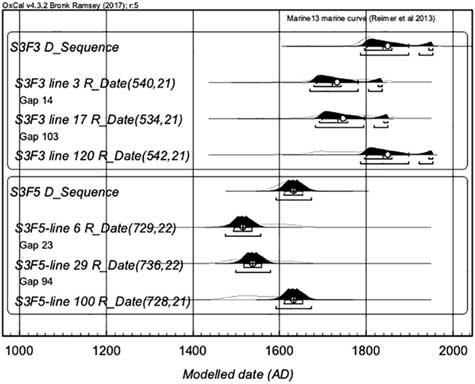
Three shell carbonate samples for 14C analysis were collected from each of the two dead-collected Glycymeris sp. shells (S3F3 and S3F5), covering early to late ontogeny (Figure 5). The sampled points on the shell growth increments correspond to the exact age of their growth: age 3 and age 6, for samples at the beginning, and ~age 110 and ~age 100 at their end (S3F3 and S3F5, respectively). By using these values, more precise dates for the beginning and the end of the shells can be determined using the Bayesian approach (Bronk Ramsey et al. Reference Bronk Ramsey, van der Plicht and Weninger2001).
Bayesian analysis of the sequence of shell increments for shell individuals F3S3 and F3S5 for ΔR set to –37±51 yr. Black areas are probability functions for the modeled calibrated 14C dates for each increment, and grey/non-filled areas are probability functions for non-modeled calibrated 14C dates. Horizontal brackets mark 68.2 % (1σ) and 95.4 % (2σ) possibilities ranges (narrower and wider brackets, respectively), rounded symbols mark mean values, brackets mark σ, + signs mark median.

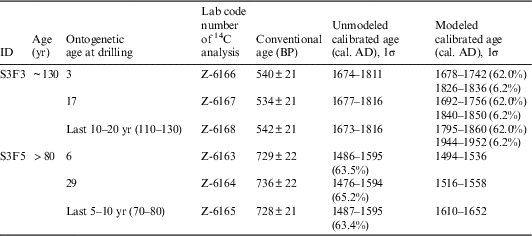
For 14C calibration and 14C wiggle-matching of the shells S3F3 and S3F5, we presumed the same and steady ΔR value during formation of both shells, which was set to –37±51 yr. ΔR was determined by the Bayesian method as applied in Diaz et al. (Reference Diaz, Macario, Gomes, Álvarez-Lajonchere, Aguilera and Alves2017), from the value reported here and bivalve shells reported in Siani et al. (Reference Siani, Paterne, Arnold, Bard, Métivier, Tisnerat and Bassinot2000) (–61±50 yr). These values were selected since they are both located off the Istrian peninsula. This is the northernmost and shallowest part of the Adriatic Sea, with maximum depths of 20–40 m, differentiating it from other Adriatic locations. Applying the 14C wiggle-matching of the shell increment gives more precise dates for the shells S3F3 and S3F5, as reported in Figure 5 and Table 2. For the last dated increment in shell S3F5, due to the degraded state of that portion of shell and the inability to date it precisely with sclerochronology, the ontogenic age at that portion was set to 100 years for the Bayesian analyses.
Unmodeled and modeled calibrated ages for two sub-fossil shells (S3F3 and S3F5). The modeled calibrated ages were estimated using the 14C wiggle-matching tool in the OxCal program. Three samples per shell were taken: at the umbo, in the middle of the shell and at the end. For calibration, the marine curve with ΔR=–37±51 yr was used. Numbers in brackets mark the 1σ probability for calibrated ages, values lower than 5% probability are not reported.

DISCUSSION
Chronology Construction and 14C Analysis
Species of the genus Glycymeris provide interesting archives of geochemical data and several studies have analyzed 14C in the shells of species in this genus from different geographic areas (Cullen Reference Cullen1970; McLaren and Gardner Reference McLaren and Gardner2000; Yoneda et al. Reference Yoneda, Uno, Shibata, Suzuki, Kumamoto, Yoshida, Sasaki, Suzuki and Kawahata2007; Gutierrez-Mas Reference Gutierrez-Mas2011; Kim et al. Reference Kim, Woo and Hong2016). In the Mediterranean Sea, 14C data are available for G. nummaria (Israel; Sivan et al. Reference Sivan, Potasman, Almogi-Labin, Bar-Yosef Mayer, Spanier and Boaretto2006) and G. glycymeris (Adriatic Sea; Siani et al. Reference Siani, Paterne, Arnold, Bard, Métivier, Tisnerat and Bassinot2000). To the best of our knowledge, the data presented here are the first 14C data derived from the species G. pilosa. According to recent sclerochronological studies, this species deposits growth increments annually and they are clearly distinguishable both in the acetate peel replicas of shell cross sections (Peharda et al. Reference Peharda, Black, Purroy and Mihanović2016, Reference Peharda, Vilibić, Black, Markulin, Dunić, Džoić, Mihanović, Gačić and Puljas2018), and on the external shell surface during early-to-mid ontogeny (Peharda et al. Reference Peharda, Thébault, Markulin, Schöne, Janeković and Chauvaud2017). The results of these studies clearly indicate that sclerochronological methods can be applied to G. pilosa for determination of the calendar year when the growth increment was deposited and to obtain time series of annually resolved 14C data. This approach was successfully applied by Reynolds et al. (Reference Reynolds, Butler, Williams, Scourse, Richardson, Wanamaker, Austin and Cage2013) and it enabled the generation of multi-centennial records from G. glycymeris shells.
The length of any chronology based only on live-collected specimens is limited by the maximum longevity of the species used. However, by adding dead-collected specimens using a combination of 14C dating and cross-dating, chronologies can be extended further back into the past. This is also true for G. pilosa. Three dead-collected G. pilosa shells were 14C dated in this study. Two of these specimens have dates corresponding to a period prior to the 20th century (S3F3 and S3F5), while one specimen (S3FP11) lived during the second part of the 20th century. This last shell was also matched with the chronology constructed by Peharda et al. (Reference Peharda, Vilibić, Black, Markulin, Dunić, Džoić, Mihanović, Gačić and Puljas2018) using live-collected G. pilosa. However, since the chronology extends only until the early 1970s, and is consists of only one shell in its earliest parts, it was not possible to extend this chronology further back in time by adding a single dead-collected specimen. Two older, dead-collected shell are also available, but these do not overlap with the chronology by Peharda et al. (Reference Peharda, Vilibić, Black, Markulin, Dunić, Džoić, Mihanović, Gačić and Puljas2018). Still, they suggest that it is possible to obtain dead-collected Glycymeris shells from the North Adriatic dating back several centuries. Combining the two approaches, sclerochronology and 14C dating, can enable construction of shell master chronologies spanning several decades to a few centuries for this location and other sites inhabited by G. pilosa in the Mediterranean. Future studies should apply 14C dating on a larger number of dead-collected Glycymeris shells with the objective of obtaining 10 or more shells with overlapping lifespans, thereby enabling the extension of chronologies back in time. Still, the results of Peharda et al. (Reference Peharda, Black, Purroy and Mihanović2016, Reference Peharda, Vilibić, Black, Markulin, Dunić, Džoić, Mihanović, Gačić and Puljas2018) indicate that shell master chronologies spanning several decades to a few centuries may be possible based on Glycymeries species from the Mediterranean.
The longevity of the Glycymeris sp. specimen S3F3 (~130 years) is significantly longer than the longevity of previously live-collected G. pilosa shells from the Adriatic Sea (~70 years; Peharda et al. Reference Peharda, Black, Purroy and Mihanović2016, Reference Peharda, Vilibić, Black, Markulin, Dunić, Džoić, Mihanović, Gačić and Puljas2018). This longevity is similar to the reported longevity of the fossil G. inflata (~140 years; Altaba et al. Reference Altaba, Forés and Monserrat2016). The availability of living and recently dead sub-fossil Glycymeris specimens together with a longevity that extends over a century or longer, opens up great possibilities for new palaeoceanographic research in the Adriatic, and elsewhere in the Mediterranean Sea. This type of chronology would provide a temporal framework for different proxies, e.g. increment width, stable isotopic and trace elemental ratios, as well as the microstructure embedded in the shell (Schöne et al. Reference Schöne, Oschmann, Rössler, Freyre Castro, Houk, Kröncke, Dreyer, Janssen, Rumohr and Dunca2003, Reference Schöne, Freyre Castro, Fiebig, Houk, Oschmann and Kröcke2004, Reference Schöne, Fiebig, Pfeiffer, Gleß, Hickson, Johnson, Dreyer and Oschmann2005, Reference Schöne, Wanamaker, Fiebig, Thébault and Kreutz2011; Butler et al. Reference Butler, Scourse, Richardson, Wanamaker, Bryant and Bennell2009; Milano et al. Reference Milano, Nehrke, Wanamaker, Ballestra-Artero, Brey and Schöne2017; Reynolds et al. Reference Reynolds, Hall, Scourse, Richardson, Wanamaker and Butler2017).
Bomb-Pulse 14C
∆14C values for G. pilosa compared to the modeled surface ocean bomb curve (Reimer et al. Reference Reimer, Baillie, Bard, Bayliss, Beck, Blackwell, Ramsey, Buck, Burr, Edwards, Friedrich, Grootes, Guilderson, Hajdas, Heaton, Hogg, Hughen, Kaiser, Kromer, McCormac, Manning, Reimer, Richards, Southon, Talamo, Turney, van der Plicht and Weyhenmeyer2009) and to the 14C bomb data obtained from coral Cladocora caespitosa collected in the Ligurian Sea (Tisnérat-Laborde et al. Reference Tisnérat-Laborde, Montagna, McCulloch, Siani, Silenzi and Frank2013) showed a similar pattern: ∆14C increased after the mid-1950s and were highest during the 1970s. While the G. pilosa curve has a similar intensity to the Modeled Ocean curve, both peaking at ~120‰, the coral curve is damped with a highest peak at 90‰. Also, compared to the modeled data for the surface waters (0–100 m) of five Mediterranean Seas (mean 84±12‰, maximum for Levantine Sea is 101‰) presented by Ayache et al. (Reference Ayache, Dutay, Mouchet, Tisnerat-Labore, Montagna, Tanhua, Siani and Jean-Baptiste2017), our reconstructed curve shows higher maximum Δ14C value (120‰; Figure 4). However, for the model output for March 1977 for water depth of 0–200 m (Figure 5; Ayache et al. Reference Ayache, Dutay, Mouchet, Tisnerat-Labore, Montagna, Tanhua, Siani and Jean-Baptiste2017), Adriatic is marked in a Δ14C range of 111–120‰ and 120‰ is reported for the Ionian Sea, which imply that the model developed corresponds to the values reported in this paper. According to Tisnérat-Laborde et al. (Reference Tisnérat-Laborde, Montagna, McCulloch, Siani, Silenzi and Frank2013), the lower bomb peak value obtained from corals from the Ligurian Sea can be attributed to mixing of the North Atlantic Central Water inflow with relatively depleted underlying Intermediate Mediterranean and Levantine Intermediate waters. Ayache et al. (Reference Ayache, Dutay, Mouchet, Tisnerat-Labore, Montagna, Tanhua, Siani and Jean-Baptiste2017) concluded that surface Atlantic waters that enter the Mediterranean Sea through the Gibraltar are enriched during their spread toward the east Mediterranean, which leads to relatively higher 14C level in the east Mediterranean surface water. Higher 14C levels observed for surface waters of the north Adriatic can therefore be explained by influence of the eastern Mediterranean currents with prevailing air-sea gas exchange processes (Wanninkhof et al. Reference Wanninkhof, Asher, Ho, Sweeney and McGillis2009) and enhanced by shallow water depth of the north Adriatic (maximum of 10 m).
Bivalve shells have previously been used as archives of bomb pulse data. Scourse et al. (Reference Scourse, Wanamaker, Weidman, Heinemeier, Reimer, Butler, Witbaard and Richardson2012) analyzed A. islandica shells collected from several locations from shelves around the North Atlantic Ocean. In general, the ∆14C in this record increased after the mid-1950s and were highest during the 1970s. A range of responses to atmospheric bomb testing was obtained and differences in hydrographic settings have been suggested as possible causes of the observed variations (Scourse et al. Reference Scourse, Wanamaker, Weidman, Heinemeier, Reimer, Butler, Witbaard and Richardson2012). 14C data obtained in this study, from the G. pilosa shells collected in the northern Adriatic Sea, are most similar to results of Scourse et al. (Reference Scourse, Wanamaker, Weidman, Heinemeier, Reimer, Butler, Witbaard and Richardson2012) presented for Tromsø, where A. islandica were collected from a very shallow site. Furthermore, they both appear to be similar to the modeled global surface (mixed-layer) bomb curve (Reimer et al. Reference Reimer, Baillie, Bard, Bayliss, Beck, Blackwell, Ramsey, Buck, Burr, Edwards, Friedrich, Grootes, Guilderson, Hajdas, Heaton, Hogg, Hughen, Kaiser, Kromer, McCormac, Manning, Reimer, Richards, Southon, Talamo, Turney, van der Plicht and Weyhenmeyer2009), which is expected according to Scourse at al. (2012), as rapid assimilation of the atmospheric bomb pulse can occur in shallow areas.
Our samples were collected at 10–11 m depth in the shallow northern Adriatic Sea (<50 m), that is isolated and one of the most land locked parts of the Mediterranean Sea (Orlić et al. Reference Orlić, Gačić and La Violette1992). This area is influenced by the Mediterranean waters entering the Adriatic Sea through cyclonic circulation and by local factors including the major freshwater source in this area – the River Po (Orlić et al. Reference Orlić, Gačić and La Violette1992). Maximum post-bomb ∆14C values recorded in this study indicate rapid assimilation of the atmospheric bomb pulse in the northern Adriatic, and it would be very interesting to see if the same is seen for other parts of the Adriatic where G. pilosa samples are available.
Marine Reservoir Age and Correction
According to Siani et al. (Reference Siani, Paterne, Arnold, Bard, Métivier, Tisnerat and Bassinot2000), who analyzed the 14C composition in different bivalve species from museum collections, the average R(t) age in the Mediterranean is 390 yr and the dispersion is±85 yr. The high reservoir ages that Siani et al. (Reference Siani, Paterne, Arnold, Bard, Métivier, Tisnerat and Bassinot2000) determined for certain samples (600±50 yr) are most likely related to 14C-depleted freshwater contribution. In the present study, the marine reservoir age of 263±23 yr (ΔR of –6±32 yr) was calculated based on a single data point (one growth increment assigned to year 1950) since no other pre-bomb sample was available. For the north and mid Adriatic there are only five ∆R values available, deriving from three bivalve shells and two coralline algae (see the on-line 14CHRONO Marine Reservoir Database URL: http://calib.org/marine/). Faivre et al. (Reference Faivre, Bakran-Petricioli, Barešić and Horvatinčić2015) presented data for coralline algae (86±21, 136±20 yr) and a brackish water bivalve shell at Bakar (100±20 yr). Langone et al. (Reference Langone, Asioli, Correggiari and Trincardi1996) analyzed bivalve shells from Rimini (139±28 years), while Siani et al. (Reference Siani, Paterne, Arnold, Bard, Métivier, Tisnerat and Bassinot2000) gave data for bivalve shells from Rovinj (–61±50 yr, AD 1926). ΔR values for the Adriatic Sea include those compiled by Reimer and McCormac (Reference Reimer and McCormac2002; 43±48 yr) and modeled by Ayache et al. (Reference Ayache, Dutay, Mouchet, Tisnerat-Labore, Montagna, Tanhua, Siani and Jean-Baptiste2017; –111±32 yr, from a prebomb reservoir age 349±32 yr for AD 1940).
Our calculated reservoir age (264±23 yr; ΔR=–6±32 yr) corresponds better to the mean ocean reservoir age (MRA) than to the mean value for the five samples from the Adriatic. The closest location for direct comparison is Rovinj, also on the Istrian peninsula, where ΔR was estimated at –61±50 yr (Siani et al. Reference Siani, Paterne, Arnold, Bard, Métivier, Tisnerat and Bassinot2000, from a bivalve shell assigned to the year AD 1926). Similarly, part of the Adriatic, where Faivre et al. (Reference Faivre, Bakran-Petricioli, Barešić and Horvatinčić2015) conducted their study, can be influenced by freshwater intake and a sample of a coralline algae and a gastropod showed a freshwater reservoir effect, having negative δ13C values (–4.1‰ and –5.0‰, respectively). Rimini, the site where Langone et al. (Reference Langone, Asioli, Correggiari and Trincardi1996) sampled, is under a different underwater regime as it is located near a deeper and more open part of the Adriatic Sea. The concordance of the calculated reservoir age to the MRA is confirmed by the reconstructed bomb peak 14C curve (Figure 4), which fits well with the Modeled Ocean (mixed-layer) curve (Reimer et al. Reference Reimer, Baillie, Bard, Bayliss, Beck, Blackwell, Ramsey, Buck, Burr, Edwards, Friedrich, Grootes, Guilderson, Hajdas, Heaton, Hogg, Hughen, Kaiser, Kromer, McCormac, Manning, Reimer, Richards, Southon, Talamo, Turney, van der Plicht and Weyhenmeyer2009). However, following data from Faivre et al. (Reference Faivre, Bakran-Petricioli, Barešić and Horvatinčić2015) and Wanamaker et al. (Reference Wanamaker, Butler, Scourse, Heinemeier, Eiríksson, Knudsen and Richardson2012), there is a possibility of ΔR change in the range of one hundred years in a period of a century.
14C Wiggle-Matching of Fossil Shell Dates
From Table 2 is apparent that after applying Bayesian modeling for the shell S3F3, it could be stated that there are two possible periods of existence: the first from the early 18th century to the mid-19th century, with an uncertainty of 64 years, and the second from the mid-19th century to the mid-20th century, with an uncertainty of 10 years. The second period could be dismissed since the shell increment sclerochronologically dated to AD 1950 (shell S3P3, increment at age 3) showed a 14C date of 463±22 yr BP, almost a 100-year difference from the last increment on S3F3.
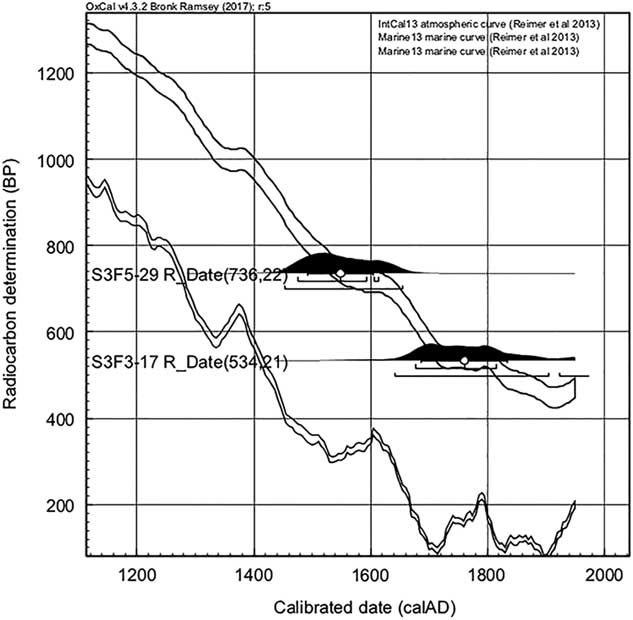
After applying Bayesian modeling, the second shell S3F5 showed one period of existence: from the mid-16th century (with an uncertainty of 42 years) to the mid-17th century. When unmodeled dates for shell increments are calibrated to the marine curve (with ΔR=–37±51 yr), they overlap for each shell. Figure 6 shows the results for the middle positioned increments only of the two fossil shells (S3F3 and S3F5), in order to demonstrate that they both lie on the two distinct flat parts of the curve. The flat part of the curve enables that events of hundred years apart (as is the difference in the ages of the beginning and the end of the shells increments) actually give the conventional 14C age on the curve with constant ΔR.
Unmodeled calibrated probability functions for increments in the middle of shells S3F5 (increment marking ontogenic age of 29 years) and S3F3 (increment marking ontogenic age of 17 years). Marine13 curve with 1σ range, horizontal brackets mark 68.2 5(1σ) and 95.4% (2σ) possibility ranges (narrower and wider brackets, respectively), rounded symbols mark mean values, brackets mark σ, + signs mark median.

However, the results can be different if ΔR is not constant over time and further work on more fossil shell samples should be done for more reliable results.
Other applications based on the carbon chemistry recorded in Glycymeris from the Adriatic involve looking at δ13C data to study the Suess effect, as performed by Butler et al. (Reference Butler, Scourse, Richardson, Wanamaker, Bryant and Bennell2009) using A. islandica. However, in addition to the δ13C data generated in our study, new δ13C samples need to be collected from Glycymeris shells, especially from parts covering the early ontogeny to secure a reliable sample size for this analysis.
It is also important to note that bivalve shells provide valuable archives for archaeological research (Allen and Payne Reference Allen and Payne2017). Fernandes and Dreves (Reference Fernandes and Dreves2017) pointed out the possibilities of obtaining high-resolution 14C records from long-lived bivalves and recommended that these studies should be expanded to include different habitats and other species in addition to Arctica islandica. According to these authors, there is considerable potential for the application of 14C analysis in bivalves within archaeology, including studies of dietary habits and metabolic pathways in humans.
Acknowledgments
This research was supported by the Croatian Science Foundation under the project SCOOL (IP-2014-09-5747). Authors are grateful to Dragan Švigir for assistance in sample collection, to Hana Uvanović and Sanja Puljas for assistance with acetate peel preparation, and to James Scourse and Al Wanamaker for valuable advice during the preparation of the study. We are also very thankful to Ron Reimer of Queen’s University Belfast for calculating the data of the modeled surface ocean (mixed layer) curve from 1996 to 2016 using the data for the Northern Hemisphere bomb peak available in Reimer et al. (Reference Reimer, Bard, Bayliss, Beck, Blackwell, Bronk Ramsey, Buck, Cheng, Edwards, Friedrich, Grootes, Guilderson, Haflidason, Hajdas, Hatté, Heaton, Hoffmann, Hogg, Hughen, Kaiser, Kromer, Manning, Niu, Reimer, Richards, Scott, Southon, Staff, Turney and van der Plicht2013). Paolo Montagna and Mohamed Ayache kindly provided access to data used in their publications. Further on, we want to acknowledge help of Jesper Olsen, the Aarhus University, Denmark, Kita Macario of the Universidade Federal Fluminense, Brazil, and Jadranka Barešić and Ines Krajcar Bronić of the Ruđer Bošković Institute, Croatia in 14C modeling and analyses of data. We would also like to thank Linda Zanella, two anonymous reviewers, and associate editor Quan Hua for their comments that greatly improved our manuscript.