Introduction
Despite learning objectives in the US National Standard Curriculum, which were updated in the US National Emergency Medical Services (EMS) Education Standards,1, 2 many paramedics are not taught research fundamentals and how to find and critically appraise medical literature.Reference Sayre, White, Brown and McHenry3, Reference Jones and Jones4 Specific barriers have consistently been identified for the paucity of robust prehospital clinical research, including issues obtaining consent, and a lack of prehospital provider awareness of the importance of research and its clinical applications.Reference Sayre, White, Brown and McHenry3, Reference Myers, Slovis and Eckstein5 Since 1998, six cognitive objectives have appeared in the US Paramedic National Standard Curriculum,1 with further detail provided with the updated 2009 US National EMS Education Standards.2 These include: “describe the importance of quality EMS research to the future of EMS; describe the importance and benefits of research; explain the EMS provider’s role in data collection; explain the basic principles of research; [and] describe a process of evaluating and interpreting research.”1
Even with these objectives, many paramedic training programs are not teaching the content, likely due to lack of educator comfort with the material and a lack of resources available to educators without research experience.Reference Sayre, White, Brown and McHenry3, Reference Jones and Jones4 Direct calls to action have been made for educational modules that can be adapted by programs to help educators meaningfully teach students these concepts.Reference Sayre, White, Brown and McHenry6, Reference Schmidt, Nelson, Daya, DeIorio, Griffiths and Rosteck7
To address the need for an educational module on research fundamentals and critical appraisal of medical literature that can be distributed to EMS educators and EMS medical directors, a four-part paramedic journal club was developed and implemented.
Methods
Curriculum Development
Using the US National Standard Curriculum,1 the National EMS Education Standards,2 and several reference texts,Reference Brown, Criss and Prasad8–Reference Aehlert and Vroman10 in conjunction with personal experience, a series of lesson plans was developed that focused on incorporating practical knowledge essential to finding and evaluating medical literature, into a short period of time. The first three journal club sessions were divided into a 30-minute lecture followed by a 90-minute interactive class discussion. First, the class chose a topic and were provided with related articles. The scientific method as it relates to the evaluation and treatment of patients was reviewed in the beginning of the session, and then the structural differences between randomized controlled trials, reviews, case studies, and letters to the editor were discussed. Second, the class chose a new topic, and was provided with a related trade magazine article. After a short lecture on the process of peer-review and publication, the class used different search engines (open access and utilizing library subscriptions) to verify the article’s sources. The class picked another new topic for the third session, this time with students finding, downloading, and sending a PDF of a peer-reviewed article to the educator. The educator gave a statistics lecture and then critiqued the results section of several articles found by the students. For the fourth session, each student found a peer-reviewed article on a topic of personal interest and presented the article to the class as if they were telling their paramedic partner about it during down time between calls, taking no more than five to ten minutes. The overarching goals for these sessions were to be respectful of adult learning theory, while providing a practical, useful understanding of research practices.
Curriculum Implementation
The Stony Brook University IRB (Stony Brook, New York USA) reviewed the lesson plans and proposed assessment tools and deemed this “not research.”
The journal club series has been run with three different paramedic student cohorts as part of a university hospital-based paramedic program (2016, 2017, and 2018). Minor adjustments to the slides have been made based on feedback.
Before and after the journal club series, the 2017 and 2018 cohorts completed questionnaires containing demographic questions and Likert-style questions about research perceptions which were largely derived from other studies,Reference Schmidt, Nelson, Daya, DeIorio, Griffiths and Rosteck7, Reference Hargreaves, Goodacre and Mortimer11 and beta tested on 10 paramedics and 10 emergency medical technicians with diverse educational and work experience. One year after graduation, the 2017 cohort received a follow-up questionnaire.
Statistical Analysis
Given the preliminary nature of this study, in conjunction with its incorporation into the standard paramedic program curriculum at this institution, all enrolled paramedic students were included. Questionnaire responses were linked with student-generated unique identifiers. Statistical analysis was performed using SPSS Statistics Faculty Pack 25 (IBM Corporation; Armonk, New York USA). Descriptive statistics were used for demographic data. Research perception responses were collapsed into “agree” (strongly agree, agree) and “not agree” (neutral, disagree, strongly disagree). McNemar’s Test was used for analysis of the pre- and post-questionnaire research perception responses. Related-samples Cochran’s Q testing with adjusted P values was used to compare responses of individuals from the 2017 cohort who completed all three questionnaires.
Results
During the 2016 cohort, 13 students participated in the journal club series and provided qualitative feedback. During the 2017 and 2018 cohorts, 21 and 12 paramedic students participated, respectively. Of the students in the 2017 cohort, 20 became paramedics, of whom 15 completed the one-year follow-up survey (response rate of 75%).
Student comments from the 2016 cohort included:
The final session was great; it was useful to review research articles and present to the class. This should be emphasized further.
Having the option to research a topic about EMS that [was interesting] was helpful because not only [was knowledge gained] from the research, but [students] were able to feel more comfortable presenting a topic [of] previous interest.
Presenting in front of the class is not something that I was looking forward to, but afterwards thought it was very helpful.
Of the 33 paramedic students in the 2017 and 2018 cohorts, the mean age was 24 years (range 18-45), with mean years of experience in EMS of four (range 0-28). A majority were men (76%; n = 25) and many held college degrees (n = 16; 48%). Before the start of the journal club series, 13 students (39%) indicated they had a subscription to a research journal, writing in the Journal of Emergency Medical Services (n = 9) and EMS World (n = 6) when asked for the name of the journal. None wrote the name of a peer-reviewed journal. Students reported reading research articles weekly (n = 1; 3%), monthly (n = 15; 46%), yearly (n = 11; 33%), and never (n = 6; 18%). Barriers to reading medical research articles included not having enough time and not knowing where to find them. When asked how they stay informed on advances in medicine, students selected talking with friends, going to continuing medical education classes, reading medical research articles, reading blogs, listening to podcasts, and using Facebook (Facebook Inc.; Menlo Park, California USA), in descending order of popularity.
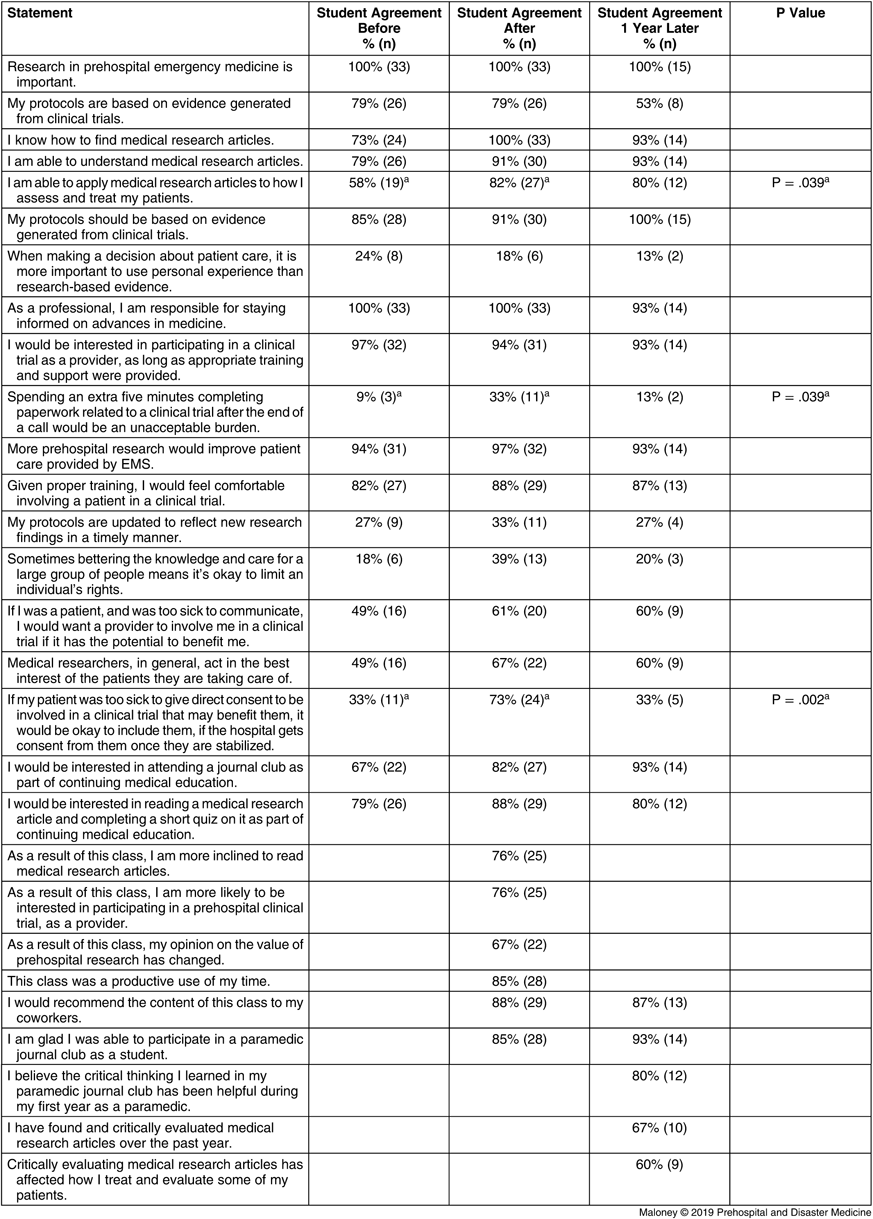
Table 1 describes student responses to the research perception questions. After the journal club series, there was an increase in self-reported abilities to find, evaluate, and apply medical research articles, which was demonstrated by each student during the fourth session. Additionally, there were overall positive trending opinions of participating in and the importance of prehospital research. A statistically significant improvement was observed in student approval of exceptions from informed consent.
Paramedic Student Responses on Questionnaires Given Before, After, and 1-Year After the Journal Club Series

Note: A total of 33 students took the before and after questionnaires, and 15 completed the 1-year follow-up questionnaire. When comparing the responses from the 1-year follow-up questionnaire to those just after the journal club, only the data from the responding 15 providers were included.
Abbreviation: EMS, Emergency Medical Services.
a Denotes the questionnaire iterations the P value pertains to.
In the one-year follow-up survey, comments included:
Learning how to read and analyze research articles not only molded me into a more confident provider, it also influenced me to advocate for the creation of a journal club at my job! [Agency] medical directors have been extremely engaged and it [has] opened the door to a lot of discussion between the doctors and the field employees.
The time spent [during] journal club was time well spent. In hindsight, I wouldn’t trade it for another type of training or education.
Discussion
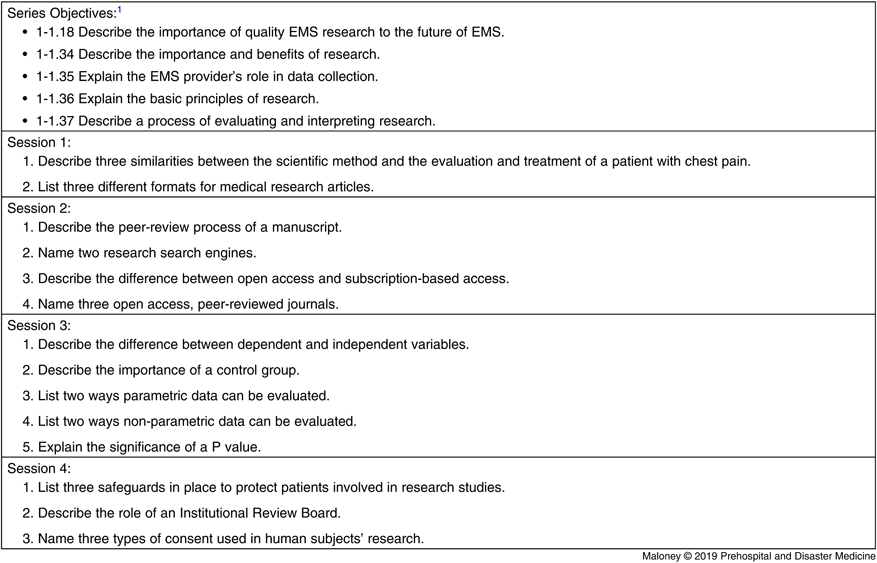
Overall, the journal club series has been well-received by students. Some debate has occurred about when during the paramedic course the journal club would be most efficacious. Some believe having the series earlier allows more time for students to refine the skill and find reliable resources when questions arise. Currently, the series runs at the end of the program during the Paramedic Internship when less new material is introduced, which allows for more attention when preparing for the sessions. It has also been challenging determining which parts of the articles students read at home; however, asking students to read the Abstract and Introductions at home seems reasonable as both contain limited jargon. Then, students are asked to volunteer to summarize these sections when the discussion starts to allow some context for those who did not read, or understand, the assignments at home. Finally, after the 2018 iteration of the series, a misunderstanding of the IRB, consents, and medical ethics was observed and thus a lecture was added to the beginning of the fourth session (Table 2).
Journal Club Series Learning Objectives

Going forward, sharing this educational module, complete with lesson plans, slides, and annotated accompanying articles, could allow EMS educators and medical directors to adapt it to their programs. While textbook publishers’ slides may have essential definitions, the actual practical application of the process and ability to practice communicating findings to others is incredibly valuable to the students as they prepare to become life-long learners. Moreover, it is the responsibility of educations to provide students with the tools to find and critically appraise news about advances in medicine, especially in the age of social-media-driven information, and personal blogs and podcasts.
Additionally, this module could be adapted by agency medical directors for continuing medical education classes to discuss the evidence protocols are based on, and perhaps debunk harmful medical trends or misconceptions. It has been suggested that showing providers how research findings directly impact and improve the patient care they provide, and acknowledging their clinical expertise as prehospital providers,Reference Sayre, White, Brown and McHenry 3 , Reference Watson, Sanoff and Mackintosh 12 could increase their buy in to participating in future research, which seems to be an excellent use of time and resources.
Limitations
Limitations of the study include that it was performed at a single center, and while multiple cohorts of paramedic students were included, the overall number of participants was small. In addition, this study relies on student self-reported opinions, not actually demonstrated behaviors.
Conclusion
This paramedic journal club series allowed for paramedic students to have a self-reported increase in understanding of multiple areas of research, and suggested an increased willingness to participate in future clinical research. Most importantly, each student demonstrated the ability to find, critically appraise, and discuss the findings of medical research literature. The positive reception of this curriculum suggests this module could be adapted by EMS educators and medical directors as a meaningful addition to paramedic initial or continuing education.
Conflicts of interest
none