INTRODUCTION
The geoduck clams belonging to the genus Panopea Ménard de la Groye, 1807 are gigantic bivalves inhabiting soft mud–sand bottoms from the intertidal to over 110 m depth, buried down to 1 m depending on its longitude (Valero et al., Reference Valero, Hand, Orensanz, Parma, Armstrong and Hilborn2004; Siddon, Reference Siddon2007; Arambula-Pujol et al., Reference Arambula-Pujol, García-Juárez, Alcántara-Razo and Aragón-Noriega2008). The siphon of the clam is extended to catch food and to expel waste and gametes during the reproductive season (Arambula-Pujol et al., Reference Arambula-Pujol, García-Juárez, Alcántara-Razo and Aragón-Noriega2008). The geoduck clams have been commercially harvested from 1969 in the north-east Pacific geoduck fishery (Vadopalas et al., Reference Vadopalas, Pietsch and Friedman2010), its latitudinal distribution ranges from Alaska to Mexico (Anderson, Reference Anderson1971; Siddon, Reference Siddon2007). Arambula-Pujol et al. (Reference Arambula-Pujol, García-Juárez, Alcántara-Razo and Aragón-Noriega2008) stated that the specimens collected inside the Gulf of California waters belong to Panopea globosa (Dall, 1898). Recent studies of P. globosa clams, with genetic and morphometric analyses carried out by Rocha-Olivares et al. (Reference Rocha-Olivares, Calderón-Aguilera, Aragón-Noriega, Saavedra-Sotelo and Moreno-Rivera2010) and Calderón-Aguilera et al. (Reference Calderón-Aguilera, Aragón-Noriega, Hand and Moreno-Rivera2010) respectively confirm the species is endemic from the Gulf of California.
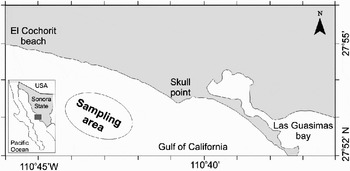
During a field population study of Panopea globosa carried out in 2009 in Playa del Sol (27°25′N 110°35′W) on a beach located in the Municipio Empalme Sonora, off the eastern coast of the Gulf of California, the existence of a symbiont pea crab in the mantle cavity of P. globosa was noticed. A total number of ten individuals of the clam, four females and six males, were collected by divers at a depth ranging from 10 to 25 m, embracing a study area of 3500 ha (Figure 1). All individuals were sexed, measured and confirmed that the species was P. globosa. The pea crab was identified later as being Pinnaxodes gigas Green, Reference Green1992, a species that was described by Green (Reference Green1992) and subsequently reported by Campos et al. (Reference Campos, Díaz and Gamboa-Contreras1998) from single, free-living individuals. The specimens are deposited in the National Crustacean Collection (CNCR) from the Instituto de Biología, Universidad Nacional Autónoma de México (UNAM).
Study area in the eastern coast of the Gulf of California.

MATERIAL EXAMINED
Carapace measurements are carapace length × maximum width respectively.
Adult males: (17 × 20 mm), (19 × 23 mm), (29 × 31 mm), (16 × 18 mm), (15 × 17.5 mm), (23 × 25.5 mm). Ovigerous females: (25 × 30 mm), (28 × 32 mm), (27.5 × 32 mm), (23.5 × 26 mm). Adult females: (32 × 36 mm), (31.5 × 34 mm), (24 × 26.5 mm), (26 × 28.5 mm), (33 × 36.5 mm).
DESCRIPTION
Characteristic features of the species have already been presented by Green (Reference Green1992) and Campos et al. (Reference Campos, Díaz and Gamboa-Contreras1998). We emphasize some features. The carapace is heavy, subpentagonal, convex, front produced. The legs are strong, symmetrical. The chelae are strong with the propodus inflated interiorly, the moveable finger presents large tooth at base, immovable finger presents two small teeth, one distal and one proximal. Abdomen is broad at base, narrowing towards sixth segment. The last third of sixth segment and base of telson are expanded, the telson narrowing to rounded tip. Third maxilliped is large with a suture present between merus and ischium, outer margin nearly straight and joining a broadly arched distal end, inner margin mostly concave. Dense pubescence surrounds the abdominal depression; the thoracic sternites are heavily calcified.
REMARKS
Pinnaxodes gigas and Pinnaxodes floridensis Wells & Wells (Reference Wells and Wells1961) are very similar in shape and coloration. The main characteristics used to identify the crabs collected in the present study were the shape of the abdomen and the size of the crabs, as suggested by Green (Reference Green1992). Pinnaxodes gigas presents the abdomen narrow from its base to the sixth segment, the distal third of this segment and the base of the telson are expanded, and the telson narrows to form a rounded tip. In P. floridensis the abdomen presents an abruptly inflated and rounded telson. In addition, the size (carapace width) of the crabs collected in the present study ranged from 17.5 to 31 mm for the males and from 26 to 36.5 mm for the females, much larger than the 11 mm of carapace width described by Wells & Wells (Reference Wells and Wells1961) for the largest specimen of P. floridensis collected in their study.
Campos et al. (Reference Campos, Díaz and Gamboa-Contreras1998) held the hypothesis that P. gigas was a ‘… symbiont of holothurids, capable of leaving its host temporarily …’ [sic], since the related species P. floridensis was described inhabiting holothurids in the West Atlantic (Wells & Wells, Reference Wells and Wells1961; Miller & Pawson, Reference Miller and Pawson1984; Takeda & Prince Masahito, Reference Wells and Wells2000). Wells & Wells (Reference Wells and Wells1961) have reported P. floridensis in the respiratory tree of the holothurian Holothuria (Theelothuria) princeps Selenka, 1867 in the Gulf of Mexico at an infestation rate of 45–61%, finding mostly a single specimen in each host, although male–female pairs were also frequently encountered. In the present study one single specimen of P. gigas was mostly found in each host, however, male–female pairs and even three crabs per host were also found in Panopea globosa, with an infestation rate of 100% and an average number of 1.4 crabs per host of the specimens studied.
The association between Panopea generosa Gould, 1850 and an unspecified pinnotherid crab under the name ‘cangrejo chícharo’ (pea crab) in Baja California was recently pointed out by Cáceres-Martínez & Vásquez-Yeomans (Reference Cáceres-Martínez, Vásquez-Yeomans, Lovatelli, Farías and Uriarte2008). The members of the genus Pinnaxodes have been recognized as symbionts, either facultative or obligate, of many species of holothurians, mussels and echinoids (Rathbun, Reference Rathbun1918; Konishi, Reference Konishi1977; Manning, Reference Manning1993; Campos et al., Reference Campos, Díaz and Gamboa-Contreras1998; Ng & Manning, Reference Ng and Manning2003; Melo & Boehs, Reference Melo and Boehs2004). Green (Reference Green1992) described P. gigas in the Gulf of California, subsequent reports indicated the species inhabiting only in the area (see Campos et al., Reference Campos, Díaz and Gamboa-Contreras1998).
The finding of P. gigas as a symbiont of Panopea globosa is the second record of a pea crab belonging to the genus Pinnaxodes infesting bivalves in the Pacific Ocean, the first one being P. major Ortmann, 1849 from Japan, symbiont of the mussel Atrina pectinata (Linnaeus, 1767) (Takeda & Prince Masahito, Reference Takeda and Prince2000).
ACKNOWLEDGEMENTS
The authors are grateful to Dr E. Campos for his kind help with literature and to Dr F. Alvarez for accepting the voucher material that will be deposited in the National Crustacean Collection (CNCR), Instituto de Biología, Universidad Nacional Autónoma de México (UNAM). A fishing permit granted to R. Ulloa under the ‘Programa de Investigación para el seguimiento de la pesquería de almeja generosa (Panopea spp.) en la costa de Sonora, México: prospección y evaluación de nuevas áreas de aprovechamiento’ research programme allowed the collection of the specimens and specifically through the ‘Permiso de pesca de fomento DGOPA.00980.130209.0467′ permit to Mr Lorenzo Osuna, who collected the specimens. Thus, the study complies with the Mexican Federal regulations. Two anonymous referees helped us to improve this manuscript through insightful comments. E.J.M. Emparanza is grateful to Mr Vicente Hernández, Mr Salvador Zamorano, Ms Rafaela Arce, Mr Benjamín Rivadeneira and Dr Madia Ferretti for additional logistic support and encouragement. E.J.M. Emparanza and R. Ulloa want to dedicate this work to the memory of the late Chilean marine biologist Sandra L. Cifuentes, a soulful friend and curious professional. This research received no specific grant from any funding agency, commercial or non-profit sectors.