Introduction
It has been known for many years that, in most cases, the Virgin appears on the right of Annunciation compositions,1 a claim confirmed by the present work: out of 1007 Annunciations studied from C3 to 1750 only 200 are variant, with Gabriel on the right. What is very important is that the analysis of these results offers a clear explanation why such variants are comparatively rare, and more so in the period C3–1400. Since the claims made in this paper are at variance with all previous studies of the Annunciation, included mine, I shall postpone the discussion of those studies to a further paper, in order to concentrate our discussion on the fundamentals of the present results. I shall first consider in Figures 1 and 2 a simple example based on Figure 5 of a paper by McManus.Reference McManus2Figure 1 shows the original picture, whereas Figure 2 gives its reflection on a central plane perpendicular to the figure. This is wrong not because the Angel is on the right but because he is now gesturing to the Virgin with his left hand, whereas, as I shall later show, Gabriel must always be represented as dextral. If the painter were to present Gabriel on the right, but showing to the Virgin, as in the original, his right hand, he must not use a reflection at all but rather a rotation by 180° around a central axis of the painting. Which is the same, from an elementary geometrical result, as reflecting Figure 2 on its own plane: this in three dimensions would show that the right hand is now at the back and not at the front. It is sufficient to imagine that the painter would have to replace the lilies by a right hand and raise the arm (which was not shown in Figure 1). This is possible with a good level of skill but it is a task that earlier painters would probably have found difficult and would have tried to avoid, as the evolution of the iconography, discussed in the next section, shows. In fact, Annunciations with Gabriel kneeling on the right do not appear until C15. Of course, with Gabriel on the left as displayed by Veneziano, it is much easier to show the right-hand gesture.
Domenico Veneziano, Annunciation (1442–1448). Fitzwilliam Museum, Cambridge, by kind permission of the syndics.

Figure 1 reflected on a vertical plane perpendicular to the paper through its central vertical axis.
That it must be the right and not the left hand of Gabriel that gestures is the most important result of the analysis of a database that I constructed, which contains 1007 Annunciations from a large number of museums and churches in many different countries: in only 24 cases does Gabriel show his left hand to the Virgin.
It is important to understand that all the work of this paper is done from the point of view of the painter, a point that is not always sufficiently considered. As said before, the Annunciation problem is not one of right-left (reflection) symmetry, but of a binary rotation (rotation by 180°). Thus, for the painter it is essential for him to imagine the further reflection of Figure 2 on the picture plane, which completes a rotation by 180° of Figure 1. This is so, because if he wants to move his real or imaginary sitter for Gabriel from the left to the right of the picture, not changing his posture, he has to perform a 180° rotation that (like all rotations) preserves the sitter’s handedness.
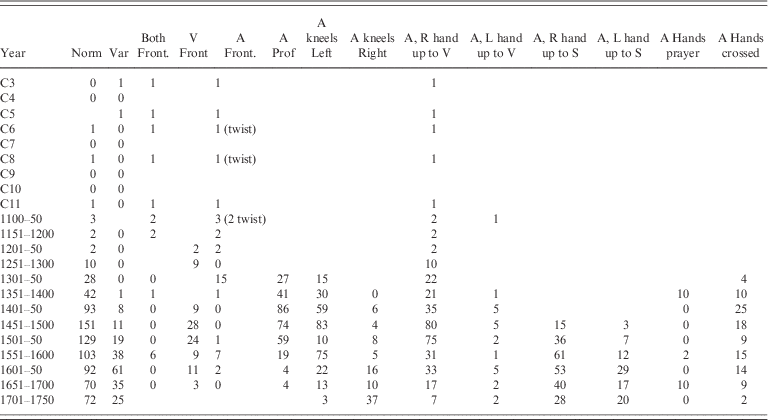
It may be important to stress that the database constructed is unbiased, all pictures found were accepted as long as they were reasonably readable. Also, the information registered for every picture was totally general, entering as many iconographic details as possible. It was only when the database was finished and the process of collating data was started that to my great surprise the right-handedness of Gabriel appeared as the most stable feature throughout the database: of the 1007 Annunciations on the database Gabriel shows the right hand to the Virgin in 334 of them and in only 24 cases is it the left hand (see Table 1). Curiously, the clearest example of this aberrant behaviour is by Fra Angelico in the Annunciation of 1450 in the Armadio degli Argenti, Museo di San Marco, Florence, shown in Figure 3.
Fra Angelico, 1450, Armadio degli Argenti, Museo di San Marco, Florence.
Annunciation results
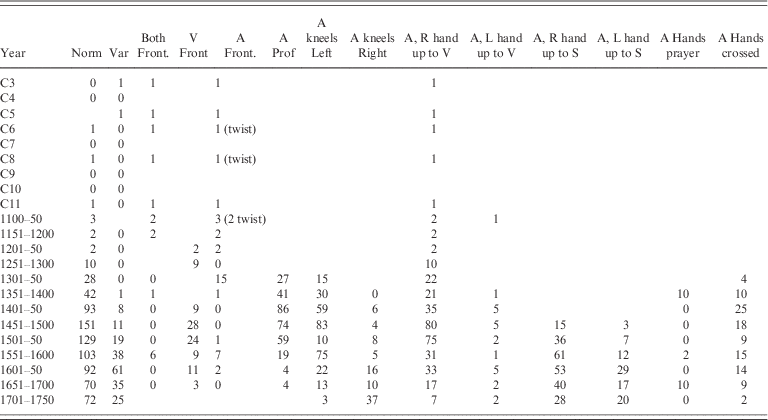
Norm – normal; Var – variant; A – Angel; V – Virgin; L – left; R – right; S – sky; Prof – profile; S – Sky.
It might be queried why Gabriel should be dextral, but unfortunately I have not found scriptural evidence and neither have the experts I consulted. It is not impossible that this feature is a case of religious syncretism. The nearest precedent to Gabriel in time is Hermes (Mercury), the messenger of the gods, who thus has a similar function and even carries a pair of small wings on his helmet. Hermes’s iconography appears to be totally stable, although of course the number of original examples is much smaller than those of Gabriel.3 Hermes, however, is universally represented with a wand, the caduceus, in his left hand, presumably the better to convey his message with his right one. Gabriel also often carries a wand on his left hand, sometimes replaced by a bunch of lilies or a phylactery.
AltmannReference Altmann4 had pointed out that in three-dimensional representations of the Annunciation, like reliefs, carvings, sculptures, variant works appear with apparently higher frequencies, a fact that unfortunately had never been studied. Andrea della Robbia has several Annunciations in majolica in the Sanctuary of La Verna in Tuscany, produced around 1475, all variant. The magnificent polychrome wood carving by Veit Stoss at the Basilica of St Mary in Krakow, made in 1477–1489, is a famous example. Clearly, the fact that the reader (and the maker) of these pieces can move the angle of vision so as to reach different parts of the object, gives more freedom to the artist to place Gabriel on the right even if the right arm is near the back.
Evolution of the iconography
Most of the results I shall now discuss may be found from Table 1, which is a collation of some of the more significant results of the database. The earliest known Annunciation, from C3, appears in a vault at the Priscilla Catacombs, via Salaria, in Rome. It shows the Virgin enthroned on the left, almost frontal, with the Angel on the right, totally frontal, right arm to the Virgin. The frontality of the subjects, which makes no positional distinction between the two arms, entails no pictorial problems here. Even by C5, exactly the same composition occurs in the mosaic at Santa Maria Maggiore (Figure 4), but now the artist is able to twist Gabriel’s torso to move it slightly towards facing the Virgin. By C8 (Figure 5) this gyration of Gabriel towards the Virgin increases, although sufficient frontality is kept to permit easy display of the right hand even in a variant composition. It is only5 in C11 that Gabriel appears on the left, albeit levitating but still with his right arm to the Virgin. It is quite clear that as time passes and the artists’ skills improve, the desire to have the Angel facing the Virgin begins to be implemented, by twisting the still standing Gabriel towards the Virgin. We see this effect in the period 1100–1150, where I have three pictures, all with Gabriel standing on the left (that is, ‘normal’), all gesturing with the right hand and, finally in Mount Athos, fully facing the Virgin for the first time. In the period 1251–1300, which includes the famous Annunciations by Cimabue, Pietro Cavallini, and Torriti, we have ten Annunciations, all normal, all with Gabriel still standing, all facing the Virgin with the right arm up.
C5, mosaic on the entablature on side of nave, Santa Maria Maggiore, Rome.
C8, Western semi-dome, Monastery of Deir al-Suriani, Wadi Natroun, NW Egypt. Photo courtesy of Dr K.C. Innemee, Leiden University.
A significant change in composition occurs in the period 1301–1350 where, for the first time, we see Gabriel kneeling (on the left, of course). Perhaps the earliest example is the magnificent ‘Giotto’ at the Basilica of St Francis in Assisi, completed according to Vasari in 1296–1304. Its style, however, is so different from that of the Annunciation at the Cappella Scrovegni in Padova, completed by 1305, that the attribution requires some thought. Be that as it may, out of the 28 pictures in this period 12 show Gabriel kneeling on the left, right hand up.
The period from 1351 to 1400 is still fairly stable. Out of 42 pictures only one is variant, the earliest example I know since the C5 one in Santa Maria Maggiore. This, although in poor condition, can be found in the narthex of Santa Maria in Trastevere, Rome, and dates from some time in C14. Gabriel is sufficiently twisted so as to be almost frontal, thus permitting a clear display of the right-hand gesturing to the Virgin. Nevertheless, the composition remains fairly stable during this period, with 30 out of the 42 pictures having Gabriel kneeling. An interesting feature is that there is a substantial increase in the number of pictures where the Angel is shown with hands crossed. This merely reflects a greater variety in the semiotics of the scene. As discussed in a previous paper1 there are eight Annunciation scenes corresponding to the same number of verses in Luke 1:26–38, and in some of these scenes Gabriel usually appears with hands crossed. This is the case in ten of the 42 pictures in this period. Further discussion of the semiotics of the Annunciation will be postponed to a further paper.
In the period C6–1400, the basic, more stable features of the Annunciation pictures were established. Thus, out of 91 pictures only one is variant and in only two is Gabriel left-handed. Of course, from this time on, composition is very much affected, first by the Renaissance, and then by Mannerism and by the Baroque style. As time goes on the painters become more daring, they overcome the difficulties of variance, often by having Gabriel on the right almost frontal and succeeding in the correct display of the right hand even when the Angel kneels on the right. (A good example is the Andrea del Sarto picture, 1513–1514, in the Galleria Palatina, Florence, Figure 6.) But this is not so common, from 1401 to 1750 there are 907 pictures (710 normal and 197 variant) but there are only 86 pictures with Gabriel kneeling on the right. The first one is by Rogier van der Weyden, 1445–1448, in the Staatliche Museum zu Berlin. Of around the same period is a variant picture by Dirk Bouts (Figure 7) where Gabriel on the right is almost frontal, thus avoiding all problems of the display of the right hand. This picture’s composition is very similar to that of another later and much larger variant example, the magnificent Lorenzo Lotto, 1527, at the Pinacoteca Comunale, Recanati.
Andrea del Sarto, 1513–1514, Galleria Palatina, Florence.
Dirk Bouts, ca. 1450, Princes Czartorisky Gallery, Krakow, Poland. (Author’s photograph.)
The rapid increase in the number of variant pictures in the period 1551–1600 is due to El Greco, the most prolific Annunciation painter ever, with 16 works, ten in the period mentioned. He painted only one normal Annunciation, a tondo, 1605, in the Hospital de la Caridad, Illescas, Toledo.
It is highly probable that substantial changes in the commissioning of pictures occurred after 1400. Whereas before quite clearly one of the scenes from Luke may have been mentioned, it is probable that reference may now have been made to a painting by a great artist who thus created a fashion. As an example, Titian in 1537 painted an altarpiece in Venice, now lost, but fortunately an engraving remains at the Metropolitan Museum of Art of New York. This was a quite novel composition with the Angel on the left pointing to the sky (Luke 1: 35, Spiritus Sanctus superveniet in te) and the Virgin on right further back. Although this feature appeared in some way already in 1451–1500, it now became fashionable and from 1501 to 1750 there are 218 pictures displaying it. One good example of this influence is the Annunciation by the Gaeta painter Scipione Pulzone, 1587, in the National Museum of Capodimonte, Naples, where statements by the painter to this specific effect are recorded.
Discussion
I shall now summarize very briefly my arguments. The main result is that there must have been a tradition for Gabriel to be right-handed, since out of 1007 items in only 24 of them does Gabriel show his left hand to the Virgin. I further argue that when painting became sufficiently sophisticated to permit the Angel figure to face that of the Virgin, sometime around C11, it was necessary to place him to the left so as to facilitate the display of the right arm. This explains why the first variant picture, discounting the frontal ones up to C5, had to wait until C14. Thus, a stable tradition of normal Annunciations was created from C3 to 1400, with only three variants out of 90. Of course, with greater degrees of sophistication after that period, more variants appeared, but the strength of the tradition of Gabriel on the left is nevertheless evident: although from 1401 to 1450 there are eight variant pictures out of 102, only one is Italian, by Filippo Lippi (Galleria Doria Pamphili, Rome), the rest coming from other European countries where much fewer examples had previously appeared, probably not enough to sustain a tradition. It appears highly likely that this tradition becomes diluted over time. However, it is interesting to note that in the period with the highest proportion of variant Annunciations, 1601–1650, out of the 61 variants, only 31 are Italian. As time progresses, tradition appears to be diluted by fashion, with the great innovators such as Titian or Rubens engendering a number of imitators.
Acknowledgements
This work would not have been possible without the help of Dr Paul Altmann, who organized the structure of the database and who, with infinite patience, attended to my numerous requirements and rescued me from my numerous mistakes. It is a pleasure to acknowledge the generous help of my collaborator from Madrid, Dr Gloria Martínez Leiva, who provided me with a large number of Spanish entries. Dr K.C. Innermee of Leiden University kindly provided information and photographs of the paintings at Deir al-Suriani and Professor Gerry Altmann very kindly reformatted the illustrations. I should also like to pay tribute to the various electronic catalogues now available, of which I should like to mention here the excellent Cultura Italia, the French Joconde, the Paul Getty catalogues and the compilation of all the foreign pictures (now completed) and British pictures (in progress) in the UK. No public funds were used in this work.
Simon Altmann is a long-retired mathematical physicist who since his retirement has published books on the philosophy of nature and the history of mathematics, and a collection of poems, Not for Poets (eBook). His Tales of Three Countries will be published by Christmas (Editorial Araña) and he has a book, Einstein’s Error, now with publishers. He has been interested in the Annunciation for some 50 years and has published three articles on it, largely wrong. His paper on Las Meninas was published in this journal (2013).