

With the rapid growth of the world population, global warming, and social conflicts, various disasters frequently arise. According to the definition of disasters proposed by the World Health Organization, disasters are events that occur when significant numbers of people are exposed to hazards to which they are vulnerable, with resulting injury and loss of life, often combined with damage to property and livelihood.Reference Davis, Samanlioglu, Qu and Root 1 How to launch scientific and efficient medical rescue has become a worldwide focus.
Disaster medicine has been defined as “the science for analysis and development of the methodology requested to handle situations where available resources are insufficient in relation to the immediate need of medical care; its overall objective is to reduce or eliminate avoidable loss of physical and psychological health.”Reference Lennquist 2
Disasters in China occur at a high frequency, incur heavy losses, and require extensive prevention efforts.Reference Zhang, Yi and Zhao 3 China has been subject to some of the world’s most severe natural disasters, which has accelerated the progress in disaster medicine. Therefore, strengthening investigations of disaster medicine is of academic and practical significance for reducing disaster losses.Reference Hou, Lv and Ding 4
Bibliometrics, a widely accepted statistical analysis method in information science,Reference Sweileh, Aljabi and Abutaha 5 has been applied to investigations of disaster nursing,Reference Wang and Sheng 6 disaster medical techniques,Reference Gong, Mohammed and Nicolaou 7 some infectious diseases,Reference Hossain, Karimi and Wigand 8 , Reference Fu, Hu and Wang 9 and medical rescue for specific disaster typesReference Mryglod, Holovatch, Kenna and Berche 10 in the field of disaster medicine. For disaster medical research and practice, a key issue is how to obtain an overall perspective of the research focus and development direction. These investigations presented the status of some certain topics of disaster medicine. However, few investigations have been performed to provide a macroscopic overview of the overall structure and developing trends in disaster medicine using bibliometrics and information visualization technology, which motivate the present study. How many subdomains can China’s disaster medicine be divided into? Which themes are the core themes, and which themes play an important role in connecting other themes? Which themes are being gradually noticed or neglected? What are the limitations of this research field? To answer these questions, we explored and visualized the intellectual structure of disaster medicine in China using bibliometrics and information visualization technology, such as cluster analysis, social network analysis (SNA), and strategic diagram analysis (SDA) based on the co-word matrix.
METHODS
Data Sources
China National Knowledge Infrastructure, the largest Chinese journal full-text database, has abundant literature resources and broad retrieval functions, including access to the great majority of Chinese journals relating to disaster medicine. In China, the concept of disaster is generally equivalent to the concept of emergencies at law. According to the emergency response law of China, emergencies consist of natural disasters, accidental disasters, public health incidents, and social security incidents. In addition, due to the diverse expressions of disaster and disaster medicine in Chinese, we selected a number of technical terms to constitute the retrieval strategy and to identify research samples to ensure that our investigation adequately covered this field. The retrieval strategy (Chinese translated into English) was as follows: (SU=rescue OR SU=emergency) AND (SU=disaster OR SU=natural disaster OR SU=accident disaster OR SU=public health incident OR SU=social security incident) AND (SU=medicine OR SU=health), covering the period of 1980-2016. The literature type was journal articles. The retrieval date was June 15, 2017. To normalize key words, combining synonyms was necessary; for example, “disaster medicine,” “rescue medicine,” and “disaster rescue medicine” were combined into “disaster medicine.” A literature retrieval group comprised 3 professionals who had been trained in professional retrieval. The group leader carried out the literature retrieval. The literature screening was conducted by 2 group members based on inclusion and exclusion criteria, and the group leader made decisions in cases of disagreement.
Inclusion and Exclusion Criteria
To ensure the comprehensiveness and normalization of the research samples, we identified the inclusion and exclusion criteria by consulting experts in this field. The inclusion criteria were articles that examined (1) disaster medicine theory, (2) relationships between disaster medicine and other disciplines, (3) the practice of disaster medical rescue and nursing, (4) the progress of medical rescue technology, (5) the development and application of medical rescue equipment, (6) disaster medical education and training, (7) the construction of disaster medical rescue systems, (8) military emergency medical security system management, and (9) other related research articles. The exclusion criteria were interviews, conference notices, translated text, and articles without key words.
Co-Word Analysis
Co-word analysis is a content analysis technique that is effective in mapping co-occurrence relationships and the strength of the relationship between a pair of items existing in the same text and in revealing the inner construction of a research field. Co-occurrence of two key words is an indication of a relationship between the topics to which they refer.Reference Zong, Shen and Yuan
11
With the support of SNA and SDA, co-word analysis can visualize the intellectual structure as maps of the conceptual space.Reference Liu and Hu
12
Price’s law, proposed by information scientist Derek J. de Solla Price, is a classical law of scientometrics. It pertains to identifying the core authors according to the volume of publications in the research field, stating that half of the publications come from the square root of all contributors.Reference Price
13
Price’s law can be formularized: m=0.749*
 $$\sqrt {N_{{max}} } $$
(m represents the number of papers published by the least prolific author in core authors, N
max
represents the number of papers published by the most prolific author in core authors). We referred to the core idea of Price’s Law to determine the high-frequency key words.
Cluster Analysis
Cluster analysis, aimed at finding subsets (called clusters), is the task of grouping a set of objects in such a way that objects in the same cluster are more homogeneous.Reference Casella and Girón 14 Cluster analysis is a broad-reaching method for explorative data mining for bibliometric analysis and visualization. The results of clustering can graphically show the merging process and clusters.Reference Yang, Wu and Cui 15
Social Network Analysis
SNA is the process of using network and graph theory to study social structure. It can evaluate the unique structure of the relationships among individuals and draw network diagrams using information visualization technology.Reference Lurie, Fogg and Dozier 16 Through the analysis of the network, we can identify the hidden links between the subjects, which play an important role in analyzing the scale, maturity, and knowledge structure of a research field.Reference Burt, Kilduff and Tasselli 17
Density is an indicator that describes network connectivity. Centrality refers to the position or “power” of a node in a network. Centralization refers to the centralized tendency of the network. Centrality/centralization can be divided into 3 types: degree, betweenness, and closeness. Degree centrality of a node is measured by the number of nodes to which it is directly connected. Betweenness centrality is a measure of the ability of a node to control resources in a network. Closeness centrality measures the ability of a node not to be “controlled” by others.Reference Ghosh and Lerman 18
Strategic Diagram Analysis
SDA is used to analyze the structure of a research field by describing the internal relationships within a theme and the interactions between themes.Reference Gan and Wang 19 Four indicators are used in SDA. Centrality is used to measure the strength of a cluster’s interactions with other clusters. Density is used to measure the strength of the links that join the key words comprising the cluster.Reference Coulter, Monarch and Konda 20 Novelty is used to measure the average co-occurrence year of each cluster. Attention is used to measure the average co-occurrence frequency of each cluster. Based on the location of each cluster, strategic diagrams describe the status and emerging themes in the research field.Reference Khasseh, Soheili and Moghaddam 21
RESULTS
Retrieval
A total of 3,079 records were retrieved, and 1,749 articles were ultimately selected as research samples after excluding irrelevant records. We obtained 8,284 key words, or an average of 4.74 key words per article. We defined 29 key words with frequencies of≥18 as high-frequency key words.
Cluster Analysis
According to the dendrogram (see Supplementary Figure 1 in the online data supplement), high-frequency keywords were classified into 6 clusters. We named each cluster according to the characteristics of the keywords (see Supplementary Table 1 in the online data supplement).
Social Network Analysis
In the SNA map (see Supplementary Figure 2 in the online data supplement), key words in the same cluster were represented by the same shape and color. The size of node was related to the degree centrality. The thickness of the links was related to the strength of the connection between the nodes. “Medical rescue” is located at the center. The network density value is 0.59. The degree, betweenness, and closeness centralization values are 43.92%, 5.36%, and 58.44%, respectively.
“Medical rescue” has the highest degree and betweenness centrality, and the lowest closeness centrality. “Nuclear radiation” and “army” have significantly lower degree and betweenness centralities than the key words with similar frequencies. “Medical rescue teams” and “triage” have significantly higher degree and betweenness centralities than the key words with similar frequencies (see Supplementary Table 2 in the online data supplement). Cluster 6 has the highest average degree centrality and the lowest average closeness centrality. Cluster 4 has the highest average betweenness centrality (see Supplementary Table 3 in the online data supplement).
To clearly display the importance of key words and find key words with special statuses, we divided the 3 types of centralities of each key word by the maximum of each type of centralities (see Supplementary Figure 3 in the online data supplement). A strong correlation exists among the 3 types of centralities. The absolute values of the mutual correlation coefficients all exceed 0.9. The betweenness centrality decreases with decreasing degree centrality, and the closeness centrality increases with decreasing degree centrality. Generally, the 3 types of centralities of key words reflect their statuses congruously. However, certain key words, such as “prehospital emergency care,” have high degree centrality but low betweenness centrality. Some key words, such as “emergencies,” have high betweenness centrality but low degree centrality.
Strategic Diagram Analysis
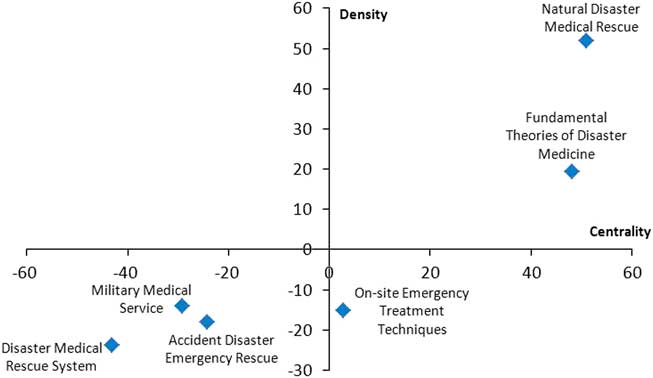
According to Figure 1, Clusters 4 and 6 lie in Quadrant I. The centrality and density of Cluster 4 are both the highest. Clusters 1, 2, and 3 are located in Quadrant III, with below-average centrality and density. The centrality and density of Cluster 3 are both the lowest. Cluster 5 is located in Quadrant IV, and its centrality is above average.
Strategic Diagram (Centrality and Density) for Disaster Medicine in China.
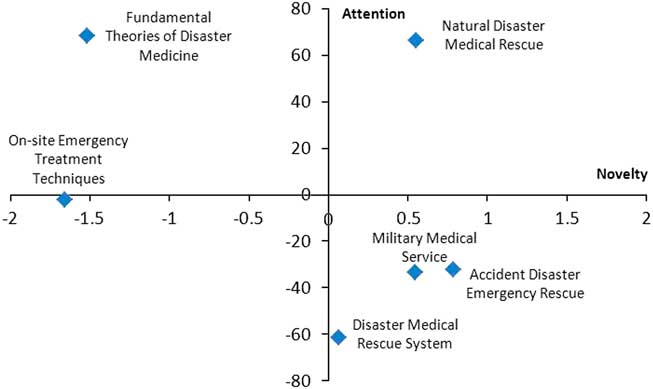
According to Figure 2, Cluster 4, in Quadrant I, features moderate novelty and attention. Cluster 6, in Quadrant II, exhibits lower novelty and higher attention. Contrary to Cluster 6, Clusters 1, 2, and 3 exhibit lower attention and higher novelty. Located in Quadrant III, the novelty and attention of Cluster 5 are both below average.
Strategic Diagram (Novelty and Attention) for Disaster Medicine in China.
DISCUSSION
Overall Evaluation
In 1987, the characteristics, significance, and prospects of disaster medicine were explored for the first time in a Chinese academic journal. Through the development of 30 years, the results of the cluster analysis reveal that research themes of China’s disaster medicine have begun to take shape. A total of 6 research themes represent different subdomains in the field of disaster medicine in China. In SNA, the density value of this network indicates that the relationships among nodes are relatively close. However, the centralized tendency is not strong, indicating that communication in this network does not depend on certain key words. Research themes are comprehensive and extensive, but concentrated and concrete themes have not formed. Therefore, investigations in this field are dispersed, and the research depth is insufficient.
Core Key Words and Themes
In SNA, “medical rescue” has the highest degree centrality and the lowest closeness centrality, indicating that it is the core key word. “Medical rescue” is a comprehensive concept, and its development has a strong dependence on other factors. Its influence radiates outward, promoting more in-depth investigations. Located in Quadrant I of strategic diagrams, this evidence demonstrates that “natural disaster medical rescue” is the core theme. Cluster 6 has the highest average degree centrality in SNA, indicating that “fundamental theories of disaster medicine” is also a significant theme.
Pivotal Key Words and Themes
Co-occurring with all other key words, any 2 key words without co-occurrence can be linked through “medical rescue.” Therefore, “medical rescue” has the highest betweenness centrality and the most significant “bridge function” in connecting different key words. As the central task of disaster medicine, “medical rescue” is the pivotal point in the dissemination of disaster medicine knowledge. Clusters 4 and 6 have significantly higher average betweenness centralities in SNA and centralities in SDA than other clusters, indicating that Clusters 4 and 6 exert a significant “bridge function” in connecting different clusters.
Key Words With Special Statuses
The key words with relatively high frequencies but low degree and betweenness centralities usually have strong relationships with a minority of key words. Therefore, the topics represented by these key words are relatively microscopic. To the contrary, the key words with relatively low frequencies but high degree and betweenness centralities have broad and mild relationships with a majority of key words. The topics represented by these key words are relatively macroscopic.
The reason why some key words have high degree centralities but low betweenness centralities is that their co-occurring key words are mostly marginalized ones. These key words’ statuses in network communication are disproportional to their degree centralities. Compared with other key words with similar degree centralities, they are prone to being marginalized. The key words with low degree centralities but high betweenness centralities may gather in a minority of investigations. Although the links between these key words and other key words are in the minority, they dominate the links from a minority of key words to many key words. Therefore, these key words are crucial to the communication of the entire network.
Marginalized and Emerging Themes
“On-site emergency treatment techniques,” due to the lack of new research findings, has been marginalized. With a low level of concern and late research start, “military medical service,” “accident disaster emergency rescue,” and “disaster medical rescue system” are associated with emerging themes that have not received widespread attention. These themes are currently immature but possess considerable scope for future development.
Weak Points
First, the investigations focus primarily on fundamental theories, basic treatment techniques, earthquake medical rescue, but lack high-level investigations of information management, application of big data, international cooperation, and the command mode of disaster medicine. Insufficient attention has been paid to the combination of modern medical modes and disaster rescue, such as the application of information technology and wearable medical devices in disaster medical rescue. Furthermore, most investigations involve only internal factors of disaster medicine, such as medical techniques, rescue organizations and personnel, but rarely involve external factors, such as laws, government functions, and multi-sectoral coordination.
CONCLUSIONS
We investigated the intellectual structure, such as core key words and themes, pivotal key words and themes, key words with special statuses, marginalized, and emerging themes, of China’s disaster medicine. Based on the intellectual structure, we summarized the weak points in this field. These findings may provide new insight for understanding the landscape and predicting the dynamic directions of disaster medicine in China.
LIMITATIONS
Due to the lack of standard technical terms and the diverse expressions of “disaster” and “disaster medicine” in China, we selected a number of technical terms to formulate the retrieval strategy, which may lead to bias in the selection of articles. Although we have taken many measures to reduce bias, we could not completely eliminate bias.
Acknowledgments
The authors thank Mr Li Luo and Dr Luyang He from the School of Public Health, Fudan University; and Drs Lina Chen, Hang Fu, Manli Wang, and Zhaohui Cheng from the School of Medicine and Health Management, Huazhong University of Science and Technology, for their useful suggestions.
Funding
This research was funded by the National Key Technology Research and Development Program of the Ministry of Science and Technology of China (Grant No. 2015BAK08B00).
Conflict of Interest Statement
The authors report no conflict of interests.
Supplementary materials
To view supplementary material for this article, please visit https://doi.org/10.1017/dmp.2018.63



