Introduction
Islamic law can be quite daunting for researchers and locating materials can be impossible for the uninitiated. There are many detailed research guides available which provide comprehensive descriptions of materials that cover all aspects of Islamic law. The purpose of this article is to provide a simple introduction to researching Islamic law, with suggestions of useful and notable resources.
What is Islamic law?
It will be necessary to describe the different sources of Islamic law, but this is not intended to be an extensive or detailed guide. There are many other articles and textbooks which will provide you with a better understanding of this particularly complex legal system, and they are listed in the bibliography.
Islamic law governs every aspect of a Muslim's life, clarifying every area from how to pray, to divorce and inheritance, to crime and punishment. The origins of these rules come firstly from the Qur'an and secondly from the Sunnah. The Qur'an is accepted by Muslims as the direct Revelation of the word of God to the Prophet Muhammad. Hence, the Quranic injunctions are to be regarded as perfect and beyond question. Alongside this, Muslims should also strive to model their behaviour on the Sunnah, or “tradition of the Prophet”, that is the personal example set by the Prophet. His teachings, sayings and doings during his lifetime were recounted over the years in several corpus of individual accounts (Hadith) of the Prophet's sayings and doings during his lifetime. The words and actions of the Prophet are said to be the embodiment of the divine law. The term Sharia is used to describe this divine law.
There are other sources of law – ijma (consensus), qiyas (analogy) aql (intellect) and urf (local custom) – but I will not go into any detail here. Suffice to say, that together, the Qur'an and Sunnah constitute the primary sources of Islamic law and all other sources are secondary.
Throughout the years many scholars have studied and interpreted these primary sources to produce a variety of works known as fiqh referred to as Islamic jurisprudence. Fiqh literally means “understand” or “perception” and denotes the human interpretation of the divine law which is fallible and changeable (unlike Sharia). These collections of fiqh contain the legal rulings of scholars as they interpret and apply Sharia law in various ways. Among the Sunni Muslims, many schools of law (madhahib) emerged, of which four have remained dominant: the Maliki madhhab, the Hanafi madhhab, the Shafi'i madhhab and the Hanbali madhhab. These collections of texts are then interpreted by other scholars giving rise to a vast collection.
Islamic legal systems
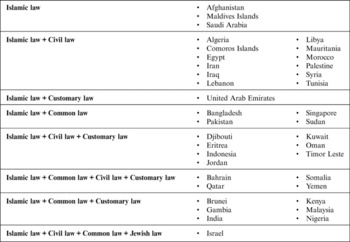
Although all Muslims are subject to Islamic law, it is worth noting which countries have an Islamic or mixed legal system. There are only a few countries which are solely based on Islamic law, while others are a mixture of civil, customary, common and Jewish law (see table 1).

This information can be found at JuriGlobe Footnote 1 which provides a brief overview of world legal systems and the official languages which apply to each country. For all Arab states the laws are published in the official Arabic language only and it is often difficult to find English translations. Note that some understanding of Arabic may be necessary when searching for materials from particular countries.
There are a number of resources to use to find primary materials for individual countries. A good starting point would be to search the FLAG database.Footnote 2 This is a gateway to the holdings of foreign, international and comparative law in UK universities and national libraries. It describes the print collections of over 60 libraries in the UK. You can search for individual counties and find details of each library's holdings, including the dates and language of materials held. Contact details for each library are also provided.
Turning to online resources, there are a number of gateways where you can find freely available legal materials for individual countries – although note that it is often difficult to find free information from Middle Eastern countries. The widely used World Legal Information Institute (WorldLII) Footnote 3 is a good starting point, particularly the section for Islamic countries.Footnote 4 This is a collaborative project between various Legal Information Institutes who are participants in the free access to law movement.Footnote 5 It provides access to a number of databases from jurisdictions around the world containing primary and secondary legal materials. Be aware that the strength of coverage does vary for each country so you may not find what you are looking for.
If WorldLII does not provide what you need, alternative websites include the Islam Catalogue Footnote 6 which covers countries with an Islamic legal system. It is a gateway to particular information for each country including basic legal documents, an overview of the legal system, laws and regulations, agreements and treaties as well as information on human rights issues.
Another useful site is GLIN Footnote 7 – a database of official legal texts (laws, regulations and judicial decisions etc.) from participating countries. Documents are available in their original language, although English summaries are available. Full-text access is restricted for some jurisdictions. Check the database contentFootnote 8 to see the scope of coverage.
Finding primary sources
As mentioned above, Islamic law is linked to the interpretation of the Qur'an and Sunnah, so most texts will in fact be in Arabic. However, there will be a number of English translations available and they can be found at the resources below. If you wish to do a thorough research of Islamic law, you will require an understanding of Arabic.
A major source of primary sources in print will be the School of Oriental and African Studies, University of London (SOAS). The library is the national resource for the study of Asia, Africa and the Middle East. You will be able to find a variety of materials including the Qur'an and Hadith in the Middle East section. SOAS will invariably collect material in the vernacular language although there is a growing collection of English language texts. You can search the catalogueFootnote 9 using keywords such as Hadith, Sunnah (alternative spelling Sunna) and Qur'an (alternative spelling Koran).
There is also a wealth of information available online. One of the most comprehensive websites is the Compendium of Muslim Texts. Footnote 10 The site is maintained by the Muslim Student Association of the University of Southern California and contains links to multiple translations of the Qur'anFootnote 11 and various collections of Hadith.Footnote 12 In fact, it is one of the most complete compilations of Hadith available free online which is in English. There are many other sites of Hadith collections which are more exhaustive, but they are in Arabic only (see the al-Waraq Footnote 13 and aI-Mawsu'ah al-Shamilah Footnote 14 sites mentioned in the next section).
Another useful gateway was created by the Centre of Islamic and Middle Eastern Law (CIMEL) Footnote 15 from the School of Oriental and African Studies. This is a comprehensive resource providing links to Islamic and Middle Eastern legal materials online – including links to primary sources as well as legal rulings and articles. Please be aware, however, that the site is currently undergoing reconstruction so not all the links are working at the moment. Nevertheless, this is a comprehensive site for all Islamic law materials and is a very useful research tool.
Other sites include the Holy Qur'an Resources on the Internet Footnote 16 which includes links to essays, articles, bibliographies and commentaries dealing with the Qur'an. The Islam and Islamic Studies Resources created by the University of Georgia also provide links to and commentaries on the Qur'anFootnote 17 and Hadith.Footnote 18 Both sites provide searchable translations of the texts.
For a Shiite stance, see the Al-Islam.org siteFootnote 19 developed by the Ahlul Bayt Digital Islamic Library Project, which provides full-text resources for the Qur'an and Hadith. It provides sound clips of recitations as well as translations and commentaries. Not to be confused, the Al-Islam.com siteFootnote 20 also provides access to Qur'an and Hadith texts, as well as sound clips of recitations, commentaries and encyclopaedias. However, this site is best searched in Arabic as it provides more information.
Finding secondary sources
As mentioned above Islamic jurisprudence has developed over time, and various schools have emerged, each with its own interpretation and application of Sharia. This has resulted in a vast collection of secondary sources which can be quite difficult to research.
SOAS holds many of these texts in print, although they will mostly be in Arabic. All of these works concerning fiqh are kept in the law section and you can search the library catalogueFootnote 21 for texts by Shiite and Sunni authors. However, the distinction is not always that easy and there are many other branches in Islam – it is generally accepted that the researcher should know who the author is that they need. If you do not have a particular scholar in mind, try using keywords such as Islamic law or fiqh, and Sunni (including the main schools – Maliki, Hanadi, Sha'fi'i and Hanbali) or Shiite. You will also be able to find fiqh collections about particular topics of Islamic law (such as family law, criminal law etc.) but it is usual to find authors discussing all topics within one collection.
The Islam and Islamic Studies Resources siteFootnote 22 created by the University of Georgia also provides a number of secondary sources. You can access texts from important Sunni scholars as well as other relevant articles on Islamic law. Likewise, for a Shiite stance, the Al-Islam.org siteFootnote 23 provides access to a number of works on Islamic jurisprudence.
You can also find a large number of Arabic and Islamic works freely available online in full text. Note that most sites will be in Arabic only. They provide access to extensive information on Arabic studies, so can be very useful to researchers with a reading knowledge of the Arabic language. For example, the site Al-Waraq Footnote 24 contains a number of texts on Arabic literature and humanities, while I-Mawsu'ah al-Shamilah Footnote 25 provides access to more than 6,600 texts on a variety of subjects. This collection of books covers not only Quranic and Hadith studies and commentaries, but Islamic doctrines, law and jurisprudence as well as Arabic language and literature, biographies and general works on history, ethics and geography.
Finding other sources
As with all research, you can find a vast amount of information from journal articles – in this case particularly the Arab Law Quarterly, Journal of Islamic Studies or the Yearbook of Islamic and Middle Eastern Law. You can search for journal articles in Westlaw UK with the Legal Journals Index (for articles from the UK and EU), the Index to Legal Periodicals (for mainly US journal articles), the Index to Foreign Legal Periodicals (for worldwide journal articles including those published in the vernacular language) and HeinOnline (for full-text access to US and international journals).
There are also a number of very useful resources specifically aimed at researching Islamic or Middle Eastern studies. These include the Index Islamicus which is a bibliographic database of books and journal articles about Islam or the Muslim world. It covers works which were published since 1906 in Western languages only. Another useful bibliographic database is Middle Eastern and Central Asian Studies (MECAS), which provides access to a wide range of material relating to the study of the countries and peoples of the Middle East, Central Asia and North Africa. It includes recently published literature covering, among others, political and legal aspects. Further, the Encyclopaedia of Islam is an important resource, as it is an authoritative reference work in the field of Islamic studies and contains articles on all aspects of the Islamic world. All of these databases are available at SOAS to all library users when on site.Footnote 26
Finally, you can also find links to other various resources on the ReligionFootnote 27 and LawFootnote 28 subject guides created by SOAS librarians. They provide links to general sites relating to Islam and Islamic law. They also include details of relevant centres, organisations and other libraries that may be of interest. Likewise, the University of Exeter has created a guide to Arabic, Islamic and Middle Eastern resources Footnote 29 which provides general gateways to a variety of Islamic sources alongside information on Islam and Islamic culture.
Conclusion
There is an abundance of information available on Islamic law - particularly online. The resources I have mentioned above should provide you with a starting point to researching Islamic law. Remember that to search thoroughly this area it will be necessary to have some understanding of Arabic. When researching fiqh collections it will also be more beneficial if the researcher knows the author they wish to consult as there is such a vast amount available. The research guides listed in the bibliography will also be able to provide more information on which sources are useful for researching particular areas of Islamic law.
Acknowledgements
I gratefully acknowledge the assistance given to me by Dominique Akhoun-Schwarb (Assistant Librarian for Near and Middle East), School of Oriental and African Studies.