INTRODUCTION
The marine environment of Iran includes two different habitats: the semi-enclosed Persian Gulf that is hyper-saline and warm; and the Oman Sea, a relatively more exposed and deep component of the Arabian Sea in the north-west of the Indian Ocean. There have never been comprehensive, dedicated marine mammal surveys conducted in Iran, and species occurrence, primarily from reports of standings, is poorly known. The species of dolphin recorded in Iranian waters, which appear to be most common, are the Indo-Pacific humpback dolphin (Sousa chinensis), Indo-Pacific bottlenose dolphin (Tursiops aduncus) and finless porpoise (Neophocoena phocaenoides) (Braulik et al., Reference Braulik, Ranjbar, Owfi, Aminirad, Dakhteh, Kamrani and Mohsenizadeh2010a). Other species also recorded are the Indo-Pacific common dolphin (Delphinus capensis tropicalis), striped dolphin (Stenella coeruleoalba), spinner dolphin (Stenella longirostris) and Risso's dolphin (Grampus griseus) (Braulik et al., 2010a).
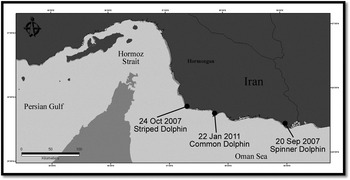
There have been several cetacean mass stranding events in Iran in recent years which received a lot of publicity. On 20 September 2007, the partially decomposed carcasses of 79 spinner dolphins were stranded along 13 km of coast, 125 km east of Jask. A retrospective investigation concluded that the most likely cause of death was fishing activities (Braulik et al., Reference Braulik, Savadkouhi, Fadakar, Mohammadi, Brownell, Reeves, Nabavi and Fernandez2010b). Approximately a month later, on 24 October 2007 there was a live mass stranding of 73 striped dolphins. The stranded group appeared to have become trapped in an estuarine area with complex sandbanks and shallows. What caused this locally uncommon, pelagic species to enter such atypical habitat could not be determined (Braulik et al., Reference Braulik, Savadkouhi, Fadakar, Mohammadi, Brownell, Reeves, Nabavi and Fernandez2010b). The current paper details another cetacean mass stranding that occurred in Iran, providing details of the event and a brief analysis of the possible causes.
DESCRIPTION OF THE MASS STRANDING EVENT
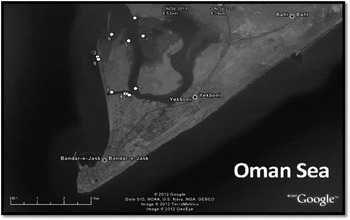
On 22 January 2011, 11 Indo-Pacific common dolphins stranded in Jask on the Oman Sea coast of Iran (25°40′13″N 57°47′8″E to 25°41′51″N 57°47′31″E) (Figure 1). The stranded animals were found in a long winding estuary. Dolphins were seen swimming near the shore during the first hours of day by local people. After several hours, a dead dolphin was discovered on the beach with milk flowing from the mammary slits. During 22 January 2011, another 10 stranded dolphins were found on the shore, of which one was still alive. Eight of the dead dolphins were located in the estuary and two were located outside the estuary along the coast (Figure 1). Our investigation showed that all individuals were female.
Location of each Indo-Pacific common dolphin stranded in the central estuary of Bander-e-Jask on 22 January 2011.

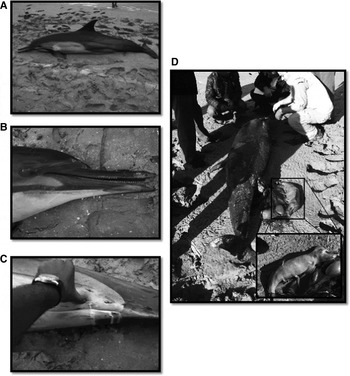
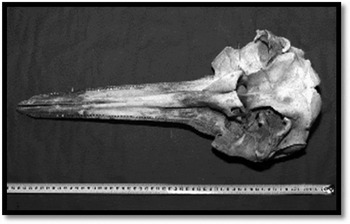
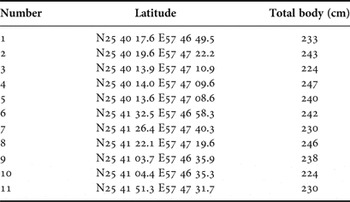
With the help of trained local people, the local DoE (Department of the Environment) game guard and DoE staff, the skin of one stranded, live dolphin was kept moist, and, using a rescue boat, the live dolphin was taken back to the open waters and released The dolphin swam away, did not re-strand and we assume it survived. All individuals had very long beaks (Figures 2 and 3), indicating that they are most likely to be Delphinus capensis tropicalis the very long-beaked subspecies of common dolphin found in the Arabian region. Body length was measured from all the dead dolphins and the average length was 236 cm (range 224–247 cm) (Table 1). These lengths are within the range reported for the Indo-Pacific common dolphin (Delphinus capensis tropicalis) and are longer than those reported for female standard long-beaked common dolphin (Delphinus capensis capensis) (Jefferson et al., Reference Jefferson, Webber and Pitman2008). Also, D. c. capensis is not known to occur in the Arabian Sea region (Jefferson & Van Waerbeek, Reference Jefferson and Van Waerbeek2002) and therefore we have assumed all of our specimens were D. c. tropicalis. All the carcasses were buried after examination. Tissue samples were collected and preserved in ethanol for DNA studies and these will be used to confirm our species identification (Geraci & Lounsbury, Reference Geraci and Lounsbury2005).
Indo-Pacific common dolphin mass stranding in January 2011 in Iran: (A) live dolphin; (B) close-up photograph of the head and beak of one dolphin; (C) milk flowing out of mammary slit; (D) pregnant dolphin and baby dolphin in womb, all of them found on central estuary of Bandar-e-Jask after the mass stranding event.

Photograph of the skull of one Indo-Pacific common dolphin involved in the mass stranding event of January 2011 in Iran.

Body size of all stranded female Indo-Pacific common dolphins (1–10 were dead and 11 was alive).

Jask central estuary is a protected area with about 100,000 ha of mangrove forest in tidal flood canals. As it has abundant nutrients, this estuary system is used for aquaculture and is also a critical place for fish spawning. Jask central estuary has a meandering main channel where fishing boats are often active, especially during high tide. There is also a man-made channel linking the estuarine channel to the sea and the seaward entrance of this man-made channel had become blocked over time due to congestion of sediments. In this incident, 5 of the dolphins were stranded in this man-made channel.
All the dead dolphins were photographed and filmed during the procedure of examining the specimens. Unfortunately, because of distance and remoteness of the location, the experts of the Plan for the Land Society, Department of the Environment, Iranian Fisheries Organization, and Veterinary Organization groups arrived late at night and a full investigation into the possible causes of the event was not conducted.
Cause of the stranding
All the potential causes of marine mammals stranding outlined by Geraci & Lounsbury (Reference Geraci and Lounsbury2005) were considered. These include: disease; fleeing from a predator; interaction with fisheries activities; encounters with boats or ships; contaminants; adverse weather conditions; natural toxins; following prey inshore; and human-caused injuries. All dolphins appeared to be in good nutritional condition and there were no obvious marks or injuries on their bodies. The stomachs of 9 individuals were examined and no food was found in any of them. The weather at the time of the stranding was calm. Spring tides were occurring at that time, low tide occurred at 05:16 am (local time) and was 1.22 m; high tide occurred at 10:53 am and was 3.7 m in the area. No military manoeuvres were reported by the Iranian Navy, nor had there been any algal bloom or natural toxins reported by the national Fisheries Organization at the time of incident. There were not any other dead animals on the beach, nor any evidence of fishing gear. No comprehensive necropsies were conducted, and no tissue samples were analysed for toxins, infectious diseases, injuries from underwater acoustic disturbances or other potential causes of death so it is not possible to comment whether these may have contributed to the stranding.
The fact that the group approached the shore alive and all individuals were in good body condition and had no visible marks on the body suggests that fisheries interactions can be ruled out as a likely cause of the stranding. Without more detailed information it is not possible to rule out the possibility that one or more animals were sick or the involvement of a harmful algal bloom; however the circumstances do not indicate these as likely causes of the event. It is possible that dolphins entered the estuary in search of food, to avoid a predator or due to human disturbance and that they were then caught in the complex oceanographic and geomorphologic condition of the estuary around low tide, which made them confused and caused them finally to strand.
DISCUSSION
Being the link between the Persian Gulf and Oman Sea, Jask city is an important location for stranding incidents. So far, there have been three mass strandings reported in this region in recent years (Figure 4).
Location of three mass stranding events of dolphins along the coast of Iran: long-beaked common dolphins are thought to be one of the more common species in Iran. A live group of 12 individuals (Delphinus cf. tropicalis= D. c. tropicalis) were recorded in the north-west of the Persian Gulf (Henningsen & Constantine, Reference Henningsen and Constantine1992). There have been two records of long-beaked common dolphins stranded along the Iranian coastline of Boushehr Province, one individual stranded in November 2007, and two individuals (a 203 cm male, and a 186 cm female) stranded near Amery in Boushehr in February 2008 (Braulik et al., Reference Braulik, Savadkouhi, Fadakar, Mohammadi, Brownell, Reeves, Nabavi and Fernandez2007, Reference Braulik, Ranjbar, Owfi, Aminirad, Dakhteh, Kamrani and Mohsenizadeh2010a.; Sharif Ranjbar, Reference Sharif Ranjbar2007). In May 2011 a 178 cm long male stranded in Kajoo Village of Chabahar County. Long-beaked common dolphins typically inhabit tropical waters within 180 km off the coast, and in Oman can be seen in mixed groups with spinner dolphins, sometimes in association with yellow-fin tuna (Thunnus albacores) (Jefferson et al., Reference Jefferson, Webber and Pitman2008). They are also sighted fairly frequently along the coast of Pakistan (Kiani et al., Reference Kiani, Iqbal and Siddiqui2011). A D. c. tropicalis skull is stored at the GeoPark Museum on Qeshm Island (Braulik et al., Reference Braulik, Ranjbar, Owfi, Aminirad, Dakhteh, Kamrani and Mohsenizadeh2010a).

In conclusion, this last mass stranding of Indo-Pacific common dolphins is the first of its kind in Iran, but is the third mass stranding of dolphins recently recorded on the Iranian coastlines of the Persian Gulf and Oman Sea.
ACKNOWLEDGEMENTS
We thank the following organizations and people who worked hard in providing assistance in the rescue mission for this incident: Sohrab Poshtare and Mohammad Barmoode of the Jask Enviromental Office; Hamid Vafadar, Managing Director of the Natural Environment Organization; Abdolvahid Riazifar, Vice President of the Natural Environment Organization; and Hassan Hashemi of the Hormozgan Conservation Authority. We also extend our gratitude to those who helped us in our team transportation and local trained people who reported and helped us with the stranded dolphin.