

Introduction
The topic of party change has been a popular theme in the party politics literature in the last 20 years (Harmel and Janda, Reference Harmel and Janda1994; Katz and Mair, Reference Katz and Mair1995; Raniolo, Reference Raniolo2002, Reference Raniolo2013; Bosco and Morlino, Reference Bosco and Morlino2006; Bardi et al., Reference Bardi, Bartolini and Trechsel2014). Many interpretations of party change draw on theories of institutional change because political parties are first and foremost complex institutions (Duverger, 1951; Katz and Mair, Reference Katz and Mair1992; Panebianco, Reference Panebianco1988). These interpretations suggest that party change may be evolutionary or developmental, continuous or discontinuous; it may be a gradual process of stimuli-response to environmental challenges, internal pressures, or a combination of both.
Following this line of research, our paper draws on recent advances in the theory of institutional changeFootnote 1 to examine if and in what manner middle-level elites perceive party transformations. The new wave of research contends that institutions may or may not respond to external stimuli because of the resilience and stickiness of institutional patterns. In consequence, change in political environments may be associated with persistence rather than adaptation or innovation.Footnote 2 Building on this new research programme, we argue that party change is a multidimensional process, characterized by adaptation, innovation, or persistence.
It should be noted that we are not interested in party change as such but in the way in which party national delegates perceive change. Our research question is whether the critical juncture caused by the Italian political turmoil during the 1990s has been matched by adaptation, innovation, or persistence in Italian middle-level elites’ attitudes and opinions. Our empirical analysis is based on interviews of middle-level elites of 15 Italian political parties collected between 2004 and 2013. The article chiefly focusses on the first decade of the new millennium because this is a crucial period in Italian politics. In this period new party alignments shaped the pre-conditions that led to the ‘electoral earthquake’ of 2013 (Chiaramonte and De Sio, Reference Chiaramonte and De Sio2014). This analysis is then updated and integrated with findings of a recent survey carried out during the Partito Democratico (PD) national conference held in Milan in 2013.
Our research builds upon previous work on Italian national party delegates (Bordandini et al., Reference Bordandini, Di Virgilio and Mulè2011; Di Virgilio and Giannetti, Reference Di Virgilio and Giannetti2011; Bordandini, Reference Bordandini2013; Cerruto and Facello, 2014). It improves on extant literature by offering an analytical framework based on advances in theories of institutional of change and by testing the expectations derived from these theories. The article is structured as follows. The second section outlines our theoretical framework. The third section analyses whether the Italian political turmoil of the 1990s can be considered a critical juncture. The fourth section describes the unit of analysis and the available data set. The fifth section explores the belief system of middle-level elites. The sixth develops a statistical model to assess the relationship between innovation and barriers to entry in party organizations. The next session updates the data set in order to assess whether our results hold on a sample of party delegates at the 2013 national conference of the PD. The last section offers some concluding remarks.
The theoretical framework
Peter Mair (Reference Mair1997: viii), one of the most accomplished scholars in the field of party change,Footnote 3 believes that the focus on party change rests primarily on how this question can be approached and interpreted. Thus, the first cut into the problem of party change is to clarify the meaning of the term ‘change’. In Mair’s view, the meaning of the term ‘change’ is derived from its opposite: persistence or stability. Detecting persistence of organizational and behavioural traits in political parties denotes stability on those traits. Party change is the opposite of changeless or immutable conditions.
When socio-economic conditions do vary, the traditional literature on party politics emphasizes party adaptability to those variations. This approach has spawned a wide literature on party change based on adaptation as the party’s chief resource (Calise, Reference Calise2010; Bardi et al., Reference Bardi, Bartolini and Trechsel2014).
Interpreting party responses as adaptation to environmental pressures is an important building block of research on party change. As mentioned above, this research draws on the theories of institutional change based on exogenous factors as triggers of party change.
Our work updates this tradition by applying the recent theory of institutional change concerned with critical junctures. Critical junctures are defined as ‘moments in which uncertainty as to the future of an institutional arrangement allows for political agency and choice to play a decisive causal role in setting an institution on a certain path of development’ (Capoccia, Reference Capoccia2015: 148). Critical junctures induce discontinuous and radical reorganization because of an in-built capacity to overcome institutional stasis. In this view, institutional change results from a breakdown of traditional and continuous dynamics in the organization, bringing about innovative patterns and configurations. Critical junctures generate uncertainty by disrupting the institutional status quo. In times of uncertainty, when multiple options are available to key actors, the expectation is that the organizational scenario of politics creates space for political entrepreneurship and innovation (Capoccia, Reference Capoccia2015: 160).
We contend that this perspective is important for understanding party change because it suggests that critical junctures may induce innovation rather than mere adaptation. The distinction between adaptation and innovation is noteworthy. Innovation brings about new ideas, practices, procedures, and programmes; it is unprecedented and it is always qualitative in nature. Lowi (Reference Lowi1963: 581–582) claims that innovation helps the formulation of problem-solving policies apt to meet political challenges and therefore is a continuing requirement of a free and dynamic society. This is why the analytical distinction between party change as adaptation or innovation is relevant for political scientists. Yet, research findings on party innovation are few and far between (Appleton and Ward, Reference Appleton and Ward1997).
A further point to note is that in democracies parties are channels of innovation only if they are able to represent social diversity. Franzmann (2011: 339) considers heterogeneity of political competitors a necessary condition for innovation. If parties are too homogenous, in the sense that they do not sufficiently represent voters’ diversity, the emergence of new parties promising innovation is likely.
But what is the meaning of innovation? We adopt Schumpeter’s definition of innovation as ‘creative destruction’, a process of mutation that destroys the old patterns and creates new ones (Schumpeter, Reference Schumpeter1934). Empirically, this is not mere substitution; rather the shaping of previously unknown models, ideas, configurations, or arrangements by political entrepreneurs or ‘leaders-new people’.
In a nutshell, innovation is change caused by endogenous forces, while adaptation is change induced exclusively from exogenous forces. Surely, endogenous forces at times latch on exogenous pressures to foster innovation. A typical example is when a political entrepreneur confronts environmental challenges. In this case endogenous and exogenous forces intermingle.
In general, however, innovation always entails the substitution of the old with the new through a process of Schumpeterian ‘creative destruction’. Adaptation instead occurs when the party responds to external pressures by juxtaposing new practices and ideas to the old ones.
The argument sketched out so far sheds light on the analytical benefits of approaching party change as a multidimensional phenomenon along three dimensions: adaptation, innovation, and persistence (or lack of change). Somehow, this multidimensionality has been unduly neglected in empirical research, too exclusively focussed on party adaptation. Our work contributes to filling this gap in the literature.
The critical juncture in Italian party politics: the political turmoil of the 1990s
This section highlights the key elements that define the Italian political turmoil of the 1990s as a critical juncture. We contend that two important defining features of a critical juncture are relevant in the Italian case: (1) inducing discontinuous and radical reorganization and (2) a breakdown of traditional and continuous dynamics. Since the structure, dynamics, format, and organization of party politics in the past 20 years has undergone significant changes, some simplifying assumptions are necessary in order to carry out our analysis. The goal of this section is to briefly and schematically map out the fundamental traits of the Italian critical juncture.
The first point to note is that while in most Western countries party de-institutionalization has occurred incrementally (Chiaramonte and Emanuele, Reference Chiaramonte and Emmanuele2015), in Italy, by contrast, the historical parties suddenly and quickly departed from the political scene in the early 1990s. The arguments regarding the transformation of the Italian political system in the 1990s are well rehearsed and can be summarized as follows: new political supply, new political demand, and new rules of the game. This abrupt renewal of the Italian political landscape represents a unique case study to test the expectations and predictions of the new wave of institutionalist theories based on critical juncture analysis.
Starting with the political supply, the departure of historical parties meant that the new millennium set off with new parties, fruit of a sequence of extinctions, new entries, split-offs, and mergers that began in the early 1990s and continued for about two decades. That period represented year zero of a complex party readjustment process when the old party organizations, builders of the republican democracy born in the aftermath of WWII, broke down and disappeared (Cotta and Isernia, Reference Cotta and Isernia1996; Cotta and Verzichelli, Reference Cotta and Verzichelli2000; Di Virgilio, Reference Di Virgilio2002, Reference Di Virgilio2006; Pasquino, Reference Pasquino2002; Ceccanti and Vassallo, Reference Ceccanti and Vassallo2004; Grilli di Cortona, Reference Grilli di Cortona2007; Ignazi, Reference Ignazi2008, Reference Ignazi2012; Newell, Reference Newell2009). Moreover, modifications in the electoral law altered the format and mechanics of the party system, modifying the traditional competitive drives (Bellucci and Segatti, Reference Bellucci, Maraffi and Segatti2010; Cotta and Verzichelli, Reference Cotta and Verzichelli2016).
It should be noted that the old party organizations were highly institutionalized and deeply anchored to civil society. This meant that historical parties were able to articulate demands and relationships between social partners and between party organizations and voters. They were able to aggregate long-term centre-periphery territorial divisions and profound cultural differences. Consequently, politically relevant cleavages were frozen into a highly structured party system (Morlino, 1991; Vassallo, 1992; Cotta and Verzichelli, Reference Cotta and Verzichelli2000). The advent of a critical juncture initiated a ‘revolution of the political supply’ that swept away the old, highly institutionalized parties (Di Virgilio, Reference Di Virgilio2010).
Hence, one salient trait of the critical juncture was to induce discontinuous and radical reorganization. The new parties were organizationally weaker than their predecessors, with looser ties to the national electorate and therefore with weaker political articulation capabilities. Several new terms were coined to describe such parties. They were either called ‘personal parties’, in the sense that they were put together by one person or the ‘President party’, if characterized by a charismatic leadership, such as Forza Italia (Calise, Reference Calise2010).
Furthermore, as predicted by the institutional theory of critical junctures the unprecedented collapse of historical parties caused a breakdown of traditional and continuous dynamics. In a few months, the magistrates ‘clean hands’ policy put the old party leaders on trial for charges involving acts of political corruption and of improper and unlawful political financing methods (Burnett and Mantovani, Reference Burnett and Mantovani1998). In consequence, the historical parties were depleted of those symbolic and material resources that had nurtured them for about half a century (Cotta and Isernia, Reference Cotta and Isernia1996). Such readjustment destroyed the Christian Democratic Party, which had been the dominant government party during the post-war period, and helped restyling its long-time political opponent, the Communist Party, into a centre-left party.
With the restructuring of political alternatives between the so-called First and Second Republic the strength of class cleavage dramatically decreased. Bellucci and Heath (Reference Bellucci and Segatti2012) convincingly show that there was a sudden rupture in the relationship between both religion and vote, and class and vote in 1994, with the transition to the Second Republic: ‘since 1994 the level of class voting has fluctuated up and down, and in 2006 was only a little lower than levels observed in the First Republic, only to drop down again in the last election in 2008. However, the religious cleavage has remained at historically very low levels’ (Bellucci and Heath, Reference Bellucci and Segatti2012: 118).
This quotation suggests that the new Italian political landscape brought about a breakdown of continuous dynamics, as predicted by critical juncture analysis. In turn, the breakdown of continuous dynamics created social and political fluidity that fuelled calls for renewal (Morlino and Tarchi, Reference Morlino and Tarchi2006).
Such calls brought up new social cleavages, including ethical conservatism/progressivism (i.e. gay rights); winners vs. losers of globalization (i.e. immigration); materialism–post-materialism (i.e. environment) (Inglehart, Reference Inglehart1990; Hooghe et al., Reference Hooghe, Marks and Wilson2002; Kriesi et al., Reference Kriesi, Grande, Lachat, Dolezal, Bornschier and Frey2008; Hooghe et al., Reference Hooghe, Bakker, Brigevich, de Vries, Edwards, Marks, Rovny, Steenbergen and Vachudova2010; Dalton and Welzel, Reference Dalton and Welzel2014). Against this background, we expect the attitudes and opinions of middle-level elites of the new parties in the new millennium to reflect new social cleavages rather than mirror old cleavages.
To sum up, this section briefly highlighted the main traits of the critical juncture ushered in by the political cataclysm of the early 1990s. The critical juncture created a radically different political scenario in political supply, political demand, and rules of the game that offered real and concrete opportunities for innovation. Interpreting the Italian political turmoil of the 1990s with the tools of critical juncture analysis raises the expectation that the decisions and choices of national party delegates are freer and thus there is more room for radical innovation.
The unit of analysis and the data set
The unit of analysis
Building on Katz and Mair’s (Reference Katz and Mair1993) theory of party organization, we explore party delegates’ role of linkage coordination in three different ‘faces’ of party organization: the party on the ground, the party in central office, and the party in public office. National delegates can be considered the party’s representatives on the ground. In most cases, members vote for their representatives at the local/municipal level; these then elect the provincial/state’s delegates who, in turn, elect the national delegates. For this reason middle-level elites deeply affect the participatory linkage, which is the ability of a party to involve members in the decision-making process (Lawson, Reference Lawson1980; Merkl, Reference Merkl2005; Bordandini, Reference Bordandini2013). Therefore, middle-level elites are central actors of intra-party democracy because their activity allows the party on the ground, that is, the party membership, to be involved in the formulation of its programme (Heidar and Saglie, Reference Heidar and Saglie2003). In addition, middle-level elites may strengthen the party linkage with its political environment. This environmental linkage, or the capacity of parties to penetrate social groups, is what cleavage theorists generally refer to as ‘segmentation’ (Bellucci and Heath, Reference Bellucci and Segatti2012). Middle-level elites engage in the segmentation capacity by connecting the party organization with interest groups, such as trade unions, and by participating in networks of cultural and recreational associations. In this manner, middle-level elites reinforce the cleavage structure in society and help anchoring the party on the ground with voters and sympathizers. National party delegates often enjoy social visibility thanks to their organizational or elective positions in politics and local-level associations. They are focal members of party communities, moulding the relationship between top leadership, the party on the ground, and society.
This role of linkage between parties and society has been progressively reinforced in recent years, chiefly because the party on the ground has significantly shrunk in size and relevance in the past 20 years. International trends demonstrate, with few exceptions, that party membership has declined substantially in most countries (van Biezen and Pogungtke, 2014). Dropping membership figures mark the transition from the mass party to the catch-all party and then to the electoral-professional party and finally to the cartel party (Katz and Mair, Reference Katz and Mair1995). This transition, which is characterized by party professionalization and new sources of party funding, altered the quality of party organizations (Bardi et al., Reference Bardi, Bartolini and Trechsel2014). It strengthened the centralization process of the party organization, rendering more autonomous and powerful the party in central office and the party in public office.
Centralization of party organizations inevitably amplifies the role of middle-level elites as linkage coordination. It is they, in fact, who must transmit the opinions and moods of members and supporters to the governing bodies and, at the same time, make the party’s political line known at the local level (Ignazi, Reference Ignazi1989: 331).
While recent trends in leadership selection indicate that party leaders are sometimes chosen from external arenas, such as Berlusconi in Italy, national party delegates have traditionally been the pool of leadership selection. More generally, a focus on party middle-level elites as unit of analysis is justified by the fact that party delegates are the leaders of the future or, in Schumpeterian terms, the ‘leaders-new people’.Footnote 4 These ‘leaders in the years to come’ (Bordandini et al., Reference Bordandini, Di Virgilio and Mulè2011), mingle with top leadership while they build the bridge between the party membership and its leadership.
The data set
National party delegates are activists with a long history of political militancy and, in many cases, with organizational or elected positions in politics at the local level.Footnote 5 They are a unique ‘strategic group’ because they operate as a transmission belt within the vertical articulation of the party organization. ‘They perform roles of linkage-coordination between distinct organizational areas from which they derive the main resources to capitalize in the struggle for organizational power and, in general, in the quest for political influence’ (Raniolo, Reference Raniolo2011: 236). They are ‘individuals who are intensively involved politically, but who do not live off politics’ (Bellucci et al., Reference Bellucci and Heath2000: 16–17). National party delegates lie somewhere between local and national leadership, and thus can be defined as middle-level party elites.
Our data show that party delegates hold senior positions in both the party in central office and in public office. In our sample, 72% of national delegates hold leading positions in their party and about one out of ten hold elective office at the national level.
Middle-level elites are thus a ‘strategic group’ not only because they are the driving force of party organization, but also because they connect the party on the ground, the party in central office and the party in public office. Party delegates can be considered privileged witnesses who experience from ‘within’ the parties’ transformations induced from without. Hence, their values and attitudes are more stable compared to those of simple members, and this is another reason why they represent a bridge between the old and the new parties in Italy (Bordandini et al., Reference Bordandini, Di Virgilio and Mulè2011).
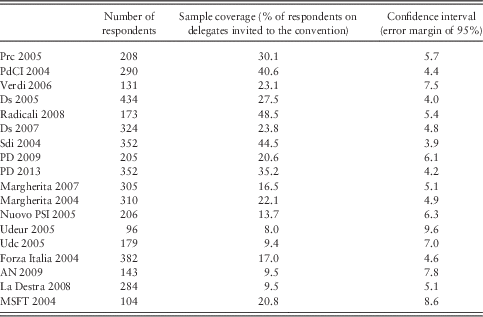
This paper draws upon data gathered from 4478 interviews of national party delegates at 18 national conventions (of 15 different parties) that took place between 2004 and 2013 (Table 1).Footnote 6 Data collection was carried out by means of a structured self-completion questionnaire distributed during the conventions.Footnote 7
Party delegates, 2004–13

AN=Alleanza Nazionale; Ds=Democratici di Sinistra; MSFT=Movimento Sociale Fiamma Tricolore; PD=Partito Democratico; PdCI=Partito dei Comunisti Italiani; Prc=Partito della Rifondazione Comunista; Sdi=Socialisti Democratici italiani; Udc=Unione dei Democratici Cristiani e di Centro.
Calculated from Bordandini and Di Virgilio (2009–2013).
The questionnaire comprised a general section for all parties and a specific section adapted to the characteristics of each party and to the context in which the convention took place. It was not possible, unfortunately, to participate in the founding convention of Popolo delle Libertà (PDL) (Rome, 27–29 March 2009), due to the unanticipated decision of the party to deny, a few days before the beginning of the proceedings, the authorization that had initially been granted.
To summarize our expectations, following the 1990s critical juncture in Italian party politics we expect that the attitudes and opinions of middle-level elites reflect the transformations of political parties in the party belief system. Our work assesses whether such transformations are the outcome of innovation, adaptation, or persistence. In addition, we test whether high barriers to entry for women and young delegates might have dampened innovation since the sample shows that both women and young delegates are under-represented (23.3 and 21.5%, respectively).
The belief system of party delegates
This section analyses the belief system of the Italian middle-level elite. In light of the early 1990s critical juncture, the expectation is that old attitudes and patterns are replaced by fresh attitudes and ideas. In the new scenario Italian middle-level elites could have developed policy priorities and programmes able to foster innovation.
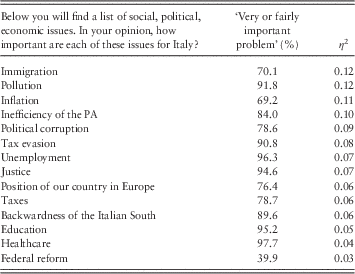
Following previous empirical studies (Bordandini and Cartocci, Reference Bordandini and Di Virgilio2011), we analyse delegates’ belief system focussing on four groups of indicators. The first group relates to the political agenda as regards the most urgent reforms for the country: public administration and federal reforms, economic policy (taxes, tax evasion, inflation, labour market); welfare system (healthcare, education, immigration); environment (pollution); the judiciary (political corruption, crime, and justice). The second group concerns ethical issues, such as abortion, assisted reproductive technology, drug liberalization, gay rights, and so on. The third group pertains to traditional cleavages, including State/Church, Capital/Labour. Lastly, the fourth group is connected with trust in justice and in public order institutions. Our work improves on previous studies in two ways. First, we apply these indicators to detect the presence of innovation, persistence, and adaptation in the party delegates’ belief system. Second, we simplify the data presented (Table 2) and add correlations (Table 3). This improvement helps identify the dimensions of adaptation, innovation, and persistence.
Less discriminant attitudes among party delegates

The data are weighted.
Calculated from Bordandini and Di Virgilio (2009–2013).
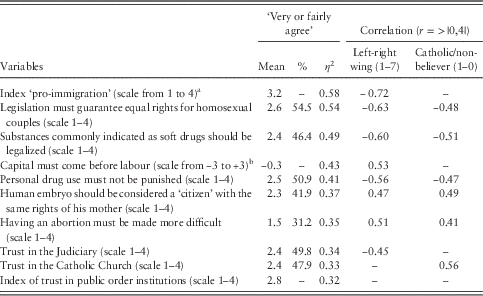
Most discriminant opinions among party delegates

The data are weighted.
Calculated from Bordandini and Di Virgilio (2009–2013).
a We construct a pro-immigration index to analyse the greater or lesser support on the issue of immigration. The index varies from 1 (minimum support) to 4 (maximum support) and stems from the combination of the responses to the following queries (presented as a four-position Likert battery): (a) Immigrants are a danger to our culture and to our identity; (b) Immigrants, if they are regularly registered and if they pay their taxes, should be able to vote in the administrative elections of the municipality in which they live; (c) Immigrants constitute a resource for economic development; (d) Immigrants are a threat to public order and the security of people. We inverted the polarities of the queries (a) and (d), and we carried out – in order to verify the congruency of the indicators – a single-factor confirmative analysis. The variance explained by the factor exceeds 70%.
b The values of the index vary from +3 [maximum trust in the association of entrepreneurs (Confindustria) compared to the trade union] to −3 (minimum trust in Confindustria compared to the trade union).
Tables 2 and 3 compare those aspects in which the delegates differ to a lesser degree (Table 2), and those in which they differ to a greater extent (Table 3). Our statistical technique is the variance analysis.Footnote 8 Table 2 shows that the most evenly distributed stances among the delegates, regardless of party affiliation, involve primarily the political agenda (the first group of indicators). Consistent with previous research, our results indicate that Italian middle-level elites agree, quite peculiarly, on the fact that all the problems are important for the country (see the low η 2 scores and the percentages of very-fairly important).
The delegates’ profiles highlight a lack of priorities, linked to a widespread, non-proactive attitude of generalized indistinct criticism. Middle-level party officials are convinced of the need to found the entire country anew, from an economic, administrative, fiscal, and socio-political point of view! Table 2 suggests that about eight out of ten respondents consider all these policy problems as ‘very or fairly important’. One exception is federal reform, which is considered a priority by less than four delegates out of ten.Footnote 9
Our results clearly point to a lack of innovation in the party delegates’ belief system. The inability to set priorities indicates a rather void political agenda and no vision on which to build political projects and solutions. Such findings point to persistence rather than adaptation or innovation in the delegates’ attitudes and opinions.
Table 3 illustrates the major differences among delegates by party affiliation (those that produce a η 2>0.3). It reveals that there are four main differences: (a) attitude towards immigration; (b) ethical issues (namely, liberalization of soft drugs, abortion, gay rights); (c) capital/labour cleavage; (d) trust in institutions, particularly in the Catholic Church and Judiciary.
The correlations reported in Table 3 show that these new attitudes are strictly correlated with the traditional left-right dimension and the Catholic/non-believer cleavage. For this reason the new attitudes can be retraced to the old belief system, which is reflected in the left-right cleavage.Footnote 10 In terms of our theoretical framework, these findings also suggest the persistence of old and the emergence of new cleavages.
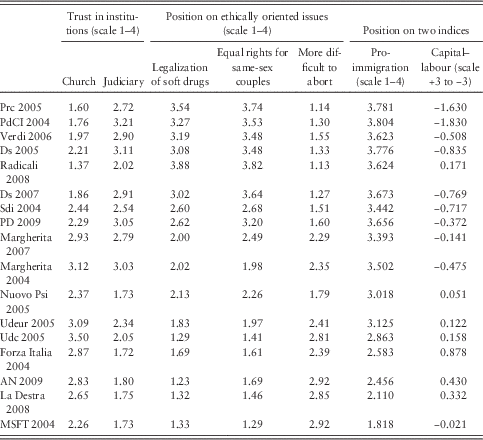
We now focus on the differences in responses of delegates belonging to different political parties, along the dimensions of adaptation, innovation, and persistence. Table 4 shows that differences in responses are quite predictable on the basis of party positions on old cleavages. This finding strongly suggests persistence in the differences among parties rather than innovation.
Delegates’ trust in institutions and attitudes on political issues

AN=Alleanza Nazionale; Ds=Democratici di Sinistra; MSFT=Movimento Sociale Fiamma Tricolore; PD=Partito Democratico; PdCI=Partito dei Comunisti Italiani; Prc=Partito della Rifondazione Comunista; Sdi=Socialisti Democratici italiani; Udc=Unione dei Democratici Cristiani e di Centro.
Calculated from Bordandini and Di Virgilio (2009–2013).
The data illustrate, for instance, that Partito dei Comunisti Italiani delegates record the highest score in the ‘pro-immigration’ index (mean value of 3.8); conversely, the lowest value is found among Movimento Sociale Fiamma Tricolore respondents (mean value of 1.9). The mean values clearly distinguish left-wing from right-wing parties, even if the trend is not monotonic.
By contrast, a clear monotonic trend from left to right is found in the liberalization of soft drugs, gay rights, the protection of the embryo in vitro under general human rights, abortion, and the death penalty. This says that with regard to ethical issues the mean value drops (soft drugs and gay rights) or rises (more difficult recourse to abortion) moving from left to right.
As expected, Table 4 also reports that trust in the Church peaks among delegates of Catholic parties. Apart from this, confidence in Church presents a monotonic evolution, with lower values found in left-wing parties, compared to those of the right.
No different is the evolution of the traditional cleavage capital/labour. Our findings reveal the negative attitude of left-wing party delegates towards Confindustria, the Italian association of employers and the positive attitude of those who belong to Forza Italia (mean of 0.9), Alleanza Nazionale (0.4), and La Destra (0.3). The cleavage capital/labour, therefore, fully reflects the persistence of traditional alignments.
To conclude, close examination of delegates’ attitudes suggests that the new cleavages are simply added to the old ones, without breaking the past patterns typical of Italian politics. The correlations in Table 3 show that the fault lines are the old ones: Catholics/non-believers and left/right. Rather than innovation in the delegates’ belief system, the data suggest a crystallization where new fault lines are added to the old ones without replacing them.Footnote 11 Therefore, we cannot speak of Schumpeterian innovation that ‘breaks old tradition and creates new ones’. Perhaps for this reason, experts of Italian politics have recently highlighted ‘the miserable plight of all Italian political parties and their poverty of ideas and projects’ (Pasquino and Valbruzzi, Reference Pasquino and Valbruzzi2012: 620). This persistence of old patterns requires explanation. It is likely that such crystallization of the belief system has played an important role in hindering innovation and/or the emergence of innovative political entrepreneurs.
Entry barriers and ‘negative case’
Entry barriers
In view of the political fluidity generated by the critical juncture of the early 1990s, we expect new opportunities for young people and women. Historical accounts of internal party conflicts demonstrate that new generations of leaders often elaborate innovative programmes that challenge the dominant coalition (Panebianco, Reference Panebianco1988). And it is women, traditionally under-represented in political parties, who can bring about different visions for problem-solving decisions.
We know from previous research that women have been significantly under-represented among Italian national party delegates and that, in general, the average age of party delegates has been stable for the past 30 years (Mulé, Reference Mulé2011).
We build and improve on those findings to examine whether there is a gender and age imbalance in the delegates’ attitudes towards new social cleavages. Our data show that women are more open to immigration (86% of women against 79% of men), gay rights (73 against 53%), the legalization of soft drugs (57 against 47%), and abortion (82 against 67%). Furthermore, women are more favourable to in vitro fertilization, only 30% believe the human embryo is an unborn citizen against 45% of men. Finally, women are more concerned about the environmental impact of generating nuclear power, only 14% are in favour of nuclear power against 25% of men. Likewise, young delegates (under 36 years old) are more open to gay rights (65 against 55% over 36 years old), to the legalization of soft drugs (56 against 47%), and to the environment (18% accept nuclear power against 24%). Our data clearly illustrate that there is a gender and age imbalance in the delegates’ attitudes towards new social cleavages.
Italy as a ‘negative case’
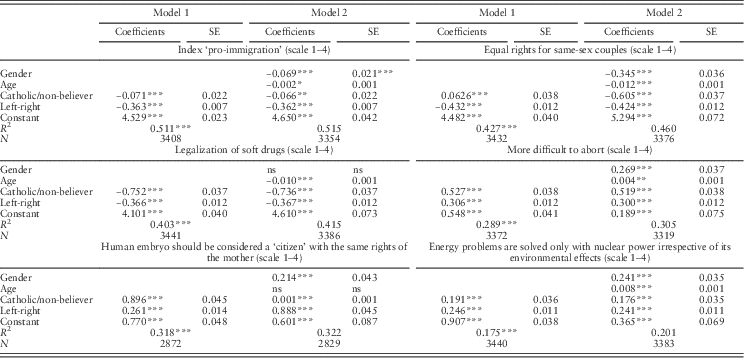
The fifth section established that the variability of delegates’ attitudes towards new social cleavages was integrated into the traditional left-right and Catholic/non-believer cleavages. To assess whether women and young delegates contribute to party innovation strategies aside these traditional cleavages, we run two regression models (Table 5). The first one regresses each new cleavage on left-right and Catholic/non-believer variables; in the second model regressors are augmented with age (dummy: 0=under 36) and gender (female =0). This second model allows us to estimate the age and gender influence on the party’s openness to new cleavages irrespective of left-right and Catholic/non-believer dimensions. Table 5 confirms the relevance of left-right and Catholic/non-believer variables to explain the variability of new cleavages as underlined in sixth section. However, Model 2 suggests the relevance of age and gender beyond traditional cleavages.
Multivariate regressions predicting openness towards immigrants, rights for homosexual couples, drug liberalization, and closeness towards abortion

Gender is coded with men=1 and female=0, Catholic/non-believer is coded with Catholic=1 and non-believer=0. Left-right wing is a seven-point scale.
Calculated from Bordandini, Cartocci and Di Virgilio’s data set.
***P<0.001, **P<0.01, *P<0.05.
Regression coefficients reported are almost always significant. Their signs suggest that women are more open to innovation (in terms of new cleavages) than men and young delegates are more open to innovation than older delegates. Importantly, R 2 increases from the first to the second model for each dependent variable.
Regression results suggest that high barriers to entry in Italian party organizations help explain the limited innovative capability of party delegates.
Overall, the low generational turnover indicates a telling myopic behaviour, which protects the status quo rather than investing in the future. Entry barriers in Italian political parties seem to be surprisingly high in the new millennium despite the critical juncture of the early 1990s.
In critical juncture analysis Italy is a ‘negative’ case. Negative cases occur when institutional change was possible but did not happen (Capoccia, Reference Capoccia2015). In the first decade of the new millennium, party leaders failed to appreciate the important innovative role of young people and women.
Looking forward: searching for innovation
This section updates our work by analysing the responses of delegates at the recent national party conference of the PD held in Milan in 2013, which elected Matteo Renzi to the head of the party (352 cases). The PD is one of the few Italian political parties that still enjoys a relatively strong party organization. For this reason, the PD is an important case study because national delegates retain their role of transmission belt in the party organization chain. This new data set is a useful testing ground to assess the association between innovation and age and gender.
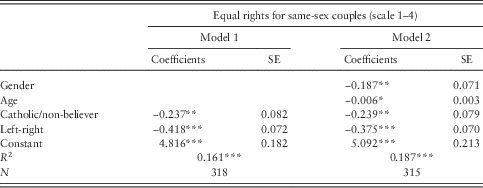
As a consequence of his election at the head of the PD, Matteo Renzi replaced Enrico Letta as Italian prime minister in February 2014. One innovative policy in terms of belief system introduced by the Renzi government was to legalize same-sex civil unions (Law No. 76/2016). This is the reason why in this section we focus on the PD delegates’ attitudes on gay rights in 2013. In general the data show that young delegates are more innovative than older ones (95.8% young are pro-gay rights against 91.6% of older ones). Likewise, women (95.3%) are more innovative than men (89.3%).
Applying our two regression models (explained in the previous section) to the new data set of 2013, we test if and how age and gender influence the dependent variable (pro-gay rights), controlled for left/right and Catholic/non-believer.
It should be noted that our models fit well the PD case because it is internally divided into a centre-left/left wing and a Catholic/non-believer wing (Pasquino and Venturino, Reference Pasquino and Venturino2014).
Table 6 shows that R 2 increases when from the first to the second model (augmented with age and gender as regressors). Our findings confirm that coefficients are significant. Model 2 supports our hypothesis that women are more open to innovation than men and young delegates more than older ones.
Multivariate regressions predicting openness towards rights for homosexual in 2013’s Partito Democratico (PD) delegates.

Gender is coded with men=1 and female=0, Catholic/non-believer is coded with Catholic=1 and non-believer=0. Left-right wing is a seven-point scale.
Calculated from Bordandini, Cartocci and Di Virgilio’s PD data set.
***P<0.001, **P<0.01, *P<0.05.
Conclusions
The article offered a fresh analytical perspective in the literature on party politics by weaving insights from recent theories of institutional change based on critical juncture analysis. It argued that party change is not simply adaptation to environmental pressures, as conventional wisdom suggests. Rather, party change is a multidimensional process characterized by adaptation, innovation, and persistence. Unpacking the concept of party change in these three dimensions shed light on what occurred to the belief system of a ‘strategic group’ of Italian party organizations. Empirically, the article attained new results by exploring these dimensions in the national party delegates’ belief system. Our results clearly point to a lack of innovation in the policy agenda. Most importantly, the differences among parties are related to ethical issues, which reflect adaptation to old cleavages.
Our findings, however, are inconsistent with critical juncture analysis that predicts innovation. In particular, our results highlight the enduring persistence of old cleavages and the consequent lack of innovation in the attitudes and opinions of party delegates in the new millennium.
To explain these findings we tested the hypothesis that innovation is a function of lower barriers to entry in party politics. The results show that women and young people are more open to innovative trends, such as new social cleavages. Hence, barriers to entry in party organizations appear to be a key to understanding the lack of innovation in middle-level elites’ attitudes and opinions. The important question regarding what other conditions provide incentives for innovation in the belief system of middle-level elites calls for further scholarly research.
Acknowledgements
The authors would like to thank Anna Bosco and Leonardo Morlino for constructive comments to earlier versions of this paper. An earlier version of this article was presented at the Giornata di studi in memoria di Aldo Di Virgilio, Bologna University, 26 February 2016. The authors owe to Aldo Di Virgilio the idea of unpacking party change by using the concept of innovation. This paper is dedicated to his memory. The paper is the product of a joint effort by the two authors, but the responsibility for the final draft is the following: P.B.: The critical juncture in Italian party politics: the political turmoil of the 1990s, The data set, The belief system of party delegates, Italy as a ‘negative case’ sections; Looking forward: searching for innovation, R.M.: Introduction, The theoretical framework, The unit of analysis, Entry barriers, Conclusions sections.
Financial Support
The research received no grants from public, commercial, or non-profit funding agency. However, the data set used is part of the national party delegates’ research project. Until 2011 this project was part of an inter-university research programme (PRIN), co-funded by the Ministry of Education, University, and Research. The survey of 2013 was carried out by P.B., Aldo Di Virgilio, and Roberto Cartocci, Department of Political and Social Sciences (University of Bologna).
Data
The replication data set is available at http://thedata.harvard.edu/dvn/dv/ipsr-risp.