Implications
Newborn piglets are in a negative energy balance immediately after birth, before the establishment of an adequate suckling pattern. They have <2% body fat at birth, and most of it is present as structural fat in cell membranes and hence not available as substrate for oxidation. In general, energy utilization is very efficient in the newborn pigs, but colostrum intake is often a limiting factor for survival and performance. Insufficient colostrum intake reduces the body temperature of newborn piglets, and thus nutritional strategies to improve energy transfer from sow to offspring will presumably increase piglet survival.
Introduction
Neonatal piglet survival has decreased during the last 20 years (Pedersen et al., Reference Pedersen, Berg, Jørgensen, Bonde, Kongsted, Lauridsen, Oksbjerg, Poulsen, Sorensen, Su, Sørensen, Theil, Thodberg and Jensen2010) and is a major problem in modern pig production. Piglets are born deficient in energy, and intake of energy from colostrum (Pettigrew, Reference Pettigrew1981) and milk after the onset of lactation is of paramount importance for the newborn piglets (Le Dividich et al., Reference Le Dividich, Rooke and Herpin2005; Quesnel et al., Reference Quesnel, Farmer and Devillers2012; Theil et al., Reference Theil, Nielsen, Sørensen and Lauridsen2012). Energy originating from oxidized glycogen, colostrum and transient milk all contribute to maintain a constant body temperature and to keep the piglets alive (Theil et al., Reference Theil, Nielsen, Sørensen and Lauridsen2012). The energy requirement of newborn piglets is very high because of physical activity (locomotion, suckling and attempts to take ownership of a mammary gland) and to the great need for thermoregulation. However, the energy deficiency in neonatal piglets has been further challenged owing to selection for large litters. First, the competition during the colostrum period has increased along with the number of littermates (Rutherford et al., Reference Rutherford, Baxter, D’Eath, Turner, Arnott, Roehe, Ask, Sandoe, Moustsen, Thorup, Edwards, Berg and Lawrence2013). Second, selection for large litters has had the unintended consequence of reducing the average birth weight of piglets (Foxcroft et al., Reference Foxcroft, Dixon, Dyck, Novak, Harding and Almeida2009) that has decreased their capacity to ingest colostrum (Amdi et al., Reference Amdi, Krogh, Flummer, Oksbjerg, Hansen and Theil2013). Another problem with low birth weight piglets is that they have a greater energy requirement per kg of birth weight (Noblet and Etienne, Reference Noblet and Etienne1987) because of their high surface-to-volume ratio. Selection for large litters has further challenged survival of these piglets because sows do not have an inherent mechanism to favor a high glycogen deposition in small born piglets (Theil et al., Reference Theil, Cordero, Henckel, Puggaard, Oksbjerg and Sørensen2011; Amdi et al., Reference Amdi, Krogh, Flummer, Oksbjerg, Hansen and Theil2013). Therefore, any change in nutritional or management strategies for late gestating sows that favors transfer of energy from the sow to the offspring is expected to improve neonatal piglet survival. The purpose of the present review is to provide an update on nutritional factors of importance for sows around farrowing with regard to fetal glycogen deposition and production and composition of colostrum and transient milk, with the overall aim of improving piglet survival via increased transfer of energy. Nutritional aspects with the aim of reducing stillbirth rate and the role of specific colostral immunoglobulins are considered beyond the scope of the present review. In addition, the review will not cover intrinsic piglet factors relevant for piglet survival, because these issues have been recently addressed by other authors (Pedersen et al., Reference Pedersen, Berg, Jørgensen, Bonde, Kongsted, Lauridsen, Oksbjerg, Poulsen, Sorensen, Su, Sørensen, Theil, Thodberg and Jensen2010; Quesnel et al., Reference Quesnel, Farmer and Devillers2012 and Reference Quesnel, Gondret, Merlot, Loisel and Farmer2013).
Energy: crucial for neonatal survival
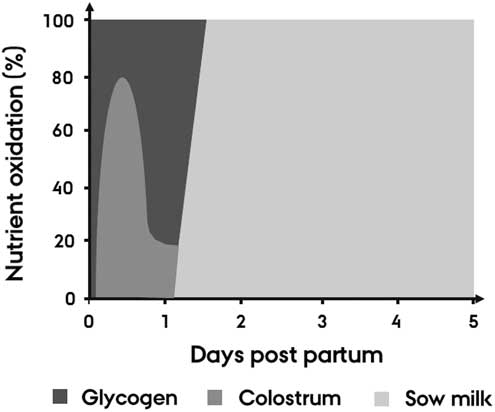
When a piglet is being born, its risk of dying is greater than at any other stage of life. Birth is associated with several distinct and coordinated physiological events in both piglets and sows. For piglets, birth marks a sudden decrease in body temperature (Kammersgaard et al., Reference Kammersgaard, Pedersen and Jørgensen2011) and the abrupt transition from parenteral (via placenta) to enteral supply of nutrients (Siggers et al., Reference Siggers, Sangild, Jensen, Siggers, Skovgaard, Støy, Jensen, Thymann, Bering and Boye2011). Consequently, thermoregulation becomes extremely important and it must be met by oxidation of nutrients (Noblet et al., Reference Noblet, Dourmad, Etienne and Le Dividich1997). Most piglets that die are lost during the first 3 postnatal days (Tuchscherer et al., Reference Tuchscherer, Puppe, Tuchscherer and Tiemann2000), and short-term survival (i.e. survival to day 3) is much more relevant to focus on than long-term survival (survival until weaning). To survive until day 3, sufficient amounts of energy must be available from three different sources, namely glycogen depots, colostrum and transient milk (Figure 1). If one of these energy sources fails to supply adequate amounts of energy, the piglet ends up dying either because of hunger or because it eventually is crushed by the sow when the piglet is too weak to realize when the sow changes position (e.g. from standing to lying). For the sow, the transition from late gestation to early lactation is associated with substantial hormonal changes (Farmer and Quesnel, Reference Farmer and Quesnel2009; Foisnet et al., Reference Foisnet, Farmer, David and Quesnel2010), altered supply of nutrients (Theil et al., Reference Theil, Nielsen, Sørensen and Lauridsen2012), altered intermediary metabolism of nutrients (Flummer C, Røjen BA, Kristensen NB and Theil PK, unpublished) and altered utilization of nutrients (Theil et al., Reference Theil, Jørgensen and Jakobsen2002 and Reference Theil, Jørgensen and Jakobsen2004). Sows are normally fed a gestation diet low in protein, energy and fat but often high in fiber throughout gestation. However, in some countries (e.g. Denmark), sows are commonly fed a lactation diet (high in protein, fat, energy and low in fiber) during the last week of gestation. The inherent alterations/adaptations in the physiology around parturition (the transition period), and the different requirements by sows whether in the state of late gestating or lactating are typically ignored. Thus, official nutritional recommendations for sows do not currently consider whether sows in late gestation produce colostrum (a minor daily investment), or whether sows at peak lactation produce milk with huge amounts of nutrients (Theil et al., Reference Theil, Jørgensen and Jakobsen2002, Reference Theil, Jørgensen and Jakobsen2004 and Reference Theil, Nielsen, Sørensen and Lauridsen2012). In addition, feeding recommendations for sows should take into account live weight, parity number and body condition.
Relative contributions of oxidized nutrients to cover the energy requirement of newborn piglets (from Theil et al., Reference Theil, Nielsen, Sørensen and Lauridsen2012).
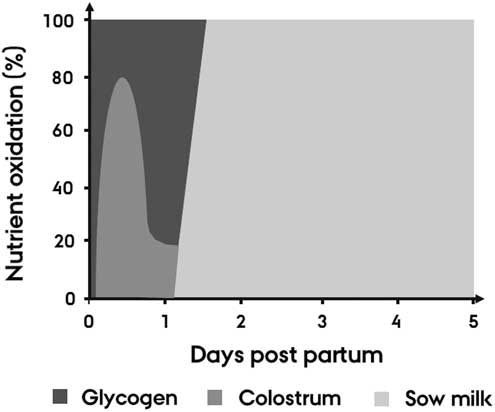
Although sufficient supply is crucial for newborns in all animal species, this is even more important in pigs because they are litter-bearing animals and because newborn piglets do not have fat depots (Pastorelli et al., Reference Pastorelli, Neil and Wigren2009) or brown adipose tissue that is present in calves, lambs and rodents. Newborn piglets are born with very small energy depots (mainly glycogen), and the energy supplied from stored glycogen and colostrum are equally important to avoid neonatal death before transient milk supplies sufficient amounts of energy (Figure 1). Indeed, the glycogen depots supply energy in amounts adequate for ∼16 h (Theil et al., Reference Theil, Cordero, Henckel, Puggaard, Oksbjerg and Sørensen2011) and energy supplied from colostrum must contribute significantly to ensure piglet survival because transient milk is not being secreted until ∼34 h postpartum (stage II of lactogenesis, Hartmann et al., Reference Hartmann, McCauley, Gooneratne and Whitely1984; Krogh et al., Reference Krogh, Flummer, Jensen and Theil2012).
Colostrum, especially late colostrum, and transient milk are rich in fat, and parturition marks a shift in the neonatal energy supply from glucogenic substrates (mainly glucose and fructose during gestation) to more ketogenic substrates (fat from colostrum and transient milk). Ingestion of colostrum supplies the neonate with fat and ingestion of colostrum causes secretion of potent lipases in the oral cavity of the piglet (lingual lipase; Middowson, Reference Middowson1985) that ensure degradation of the fat and render it highly digestible (Le Dividich et al., Reference Le Dividich, Rooke and Herpin2005). In the newborn piglet, colostral fat may serve two important purposes, namely, retention of fat, which helps insulating the piglet against additional heat loss, and oxidation of fat, which is important for thermoregulation (Herpin et al., Reference Herpin, Damon and Le Dividich2002). Indeed, the liver of newborn piglets is capable in oxidizing both medium and long-chain fatty acids (FA) to CO2 (Odle et al., Reference Odle, Lyvers-Peffer and Lin2005), and the glycogen stored in the liver likely plays an important role because glucogenic substrates are needed to fuel oxidation of ketogenic (fat) energy.
Attempts to increase glycogen depots by sow nutrition
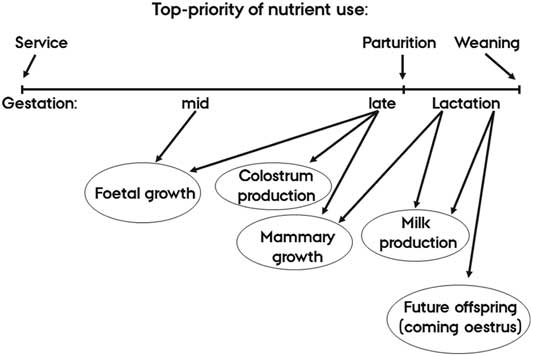
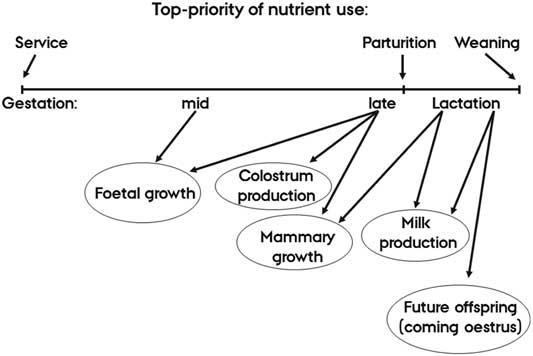
Glycogen is deposited in pig fetuses during the last month of gestation in liver and muscle tissues (Père, Reference Père2003). At birth, the concentration of glycogen is greater in the liver (9.6% of wet weight) than in muscles (6.5% to 8.4% of wet weight), but the total pool of glycogen deposited in the muscles is ∼10 times larger than the depot in the liver owing to the larger muscle mass (Theil et al., Reference Theil, Cordero, Henckel, Puggaard, Oksbjerg and Sørensen2011). During the first 2 days after birth, glycogen pools are oxidized and glycogen in the liver is depleted faster than pools in different muscles (Okai et al., Reference Okai, Wyllie, Aherne and Ewan1978; Theil et al., Reference Theil, Cordero, Henckel, Puggaard, Oksbjerg and Sørensen2011). Immediately after birth, the expression of genes involved in glycogen catabolism is high (Theil et al., Reference Theil, Cordero, Henckel, Puggaard, Oksbjerg and Sørensen2011), emphasizing the importance of a rapid energy supply for thermoregulatory purposes. Increased glycogen deposition during the fetal stage may be a way of improving the short-term survival of piglets. Jean and Chiang (Reference Jean and Chiang1999) reported that glycogen concentrations in the piglet liver and muscle tissues were increased by 14% to 20% when sows were fed medium-chain FAs (mainly C8) or coconut oil (rich in C12) compared with soybean oil. The dietary inclusion level of fat (10%) was applied from day 84 of gestation, and it had a profound effect on survival until day 3 for piglets weighing <1.1 kg at birth. Survival increased from 48% (in soybean fed sows) to 80% and 99% in sows fed coconut oil and medium-chain FAs, respectively. In another study, survival rate of piglets under 1 kg birth weight was increased from birth until 3 weeks later when sows were fed additional energy in the form of corn oil as compared with corn starch from day 109 of gestation to parturition (Seerley et al., Reference Seerley, Pace, Foley and Scarth1974). However, in that study, the glycogen depots of piglets were not improved. Several other attempts to improve fetal glycogen deposition via altered nutrient supply to sows in late gestation have failed. Boyd et al. (Reference Boyd, Moser, Peo and Cunningham1978) fed gilts and older sows with a conventional diet until day 99 of gestation and then, from day 100 one of two isoenergetic diets containing either 20% tallow or 32% corn starch were fed until parturition without affecting glycogen deposition or piglet survival. Newcomb et al. (Reference Newcomb, Harmon, Nelssen, Thulin and Allee1991) studied glycogen deposition in newborn piglets from sows fed one of three different diets from day 100 of gestation until parturition. The diets supplied equal amounts of energy and protein but differed in energy source (274 g wheat starch, 157g soybean oil or 157 g medium-chain triglyceride/kg of diet). Piglets born from sows fed soybean oil had 32% to 37% greater hepatic glycogen concentrations than piglets from sows fed medium-chain triglycerides or wheat starch, respectively, but differences were not statistically significant, and no differences were observed in carcass (i.e. muscle) glycogen. Pastorelli et al. (Reference Pastorelli, Neil and Wigren2009) compared a conventional low fat diet (3%) with three diets supplemented with 3% fat from either tallow (rich in saturated FAs), oats or linseed (rich in monounsaturated and polyunsaturated fatty acids (PUFA)). These diets were fed to sows from mating to parturition but did not favor retention of glycogen in fetuses. In a study by Theil et al. (Reference Theil, Cordero, Henckel, Puggaard, Oksbjerg and Sørensen2011), sows were fed either a conventional gestation diet low in fiber (17%) or three high-fiber diets (32% to 40%), which were low in starch (30% to 43%) from mating until day 108 of gestation. Furthermore, these sows were fed lactation diets with different fat contents and fat sources from day 108 and onward (added fat: 3% animal fat, 8% fish oil, 8% sunflower oil, 8% coconut oil or 4% octanoic acid+4% fish oil). Neither gestation diets (until day 107) nor lactation diets (from day 108) affected glycogen deposition in the fetuses at birth. Taking all these studies into consideration, it is questionable whether glycogen deposition in fetuses can be stimulated by sow nutrition in late gestation. The precursor for glycogen synthesis is plasma glucose, which is derived from assimilated starch. As gestation diets are normally rich in starch (∼50% of the dry matter), and as sows commonly are fed above maintenance during the last trimester of pregnancy (Theil et al., Reference Theil, Jørgensen and Jakobsen2002 and Reference Theil, Nielsen, Sørensen and Lauridsen2012), glycogen deposition is probably not limited by the amount of available precursors. Moreover, glycogen deposition likely has a high priority in late gestation (Figure 2) because of the vital role of energy for neonatal survival.
Top priority of nutrients for sows (parity⩾2) during a reproductive cycle (from Theil et al., Reference Theil, Nielsen, Sørensen and Lauridsen2012). In mid and late gestation, nutrients are prioritized for fetal growth, at the expense of maternal weight gain. Furthermore, in late gestation, nutrients are also prioritized for fetal and mammary growth and colostrum production, whereas the top priorities during lactation are continuous mammary growth and milk production (in early lactation) and milk production (and, to a less extent, future offspring) in late lactation.
Definitions of colostrum, transient milk and mature sow milk
Sow mammary secreta are gradually changed from colostrum into transient milk and from transient milk into mature milk. Most (or even all) colostrum are produced before parturition, whereas transient milk and mature sow milk are produced after parturition (Hartmann et al., Reference Hartmann, McCauley, Gooneratne and Whitely1984; Csapó et al., Reference Csapó, Martin, Csapó-Kiss and Házas1996). Colostrum can be defined as the mammary secreta ingested by neonatal piglets until 24 h after birth of the first piglet (as suggested by Devillers et al., Reference Devillers, van Milgen, Prunier and Le Dividich2004). Transient milk is defined as the mammary secreta being produced from 34 h after parturition until day 4 of lactation because the milk becomes rather rich in fat on day 2 to day 4. Mature milk is defined as milk secreted from day 10 of lactation through the end of lactation because the composition is essentially constant during that period (Klobasa et al., Reference Klobasa, Werhahn and Butler1987; Csapó et al., Reference Csapó, Martin, Csapó-Kiss and Házas1996). Mammary secretions in the periods from 24 to 34 h postpartum, and from day 4 to day 10, are regarded as transition periods with respect to mammary secreta because gradually less colostrum (24 to 34 h) and transient milk (day 4 to day 10) are being secreted, and gradually more transient milk (24 to 34 h) and mature milk (day 4 to day 10) are being secreted.
Sow colostrum: synthesis, quantification, amount and composition
Synthesis of sow colostrum
At present, it is not known exactly when or at which rate colostrum is being synthesized in the mammary gland, or when colostrum synthesis ceases. Most (if not all) of the colostrum are produced before the first piglet is born and, consequently, colostrum yield cannot be dependent on piglets suckling (Theil et al., Reference Theil, Nielsen, Sørensen and Lauridsen2012). The first colostrum component (β-lactoglobulin) is produced around day 80 of gestation (Dodd et al., Reference Dodd, Forsyth, Buttle, Gurr and Dils1994), but the last week of gestation is important for colostrum yield (Flummer and Theil, Reference Flummer and Theil2012; Krogh et al., Reference Krogh, Flummer, Jensen and Theil2012).
Quantification of sow colostrum
Both the amount and composition of colostrum change rapidly (see below) that makes it particularly challenging to quantify the exact amounts of nutrients secreted in colostrum. When colostrum yield of sows is to be quantified, it is necessary to measure the amount of colostrum ingested by all the piglets and summing their intakes to derive the sow yield. There are two different methods that can be used to assess the colostrum intake of piglets. The most frequently used method is to weigh piglets at birth and after the colostrum period (24 h after birth of the first-born piglet), and then calculate the colostrum intake of each piglet based on a prediction equation established by Devillers et al. (Reference Devillers, van Milgen, Prunier and Le Dividich2004). The equation reported by Devillers et al. was based on a study on piglets that were removed from the sow and bottle-fed with colostrum, and a relation between known intake of colostrum and piglet weight gain was established. However, the equation proposed by Devillers et al. (Reference Devillers, van Milgen, Prunier and Le Dividich2004) underestimates the actual colostrum intake likely because bottle-fed piglets were less physically active, and thus less colostrum was required to reach a certain live weight gain. The other method that can be used to quantify colostrum intake is the deuterium oxide dilution technique. By this approach, the amount of ingested water is quantified and converted into colostrum intake by accounting for the composition of colostrum. Using this technique, colostrum intake was recently quantified in 240 piglets from 40 litters (Theil et al., Reference Theil, Flummer, Hurley, Kristensen, Labouriau and Sørensen2014) and it was on average 43% higher than predicted as per the equation of Devillers et al. (Reference Devillers, van Milgen, Prunier and Le Dividich2004). According to the study by Theil et al. (Reference Theil, Flummer, Hurley, Kristensen, Labouriau and Sørensen2014), the colostrum intake of individual piglets can accurately be predicted by a mechanistic prediction model, being:
 $$\eqalign{{\rm CI}\,({\rm g)}=\,{\minus}{\rm 1}0{\rm 6}{\plus}{\rm 2}.{\rm 26\, WG}{\plus}{\rm 2}00\,{\rm BWB}{\plus}0.{\rm 111 }\,D \cr {\minus} {\rm 1414 \, WG}/D{\plus}0.0{\rm 182\, WG}/{\rm BWB}$$
where CI is the colostrum intake (g), WG the weight gain of individual piglets from birth to 24 h after first born piglet (g), BWB the weight of individual piglets at birth (kg) and D the duration of colostrum intake (min; Theil et al., Reference Theil, Flummer, Hurley, Kristensen, Labouriau and Sørensen2014).
A third and direct method, the weigh–suckle–weigh technique, is frequently used when measuring milk production of sows. However, that method is not applicable during the colostrum period because colostrum is available at all time for all piglets.
Amount of sow colostrum
As stated above, colostrum quantity is generally accepted as the amount of colostrum being secreted from the birth of the first piglet until 24 h later. Sufficient uptake of colostrum is crucial to avoid neonatal death (Pettigrew, Reference Pettigrew1981; Le Dividich et al., Reference Le Dividich, Rooke and Herpin2005), and it was recently demonstrated that piglet mortality increases markedly if colostrum intake is <200 g/piglet (or 180 g/kg birth weight; Quesnel et al., Reference Quesnel, Farmer and Devillers2012). Indeed, mortality rate averaged <10% if piglets ingested >200 g of colostrum, 34% if piglets ingested 100 to 200 g of colostrum, and it increased to 63% if piglets ingested <100 g of colostrum. Thus, an intake of 200 g of colostrum per piglet, or 180 g/kg birth weight, seems to be a minimum requirement to reduce the risk of mortality. An average intake of 250 g of colostrum is recommended to achieve a good BW gain (quantities predicted as per Devillers et al., Reference Devillers, van Milgen, Prunier and Le Dividich2004).
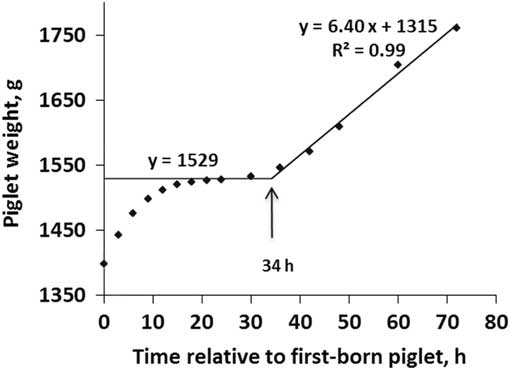
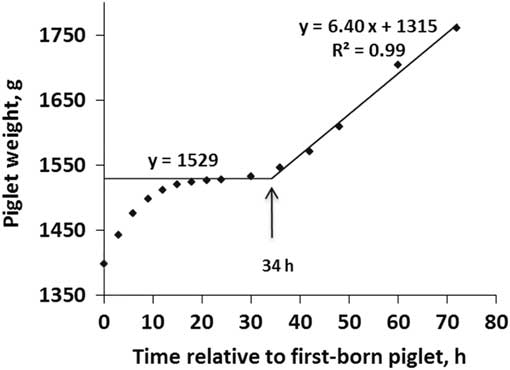
The amount of colostrum secreted from the udder likely changes during the colostrum period, as evaluated by the rate of piglet gain during the first 24 h period postpartum (Figure 3). Apparently, most of the colostrum is secreted during the initial 12 to 16 h after onset of parturition, whereas much less colostrum seems to be available beyond 16 h, and amounts then only suffice to maintain the piglet live weight until ∼34 h after the first piglet is born. It remains unknown, however, whether the constant live weight of piglets between 16 and 34 h is because of a low intake of colostrum and transient milk, or whether it is because of increased losses of urine and feces that counteracts the weight gain reached by ingested colostrum. At 34 h, a copious amount of transient milk begins to be secreted and this is referred to as the onset of lactation or second stage of lactogenesis (Hartmann et al., Reference Hartmann, McCauley, Gooneratne and Whitely1984). A minor amount of transient milk is, however, being produced before 34 h (and maybe even before 24 h), and although colostrum is produced before parturition while transient milk is produced after, the gradual change from colostrum secretion into secretion of transient milk makes it difficult to quantify the exact amount of colostrum produced.
The time for onset of lactation was revealed by a broken line analysis of piglet weight gains during the critical perinatal period.
Composition of sow colostrum
Colostrum is regarded as the ‘elixir of life’ because of the high abundance of many different components (macronutrients and micronutrients and bioactive molecules such as immunoglobulins, growth factors and enzymes), and many of these components are important for survival of the newborn piglet and proper development of, for example, the gastrointestinal tract (Mei et al., Reference Mei, Zhang, Wang, Sangild and Xu2006; Bjørnvad et al., Reference Bjørnvad, Thymann, Budek, Nielsen, Mølgaard, Michaelsen and Sangild2007). Sow colostrum differs from mature milk in concentrations of macronutrients and immunoglobulins (Tables 1 and 2). However, even though the colostrum period is very short, the content of many colostrum components changes substantially and rapidly. These concentrations change almost from hour to hour, although with respect to the content of macrochemical components (lactose, protein and fat), no or only minor changes are observed from 0 to 6 h (Jackson et al., Reference Jackson, Hurley, Easter, Jensen and Odle1995). Therefore, it is appropriate to distinguish between early (0 h), mid (12 h) and late (24 h) colostrum in terms of composition.
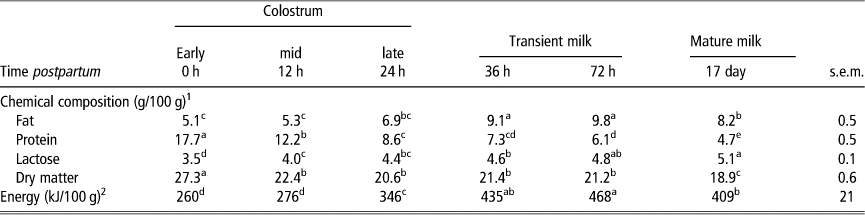
Contents of fat, protein, lactose, dry matter and energy in colostrum (early, mid and late), transient milk and mature milk

1 Values in rows without a common superscript differ (P<0.05; Krogh U, Bruun TS, Amdi C, Flummer C, Poulsen J and Theil PK, unpublished).
2 Calculated energy deriving from lactose and fat (energy in protein not included as proteins serve other functions than energy supply for neonatal piglets).
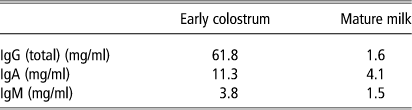
Contents of immunoglobulins in colostrum and mature sow milk
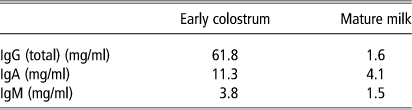
Modified after Butler and Kehrli (Reference Butler and Kehrli2005).
The macrochemical composition of colostrum (0, 12 and 24 h), transient milk (36 and 72 h) and mature milk (day 17) was recently studied in high-prolific sows (Krogh U, Bruun TS, Amdi C, Flummer C, Poulsen J and Theil PK, unpublished). The lactose content increased steadily from 3.5% in early colostrum to reach 5.1% in mature milk (Table 1). The fat content was lowest in early and mid colostrum (5.1% to 5.3%), intermediate in late colostrum, highest in transient milk (9.1% to 9.8%) and intermediate in mature milk (8.2%). Lactose and fat in colostrum serve a main purpose of supplying energy and the content of calculated gross energy derived from fat and lactose was lowest in early and mid colostrum (260 to 276 kJ/100 g), intermediate in late colostrum, highest in transient milk (435 to 468 kJ/100 g) and intermediate in mature milk (409 kJ/100 g; Table 1). In contrast with lactose and fat, the protein content decreased from 17.7% in early colostrum over mid and late colostrum (12.2% and 8.6%, respectively) and transient milk (7.3% to 6.1%) to reach the lowest concentrations in mature milk (4.7%). The most pronounced changes in the protein fraction occurred from early to late colostrum. The changes incurred as lactation progresses in high-prolific sows were similar to those reported by Klobasa et al. (Reference Klobasa, Werhahn and Butler1987), before selection for large litter size began (Pedersen et al., Reference Pedersen, Berg, Jørgensen, Bonde, Kongsted, Lauridsen, Oksbjerg, Poulsen, Sorensen, Su, Sørensen, Theil, Thodberg and Jensen2010). The protein fraction of colostrum serves other purposes than supplying energy, including transfer of immunity (immunoglobulins), stimulation of growth (growth factors) and facilitation of fat digestion (enzymes). Common to all these metabolites is the fact that they are present in greater concentrations in early v. late colostrum. Thus, in terms of nutritive (energetic) value, late colostrum and transition milk are superior to early colostrum because of greater contents of fat and lactose. In contrast, the immunological and bioactive values of colostrum are much higher in early colostrum than in late colostrum (Klobasa et al., Reference Klobasa, Werhahn and Butler1987). For the piglet, it is important to ingest these molecules early after birth because large molecules can only be absorbed as intact molecules before gut closure. Such as in the case for energy, colostral immunoglobulins are important for the piglets to avoid diseases and death, but they are more important for ensuring survival in the long term (throughout lactation and after weaning), whereas energy is crucial to ensure survival on a short-term basis.
Attempts to increase colostrum quantity via sow nutrition
Sow colostrum production seems not to be related to litter size (Quesnel, Reference Quesnel2011), but it is highly variable among sows (ranging from 1.9 to 5.3 kg; Le Dividich et al., Reference Le Dividich, Rooke and Herpin2005). Approximately, one-third of sows produce less colostrum than the recommended level of 250 g colostrum/piglet (Quesnel et al., Reference Quesnel, Farmer and Devillers2012), which will be adequate for survival and proper growth. In addition, even if sow colostrum yield per se is adequate, quite a lot of piglets typically ingest less than the amount required to survive because colostrum intake differs greatly among littermates (Quesnel et al., Reference Quesnel, Farmer and Devillers2012). Indeed, colostrum intake is positively related to birth weight and negatively related with litter size (Le Dividich et al., Reference Le Dividich, Rooke and Herpin2005). Piglets born with a low birth weight have a reduced capacity to ingest colostrum (Amdi et al., Reference Amdi, Krogh, Flummer, Oksbjerg, Hansen and Theil2013), and despite a high demand for energy per unit of BW, many of these piglets ingest less colostrum than the minimum estimated requirement of 180 g of colostrum/kg birth weight (Quesnel et al., Reference Quesnel, Farmer and Devillers2012). As a consequence, any change in dietary composition, feeding strategy or management of sows that can increase colostrum yield will expectedly increase the short-term survival of piglets.
Currently, not much is known on how sow nutrition affects colostrum yield. Dietary fat from different sources are commonly included in lactation diets to improve milk yield of sows (Boyd et al., Reference Boyd, Moser, Peo, Lewis and Johnson1982; Lauridsen and Danielsen, Reference Lauridsen and Danielsen2004), and CLA, a bioactive FA, is known to impact mammary gland metabolism and increase the milk yield of dairy cows (Zheng et al., Reference Zheng, Liu, Yao, Yuan, Ye, Ye and Wu2005). It was therefore reasonable to assume that inclusion of dietary CLA could increase colostrum production, but sows fed with 1.3% CLA (an equal mixture of cis-9/trans-11 and trans-10/cis-12 isomers) from day 108 of gestation until parturition tended to produce less colostrum (409 v. 463 g; P=0.07) and more piglets died or had to be moved to other sows during the 1st week of lactation to ensure their survival (17.6% v. 7.8% in the control group; P=0.04; Krogh et al., Reference Krogh, Flummer, Jensen and Theil2012) compared with control sows. In another study (Flummer and Theil, Reference Flummer and Theil2012), sows were fed a conventional lactation diet, which was supplemented or not with 2.5 g/day Ca(HMB)2 from day 108 of gestation until parturition. The active compound (HMB; also known as β-hydroxy β-methyl butyrate) is a metabolite of leucine. Providing HMB increased the colostrum intake as predicted by piglet weight gain during the colostrum period (132 v. 76±21 g/piglet for control piglets, P=0.05) and piglet mortality during that colostrum period was lowered from 4.8% (control litters) to 0.0% (HMB litters; P<0.05).
Diets high in fiber in late gestation may be beneficial for colostrum production of sows, although it depends on the dietary fiber (DF) source. In a study by Theil et al. (Reference Theil, Flummer, Hurley, Kristensen, Labouriau and Sørensen2014), sows were fed either a conventional gestation diet (17% DF) or one of three high-fiber diets (32% to 40% DF) originating from pectin residue, potato pulp or sugar beet pulp from mating until day 108 of gestation. The colostrum intake of piglets (measured by the deuterium oxide dilution technique) was greater when sows were fed pectin residue or sugar beet pulp (520 and 504 g/piglet, respectively) as compared with potato pulp or the low-fiber diet (393 and 414 g/piglet, respectively; P=0.02). In the same experiment, it was found that concentrations of short-chain FAs in sow plasma on the day of parturition were positively related to piglet live weight gain during the colostrum period across dietary treatments (Hansen et al., Reference Hansen, Lauridsen, Sørensen, Bach Knudsen and Theil2012). It is not clear, however, which mechanism is responsible for these beneficial effects on colostrum yield. Quesnel et al. (Reference Quesnel, Meunier-Salaün, Hamard, Guillemet, Etienne, Farmer, Dourmad and Père2009) reported a numerically greater colostrum yield in sows fed a high-fiber diet compared with a low-fiber control diet from day 26 of gestation until parturition (3.4 v. 3.0 kg), although the difference was not significant. Recently, Loisel et al. (Reference Loisel, Farmer, Ramaekers and Quesnel2013) investigated the influence of the level and source of DF on colostrum yield. The amount of fiber was progressively increased to 23% in the sow gestation diet, from day 92 of pregnancy onward, compared with a 13% DF diet. In the high-fiber diet, wheat and barley were partly replaced by a mixture of soybean hulls, wheat bran, sunflower meal (undecorticated) and sugar beet pulp, which provided more soluble and insoluble fiber than the low-fiber diet. The high-fiber diet did not affect colostrum yield per se, but the colostrum intake of piglets having a low birth weight (<900 g) was nearly 60% higher when sows were fed the high-fiber diet compared with the low-fiber diet and piglet mortality between day 1 and day 21 of lactation was decreased (6.2% v. 14.7%; P=0.01). Thus, these studies collectively indicate that sow nutrition is important for colostrum production in late gestation. Increasing colostral fat content may depress colostrum intake by piglets, but the overall energy transfer to piglets does increase because the elevated fat content more than compensates for the decreased colostrum intake (Le Dividich et al., Reference Le Dividich, Herpin, Paul and Strullu1997).
Attempts to alter macrochemical composition of colostrum by sow nutrition
Altering the composition of sow colostrum via sow nutrition may be another way of transferring more energy to the neonate and thereby increasing neonatal survival, and colostral fat can be increased by altering the sow nutrition in late gestation (Nissen et al., Reference Nissen, Faidley, Zimmerman, Izard and Fisher1994; Le Dividich et al., Reference Le Dividich, Rooke and Herpin2005; Loisel et al., Reference Loisel, Farmer, Ramaekers and Quesnel2013). In contrast with inclusion of fat or fiber in the sow diets, alterations in dietary composition are not likely to improve the energy transfer to the neonate by changing the lactose content. In fact, lactose plays an osmotic role and draws water into the mammary secreta, so that increased lactose production will likely affect colostrum yield by merely diluting colostrum instead of increasing lactose concentration. Colostral protein content can possibly be altered via the diet, but utilization of protein as substrate for oxidation is inefficient, and therefore the protein fraction of colostrum is of less importance than fat and lactose contents for short-term survival.
Impact of dietary fat
Addition of dietary fat in late gestation has been shown to increase the fat content of colostrum or alter the fatty-acid profile of colostral fat. Boyd et al. (Reference Boyd, Moser, Peo, Lewis and Johnson1982) reported a higher colostrum fat content (13.2%) when sows were fed a diet supplemented with 8% tallow compared with control sows fed an equal amount of metabolizable energy on a daily basis, producing colostrum containing 9.6% fat. In that experiment, six sows were exposed to each of the dietary treatments from day 100 of gestation and during lactation. Jackson et al. (Reference Jackson, Hurley, Easter, Jensen and Odle1995) reported that a gestation diet supplemented with 10% corn oil from day 100 of gestation until parturition increased fat content in early colostrum from 5.6% to 6.9% (P<0.05). These authors concluded that fat addition may be a way to ensure high transfer rate of colostral energy, especially when sows are induced to farrow prematurely. Cordero et al. (Reference Cordero, Isabel, Morales, Menoyo, Piñeiro, Daza and Lopez-Bote2011) reported an alteration in fatty-acid profile without any change in macrochemical composition of colostrum when sows were fed a diet containing CLA. Nissen et al. (Reference Nissen, Faidley, Zimmerman, Izard and Fisher1994) demonstrated that diet supplementation with the leucine metabolite HMB (2.0 g/day of Ca(HMB)2) the last 3 to 4 days before parturition increased the fat content of colostrum on day 1 by 41% (4.9% in control and 6.9% in HMB supplemented sows; P=0.01). In contrast with the study by Nissen et al., Flummer and Theil (Reference Flummer and Theil2012) reported greater colostrum yield for HMB sows (treatment described above) but no difference in colostrum composition (5.8% in control and 5.5% in HMB supplemented sows; P=0.73). The mechanism of action of HMB is likely because of its lipolytic effect causing fat mobilization and high plasma levels of NEFA, which then act as precursors for de novo synthesis of fat secreted in colostrum.
Impact of DF
Besides adding fat to the sow diet, inclusion of DF may be another way of increasing the lipid content of colostrum, which may increase lipid accretion and, in turn, enable the piglet to maintain a constant body temperature. Loisel et al. (Reference Loisel, Farmer, Ramaekers and Quesnel2013) demonstrated that fiber supplied to sows from day 106 of gestation until parturition increased the fat content of late colostrum from 8.3% in control sows to 10.7% in sows fed high fiber. DF increases the plasma concentration of short-chain FAs (Hansen et al., Reference Hansen, Lauridsen, Sørensen, Bach Knudsen and Theil2012), which then can be used by the mammary gland as precursors for de novo synthesis of lipids (Theil et al., Reference Theil, Nielsen, Sørensen and Lauridsen2012).
From colostrum to transient milk
The onset of lactation, that is, secretion of transient milk, is dependent on suckling by piglets, which is in contrast with mammary synthesis of colostrum (Theil et al., Reference Theil, Nielsen, Sørensen and Lauridsen2012). This was illustrated in an experiment where suckling was prevented in selected mammary glands by taping the nipples for 6 days, beginning either 12 or 24 h after onset of parturition. Suckling is an important signal to stimulate mammary expression of prolactin receptors and α-lactalbumin and to maintain mammary function (Theil et al., Reference Theil, Sejrsen, Hurley, Labouriau, Thomsen and Sørensen2006). As mentioned previously, it seems that low amounts of colostrum are available from the udder from 16 until 34 h after birth of the first piglet (Figure 3). If onset of lactation could be hastened by sow nutrition, this could be a way of improving short-term survival of piglets. The onset of lactation was studied in an experiment where sows were fed a standard lactation diet with or without supplementation of 1.3% dietary CLA (Krogh et al., Reference Krogh, Flummer, Jensen and Theil2012). Thus, stage 2 of lactogenesis started 34 h after birth of the first piglet, irrespective of dietary treatment (P=0.41).
Increased yield of transient milk may be another way of improving neonatal survival. In a study by Guillemet et al. (Reference Guillemet, Hamard, Quesnel, Père, Etienne, Dourmad and Meunier-Salaun2007), sows (n=42) were fed either a low- or a high-fiber diet (3.2% or 12.4% crude fiber, respectively) from day 28 of gestation until parturition. Piglets nursed by sows fed high-fiber diets had a greater BW gain during the 1st week of lactation (185 g/day) than piglets in the low-fiber control group (163 g/day, P<0.01), suggesting that the DF may have increased the yield of transient milk. In a study carried out by Oliviero et al. (Reference Oliviero, Kokkonen, Heinonen, Sankari and Peltoniemi2009), sows (n=41) were fed either 3.8% or 7.0% crude fiber from day 94 of gestation until parturition and piglets had a greater BW gain (175 g/day) from day 1 to day 5 when sows were fed the high-fiber diet compared with the low-fiber control diet (150 g/day; P=0.04). The mortality in early lactation was not affected in these studies, which could suggest that the yield of transient milk is more important for growth performance than for piglet survival. However, the impact of transient milk intake on preweaning survival needs to be studied on a larger number of litters, and it is still uncertain whether time for onset of lactation and yield of transient milk may improve piglet survival.
Sow nutrition and effects on immunoglobulin contents of colostrum
Colostrum is a unique mammary secretion not only in terms of energy and specific nutrients for the neonate but also in terms of bioactive molecules. Indeed, colostrum is involved in massive translocation of bioactive molecules from the mother’s blood into mammary secretions, and thereby delivery to the neonate. The most noteworthy of these molecules are the maternal immunoglobulins, which are transferred to the neonate and provide passive immunity, hence reducing risk of diseases and increasing piglet survival.
Sow colostrum contains approximately six times more immunoglobulins (IgA, IgG and IgM) than sow milk, and whereas IgG is the most abundant class of immunoglobulins in colostrum (81%), IgA is the most abundant class in sow milk (70%; Butler, Reference Butler1974). Changes in immunoglobulin concentrations in mammary secretions reflect the ability of the species to transfer maternal immunity to the offspring. Piglets are born agammaglobulinemic (i.e. without immunoglobulins) because circulating immunoglobulins in sows cannot cross the placental barrier (Le Dividich et al., Reference Le Dividich, Rooke and Herpin2005). Consequently, intake of colostrum is crucial for the piglet to obtain passive immunity from the sow. The ingested IgG from colostrum is absorbed as intact molecules before gut closure and IgG is important for systemic immune function. After the onset of parturition, the content of IgG in colostrum drops rather fast to a low level, whereas the content of IgA only drops slightly. Ingested IgA is important for the protection of the gastrointestinal tract (Hurley and Theil, Reference Hurley and Theil2011), and IgA provided by colostrum and milk therefore plays an essential role in preventing diarrhea during the neonatal period and throughout suckling. Even though avoidance of piglet diseases is more important for the long-term survival (Le Dividich et al., Reference Le Dividich, Rooke and Herpin2005; Devillers et al., Reference Devillers, Le Dividich and Prunier2011), colostral immunoglobulins may increase short-term piglet survival. Indeed, newborn piglets may die because of diarrhea associated with infection of Escherichia coli because of dehydration, which is caused by transfer of water into the gut lumen, and diarrhea is responsible for 6% of the loss of piglets in the suckling period (Johansen, Reference Johansen2013). Another diagnosed disease in newborn piglets is haemorrhage-necrotizing enteris, which is caused by Clostridium perfringens. This pathogen produces a toxin, which causes serious damage to the intestinal epithelium, potentially leading to piglet death. Piglets may be infected within the 1st week of birth.
Different nutritional strategies have been studied to increase the concentration of immunoglobulins in the colostrum of sows, with special focus given to IgG. One of the most studied strategies to obtain that effect in swine and other species is dietary FA supplementation during gestation, and especially the long-chain n-6 and n-3 PUFA. It has been shown that the maternal–fetal transfer of n-6 or n-3 PUFA and subsequent transfer via sow milk improved both passive and active immune status in piglets by increasing leucocytes, IgG and Aujeszky antibodies (Mitre et al., Reference Mitre, Etienne, Martinais, Salmon, Allaume, Legrand and Legrand2005). Differences in the concentration of immunoglobulins (IgG, IgA and IgM) and FAs in colostrum and milk of sows fed different dietary fat sources (coconut oil, fish oil, sunflower oil, and a combination of octanoic acid and fish oil) during the last week of gestation and throughout lactation were recently observed (Lauridsen C and Theil PK, unpublished).
Supplementation of the maternal diet with CLA from day 108 of gestation to term increased sow colostrum IgG, IgA and IgM, and nursing piglets from the CLA-fed sows had significantly greater circulating lysozyme and IgG (Corino et al., Reference Corino, Pastorelli, Rosi, Bontempo and Rossi2009). Recently, seaweed and seaweed extracts have been explored as novel sources of bioactive compounds with immunomodulatory properties. Supplementation of sow diets with seaweed from day 107 of gestation until weaning increased the concentration of IgA and tended to increase IgG in colostrum compared with control sows (Leonard et al., Reference Leonard, Sweeney, Bahar and O’Doherty2012). Other dietary initiatives have included feeding quillaja saponins during gestation, but no effects were obtained with regard to concentrations of IgG and IgA in the colostrum or milk of the sows (Ilsley and Miller, Reference Ilsley and Miller2005). Besides the content of immunoglobulins, other factors contributing to the immunological value of colostrum could be considered. In the study by Krakowski et al. (Reference Krakowski, Krzyzanowski, Wrona, Kostro and Siwicki2002), an estimation of the influence of non-specific immunostimulation of pregnant sows was carried out. Group I received isoprinosine, group II Tymostimuline, group III HMB and group IV served a control. The immunostimulants were applied 4 to 6 weeks before the expected date of delivery. It was found that the non-specific immunostimulation of pregnant sows by each of these immunostimulants increased the concentration of IgG, total protein content and lysozyme activity in colostrum.
Other possibilities of improving short-term piglet survival by sow nutrition
Sow BW, body condition and fat mobilization are three factors that are important for the performance of lactating sows (Theil et al., Reference Theil, Nielsen, Sørensen and Lauridsen2012), but only a few studies have focused on how these traits affect colostrum production and/or neonatal survival of piglets. Hansen et al. (Reference Hansen, Lauridsen, Sørensen, Bach Knudsen and Theil2012) reported a positive relationship between P2 backfat and piglet mortality in the colostrum period; thus, sows with a lean body at parturition were more likely to give birth to vital piglets. However, no correlation between backfat and piglet weight gain in the colostrum period was found. Rekiel et al. (Reference Rekiel, Wiecek and Beyga2011) showed that BW of sows was negatively correlated with fat and energy content of colostrum, suggesting that small sows are superior to large sows in transferring energy to the neonate. However, Rekiel et al. (Reference Rekiel, Wiecek and Beyga2011) found no relationship between backfat and colostrum composition or fat mobilization and colostrum composition. Feed intake is negatively related to fat mobilization and it is more easily assessed than fat mobilization. When feed allowance was increased in the last 15 days of gestation (3.7 v. 2.9 kg/day), piglet vitality during the 1st hour after birth tended to increase, but there was no impact on piglet survival during lactation (Quiniou, Reference Quiniou2005). In contrast, increasing feed allowance from 2.3 to 3.0 kg/day during the last 21 or 42 days of gestation did not affect short-term piglet survival (Hughes and van Wettere, Reference Hughes and van Wettere2013). These studies suggest that BW, backfat and fat mobilization affect to some extent the colostrum production and/or neonatal survival of piglets, but more scientific evidence is needed.
Nutrition of sows may also indirectly affect the short-term survival of piglets by influencing gestation length or the farrowing process. For instance, a long farrowing and hypoxia experienced by piglets will likely decrease their vitality and chance of surviving. Constipation may also be reduced by including high levels of DF, which in turn may reduce farrowing time and increase short-term survival (Oliviero et al., Reference Oliviero, Kokkonen, Heinonen, Sankari and Peltoniemi2009). In accordance, feeding a high-fiber diet reduced the birth intervals between first-born piglets and piglet survival until weaning was increased, although the overall farrowing length was not affected by the diet (Loisel et al., Reference Loisel, Farmer, Ramaekers and Quesnel2013).
Conclusions and perspectives
Energy is a limiting factor for short-term piglet survival, and sow nutrition can be altered with beneficial effects on colostrum yield and colostrum composition, with the overall aim of improving not only the transfer of energy but also of immunoglobulins and other metabolites in colostrum. Although it is widely recognized that colostrum is produced in late gestation, it is currently not known exactly when. Clarification of this and research on the factors of importance for colostrum yield and its content of diverse immunological and bioactive molecules are expected to lead to increased neonatal piglet survival. It is questionable whether neonatal piglet survival can be improved by altered glycogen deposition, increasing transient milk yield or speeding up the onset of lactation.
Acknowledgment
This review is based on two invited presentations at the 63rd Annual Meeting of the European Association for Animal Production held in Bratislava, Slovakia, August 2012.