Several recent studies have found that adults' phonological and lexical processing are intertwined in a variety of ways in speech and language production. For example, it has been observed that adults respond more quickly in picture-naming tasks to words with high phonotactic probability than to words with low phonotactic probability (Vitevitch, Armbruster, & Chu, 2004). Similarly, adults differ in naming response latencies to nonwords with phonotactic patterns that are more common versus less common in their native language lexicons. They also tend to rate nonwords as being more wordlike when they contain sound sequences that are more versus less frequent in the ambient language (e.g., Frisch, Large, & Pisoni, 2000; Vitevitch, 2002; Vitevitch & Luce, 2005). Such findings suggest that adult speakers are, in some respect, sensitive to the frequency of occurrence of various phoneme sequences that occur within the words in their lexicons (Bailey & Hahn, 2001; Pierrehumbert, 2001, 2003).
Intuitively, one might expect a considerable amount of experience with speech and language processing would be necessary to develop the sensitivities adults have shown in the types of experiments mentioned above. However, recent research utilizing gaze fixation procedures indicates that in the first year of life, infants appear to “… perform statistical analyses of distributions of sounds they hear, thereby learning categories that form the basis of the child's phonology” (Swingley, 2005b, p. 87). It is not entirely clear how this occurs, but it appears to partly involve the discovery of language-specific prosodic tendencies (e.g., trochaic or strong–weak stress patterns of English) that aid in the recognition of syllable boundaries and their patterns of occurrence, as well as a certain amount of segmental information (Swingley, 2003, 2005a, 2005b; Swingley & Aslin, 2002; Werker, Fennell, Corcoran, & Stager, 2002). Swingley (2005b, p. 119) has suggested that as a result of such statistical analyses, infants develop a “protolexicon [that] furthers language acquisition … by obviating phonological encoding difficulties in early word learning; and by allowing the infant to begin tabulating lexical co-occurrence statistics that lay the foundations of syntax.” Although these impressive prelinguistic proclivities may provide a foundation, the nature of any relationship between what infants are capable of at 6–8 months of age in this respect compared with their subsequent phonological and lexical development, when overt evidence of speech and language production can be determined, remains unclear (Tsao, Liu, & Kuhl, 2004).
For older children actively producing meaningful speech and language, various investigations have suggested that phonological and lexical development do interact in some fashion for both typically developing children and children with phonological and/or language disorders (Dollaghan, 1998; Edwards & Lahey, 1998; Estrem & Broen, 1989; Ferguson & Farwell, 1975; Schwartz & Leonard, 1982; Schwartz, Leonard, Loeb, & Swanson, 1987; Vihman & Velleman, 2000). For instance, in their classic study, Schwartz and Leonard concluded that at least some quite young children appear to avoid using words containing sounds they are not able to produce, and also that they may learn more words containing phones that are part of their existing phonological repertoire. In addition, Edwards, Beckman, and Munson (2004), Munson, Edwards, and Beckman, (2005), Storkel (2001, 2003), and Gathercole and colleagues (Gathercole, Frankish, Pickering, & Peaker, 1999; Gathercole, Hitch, Service, & Martin, 1997) have observed that older children demonstrate sensitivity to various phonological factors in lexical learning tasks. For example, Storkel (2001) found that typically developing, preschool- and school-age children learned nonwords containing high-probability sound sequences more rapidly than they learned low-probability sequences. Edwards et al. made a similar observation and also noted that expressive vocabulary size was the best predictor of overall phonological production accuracy in a group of 3- to 8-year-old children.
Similarly, Gathercole et al. (1997) found that 5-year-olds with larger expressive and receptive vocabularies were able to repeat nonwords more accurately than peers with smaller vocabularies. Given that nonwords have no meaning associated with them, this finding suggests there is a relationship between the size of a child's lexicon and his/her short-term phonological memory. Further, Gathercole et al. (1999) found evidence that “children with high versus low vocabulary knowledge are distinguished principally by the adequacy of the temporary phonological memory representations that underpin recall of all verbal stimuli and that provide crucial input to the long-term learning of novel sound patterns” (p. 91). In addition, findings pertaining to the phonetic/phonological continuity observed between the period of late babbling and early lexical development may also be indications of a link between phonological and lexical development (Storkel, 2002; Thal, Oroz, & McCaw, 1995). Thus, there is growing evidence of some type of relationship between the development of children's phonological and lexical abilities, although a number of important issues remain to be addressed in greater detail. For example, it is largely unclear how strong the lexical–phonological interaction might be or whether there may be a closer connection for some children than others.
THE CURRENT STUDY
In contrast to a number of recent studies that have investigated possible lexical–phonological relationships by examining preschool and school-aged children performing various experimental tasks, a focus of the present investigation was to analyze younger (2-year-old) children's phonetic and phonological abilities from a more naturalistic perspective. Because 2-year-olds are still quite early in the process of linguistic development, children in this age range have been the focus of a number of studies regarding their phonological and speech production abilities, for instance, in terms of sound inventories, sound substitution and deletion patterns, and phonological processes, as well as a variety of acoustic and other measures of speech production (e.g., Dyson, 1988; Kent & Forner, 1980; McLeod, van Doorn, & Reed, 2001; Olmsted, 1971; Prather, Hedrick, & Kern, 1975; Smit, Hand, Freilinger, Bernthal, & Bird, 1990; Smith, 1978; Smith & Kenney, 1998, 1999; Stoel-Gammon, 1987; Watson & Scukanec, 1997; Werker et al., 2002). Although such studies have determined that various phonological and acoustic patterns can be observed when the speech of many children is analyzed, it has also been noted that considerable variation exists between children. In the current study, we exploit these individual differences in an attempt to disentangle the effects of maturity, as measured by chronological age, and developmental status, as measured by size of the lexicon.
Although a number of studies have examined various aspects of normal and delayed phonological and linguistic development (e.g., Beckman & Edwards, 1999; Catts, 1986; Dyson, 1988; Gibbon, 1999; Ingram, 2002; Pharr, Ratner, & Rescorla, 2000; Pollock & Keiser, 1990; Rescorla & Ratner, 1996; Shriberg, Kwiatkowski, Best, Hengst, & Terselic-Weber, 1986; Smit et al., 1990; Storkel, 2004), advanced/precocious linguistic development has received considerably less attention (e.g., Robinson, Dale, & Landesman, 1990; Thal, Bates, Goodman, & Jahn-Samilo, 1997). Studies that have evaluated aspects of precocious, language-related development have considered, for example, relationships between early talking and later language or literacy (e.g., Crain-Thoreson & Dale, 1992; Henderson, Jackson, & Mukamal, 1993; Jackson, 1988; Jackson & Klein, 1997) or between early language development and intellectual abilities (Guilford, Scheuerle, & Shonburn, 1981). Although some investigations have considered early reading as it may relate to phonological awareness, few if any studies have examined precocious lexical development and whether and how it might relate to productive phonological development. As a result, it is not clear if advanced lexical development might have any interaction with phonological development; however, given lexical–phonological relationships that have been observed in other studies (e.g., Edwards et al., 2004; Gathercole et al., 1999; Munson et al., 2005; Storkel, 2001, 2003), it would seem to be a reasonable expectation.
One purpose of the present investigation, therefore, was to examine phonological patterns of several groups of children representing a range from average to precocious lexical development. The basic design for investigating these issues was to compare various phonological characteristics in children of the same chronological age but with different lexical capabilities and children of different ages but with similar lexical abilities. Based on findings of studies that have suggested a relationship exists between a child's lexicon and his/her phonological system (Edwards et al., 2004; Estrem & Broen, 1989; Ferguson & Farwell, 1975; Gathercole et al., 1997, 1999; Schwartz et al., 1987; Schwartz & Leonard, 1982; Storkel, 2001, 2003; Storkel & Morrisette, 2002) and current theories that emphasize the interrelatedness of phonology and the lexicon in development (Garlock, Walley, & Metsala, 2001; Swingley, 2005b), it was hypothesized that children with precocious vocabularies would also show evidence of advanced phonological abilities when compared to children of the same age who had average-sized lexicons. For example, in terms of common phonetic/phonological analyses, it was hypothesized that children with precocious lexicons would show larger consonant inventories, greater consonant production accuracy, and/or fewer phonological processes than their age mates with average vocabulary sizes. Similarly, it was predicted that children who differed in age but were matched for vocabulary size would show comparable phonological performance patterns.
METHOD
Participants
To examine potential relationships between lexicon size and productive phonological development, spontaneous language samples were collected from 51 2-year-old children (29 girls, 24 boys), who were recruited from the north shore of Chicago (a predominantly middle to upper class area) by personal referrals and through newspaper advertisements. With the exception of three children suspected to have phonological disorders, all the children that were recruited were entered into the study. They were subsequently divided into subgroups according to age (either 24 or 30 months) and vocabulary size (average or precocious; this distinction is described in greater detail below). General phonological development was the primary measure of interest, which was evaluated for three main subgroups of children. It was assessed using a variety of common measures employed by linguists and speech–language pathologists, such as size of the children's consonant inventory, the number of different consonants produced correctly, the occurrence of phonological processes, and so forth. One group of subjects consisted of 24-month-olds with average lexicons; another group consisted of 24-month-olds with advanced/precocious lexicons (i.e., an age-matched group for the first group). A third group consisted of 30-month-olds with average-size lexicons that were approximately the same size as those of the advanced 24-month-olds' lexicons (i.e., a vocabulary-matched group for the precocious 24-month-olds). Data were also obtained for a smaller, fourth group that consisted of 30-month-olds with advanced vocabularies. (Because there were not as many subjects in this group, their data were utilized only in certain, select analyses, which will be described below.)
Fifteen of the children had a mean age of 2 years, 0 months (2;0 range = 1;11–2;1). They were classified as “average” talkers, having scored within the 20th to 75th percentiles on the expressive vocabulary portion of the toddler version of the MacArthur Communicative Development Inventory (CDI; Fenson et al., 1994). Scoring for the CDI was completed as directed in the manual. Two examiners checked the scores, and discrepancies were resolved by recounts or by consulting the manual. Estimated vocabulary size for these 15 children averaged 330 words (SD = 85.9; range = 200–481 words). They were designated as the 24/Av group (age/CDI). A second group, consisting of 14 children, also had a mean age of 2;0 (range = 1;11–2;1). They were classified as “precocious” talkers because they had scores at or above the 85th percentile on the expressive vocabulary portion of the CDI. Thus, they were considered as exhibiting advanced lexicons for their age and were designated as the 24/Pr group. Their mean vocabulary size was 590 words (SD = 39.0; range = 507–650 words), which was thus approximately 79% greater than the average lexicon size of the age-matched, typical talkers (24/Av).1
The CDI includes a 680-word checklist that allows estimates of the size and composition of the expressive lexicon. Use of a recognition format such as the CDI is likely to result in underestimation of the vocabulary size of precocious learners because they will be closer to ceiling than their peers; hence, obtained differences may be viewed as conservative estimates of variation across groups.
In addition to these three primary groups that were classified and compared on the basis of being either age matched or vocabulary matched, a fourth, smaller group (30/Pr) consisted of eight 30-month-olds with advanced vocabularies (average = 657 words; SD = 17.6; range = 631–680 words). Although they could serve to a limited extent as an age-matched comparison group for the 30/Av children, they were included primarily to extend the range of vocabulary sizes across the entire group of 2-year-olds for a limited number of comparisons. The primary comparisons made, however, involved the two groups of 24-month-olds that varied according to lexicon size (24/Av and 24/Pr) and the 30-month-olds with typical lexicon sizes (30/Av). That is, the 24/Pr group had both an age-matched comparison group (24/Av) and a vocabulary-matched comparison group (30/Av),2
Although the distinction made between the 24/Av and the 24/Pr groups is somewhat arbitrary (i.e., one could argue that they constitute a continuum), the ability to compare the 24/Pr group with both age mates and vocabulary mates necessitated making such a separation among the 24-month-olds. That is, within the 24-month-old age group, the two subgroups of children did not overlap in their lexicon sizes, whereas there was substantial and expected overlap among the 24/Pr and 30/Av groups. (It is also worth noting that in certain analyses, the two 24-month-old groups will in fact be considered as part of a continuum.)
Data collection
Each participant came to the Child Language Laboratory at Northwestern University with a parent for a visit of approximately 1 hr. Several aspects of phonological (and grammatical) development were assessed using various formal and informal approaches for data collection. Each session began with a measure of the child's ability to fast map, that is, to link novel labels to novel referents in the absence of ostensive cues. (The results of the fast-mapping task and various grammatical analyses are reported by McGregor, Sheng, & Smith, 2005.) Following the fast-mapping procedures, each child was allowed to play with a set of toys for approximately 20 min, with the purpose of collecting a minimum of 50 spontaneous utterances from each subject with limited prompting or questioning from the examiner. A parent was always present and observed, but did not participate directly in the data collection session.
Data analysis
One of the primary issues of interest in the present study was whether vocabulary size was related to phonological patterns and abilities shown by these 2-year-old children. This question was evaluated by examining a number of phonological characteristics of productions by the age-matched children (24/Av vs. 24/Pr, whose vocabularies differed in size by an average of approximately 250 words), compared with the vocabulary-matched children (24/Pr vs. 30/Av, who differed in age by about 6 months but had similar average vocabulary sizes). To obtain a broad, general assessment of the children's phonological abilities and performance, a variety of different measures that are commonly employed by many researchers and clinicians who evaluate children's phonological development were utilized (e.g., Bernthal & Bankson, 2004; Bleile, 2004; Lowe, 1994; Rescorla & Ratner, 1996; Smit & Hand, 1997; Stoel-Gammon, 1987, 1991; Yavas, 1998). Several of the measures are classified as “independent” analyses of children's speech, in that the sounds and patterns produced are considered without regard to adult targets and whether the children's productions would be judged as correct or incorrect. In contrast, other measures involved “relational” comparisons, that is, they were judged as correct or incorrect when compared to adult productions. The various analyses that were selected included the following:
- Number of singleton consonants targeted: The number of different consonants targeted by each child in his/her spontaneous speech, whether produced correctly or not when compared to adults, is a general indicator of possible interactions between the phonological and lexical systems. That is, it is reasonable to expect, for example, that the more words children know, the greater variety of consonants they will target in attempting to produce those words. This measure is thus an “inventory” of the different consonants in those words a child attempts to say; it does not consider the number of times a target might occur within a sample.
- Number of singleton consonants correct at least one time: The number of different consonants produced correctly at least one time is indicative of at least a rudimentary ability to produce sounds accurately, versus the number that might be targeted but not necessarily produced correctly, as is the case with the number of singleton consonants targeted. This measure is thus also an inventory of consonants, that is, those produced correctly at least once; it also does not consider how many times individual consonants were produced accurately.
- Number of consonants produced with at least 75% accuracy: The number of different consonants produced correctly relative to a particular threshold goes beyond the rudimentary phonological abilities associated with the previous measure, and is instead concerned with demonstrating a certain degree of “mastery.” This measure is also another inventory of consonants, specifically those produced accurately at least 75% of the time; whether they were produced correctly 75 or 100% of the time or somewhere in between is not of concern in this analysis.
- Percentage of correct consonants (PCC): This common measure of phonological performance considers overall accuracy of consonant production. That is, given all consonants targeted, what percentages were produced correctly (e.g., 146 consonants correct out of 173 targeted, PCC = 84%). Because children's phonological performance can vary considerably across word/phrase positions, PCC across all word positions combined was examined, as well as for initial, medial, and final positions separately.
- Phonological processes: In addition to evaluating the occurrence and accuracy of consonants as individual segments (as in the preceding analyses), phonological process analysis was utilized to examine general patterns not necessarily associated with the accuracy of specific segments. It was decided a priori that only those processes that had a minimum of five opportunities to occur would be considered, and of those, only those that occurred at least 30% of the time they could have were viewed as being frequently occurring.3
Many researchers and clinicians simply report any occurrence of a process when describing a child's phonological behavior, but in the present study a “quantitative” approach was employed to avoid classifying phonological processes with only a few opportunities for occurrence and/or only low frequencies of occurrence as part of a child's typical phonological patterns (McReynolds & Elbert, 1981). This allowed us to limit the analysis to the most prominent processes. For example, it is difficult to have much confidence in reporting that a child showed a certain phonological process 50% of the time if such a claim is based on one occurrence of the process out of two possibilities for it to occur, compared to 50% occurrence based on 15 or 20 possible occurrences.
These various phonological analyses of the children's speech were accomplished by first phonetically transcribing a minimum of 50 utterances obtained from the spontaneous language samples. The transcriptions were subsequently input and analyzed using computer software (Masterson & Pagan, 1993) run on a Macintosh G3 computer. This software calculates a number of phonetic and phonological measures that are of interest to researchers and clinicians, including for example, phonetic inventories, consonant substitutions, percentage of consonants correct, and the occurrence of 33 different phonological processes. Phonetic transcriptions were done by three different transcribers, each of whom transcribed data for children of different ages and lexical abilities (based on when individual children were recruited into the study). Two of the transcribers were graduate students in speech and language pathology, both of whom had previously had courses in phonetics and clinical experience transcribing children's speech. They were also each further trained by working in conjunction with one of the investigators (B.L.S.) to calibrate their transcriptions. All intelligible words produced by the children were transcribed in their entirety, but as noted above, analyses focused on patterns of consonant inventories, consonant accuracy, and phonological processes primarily pertaining to consonant production, syllable shape, and so forth.
Reliability
Intrajudge reliability was assessed by having one of the graduate assistants retranscribe (after a period of several months) sessions for four subjects, including at least one from each of the three primary groups of interest, that is, 24/Av, 24/Pr, and 30/Av. Her transcriptions were then again input and reanalyzed utilizing the same software package to determine the similarity of results from the two different times she transcribed the utterances. For the four subjects whose spontaneous samples were retranscribed and reanalyzed, PCC across all word positions (PCC-a), one of the primary measures to be utilized in evaluating the children's phonological abilities, differed by an average of 1.8% from the first set of transcriptions to the second set (i.e., PCC-a for Time 1 = 56, 76, 77, and 89% for the four different subjects vs. Time 2 = 58, 77, 77, and 85%, respectively). Because analyses conducted to compare across the various age and lexicon-size groups were quite general, accuracy of individual sounds was not assessed so reliability measures were not made at this level. However, when comparing PCC by word position between this transcriber's first and second sets of transcriptions, differences averaged 7.4% (initial = 7.3%, medial = 8.5%, final = 7.0%).
To evaluate interjudge reliability, one of the graduate assistants transcribed sessions from four children that previously had been transcribed by the other assistant, including at least one from each of the three primary groups of interest. (These four subjects were different ones from those that were retranscribed for intrajudge comparisons.) PCC-a differed by an average of 5.8% between the two transcribers for these four children. When comparing PCC by word position between the first and the second transcriber, differences averaged 11.8% (initial = 8.0%, medial = 13.3%, final = 14.3%). Given the types of phonological analyses to be made among the various groups of children, these levels of intra- and interjudge reliability suggested that differences of less than about 10–15% should be viewed as being within the realm of transcriber error and, therefore, not necessarily noteworthy in any qualitative comparisons.
RESULTS
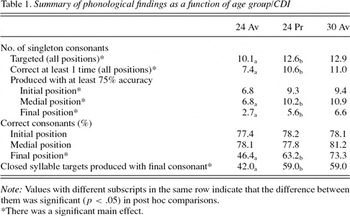
The results of the various phonological analyses that were conducted are summarized in Table 1 and discussed below.

Number of singleton consonants targeted
For all the children combined, a significant correlation was obtained for vocabulary size versus number of singleton consonant targets (r = .57, p < .0001). When comparing the number of different consonant targets in the words the various subgroups produced, the vocabulary-matched groups (24/Pr and 30/Av) were found to be more similar than the age-matched groups (24/Av and 24/Pr). Specifically, as can be seen in the first row of Table 1, the 24/Pr group targeted about 25% more singleton consonants (12.6) across all word positions than the age-matched 24/Av group (10.1), whereas the number of consonants targeted by the vocabulary-matched groups (24/Pr and 30/Av) were very similar (12.6 and 12.9, respectively, a difference of only 2%). A one-way analysis of variance was significant, F (2, 38) = 6.040, p < .01, and post hoc analyses (Tukey–Kramer Multiple Comparisons Test) indicated that there were significant differences between the number of singleton consonants targeted across all word positions for the 24/Av versus 24/Pr groups (p < .05), but not for the 24/Pr versus 30/Av groups (p > .05). Thus, the two groups that had essentially the same vocabulary size (24/Pr and 30/Av) also targeted a similar number of consonants in the words they produced, whereas for the age-matched groups, the children with larger lexicons (24/Pr) targeted more consonants than the 24/Av children.
Number of singleton consonants correct at least one time
Averaged across all word/phrase positions, the inventory of consonants produced accurately at least once by the 24/Pr group was 10.6 consonants, which was about 43% greater than the 7.4 consonants produced correctly at least once by the 24/Av group. However, as shown in row two of Table 1, the number of singleton consonants produced correctly at least once was very similar for the 24/Pr (10.6 consonants) and 30/Av (11.0 consonants) groups, a 4% difference. A one-way analysis of variance was significant, F (2, 38) = 8.780, p < .001, and post hoc analyses (Tukey–Kramer Multiple Comparisons Test) indicated that there was a significant difference between the number of singleton consonants produced correctly at least one time (averaged across all word positions) for the 24/Av versus 24/Pr, age-matched groups (p < .01), but not for the 24/Pr versus 30/Av, vocabulary-matched groups (p > .05).
Number of consonants produced with at least 75% accuracy
The same general pattern was observed for this measure as was seen in the previous comparisons; that is, the 24/Pr children tended to perform more like their vocabulary-matched peers (30/Av) than their age-matched peers (24/Av). For instance, the 24/Pr and 30/Av groups produced respective averages of 9.3 and 9.4 initial-position consonants correctly at least 75% of the time in their spontaneous speech, whereas the 24/Av group averaged only 6.8 consonants that met this criterion (see Table 1). Thus, the 24/Pr and 30/Av children had mastered about 35–40% more consonants in initial position than the 24/Av group, F (2, 38) = 3.983, p < .05. In this instance, Tukey–Kramer post hoc tests indicated that the 24/Av versus 24/Pr comparison approached but did not quite achieve significance (p > .05); the 24/Pr versus 30/Av comparison also was not significant (p>.05). The results for the number of medial-position consonants produced correctly at least 75% of the time (6.8, 10.2, 10.9 for the 24/Av, 24/Pr and 30/Av groups, respectively) were also significant, F (2, 40) = 11.625, p < .0001, and the post hoc comparisons were significant for 24/Av versus 24/Pr (p<.01) but not for 24/Pr versus 30/Av (p>.05). For final position, all three groups produced substantially fewer consonants correctly at least 75% of the time; however, the same general pattern was observed again. That is, the 24/Av group produced an average of only 2.7 consonants with at least 75% accuracy, whereas the 24/Pr group and the 30/Av group produced 5.6 consonants and 6.6 consonants, respectively, or approximately 2–2.5 times as many final consonants as the 24/Av group (F = 13.893, p < .0001). Post hoc comparisons showed a significant difference between the age-matched groups (24/Av vs. 24/Pr: p < .01), but not between the vocabulary-matched groups (24/Pr vs. 30/Av: p > .05).
PCC
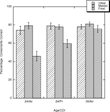
Figure 1 shows that all three groups of children had similar accuracy levels (i.e., approximately 77–81% correct) for initial- and medial-position consonants; initial position: F (2, 40) = 0.017, p > .05; medial position: F (2, 40) = 0.365, p > .05. Therefore, no effect of age or lexicon size was observed for PCC-initial (PCC-i) or PCC-medial (PCC-m) position. For accuracy of final-position consonants (PCC-f), however, there was a significant main effect for Group, F (2, 40) = 8.636, p < .001. Post hoc comparisons indicated that the difference between the 24/Av (PCC-f = 46%) and 24/Pr (PCC-f = 63%) groups was significant (t = 2.56, p < .05), but the difference between the 24/Pr group (PCC-f = 63%) and 30/Av groups (PCC-f = 73%) was not (t = 1.51, p > .05). Thus, differences in final consonant production accuracy were observed between the age-matched groups that differed in lexicon size (24/Av vs. 24/Pr), but no difference was found between the vocabulary-matched groups that differed in age (24/Pr vs. 30/Av), again suggesting that lexicon size was more closely associated with PCC-f than age was. This finding also relates to data concerning types of syllable shapes utilized by the different groups. Specifically, as shown in the last row of Table 1, the 24/Pr and 30/Av groups each produced 59% of their closed-syllable targets with a final consonant, whereas the 24/Av group produced closed-syllable targets with a final consonant only 42% of the time. This contrast represents a significant difference, F (2, 40) = 5.071, p = .01 (Tukey–Kramer post hoc tests: 24/Av vs. 24/Pr: p < .05; 24/Pr vs. 30/Av: p > .05).

The percentage of correct consonants (PCC) by word position forthe age-matched and vocabulary-matched groups. Error bars show standard errors of the mean.
PCC/lexicon size correlations
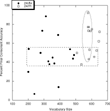
In contrast to the group results reported up to this point (many of which support the hypothesis that lexicon size and phonological abilities are intertwined in some way), it is also useful to consider some of the same data from a different perspective. For example, as reported above, a significant difference between the two age-matched groups (24/Av and 24/Pr) was observed for PCC-f. This significant result can also be seen in Figure 2 as a significant correlation between vocabulary size and final consonant accuracy across all the 24-month-olds (r = .42, p < .05). However, it is also insightful to examine some of the qualitative aspects of this relationship. For example, the horizontal box in Figure 2 shows that about half of the individual subjects from both the 24/Av and the 24/Pr groups had accuracy levels within the range of approximately 35–55% for PCC-f. Yet, these 15 children's vocabulary sizes varied between about 200 and 650 words, which is a range of more than a threefold difference in lexicon size with no appreciable difference in consonant accuracy. Similarly, as shown by the ellipse in this figure, for those 24/Pr children with vocabulary sizes of approximately 600 words, PCC-f accuracy ranged from about 45 to 95%, that is, differing by a factor of 2. Several other “counterexamples” of the lexicon size/PCC-f relationship can also be seen when comparing subjects such as the 24/Av child with about a 300-word vocabulary and 90% PCC-f versus one with about a 400-word vocabulary and 15% PCC-f, as well as that same child with a 300-word lexicon and 90% PCC-f versus a couple of 24/Pr children with 600-word lexicons but only 40–50% PCC-f. Thus, despite the statistically significant relationship between PCC-f and vocabulary size (i.e., .42), observations such as these indicate that lexicon size and phonological performance have, at best, a rather modest relationship (e.g., only about 18% of the variance is accounted for).

The percentage of correct consonants (PCC) in final position(PCC-f) compared with vocabulary size for the 24/Av and 24/Pr subjects. The horizontal box shows that about half of the individual subjects from both the 24/Av and the 24/Pr groups had accuracy levels within the range of approximately 35–55% for PCC-f. The ellipse shows that, for those 24/Prchildren with vocabulary sizes of approximately 600 words, PCC-f accuracyranged from about 45 to 95%, that is, differing by a factor of 2.
Phonological processes
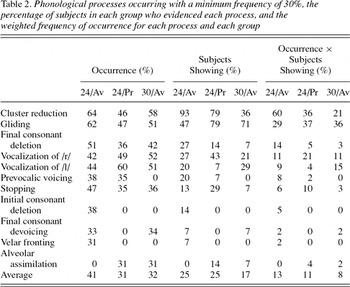
Based on the quantitative criteria that had been predetermined for evaluating phonological processes, 11 different processes were observed across the three groups of children, although not all these processes occurred at the specified levels for each group. Table 2 contains three sections representing several comparisons of these 11 processes. The first section shows the average percent occurrence for each subgroup for each of the processes. (These averages are based on data from only those subjects in each group who met the quantitative criteria that had been established.) The second section shows the percent of subjects in each group that met the criteria for each process. The third section reports a weighted value that is the product of these first two sections, that is, percent occurrence times percent of subjects showing a given process. The weighted frequency of occurrence of these 11 processes averaged 13% for the 24/Av group, 11% for the 24/Pr group, and 8% for the 30/Av group. These small differences across groups were not statistically significant, F (2, 30) = 0.302, p > .10, suggesting there was no general effect of either age or lexicon size on the weighted frequency of occurrence of these particular phonological processes.

The list of these 11 phonological processes is rank ordered based on their frequency of occurrence for the 24/Av group in the third section. As can be seen in section three, Cluster Reduction and Gliding were most common for all three groups when considering these weighted values. In most cases, they occurred at least about twice as often as any of the other 9 processes; however, across the three groups of subjects, these 2 processes patterned somewhat differently. About twice as many 24/Av subjects manifested cluster reduction versus gliding as their most common process, that is, 60% of subjects showed cluster reduction (weighted) whereas 29% showed gliding. The age-matched children (24/Pr) showed equally frequent occurrence of both cluster reduction and gliding (36–37%), and the 30/Av group showed somewhat more frequent occurrence of gliding than cluster reduction (36 vs. 21%). Comparing across the three groups, it can be seen that the 24/Av children showed cluster reduction nearly twice as often as their age-matched peers (24/Pr) and three times as often as the 30/Av children (60 vs. 36 vs. 21%, respectively). The three groups were much more similar regarding frequency of occurrence of gliding, with weighted averages of 29–37%. It is also worth noting that the third most common process for the 24/Av group was final consonant deletion (14%), which was considerably less frequently occurring for the 24/Pr (5%) and 30/Av (3%) groups. This finding basically parallels what was observed regarding PCC-f, which is that a significant difference was noted between the 24/Av and 24/Pr groups but not between the 24/Pr and 30/Av groups.4
Data for temporal–acoustic analyses were also obtained from six to eight subjects in each of the four groups, including the 30/Pr children (i.e., 28 children who were able to complete an additional naming task). It was expected that the children with larger vocabularies than their age-matched peers would show decreased duration and/or variability of various segments and words that were measured, because the children with larger lexicons would likely have had more experience/practice producing words with a greater variety of word shapes and more phonetic complexity. However, no patterns of this nature were observed.
DISCUSSION
A number of previous investigations have shown a relationship between children's lexicons and their phonological systems (e.g., Edwards et al., 2004; Gathercole et al., 1997, 1999; Schwartz et al., 1987; Storkel, 2001, 2003). Most of these studies have involved children who were at least 4–5 years of age, and tasks that were experimental, for example, repetition of nonwords, speech discrimination, gating procedures, or phonemic awareness tasks. The general purpose of the present research was to examine the relationship between vocabulary size and phonological/phonetic abilities in younger children from a more naturalistic perspective, that is, based on spontaneous language samples. Given the hypothesized role of the lexicon in phonological development (Garlock et al., 2001), we predicted that children with advanced lexicons would also demonstrate advanced phonological abilities relative to children with typical lexicon sizes. The comparison of lexically precocious 2-year-olds to both their age mates and their older vocabulary mates also provided an opportunity to determine whether phonological development is more closely related to chronological age or lexical development.
Phonological findings
As expected, several of the analyses supported the hypothesis of a relationship between children's lexicon sizes and their phonological abilities. The lexically precocious 24-month-olds were similar to their 30-month-old, vocabulary-matched peers on all measures. Moreover, both of these groups were superior to the 24-month-olds with smaller lexicons when considering measures such as the number of singleton consonants targeted, the number of singleton consonants correct at least once, the number of singleton consonants correct at least 75% of the time, and the percentage of correct final consonants. Similarly, when phonological processes affecting syllable structure were considered, the lexically precocious 24-month-olds demonstrated less cluster reduction and less final consonant deletion than their age mates but were similar to their vocabulary mates. Thus, the 24-month-olds with advanced lexicons were generally more similar in phonological abilities to the older children they were matched with on the basis of vocabulary size, as opposed to their age-matched peers who had smaller vocabularies. Such findings therefore support the idea of a relationship between the phonological and lexical systems; they also suggest that, at least for 2-year-olds, vocabulary size is more closely intertwined with phonological abilities than is chronological age.
However, not all analyses examining possible phonological–lexical interactions provided evidence supporting such a relationship. That is, several comparisons of lexicon size and phonological patterns did not show significant results in support of the prediction that, compared to their age mates with average lexicons, the lexically precocious children would demonstrate superior phonological abilities. For instance, the occurrence of a considerable number of phonological processes (e.g., gliding, vocalization of /r/, and stopping) did not differentiate the groups of children. In addition, the measure of PCC yielded mixed support for the hypothesis of a relationship between the phonological and lexical systems. Specifically, there were not significant differences among any of the age- or vocabulary-matched groups for consonant accuracy in initial or medial position. Rather, the only distinction was in final position, with the 24/Av and the 24/Pr (age-matched) children showing a difference, whereas the 24/Pr and 30/Av (vocabulary-matched) groups did not. This pattern parallels findings from various other studies that have found final-position consonant targets to be a particularly challenging aspect of phonological development, especially for children who have speech and language problems (e.g., Pharr et al., 2000; Smith & Stoel-Gammon, 1983; Stoel-Gammon, 1987, 1991). Rescorla and Ratner (1996), for example, compared phonetic/phonological patterns of 30 late-talking 24-month-old toddlers who had specific expressive language impairments (SLI-E) with 30 age-matched, typically developing toddlers. Among other differences, they found that “profiles of consonant usage were similar between the two groups for initial phoneme usage, but considerably different for final consonant closure” (p. 153). That is, the typically developing children produced more than three times as many final consonants as the SLI-E toddlers. Thus, accuracy of final consonant production seems to be a particularly important indicator of phonological abilities as they may relate to lexical development, whereas the accuracy of initial and medial position consonants does not.
Another observation suggesting that the phonological–lexical relationship is not especially strong is that the correlation between size of the lexicon and accuracy of final consonant production, although significant, was modest, accounting for only 18% of the variance in performance. In fact, about half of the 24-month-old subjects had PCC-f values of approximately 45% (±10%), despite the fact that the range of their lexicon sizes was from 200 to over 600 words. Thus, some 24-month-old children had vocabularies more than three times as large as other children, yet their PCC-f values were basically the same. Similarly, some 24-month-old children with the same lexicon size showed PCC-f values approximately twice as great as their peers. Given these exceptions and qualifications to the patterns reported above, one must be cautious in drawing very strong conclusions about the extent to which lexicon size and phonological performance are intertwined. That is, the results indeed appear to support the existence of a relationship between the phonological and lexical systems, but one that it is limited in scope. Thal et al. (1995) reached a similar conclusion, stating: “Are there links between lexicon, phonology, and grammar? The results of this study suggest that the answer is generally, yes … However, the different patterns that we found, depending on how particular behaviors were measured …, suggest that caution is in order” (p. 422).
The lexicon–phonology relationship
One explanation for the relationship that does exist between lexicon size and phonological production ability is that vocabulary development is a force that shapes the phonological system. Although Ferguson and Farwell (1975) proposed the idea of “Gestalt” rather than segmental representations several decades ago, there has been quite limited data supporting this hypothesis until more recently, although it is still not uniformly accepted (e.g., Garlock et al., 2001; Nittrouer, 1996; Walley, 1993). The basic notion of the lexical restructuring that is believed to occur is that “lexical representations become more completely specified and/or more segmental over the course of childhood” (Garlock et al., 2001, p. 473), potentially at least in part as a function of vocabulary growth. As new words are added to the lexicon, the need to represent new distinctions arises. Thus, it is possible that children with larger lexicons are in some sense aware of and/or have had more experience producing (or attempting to produce) a greater variety of segments, syllables, and word shapes. This increased exposure/experience might enhance their speech output capabilities, enabling them to produce a greater number of segments more accurately, particularly in final position consonants, it appears.
Alternatively, it may be that phonological development drives the building of the lexicon. That is, children who can perceive and produce a greater number of phonemic contrasts should be more successful at comprehending input, more experienced at producing output, and thereby may more easily learn new words. Such an explanation gathers support from the finding that young children sometimes tend to avoid using words containing sounds they are not able to produce; similarly, they may also learn more words containing phones that are part of their existing phonological repertoire (Schwartz & Leonard, 1982). Recent findings by Swingley (2003, 2005a, 2005b), for example, also support the idea that there is considerable phonetic detail in young children's representations of words, as opposed to the more vague, Gestalt-like representations associated with the hypothesis that lexical development drives phonological development.
It is also very possible that the relationship between young children's lexicons and their phonological abilities is not as “unidirectional” as the above two proposed explanations imply. That is, the interaction of the lexical and phonological systems may be more cyclical or bidirectional in nature, reinforcing and building upon one another. It is also possible that some additional factor such as phonological memory underlies success at both the representation of phonological contrasts and the storage of words in the mental lexicon (Gathercole et al., 1997, 1999). In other words, lexical development may not drive phonological development, nor vice versa; rather they both may progress as a function of some other influence, such as phonological memory. The fact that scores on the Children's Nonword Repetition Test, a measure of phonological short-term memory, account for significant variation in receptive vocabulary growth over a 2-year period may be supportive of such an idea (Gathercole & Baddeley, 1989), for instance.
Ultimately, the specific nature of the relationship that exists between the lexical and phonological systems remains quite unclear at this time, despite growing evidence supporting the idea that there is some type of interaction between them. As pointed out by Rescorla and Ratner (1996, p. 154), for instance, “Restricted phonetic capacity may limit the child's ability to approximate linguistic targets; conversely, limited language capacity may provide little opportunity to practice speech articulation skills.” That is, the “direction” of such a relationship is unclear, as are the extent of involvement of higher level linguistic processing, lower level speech motor skills, and/or phonological memory factors. For example, the fact that all groups in the present investigation demonstrated comparable accuracy levels for PCC in initial and medial positions, but differed substantially with regard to PCC-f is an interesting observation to try to explain. How can one account for the fact that the 24/Av children are equally skilled as the 24/Pr and 30/Av groups in producing consonants in initial and medial positions, but not in final position? Is it the case that what might be stored in children's lexicons is more salient for initial and medial consonants? If so, is this related to factors pertaining to their acoustic–perceptual salience, and how might this relate to any “lexical restructuring” that is occurring? Alternatively, is it possible that what is stored in the 24/AV children's final position representations is adequate, but that they have speech motor limitations relative to producing final consonants? Clearly, there are many questions remaining to be addressed by future research regarding the nature of relationships between the lexical and phonological systems.
CONCLUSION
Several findings in the present study supported the idea that children's phonological abilities and their lexicon size interact in development in some fashion, as evidenced by a number of differences seen between the age-matched groups that differed in vocabulary size (24/Av vs. 24/Pr) but not between the vocabulary-matched groups of different ages (24/Pr vs. 30/Av). Some exceptions to these patterns lead us to conclude that this relationship is nonetheless a relatively modest one. However, given that a number of other studies have also observed various relationships between the lexical and phonological systems in both children and adults (Dollaghan, 1998; Edwards & Lahey, 1998; Frisch, Large, & Pisoni, 2000; Maillart, Schelstraete, & Hupet, 2004; Munson et al., 2005; Schwartz et al., 1987; Vitevitch, 2002; Vitevitch & Luce, 2005), what is needed at this point is further elaboration of the nature and strength of that interaction, as well as an examination of what other factors may be involved that obscure such a relationship, sometimes making it difficult to detect.