

The interrelationships between the economic system and the legal system are extremely complex, and many of the effects of changes in the law on the working of the economic system . . . are still hidden from us. (Coase Reference Coase1988, p. 31).
. . . having too many sticks in the bundle of rights that is property increases the cost of transferring property. (Posner Reference Posner2003, p. 67)
1. Introduction
Between 1660 and 1830, Britain's Parliament passed roughly 3,500 Acts altering individuals' and families' rights to real and equitable estates, principally rights to land and permanent fixtures, such as buildings and mines, upon the land. The volume of these Acts, which we refer to as estate Acts, exceeded the volume of all other legislation, with the exception of Acts establishing statutory authorities and enclosure commissions. Concerning the latter, a large literature exists. Few scholars, however, have studied estate Acts. As a result, fundamental questions remain unanswered. What was the economic rationale underlying estate legislation? What were estate Acts' economic effects?
This article answers these questions by analyzing several sources seldom studied by economic historians. The first is a database containing all estate Acts passed by Parliament between 1660 and 1830, constructed by the authors.Footnote 1 The second is a series of parliamentary reports including the First Report of His Majesty's Commissioners Respecting Real Property and the Report from the Select Committee on House of Commons Officers and Fees.Footnote 2 The third is the Journals of the House of Commons.Footnote 3 The fourth is the Middlesex Deeds Registry.Footnote 4 These sources reveal rationales for estate legislation.
Estate Acts were necessary because the inheritance system – known as strict settlements – created equitable estates in land (enforced by the court of Chancery) on top of real estates in land (enforced by common law courts). These overlapping estates involved numerous individuals, including the landholder, his extended family, additional beneficiaries designated by past landholders, and all potential heirs (including those unborn). All of these individuals possessed rights to revenues derived from the land. These complicated bundles of overlapping rights prevented property holders from using resources as they saw fit. Landholders could neither mortgage, nor lease, nor sell much of the land under their control. Landholders had to dedicate large tracts of land to traditional tasks. Landlords could not cut timber or mine coal unless explicitly authorized to do so. Landholders could neither utilize resources in new ways nor improve infrastructure without reaching agreements with all other parties possessing interests in a parcel, and such agreements could not, in most cases, be enforced by law, but could, in many instances, be challenged through courts. Conveying land to new parties proved particularly problematic. The Chancery court emphasized the security of beneficial interests (even minor and tangential) rather than the rights of purchasers (however deserving and efficiency enhancing). This inflexible system posed problems for people trying to exploit opportunities arising from technologies unanticipated in decades past.
Estate Acts loosened these constraints by permitting previously prohibited actions, reorganizing complicated bundles of rights, and conveying those new rights to new users. Estate Acts began as petitions from landholders seeking relief from restrictions that strict settlements imposed on the employment of land and resources. Parliament reviewed these petitions, ensured that they met certain standards for protecting the rights of all interested parties, and then passed legislation establishing new rules regarding the employment and conveyance of property. Most estate Acts authorized the sale, lease or improvement of land. In layman's language, estate Acts freed land from the shackles of the past and exposed land to the invisible hand. In economic terms, estate Acts reduced transaction costs and enabled landholders to undertake activities that they could not undertake given existing property-rights arrangements and legal institutions.
It should be expected that reducing transaction costs facilitated the reallocation of resources to new and superior uses. Case studies and quantitative evidence indicate that this was the case. Concentrations of estate Acts occurred in urbanizing areas, such as the periphery of London, and in industrializing regions, such as the county of Lancaster. Correlations between estate legislation, urbanization and industrialization suggest a link between the reorganization of property rights and Britain's march towards modernity.
A companion paper (Bogart and Richardson Reference Bogart and Richardson2008b) illuminates quantitative characteristics of estate legislation. It demonstrates, for example, that landholders from all walks of life employed estate Acts to alter rights to land that they possessed. The preponderance of the land affected by estate Acts lay in England. A minority lay in Scotland, Wales and Ireland. A small fraction lay in colonies overseas. An appendix contains a series of tables presenting an array of information, including chronological and cross-sectional data series, with which scholars can test our hypotheses or advance their own.
Another companion paper advances a broader argument (Bogart and Richardson Reference Bogart and Richardson2008a). At the end of the seventeenth century, Parliament established multiple forums where rights to land and resources could be reorganized. These forums served individuals, families and communities by issuing estate, enclosure and statutory authority Acts. These forums enabled property rights to adapt to changing economic conditions. The paper employs historical evidence, archival data and statistical analysis to demonstrate that between 1700 and 1830, Parliament passed an increasing number of Acts reorganizing property rights in response to increases in the demand for such Acts. Tests with placebo groups confirm the robustness of this result.
Together, these essays lay the foundation for our broader hypothesis. Institutional adaptability facilitated Britain's transition from a medieval to a modern property-rights system. Britain was the first nation to make this transition and the only European empire to make the transition gradually and peacefully. The transition occurred in the decades following the Glorious Revolution and may be one reason why the Industrial Revolution began in Britain. Our emphasis differs from that of Douglas North and Barry Weingast (Reference North and Weingast1989), who argue that following the Glorious Revolution, security against sovereign expropriation fostered the growth of capital markets. Scholars – including Gregory Clark (Reference Clark1996) and Patrick O'Brien (Reference O'Brien, Floud and McCloskey1994) – dispute the accuracy of that assertion. We emphasize that Parliament's actions lowered transaction costs, increased the security of conveyance and restructured property rights in ways that enhanced efficiency.
The argument that we advance in this series of papers addresses issues of broad academic interest. Social scientists often note that developed and developing nations differ in the nature of their property rights' regimes. Hernando de Soto (Reference De Soto2000) observes, for example, that in developing nations, inflexible and opaque rules regarding property prevent citizens from converting assets, which they hold in abundance, into capital, the medium of the modern market economy. Ronald Coase (Reference Coase1960, Reference Coase1974) observes that attaining economic efficiency in the presence of transaction costs requires the proper definition and allocation of rights. Common and statutory law recognized this principle in nineteenth-century Britain, Coase argues, and by assigning property rights to maximize productivity, fostered British economic ascendance. Richard Posner (Reference Posner2003) emphasizes a related issue. According to Posner, common-law legal systems foster economic efficiency because judicial decisions ‘allocate responsibilities between people engaged in interacting activities in such a way as to maximize the joint value’ (Posner Reference Posner2003, p. 98). Like Coase, Posner corroborates his claim with historical examples.
This article adds new observations to the historical corpus. In the eighteenth century, when the British economy entered an unparalleled era of expansion, Britain's Parliament began operating according to Coasian principles and reorganized property rights en masse. In the nineteenth century, when most common-law doctrines reached their modern form, doctrines of equity (enforced through the Chancery court) dominated the conveyance of land. These doctrines were designed to protect beneficial interests, not to maximize productivity. Efficiency became a dominant doctrine in the English legal system only after Parliamentary intervention.
The rest of this article advances our argument. Section 2 provides historical background, principally by describing the system of strict settlements and English law governing equitable and real estates. Section 3 sketches our economic interpretation of the equitable and real property, principally by elucidating how the system of strict settlements contributed to high (and often prohibitive) transaction costs and the insecurity of conveyance. Section 4 contains case studies that illuminate real-world problems posed by the system of strict settlements. Section 5 discusses how estate Acts solved these problems, lowered transaction costs and facilitated the reallocation of resources. Section 6 reveals correlations between the number of estate Acts in each county and the rate of urbanization. Section 7 discusses the implications of our analysis. It focuses on broad issues, such as how the development of Britain's property-rights system fostered economic development.
2. Strict settlements
Estate Acts arose from an English system of inheritance that solidified around the Civil War of the 1640s and prevailed for several centuries thereafter. During this era, large landowners held most of their land under settlement. Lesser gentry and yeoman families also employed the legal device, even on single family farms. While estimates vary, at the peak, at least a quarter and as much as three-quarters of land in England was strictly settled.Footnote 5
A settlement served several principal purposes. The first was to keep a family's estate together for future generations. A settlement dictated that the estate descend intact from one generation to the next. It did this by assigning control of the estate to a single heir, usually the eldest son of the current holder. A second purpose was to care for the extended family. A settlement did this by assigning stipends to relatives such as children, grandchildren, widows, cousins, uncles, aunts, nephews and nieces. Some individuals received periodic payments, such as monthly or annual stipends. Other individuals received lump sums, often upon marriage or reaching the age of adulthood.
A settlement was a generic name for a property transaction and for the documents created in its consummation. Settlement deeds contained six common elements. The premises listed the names, occupations and ranks of the parties involved, including the trustees. The recitals and testatum described the property to be settled and the purpose of the settlement. The habendum contained the trusts imposed upon the property, such as jointures (payments to widows) and portions (payments to younger children). The entails set out the order of succession, established life-estates for living heirs, and established a series of fee tail estates for unborn heirs. The powers described what the life tenants and trustees could do with the estate (English and Saville, Reference English and Saville1983, pp. 19–21).
Many features of settlements influenced the use and allocation of property. The holder of settled land was not the absolute owner. The holder was merely a life tenant of an estate. The land belonged to a trust, for which the holder was named the beneficiary. The holder, in turn, held the land in trust for other beneficiaries, typically including his wife, children, unborn descendants, all potential future heirs and members of his extended family, such as his brothers, sisters, nieces, nephews and other descendants of previous holders of the estate. The life tenant controlled the use of the land possessed by the nested trusts as long as the life tenant fulfilled the terms of his stewardship. This legal structure – a trust within a trust – kept settlements from being adjudicated in common law courts. The common law did not recognize such legal structures. Only the Chancery court recognized and enforced such arrangements.
Settlements restricted the uses to which resources could be put. The holder of a settled estate (who was just a life tenant) could not grant leases lasting beyond his life and could not grant leases from which he benefited at the expense of his successors (such as leases in which tenants paid lump sums up front in return for concessions). The holder of a settled estate could not sell, exchange, or mortgage the property. If he completed such transactions, he could be held liable for damages to the estate, and the transaction could be voided, because he had no power to transfer title. Similarly, the holder of an estate could not alter the property, even if he considered the alterations to be an improvement. The removal of trees, hedges and buildings, the opening of new mines, quarries and peat bogs, and the conversion of arable lands into pasture (or vice versa) could be considered waste. All those who benefited from such actions could be liable for damages if, upon inheriting an estate, the successor claimed to have been harmed by the actions. Sales, exchanges, mortgages, improvements and long-term leases could only be undertaken if the powers section of a settlement contained specific clauses authorizing such actions. Settlements written in the seventeenth and eighteenth centuries seldom provided such powers. By the nineteenth century, settlements became increasingly sophisticated, and tended to provide broader powers to estate holders.
A settlement legally bound the hands of all heirs alive when it was written. A settlement could not be changed until a tenant in tail (i.e. the next in line to inherit) who was born after the date of settlement came of age (i.e. reached age 21). Then, the current life tenant (usually the father) and the future tenant in tail (usually the son) could remove the entail by the legal process of common recovery. This procedure involved a collusive lawsuit concerning a fictitious transaction backed by a warranty to recover land of equal value in fee simple should the warrantor default.Footnote 6 This legal trick would have enabled the life tenant alone to break the entail in the absence of the strict settlement, which lawyers devised to block common recovery, by creating an equitable estate protected by the Chancery courts, which life tenants could not break.
Whenever possible, families resettled estates when the heir apparent reached the age of majority and/or when the heir apparent married. Resettlements at age of majority protected the interests of the extended family, who would lose their legal claim to financial support if an heir born after the date of settlement (and therefore unbound by the settlements' provisions and entail) inherited the estate. Resettlement at time of marriage protected the interests of the wife, who needed means of support should she outlive her husband; the wife's children, who needed to be placed first in line for succession; and the in-laws, who usually contributed land to the estate and who, in certain circumstances, might regain that land or enter the line of succession.
These facts ensured that families kept their land settled at almost all times and that settlements could be changed only infrequently, at intervals of two or more decades, as a family waited for an heir to come of age and for the father and son to reach an agreement about restructuring the estate. The time to resettlement could be greatly lengthened if the life tenant died without a surviving son and the estate passed to a male relative who was a child when the settlement was written. The entail would bind such an heir until he bore a son who reached the age of 21.
Settlements restricted powers for several reasons. Restrictions prevented the holder of the estate from dissipating resources dedicated to the support of future heirs and the extended family. Another reason was powers' uncertain effects on the legal stability of the settlement. In the late seventeenth century, settlements were a novel legal form. Settlements with expansive powers had not been tested in the Chancery court. Chancery interpreted settlements conservatively and presumed that life tenants did not possess powers that were not explicitly described in documents. Landholders could not predict how the court would react to the inclusion of additional powers or whether the wording of a novel clause might provide a life tenant with a loophole enabling him to circumvent all other restrictions.
Landholders also did not know the personality of the person(s) who would inherit their estates. Settlements were designed to last far into the future. Settlements dictated that if possible, the estate descend from first son to first son, but disease and demographics dictated that estates occasionally shifted from the direct paternal line, and cousins, minor children or distant relatives might inherit. This person would have power over the widow, dependants and descendants of the individual who established the settlement. Providing too much power to the life tenant of the estate, particularly when the wording of clauses providing powers had not been tested in court, put the interests of other members of the family at risk.
Uncertainty about the impact of providing powers to the life tenants and the threat that powers might pose to the interests of the extended family meant that landholders only included extensive and/or novel powers when doing so promised lucrative returns. In the seventeenth century, when the settlement system evolved, technology changed slowly. Economic progress proceeded at a slow pace. The problems posed by expansive powers probably outweighed the potential benefits, at least in the eyes of the wealthy families, which typically bound land in restrictive settlements. Most of those families felt that reorganizing resources once each generation, when the family resettled its estates, would ensure the family employed resources optimally. As the eighteenth and nineteenth centuries progressed, however, the pace of technological change accelerated and economic opportunities arose more often. Families needed new and flexible ways of managing estates. Simultaneously, courts and lawyers gained experience with particular clauses providing particular powers, and the risk of including these clauses in settlements declined. These circumstances meant that restrictive settlements became increasingly inefficient.
Market transactions could not easily alleviate these inefficiencies because conducting transactions and enforcing contracts on settled land could be costly, uncertain and insecure. Settlements were long, complex documents, traditionally unpunctuated and full of repetition.Footnote 7 Interpreting settlements required experience, skill, detailed knowledge of the document, and a large library of property laws, precedents and legal texts estimated at 674 volumes in 1826 (English and Saville Reference English and Saville1983, p. 18). Public libraries did not contain these volumes. The public also lacked access to information about Chancery courts proceedings and precedents, because the court did not keep detailed written records of its proceedings until the later seventeenth century. Settlements themselves were not part of the public record. Copies of the deeds were usually held by the life tenants, trustees, lawyers and maybe members of the extended family. Settlements had to be consulted before taking out mortgages, drawing up leases, or completing sales, because if the settlement did not specifically authorize a transaction, the transaction could be voided. Ambiguities in settlements often deterred individuals from transacting on estates, for fear that the transactions would be disputed by other beneficiaries.
Another source of confusion was the multilayered structure of settlements. Strict settlements established equitable estates, which created a trust within a trust and gave beneficiaries rights to income from a family's real estates. Equitable estates were enforced in the Chancery court. A real estate was a set of rights to land and permanent fixtures, such as buildings and mines, upon the land. Real rights of many forms existed; the most common and consequential were feudal tenures. Tenures (and other rights to real property) were enforced in common law courts.
The next section of this article elaborates on the transaction costs created by the system of strict settlements. The discussion covers a wide range of issues in the laws governing equitable and real estates. The discussion explains how the overlapping equitable and real estates impeded the reallocation of resources and reduced the security of conveyancing (i.e. of transferring land among owners).
3. Transaction costs created by strict settlements
The Coase Theorem revolves around a pivotal point. Transaction costs – particularly the expense, certainty, enforceability and feasibility of contracting – determine property rights' economic effects. Low transaction costs yield environments in which the assignment of rights influences the distribution of wealth, but not the allocation of resources among competing tasks or the efficiency of market outcomes. High transaction costs yield environments in which the assignment of rights affects the allocation of resources, the efficiency of markets and the distribution of income. The transaction costs associated with the system of strict settlements were, as this section shows, often high and occasionally prohibitive.
A settlement created an estate in equity with a plethora of participants. These included the life tenant, current dependants and potential heirs. The life tenant made decisions concerning the management of the estate, subject to the terms of the settlement, which limited his powers, obligated him to carry out the wishes of his ancestors, compelled him to care for members of his extended family, and ensured that he did not take actions that prejudiced the interests of heirs to come. Dependants and heirs could defend their interests, if they believed them to be neglected or attacked, through the Chancery court and other judicial venues.
The settlement was, in other words, an intergenerational bargain within an extended family. The costs of renegotiating the agreement rose with the size of the family, the diversity of its members (and their interests), the complexity of the settlement, and the intricacies of the bargain to be struck. Life tenants who wished to undertake actions beyond the bounds of their powers had to convince all parties of the settlement to concur. Otherwise, other parties to the settlement could hold up the transaction, by claiming that their interests were affected, and bring actions in various legal venues.
Economic transactions between life tenants and third parties – such as purchasing property from, leasing land from, or mining coal on a settled estate – created additional complications. For simplicity, we refer to all potential third parties as ‘entrepreneurs’. We begin by considering the case of an entrepreneur hoping to strike a deal with a life tenant who possessed powers to sell, lease and/or improve his land, and explain how settlements complicated transactions even with empowered owners. Later, we discuss the problems of transactions with owners lacking such powers.
Deals between life tenants and entrepreneurs often foundered because of problems posed by settlements. One problem was the lack of public information concerning the contents of settlements. Settlements were not public records. Copies of them existed in no public repository. Entrepreneurs could only get information about settlements from life tenants themselves or perhaps from other private parties with copies of the documents. Interpreting these documents might be difficult, because settlements represented intergenerational bargains among extended families. Implicit understandings of longstanding might influence families' relations. Families might interpret and enforce their bargains internally. Differences might exist between the settlement as written and the bargain as implemented. If families resolved the issue amongst themselves, ambiguities might exist in the documents that had not been tested in court or reworked with lawyers.
Ambiguities in settlements were a common concern. Ambiguity existed in part because of uncertainty about how the Chancery would interpret the wording of documents disputed before them. Chancery began to adjudicate large numbers of settlements only in the eighteenth century. These early settlements were conservative, or strict, providing few powers to life tenants. Chancery developed experience dealing with these laconic compacts, but how Chancery would interpret novel wordings and powers remained uncertain. Solicitors and barristers lamented this fact even in the nineteenth century.
Another complication arose from the long and variable statutes of limitations concerning the conveyance of land. English law lacked a set length of time after which an individual who purchased land honestly and enjoyed undisputed proprietorship was secure in his title. The length of time after which an individual knew he was secure against claims of adverse possession depended upon the method of conveyance via which they acquired the land, the type of tenure under which they held the land, the existence of settlements and entails, the existence of prior rights or conveyances, and the existence of writs or other legal remedies available to potential plaintiffs. For example,
The time limitation in a writ of right is sixty years, that in a formedon, a writ in the nature of a writ of right, and one of the remedies to recover a mere right of property, is only twenty years; whilst in the possessory actions of mort d'ancestor and novel disseisin, fifty years is the limitation for writs founded on ancestor's possession, and thirty years for writs founded on the claimant's own possession. (BPP 1829 p. 132)
Many actions undertaken in the court of Chancery possessed no statute of limitations.
These long, variable and at times unlimited periods meant that entrepreneurs purchasing land from settled estates had to be concerned that their purchase could be disputed far into the future. Entrepreneurs had to fear ‘pocket conveyances’ and ‘pocket settlements’ which might appear decades in the future giving other parties the ability to dispute the entrepreneurs' possession of the property. These fears were exacerbated by a legal principle that prevented trustees of land from providing receipt for payments for land that they sold. Only the beneficiary of the trust could provide proper receipt for payments. The life tenant of a settled estate was the beneficiary of a trust that held the land for his use, and thus could provide receipt for his own interests, but the life tenant was also a trustee for the tenant in tail, all other potential heirs and everyone in his extended family that received support via the settlement. The life tenant could not provide receipt for payments meant to buy out their interests. Thus an entrepreneur wishing to purchase land from a settled estate had to have written receipts from all interested parties, no matter how remote, to ensure that they did not dispute the fact of his payment. If he did not acquire written receipts from all interested parties, even those he did not know about, he could be forced to pay again. Even if he acquired receipts, he could also be forced to pay again if he delivered the payment to the trustees, rather than the beneficiaries, and the trustees took the money for themselves and denied it to their charges.
In 1829, a leading barrister, J. J. Park, described this problem to a Parliamentary commission in these terms:
The doctrine of seeing to the application of purchase money, in cases where there is a trust or authority to sell, appears to me to be one of the false steps of the English law. Every principle of common sense, of justice, and of convenience, dictates that the party who places a confidence in another respecting his property should be the sufferer, if that confidence should be misplaced, rather than an innocent person who has acted bona fide. If A. intrusts B. to sell his estate, and I buy it, and pay B. the money, which he embezzles, it is preposterous to say that A. can with justice require me to pay the price over again. He was the agent of A., not of me; I did not select him. (BPP 1829 p. 169)
Complaints about this problem of paying twice appear numerous times in the testimony collected by the Parliamentary commission and the literature on legal history.
One reason for this rule regarding receipts was a precaution of courts in favour of parties beneficially interested. This precaution pervaded legal doctrines concerning trusts and estates, and particularly influenced the proceedings in Chancery, which was a court of equity where parties sought equitable relief and courts sought outcomes according to ‘equity and good conscience’ (Baker Reference Baker1971, p. 129). In 1829, when testifying before the Parliamentary commission concerning real property, John Bell esquire, the King's Counsel, stated that ‘I think we have got into difficulties by an anxiety to protect against breaches of trust’ (BPP 1829, p. 235). This anxiety meant that ‘in order to prevent fraud, courts have borne too hard upon trustees, and thereby prevented proper persons from accepting trusts who would otherwise have done [so]’ (BPP 1829, p. 235). The predisposition towards protecting the beneficiaries of trusts often prevented trustees from taking actions that maximized the value of the assets under their supervision. For example, trustees who sold land to raise cash for beneficiaries (for purposes stipulated in a settlement) could not purchase the property if they believed it was selling for too low a price. The predisposition could also lead to the punishment of trustees who exceeded their authority to invest funds in projects that paid highly. The King's Counsel emphasized this point by describing an often mentioned case from Chancery court in which a trustee lent money on West Indian mortgages and earned his charges ‘a very large sum on the whole by this management of the property’, but on one transaction, lost money when the mortgagee failed. The beneficiaries sued. When deciding the case, the chancellor, Lord Tharlow, wrote ‘he was extremely sorry to charge the trustees with the loss, but he felt bound to do it’ (BPP 1829, p. 235).
Now, consider the position of an entrepreneur hoping to strike a deal for the purchase of land locked in a settled estate that the life tenant lacked the power to sell. What were the entrepreneur's options? The entrepreneur could wait for the family to resettle the estate. Then, the family could add the necessary powers to the document. The wait might last for years, depending on the length of time a tenant in tail who was born after the writing of the current settlement took to reach the age of adulthood.
The other option was to strike a bargain that all of the parties to the settlement would adhere to voluntarily until either (a) the family could rewrite the settlement and/or (b) until the entrepreneur possessed the land long enough for the title to be secure against claims of adverse possession. Enforcing such a bargain might be difficult, for several reasons. First, transactions such as this were seldom repeated, and certainly not repeated the infinite or indefinite number of times needed to sustain cooperation via trigger strategies (a typical way in which self-enforcing agreements arise). Second, adherence to the bargain depended only in part on the parties' economic interests and also on personal relations. Extended families could be complicated emotional arenas, where jealousy, desire, love, hope, hate, antipathy and revenge might motivate individuals to take unexpected and, at times, economically irrational actions. Entrepreneurs must have been reluctant to sink large sums into projects which might be halted when siblings fought, or children rebelled, or distant cousins fell in or out of love. Third, parties who wanted to defect from the agreement could do so at low financial cost, because equity and common law courts gave them quick and inexpensive mechanisms to assert their rights against parties that illegally held land or violated covenants of trust. Fourth, the entrepreneur faced problems of fraud from the family, which might promise to provide him with certain lands at a certain price, but which could back out of the deal or hold him up for larger sums after he had sunk significant investments, perhaps by ex-ante establishing exit strategies of which the entrepreneur was not aware. One possibility would be to create ‘pocket conveyances’, which transferred property to other parties, prior to selling or leasing the land to the entrepreneur. Another possibility would be to conceal a family member's interest in the settlement, perhaps by failing to provide a clause of the document, or insisting that someone with a beneficial interest had migrated abroad or fallen out of contact with the family or was believed to be deceased. Then, the family could renege on the deal by ‘rediscovering’ the overlooked clause or ‘resurrecting’ the supposedly departed relative.
In theory, a life tenant hoping to sell settled land to an entrepreneur had one additional option. He could sue in Chancery, hoping to convince the court that its rules, precedents and principles should allow him to sell the land. Chancery's presumption was to protect beneficiaries and to prohibit transactions not authorized in the original settlement, but the life tenant could argue that his family's settlement contained either ambiguous clauses that, in fact, authorized the sale or implicit powers that, in the past, had been exercised to enable similar sales. Such suits were not unknown, but they were uncommon, and by the early eighteenth century, increasingly rare.
Life tenants avoided Chancery because of the court's practical defects. By 1700, ‘the word, “Chancery”, had become synonymous with expense, delay, and despair’ (Baker Reference Baker1971, p. 128). During the eighteenth century, scholars estimate Chancery's backlog at something like 10,000 to 20,000 cases, with the time needed to dispose of them as long as thirty years (Baker Reference Baker1971, p. 129). One source of these problems was the principle that ultimate responsibility for everything done in the court rested on the chancellor's shoulders. Most chancellors wished to reach decisions only after all relevant facts were ascertained, and this required time and effort. Chancellors often commissioned enquiries into facts and adjourned trials until they received reports. Chancellors might require extensive investigations before deciding straightforward issues, even if all parties to the suit agreed on the pertinent questions and relevant facts. For example, in his testimony before the Royal Commission, the King's Counsel, John Bell, described the case of Leak v. Robinson, where both parties wanted the chancellor to decide ‘whether certain limitations were not too remote’, and neither party wanted to incur the expense of ‘a taking of accounts’, but the court refused to settle the question expeditiously, and the case ‘remained for many years in the court of Chancery, and put the parties to a very great expense in taking accounts’ (BPP 1829, p. 243).
A second source of expense and delay was the dependence of Chancery officials on the fee system. Most of the hundreds of clerks were paid for each task they performed. The clerks were paid by the page for drafting documents, so they developed ‘such large handwriting, and used such wide margins, that it was said a skillful clerk could spread six ordinary pages into forty’ (Baker Reference Baker1971, p. 130). Litigants were obliged to order and pay for copies they did not want and which were sometimes never made. Proceedings became verbose and complex. The paperwork involved often inhibited the progress of suits. Since every step in litigation imposed fees, there was incentive for neither swiftness nor procedural reform. ‘Many of the fees were extortionate . . . and standards for taking them were somewhat flexible’ (Baker Reference Baker1971, p. 129). While two distinguished chancellors, Francis Bacon and Lord Macclesfield, were dismissed for accepting ‘presents’ for favouring one side in a suit, their subordinates regularly received ‘gifts’ for expediting paperwork, which clerks came to see as fees which could be demanded with an untroubled conscience. Positions as a Chancery clerk became so valuable that in the early 1700s, they could be sold for thousands of pounds. Clerkships came to be seen as property. Attempts to reform the system were resisted with hostility.Footnote 8
A third source of expense and delay was uncertainty concerning, and ambiguity within, Chancery's legal doctrines. This complaint arose often in testimony before the Royal Commission. Barrister Charles Butler, for example, stated that much litigation arose due to confusion about what the court of equity considered an abuse of power. Litigation to determine what was or was not an abuse was expensive. Animosity within families, however, often compelled family members to sue, in the hope that they would win their case, or at least impose large costs on their rivals (BPP 1829, p. 116).
4. Case studies
This section presents concise case studies that illustrate problems posed by the system of strict settlements. These case studies come from the Journals of the House of Commons and testimony provided to the First Report of the Royal Commission on Real Property.
The first case illustrates ways in which strict settlements, limited powers and long lives could keep landholders from putting resources to productive uses. To the Royal Commission, a barrister, Hasler Capron, described a case involving a client. The client inherited an estate in 1762 at the age of 11. He had been alive at the time of the settlement, and was bound by its provisions, which lacked explicit powers to harvest timber. In 1829, when Capron's testimony was taken, the client had been bound by the settlement for 67 years.
Not a stick has been cut during the whole of that period; all the old trees, with scarcely an exception, have become decayed and valueless; no young timber is rising to replace them, and no underwood has been produced. (BPP 1829, p. 173)
Capron testified that ‘it was thought right, many years since, to make an application to the then Lord Chancellor on the subject, who declined interfering, and his example was followed by one of his successors at a later period’ (BPP 1829, p. 173).
A second case study illustrates how settlements could remain in force for longer periods and how the property could pass unexpectedly to remote relatives. This case involves the estates of the duke of Northumberland.Footnote 9 In 1767, the first duke of Northumberland settled his estates on his eldest son for life and upon that son's son in tail. The first duke had another son who was set to inherit in the event of the death of the eldest or the exhaustion of his direct line. In 1786, the eldest son succeeded his father as the second duke of Northumberland and inherited the estate. The second duke had a son who was the tenant in tail in the 1767 settlement and another son who was to inherit in the event of the eldest son's death or the exhaustion of his direct line. When the eldest son married in 1817, he joined with the second duke in resettling the estate. The settlement limited the life tenant's power to sell or lease land. In 1818, the eldest son succeeded his father as the third duke and inherited the estate as a life tenant. The third duke died without issue and the estate passed to his brother who succeeded as the fourth duke. In 1865, the fourth duke also died without issue. His death exhausted the line of the eldest son of the first duke so the estate passed to the senior heir in the line of the second son of the first duke, the earl of Beverley. The earl had been alive when the second duke's estate was resettled in 1817. The earl's eldest son had also been alive. The earl inherited the Northumberland estates and became the fifth duke of Northumberland. Since he had been alive at the date of resettlement, he was bound by its terms. Two years later, he died, and his eldest son succeeded him as the sixth duke. Since he had been alive at the date of resettlement, even though he was just an infant, he was bound by its terms. When he inherited, his son became tenant in tail. Since his son was born after 1817 (and thus after the date of the resettlement) and before 1846 (and thus was over the age of 21), the sixth duke and his heir apparent could employ the process of common recovery to break the entail and resettle the estate. Thus the 1817 settlement with its restrictive powers lasted 50 years. Over this period, the life tenant changed six times, ultimately residing with the second duke's cousin's grandson. A priori, it would have been impossible to predict this line of descent or to know the personalities, capabilities and powers appropriate for each life tenant.
The vagaries of descent generated anxiety about the relationship between an estate's life tenant and the estate's other beneficiaries. A lacuna in the male line might shift control of the estate to distant relatives, who might lack emotional (and perhaps legal) ties to those who remained dependent on the estate, such as the previous life tenant's widow and daughters. In such circumstances, a life tenant might shortchange beneficiaries to whom he lacked close emotional ties (or perhaps had long-standing animosities). Fears of abuse increased when prospective heirs were born after the date of the settlement, in which case they could inherit the estate in fee simple, and have legal obligations neither to current beneficiaries nor the extended family. Circumstances of this sort play prominent roles in novels of the period. Jane Austen's Pride and Prejudice is an example. Complaints about abusive heirs also appear in legal literature. To the Royal Commission, for example, the leading barrister John Tyrrell testified that concerns about abusive heirs shaped the structure of settlements, particularly restraints on the power of alienation by a life tenant, because the life tenant might be a stranger with no interest in the family. John Tyrrell described ‘several cruel cases’ with which he had personal experience (BPP 1829, pp. 321–3).
Settlements also contributed to anxieties about the security of conveyance. As the previous section noted, entrepreneurs purchasing land from settled estates had to worry about the strength of their titles. A case dealing with the sale of land near the river Rodon illustrates the problem. In a petition submitted to the House of Commons, Joseph Goodman described how he signed a deed of covenant with several landowners near the river that
would permit him to come upon their lands for the clearing the said River in order to make it navigable and for removing any impediments therein; and such of the said land owners as had an inheritance in fee-simple did give power to the said petitioner to dig down or cut away any part of the lands belonging to them, not exceeding 30 feet in breadth, in order to enlarge the said River for the more easy making the same navigable; and the said petitioner covenanted to make satisfaction to the land owners for what damage should accrue thereby to be ascertained in manner therein mentioned.Footnote 10
Goodman began to improve the river and had come close to completing the project when he learned that the deed would be voided because ‘several estates and interests, in all or greatest part of the said lands, being limited to persons not in being, or to infants or coverts, or under some entail or settlement’ could not be conveyed to him. A witness stated ‘that several of the persons, who signed the aforesaid Deed were only tenants for life; and could not agree that the said Joseph Goodman should have the banks of the river so cut’. Goodman lost his rights to the land and was only able to recover them with the aid of a parliamentary Act.Footnote 11
Another example of insecure conveyancing comes from barrister John Gurney's testimony to the Royal Commission on Real Property. Gurney described a case where a gentleman sold an estate claiming that he held it in fee simple. The purchaser built a ‘good house’ on the lands and lived on the property for 40 years. Then, a daughter of the gentlemen who sold the property discovered a deed of settlement made many years earlier upon her parents' marriage. The settlement did not provide powers to sell portions of the estate. The daughter brought the case to court and ‘recovered the estate’ (BPP 1829, p. 97). The purchaser lost his home, the land and the money that he had invested in the property.
5. Estate Acts and the relaxation of strict settlements
During the eighteenth and nineteenth centuries, Parliament could remedy almost any difficulty arising from the system of strict settlements. Prior to the rise of strict settlements, Parliament occasionally resolved disputes over landholding, sometimes in response to petitions from the public, but usually in response to petitions from the royal household, which requested changes in rights to royal estates, often in order to reward tenures and pensions to people who had served the regime well. After the rise of strict settlements, the mechanisms previously employed to manage royal estates became mechanisms for managing strictly settled estates of landlords large and small. This section describes those mechanisms, which we refer to as estate Acts, and the ways in which parties to settlements used estate Acts to restructure rights and convey property.Footnote 12
Estate Acts began as petitions from landholders seeking relief from restrictions that strict settlements imposed on the employment of land and resources. Over time, Parliament standardized procedures for processing petitions. Typically, petitions were submitted to the House of Lords, introduced as estate bills, and referred to a committee, which ensured that the requests met certain requirements designed to protect the rights of interested parties. Notice of a bill had to be sent to all parties with interests in the property. Notification requirements included all individuals with rights to the land via deed, marriage, custom or settlement. These individuals had the right to tell the committee their concerns about the legislation. Bills deemed beneficial to the pertinent parties were publicly read three times, sent through committees in both houses, passed by the Lords and the Commons, and sent for royal assent.
This multilayered process provided individuals with an opportunity to describe the ways in which the legislation could harm their interests and enabled Parliament to ensure that these parties received compensation. The process also meant that estate bills represented joint decisions of the national legislature (Parliament), the executive branch (the monarch and his ministers) and the courts of final appeal (the monarch, the chancellor and Parliament). Parliament kept written records of the proceedings and served as a repository where information about estate Acts could be examined by the public. Parliament provided copies of these documents to parties which requested them, enabling parties to use Parliament as a means of documenting transactions.
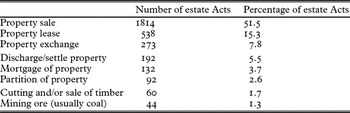
Estate Acts served several functions. Estate Acts' primary task was authorizing transactions prohibited by strict settlements. Table 1 indicates the most common kinds of transactions. The typical Act authorizing a sale indicated what specific piece of land could be sold and what property the life tenant would return to the estate to ensure that all beneficiaries received at least the same support as before. The typical Act authorizing exchange of property indicated what property would be transferred out of an estate and what property would replace it. Acts authorizing leases specified the property that could be leased, the terms under which it could be let, and the length of the leases. Acts authorizing a discharge released property from a settlement and specified land that would enter the settlement in return. A mortgage Act permitted a life tenant to borrow money, using land as collateral. If the borrower defaulted, the Act might empower the lender to take ownership of the collateral or might provide the lender with rights to use (or lease) the collateral until he recovered what he was owed. An Act of partition divided a unit of land into two or more units. Life tenants might use these Acts to divide property amongst members of the extended family, perhaps by subdividing a large lot containing a single house into several lots on which family members built separate dwellings. Life tenants might also use these Acts to subdivide property in preparation for improving the land and selling it at a later date. All of these Acts helped landholders convey property to other parties and put resources to new and better uses.
Transactions authorized by estate Acts, 1660–1830

Source: Database of Acts of Parliament, see Bogart and Richardson (Reference Bogart and Richardson2008b) for details.
Notes: The percentages in column 2 do not add to 100 because there were some estate Acts that did not fall into these transaction categories.
Acts concerning timber and mining also affected the employment of resources. Acts authorizing the cutting and sale of timber allowed life tenants to harvest trees from their estates. Timber was an important commodity at the time. Old-growth timber was a principal input for naval construction. Tall, straight trees were needed to make the masts and keels of ships. Timber was also used to construct homes, farms and workshops, and for manufacture of durable merchandise, such as furniture, tools and wagons. Wood served as a source of fuel. Timber's value made managing woodlands an important task for landed families. Determining the optimal mix of trees and the optimal time to harvest took knowledge, skill and patience. As trees grew, their value increased. Once trees attained full height, and the wood began to age, trees' value began to decline. Trees' growth/value profile, the financial needs of the family, interests rates and other economic conditions (such as the demand for lumber) determined the point of maximum profit. All of these conditions could not be incorporated into settlement contracts. Estate Acts allowed families to harvest timber at the point of maximum profit, which was difficult, if not impossible to do, when settlements restricted life tenants' and trustees' powers.
Acts authorizing the mining of ore allowed families to sell minerals and coal discovered on their estates. The value of metals – such as iron and tin – grew throughout the eighteenth century, as technological progress lowered the cost of smelting, increased the quality of metals, and expanded the range of products which could be made with pewter and steel. The value of coal also increased, as demand for fuel rose, and the availability of alternatives (particularly wood) declined. Estate Acts allowed families to open new mines or lease the rights to mine coal on their estates (mining leases typically lasted 40 to 60 years). Settlements seldom included such powers, because of the difficulty of writing a contract specifying the conditions under which one would want to take such action.
In addition to authorizing actions prohibited by settlements, estate Acts served as a mechanism for completing incomplete settlement contracts. Settlements could not possibly consider all possible contingencies that could arise during their long and variable existence, particularly during an era of revolutionary economic and technological progress unanticipated by the original writers of the documents. The settlement system dealt with incompleteness in several ways. The doctrine of perpetuities forced settlements to be reinstituted periodically, allowing families to rewrite the agreement and reorganize the allocation of resources when they prepared to pass the land to a tenant in tail born after the date of the settlement. Chancery courts created default rules which came into force when circumstances not covered by the settlement arose. Chancery itself could be approached when the default rules or the settlement itself generated unpalatable outcomes. But, as the previous section showed, Chancery's default position depended upon doctrines of equity, which protected beneficial interests and the desires of the deceased (i.e. those who settled the land on their descendants). In addition, Chancery's sclerotic procedures raised the cost and slowed the dispensation of justice.
Estate Acts provided an alternative route for dealing with incomplete contracts. This route differed from the law of equity in important ways. Parliament streamlined procedures for requesting reviews, providing a relatively rapid and inexpensive forum for dealing with contingencies. Parliament employed default rules that emphasized the productive employment of resources as long as beneficial interests received sufficient compensation. Parliament's doctrines, in other words, looked forward, emphasizing the interests of current and future generations. Parliament's doctrines de-emphasized the dictates of deceased landholders, except for the beneficial interests which Parliament satisfied but did not emphasize.
Estate Acts also served as a mechanism for revealing information pertinent to property. Entrepreneurs seeking to acquire rights to resources worried about the provenance of the land that they sought to purchase. Equitable rights to the land were private information. Real rights to land were, in some cases, public information and, in other cases, private. Public repositories did not retain records indicating who had which rights or where such information might reside.Footnote 13 Sellers had an incentive to withhold enough private information to derail deals that they wished to unwind. Ex-post revelation of private information occasionally cost entrepreneurs substantial sums. Fears of such situations must have deterred entrepreneurs from undertaking many potential projects.
Parliament's procedures for processing bills required the notification of all parties with interests in the property. Parliament recorded all of the information that it received, including a verbatim copy of the settlement agreement and all rights regarding the land. Parliament encapsulated this information within an estate Act, and then established new rules regarding the land. Parliamentary scribes recorded all of this information in a series of documents. These documents could be used as evidence in a court of law. That fact was the essence of a private Act. These Acts created definitive documentation regarding personal and property rights. Private parties had to bring these documents to court to enforce these rights. Private parties obtained these documents from the Parliamentary record office, which could be searched by the public.
The legal nature of Parliamentary decisions and the creation of legal documentation meant that rights to land and resources could be conveyed securely via estate Acts. Estate Acts described all relevant information. Estate Acts encoded this information in documents that courts recognized as the last word on the subject. Estate Acts placed this information in the public record. Entrepreneurs that purchased or leased land via an estate Act need not worry that courts would reverse the transaction at some point in the future.
Not only did the Parliamentary process differ from the Chancery process because the former emphasized efficiency while the later emphasized equity, the Parliamentary process was quicker, cheaper and more predictable than suits in the Chancery court (English and Saville Reference English and Saville1983, p. 50). The success rate for private bill initiatives in Parliament was very high, particularly after the early 1700s (Hoppit Reference Hoppit1996). The process usually took a matter of weeks, whereas in the Chancery the process could take years owing to the large backlog of cases (Baker Reference Baker1971, pp. 128–33). Evidence on the fees for many types of private bills is available in a report from the Select Committee on House of Commons Officers and Fees. The report shows that fees paid to clerks for estate bills in 1832 were minimal, amounting to an average of £28 for bills affecting one person and an average of £70 for bills affecting several persons or having more than one object (BPP 1833, p. 247). The report also provides information on the total fees paid to solicitors for one estate bill in 1831. The total cost including fees for the Lords was £534 (BPP 1833, p. 250). It is revealing this solicitor's fee was similar to those for enclosure, road, railway and urban improvement bills in the 1820s. Among the 19 enclosure, road, railway and urban improvement bills described in the report, the average solicitor's fee was £526. Thus it does not appear that estate bills were any more expensive than the average local or private bill.
The evidence on Chancery suits suggests that fees could be larger. Baker chronicles the case of Morgan v. Lord Clarendon in 1808 where the fees exceeded £3,700 and the case lasted more than 16 years before the counsels were briefed (Baker Reference Baker1971, p. 131). We are not aware of any comparable cases from the same period where the expense of an estate bill reached such proportions and with similar delays.
A case study illustrates how estate Acts helped life tenants manage their property and facilitated the conveyance of land (see English and Saville Reference English and Saville1983, pp. 54–8, for additional details). The Coke family of Norfolk obtained five estate Acts over a 150-year period. In 1665, John Coke settled his estates on relatives in succession and in tail male; reserving for himself powers to make leases. In 1671, John Coke died without children. His cousin, Robert Coke, succeeded as life tenant to the estate. Ambiguities in the settlement obscured the heir's power to make leases. So in 1678, Robert Coke obtained an estate Act empowering him to make leases of the estates. In 1718, Robert resettled the estate when his son reached the age of majority. In 1747, Robert's grandson, Thomas Coke, resettled the estate when his son, Edward Coke, reached the age of majority. At that time, shares of the income from 64 of the 83 properties in the Coke estates were reserved for financing beneficial interests, such as bride's pin money, jointures for wives and widows, and portions for children, grandchildren and relatives. The Coke family wished to charge all the sums to the same lands, so that they could freely use the rest of the property. An estate Act facilitated this rationalization of the family's assets. In 1753, Edward Coke died, leaving Thomas Coke with no surviving sons. In 1759, to protect the interests of his female descendants, Thomas Coke inserted in the settlement additional restrictive covenants. In 1776, Thomas Coke passed away, and his nephew Thomas William Coke inherited. He survived for 66 years, and during that period, obtained three estate Acts that authorized him to sell lands as long as he replaced them with new property of equivalent value dedicated to the same uses.
Another case study illustrates how estate Acts enabled landholders to respond to opportunities created by London's real-estate boom during the 1720s. London sits within Middlesex County, which operated a registry recording real-estate transactions since the eighteenth century. From 1715 to 1719, the number of deeds registered annually averaged 1,552. From 1720 to 1724, the number of deeds registered annually averaged 2,395 (Sheppard, Belcher and Cottrell Reference Sheppard, Belcher and Cottrell1979). The real-estate boom generated opportunities to profit from the construction of housing and factories. The duke of Norfolk held estates in the city and on its outskirts, but the settlement under which he held his lands prohibited the extension of leases beyond his life. In 1724, the duke of Norfolk overcame this constraint by obtaining an Act that allowed him to extend leases for up to 60 years. In 1725, the duke registered a 42-year building lease for his lands in London. The duke's deed specifically mentioned the passage of the Act giving him the legal authority to enter into long-term lease contracts.Footnote 14
A final case study illustrates how estate Acts increased the security of conveyance. To the Royal Commission, the barrister Alexander Sidebottom described a case where buyers wished to purchase land from eight different manors. However, on these manors, enclosures and allotments had been made without distinguishing whether tracts of land were held in copyhold or freehold, resulting in confusion concerning the provenance of titles. It was suggested that the lords of the manors could stipulate that a certain percentage of the land should be considered copyhold of each manor. Such stipulations could help to determine the average value of the land (and thus the purchase price), but such stipulations would leave the purchaser vulnerable to future suits to recover plots of land conveyed incorrectly. Transferring titles securely required following correct procedures. Therefore, the buyers and sellers asked Parliament to authorize a commission that would determine what was freehold and what was copyhold. The commission's decisions formed the foundation of the estate Act. The Act converted the commission's decisions into facts of law, providing the buyers and sellers with the documents necessary to convey title securely. Sidebottom stated that estate Acts were the only way to get out of such difficult situations (BPP 1829, pp. 272–3).
6. Urbanization and estate Acts
Our hypothesis suggests that there should have been a correlation between estate Acts and economic development. This section shows that such a correlation existed during the decades surrounding the Industrial Revolution. We focus on urbanization, a key component of development, and a phenomenon which we can measure accurately, using data on population densities.Footnote 15
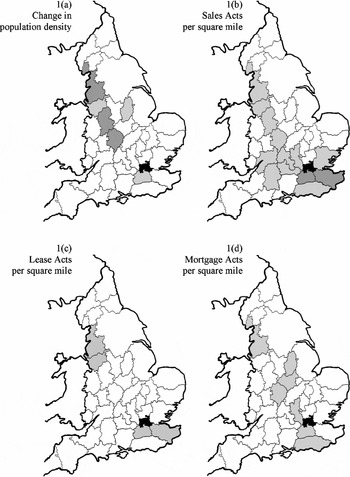
Figure 1(a) illustrates urbanization across English counties between 1760 and 1830. The light shading indicates counties where during that period the population per square mile increased by more than 150. The medium shading indicates counties where during that period the population per square mile increased by more than 200. The black shading indicates that the population per square mile of the county of Middlesex increased by more than 4,000, which is equivalent to a 227 per cent increase between 1760 and 1830. The growth of population in Middlesex stems from the growth of London. Growth of population in the Midlands and the North stems from the rise of industries, such as textiles, manufacturing and mining, and the ensuing expansion of industrial urban areas. In the North, the county that experienced the most growth was Lancashire. Its population grew by more than 1 million, with much of the growth concentrated in the cities of Manchester and Liverpool.
Geographic distribution of estate Acts, 1760 to 1830

Figures 1(b) to (d) reveal that between 1760 and 1830, estate Acts were concentrated in industrializing urban areas. Figure 1(b) illustrates the number of Acts authorizing sales of settled land that Parliament passed between 1760 and 1830. The light shading indicates counties with more than one and a half estate Acts per 100 square miles. The medium shading indicates counties with more than three estate Acts per 100 square miles. The black shading indicates that Middlesex had more than 20 Acts per 100 square miles. Figure 1(c) illustrates the number of estate Acts authorizing leases per 100 square miles. The light shading indicates counties with more than one-tenth of an Act per 100 square miles. The black shading indicates that Middlesex had more than 20 Acts per 100 square miles. Figure 1(d) illustrates the number of estate Acts authorizing mortgages per 100 square miles. The light shading indicates counties with more than one Act per 100 square miles. The black shading indicates that Middlesex had more than 10 Acts per 100 square miles.
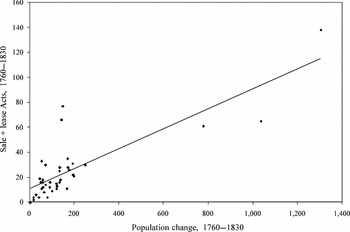
The correlation between estate Acts and population growth can be seen clearly when the data are plotted on a graph. Figure 2 accomplishes this exercise. The figure plots the county-level change in population from 1760 to 1830 against the number of estate Acts authorizing sales and leases in each county over the same period. Higher changes in population are strongly associated with larger numbers of sale and lease Acts. The correlation coefficient is 0.82.
County-level urbanization and estate Acts in England, 1760–1830
Source: For sale and lease Acts see Bogart and Richardson (Reference Bogart and Richardson2008b). For population by county see Wrigley (Reference Wrigley2007).

The geographic correlation between urbanization and estate Acts provides one piece of evidence that estate Acts promoted greater efficiency. The restrictions associated with strict settlements should have become more binding as urbanization increased and as landowners on the periphery of urban expansion perceived the opportunity to profit by switching land from rural to urban uses. Without estate Acts, it would have been much more difficult for landowners to reallocate resources in response to urbanization. At the same time, by relaxing the constraints on building in a particular city, estate Acts made that city more attractive to business and individuals. Many estate Acts were specifically passed to authorize building leases in urban areas. For instance, there was a cluster of building lease Acts in Lancashire in the 1790s, when Manchester and Liverpool were growing rapidly. Estate Acts and urbanization were clearly interconnected.
7. Conclusion
In this article, we have argued that by removing the shackles of the past, reducing transaction costs, restructuring equitable and real estates, reallocating resources to new uses and increasing the security of conveyance, estate Acts made property more productive. Our argument addresses a large literature concerning property rights and economic progress. A well-known hypothesis is that British courts developed a common law that protected property and promoted efficiency better than the legal codes of other nations. The reward for adopting such judge-made laws was rapid economic development (La Porta et al. Reference La Porta, Lopez-de-Silanes, Shleifer and Vishny1997, Reference La Porta, Lopez-de-Silanes, Shleifer and Vishny1998).
This article argues that Britain did not have an inherently superior property-rights system circa 1700. Like many European countries, an array of courts enforced an array of rights in an array of ways. These overlapping legal systems tied land to traditional uses. One key to Britain's economic success was its ability to adapt property rights in a manner which reduced transaction costs and reallocated land and resources to higher-value uses. Parliament played a key role in this process, by establishing a forum where families and individuals could reorganize rights to equitable and real estates outside the existing judicial process. This Parliamentary forum made property rights increasingly adaptable. At the end of the seventeenth century, most families had locked land into strict settlements that minimized the risk of opportunistic behaviour, but in doing so, restricted the uses to which land could be put. Those restrictions could be costly if economic conditions changed, which they did during the eighteenth century. Parliamentary estate Acts enabled landowners to react to the rapid pace of economic progress. Eventually, during a time period which falls outside the bounds of this study, Parliament passed general reforms of the equitable and real property systems, creating the common law of property that scholars admire today. The efficiency of the English common law, in sum, was in part due to Parliamentary intervention, and not an inevitable outcome of judge-made laws.
In future research, we plan to explore the relationship between the legislative and judicial processes for creating legal codes. We also plan to identify the causal links between adaptable institutions and economic development as well as the political mechanisms that fostered adaptability. A final topic that we plan to examine is the issue of redistribution. Our transaction-cost analysis does not preclude the possibility that estate Acts redistributed income. Our examination of the evidence indicates, however, that redistribution was (at most) a second-order issue. Contemporary commentators incessantly discussed issues of efficiency, but seldom (almost never) discussed issues of redistribution. The reason, we believe, lies in Parliament's efforts to ensure that estate Acts resulted in Pareto-superior reorganizations of rights. The hows and whys of Pareto-superiority are worthy of further research.
Acknowledgements
We thank Hans-Joachim Voth, Albrecht Ritschl and participants at the EREH Fast-track conference in Paris for advice, encouragement and comments. We also thank two anonymous reviewers who provided excellent comments in an extremely timely manner.