




No CrossRef data available.
Article contents
Eliciting women's preferences in health care: A review of the literature
Published online by Cambridge University Press: 28 May 2004
Abstract
Objectives: The increasing availability of information about health care suggests an expanding role for consumers to exercise their preferences in health-care decision-making. Numerous methods are available to assess consumer preferences in health care. We conducted a systematic review to characterize the study of women's preferences about health care
Methods: A MEDLINE search from 1965 to July 1999 was conducted as well as hand searches of the itshape Medical Decision Making Journal (1981–1999) and references from retrieved articles. Only original articles on women's health issues were selected. Information on thirty-one variables related to study characteristics and preferences were extracted by two independent investigators. A third investigator resolved disagreements. Qualitative and quantitative analyses were conducted to synthesize the data.
Results: Four hundred eighty-three studies were identified in the initial search. Seventy articles were selected for review based on title, abstract, and inclusion criteria. There was an increase in published articles and number of methods used to elicit preferences. White women were studied more than black women (p<.001). Preferences were mainly studied in outpatient settings (p<.005) and in the United States, United Kingdom, and Canada (83 percent). Preferences related to participation in decision-making were the most common (21 percent). Only 4 percent of the studies were performed to inform the debate for public policy questions. Willingness to pay was the method most used (11 percent), followed by category scaling (10 percent), rating scale (9 percent), standard-gamble (6 percent). Preferences for individual particular (opposed to sequential and health states) outcomes (68 percent), different treatments/tests (47 percent), and related to a treatment episode (31 percent) were addressed. Information regarding diseases, conditions, or procedures was given in 57 percent of studies. Information provided was mainly written (37 percent) and included positive and negative potential outcomes (67 percent). There is no relationship between the method or tool used for delivery information and the choice performed.
Conclusions: The literature on preferences in women's health care is limited to a fairly homogeneous population (white women from the United States, United Kingdom, and Canada). Additionally, use of utility-based measures to capture preferences has decreased over time while others methods (e.g., time trade-off [TTO], contingent valuation) have increased. Women's preferences are not necessarily uniform even when asked similar questions using similar tools. Little information on women's preferences exists to inform policy-makers about women's health care.
Information
- Type
- Research Article
- Information
- International Journal of Technology Assessment in Health Care , Volume 20 , Issue 2 , April 2004 , pp. 145 - 155
- Copyright
- © 2004 Cambridge University Press
Information about health care is increasingly available to consumers through the Internet, lay press, and specialty journals. This increased availability suggests an expanding role for consumers in decisions about the provision of health care. This expansion applies to the individual level where, as patients, consumers may want more say in choosing between treatments and assessing relative risk/benefit ratios in relation to treatment strategies. In addition, consumers, as taxpayers, may provide substantial input into national policy decisions about the allocation of health-care resources in society, including what services should be provided and to whom, as more information about the effects and costs associated with various health-care services enters the public domain.
As consumer access to information has increased, methods to assess consumer preferences about health-care services and medical treatments and for use in cost-utility analysis have proliferated. Various approaches and tools now exist to evaluate preferences whether in regard to treatment choices or possible roles for the consumer in participating in health-care decision making. Some include probabilities of events happening, some require choices between alternatives, while others ask for straightforward ratings (75). The standard gamble technique, for example, is a utility-based approach derived from economic theory in which individuals choose an indifference point between a gamble on full health and death at a specific probability level and remaining in the current chronic health state (21). Conjoint analysis, on the other hand, asks individuals to choose between different options through which the relative importance of attributes of those options, such as cost or waiting time, is revealed (39).
While many tools exist, the way information is presented within a given technique is also important. Choice alternatives may be presented under certainty or uncertainty, with the risk quantified or generally indicated. Medical conditions associated with the alternatives can be described directly and specifically or indirectly through their impact on function. Description of alternatives can accent positive prospects, negative prospects, or both.
Other aspects of preference assessment also vary. The alternatives presented, about which choices are made, depend on the aims of the study in question. They can be for a particular health state, a sequence of health states, or a type of decision-making role. Alternatives can be presented in written form, through a video, or conversationally. Finally, the context in which the decision is made is not consistent across studies. For example, consumers can be asked to make hypothetical choices about treatments under the assumption that they do not have the condition in question or in the midst of an actual treatment episode (70).
Different tools, using varying scenarios and styles for presenting information, have been used to assess consumer preferences in numerous settings. Systematic reviews of methods to assess these preference assessments in health care, however, are generally lacking. Assessing what is known to date can underscore what is known about preferences, the frequency with which certain tools have been used, how information is generally presented, the topics studied and convergence and divergence of results from different tools, and important areas for future work. Directing research in this area is important given its significance in informing individual and policy decision making.
The purpose of this study is to characterize the study of women's preferences about health-care diagnoses and treatments. Women were chosen for several reasons. First, they use more and different health-care services than men. Also, research has shown that communication style and information content in medical encounters are a function of the gender of the physician and the patient (22). Studies have also documented that the attitudes of women seeking care, along with the physician, affect the treatment pathway (60) and that women and men respond to risk differently (29). A systematic review was undertaken that specifically analyzed the characteristics of the studies about women; why preferences were studied; what methods were used; what type of information was provided; what tools were used; and what the findings in relation to preferences resulted.
METHODS
A MEDLINE search from 1965 to July 1999 was carried out to identify the published literature regarding women's preferences. Hand search of the Medical Decision Making Journal (1981–1999) and the references from the retrieved articles supplemented the results of the systematic literature search. The emphasis of the search was on sensitivity, rather than specificity, to ensure all potential, important references were identified for review. The search included the following Medical Subject Heading (in MEDLARS) terms: decision making/or choice behavior; decision support techniques/or data interpretation, statistical/or decision theory; attitude to health; patient participation. Additionally, preferences, willingness to pay, utilities, utility were used as a free text. The search was limited to English, French, and Spanish languages.
Nearly 500 articles were identified from the initial search. A subset of these articles was selected for review according to the following criteria. The a priori inclusion criteria were that the article represent original work on assessing patient preferences, specifically address women's health issues, that the study setting be a developed country or countries (defined as an Established Market Economy by the World Bank) and be published between 1965 and 1999. While exploration of preferences has begun in developing countries, these articles were not included for a lack of comparability about treatments on offer and the early developmental stage of the literature in this area. Articles addressing health issues affecting both genders were included if their title contained the word “women.”
Two independent reviewers extracted information on study characteristics for all articles. The characteristics recorded included year of publication; clinical topic or health issue; country(ies) where the study was carried out; gender; race and age of participants; study design; setting in which the study was conducted; preference elicitation technique used; type of preference addressed, meaning what was the choice for or about; use of other health-related quality of life scale; type of information provided in scenario descriptions; how information about treatments was presented; preference method used; type of preference elicited; if the preference involved the respondent, others, or both; the situation in which the preference was stated, for example hypothetical treatment without the condition; data analytic techniques used; stated results; and limitations. A copy of the extraction survey is available from the authors. When disagreement arose, a third reviewer was consulted for adjudication.
Qualitative and quantitative techniques were used to analyze the data collected through record extraction. Where possible frequencies and means were compared using appropriate statistical techniques. SAS software was used for the quantitative analyses. For those articles that involved the same study population and/or preference questions about the same procedure or disease, qualitative analysis was used to examine agreement regarding the findings.
RESULTS
A total of 484 studies were identified from the original search, of which 75 studies were selected for review based on title and abstract. Five studies were excluded after reading, as they did not meet the inclusion requirements, which left seventy studies for assessment.
The number of published articles about women's health-care-related preferences has increased substantially over time (Table 1). During the 1980s, between two to five articles were published every two years. These numbers more than doubled during the period 1992–1999 with twelve to twenty-six articles published every two years. In the period of time studied, the USA accounts for 49 percent of all the studies published in women preferences for health care, followed by the United Kingdom (20 percent) and Canada (14 percent). Other countries that have performed studies in this area that met our inclusion criteria were Sweden (6 percent), The Netherlands (4 percent), Australia (3 percent), and France (1 percent). One study includes data from three countries, the United Kingdom, France, and Germany (32).

Most of the studies focused on health conditions or issues that pertain predominantly or exclusively to women. Breast cancer was the clinical condition addressed most frequently, in 27 percent of studies (6;10;13;18;37;42;43;51;53–55;62;64;67;87;88;94;95;102) with prenatal diagnoses the second most common (20 percent; 8;11;12;20;24;34;44;45;59;66;68;76;77;97). Other common topics in order of frequency were reproductive techniques (10 percent;24;30;31;38;78;81), hormone replacement therapy (6 percent; 48,73;96;105), abortion/miscarriage (7 percent; 2; 36;46;79;83), treatment for menstrual disorders (7 percent; 17;35;78;86;100), and osteoporosis (1 percent; 33). Contraceptives use (32) treatments for genitourinary infection (90) and ovarian cancer (23;74), approaches to gynecologic exams (1;101) and maternity care (19), labor (14), total joint replacement (57), vaginal candidiasis (91), antenatal care (84), cardiac rehabilitation (69), colposcopy (4), and cancer (15) were also the subjects of a small number of studies.
In 87 percent of the cases, preference assessment was the purpose of the study, while in the remainder, women's preferences were assessed as an adjunct to the main study. In 89 percent of studies, women were asked about themselves only. White women were study participants more often than black women (p<.001), who were included in 18 percent of studies. Mean age of respondents varied among studies and reflected the topics addressed. For example, respondents in studies concerning reproductive techniques (31;38;71;81) and those for prenatal testing were in their middle thirties (24;44;45;77). Breast cancer study participants, on the other hand, were usually in their fifties (10;18;43;53;55;64;67;87). Preferences were mainly studied in outpatient settings versus hospitals (p=.004).
Preferences related to women's participation in health-care decision-making was the topic assessed most frequently, 21 percent of studies. Studies in this area included preferences for level of involvement in decisions, when to be told certain pieces of information, having or not having information about prognosis or likely outcomes, and having information when it would not affect treatment course. The second most common preference topic studied was the effect of women's preferences on management decisions about their care (20 percent). For example, one study examined the relationship between women's stated preferences about treatments for their menstrual disorders and the treatment decision of practitioners (17). The third preference topic studied was to analyze the trade-off between risk and benefits when deciding for health-care interventions (15.7 percent), such as the trade-offs between risks and benefits of radiation therapy after conservative surgery for early stage breast cancer (43).
The fourth most common topic is examining women's trade-offs between increase in survival and decrease in quality of life or an increase in costs (10 percent), to assess the preference for a trade-off between invasive and noninvasive technologies (9 percent), to study factors other than health gain alone that determine choice (7 percent). Only 4 percent of the studies have been performed to inform the debate for public policy questions; 4 percent to show differences in values for outcomes between healthy people and patients; 3 percent to assess how preferences influence compliance; 3 percent to study differences in preferences between patients and physicians; 1 percent to assess trade-off between palliative and curative treatment; 1 percent to assess additiveness of preferences over time; and 1 percent to assess how information affects preferences.
Although this review focused on women, men were also included as study subjects in 23 percent of the studies. The studies that include women's and men's preferences dealt with the following subjects: assistive reproductive techniques (30;31;38;71;81;82), amniocentesis (11;76), prenatal screening for genetic diseases (24;76), preference for the time to inform about presence of Down's syndrome (34), women and physician preferences for health outcomes in estrogen replacement therapy (48), patient and doctor preferences in infection treatment (genitourinary [90]) and vaginal candidosis (91), preferences for cardiac rehabilitation program features (69), and elective surgery (57). In several of these studies, some systematic preferences between men and women have been observed. When utilities for different outcomes of care were studied, women usually gave higher utilities than men in regard to estrogen replacement therapy (48), therapeutic abortion (77), and chorionic villus sampling (11). Additionally, men and women rated differently the features of a cardiac rehabilitation program (69).
Figure 1 shows the evolution of preference elicitation methods over time. Table 1 shows the number of studies during each time period, while the Figure indicates the distribution of preference methods used. Eighty-nine percent of studies used a cross-sectional design, providing a snapshot of preferences. Study power considerations were only explicitly addressed in 10 percent of the studies. The earliest methods of preference elicitation (simple question and rating scale) were the most simplistic. Over time, new methods to elicit preferences evolved, which peaked in the mid 1990s, during which thirteen different methods to elicit preferences were used.

Methods used to elicit preferences over time. VAS, Visual Analogue Scale; TTO, time trade-off; SG, standard gamble; MBS, Miller Behavioral Scale; KHOS, Krantz Health Opinion Survey; WT accept, willingness to accept; WTP, Willingness to pay.
While methods to assess preferences are proliferating, use of the standard gamble (SG) technique, considered to be the gold standard of preference assessment as it includes both elements of risk and choice, has decreased substantially over time. While use of the SG has decreased, the TTO has increased over time and was used in 29 percent of studies in 1998–1999. More recent methods used include conjoint analysis, willingness to accept, and combinations of methods. In nearly half (47 percent) of the studies, comparisons of treatments/tests were the choice alternatives specified in the preference assessment. The choice of treatment/test versus doing nothing, for example the willingness to pay for in vitro fertilization versus not intervening (38) was the preference option assessed in nearly a quarter of cases (24 percent). The type of information provided varied. Information regarding diseases, conditions, or procedures was given in 57 percent of studies. Of these, 63 percent gave specific information about the condition in question, while 10 percent provided multi-attribute information; some overlap occurred as 30 percent of studies provided both. Preferences about outcomes for a given test or procedures were addressed in thirty-five of the seventy studies reviewed. Sixty-eight percent of the outcome-focused studies addressed particular outcomes, such as health state, as opposed to sequential outcomes or a series of health states.
Outcomes were addressed in thirty-five of the seventy studies reviewed. Within this group, information on the positive and negative outcomes possibly associated with an intervention were given to patients in 57 percent (n=20) of the studies. Positive outcomes alone were presented in 9 percent of studies, while negative outcomes alone were presented in 14 percent of studies. In 20 percent of studies, researchers did not specify the type of outcome information presented to subjects for eliciting preferences in treatments/tests.
Nearly two-thirds of the studies reviewed used a single instrument by which to assess preference. Information about alternatives over which preferences were to be expressed was most commonly presented in written form, 58 percent of cases, such as cards or vignettes. Other mediums included personal interview (36 percent), brochure/information sheet (2 percent), audio-guided book (2 percent), and interactive video-disc (2 percent).
Table 2 shows when the preference assessment was made in relation to the clinical status of the respondent. Most of the studies (70 percent) that addressed questions about women's preferences for test/treatments were composed of respondents having the clinical condition in question. In addition, most posed the question when the women were deciding about treatment path that they were going to pursue (45.7 percent). Some studies (16 percent) asked women with and without the clinical condition about their preferences, while only (14 percent) of the studies addressed the preferences of women without the clinical condition.

Table 3 summarizes the findings related to women's preferences by topic for groups of studies exploring the same conditions. The table shows the dates of studies, the nature of the choice, and whether different studies agreed. As shown in the table, no relationship is suggested between the method used to elicit preferences from women and the content of the choices presented. For example, the willingness to pay method was used in both questions about antenatal screening, desire for information and for different treatments. Neither was a relationship suggested between the mode of information delivery and the type of choice presented. In the case of screening for cystic fibrosis, one study used oral data to deliver information and applied the willingness to pay technique (68) and the other used cards to deliver information and applies the standard gamble method (12).

No trend emerged between methods and tools and the preferences expressed. For example, in the case of antenatal screening, the methods and tools used in the five studies were different, while the preference expressed by the women was the same. Alternatively, the preferences expressed by women differed among the five studies that addressed the issue of miscarriage/abortion (medical versus surgical) when different methods were used conjoint analysis (83), questions (2;46), willingness to pay (36), rating scale (79), and the choice made by women were different, some prefer the surgical approach (46;83) and others the medical approach (2;36;75).
In the case of decision involvement, the same tool was used and the preference valuations from women were different in terms of their ordinal rankings. In one study (18), 22 percent of women preferred the active role, 44 percent preferred the collaborative role, and 34 percent preferred the passive, while in two studies (6;10) 20 percent and 18 percent preferred the active role, 37 percent and 34 percent preferred the collaborative role, and 43 percent and 47 percent preferred the passive role. In some cases, women were unable to express a preference. In a study relating to preferences to treatment for abortion (46), 54 percent had no preference then subsequently expressed strong preferences, greater than 74 percent in both cases, for the treatment, medical or surgical abortion, to which they had been randomized.
DISCUSSION
Involving patients, and citizens, in health-care decisions has become an important objective in recent health-care reforms around the world (5;58;93) and a key issue in trying to improve health-care quality (16). Different studies have shown that including or considering patient preferences for selected outcomes of care (9) or health-care services (52;60;80) increase patient satisfaction and improve patient perceptional outcomes (3;40;41;50;56;63). Evidence suggests that satisfied patients comply more with treatment regimens (65;98;103), return for care (7;65), and keep appointments (47). Consequently, they may achieve better outcomes (40) and make better use of health services (27;61). Also, studies indicate that satisfied patients may also improve physician satisfaction (72;89).
Finally, the principle of evidence-based medicine requires that the impact of care on people's lives become the center of health-care delivery (www/cochraneconsumer.com). Evidence-based patient choice is considered a fundamental component of quality health care (49), Therefore, the need to include consumer's preferences in relation to her decisions regarding her own health-care advocates for further study.
Our research shows that the study of women's preferences for treatments, tests, or procedures in clinical care have increased over time. However, our review points to several gaps in the literature. We identify these gaps for the purpose of informing future research. As in other areas of clinical research, preferences from white women have been studied far more than black women and other ethnicities. Because ethnicity may affect preference choice, more studies addressing preferences in minority populations should be carried out. We also found this literature to be unrepresentative in terms of nationality, as 83 percent of the studies were conducted in the United States, United Kingdom, or Canada. Given that different cultures have different health-care values, the extrapolation of health-care choices based on preference studies from one country to others should be viewed with caution.
We also found limitations in terms of study design. The current literature is based on cross-sectional studies, thus preferences are assessed at one point in time. Preferences may not be static over time; they may change as a function of personal experiences (i.e., adaption to a health state; 14) and psychological health (15) and changes in health-care technology. The studies included did not allow us to assess changes in women's preferences over time. Better study designs are needed to capture temporal patterns in women's preferences (e.g., serial cross-sectional or before/after studies, and panel studies). This shortcoming has been noted by other authors in relation to general studies of preferences (75).
Our review also illuminates the need to conduct studies on preferences in the inpatient setting. The majority of studies we reviewed were carried out at outpatient settings. While inpatients are a small sample of the real number of people affected with one disease, there may be systematic differences in preferences among outpatients versus inpatients. Additionally, hospital care accounts for a greater proportion of expenditures in a health care. Although eliciting preferences at hospital level could be seen as a risk for increasing costs, previous research have shown the opposite in several clinical conditions (28;99;104). Therefore, expanding preference elicitation to inpatient and other settings (e.g., intermediate care, residential care) is justified.
With respect to policy making, only 4 percent of the studies approached preferences to inform the debate for public policy questions. The reviewed studies typically used patients as the “judges” to determine preferences for individual treatment decisions or medical outcomes. As a general rule, preferences should be elicited from the population for which they are to be applied (75). Therefore, if policy decisions are to reflect consumer preferences, studies with this explicit focus are needed and preferences from a representative sample of the population should be used.
The disagreement shown in several studies that address the same procedures or clinical conditions is noteworthy. It leads us to suggest that the “external validity” of studies is weak, that is, you cannot generalize at this point from one study with one population to another. However, for some procedures, consensus on a treatment approach was reached and the findings from several studies suggested a single course of action. Further research into how to establish external validity in terms of preference investigations is an important area that may help in the design of macro health-care policy.
An important reason to study preferences is to promote informed decision-making. Consumers seek different roles regarding their level of involvement (e.g., active versus passive) in decisions about their care, and satisfaction with services is likely to reflect the ability to provide their preferred level of involvement. Accordingly, it is encouraging that a large proportion of the studies addressed preferences for women's participation in health-care decision-making, whereby providing some evidence about what women desire their roles to be.
The majority of studies presented both positive and negative outcomes of the intervention/treatment decisions, and one third attached probabilities to these outcomes. This rate is reassuring, as truly informed decision making requires having information on both positive and negative attributes. Additionally, previous research has shown that the way potential outcomes are framed influences decisions (87;92). This also applies to clinical decision making. For example, individuals tend to be risk-seeking when outcomes are framed positively (i.e., expressed in terms of cure or survival rates), but risk-averse when outcomes are framed negatively (i.e., expressed in terms of death or disease recurrence rates).
Most studies used a written tool to provide information about choices. Combination of tools, especially written/visual plus oral/audio, have been shown to increase patient knowledge and, hence, promote more informed decisions. One of the most interesting findings of this review is how methods for eliciting preferences have diffused over time. One important trend is the reduction in use of the SG, which was accompanied by the increase in use of the TTO. Because the TTO was developed as an “easier” alternative to the SG and behaves similarly, this trend is not surprising.
The influx of new methods in the mid-late 1990s seem to reflect efforts to make preference solicitation easier to understand as well as standardize the measurement. Accordingly, one must consider the trade-off in terms of validity, reliability, and ease of use. The SG generally has better psychometric properties than the other methods (with the exception in some cases of the TTO) and is the only tool to incorporate risk explicitly in the decision (21). However, because of its high respondent burden relative to the others, it not feasible for large population-based studies. For these situations, simple response techniques such as category scaling and rating scales may be more appropriate. Also rating scales are often used for large studies, and in some cases, rating scale values have been converted to SG-like utility values (85).
Several limitations of our study should be noted. Our search was confined to English, French, and Spanish, which may have limited our ability to detect patterns of cross-country preferences. However, because authors from non-English speaking countries frequently publish in English language journals and we found relatively few studies from other countries, we do not believe this strategy impacts our ability to conclude that more cross-country studies are needed. The sources of information used here were mainly biomedical databases, given that the objective of the study was to locate the literature on women's health-related preferences. Limiting our search to these databases may have introduced a selection bias; however, we reviewed and included articles referenced within other articles, which included studies likely to be found in other databases and the grey literature. Similar to other authors, we did not search EMBASE (26). We also did not search for unpublished literature.
CONCLUSION AND RECOMMENDATIONS
In summary, the literature on preferences elicitation in women's health care is limited to cross-sectional studies in a fairly homogeneous population, white women from the United States, United Kingdom, and Canada, and clinical setting, the outpatient setting. Preferences were generally elicited regarding decision-making roles or treatment decisions. The use of utility based methods (e.g., SG), has decreased over time while other methods have increased (e.g., TTO, rating scales). There is a need to expand the research in preference assessment to different populations, clinical settings, and beyond cross-sectional studies.
The study was supported in part by the Kerr L White Institute for Health Services Research (Atlanta) and the Catalan Agency for Health Technology Assessment.
References
Anapol D,
Wagner NN.
1978
Patient provider preferences and the pelvic examination.
Nurse Pract.
3:
13.Google Scholar
Bachelot A,
Cludy L,
Spira A.
1992
Conditions for choosing between drug-induced and surgical abortions.
Contraception.
45:
547–
559.Google Scholar
Barry MJ,
Mulley AG Jr,
Fowler FJ,
Wennberg JW.
1988
Watchful waiting vs immediate transurethral resection for symptomatic prostatism. The importance of patients' preferences.
JAMA.
259:
3010–
3017.Google Scholar
Barsevick AM,
Johnson JE.
1990
Preference for information and involvement, information seeking and emotional responses of women undergoing colposcopy.
Res Nurs Health.
13:
1–
7.Google Scholar
Bastian H.
1998
Speaking up for ourselves. The evolution of consumer advocacy in health care.
Int J Technol Assess Health Care.
14:
3–
23.Google Scholar
Beaver K,
Luker KA,
Owens RG, et al.
1996
Treatment decision making in women newly diagnosed with breast cancer.
Cancer Nurs.
19:
8–
19.Google Scholar
Becker MH,
Maiman LA.
1980
Strategies for enhancing patient compliance.
J Community Health.
6:
113–
135.Google Scholar
Berwick DM,
Weinstein MC.
1985
What do patients value? Willingness to pay for ultrasound in normal pregnancy.
Med Care.
23:
881–
893.Google Scholar
Bessette L,
Keller RB,
Liang MH, et al.
1997
Patients' preferences and their relationship with satisfaction following carpal tunnel release.
J Hand Surg [Am].
22:
613–
620.Google Scholar
Bilodeau BA,
Degner LF.
1996
Information needs, sources of information, and decisional roles in women with breast cancer.
Oncol Nurs Forum.
23:
691–
696.Google Scholar
Bryce RL,
Bradley MT,
McCormick SM.
1989
To what extent would women prefer chorionic villus sampling to amniocentesis for prenatal diagnosis?
Paediatr Perinat Epidemiol.
3:
137–
145.Google Scholar
Cairns J,
Shackley P,
Hundley V.
1996
Decision making with respect to diagnostic testing: A method of valuing the benefits of antenatal screening.
Med Decis Making.
16:
161–
168.Google Scholar
Chapman GB,
Elstein AS,
Hughes KK.
1995
Effects of patient education on decisions about breast cancer treatments: A preliminary report.
Med Decis Making.
15:
231–
239.Google Scholar
Christensen-Szalanski JJ.
1984
Discount functions and the measurement of patients' values. Women's decisions during childbirth.
Med Decis Making.
4:
47–
58.Google Scholar
Ciampi A,
Silberfeld M,
Till JE.
1982
Measurement of individual preferences. The importance of “situation-specific” variables.
Med Decis Making.
2:
483–
495.Google Scholar
Cleary PD,
Edgman-Levitan S.
1997
Health care quality. Incorporating consumer perspectives.
JAMA.
278:
1608–
1612.Google Scholar
Coulter A,
Peto V,
Doll H.
1994
Patients' preferences and general practitioners' decisions in the treatment of menstrual disorders.
Fam Pract.
11:
67–
74.Google Scholar
Degner LF,
Kristjanson LJ,
Bowman D, et al.
1997
Information needs and decisional preferences in women with breast cancer.
JAMA.
277:
1485–
1492.Google Scholar
Donaldson C,
Hundley V,
Mapp T.
1998
Willingness to pay: A method for measuring preferences for maternity care?
Birth.
25:
32–
39.Google Scholar
Donaldson C,
Shackley P,
Abdalla M,
Miedzybrodzka Z.
1995
Willingness to pay for antenatal carrier screening for cystic fibrosis.
Health Econ.
4:
439–
452.Google Scholar
Drummond MF,
O'Brien B,
Stoddart G,
Torrance GW.
1997
Methods for the economic evaluation of health care programmes.
Oxford:
Oxford University Press
Elderkin-Thompson V,
Waitzkin H.
1999
Differences in clinical communication by gender.
J Gen Intern Med.
14:
112–
121.Google Scholar
Elit LM,
Levine MN,
Gafni A, et al.
1996
Patients' preferences for therapy in advanced epithelial ovarian cancer: Development, testing, and application of a bedside decision instrument.
Gynecol Oncol.
62:
329–
335.Google Scholar
Eng CM,
Schechter C,
Robinowitz J, et al.
1997
Prenatal genetic carrier testing using triple disease screening.
JAMA.
278:
1268–
1272.Google Scholar
Faden RR,
Gielen AC,
Kass N,
O'Campo P,
Sheon A.
1993
Reproductive preferences of pregnant women under shifting probabilities of vertical HIV transmission.
Womens Health Issues.
3:
216–
222.Google Scholar
Fergusson D,
Laupacis A,
Salmi LR,
McAlister FA,
Huet C.
2000
What should be included in meta-analyses? An exploration of methodological issues using the ISPOT meta-analyses.
Int J Technol Assess Health Care.
16:
1109–
1119.Google Scholar
Fitzpatrick R.
1990.
Measurement of patient satisfaction.
In: Hopkins A,
Constain D, editors.
Measuring the outcomes of medical care.
London:
Royal College of Physicians
Flood AB,
Wennberg JE,
Nease RF Jr, et al.
1996
The importance of patient preference in the decision to screen for prostate cancer. Prostate Patient Outcomes Research Team.
J Gen Intern Med.
11:
342–
349.Google Scholar
Flynn J,
Slovic P,
Mertz CK.
1994
Gender, race, and perception of environmental health risks.
Risk Anal.
14:
1101–
1108.Google Scholar
Frank DI.
1990
Factors related to decisions about infertility treatment.
J Obstet Gynecol Neonatal Nurs.
19:
162–
167.Google Scholar
Fuchs N,
Prinz H,
Koch U.
1996
Attitudes to current oral contraceptive use and future developments: The women's perspective.
Eur J Contracept Reprod Health Care.
1:
275–
284.Google Scholar
Gabriel SE,
Kneeland TS,
Melton LJ III, et al.
1999
Health-related quality of life in economic evaluations for osteoporosis: Whose values should we use?
Med Decis Making.
19:
141–
148.Google Scholar
Gayton WF,
Walker L.
1974
Down syndrome: Informing the parents. A study of parental preferences.
Am J Dis Child.
127:
510–
512.Google Scholar
Geller SE,
Bernstein SJ,
Harlow SD.
1997
The decision-making process for the treatment of abnormal uterine bleeding.
J Womens Health.
6:
559–
567.Google Scholar
Gibb S,
Donaldson C,
Henshaw R.
1998
Assessing strength of preference for abortion method using ‘willingness to pay’: A useful research technique for measuring values.
J Adv Nurs.
27:
30–
36.Google Scholar
Gramlich EP,
Waitzfelder BE.
1998
Interactive video assists in clinical decision making.
Methods Inf Med.
37:
201–
205.Google Scholar
Granberg M,
Wikland M,
Nilsson L,
Hamberger L.
1995
Couples' willingness to pay for IVF/ET.
Acta Obstet Gynecol Scand.
74:
199–
202.Google Scholar
Green PE,
1978
Srinivasan VA Conjoint analysis in consumer research: Issues and outlook.
J Consum Res.
5:
103–
123.Google Scholar
Greenfield S,
Kaplan S,
Ware JE Jr.
1985
Expanding patient involvement in care. Effects on patient outcomes.
Ann Intern Med.
102:
520–
528.Google Scholar
Greenfield S,
Kaplan SH,
Ware JE Jr,
Yano EM,
Frank HJ.
1988
Patients' participation in medical care: Effects on blood sugar control and quality of life in diabetes.
J Gen Intern Med.
3:
448–
457.Google Scholar
Hack TF,
Degner LF,
Dyck DG.
1994
Relationship between preferences for decisional control and illness information among women with breast cancer: A quantitative and qualitative analysis.
Soc Sci Med.
39:
279–
289.Google Scholar
Hayman JA,
Fairclough DL,
Harris JR,
Weeks JC.
1997
Patient preferences concerning the trade-off between the risks and benefits of routine radiation therapy after conservative surgery for early-stage breast cancer.
J Clin Oncol.
15:
1252–
1260.Google Scholar
Heckerling PS,
Verp MS,
Albert N.
1999
Patient or physician preferences for decision analysis: The prenatal genetic testing decision.
Med Decis Making.
19:
66–
77.Google Scholar
Heckerling PS,
Verp MS,
Hadro TA.
1994
Preferences of pregnant women for amniocentesis or chorionic villus sampling for prenatal testing: Comparison of patients' choices and those of a decision-analytic model.
J Clin Epidemiol.
47:
1215–
1228.Google Scholar
Henshaw RC,
Naji SA,
Russell IT,
Templeton AA.
1993
Comparison of medical abortion with surgical vacuum aspiration: Women's preferences and acceptability of treatment.
BMJ.
307:
714–
7.Google Scholar
Hertz P,
Stamps PL.
1977
Appointment-keeping behavior re-evaluated.
Am J Public Health.
67:
1033–
1036.Google Scholar
Holmes MM,
Rovner DR,
Rothert ML, et al.
1987
Women's and physicians' utilities for health outcomes in estrogen replacement therapy.
J Gen Intern Med.
2:
178–
182.Google Scholar
Holmes-Rovner M,
Llewellyn-Thomas H,
Entwistle V,
Coulter A,
O'Connor A,
Rovner DR.
2001
Patient choice modules for summaries of clinical effectiveness: A proposal.
BMJ.
322:
664–
667.Google Scholar
Hornberger JC,
Habraken H,
Bloch DA.
1995
Minimum data needed on patient preferences for accurate, efficient medical decision making.
Med Care.
33:
297–
310.Google Scholar
Hughes KK.
1993
Decision making by patients with breast cancer: The role of information in treatment selection.
Oncol Nurs Forum.
20:
623–
628.Google Scholar
Jacoby A.
1987
Women's preferences for and satisfaction with current procedures in childbirth-findings from a national study.
Midwifery.
3:
117–
124.Google Scholar
Jansen SJ,
Stiggelbout AM,
Wakker PP, et al.
1998
Patients' utilities for cancer treatments: A study of the chained procedure for the standard gamble and time tradeoff.
Med Decis Making.
18:
391–
399.Google Scholar
Johnson JD,
Meischke H.
1994
Women's preferences for cancer-related information from specific types of mass media.
Health Care Women Int.
15:
23–
30.Google Scholar
Johnson JD,
Roberts CS,
Cox CE, et al.
1996
Breast cancer patients' personality style, age, and treatment decision making.
J Surg Oncol.
63:
183–
186.Google Scholar
Kaplan SH,
Greenfield S,
Ware JE, Jr.
1989
Assessing the effects of physician-patient interactions on the outcomes of chronic disease.
Med Care.
27:
S110–
S127.Google Scholar
Karlson EW,
Daltroy LH,
Liang MH,
Eaton HE,
Katz JN.
1997
Gender differences in patient preferences may underlie differential utilization of elective surgery.
Am J Med.
102:
524–
530.Google Scholar
Kasper JF,
Mulley AG Jr,
Wennberg JE.
1992
Developing shared decision-making programs to improve the quality of health care.
QRB Qual Rev Bul.
18:
183–
190.Google Scholar
Kuppermann M,
Shiboski S,
Feeny D,
Elkin EP,
Washington AE.
1997
Can preference scores for discrete states be used to derive preference scores for an entire path of events? An application to prenatal diagnosis.
Med Decis Making.
17:
42–
55.Google Scholar
Larsen DE,
Rootman I.
1976
Physician role performance and patient satisfaction.
Soc Sci Med.
10:
29–
32.Google Scholar
Levine MN,
Gafni A,
Markham B,
MacFarlane D.
1992
A bedside decision instrument to elicit a patient's preference concerning adjuvant chemotherapy for breast cancer.
Ann Intern Med.
117:
53–
58.Google Scholar
Linder-Pelz S,
Struening EL.
1985
The multidimensionality of patient satisfaction with a clinic visit.
J Community Health.
10:
42–
54.Google Scholar
Lindley C,
Vasa S,
Sawyer WT,
Winer EP.
1998
Quality of life and preferences for treatment following systemic adjuvant therapy for early-stage breast cancer.
J Clin Oncol.
16:
1380–
1387.Google Scholar
Linn MW,
Linn BS,
Stein SR.
1982
Satisfaction with ambulatory care and compliance in older patients.
Med Care.
20:
606–
614.Google Scholar
Lippman A,
Perry TB,
Mandel S,
Cartier L.
1985
Chorionic villi sampling: Women's attitudes.
Am J Med Genet.
22:
395–
401.Google Scholar
McQuellon RP,
Muss HB,
Hoffman SL, et al.
1995
Patient preferences for treatment of metastatic breast cancer: A study of women with early-stage breast cancer.
J Clin Oncol.
13:
858–
868.Google Scholar
Miedzybrodzka Z,
Semper J,
Shackley P,
Abdalla M,
Donaldson C.
1995
Stepwise or couple antenatal carrier screening for cystic fibrosis?: Women's preferences and willingness to pay.
J Med Genet.
32:
282–
283.Google Scholar
Moore SM,
Kramer FM
1996
Women's and men's preferences for cardiac rehabilitation program features.
J Cardiopulm Rehabil.
16:
163–
168.Google Scholar
Mulley AG Jr.
1989
Assessing patients' utilities. Can the ends justify the means?
Med Care.
27:
S269–
S281.Google Scholar
Neumann PJ,
Johannesson M.
1994
The willingness to pay for in vitro fertilization: A pilot study using contingent valuation.
Med Care.
32:
686–
699.Google Scholar
Novack DH,
Suchman AL,
Clark W, et al.
1997
Calibrating the physician. Personal awareness and effective patient care. Working Group on Promoting Physician Personal Awareness, American Academy on Physician and Patient.
JAMA.
278:
502–
509.Google Scholar
O'Connor AM,
Tugwell P,
Wells GA, et al.
1998
A decision aid for women considering hormone therapy after menopause: Decision support framework and evaluation.
Patient Educ Couns.
33:
267–
279.Google Scholar
Ortega A,
Dranitsaris G,
Sturgeon J,
Sutherland H,
Oza A.
1997
Cost-utility analysis of paclitaxel in combination with cisplatin for patients with advanced ovarian cancer.
Gynecol Oncol.
66:
454–
463.Google Scholar
Patrick DL,
Erickson P.
1993
Health status and health policy. In:
Quality of life in health care evaluation and resource allocation.
New York:
Oxford University Press;
22–
26.
Pauker SG,
Pauker SP,
McNeil BJ.
1981
The effect of private attitudes on public policy. Prenatal screening for neural tube defects as a prototype.
Med Decis Making.
1:
103–
114.Google Scholar
Pauker SP,
Pauker SG.
1987
The amniocentesis decision: Ten years of decision analytic experience.
Birth Defects Orig Artic Ser.
23:
151–
169.Google Scholar
Robinson K,
Gathehouse S,
Browning GG.
1996
Measuring patient benefit from otorhinolaryncological surgery and therapy.
Ann Otol Rhinol Laryngol.
105:
415–
422.Google Scholar
Rosen AS,
Nystedt L,
Bygdeman M,
Lundstrom V.
1979
Acceptability of a nonsurgical method to terminate very early pregnancy in comparison to vacuum aspiration.
Contraception.
19:
107–
117.Google Scholar
Ross CK,
Steward CA,
Sinacore JM.
1993
The importance of patient preferences in the measurement of health care satisfaction.
Med Care.
31:
1138–
1149.Google Scholar
Ryan M.
1996
Using willingness to pay to assess the benefits of assisted reproductive techniques.
Health Econ.
5:
543–
558.Google Scholar
Ryan M.
1999
Using conjoint analysis to take account of patient preferences and go beyond health outcomes: An application to in vitro fertilisation.
Soc Sci Med.
48:
535–
546.Google Scholar
Ryan M,
Hughes J.
1997
Using conjoint analysis to assess women's preferences for miscarriage management.
Health Econ.
6:
261–
273.Google Scholar
Ryan M,
Ratcliffe J,
Tucker J.
1997
Using willingness to pay to value alternative models of antenatal care.
Soc Sci Med.
44:
371–
380.Google Scholar
Schackman BR,
Goldie SJ,
Freedbert K,
Losina E,
Brazier J,
Weinstein MC.
2002
Comparison of health state utilities using community and patient preference weights derived from a survey of patients with HIV/AIDS.
Med Decis Making.
22:
27–
38.Google Scholar
Shaw RW,
Brickley MR,
Evans L,
Edwards MJ.
1998
Perceptions of women on the impact of menorrhagia on their health using multi-attribute utility assessment.
Br J Obstet Gynaecol.
105:
1155–
1159.Google Scholar
Siminoff LA,
Fetting JH.
1989
Effects of outcome framing on treatment decisions in the real world: Impact of framing on adjuvant breast cancer decisions.
Med Decis Making.
9:
262–
271.Google Scholar
Street RL Jr,
Voigt B,
Geyer C Jr,
Manning T,
Swanson GP.
1995
Increasing patient involvement in choosing treatment for early breast cancer.
Cancer.
76:
2275–
2285.Google Scholar
Suchman AL,
Roter D,
Green M,
Lipkin M Jr.
1993
Physician satisfaction with primary care office visits. Collaborative Study Group of the American Academy on Physician and Patient.
Med Care.
31:
1083–
1092.Google Scholar
Timpka T,
Buur T.
1991
Medical reasoning and patient requests in decision-making for female genitourinary infections.
Methods Inf Med.
30:
215–
220.Google Scholar
Tooley PJ.
1985
Patient and doctor preferences in the treatment of vaginal candidosis.
Practitioner.
229:
655–
660.Google Scholar
Tversky A,
Kahenman D.
1981
The framing of decisions and the psychology of choice.
Science.
211:
453–
458.Google Scholar
UK Department of Health.
1999
The new NHS. Modern & dependable.
Available at: http://www.official-documents.co.uk/document/doh/newnhs/forward.htm. Accessed: July
Unic I,
Stalmeier PF,
Verhoef LC,
van Daal WA.
1998;
Assessment of the time-tradeoff values for prophylactic mastectomy of women with a suspected genetic predisposition to breast cancer.
Med Decis Making.
18:
268–
277.Google Scholar
Valanis B,
Rumpler C.
1982;
Healthy women's preferences in breast cancer treatment.
J Am Med Womens Assoc.
37:
311–
316.Google Scholar
van de Weijer PH,
Barentsen R,
Kenemans P.
1998;
Women's expectations and acceptance of cyclic induced HRT bleeds.
Maturitas.
30:
257–
263.Google Scholar
Verp MS,
Heckerling PS.
1995;
Use of decision analysis to evaluate patients' choices of diagnostic prenatal test.
Am J Med Genet.
58:
337–
344.Google Scholar
Vuori H,
Aaku T,
Aine E,
Erkko R,
Johansson R.
1972;
Doctor-patient relationship in the light of patients' experiences.
Soc Sci Med.
6:
723–
730.Google Scholar
Wagner EH,
Barrett P,
Barry MJ,
Barlow W,
Fowler FJ Jr.
1995;
The effect of a shared decisionmaking program on rates of surgery for benign prostatic hyperplasia. Pilot results.
Med Care.
33:
765–
770.Google Scholar
Warner P.
1994;
Preferences regarding treatments for period problems: Relationship to menstrual and demographic factors.
J Psychosom Obstet Gynaecol.
15:
93–
110.Google Scholar
Webb R,
Opdahl M.
1996;
Breast and pelvic examinations: Easing women's discomfort.
Can Fam Physician.
42:
54–
58.Google Scholar
Wei JP,
Sherry RM,
Baisden BL,
Peckel J,
Lala G.
1995;
Prospective hospital-based survey of attitudes of Southern women toward surgical treatment of breast cancer.
Ann Surg Oncol.
2:
360–
364.Google Scholar
Willson P,
McNamara JR.
1982;
How perceptions of a simulated physician-patient interaction influence intended satisfaction and compliance.
Soc Sci Med.
16:
1699–
1704.Google Scholar
Wolf AM,
Nasser JF,
Wolf AM,
Schorling JB.
1996;
The impact of informed consent on patient interest in prostate-specific antigen screening.
Arch Intern Med.
156:
1333–
1336.Google Scholar
Zethraeus N.
1998;
Willingness to pay for hormone replacement therapy.
Health Econ.
7:
31–
38.Google Scholar

Number of Studies by Years of Study

Methods used to elicit preferences over time. VAS, Visual Analogue Scale; TTO, time trade-off; SG, standard gamble; MBS, Miller Behavioral Scale; KHOS, Krantz Health Opinion Survey; WT accept, willingness to accept; WTP, Willingness to pay.
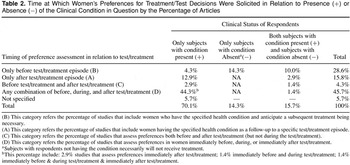
Time at Which Women's Preferences for Treatment/Test Decisions Were Solicited in Relation to Presence (+) or Absence (−) of the Clinical Condition in Question by the Percentage of Articles
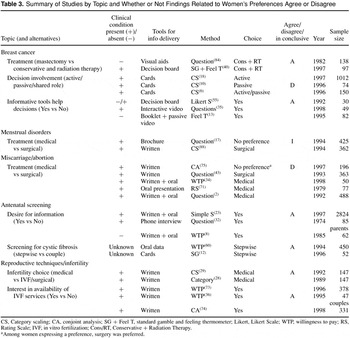
Summary of Studies by Topic and Whether or Not Findings Related to Women's Preferences Agree or Disagree
 You have
Access
- 8
- Cited by