More women, especially women of color, are running for and winning political office. From first-time candidates like Cori Bush becoming the first Black woman elected to Congress in 2020 from Missouri to states such as Nevada and Colorado, which after the 2022 election had a state legislature composed of at least 50% women, the halls of government are shifting toward more gender and racial/ethnic diversity. Organizations such as Fair Fight, Latinas Represent, Higher Heights, and EMERGE are widening the pool of women who see themselves first as candidates and then as politicians. As we see more White and non-White women winning elections at the local, state, and federal levels, it is vital to assess the ways in which they engage in constituency service.
These newly elected women in politics are likely to face gendered challenges based on the incongruence between masculine perceptions of political leaders and feminine stereotypes (Bos, Schneider, and Utz Reference Bos, Schneider, Utz, Travis and White2017; Schneider and Bos Reference Schneider and Bos2019; Sweet-Cushman Reference Sweet-Cushman2022). Feminine stereotypes characterize women as caring, sensitive, and nurturing (Prentice and Carranza Reference Prentice and Carranza2002)—qualities that reflect the communal or more supportive social roles held by women (Eagly and Karau Reference Eagly and Karau2002). The stereotypes associated with political leadership are distinctly masculine (Conroy Reference Conroy2015; Holman, Merolla, and Zechmeister Reference Holman, Merolla and Zechmeister2016; Huddy and Terkildsen Reference Huddy and Terkildsen1993). Gender stereotypes create a perception among female lawmakers that they may face bias among voters (Dittmar Reference Dittmar2015; Kanthak and Woon Reference Kanthak and Woon2015; Lawless Reference Lawless2012).Footnote 1 Much of what we know about female leaders focuses on women in general, with little attention paid to the actions of non-White female representatives. In this project, we explore how both White and non-White women engage in constituency service—specifically, we focus on how they engage with electronic correspondence.
The classic literature on how lawmakers secure reelection argues that constituent communication is critical (Grimmer, Westwood, and Messing Reference Grimmer, Westwood and Messing2014; Mayhew Reference Mayhew1974). We develop and test a theory of how women exhibit a “feminine homestyle,” in which we argue that women will be more responsive to constituent communication, and this high responsiveness will come from the worry that women have about gender bias among voters and the communal, or caregiving, motivations that propel women to pursue elected office. We argue that female legislators will also engage in a more communally oriented style of representation with constituents that better fit into a model of service representation (Eulau and Karps Reference Eulau and Karps1977). We add to the body of scholarship by analyzing how female legislators of color approach their communication style with constituents. Representatives of color are heavily invested in advancing the interests of their constituents and representing them in effective ways (Broockman Reference Broockman2013; Bejarano Reference Bejarano2013; Minta Reference Minta2011). We explore whether and how this deep interest in serving their constituents influences their approach to communicating with them.
Building on recent work using audit studies to identify differences in legislator behaviors across sex (see e.g., Costa Reference Costa2017; Thomsen and Sanders Reference Thomsen and Sanders2020), we developed an original audit study that measures the presence of a feminine homestyle by tracking the responsiveness of female and male lawmakers to constituent communication and the content of this communication. We uncovered three novel findings. First, we found that female lawmakers are more likely to respond to constituent communication than male lawmakers. Second, we found that female lawmakers respond to constituent communication in ways that reinforce communality, such as displaying empathy and compassion, while male lawmakers respond in ways that reinforce power and strength. Third, we traced the institutional implications of hardworking women in state legislatures and found that highly responsive female lawmakers reinforce a norm of increased responsiveness among their male colleagues.
Our theory of a feminine homestyle speaks not only to the quality of representation provided by female lawmakers, but also to how female lawmakers use constituent communication to mitigate the potential for gender bias. We argue and show that female lawmakers develop relationships with constituents based on empathy and community building, and these relationships can lead to increased political efficacy and engagement among citizens and a greater sense of democratic legitimacy (Badas and Stauffer Reference Badas and Stauffer2018; Clayton, O’Brien, and Piscopo Reference Clayton, O’Brien and Jennifer Piscopo2019; Hayes and Hibbing Reference Hayes and Hibbing2017; Lawless Reference Lawless2004; Michelson Reference Michelson2000; Pantoja and Segura Reference Pantoja and Segura2003; Stauffer Reference Stauffer2019; Wolak Reference Wolak2020). Theories of democratic representation argue that heightened descriptive representation leads to improved substantive and symbolic representation of marginalized communities (Mansbridge Reference Mansbridge1999; Pitkin Reference Pitkin1967; Schwindt-Bayer Reference Schwindt-Bayer2010; Schwindt-Bayer and Mishler Reference Schwindt-Bayer and Mishler2005; Tate Reference Tate2018). The improved service responsiveness of female legislators is particularly important for democratic legitimacy and accountability because this communication creates positive interactions between citizens and lawmakers (Eulau and Karps Reference Eulau and Karps1977).
Gendered Patterns of Representation
Past scholarship argues that female lawmakers work hard to manage gendered biases that lead voters and potential opponents to underrate their effectiveness (Branton et al. Reference Branton, English, Pettey and Barnes2018; Cryer Reference Cryer2019; Milyo and Schlosberg Reference Milyo and Schlosberg2000). A vast literature finds that female lawmakers outperform male lawmakers in terms of their qualifications (Bauer Reference Bauer2020; Ekstrand and Eckert Reference Ekstrand and Eckert1981; Fulton Reference Fulton2012) and their overall legislative productivity (Anzia and Berry Reference Anzia and Berry2011; Lazarus and Steigerwalt Reference Lazarus and Steigerwalt2018; Thomsen and Sanders Reference Thomsen and Sanders2020; Volden, Wiseman, and Wittmer Reference Volden, Wiseman and Wittmer2013). Female lawmakers are also more likely to call attention to issues that disproportionately affect women and marginalized communities (Brown Reference Brown2014; Fraga et al. Reference Fraga, Lopez, Martinez-Ebers and Ramirez2006; Funk and Phillips Reference Funk and Phillips2019; Holman Reference Holman2014; Osborn Reference Osborn2012; Pearson and Dancey Reference Pearson and Dancey2011; Reingold Reference Reingold1992; Smooth Reference Smooth2011; Swers Reference Swers2002; Wittmer and Bouché Reference Wittmer and Bouché2013). Female lawmakers, especially women of color, are particularly adept at substantively representing the interests of marginalized groups (Bejarano Reference Bejarano2013; Brown Reference Brown2014; Dietrich, Hayes, and O’Brien Reference Dietrich, Hayes and O’Brien2019; Fraga et al. Reference Fraga, Lopez, Martinez-Ebers and Ramirez2006; Pearson and Dancey Reference Pearson and Dancey2011). Female legislators also fulfill more constituent requests and perform more service in their districts relative to their male counterparts (Lowande, Ritchie, and Lauterbach Reference Lowande, Ritchie and Lauterbach2019; Richardson and Freeman Reference Richardson and Freeman1995), partly because constituents ask women to do more work than they ask of men (Butler, Naurin, and Öhberg Reference Butler, Naurin and Öhberg2022). Together, this literature suggests that women must work harder than men to stay in political office.
One explanation for the high performance of women in politics is the gendered dynamics that women face in leadership. Women in masculine roles, such as politics, must often contend with a double bind in which they face punishment for violating feminine expectations, but if they try to mitigate those biases by displaying feminine qualities, women are seen as not fitting into the masculine leadership role (Bauer and Santia Reference Bauer and Santia2021; Jamieson Reference Jamieson1995). We argue that female lawmakers manage these gendered dynamics by building relationships through constituent communication. Establishing relationships with voters is critical for maintaining the link between lawmakers and constituents because it is through these relationships that lawmakers learn about the problems, issues, and priorities of their districts (Fenno Reference Fenno1978; Mayhew Reference Mayhew1974). Previous scholarship analyzes the use of constituent communication to secure reelection and relies on outputs such as press releases or social media rather than direct one-on-one communication between lawmakers and constituents (Grimmer, Westwood, and Messing Reference Grimmer, Westwood and Messing2014), but it often examines the quantity and not the content of such communication (Lazarus and Steigerwalt Reference Lazarus and Steigerwalt2018). Past work overlooks the role of lawmaker sex or gendered differences across race and ethnicity in how lawmakers communicate, which gives an incomplete understanding of the responsiveness of lawmakers at home in their districts.
A robust body of scholarship finds differences in who lawmakers respond to and how shared partisanship or race affects how constituents interact with representatives (Broockman Reference Broockman2013, Reference Broockman2014; Broockman and Ryan Reference Broockman and Ryan2016; Butler and Broockman Reference Butler and Broockman2011). An emerging body of scholarship examines how women legislators communicate with constituents differently than their male counterparts (Kalla, Rosenbluth, and Teele Reference Kalla, Rosenbluth and Teele2017; Lowande, Ritchie, and Lauterbach Reference Lowande, Ritchie and Lauterbach2019). However, this research lacks a strong theoretical account to explain how female legislators use constituent communication to develop relationships with constituents. Our project fills this gap. We add to this scholarship by examining how female legislators engage in representation through constituent communication and how patterns of representation differ from the behaviors of their male counterparts (see, e.g., Costa Reference Costa2020, Reference Costa2021; Thomsen and Sanders Reference Thomsen and Sanders2020).
A Feminine “Homestyle”
Classic models of congressional behavior argue that the way lawmakers interact with their constituents in their districts matters for securing reelection (Fenno Reference Fenno1978; Mayhew Reference Mayhew1974). We consider how female lawmakers, both White and non-White, use constituent communication to manage their image (Cryer Reference Cryer2019), or what is commonly referred to as the “presentation of self” (Goffman Reference Goffman1959). Fenno (Reference Fenno1977, 898) explains that lawmakers “believe that a great deal of their support is won by the kind of individual self they present to others, i.e., to their constituents.” We consider these dynamics through a feminine homestyle that differs from the way that male legislators build constituent relationships. We theorize that female lawmakers will engage in different patterns of constituent communication for two key reasons: the potential for gendered bias and the fulfillment of communal goals. These two forces will jointly shape what we term a “feminine homestyle,” whereby female legislators are more responsive to constituent communication and engage in a communally oriented style of communication with constituents.
First, we expect that female lawmakers anticipate gender bias from voters rooted in the incongruence between being a woman, feminine stereotypes, and the masculine stereotypes of political leaders (Dittmar Reference Dittmar2015). Female lawmakers who are highly responsive to constituent communication can demonstrate to voters that they have the competency, skills, and expertise needed to handle the challenges of being in a stereotypically masculine role. Responding to constituent communication can be particularly important for women. Butler, Naurin, and Öhberg (Reference Butler, Naurin and Öhberg2022) find that constituents ask more of female legislators, and Costa (Reference Costa2021) finds that female legislators face punishment by voters when they are less responsive. Not being highly responsive jeopardizes the reelection prospects of female candidates. Evidence suggests that male lawmakers do not face these same electoral pressures given that they are not as likely to face as frequent or as high-quality reelection challengers as their female counterparts (Branton et al. Reference Branton, English, Pettey and Barnes2018; Pearson and McGhee Reference Pearson and McGhee2013).
A second factor that we expect motivates female lawmakers to be more responsive to constituents are the communal motivations that propel women to pursue political office. Female lawmakers run for political office to pursue policy goals and better their communities (Schneider et al. Reference Schneider, Holman, Diekman and McAndrew2016). Men, on the other hand, are more likely to run for political office to fulfill agentic, power-seeking goals, such as obtaining a higher level of political office (Lawless Reference Lawless2012). Communal goal fulfillment exemplifies the behaviors women display in organizations where women frequently perform in caring and supportive roles (Cottingham, Erickson, and Diefendorff Reference Cottingham, Erickson and Diefendorff2015). The combination of needing to overcome gender biases and communal goal fulfillment will, we argue, result in women being more responsive to constituents relative to men. Our first prediction outlines these effects on women’s responsiveness:
Responsiveness Prediction: Female lawmakers, all else being equal, will be more responsive to constituent communication relative to their male counterparts.
Next, we argue that the desire to improve communities and a strong ethic of care will motivate female lawmakers to engage in a more communal or feminine “homestyle” compared with male lawmakers. A feminine homestyle means that women will display a communally oriented style of communication as opposed to an agentic oriented style. Under a communal style of communication, a lawmaker may express empathy and understanding for a constituent’s concern along with a desire to help the constituent solve the problem by working through the appropriate channels of government. This style of communication not only allows the fulfillment of communal goals, it also reflects a form of service representation (Eulau and Karps Reference Eulau and Karps1977). A communal style both allows women to fulfill communal goals but also allows women to show that they are actively working to meet constituent concerns which allows women to also mitigate gender bias among constituents.
An agentic style of communication reflects the dominant perspective that lawmakers engage in credit claiming as a method for cultivating relationships with constituents (Grimmer, Westwood, and Messing Reference Grimmer, Westwood and Messing2014; Fenno Reference Fenno1978)—and that this is the best method for keeping constituents happy and securing reelection (Mayhew Reference Mayhew1974). A male lawmaker exercising agency will use constituent communication to exercise power over a constituent as opposed to building a relationship with a constituent. Together, we expect women to display more communality relative to men. Our communication style prediction delineates these differences below:
Communication Style Prediction: Female lawmakers will be more likely to engage in a communal communication style relative to male lawmakers.
Next, we consider legislator responsiveness through an intersectional lens. Certainly, women of color face bias from voters mired in the interlocking stereotypes about race and gender (Brown Reference Brown2014; Cargile Reference Cargile, Merolla, Schroedel, Navarro, Hernandez and Navarro2016; Cargile, Merolla, and Schroedel Reference Cargile, Brown and Gershon2016). Rosette et al. (Reference Rosette, Koval, Ma and Livingston2016) point out that the expectations for political leadership shaped by stereotypes steeped in perceptions of White masculinity can lead voters to see women of color as being unable to meet these expectations. Furthermore, because the political system can be both racist and sexist (Hawkesworth Reference Hawkesworth2003), women of color may face sanctions for lacking masculine leadership qualities. Concern about the potential for racial and gender bias may motivate female lawmakers to exhibit high levels of responsiveness to constituents. Therefore, our intersectionality prediction argues that women of color may have higher levels of responsiveness compared to White women.
Intersectionality Prediction: We expect that female legislators of color will be more responsive relative to White women.
However, it is also possible that female legislators of color may not face the same gendered pressures to be highly responsive, partly because of minority-majority districts, yet we still expect that these lawmakers will actively engage with their constituents. This is because, as argued by a number of scholars, politicians of color in general, but female legislators of color specifically, are uniquely attentive to the interests of constituents who appear to be multiply disadvantaged as well as underrepresented (Brown and Gershon Reference Brown and Gershon2021; Burden Reference Burden2007; Hawkesworth Reference Hawkesworth2003; Reingold, Haynie, and Widner Reference Reingold, Haynie and Widner2021). For this group of legislators, it may be that they are not only interested in protecting their reelection prospects but also, more importantly, seeking to make sure that their constituents know that their voices are being heard by elected officials. Female legislators of color, because of their lived experiences, understand the value of having and maintaining contact with those in their electoral districts because it is a way of helping constituents feel efficacious and connected to the political process (Hardy-Fanta Reference Hardy-Fanta1993). We may also see that female legislators of color are interested in engaging in a communal style of communication in their messages with constituents. Women of color run for office to fulfill communal goals, much like their White female counterparts (Bejarano Reference Bejarano2013; Conyers and Wallace Reference Conyers and Wallace1976; Fraga et al. Reference Fraga, Lopez, Martinez-Ebers and Ramirez2006; Smooth Reference Smooth2006; Orey et al. Reference Orey, Smooth, Adams and Harris-Clark2006). Thus, as we analyze the communication approach of female legislators of color, we expect to see a style that is reflective of their priorities focused on responsiveness through a communal style of communication.
Our final prediction identifies the impact that the representational style of female lawmakers will have on how male lawmakers behave in those same legislative institutions. Women, when their status transcends a level beyond a token minority to a substantial group, can effect changes in the institution that men, as the dominant gender, are not able to accomplish (Kanter Reference Kanter1977). When women are large enough to be noticed and behave as a collective group, they can affect the behavior of the organization, but if women become the dominant group, then they become too diverse to exert a unified influence. The legislative behavior of women has the potential to change the behavior of men in legislative institutions even if women hold a minority of seats in a legislature (Kanthak and Krause Reference Kanthak and Krause2012; Nugent Reference Nugent2019). If a female lawmaker speaks passionately about an issue, then a male lawmaker is more likely to deliver an emotionally rousing speech about that same issue (Dietrich, Hayes, and O’Brien Reference Dietrich, Hayes and O’Brien2019). The ability of female lawmakers to alter the behavior of their male colleagues is particularly important because institutions are often more responsive to male lawmakers rather than female lawmakers (Homola Reference Homola2019; Volden, Wiseman, and Wittmer Reference Volden, Wiseman and Wittmer2018). Moreover, women are highly collaborative with other lawmakers, especially in state legislators (Holman and Mahoney Reference Holman and Mahoney2019; Holman, Mahoney, and Hurler Reference Holman, Mahoney and Hurler2021), because collaboration provides women with more tools to accomplish policy goals (Barnes Reference Barnes2016). Both White and non-White female legislators work collaboratively with other lawmakers but more specifically with other women and through women’s caucuses to get legislation passed (Barnes Reference Barnes2016; Fraga et al. Reference Fraga, Lopez, Martinez-Ebers and Ramirez2006; Mahoney Reference Mahoney2018). The willingness of women to compromise and build relationships with lawmakers provides an indirect way by which we think women legislators will affect the responsiveness behavior of male legislators. We predict, overall, that having a high percentage of responsive women in a legislative institution will lead men in that same institution to also be more responsive.
Institutional Impact Prediction: Highly responsive female legislators in a legislative chamber will pressure male legislators to be more responsive relative to male legislators in legislatures with low proportions of responsive female legislators.
When female legislators are highly responsive, we expect to see that male legislators will also be highly responsive, though we expect the response rate of women to outpace that of men in responsive legislatures.
Data Collection
Our data set includes every state legislator serving in office leading up to the 2018 elections in the United States for whom we could find a working email address.Footnote 2 We gathered data on the current population of state legislators through state legislature websites and Project Vote Smart (we explain our processes in more detail in Appendix 3). In total, our data set includes just over 7,000 entries. There are 322 lawmakers for whom we could not find email addresses or the email address was no longer valid. We also recorded the lawmaker’s gender, race, party, the number of years a lawmaker had served in office, and whether the lawmaker served in the upper or lower house of a legislature. In addition to the lawmaker-level data, we recorded the state’s level of professionalization and other state-level characteristics (Squire Reference Squire2007), along with district-level data on the number of racial minorities living in each district. We use the district-level data on populations of color to determine whether a lawmaker represented a minority-majority district—a characteristic that could shape how women of color respond to their constituents (Shah, Scott, and Juenke Reference Shah, Scott and Juenke2019). We also collected data on the total share of the votes won in the legislator’s last election.
Our sample includes approximately 1,900 female lawmakers and 5,835 male lawmakers. There are far more Democratic women, who make up 15% of the total set of legislators, compared with Republican women, who only held 9.6% of state legislative seats when we conducted our data collection. Both women and men of color make up only a small portion of state legislatures, on average, and the vast majority identify as Democrats. Female lawmakers of color account for just under 6% of state legislators and male lawmakers of color just under 10%.
We sent each lawmaker in our sample an email from a constituent about transportation infrastructure. The email read as follows: “I’m writing to you about the current state of the roads in our community. The roads are in bad shape. There are potholes, poorly marked intersections, and roads in need of repaving. I hope that you will address these issues in the legislature ASAP. My car just can’t handle the bad roads. Please fix this issue.” We kept the text of the email constant for all lawmakers because we are interested in measuring differences in the types of lawmakers who respond across lawmaker sex and the intersection of sex and race/ethnicity rather than differences in the types of messages to which lawmakers respond.Footnote 3 We chose a gender-neutral name and identified the sender by first initial and last name, J. Davis; we used the same name for all the emails. Each legislator received the constituent email during the month of February in 2018. We did not email every legislator on the same day, but rather we staggered the emails to be sent on different days throughout February 2018. We staggered the emails to avoid the possibility that legislators would talk about their constituent emails with one another and figure out that they had all received the same message. This concern is more likely in states where legislators share staff, and the same staff member might be checking and responding to email for multiple legislators.
There are ethical concerns involved in the use of state legislators and other public officials in social science research especially involving consent and deception. We consider these issues briefly in this section but include more discussion of these concerns in Appendix 2. We sent every legislator an implied consent form informing them that they were participants in our study in December 2017. We used an implied consent form because we were not able to make sure that all state legislators had read our email and agreed to participate in our study. It was neither practical nor possible for us to obtain signatures from some 7,000 state legislators indicating that they had read the form and agreed to participate. Twenty-one lawmakers responded to the consent email declining participation in the study, and we excluded these lawmakers from our study. The use of a pre-briefing email may affect our study’s results (Crabtree and Dhima Reference Crabtree and Dhima2022). We took steps to minimize the effect of the pre-briefing message on the responses legislators later provided to our message. We sent the pre-briefing email from our institutional email accounts, but we used an account through Gmail to send our treatments to the legislators. We did this because using our university accounts would signal that this message was not a regular constituent message to legislators. We also spaced out the timing of our pre-briefing message and our treatments so that the legislators would receive our message at a time when they were no longer primed to be on the lookout for our message. We have no solid way to know whether the pre-briefing message affected the legislators’ responsiveness to our study, but we aimed to make sure that our process followed the ethical guidelines around audit studies of elected officials at the time we collected our data. We include more discussion of the ethics of audit studies in Appendix 2.
Second, our study involved a small amount of deception, as we sent an email message that appeared to be from citizen but was from a fictitious person. This deception was necessary because we aimed to observe the behavior of state legislators as though they were responding to an actual constituent. If the state legislators knew the email was not from an actual constituent, any response received would not be representative of how that legislator engages with constituents. The use of deception through a hypothetical email, as opposed to looking at the messages legislators receive from actual constituents, was also necessary because this allowed us to control the content of the message sent to the legislators. We aimed to ensure that the deception was minimal and that the email resembled the type of communication legislators regularly receive from constituents so as not to place extra burdens on the time of state legislators.
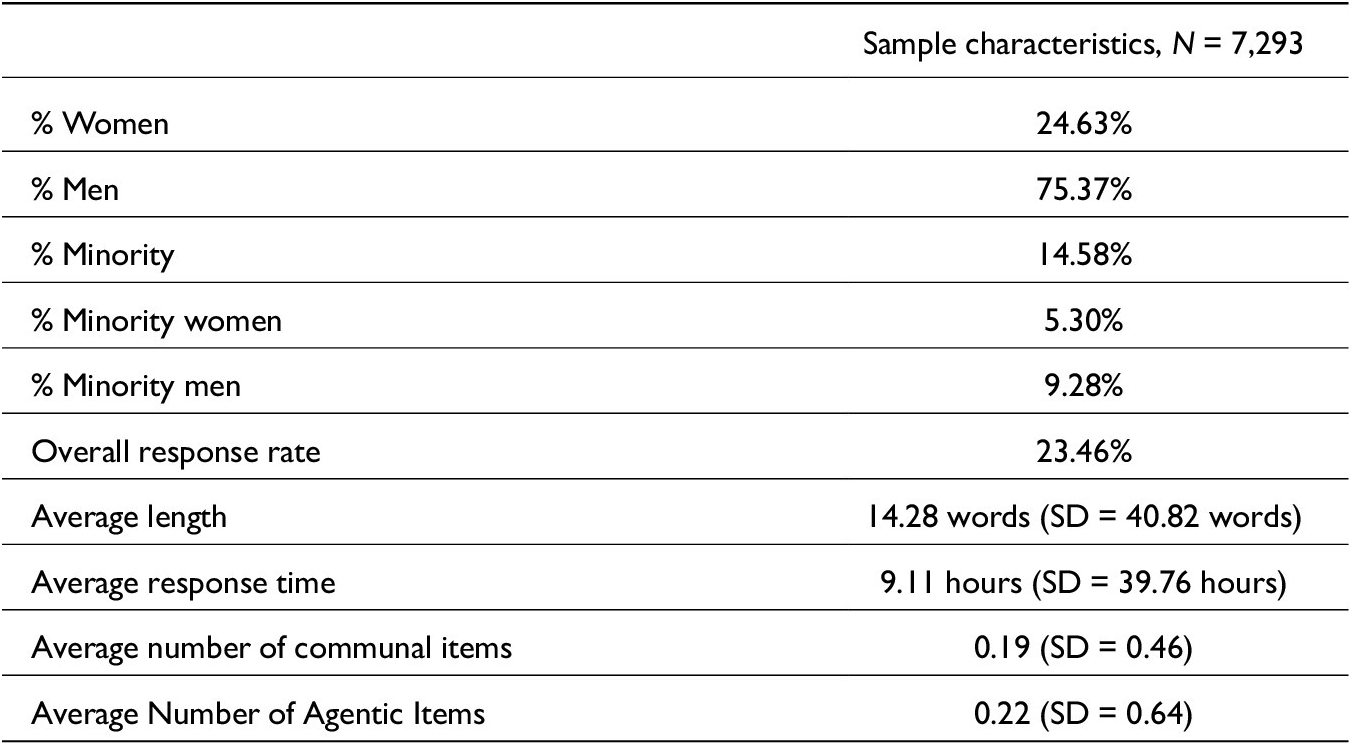
Our first set of analyses use three main outcome variables to test our responsiveness prediction. First, we recorded whether a lawmaker provided a substantive response, rather than an automated response, to the email communication. The substantive response variable is dichotomous, with 1 meaning that the legislator provided a substantial reply. This is our main response variable in our preregistration document (see Appendix 2). We also recorded two additional outcome variables, though these outcomes were not preregistered, and we use them for exploratory analyses. Second, we recorded the length, in number of words, of the substantive response. The word count variable excludes spaces and extraneous text such as email signatures and includes only the original response provided in the main body of the email. Third, we recorded the length of time, in number of hours, it took the lawmaker to respond as a continuous variable. The time variable is constructed based on the time when each email was sent to each legislator and when we received a response as we did not send all the emails on the same day or at the same time. We compiled descriptive data of characteristics of state legislators (e.g., race, gender) and summary statistics of our three key outcome variables in Table 1.
Key characteristics of state legislators, data collection, fall 2017

Note: The descriptive data on our outcome variables is based on the whole sample of state legislators and not just those who responded.
We developed a coding instrument capturing the communal and agentic ways that lawmakers engage with constituents. Communal messaging strategies reinforce caregiving and supportive social roles that value the interpersonal relationships between people (Eagly and Karau Reference Eagly and Karau2002). We developed five components of communal communication styles: (1) community focus, (2) interpersonal connections, (3) discussions of children and family, (4) inclusive problem-solving, and (5) displays of empathy. For example, one legislator wrote in response to our message, “Thank you for writing to me about the condition of our roads, as a daily commuter I could not agree more.” The communication creates a sense of shared experience and a bond between the letter writer and the representative. We created a communal measure that records the number of communal items a legislator used in their message and a dichotomous variable coded as 1 for whether a legislator used one or more communal strategy.
An agentic style of communication highlights a single person as a powerful actor and places less emphasis on collaborative relationships between people (Vinkenburg et al. Reference Vinkenburg, van Engen, Eagly and Johannesen-Schmidt2011). We identified five components of an agentic style: (1) focus on the individual lawmaker over the collective, (2) passing the problem, (3) credit claiming, (4) inward-focused problem-solving, and (5) putting distance between the lawmaker and the letter writer. For example, many lawmakers suggested that the letter writer contact other offices, such as the state department of transportation, without providing names or contact information for who exactly to contact. This strategy consolidates the power of the legislator but shows that the legislator is opting not to use that power to help constituents resolve their concerns. Table A11 in Appendix 5 outlines how we coded each email response for communal and agentic items. We created an agentic measure that records the number of agentic items a legislator used in their message and a dichotomous variable coded as 1 for whether a legislator used one or more agentic strategy.
Differences in Legislator Responsiveness
To determine whether female and male lawmakers, all else being equal, differ in responsiveness, we estimated a series of regression models using a coarsened exact matching (CEM) technique. The CEM method allows us to test differences in the responsiveness of female and male lawmakers who are equitable across key characteristics (Iacus, King, and Porro Reference Iacus, King and Porro2012). We matched based on several characteristics, including the number of years a lawmaker had served in office, the chamber that a legislator served in (upper or lower), and a state legislature’s professionalism, as these are likely to affect whether a lawmaker has the electoral motivation and resources necessary to be highly responsive to constituent communication. There are 147 unmatched legislators. We use the weights produced from the matching procedure to analyze the likelihood of receiving a substantive response and the length of the substantive message. Our models also control for gender, whether a staff member provided the response,Footnote 4 partisanship, the race of the legislator, region, the percentage of people of color in the district, and the vote share that a legislator received in the last election. We clustered the errors at the state level to control for any unobserved heterogeneity.
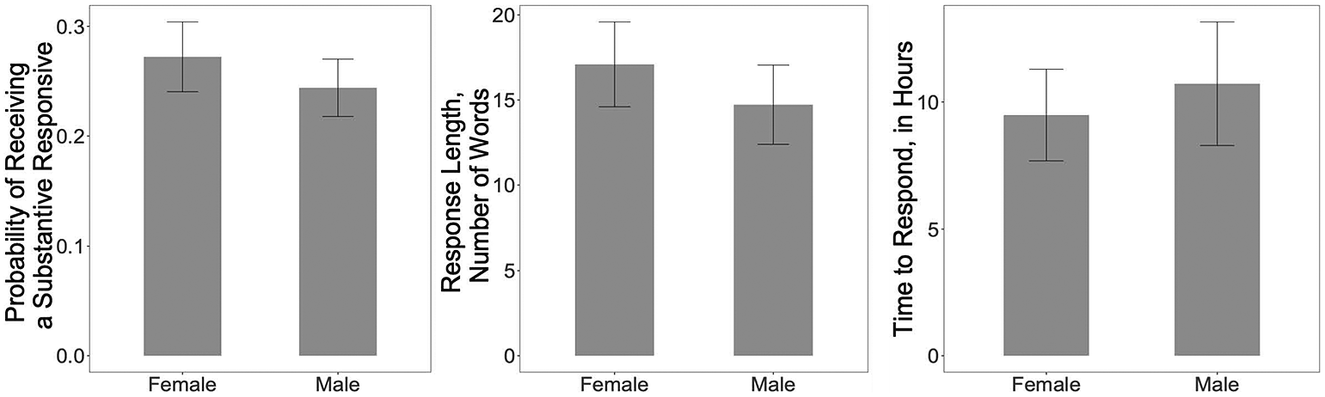
Figure 1 displays predicted values based on lawmaker sex for our three major outcomes: the probability of receiving a substantive response, the response length in number of words, and the time it took a lawmaker to respond in number of hours. We report the full set of results in Appendix 4, Tables A5 and A6. Starting with the probability of receiving a substantive response, the variable for legislator sex is statistically significant and positive. The predicted probability of a female lawmaker responding to a constituent is 27.22%, while the predicted probability of a male legislator responding is 24.40%, p < .003. This 2.58% difference fits with our expectation that female lawmakers will have a higher level of responsiveness relative to their male counterparts. We suggest that this level of responsiveness comes from the pressure to overcome biases among voters that female lawmakers are not effective legislators. Additionally, it is important to note that female politicians are contacted more by voters (Butler, Naurin, and Öhberg Reference Butler, Naurin and Öhberg2022). While we cannot directly know with absolute certainty that women respond more because of voter pressure without being able to ask women and receive nonbiased responses, the patterns we find fit our theoretical expectations. These differences in responsiveness between women and men can have substantial effects. A 3% difference in responsiveness means that legislators potentially are not responding to hundreds, possibly thousands, of constituent emails about a variety of issues beyond bad roads. Constituents writing their legislator about government services they need, such as the elderly or veterans, are, based on these results, more likely to receive a response from a female lawmaker and not a male lawmaker. This difference in responsiveness can substantially affect the quality of representation constituents receive, perceptions of political efficacy, and how motivated a constituent is to participate in politics more broadly.Footnote 5
Differences in responsiveness across legislator sex. 95% confidence intervals included. The first panel displays the predicted probability of a response for women and men. The second panel displays the estimated response length for women and men in number of words. The third panel is the estimated time to respond for women and men in number of hours.

Figure 1 shows the results of our two additional outcomes: response length and time to respond. To estimate differences in the length of the response provided by a lawmaker we use the word count variable. We use an ordinary least squares model with the CEM weights to estimate differences across candidate sex. The predicted length of a woman’s response was 17.09 words (SE = 1.27), while the predicted length of a man’s response was 14.72 words. (SE = 1.19). The responses from women were 2.37 words longer than the responses from male legislators, and this is a statistically significant difference, p = .017. While 2.37 words seems like a small difference, this longer response from women can result in providing more helpful information to constituents.
Our third key outcome variable tracks the time it took the legislator to respond to the email message. The final panel of Figure 1 shows no significant differences in the overall effect of legislator sex on the response time, p = .323. We also estimated a Cox proportional hazards models since our dependent variable is a time outcome, and these results are consistent with our findings in Figure 1. While we do not find that women respond any quicker than men, there may be nuances in how legislators manage their email. For example, a legislator may only check their email in the morning or on certain days. Our data cannot account for these individual nuances, which could affect the timeliness with which people are likely to get a response from their legislator. These results are reported in Appendix 4, Table A6.
Our first set of analyses shows that female legislators are, in line with our hypothesis, more responsive and they write slightly longer responses, but they do not respond more quickly than their male counterparts. We tested how gendered pressures might lead to higher response rates by reestimating our models with an interaction between female legislators and vote share received in the last election. The logic is that female legislators receiving a smaller share of the vote in their district will be more responsive compared to female legislators receiving a higher share of the vote. We included these models in Appendix 4, Table A7. We find no significant effect of vote share. We also tested differences in responsiveness by estimating separate models for upper and lower house chambers (see Appendix 6, Table A15) and find that women are responsive in both upper and lower chambers, but women in upper chambers take longer to respond than men.
The Intersection of Race and Sex in Constituent Communication
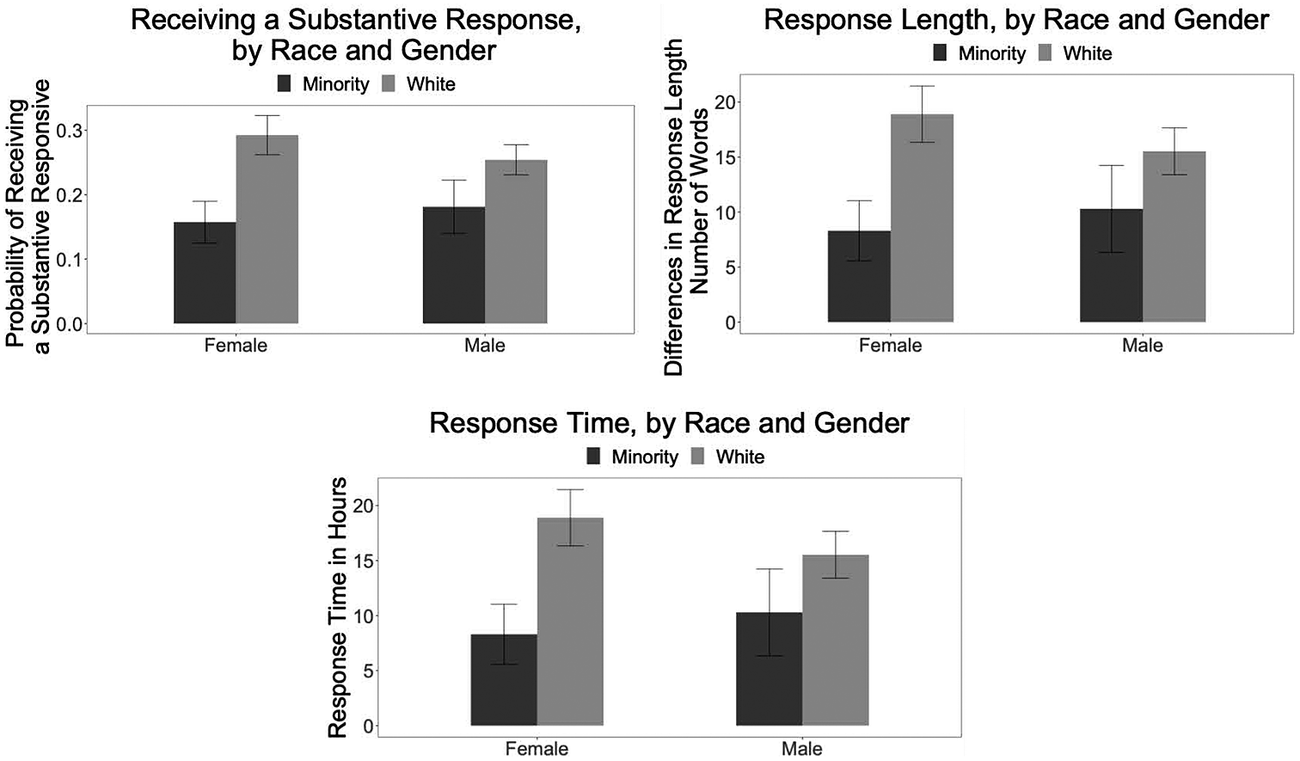
Next, we replicated our analytical strategy from the previous section, but we included an interaction between lawmaker sex and lawmaker race. Our models include the same set of controls used in the first part of the analysis. The key interaction between legislator race/ethnicity and sex only reaches significance in the likelihood of receiving a substantive response model and the effect is in the negative direction—which is not in line with our intersectionality prediction. We calculated the marginal effects of legislator race/ethnicity on the difference in the predicted probability of receiving a substantive response between White women and women of color. Figure 2 displays these marginal effects for our key outcome variables (see Appendix 4, Table A8 for the full models).
Differences in responsiveness based on legislator gender and race. 95% confidence intervals displayed.

We find that the predicted probability of a female lawmaker of color responding to constituent communication is 0.13, or 13%, less than the predicted probability of receiving a response from a White female lawmaker, p < .001. Male lawmakers of color are also less likely to respond to constituent communication relative to their White male counterparts, and there is no difference in the probability of response between a woman and a man of color. We find that White women write responses that are approximately 10.60 words (SE = 2.45) longer than non-White women, p < .001, and White women also write longer responses than White men, differing by 3.38 words (SE = 1.20), p = .004. Comparing women of color and men of color shows no differences in the length of the responses, p = .338. Again, we find no differences based on the race/ethnicity and sex of the lawmaker in response length or time.Footnote 6
To further examine why women of color were not any more responsive than White women, we estimated a series of models with three-way interactions between legislator race, gender, and representing a minority-majority district, region of the country the legislator worked in, levels of professionalism, Democratic partisanship, Republican partisanship, and the vote proportion the legislator received in their last election on our substantive response variable (see Appendix 4, Table A10 for the full models). We find few consistent patterns to account for why women of color respond less frequently, but we do find a significant negative effect for professionalism. This fits with our expectation that legislators of color in less professional legislatures, such as those in the South, likely have fewer resources to use for constituent engagement. As previously noted, elected women of color are driven to enter politics because of a commitment to their communities (Brown Reference Brown2014; Fraga et al. Reference Fraga, Lopez, Martinez-Ebers and Ramirez2006; Garcia-Marques, Santos, and Mackie Reference Garcia-Marques, Santos and Mackie2006); this may also drive them to prefer more personal means of communication with constituents. It may not be the case that a woman lawmaker of color does not read constituent email or is unaware of the constituent’s issues; instead it may be that these politicians prefer to respond through different avenues besides email.
A Gendered Style of Communication
Our communication style prediction argued that women would display more communality in their responses to constituents relative to men. We include the full results in Appendix 5, Table A12 and summarize the key findings here. The predicted probability that a female lawmaker engages in communality is 0.19 (SE = 0.009), and the predicted probability for a male lawmaker is 0.17 (SE = 0.005); this difference is statistically significant, p < .001. These patterns fit with our expectations that women will engage in a more communal style of communication.Footnote 7 We do find, contrary to our expectations, that female legislators employ more agentic communication strategies relative to their male counterparts. The predicted probability of a female lawmaker using an agentic strategy is 0.16 (SE = 0.009), and for a male lawmaker, it is 0.13 (SE = 0.004); this difference is statistically significant, p = .007. Comparing the 0.19 (SE = 0.009) probability of a communal response from a woman to the 0.15 (SE = 0.008) probability of an agentic response shows a significant difference, p = .003, which fits with our argument that female lawmakers are more likely to use a communal strategy to develop close ties with their constituents. The use of both communal and agentic strategies among women fits with other work on how women manage the double bind created by gender stereotypes (Bast, Oschatz, and Renner Reference Bast, Oschatz and Renner2022; Bauer and Santia Reference Bauer and Santia2021).
Finally, we estimated the predicted probability of using a communal style of communication with an interaction between race and gender. We find that White women are more likely to use a communal communication style at a 0.21 (SE = 0.010) probability, which is considerably higher than the probability of women of color using this strategy at 0.11 (SE = 0.016); this is a statistically significant difference, p < .001. While we cannot be certain why these differences in gendered styles occur across the race, they may be due to the lower overall response rate from non-White women. Another explanation is that women of color may have more demands on their time in terms of service requests from constitutions that put more demands on their time (see, e.g., Butler, Naurin, and Öhberg Reference Butler, Naurin and Öhberg2022; Lowande, Ritchie, and Lauterbach Reference Lowande, Ritchie and Lauterbach2019).
Female Lawmakers and Their Effect on Responsiveness
Next, we test whether highly responsive female legislators have the potential to change the behavior of male legislators by creating a new institutional norm of increased constituent responsiveness. We created a series of response rate variables that record the proportion of women and men in a legislative chamber, the upper and lower separately, who responded to our message. We then divided the number of female and male lawmakers who responded relative to the total number of women and men in that legislative chamber. We separated our analyses by legislative chamber because it is more likely legislative norms are similar within but not necessarily across chambers. We predict that women’s responsiveness in state legislatures will increase how male lawmakers engage in representation. Comparing the effect of responsive women on men and responsive men on women allows us to get at the imprecise causal mechanisms behind legislative responsiveness in a legislature that we cannot directly test.
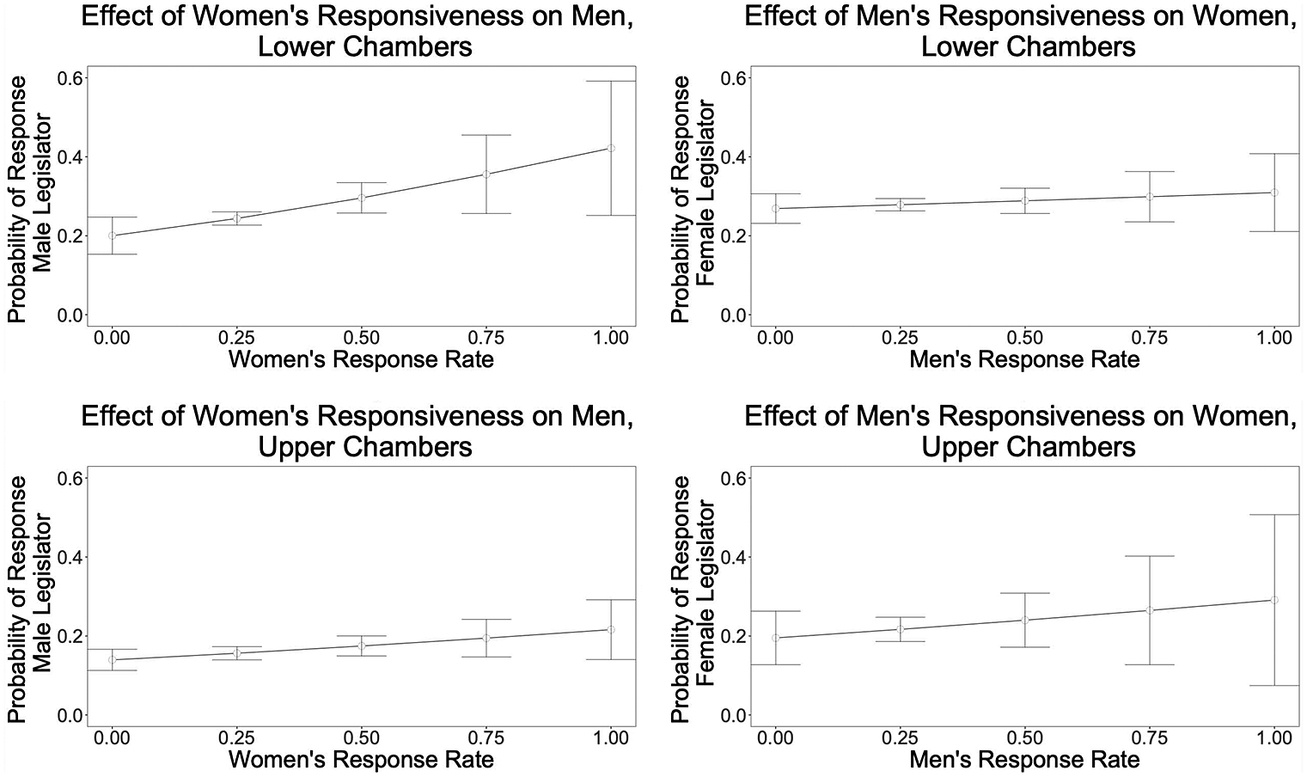
We estimated logit models for the lower and upper chambers of a legislature predicting the probability of receiving a substantive response from a lawmaker based on the response rate of female lawmakers and male lawmakers. We included two-way interactions between both our female and male response rate variables and legislator sex and an extensive set of controls (see Appendix 6, Table A14). We estimated the marginal effect of the response rate of women on the probability of receiving a substantive response from a male lawmaker. We also estimated the marginal effect of the response rate of men on the probability of receiving a substantive response from a female lawmaker. If our prediction is correct, we should see that as the responsiveness of women increases the probability of receiving a substantive response from a male lawmaker also increases. Figure 3 displays the results.
Effect of women and men’s response rates on the probability of receiving a substantive response from a lawmaker of the opposite sex. 95% confidence intervals displayed. The two left panels show the effect of women’s responsiveness, calculated through the response rate of women in a legislative chamber, on the probability of receiving a substantive response from a male lawmaker. The two right panels show the effect of men’s responsiveness, calculated through the response rate of men in a legislative chamber, on the probability of receiving a substantive response from a female lawmaker. The top two panels show results from the lower houses of state legislative chambers and the bottom two panels show the results from the upper houses of state legislative chambers.

We find that the response rate among female lawmakers increases the probability of receiving a substantive response from a male lawmaker, which is in line with our prediction—but this positive effect occurs most prominently in the lower chamber rather than the upper chamber. The top panels of Figure 3 show the effect of responsive women in the lower chamber of state legislatures, which shows that as women’s responsiveness increases from 0% to a perfect 100% response rate, the probability of receiving a substantive response from a male lawmaker increases nearly 22%, p < .001. When women’s response rate in the lower chamber of a state legislature is 25%, the probability of receiving a substantive response from a male lawmaker in that chamber is 24%, but when women’s responsiveness increases to 75%, the probability of receiving a substantive response from a male lawmaker increases to 36%, p < .10. Men’s responsiveness in the lower chamber of a state legislature does not have a similar effect on women’s responsiveness, as seen by the relatively flat line in the top right panel of Figure 3. While our analyses suggest that the causal direction of influence is from women to men, we cannot definitively rule out other causal processes with our data.
The effects of women’s responsiveness on men suggests a slightly different pattern when looking at the panels for the upper house of a state legislature (see the two bottom panels of Figure 3). A higher response rate among women in the upper chamber increases the probability of receiving a substantive response among men by about 8% moving from a zero response rate to a perfect response rate among women, p < .10 (bottom-left panel of Figure 3). This effect is consistent with the lower chamber results, but it is significantly smaller. In the upper chamber, a higher response rate among men has a positive and significant effect on the responsiveness of women in the state legislature (bottom-right panel of Figure 3). As men’s responsiveness increases from zero to 100%, the probability of receiving a substantive response among women increases by approximately 10%, but the statistical significance of this effect is not any different relative to the effect of men’s responsiveness at lower rates.
Results Summary
Our analyses uncovered four key findings. First, female lawmakers are more responsive to constituent communication relative to male lawmakers. Second, we find that women of color do not engage in constituent communication through email in the same way as White women. Third, we find that female lawmakers compared to male lawmakers engage in a communal style of communication. Fourth, when female lawmakers are highly responsive, male lawmakers are also more responsive in a legislature.
Discussion
Our research proposes and tests the presence of a feminine homestyle for women legislators that emerges in the way these legislators approach the task of constituent communication. We argued and showed that the gendered biases that women face in elections coupled with the communal motivations that compel women to run for political office will increase women’s responsiveness to constituent communication and that women will display more communality in their responses. The responsiveness of female lawmakers has important downstream implications for democratic accountability. Female elected officials bring a different leadership style and perspective to the table (Holman and Perkins Reference Holman, Perkins and Craybill2017; Rosenthal Reference Rosenthal1998; Volden, Wiseman, and Wittmer Reference Volden, Wiseman and Wittmer2013). For female citizens, this rapport can work in their favor because constituents will feel a higher sense of political efficacy and can increase citizen trust in the democratic system. Citizens value the constituent case work that lawmakers perform (Wolak Reference Wolak2017), and responsiveness can be particularly important for women because experimental work suggests they are punished for not responding quickly (Costa Reference Costa2021). Through constituent communication, female lawmakers are not only protecting themselves from gender bias, their responsiveness can lead citizens to view government more positively.
A striking finding from our research is that we did not find higher levels of legislative responsiveness among women of color. We argue this may be due to the way women of color prefer to engage with their constituents. Many female legislators of color represent minority-majority districts or areas where no one group of voters holds a majority and thus form multiracial voting coalitions (Bejarano Reference Bejarano, Brown and Gershon2016). Furthermore, these districts can afford them a unique sense of electoral safety that White female legislators do not experience (Tate Reference Tate2018). The power of descriptive representation can be strong in communities who have been traditionally underrepresented (Grose Reference Grose2010). Women of color may be active members of their communities engaging with citizens at church gatherings, town hall meetings, or going door to door to talk to constituents (Hardy-Fanta Reference Hardy-Fanta1993). Another factor to consider is the effect of the level of professionalization of the state legislature because this can lead to less resources, such as staff, and time to respond. For instance, there are many women of color who serve in Southern states, such as Alabama, Mississippi, or Texas. These are states with lower levels of legislative professionalization, and this could predict a lower likelihood of receiving a response. Lastly, it cannot be ignored that a digital divide exists, and unfortunately communities of color are on the losing side of it (Sanders and Scanlon Reference Sanders and Scanlon2021). Furthermore, making it possible that these female lawmakers of color, aware of this inequity, must engage constituents in other accessible ways.
It is important to note that we conducted our study in the winter of 2017–18. We followed the recommended best practices for using public officials as experimental subjects that were available at the time of our data collection. Were we to conduct our study today we would likely approach contacting the public officials differently using, for example, a post-briefing email as opposed to a pre-briefing email. As we noted earlier in our Data Collection section, the pre-briefing message and our message to state legislators were spaced out to lessen/get rid of any priming effects of our treatment. While we worked to limit deception and adhere to strong ethical practices, there is some risk that legislators limited their constituent communication after receiving our pre-briefing email. Studies using public officials must always weigh the risks associated with undermining trust in scientific research with the broader benefits to understanding systems of democratic accountability. There are also important limitations to our ability to measure all the causal processes at play. Each legislator has their own set of practices that guide how they run their office including responses to constituent communication. Our data cannot account for all these idiosyncratic factors. It is possible that women of different racial and ethnic backgrounds engage in different communication styles from one another (Bejarano and Smooth Reference Bejarano and Smooth2022; Gonzalez and Bauer Reference Gonzalez and Bauer2022; Greene, Matos, and Sanbonmatsu Reference Greene, Matos and Sanbonmatsu2021). Future work should do more to follow-up on our research to study how women vary in their homestyles across racial and ethnic minority groups.
We argue that responsiveness to constituent communication matters for the electoral success of female lawmakers. It is also the case that a more feminine homestyle matters for democratic legitimacy and accountability. High levels of legislative responsiveness can not only increase democratic legitimacy and accountability but also reshape the way that citizens think about women in political leadership. While having more women in political office ensures that people become more accustomed to thinking about them as politicians, it is also the case that their effectiveness as representatives serves an important end. Citizens with positive views and interactions with female lawmakers may be more likely to see women as effective political actors and be more likely to support women running for political office at the state and the national levels as well.
Supplementary material
The supplementary material for this article can be found at http://doi.org/10.1017/S1743923X23000259.
Acknowledgments
The authors are grateful to Katey Stauffer and Matthew Hayes, who read very, very early drafts of this article. We are also grateful to participants at the Sub-National Politics Conference for their helpful feedback.
Competing interest
The authors have no competing interests or conflicts of interest.