Introduction
The increased resistance of horse nematodes to anthelmintic drugs (Kaplan, Reference Kaplan2002) is a worldwide concern. The use of uncritical anthelmintic treatment strategies rather than evidence-based treatments may partly explain why reports of resistance appear to be increasing (Kaplan & Nielsen, Reference Kaplan and Nielsen2010). Recent studies from Finland and Sweden indicate that horse nematodes may possess resistance to ivermectin and pyrantel (Lindgren et al., Reference Lindgren, Ljungvall, Nilsson, Ljungström, Lindahl and Höglund2008; Näreaho et al., Reference Näreaho, Vainio and Oksanen2011). Estonia is estimated to have a horse population of 10,000 individuals (Kollom, Estonian Animal Recording Centre, pers. comm.) and these horses travel widely, but little information is available from the Baltic region about anthelmintic resistance. Thus, we designed a study to investigate the possible resistance to ivermectin and pyrantel of Parascaris equorum and strongyles in Estonian trotting and riding horses.
Materials and methods
Parasitological procedures
For inclusion in this study stables had to have a minimum of five horses aged < 3 years. The subjects included trotting horses from two stables in Tallinn county and riding horses from two stables in Viljandi country. In total, there were 41 horses, i.e. 23 females and 18 males, and their owners consented to their participation in the study. The mean age of horses was 1.9 ± 1.0 years. The study design was based on methods described by Näreaho et al. (Reference Näreaho, Vainio and Oksanen2011), except licensed anthelmintic products available in Estonia were used. Three visits to the stables were conducted during September and October 2012 to collect faecal samples for quantitative flotation analysis using the modified McMaster method (Saari & Nikander, Reference Saari and Nikander2009): first, to establish the presence of nematodes in the faeces of included horses; second to treat animals with egg counts per gram faeces (EPG) >200; and, third, to evaluate the efficacy of the drugs using a faecal egg count reduction test (FECRT). Anthelmintic drugs were given to 13 trotting horses and 19 riding horses. Oral administration of 19 mg/kg pyrantel embonate (Embotape, Bimeda Chemicals Export, Ireland) was provided if strongyle-type eggs were detected and 200 μg/kg ivermectin (Bimectin, Bimeda Chemicals Export) was provided if the sample was positive for P. equorum eggs. The weight of each horse was estimated with a girth tape (Equimax girth tape, Virbac, Orion Pharma, Espoo, Finland) using the formula: weight = (girth (cm)2× length (cm))/11,877. Resistance to ivermectin was defined as FECRT < 95%, and resistance to pyrantel as FECRT < 90% (Kaplan & Nielsen, Reference Kaplan and Nielsen2010). Larval cultures were not attempted.
Horse owners in Estonia were invited to answer an online questionnaire about the use of anthelmintic drugs in their horses. The questions addressed the decision-making process, treatment frequency, drug preferences, drug rotation, evaluation of the weight of horses, administration practices and use of faecal egg counts.
Data analysis
OpenEpi 2.3.1 (http://www.openepi.com/) was used to perform the statistical analysis. The mid-P exact test method was used to estimate the proportions, and chi-squared tests were employed to detect significant differences between proportions and sample means.
Results and discussion
Up to 32 horses with an EPG >200 received anthelmintic treatments and 19% were found to be infected with P. equorum with a mean EPG of 2766 ± 1933. These horses were orally given ivermectin paste during their second visit. Strongyle-type eggs were detected in 81% of horses with a median EPG of 3904 ± 3479. Pyrantel paste was administered to these horses per os. All horses that shed P. equorum eggs and were treated with ivermectin also shed strongyle-type eggs. The mean body weight of horses treated with ivermectin was 373.5 kg ± 121.4, and that of horses treated with pyrantel was 375.0 kg ± 132.9.
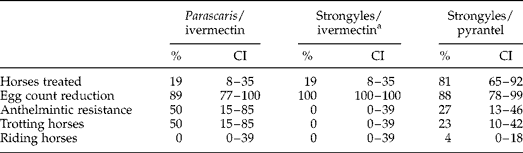
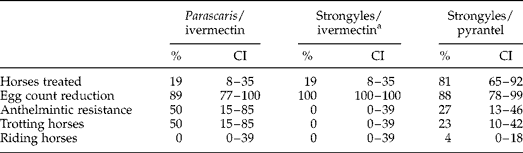
The results should be interpreted with caution because a small number of horses participated in the study. Traversa et al. (Reference Traversa, von Samson-Himmelstjerna, Demeler, Milillo, Schürmann, Barnes, Otranto, Perrucci, Frangipane di Regalbono, Beraldo, Boeckh and Cobb2009) established criteria for actual resistance as the group mean FECRT >90% and a lower confidence limit (LCL) < 90%, with suspected resistance as FECRT ≥ 90% and/or LCL < 90%. According to these criteria and the criteria proposed by Kaplan & Nielsen (Reference Kaplan and Nielsen2010), P. equorum exhibited resistance to ivermectin and strongyles were resistant to pyrantel despite the low sample number. The resistance to ivermectin in P. equorum was observed in three 2-year-old trotting horses from the same stable (table 1). The low number of horses treated with ivermectin means that further studies are required with more horses to confirm resistance, but our results should be considered as an early indication of a potential problem. These results are not significantly different compared with observations of trotting foals in Finland by Näreaho et al. (Reference Näreaho, Vainio and Oksanen2011), where the low number of subjects that satisfied the treatment protocol resulted in a high level of uncertainty. Strongyles exhibited resistance to pyrantel in both trotting and riding horses, whereas no resistance to ivermectin was detected (table 1). In the Finnish study, anthelmintic resistance occurred in 79% of trotting foals, whereas resistance affected significantly less (P< 0.001) of the strongyles that parasitized Estonian horses in the present study. In contrast, other European studies have reported that resistance to pyrantel is uncommon in strongyles (Vyšniauskas et al., Reference Vyšniauskas, Kaziūnaitė, Kaminskaitė, Petkevičius and Craven2004; Osterman Lind et al., Reference Osterman Lind, Kuzmina, Uggla, Waller and Höglund2007; Lindgren et al., Reference Lindgren, Ljungvall, Nilsson, Ljungström, Lindahl and Höglund2008; Traversa et al., Reference Traversa, von Samson-Himmelstjerna, Demeler, Milillo, Schürmann, Barnes, Otranto, Perrucci, Frangipane di Regalbono, Beraldo, Boeckh and Cobb2009; Larsen et al., Reference Larsen, Ritz, Petersen and Nielsen2011).
Efficacy (%), with 95% confidence intervals (CI), of anthelmintic treatments of intestinal nematodes in 32 Estonian horses.
a Co-infection with Parascaris equorum.
We detected ivermectin-resistant parasites in trotting horses from one stable. Pyrantel resistance was observed mainly in trotting horses aged < 1 year (n= 1), 1 year (n= 3) and 3 years (n= 3) in three of the four stables visited. The difference in resistance between trotting and riding horses (χ2= 14.7, P< 0.001) may be attributed to the different roles of the horse as racehorse or for hobby riding, where the treatments were administered to suit specific purposes. The value of a fit trotting horse may promote more intensive anthelmintic treatment practice, thereby resulting in greater resistance if the effectiveness is not continuously verified. Previous studies have examined the differences in anthelmintic practices between different types of horse farms and owners. For example, Lloyd et al. (Reference Lloyd, Smith, Connan, Hatcher, Hedges, Humphrey and Jones2000) found that private owners were not affected by the price of anthelmintics when considering their treatment options, whereas Fritzen et al. (Reference Fritzen, Rohn, Schnieder and von Samson-Himmelstjerna2010) reported that different treatment strategies and other factors promoted resistance to treatments in studs, riding farms and smallholdings.
In the present study, larval cultures were not attempted to differentiate the parasites at the species level. At present, pathogenic Strongylus spp. are considered to be a minor threat to horses in Europe compared with cyathostomins, which exhibit increasing resistance to benzimidazoles, pyrantel/morantel and ivermectin (Traversa et al., Reference Traversa, von Samson-Himmelstjerna, Demeler, Milillo, Schürmann, Barnes, Otranto, Perrucci, Frangipane di Regalbono, Beraldo, Boeckh and Cobb2009). It is reasonable to assume that the situation in Estonia is similar to that in other countries in the area, such as Finland and Sweden, because anthelmintic treatments are used widely in Estonia. In these countries, cyathostomins are considered to be of clinical importance, whereas Strongylus spp. are rare due to a long tradition of periodic anthelmintic treatments (Osterman Lind et al., Reference Osterman Lind, Kuzmina, Uggla, Waller and Höglund2007; Näreaho et al., Reference Näreaho, Vainio and Oksanen2011).
Higher EPG levels were detected in the Estonian horses before treatment (median: 1688, maximum: 7219) compared with those reported in the Finnish study by Näreaho et al. (Reference Näreaho, Vainio and Oksanen2011), who found up to 2500 EPG faeces. Two horses that were treated with pyrantel shed higher EPG levels after treatment compared with their levels before treatment, which indicated that the drug had no effect on reducing the egg-producing worm population in these horses. Both horses had EPG >5000 during the first visit, and the negative FERCT is likely to represent actual resistance to pyrantel. This indicates high environmental contamination and the need for evidence-based treatments to demonstrate the efficacy of the treatment strategy selected.
In the present study, the weight measurements, dose calculations and administration of anthelmintics were performed by the same person, who was a veterinary student. The protocol was verified by several licensed veterinarians as correct and ethically sound. Efforts were made to ensure that accurate evaluations of weights were obtained in the absence of portable electronic scales, to facilitate the provision of the correct doses specified by the manufacturers. According to the 67 owners who answered our questionnaire about the use of anthelmintics, the treatment plan was usually designed by themselves (40%), veterinarians (34%) or others (25%). The owners usually administered the drugs themselves (64%), but treatments were provided less often by the stable owners (15%), stable workers (8%), grooms (3%), veterinarians (3%) or other people (8%). The weights of horses were evaluated using scales (46%), by eye (28%), measuring with a girth tape (19%) or by asking another person for their opinion (6%). Scales are uncommon in Estonian stables. Thus, we consider that some, or even the majority, of the owners may have misunderstood the question where they interpreted it as meaning ‘scaling’ the horse without additional equipment. Given this possible bias and other responses about the methods used to estimate body weights, it appears that this practice may be a cause of the incorrect dosage of anthelmintics. Rotation between different anthelmintics was practised throughout the year by 69% of owners, occasionally by 28% and never by 3%. The owners reported that the anthelmintics they used included ivermectin (39%), ivermectin and praziquantel (39%), pyrantel (31%), moxidectin (18%) and fenbendazole (15%). The rotation of frequently used drugs appeared to favour the selection of ivermectin, ivermectic/praziquantel and pyrantel. The use of anthelmintics mainly occurred twice a year (47%), followed by three (20%), four (20%) and more than four times a year (14%). The use of faecal egg counts for diagnosis was known by 79%, but was only used rarely (54%), occasionally (40%) or not at all (6%). Thus, it appears that anthelmintic treatments are used widely by horse owners, but evidence-based methods, such as those based on faecal egg counts, appear to be employed rarely in Estonia. Faecal examinations mentioned in the questionnaires are likely to comprise simple flotation in most cases because quantitative flotation is not used widely in Estonia.
This study provides the first evidence of resistance to pyrantel in Estonia. Thus, there is a need for the stronger promotion of evidence-based treatment plans, the use of FECRTs and further studies to investigate the helminth species that infect horses. Future studies should include more horses to confirm resistance to ivermectin, which was suggested in the present study.
Acknowledgements
We thank Reet Herm, Seppo Saari, Toomas Orro, Anu Näreaho, Pikka Jokelainen and Triin Lepik for their assistance, as well as the horse owners for allowing their horses to be involved in the study and for completing the questionnaire.
Financial support
Funding was provided by Base Financing Science Theme grant 8-2/T9001VLVL and ETF9433 from the Estonian Science Foundation.
Conflict of interest
None.