Introduction
As the world ages, the number of individuals with dementia increases (Ferri et al., Reference Ferri2006; Doron, Reference Doron, Foster, Herring and Doron2014). People with dementia, like other older individuals, have legal rights and concerns and face unique issues and challenges. They may appear before courts in different roles: as victims, as witnesses, and as persons standing up for their rights and they can do so either on their own or through their representative decision-makers/guardians. Moreover, as members of a unique group within the older population, their rights have received increased attention within the global process of establishing a new binding international instrument for the advancement of older persons’ rights (Doron and Apater, Reference Doron and Apter2010; Kelly and Innes, Reference Kelly and Innes2013).
However, despite growing interest in the legal aspects of the rights and inter-relations between dementia and the law, very little empirical data have been collected or analyzed in this field. While much of the literature has comprised theoretical discourse on ethical-legal issues (e.g. Welsh et al., Reference Welsh, Hassiotis, O'mahoney and Deahl2003; Monaghan and Begley, Reference Monaghan and Begley2004; O'Neill and Peisah, Reference O'Neill and Peisah2011), there are currently no empirical studies that map the real contexts in which persons with dementia interact with the courts. Therefore, the goal of this study is to fill this gap by providing a first-of-its-kind, empirical map of the field. This mapping might reveal new key areas of the law that have not been studied or explored with regards to the roles that the law and the courts play in the lives of persons with dementia.
Literature review
Dementia and aging
Dementia is a clinical syndrome characterized by an acquired impairment of memory and cognition (Román, Reference Román2002). The overarching concept of dementia is comprehensive, with diverse clinical profiles and courses, although Alzheimer's disease (AD) is the most common type (75% of cases) (Peng, Reference Peng2003; Prince and Jackson, Reference Prince and Jackson2009). The dramatic demographic changes in recent years have had many medico-socio-economic consequences, some of which directly relate to dementia (Estes, Reference Estes2001). Indeed, recent epidemiological studies have estimated that the global prevalence of AD will rise from 27 million cases in 2006–66 million and 115 million in 2030 and 2050, respectively (Brookmeyer et al., Reference Brookmeyer, Johnson, Ziegler-Graham and Arrighi2007). Because the prevalence of dementia increases with age and the population is aging, there will be an increasing number of cases involving individuals with suspected or diagnosed dementia (Lee and Krishnan, Reference Lee and Krishnan2010). These significant changes will be accompanied by an increasing number of legal cases involving persons with dementia.
Law and dementia
Indeed, the last two decades were characterized by increasing interest in the field of law and dementia (Foster et al., Reference Foster, Herring and Doron2014). The diverse literature in this field can be divided into three main categories as follows:
-
1. Specific scholarly articles and studies on law and dementia. This category of literature usually focuses on the rights of people with dementia (Boyle, Reference Boyle2008, Reference Boyle2010; Manthrope et al., Reference Manthrope, Samsi and Rapaport2012), such as their right to receive appropriate socio-medical care (Kapp, Reference Kapp2008), as well as to autonomy, dignity, and personhood (Doron and Foster, Reference Doron and Foster2016; Mäki-Petäjä-Leinonen, Reference Mäki-Petäjä-Leinonen, Griffiths, Mustasaari and Mäki-Petäjä-Leinonen2016).
-
2. Broader studies on issues of legal competence and/or legal capacity (its definition, assessment, and relevance to particular legal contexts and within particular jurisdictions), including discussions on dementia as an example of a situation that can lead to legal incapacity. This category is broader in its scope and addresses legal concerns surrounding persons with dementia within the legal context of “capacity” (e.g. Shulman et al., Reference Shulman, Peisah, Jacoby, Heinik and Finkel2009; Jacoby, Reference Jacoby, Ames, Burns and O'Brien2010; Liptzin et al., Reference Liptzin, Peisah, Shulman and Finkel2010; O'Neill and Peisah, Reference O'Neill and Peisah2011), “competence” (e.g. Marson et al., Reference Marson, Ingram, Cody and Harrell1995) and “consent” (e.g. Fellows, Reference Fellows1998). This body of research also addresses the experiences of persons with dementia in the context of the legal experiences of adults with disabilities in general (e.g. McLeod et al., Reference McLeod, Philpin, Sweeting, Joyce and Evans2010).
-
3. General studies and scholarly articles on legal protections for at-risk adult populations, where persons with dementia are considered at-risk. For example, the presence versus the absence of dementia, and AD play important roles in the context of guardianship proceedings and interventions by Adult Protective Services (e.g. Kane, Reference Kane2001; Kapp, Reference Kapp2003).
It should also be noted that a significant conceptual development in the legal debate surrounding the rights of individuals with dementia occurred after the enactment of the UN International Convention on the Rights of Persons with Disabilities (CRPD) (Kanter, Reference Kanter2009; Quinn and Doyle, Reference Quinn and Doyle2012; Doyle and Flynn, Reference Doyle and Flynn2013). The CRPD affirmed that persons with disabilities, including dementia, enjoy legal capacity on an equal basis with others in all aspects of life. It also positively imposed a duty on state parties to provide the necessary support that persons with dementia require to enable and empower them to exercise their human rights. This paradigm shift has no doubt changed the legal landscape with regards to the rights of persons with dementia (Donnelly, Reference Donnelly, Foster, Herring and Doron2014; King and Series, Reference King, Series, Foster, Herring and Doron2014). While no systematic quantitative empirical study has been conducted to evaluate the impact of the CRPD on court rulings, there is a growing body of scholarly writings that provide case studies and examples of the actual legal impact, which the CRPD had on legislation and case-law (e.g. Harpur and Bales, Reference Harpur and Bales2010; Clifford, Reference Clifford2011).
However, when trying to narrow the search from the broad field of “law and dementia” to the specific topic of an empirical analysis of court rulings, surprisingly, we found no such study. While most of the scholarly articles mentioned above refer to some legislative frameworks or to specific case law or legal precedents, none of them are based on a quantitative empirical methodology and most of them focus on a specific legal context. In other words, to date, no attempt has been made to provide a broad descriptive analysis of the intersection between the courts and individuals with dementia. The aim of the present study is, therefore, to describe the characteristics of court rulings with regards to persons with dementia.
It is important to note that this study was conducted in the context of the Israeli legal system. In general, Israel was historically a common-law based, adversarial legal system. However, along the years it has developed a unique body of original jurisprudence (Navot, Reference Navot2007). As for legal capacity, Israel's law is still based on an anachronistic legislation known as the Legal Capacity and Guardianship Act of 1962. Therefore, and unlike jurisdictions that have reformed their guardianship and legal capacity laws, under Israeli law there is no formal recognition of tutors, best friends, intermediaries, or other legal supportive mechanisms to persons with mental disabilities. Finally, while there are specialized “Family Affairs Courts” in Israel, which hold exclusive jurisdiction in cases of guardianship, estate, and administration, other courts are also authorized to rule on legal competence in the context of their main jurisdiction (e.g. contracts or criminal law) (Doron, Reference Doron2004). Hence, similar to similar case-law studies, its findings should be read within the relevant legal context.
Methods
Similar to other empirical studies that analyze court rulings (e.g. Love et al., Reference Love, Kelly and Doron2013; Spanier et al., Reference Spanier, Doron and Milman2013), this study adopted a quantitative approach within what is known as the “empirical legal studies” (ELS) stream. Unlike the more traditional legal methodology, which focuses on single cases (legal case studies) or textual and historical interpretations of the law, ELS focuses more on a statistical, social sciences-based methodology, while adjusting to the legal court-ruling realm.
Sample
We collected all court rulings/judgments that directly addressed legal issues related to dementia. The data were collected through conducting computerized searches of one of the most comprehensive Israeli case law databases known as Nevo (www.nevo.co.il). This is a privately operated, fee-based (but accessible for free through the University of Haifa Library) computerized database of case law in Israel, similar to LexisNexis (in the USA) or QuickLaw (in Canada). This database covers all legal tribunals in Israel, including family affairs courts, labor tribunals, and religious courts. The computerized search was conducted using relevant key words (e.g. dementia, AD, and senile). Because of the novelty and uniqueness of the study, no other screening options were employed (e.g. type of court, geographic location, or type of legal procedure) in an attempt to “capture” as many cases as possible. Moreover, within the preliminary search and sample building no screening regarding the actual diagnosis, severity, and type of the dementia was made, as this information is available only in the physicians’ expert decisions, which were not available to us. Moreover, due to time and budget constraints, the timeframe for the search was limited to the most recent decade, i.e. from June 1, 2004 through May 30, 2014.
As expected, this broad and general textual search extracted a large number of cases. The outcome of our search resulted in 1009 court rulings. After screening for duplicates (court-rulings that were published twice or appeared in different forms but were actually the same ruling), the sample was narrowed to 860 cases.
At this stage, all cases that included one or more of the key words were screened again using the following exclusion criteria. All court rulings that addressed dementia indirectly or incidentally, i.e. those that included one of the key words but had no direct relevance to legal issues, involving dementia or those having potential relevance to dementia but addressed it indirectly, were excluded. This screening strategy has been used in previous studies (Spanier et al., Reference Spanier, Doron and Milman2013).
For validity purposes, the screening was performed independently by three researchers and in cases of disagreement; a fourth investigator was consulted to make the final determination. The inter-rater reliability between coders was calculated by counting similar ratings in each court rule and dividing by the total. The percent of agreement was calculated separately for each court ruling and then the average percentage of agreement between the coders was calculated for all the court rulings. The average inter-rater agreement ratio was very high at 91.22%, with a range of 86.2–100%. Following this exclusionary screening, 580 cases were excluded, leaving a final sample of 280 cases that directly addressed legal issues regarding dementia and/or individuals with dementia.
Coding schema and data extraction instrument
All case decisions made by the court can be analyzed according to different key characteristics of the case. For the purposes of this study, we developed a coding schema with the goal of capturing the following primary “groups” of variables as follows:
-
1. Group 1: Variables regarding the characteristics of the person with dementia
The goal of this group of variables is to capture the personal background characteristics of the individuals with dementia that were involved in the cases. For example, we searched for typical, standard variables, such as gender, age, education, etc. within the legal text.
-
2. Group 2: Variables regarding the characteristics of the legal procedure
This group of variables consisted of “technical” and procedural elements of the case, such as details concerning the court in which the case was heard (location, level, and judges), the type of legal procedure (criminal, civil, or administrative), and other procedural elements.
-
3. Group 3: The material legal topics of the case
The goal of this group of variables was not to understand the procedural aspect of the case but rather the substantive legal content (e.g. the area of law that was involved, such as contracts, torts, constitutional law, etc.).
-
4. Group 4: The outcome of the legal procedure
The variable regarding outcome attempted to capture the actual results of the case from the perspective of the person with dementia. (For example, was he or she found legally capable? Was the contract/will/legal document he or she executed found to be valid and enforceable?)
Following the goals of these pre-designed groups of variables, a structured data extraction instrument was developed, under which each legal ruling was analyzed and “transformed” into a statistical dataset.
Statistical analysis
The quantitative data were analyzed using SPSS (Wagner, Reference Wagner2010). For purposes of this study, descriptive statistics (mean, standard deviation, and percentages) were used in order to describe the main variables of interest.
Ethical considerations
The study's protocol was approved by the Ethics Committee of the Faculty of Welfare and Health Sciences at the University of Haifa. Moreover, because the study is based on publicly available and openly published court rulings, there were no concerns regarding privacy or informed consent. However, all the data used in this study were screened in order to maintain the anonymity and privacy of the participants in the legal procedures.
Findings
The findings will be presented according to the coding schema described above.
-
1. Information regarding the characteristics of the person with dementia
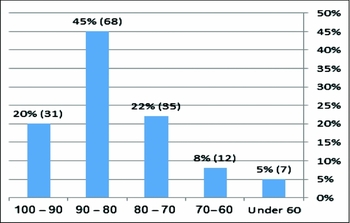
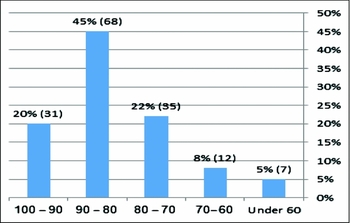
Due to characteristics of Israeli court rulings, not all the decisions included the full characteristics of the person with dementia. Within the available information regarding the socio-demographic characteristics of the person with dementia, the following facts were revealed (for each variable we provide the total number of rulings which included this information = N). The majority of these individuals were female (55%; N = 280; missing data (MD) = none); Jewish (94%; N = 245, MD = 35); single (i.e. widowed, divorced, not married, or not in a common-law relationship) (57%; N = 153, MD = 127); and had children or grandchildren (84%; N = 185, MD = 95). While only a minority (23%; N = 191, MD = 89) lived in institutional settings, the majority were experiencing either partial (23%) or full (53%) dependency in performing activities of daily living abilities (ADLs; N = 194, MD = 86). It should also be noted that in 24% (MD = none) of the cases, the individuals with dementia were already deceased (i.e. in probate cases and legal disputes regarding wills). As for the type of dementia (as stated in the court's ruling) (N = 280, MD = None), this was not specified in the majority (60%) of cases. In the remaining 40% of cases where the exact type of dementia was stated, the division was 35% AD, 4% vascular disease, and 1% Parkinson's disease. Finally, details regarding age division (N = 153, MD = 127) are provided in Figure 1 below.
Age of individuals with dementia (N = 153).
One interesting element that we looked into was the place of residence of the person with dementia, while comparing two points of time: the time when the event that led to the legal proceedings occurred (e.g. the time when the person wrote his or her will) and the time the decision was handed down by the court. The findings revealed that while the majority of individuals with dementia lived within the community at the time of the legal event (77%; N = 191, MD = 89), at the time of the courts’ rulings, only 42% were still living in the community, as 38% died before the legal proceedings were finalized and the other 20% were living in institutional settings (N = 196, MD = 84).
-
2. Information regarding the characteristics of the legal procedure
Unlike the personal characteristics, all formal procedural elements are available within the courts’ rulings. Various facts regarding legal procedures were collected. First, with regard to the “level” of the court, the majority of cases were decided in lower level courts, i.e. 42% (118 cases) were heard in the court of first instance (known as the “Court of Peace” in Israel), 18% (50 cases) were heard in Family Courts (a special division within the court of first instance that specializes in family disputes), and 16% (40 cases) were heard in other Specialized Courts (e.g. Labor Courts or Traffic Courts). The rest of the cases were decided in either a Regional Court (which is basically Israel's Courts of Appeals) (22% or 61 cases) or in the Supreme Court of Justice (2% or 11 cases). Hence, it was interesting to find that cases regarding persons with dementia were addressed at all levels of the judiciary in Israel. That being said, these findings supported the findings of a prior qualitative study where participants working with persons dementia shared that the majority of their interactions with courts were before lower level tribunals. Moving beyond the “level” of the court to the general “subject-matter” of the legal procedure, approximately half of the cases were civil cases, while the rest were criminal cases (22%, either the person with dementia was the victim or the accused); family law cases (19%, e.g. cases involving probate and wills); labor cases (6%, e.g. the person with dementia was the formal employer of a paid care-worker); and administrative cases (3%, e.g. tax entitlements).
The roles of the individuals with dementia within the legal process were divided into three groups: the first group included third parties or witnesses (44%); the second included plaintiffs (29%); and the third, defendants (27%). Out of the cases where the person with dementia was a plaintiff or a defendant, in the majority of cases the person was represented by a lawyer (84%). With regards to the party on the “other side” of the case (e.g. the legal “opponent” of the person with dementia), in approximately one-third of cases (33%), it was a governmental body (e.g. the Social Security Administration or the Attorney General); less than a third of cases involved private, for-profit institutions (e.g. private insurance companies); and only 18% were family members. The remaining cases involved various persons or entities such as non-profit organizations.
Looking more closely at the legal procedures relating directly to the person with dementia, we found that in the vast majority of cases (90%), the court did not see or directly hear from the person with dementia. The court's impression or evaluation in most cases (65%) was based on medical evaluations/expert-opinions, which were provided by a diverse group of physicians: psychiatrics (47), geriatrician and psycho-geriatrician (26), neurologist (9), and family doctors (4).
-
3. Information regarding the substantive legal issues
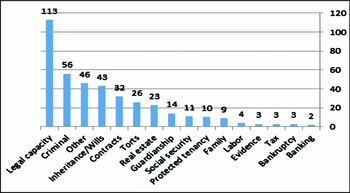
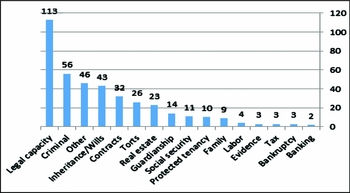
After analyzing the general characteristics of the person with dementia involved in the legal process as well as the general characteristics of the legal procedure, at this stage, we investigated the actual legal issues that were addressed by the courts. The findings are provided in Figure 2 below.
The narrow substantive legal issues involved in the courts’ rulings.
-
4. Information regarding the outcome of the legal process
Finally, we looked at the outcomes of the legal proceedings. Our focus was on whether or not the person with dementia was found to be “legally capable.” We divided the court rulings into three different legal contexts. First, we looked only into the cases that involved disputes surrounding wills. Here we found that in 61% of the cases, the ruling was that the person with dementia was “capable” of executing the will at issue. Second, we looked into criminal cases with regards to the capability of the person with dementia to stand trial. Here, in 38% of cases, the person was found fully incapable to stand trial. Finally, with regards to the remaining cases (non-criminal and non-wills/estate), the courts ruled in a majority of those cases that the person with dementia was either fully “legally capable” (43%) or partially “legally capable” (14%, i.e. legally capable in certain legal contexts but not capable in others). Only in the minority of cases (43%) did the court find the person with dementia to be fully lacking “legally capacity.”
Discussion and conclusions
The findings of this study provide, for the first time, a broad and comprehensive “mapping” of court rulings involving persons with dementia in Israel. The primary and most striking findings were that cases involving individuals with dementia appear at all levels of the court system, the cases address diverse legal issues, and individuals with dementia interact with the court not only as persons pursuing their rights but also as defendants, third parties, and witnesses. The findings themselves are not surprising. However, when they are compared with the existing scientific literature in the field of dementia and the law as described above, it is clear that the existing research touched upon only very limited and narrow elements of the actual encounters of individuals with dementia with the court system. For example, while the current literature in this field emphasizes topics, such as legal capacity or medical care, it has almost completely ignored legal issues in the field of criminal law (e.g. cases where a person with dementia is charged with abusing or assaulting a family member), labor law (e.g. cases where a migrant worker sues his or her employer, who is a person with dementia, for not paying social benefits), and constitutional law (e.g. the applicability of Israel's Basic Law on Human Dignity and Liberty to socio-medical decision-making on behalf of a person with dementia).
Some of the findings of this study support and echo findings of other, more limited or specific studies in the field of elder law or guardianship law. For example, various prior studies have pointed to the “invisibility” of older persons in guardianship proceedings, i.e. they are not present in court and the judges do not see them or directly hear from them (Doron, Reference Doron2004). We also found through this study that while counsel represented the majority of individuals with dementia, in most cases those individuals (i.e. the persons with dementia) did not physically appear during court hearings.
Another well-known critique of elder and guardianship law is the ignorance within the medical profession regarding the standards of “legal capacity” and the formal reporting requirements. Similarly, in the present study, we found that the courts and medical experts did not provide a specific diagnosis of the type of dementia in the majority of cases (60% of cases did not specify the type of dementia). Moreover, physicians in many different practice areas view themselves as “capable” of providing expert opinions with regards to dementia, even without specific training or expertise (under Israeli law only doctors can submit evaluations/expert opinions regarding the diagnosis of dementia – however, no other special training or “qualification” is needed). Evaluations are provided not only by geriatricians or psycho-geriatricians, but also neurologists, general family practitioners, and in most cases, psychiatrists are providing expert opinions to the court. This “legal construction” of dementia as a “non-specific” medical field and, for the most part, a disease or pathology that is “situated” within the psychiatric knowledge, is in and of itself a very interesting finding. This supports other scholars’ critiques regarding the stigmatic misconception of dementia as a “mental illness.” From a policy perspective, these findings also support the findings of other studies regarding the need for training of judges not only with regards to dementia in general, but with regards to the standards for evaluation and qualification of expert witnesses in the field (Werner and Doron, Reference Werner and Doron2016).
The passage of time was also found to be a significant factor in elder law cases (Spanier et al., Reference Spanier, Doron and Milman2013). As legal proceedings are quite time consuming, for many older individuals, this means that by the time the rulings have been issued, they may be deceased. The findings in this study support the understanding of the importance of time to persons with dementia in the context of legal proceedings. We also found that not only do these individuals die “along the legal way,” They also move out of their homes and into institutions. This raises an interesting question whether the legal proceedings themselves are a type of deterioration “trigger” for individuals with dementia or a “symptom” of the developmental stage of dementia, which manifests itself through the need for legal intervention. This may also reflect a reality that as dementia advances people may become more vulnerable to being dragged into family conflicts while losing their ability to resist or standup to their rights.
Finally, it was interesting to find that despite the stigmatic view of dementia (Werner and Heinik, Reference Werner and Heinik2008; Swaffer, Reference Swaffer2014) and despite the “invisibility” of individuals with dementia before judges, in a majority of the final rulings, the individuals with dementia were found to be legally capable, either fully or partially, either to stand (in criminal cases) or to perform legal transaction (sign contracts or be accountable as employers). Specifically, individuals with dementia were found to be capable of executing a will, even when diagnosed with dementia. They were found to be capable to stand trial in criminal cases and they were found to be legally capable of entering into a contract or executing property transactions. It is quite difficult to generalize on a statistical level without going into the actual textual and contextual justifications. However, these findings may support an optimistic view that courts of law are unwilling to “automatically” view a person with dementia as lacking legal capacity. Such a view, which is indeed anchored in Israel's Basic Law on Human Dignity and Liberty, must be further analyzed in future studies focused on the legal justifications and the narratives of the actual rulings.
Limitations: Similar to other ELS based on information obtained from computerized databases, this study has an inherent limitation: The legal context is Israeli law, which differs from other jurisdictions; Not all cases are reported and included in these public databases; Many “technical” court rulings, e.g. short decisions with no appearances by the parties to the case are not often reported. Therefore, the actual “representation” of the existing case law is only partial and is biased toward cases that include hearings and decisions with substantive content and references to legal arguments. Finally, the legal materials examined in this study were based only on the published rulings. Hence, rich data (e.g. cross-examinations, expert-opinions, affidavits, etc.), which exist in the courts’ archives were not viewed or examined. These limitations must be taken into account when interpreting our findings. Future studies should try to go beyond the published rulings and examine deeper and broader data, which exist in the courts’ files.
Conflict of interest
None.
Description of authors' roles
All authors were involved, in different degrees in all the parts of the research. First and second authors were the primary investigators, and authors three and four were the research coordinators.
Funding
This work was supported by the Israel Science Foundation (ISF), Grant Number 627/13, on the topic of “Structural Stigma and Dementia: The Socio-legal Construction of Dementia in Court Rulings.”