In reflecting on how the promises of the Universal Declaration of Human Rights (UDHR) were to be transformed into realities, Eleanor Roosevelt, a leading architect of the UDHR, is said to have had little faith in the abilities of states to transform ‘what ought to be’ into ‘what is.’ Instead, as William Korey recounts, Mrs. Roosevelt settled on the belief that non-state actors, mainly in the form of human rights international non-governmental organizations (human rights INGOs, or, as used hereafter, HROs)Footnote 1 would transform the prescriptions of the UDHR into reality through their behavior as a ‘curious grapevine.’Footnote 2 Over sixty years later, scholars from all disciplines – law, economics, sociology, history, ethics, political science, education, anthropology – are making the same theoretical argument that Mrs. Roosevelt did: activities of these ‘curious grapevines,’ or networks, of HROs are at the center of improvements in human rights practices.Footnote 3
Although much theoretical literature often highlights that HROs work together within networks, and often assumes that this network improves the advocacy output of the organizations, no existing study has explicitly examined this network of connections between HROs. This article seeks to add to this theoretical literature by examining the networks of relations and connections between these organizations. Two specific questions are addressed. First, what explains the network of connections among HROs? And, second, does an organization's position in the network matter for its advocacy output? In other words, are organizations better able to advocate as a result of this ‘curious grapevine?’ Attention to these questions is a necessary precondition to understanding the theoretical impact of the network of HROs on human rights practices. It also helps us understand the limitations HROs face in transmitting information and resources to each other through the network. In answering these questions, this article serves as the first global study to focus specifically on HROs while utilizing network analysis, a growing methodological technique within both the social and natural sciences.Footnote 4
Drawing on the cross-disciplinary literature on networks and collective action, I begin with the assumption that being part of the network provides a set of tools for an organization that is somewhat akin to a public good.Footnote 5 This public good includes the increased information, resources, and political clout that come from being connected to other organizations also working for human rights improvement.Footnote 6 Being part of the network provides organizations with more tools with which to set the global agenda and get their information into the media.
I argue that many factors hinder the ability of HROs to become connected, limiting the density of the overall network. Forming network connections can be a costly endeavor, too costly for many organizations outside of the global ‘North,’ those with peripheral interests, or those without standing with intergovernmental organizations (IGOs).Footnote 7 Thus, even though being part of the network provides tangible benefits for the organization and even though all organizations could, in theory, be part of the network, not all HROs are set up to take part in the HRO network. If the network is important for global advocacy activities, structural reasons why an organization is not connected to the network will have consequences for which types of organizations participate in global activism and, thus, on which types of human rights issues global advocacy focuses.Footnote 8
Furthermore, as with all public goods, I contend that there are free-riders in the HRO network. I define free-riders here as organizations that are taking more from the network than they are providing, effectively identifying themselves as key players in the HRO network without being identified by other organizations as part of the network at all. In other words, their identified connections to other organizations are not reciprocated. I contend that organizations differ in their need to be part of the overall HRO network: free-riders are more likely to be organizations which have not been as active in advocacy in the past. Thus, organizations without a strong history of advocacy output are trying to free-ride off of the HRO network public good, perhaps with the hope that they can benefit from the network and be more active in global advocacy in the future.
Finally, and at the real heart of the whole theoretical argument, I contend that network characteristics of HROs are of real importance for their future advocacy output: because they benefit from the public good of the HRO network, those organizations central to the network are the organizations that should theoretically be more active in pressuring states to change their human rights practices. Although the overall benefits of the network are still felt by free-riders, I also contend that, because of a lack of reciprocity, these benefits on advocacy output will be somewhat diminished for organizations that are more intense free-riders. This argument highlights the limited global nature of civil society and could, perhaps, offer an alternative explanation for a Western-centric focus on human rights issues.Footnote 9 Because international pressure on states is theoretically identified as the central mechanism through which HROs influence human rights performance, this argument highlights how the position of the HROs within the network could be linked to their overall effectiveness on the world scene.
I test these arguments using a new dataset on the network relations of 681 HROs, providing, as mentioned, the first network analysis of a specific set of actors long theorized to be behaving within a network. The empirical results support my hypotheses and highlight many avenues for future research. These findings add to the overall INGO scholarship within international relations, which has had a limited empirical but widespread theoretical focus on the connections between organizations. By examining how network positions can impact advocacy activities, these findings also add to present scholarship on human rights practices.
This article proceeds as follows. First, the relevant literature and central arguments are discussed. Next, the new HRO relational data is introduced. The research design and empirical results are then outlined in detail. Finally, the article concludes by addressing the implications of these findings.
Human Rights International Nongovernmental Organizations And Networks
The ‘boomerang’ or transnational advocacy network (TAN) framework, the dominant theoretical framework for understanding advocacy INGOs, centers on the work of groups of INGOs and other advocacy actors in pushing for policy and behavior change.Footnote 10 Within this framework, advocacy INGOs, like HROs, aid domestic groups already interested in advocacy but unable to bring about results on their own. In the realm of human rights advocacy, for example, if domestic groups are not able to get a state to end political repression, the group calls on HROs for assistance. HROs then work together to aid in the domestic population's ability to organize and protest in favor of the state improving human rights.Footnote 11
HROs also work to increase world awareness of the situation. Organizations often compile information on victims and perpetrators of human rights abuses and then work to get this information into the international media. The hope is that this information will lead other international actors, such as foundations, churches, intellectuals, parts of intergovernmental organizations (IGOs), and the governments of third party states, to join in the advocacy attempt and pressure the state to change its human rights practices. This behavior is often termed ‘shaming and blaming’ or ‘naming and shaming.’Footnote 12 Both by heightening domestic advocacy attempts and by bringing international attention to bear on the repressive regime, groups of INGOs thus form a critical component of a ‘boomerang pattern’ of international advocacy.Footnote 13
Central to the causal mechanism connecting advocacy INGOs to policy and behavior outcomes is the ability of INGOs to work collaboratively. Within the TAN framework, this ‘dense web of connections’ is necessary for the creation and utilization of information that is the ‘most valuable currency’ of transnational advocacy networks, generally, and INGOs, more specifically.Footnote 14 According to this framework, these network connections provide real power, consistent with the definition of network power identified from within social network studies, such as that by Knoke or the definition of network social power by Hafner-Burton and Montgomery.Footnote 15
Within INGO scholarship, DeMars, for example, contends that the INGO network provides four types of resources to organizations involved in the network: ‘normative frames, material resources, political responsibility, and information.’Footnote 16 Accordingly, individual organizations are able to use novel normative frames from other organizations to incorporate additional advocates into the movement and structure advocacy efforts. At the same time, organizations are able to share material resources for their overarching goals and divide labor between themselves through their personal connections. Organizations can advocate that political responsibility should shift from one set of actors or political elites to alternative actors. Finally, given the importance of information to the shaming mechanism through which organizations often work, the network is critical for allowing this information to be shared and dispersed to both a larger NGO and non-NGO audience. By being part of the network, the final organizational output is thought to be greater than the organization could have achieved on its own.
In practice, there are many examples of the HRO network at work that appear consistent with DeMars's categorization of the power in INGO networks. As an example of the use of normative frames through the network, in 2003, the HROs Amnesty International, Human Rights Watch, and the Lawyer's Committee for Human Rights issued a joint statement concerning the role of the media in fighting anti-Semitism at the Organization for Security and Co-operation in Europe.Footnote 17 In the statement, the organizations jointly put forth that anti-Semitism is a human rights violation, effectively shaping normative scripts on the issue.
With regards to material resources that can be gained from the network, organizations often come together to advocate for a central goal, pooling their resources in order to make the effort. In the 1990s and early 2000s, HROs worked in concert for the creation of the International Criminal Court, designed to prosecute the worst human rights offenders.Footnote 18 Even now, HROs come together periodically to discuss how to support the Court. Past HRO meetings have also helped structure which human rights to focus on and how to ensure that foreign aid to NGOs is used efficiently to meet these goals.Footnote 19 By coming together, organizations also develop new strategies and tactics through which to advocate for human rights change, as occurred during the ‘Workshop on human rights education and training issues among NGOs working in the field of human rights’ in Morocco in 2002, organized by the HRO Arab Institute for Human Rights.Footnote 20
The sharing of material resources through HRO networking also allows organizations to focus on their comparative strengths. For example, in 2011, the relatively new HRO Humanity United, which often focuses on post-election opinion research and advocacy, was interested in supporting peaceful elections in the Congo. As Federico Berello wrote:
We partnered with Human Rights Watch to implement a monitoring mechanism to report human rights violations, before, during, and after the elections. HRW opened an office in the capital city of Kinshasa, and set up a network of local observers in critical parts of the country. Through the reports provided by this network, HRW has been keeping local and international policymakers informed and engaged to advance their efforts to prevent violence and ensure a peaceful election outcome.Footnote 21
By connecting with others, organizations avoid the duplication of effort that sometimes plagues service INGOs.Footnote 22 This is not to say that duplication of efforts does not exist in human rights advocacy, but points out how HRO networking can help limit these issues by allowing organizations to divide their labor advantageously.
Recent examples of HRO networking also highlight how the network conveys political responsibility and information. Drawing on their collective research, the HROs Amnesty International, Human Rights Watch, and the International Commission of Jurists issued a joint press release in March, 2011, assigning political responsibility for human rights abuses in Nepal to both the new government of Nepal and the Chinese regime.Footnote 23 By not putting the complete blame for restrictions on assembly on Chinese influence, these organizations shifted part of the political responsibility for human rights abuses back to the Nepalese regime.
Through issuing joint statements, organizations are also able to draw on the collective clout of the whole network in getting their message across. The information used to compile press releases like those discussed above often draws on the work of even more HROs and domestic NGOs. For example, Human Rights Watch partnered with the HRO Cairo Institute for Human Rights Studies and the domestic organization the Bahrain Center for Human Rights, among others, in researching and condemning Bahraini authorities for their violence against regime protesters. By working together, the message was able to be heard at the United Nations’ Human Rights Council, despite ‘threats of reprisals’ that prevented local activists from traveling to the event.Footnote 24 Additionally, by working together, organizations ensure that the message is seen as representing the general view of HRO activists, perhaps encouraging IGOs and states to take up the advocacy issue and create the ‘boomerang’ pattern central to the dominant theoretical understanding of how HROs work.Footnote 25
Given these examples, together with the focus on the advocacy network in the canonical literature on HROs, we should clearly expect HRO networking behavior to be beneficial to the work and functioning of these organizations. Literature from communication studies on NGO networks takes this idea one step further and contends that NGO networks are a public good, defined traditionally as a good that is nonrivalrous and nonexcludable.Footnote 26 By ‘nonrivalrous’, I mean that the HRO network, once it is started, can incorporate an additional HRO with no real costs to other organizations. This appears consistent with many case study accounts of HRO coordination, like those outlined above; additional organizations join the network and are absorbed into the existing framework. By ‘nonexcludable’, I mean that, once an organization is part of the network, it is hard to exclude that organization from using the network. This definition also seems consistent with the spread of information among connected HROs; once a human rights abuse is documented by a HRO, it appears to be nearly impossible to stop organizations from utilizing the information in their advocacy.
To be clear, the extant work from communication studies that sees NGO networks as public goods focuses on networks of NGO hyperlinks only, defined as the connections of NGOs through their websites.Footnote 27 The logic, however, appears to hold when we expand the idea of what an NGO network connection is to include other types of connections, like joint meetings or statements. As described above, these connections are still often information based, similar to Shumate and Dewitt's discussion of the NGO hyperlink network as a communication-based public good. And, like Olson's discussion of a labor union as a public good, the HRO network is working for the same common good, using their collective action for the same purpose.Footnote 28
In short, the HRO network is critical to our shared understanding of how HROs work to influence human rights outcomes. By providing additional information, resources, and political clout, the network conveys real power to these otherwise seemingly powerless actors. The HRO network is akin to a public good in the struggle for human rights promotion. Despite the central importance of this logic in the theoretical literature, to date, existing cross-national support for the core arguments has been scant and has often relied on proxies of either overall civil society or a very small number of HROs.Footnote 29 Although many of these studies do find that HROs in isolation impact human rights performance, they are missing any measure of the central theoretical component of how HROs work: networks. In other words, this empirical literature looks at HROs and their activities in isolation, despite the focus in the theoretical literature on the interactions and connections within the HRO community and how these organizations network together to attract international attention and, thus, try to impact human rights performance. Very little empirical attention has been paid to exactly how these organizations are connected and whether these network characteristics matter for advocacy activities. Below, I utilize this theoretical understanding of the HRO network to formulate testable hypotheses about both the formation and structure of the network and its influence on advocacy outputs.
How Are Networks of Human Rights Organizations Formed?
Before turning to the potential impact of the HRO network on an organization's advocacy output, I first focus on understanding more about the network itself. Which organizations are more likely to be part of the network? Do the organization's individual characteristics matter for its ability to join in the network? By focusing first on which organizations are likely to take part in the HRO network, I can address issues of how structural variation in the organizations themselves can influence just which organizations stand to benefit from the public good of the HRO network.
Like other public goods, contributing to the HRO network is not completely costless. Organizations must have the resources with which to contact other HROs and participate in joint projects. Likewise, organizations must have similar visions for human rights outcomes and speak with the same human rights ‘language;’ otherwise, participating in the network may not seem advantageous for the organization.Footnote 30 This is not to say that organizations without these resources are excluded from the network; I argue that some organizations lacking some basic resources or without the same view of human rights will be part of the network and none are theoretically excluded. Instead, I simply contend that some organizations may be less likely to join the network based on certain structural characteristics. This is in line with the larger canonical literature on networks, which has long held that homophilous actors, defined as those with the same underlying conditions, are more likely to tie to each other.Footnote 31
What characteristics may increase the ability of an organization to tie or form a network connection? Are certain organizations more likely to tie to each other? I focus on three characteristics of HROs which could matter for their ability and willingness to be part of the overall HRO network: (1) their connections with IGOs, (2) their base of operation, and (3) their religious or secular status.
I argue that HROs with permanent connections to IGOs would be likely to have political and material resources through which to tie to other HROs more often. First, HROs with connections to an IGO meet throughout the year with other INGOs connected to that IGO.Footnote 32 These connections may allow for the flow of information and ideas that are central to advocacy networks and would encourage network connections between IGO-connected organizations.Footnote 33 For example, Clark et al. point out how IGO-related meetings allowed for connections between women's rights HROs located in Western Europe and those based in developing countries.Footnote 34
Second, IGO connections also represent a major step-up in the legitimacy of a HRO and could make a HRO a more desirable collaboration partner for other HROs.Footnote 35 An IGO connection would make an organization a very desirable network partner to a HRO wanting to get its human rights message to a foreign policy audience. If, for example, an organization has information it would like to be made known to the United Nations (UN) Human Rights Council, it would likely want a HRO partner with consultative status with the UN Economic and Social Council (ECOSOC).Footnote 36 Although ECOSOC is not the only IGO that offers consultative status for NGOs, ECOSOC is the ‘only main UN body with a formal framework for NGO Participation.’Footnote 37 Consultative status allows NGOs to ‘enter UN premises’ and is the only way that an NGO can be ‘accredited to participate in the [UN] Human Rights Council's sessions as observers.’Footnote 38 No other IGO connection carries as much weight in the human rights realm.Footnote 39 Consultative status with ECOSOC is given to organizations whose mission and activities reflect the goals of the UN.Footnote 40 To gain consultative status, organizations must fill out a lengthy application form and participate in a review process. Organizations with the human resources to fill out such an application process would likely be able to participate in network activities and provide the necessary resources for the overall HRO network. As such, it follows that:
hypothesis 1A: HROs with connections to UN ECOSOC are more likely to be tied with other HROs, including other HROs both with and without connections to UN ECOSOC.
In addition to IGO connections, the geographic focus or office location of an organization also seems to matter for its connections to both other HROs and to other advocacy actors. Much has been written about differences between INGOs based in the global ‘North,’ often thought of as developed democracies in Western Europe and North America, and INGOs based in the global ‘South,’ those INGOs based in developing countries.Footnote 41 At the most basic level, Northern INGOs typically have more material resources than their Southern counterparts. They are also, perhaps, better able to foster connections to Northern foreign policy leaders. Although many contend that more connections are necessary between INGOs from different locales, practitioners especially highlight problems with dependency that can complicate relations between Southern INGOs and Northern INGOs, often with a loss of domestic accountability for the Southern INGO as it becomes financially dependent on its Northern counterparts.Footnote 42 Practitioner reports have also highlighted the need for more connections between Southern INGOs, which may face additional organizational and resource restraints on collaboration and capacity building, even within a more limited geographic area.Footnote 43
Because Southern HROs are typically organizations that have limited resources, they should be less tied to the Northern HROs and less tied to other Southern HROs. Conversely, Northern HROs, because of their greater resources, should have a greater likelihood to form network connections with each other. This logic can be restated as the following empirical implication:
hypothesis 1B: Northern HROs are more likely to tie with each other. Southern HROs are less likely to be connected to each other and less likely to be tied to Northern HROs.
In addition to these basic differences in HROs which could influence their resources or desire to tie, I acknowledge that human rights, although often thought of as an all-encompassing ideology, does have schisms. These divisions could indicate that organizations may be working for slightly different goals, like organizations working to expand the human right to abortion and organizations working to limit abortion as a violation of the right to life at the same time.Footnote 44 As Shumate and Lipp make clear, organizations without the same common purpose may have little reason to coordinate their efforts.Footnote 45 Conversely, actors with a similar ideological or policy focus are more likely to come together to discuss ideas, read each other's mission and policy statements, and, possibly, join together on shared programs or endeavors.Footnote 46 Many ideological-specific INGOs even have their own meetings and outlets for networking.Footnote 47 Furthermore, patterns of INGO employment appear to be the most fluid for individuals within INGOs that share similar ideological or policy goals.Footnote 48 These ‘revolving door’ situations are even highlighted by Keck and Sikkink as evidence of an actual advocacy ‘network.’Footnote 49
Within human rights, one large ideological schism exists between religious and secular organizations.Footnote 50 Religious HROs share similar mission statements and donor connections, often separating themselves from other HROs but actively working to bridge connections with other religious-based HROs. This is distinct from the larger secular-based HRO network, which may be more likely to tie to each other. Given this difference in ideological approaches of HROs, it is implied that:
hypothesis 1C: Religious HROs are more likely to have network ties with other religious HROs but less likely to have network ties with secular HROs. Secular HROs are more likely to be connected to each other.
In short, there appear to be many reasons why certain organizations may be less likely to tie to each other. Here, I focus on three key structural differences among HROs: their ECOSOC connection, their geographic location, and their ideological bent. If these differences do matter for the propensity of organizations to join the network and, if the network is important for advocacy output, as I contend, these findings imply that structural differences among HROs can have consequences for the type of human rights advocacy on which HROs are focusing. It might indicate that marginalized organizations without IGO connections or from the global South have little power when it comes to shaping the overarching advocacy agenda. Likewise, without the connections to other advocacy organizations and the goods that the HRO network brings, organizations that have pre-existing ideological schisms may have little influence in the overall, larger movement. This would be consistent with Bob's work on the market of advocacy and Carpenter's work on the role of ‘gate-keepers’ in setting future advocacy agendas.Footnote 51 By being active in the network, organizations with certain favorable structural conditions will have even more resources from which to influence political outcomes.
‘Free-Riding’ and the Need to be Part of the HRO Network
There appears to be many reasons why individual HROs would want to utilize the public good of the HRO network. HRO networking expands the organization's individual capacity, linking the organization to outside sources of funding, prestige, and information. Further, associating with other HROs can both aid in the accomplishment of the organization's mission but can also serve as a form of ‘branding,’ allowing the individual HRO credit in the accomplishments and activities of the larger advocacy network.Footnote 52 By ‘branding,’ I am referring to the reputation of the INGO in current and future dealings; this is a common term concerning non-profits in the management and organizational literature and is somewhat synonymous with the signaling and reputation literatures in international relations and economics.Footnote 53 As such, HROs are often trying to interact with governments and IGOs that are not informed of the HRO's power or ‘brand.’ Appearing connected to other HROs, especially high-profile HROs, could help an organization in its individual dealings, including its fundraising activities.
In short, a HRO gains benefits from the public good of the network that are disproportionate to its actual contribution. In the larger literature on public goods, it has long been established that public goods are particularly prone to ‘free-riding,’ defined as taking more than one's share of the good.Footnote 54 In other words, ‘free-riders’ are those that benefit from the public good without fully contributing. Another common example of free-riding would be contributions to military alliances; small states are often seen as free-riding off the alliance contributions of larger states.Footnote 55
Although existing communication research does focus on NGO networks as a public good, to my knowledge no research has taken this a step further and actually focused on free-riding in the HRO network. I contend that, like all public goods, there can be free-riding in the HRO network. I could see free-riding here as an organization trying to raise its brand by identifying itself as part of the HRO network when it is not contributing its share.Footnote 56 It may be shirking on its responsibilities to convey information or participate in a joint project; it could be contributing less than its share in terms of political clout or connections through which HROs get their message across. Within the framework of social network analysis, a free-rider would thus be an organization with more outgoing ties than incoming ties; it would likely not be identified as connected to the organizations to which it is claiming a connection.Footnote 57 For example, as Hudson points out, this has occurred when an organization is trying to claim it is a legitimate authority on an issue; the organization may claim more local ties or involvement in larger movements in order to heighten its international legitimacy.Footnote 58 In general, organizations may also free-ride off organizations with a better known image in an effort to gain more public attention, support, and funds. In a handbook on the ethics of NGOs, Stillman points out that this practice occurs but should be frowned upon: ‘While cross-publicity between similarly minded NGOs might be a good thing if agreed in advance, free-riding on another's hard-earned reputation and goodwill definitely is not … Avoid misrepresenting to others that your NGO has any endorsements, approvals or sponsorships it does not.’Footnote 59
Herzer and Nunnenkamp mention that free-riding can be a way for an NGO to ‘avoid fundraising expenditures’ but still ‘receive higher donations as new donors are awakened by the fundraising of other NGOs.’Footnote 60 It is worth noting that I am not arguing that these claims of network connection are necessarily fraudulent; the connections to other organizations may just be somewhat overstated. In other words, these organizations are benefiting from the network without providing their contribution to the public good.
What determines free-riding within the HRO network? If the network provides goods that are important for global activism, as I lay out below, free-riding could be a technique used by organizations that are trying to rise in the global advocacy community. Thus, free-riders should be organizations with little experience or history of global activism. These HROs are trying to free-ride with the hope that they can benefit from the network and increase their future output. Again, this is somewhat akin to free-riding by states in military alliances; in some of the extant literature, small states are argued to be likely free-riders because they typically have less of an established military complex to contribute to the public good, but stand the most to gain from the public good. Also, like alliances, however, free-riding may still be thought of as efficient to the global advocacy movement if the final advocacy outcome, human rights improvement, is increased by the network public good.Footnote 61 Applying this logic to HROs, then, I have the following testable hypothesis:
HYPOTHESIS 2: Organizations that have not been active in global activism in the past will participate in more ‘free-riding.’
Advocacy Outputs and the HRO of Network Public Good
Finally, underlying much of the above logic, I contend that the HRO network is a public good with important benefits for organizations, like DeMars's discussion of the network benefits of ‘normative frames, material resources, political responsibility, and information.’Footnote 62 These benefits, it follows, should matter for the work of HROs: Namely, the more that an organization utilizes the public good, the more that it should have a boost when it comes to its typical output of international advocacy activities.
Given the benefits of the HRO network to organizations, there appear to be many ways that participation in the network would affect international advocacy output. First, organizations involved in the network will have more information on human rights abuses to report to the international media. Likewise, organizations involved in the HRO network will benefit from the combined expertise of other organizations, perhaps providing volunteers with collective insights on how to structure their information in ways that ensure that their advocacy message is picked up by international media.Footnote 63 These organizations would likely have personal contacts or be able to draw on personal contacts of other organizations, which could also help make them more likely news sources for reporters interested in information on particular human rights abuses.
Taking this one step further and drawing on ideas from network theory, it follows that the organizations that benefit most from the goods provided by the network should be those most central to the network, connected to players that also are making use of the network. This is the idea captured in the network measure of ‘eigenvector centrality,’ defined as a measure of importance of an actor in terms of how connected it is to other actors central to the network.Footnote 64 As such, eigenvector centrality is often seen as an indication of how important your ‘friends’ are.Footnote 65 This concept of network influence seems especially well suited to my central concept of interest; namely, the ability of an organization to draw on goods from the network in a way to benefit its international advocacy.Footnote 66
In short, given this discussion of the benefits of the public good of the HRO network, it seems likely that a more central position in the network could translate into heightened ability to actually provide advocacy output that would be visible for other potential actors necessary in human rights promotion, such as IGO officials, third party states, and concerned global citizens. Therefore, I should expect that:
HYPOTHESIS 3A: As eigenvector centrality of an organization increases, the amount of future international advocacy output of the organization increases.
To note, this logic makes no distinction between an organization that is central to the network and actually contributing to its share of the public good and an organization that is central to the network but only central due to its own free-riding. In fact, the network theory concept that most closely coincides with my conceptual understanding of a HRO network's benefits, that of eigenvector centrality, is actually a measure that is symmetrical, making no distinction whether the ties are going to or coming from an actor.Footnote 67 However, remember again that my idea of free-riding is an organization that is utilizing the network or identifying itself as part of the network without contributing its share to the public good. This idea, at its core, is asymmetrical: a free-rider is an organization with more ties to other organizations than organizations tying to it.
What effect will free-riding have on an organization's international advocacy output? First, as outlined in the previous hypothesis, I argue that all organizations, regardless of whether they are contributing their share of the public good, stand to benefit from the HRO network. As such, network connection and position, which I summarize as eigenvector centrality, should make international advocacy increase for any organization, whether they participate in much free-riding or not. However, when organizations are involved in free-riding, it also follows that the potential benefits of the network on international advocacy would be somewhat diminished. There would be limits to information and resources in a free-riding connection; a more well-established back and forth connection, where connected organizations are all contributing their share, would provide more opportunities for the actual share of network goods. This could also be thought of as due to some sort of legitimacy crisis; organizations that are intense free-riders may come across as less legitimate, making it harder for an organization to translate its message into global advocacy, especially advocacy that would be visible to the international media.Footnote 68
Theoretically, we could think of Organization A having a benefit in international advocacy from just telling others that they are connected to Organization B. Organization A may be able to get victims to provide information or get a press interview from announcing its connection to Organization B. As Stillman pointed out, this action may be useful in getting the general public to support the organization.Footnote 69 However, because Organization A is free-riding and not actually participating in a back-and-forth relationship with Organization B, it may miss out on some of the other goods that could come from the network, like Organization B providing it with contacts at an IGO or working with it to send out a joint press release. It might also come across as desperate to a reporter or IGO actor, which could limit its ability to get its message out. As such, Organization A's free-riding should have a slightly negative effect on its international advocacy. The organization will still benefit from the network but it will not stand to gain as much as if it had fully contributed its share to the public good. So, despite the network benefits, there will be a ‘free-rider effect’ in that the organization will not be able to internalize the full power of the network. This logic implies the following testable hypothesis:
HYPOTHESIS 3B: As free-riding intensifies for an organization, the amount of future international advocacy output of the organization decreases.
Research Design
To evaluate each of the hypotheses listed above, a new dataset of the ties between HROs was constructed, together with new data on a variety of characteristics of the HROs themselves and original data on the international advocacy output of HROs in the international media. Because this data represents one of the first attempts to capture the network behavior of HROs and their individual advocacy outputs in a systematic way, I first describe this dataset in detail and then turn to outlining the research design and empirical results of the tests.Footnote 70
HRO Network Ties
Overall, there exist very few large-scale data sources on INGOs. Most existing studies on INGOs utilize data collected from the Yearbook of International Organizations, a publication of the Union of International Associations, an INGO itself whose mission is the ‘facilitation of the development and efficiency of non-governmental networks.’Footnote 71 The Union of International Associations (UIA) produces a list of all active INGOs in the world by asking other INGOs for new organization information, looking at lists of INGOs produced by donor foundations and international organizations, and original research of newspaper and practitioner reports. The UIA then collects data on all INGOs on its list by sending out information requests to the organizations themselves. The UIA asks these organizations to self report a plethora of information, including the organization's mission or aims, its services, and languages used, main and secondary addresses, structure, staff, and membership details.Footnote 72 It has, since 1910, published its findings in its annually released Yearbook.
My data on HRO network ties is based on the UIA's work. For this project, I compiled a list of the 681 human rights specific INGOs listed in the 2001/2002 Yearbook of International Organizations.Footnote 73 The list of these organizations is provided in online Appendix 2. A square matrix of the 681 × 681 possible relational ties between these organizations was created.Footnote 74 Data on ties were taken from citations to other HROs provided in each HRO's entry in the Yearbook under the section headings concerning the HRO's aims, structure, secretariat, finance, NGO, activities, events, publications, and members. In a series of robustness checks available in online Appendix 1, I also restricted the focus to only those ties mentioned under the NGO section heading; all results remain statistically and substantively consistent.
The dataset is asymmetric or directed.Footnote 75 In other words, each datapoint within the matrix represents a self-identified link by a HRO to another HRO.Footnote 76 As an example, online Appendix 3 provides the information from the organization Human Rights Watch. As shown, this organization has twenty-five links with other HROs. These links indicate a self-identified relationship between Human Rights Watch and other HROs. This information on an organization's relationships to other HROs forms the basis for my network data.
Though this data source provides a useful starting point in examining the HRO network, I do recognize that it has some drawbacks. First, the network ties are self-reported. If the representative filling out the network survey for the Yearbook is uninformed of the totality of relations its organization is involved in, this will lead to an underreporting of that organization's outgoing ties. However, given the long use of the Yearbook as a staple in NGO research and collaboration, this dynamic may be minimal. Additionally, because this information is filled out annually, it may be capturing regular cooperative relations and not short-term campaigns. Further, because it takes time and resources to fill out these surveys, organizations may not fill out the forms in full. This could lead to an underreporting of ties.
Despite these limitations, I feel that the use of the Yearbook data both reflects the state-of-the-art literature on INGOs in other fields and is the most reliable source currently available.Footnote 77 Frequent communications with the organization that publishes the Yearbook also indicated to us that this is a source that is geared to the organizations themselves. As such, it is a good first cut at capturing actual standing relationships between organizations.
Figure 1 shows a general representation of the HRO network. This figure, which does not show the 324 HROs that have no outgoing or incoming ties to the HRO network, is organized with those organizations central to the network at the center of the figure. The size of the node, or representation of each HRO, in this visualization increases as a function of the organization's eigenvector centrality.
HRO network, node size by eigenvector centrality, isolates removed

As Figure 1 highlights, there is a dense clustering of a small number of HROs that are highly connected to each other and to other organizations in the network. This figure indicates that many organizations are only connected to the overall network through a small number of other organizations and, thus, their information and ideas are perhaps used only sparingly in the larger advocacy network.
Summary statistics support this visual representation. The overall network is very sparse. In the full matrix, density, measured as the sum of existing ties divided by the number of all possible ties, is very low (0.0028), lower in fact than a divided US Congress.Footnote 78 Out of over 460,000 possible ties, only 1,318 were found. Additionally, the network is not very cohesive, as determined by the distance-weighted fragmentation score of 0.059. The density-weighted fragmentation score ranges from 0 to 1 with 0 indicating all nodes are isolates or not connected to any other organization; thus, the score of 0.059 is indicative of a very low cohesion within the network, much lower, for example, than the Noordin Top terrorist network.Footnote 79 These descriptive statistics, although in no way a definitive test, are interesting in that they show, perhaps, some limitations in the use of the network among HROs, something somewhat at odds with traditional notions of a vibrant advocacy network.
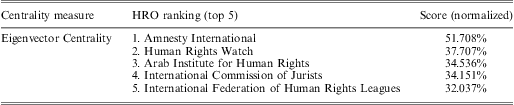
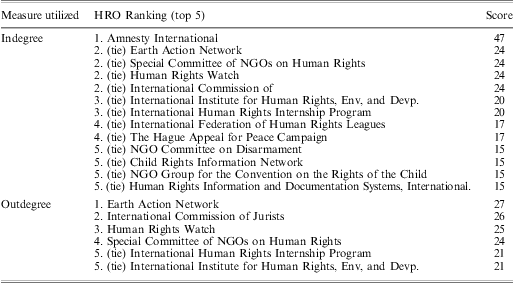
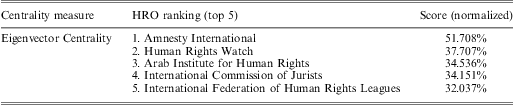
Table 1 provides a summary of the organizations with the five highest eigenvector centrality scores.Footnote 80Table 2 provides a list of the organizations with the five highest number of incoming ties, referred to as indegree scores, and the organizations with the five highest number of outgoing ties, referred to as outdegree scores.
HRO Network: Top Five Eigenvector Centrality Scores
HRO Network: Directional Relations – Degree Measures
As Table 1 indicates, there are a few key players that are central to the HRO network. Not surprisingly, Amnesty International and Human Rights Watch are in the top two spots. Perhaps surprisingly, the Arab Institute for Human Rights is also identified as an HRO with a high eigenvector centrality score, indicating that a significant number of HROs are tied to the network through this organization.
As is evident in Table 2, there are some differences in who is identifying themselves as part of the network and who others are identifying being connected to. The organizations that were seen as central in Table 1 are those which had been identified by others as ‘prestigious,’ as shown by their high indegree values in Table 2.Footnote 81 Interestingly, Amnesty International, by far the most prestigious HRO in the network, does not appear in the top five organizations by outdegree score. In other words, it is not identifying its connections to other HROs nearly as much as other HROs are claiming to be connected to it.
Hypothesis 1
In addition to data on network ties between HROs, examinations of Hypotheses 1a–1c require data on the characteristics of the individual HROs. This attribute data was also taken from the 2001 Yearbook of International Organizations. In line with the concept needed for Hypothesis 1a, I coded whether each organization had consultative status with UN ECOSOC. As mentioned, ECOSOC consultative status is required for interacting with much of the UN's human rights regime.
Additionally, for Hypothesis 1b, I record whether the HRO has a permanent office location in the global ‘North,’ defined as a permanent location in North America or Western Europe. For Hypothesis 1c, which focuses on the religious or secular nature of a HRO, I record from the UIA data whether each of the 681 HROs is a religious-based organization or not.
Because Hypotheses 1a–1c all examine the impact of various characteristics of the HRO on its propensity to tie, I rely on tests for two-group differences in tie density, as outlined in Hanneman and Riddle.Footnote 82 These tests all examine, much like a Pearson Chi-Square Test, whether the number of ties within and between the two groups is different from that which would be expected at random.Footnote 83
Hypothesis 2
Hypothesis 2 concerns whether organizations that have not been active in global activism in the past will be more likely to be intense free-riders. For the dependent variable, free-riding intensity, I create a summary measure of the number of outgoing ties, outdegree, minus the number of incoming ties, indegree, for each organization, using the coded 2001 Yearbook data. As such, this variable captures the excess number of times an organization is citing itself as part of the network.Footnote 84
For the key independent variable, past global advocacy output or activities, I utilize newly created data from the Integrated Data for Events Analysis (IDEA) project that focuses on all Reuters Global News Reports concerning each HRO. To utilize this data, I first produced a dictionary of the names of the HROs used in the network data. Virtual Research Associates, the company that produced the original IDEA dataset, then created a dataset of all events in Reuters concerning these HROs daily from 1990 to 2007. This data is organized in a ‘who’ did ‘what’ to ‘whom’ manner for each particular event.Footnote 85 As an example, on November 1, 2002, Human Rights Watch visited with the Macedonian government. The newly created IDEA dataset reports that there was a Human Rights Watch ‘visit’ with the Macedonian government on this particular day. The organization is the ‘who’ or the source of the action, the action is the ‘visit,’ and the Macedonian government is the target. This procedure produced over 10,000 distinct events where an HRO is the source actor and a government or government official is the target; each event is an advocacy output concerning an individual organization.
Because the unit-of-analysis for this hypothesis is the organization and because I am interested in how past global advocacy influences an organization's free-riding, I aggregate this data to create a count of all activity by an individual HRO from 1990 to 2000, the year prior to the year when the network data was recorded. This variable ranges from 0 events, indicating no prior advocacy output in Reuters Global News Reports, to 1,216 events for the organization Amnesty International.
Given the continuous nature of the dependent variable, I run an ordinary least squares regression model with standard errors calculated by random permutations.Footnote 86 At the organizational level, few potential control variables exist. I do include as controls here the indicators for UN ECOSOC status and whether the organization was in the global North. In a robustness test available in online Appendix 1, I also ran a model with an additional control for the year when the organization was founded, if such information was available. Results as to the key independent variable were statistically and substantively similar.
Hypothesis 3
The focus is on the effects of eigenvector centrality and free-riding intensity on future global advocacy in Hypotheses 3a and 3b. Here, I again use a statistical dataset where the unit of analysis is the organization. Since I am interested here in the effect of the HRO network, measured in 2001, on future global advocacy, my dependent variable is a measure of each organization's advocacy output in Reuters in the future year, 2002, and in the years 2002–07, when my Reuters data end. Robustness checks with advocacy output data from the same year as the HRO network data (2001) are statistically and substantively similar and available in online Appendix 1. The key independent variables are eigenvector centrality and free-rider intensity, also discussed above.Footnote 87
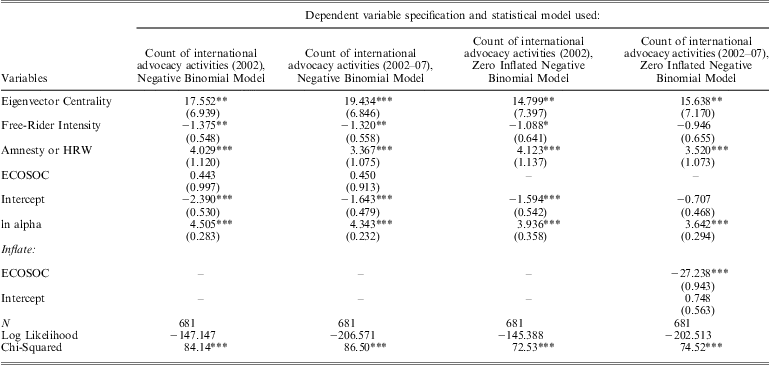
Because the dependent variable used to examine Hypothesis 4 is a count, I use event-count statistical methods. First, because of the evidence of positive contagion, I utilize a negative binomial model.Footnote 88 Second, because of the large proportion of zeros in the dependent variable, I also use a zero-inflated negative binomial model. In this model, I am assuming that there are two possible populations of observations that account for the zeros: there is one population where there are always zeros and one where we could have zeros. By using a zero-inflated model, I am modeling the inclusion into each group, then modeling the counts separately, and then combining the probabilities. I use the categorical measure of UN ECOSOC consultative status as the inflated factor. In other words, I argue that those HROs that do not have UN ECOSOC consultative status are more likely to have no international advocacy activity. I report the results of both the standard negative binomial model and the zero-inflated model because the Vuong test, which compares the two, was borderline statistically significant (p value at around 0.11), indicating that the zero-inflated model may be a better fit.
As to controls, I include a statistical dummy for two HROs that have very high counts, Amnesty International and Human Rights Watch. Results are statistically and substantively identical whether this control is included or excluded. Also included as a control in the regular negative binomial models is a dichotomous indicator of whether the organization is a member of ECOSOC or not.
Results
My hypotheses are supported by the analyses, highlighting, overall, both the factors that influence the creation of the HRO network and the effect that the network has on an organization's international advocacy. As a whole, these results show the utility in extending network methodology to our understanding of human rights advocacy and INGOs, more broadly.
Hypothesis 1: Factors that Influence Network Connections
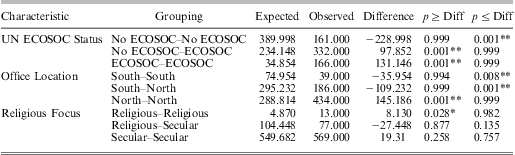
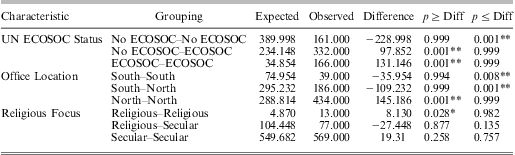
Table 3 outlines the results of the statistical tests used to examine Hypotheses 1(a)–1(c), the factors that influence the likelihood of an organization forming a network tie.
Tests for Two-Group Differences in Tie Density
*p < 0.05; **p < 0.01.
First off, in support of Hypothesis 1a, connections to UN ECOSOC matter for HRO connectivity. For HROs without ECOSOC status, there are fewer ties than expected at random. However, there are more ties between HROs without ECOSOC status and HROs with ECOSOC status than expected at random and, likewise, more ties between HROs that both have ECOSOC status.
Figure 2 highlights the central role these ECOSOC organizations have in the HRO network. Organizations with ECOSOC status are given as gray diamonds; all other HROs are seen as black circles. It is easy to see that not only does ECOSOC standing make it easier to form network ties, but those organizations with ECOSOC standing are also HROs central to the overall network. This makes sense: ECOSOC provides goods and services which the HRO network can utilize, making ties between organizations with this status more likely and making other organizations more likely to have ties to organizations with this status.
HRO network, UN ECOSOC consultative status organizations as gray diamonds
Second, differences between organizations in the global North and the global South also matter for their ability to participate in the network. Organizations based in the global South have fewer ties than expected at random and have fewer ties to Northern HROs than expected at random. Also in line with Hypothesis 1b, Northern HROs have more ties than expected at random.
Further, I find that HROs with a religious focus form ties with other HROs with a religious focus more than we would expect at random. For HROs with a religious focus, we would expect around five ties at random and I observe thirteen, a positive difference of around eight ties. A difference in expected to observed ties like this occurred less than 3 percent of the time in graphs where the ties were randomly distributed, as shown in Table 3. Also, at borderline statistical significance, HROs with a religious focus form fewer ties with HROs without a religious focus (p value at 0.135). I do not find any greater statistical difference than expected in the number of ties between secular organizations; in other words, they are connecting to each other as would be expected at random. This may be expected: given that I am focusing on HROs’ propensity to tie to each other, once I account for ideological differences in religious organizations, we do not see secular organizations tie to each other in any unique way.
On the whole, these results indicate that structural characteristics of the organization matter for its likelihood to utilize the HRO network. Organizations with UN ECOSOC status and organizations in the global North are those with a higher propensity to tie to each other. Similarly, organizations with religious ideologies are more likely to tie to each other but appear slightly less likely to tie to nonreligious HROs. If the network is a public good that matters for global advocacy, these results indicate that not all organizations will be likely to utilize the network goods, perhaps limiting their voice in global advocacy. It may be that certain organizations have structural characteristics which effectively silence their message, in part due to their difficulty in joining the HRO network and using the HRO network public good in ways to maximize their advocacy output.
Hypothesis 2: Who is a Free-Rider?
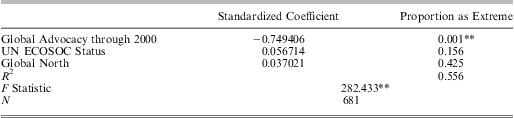
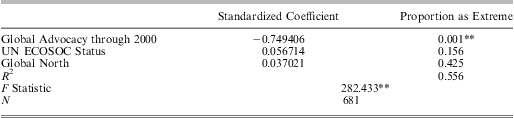
Like other public goods, organizations can free-ride off of the HRO network. Which organizations are likely to do so? As Table 4 highlights, consistent with Hypothesis 2, organizations that have participated in fewer advocacy events in the past are more likely to be intense free-riders. Other structure conditions, like UN ECOSOC status or whether the organization is from the global North, do not explain free-riding intensity with any reliability. Thus, it appears that free-riding is utilized by organizations that have less experience with global activism, conceivably with the hope that they can utilize the network in ways that would increase their future advocacy output.
Determinants of Free-Riding Intensity in 2001 HRO Network, OLS Regression with Permutation-Based Standard Errors
*p < 0.05; **p < 0.01
Substantively, an organization with one standard deviation above the mean number of past advocacy events (around sixty events) is not likely to participate in free-riding activities. If, however, the organization's past advocacy events dropped to just the mean (around four events), the organization is likely to have had an additional 1.35 free-riding events (95 percent confidence interval from 0.32 to 2.42 events). In other words, organizations with less of a history in advocacy are likely to participate in more free-riding, perhaps trying to use the network for their advantage.
Hypothesis 3: The Impact of the HRO Network on International Advocacy
Hypotheses 3a and 3b are supported by the analyses, as shown in Table 5: an organization's eigenvector centrality has a positive influence on future advocacy but free-riding intensity has a slight negative effect. The hypothesis regarding eigenvector centrality is supported both when only the next year's advocacy output is included (Columns 1 and 3) and when the next five years of advocacy outputs are included (Columns 2 and 4), regardless of whether a negative binomial model (Columns 1 and 2) or a zero-inflated negative binomial model (Columns 3 and 4) is used. The hypothesis regarding free-rider intensity is supported in all specifications except the zero-inflated model when the next five years of advocacy outputs is used as the dependent variable.
The Impact of HRO Eigenvector and Free-Riding Intensity on International Advocacy Activities
Note: Coefficients listed first, with robust standard errors in parentheses below. *p < 0.10; **p < 0.05; ***p < 0.01
Substantively, these results indicate the importance of HRO network activities on future advocacy output. If an organization's eigenvector centrality increases from the fiftieth to the seventy-fifth percentile in the dataset, it is expected to have an increase of around fifty-four advocacy events in the next year (95 percent confidence interval from 0.94 to 109.67 events). However, a similar increase in free-rider intensity will result in a decrease of seventeen events (95 percent confidence interval from −23 to −11 events).Footnote 89 Given that the recorded maximum in the advocacy output variable in 2002 is only 528 events and that the mean organization only has 1.65 events in the year, these changes in advocacy output as a result of the organization's involvement in the network are especially interesting, indicating that position within the network has a significant influence on advocacy activities.
This supports, at a most basic level, the argument of the TAN literature; networks do matter for advocacy activities. However, these results also go beyond the TAN literature in demonstrating how the HRO network, as a public good, matters for advocacy: all organizations stand to benefit from the network but organizations that free-ride may have a diminished ability to change the public good of the network into actual advocacy output.
I ran a number of statistical robustness checks concerning this result that are available in online Appendix 1. First, the results are consistent if I run models with eigenvector centrality and free-rider intensity separately or if I utilize the measure indegree instead of eigenvector centrality. Additional robustness tests using an interaction term between eigenvector centrality and free-rider intensity show that eigenvector centrality has a net positive effect on international advocacy for all organizations but that more free-riding can dampen this positive effect.
Conclusions
Scholars are interested in understanding the role that HROs have on a state's human rights practices. Much theoretical work on human rights advocacy centers on the behavior of networks of these organizations. Unfortunately, not much research has systemically examined the structure of the HRO network or the factors that influence whether organizations are connected to this network. This project, by examining the characteristics that lead organizations to become connected to each other and by connecting network characteristics to advocacy activities, serves as an important first step in understanding the role networks play in human rights advocacy. I overcome the empirical limitations of existing scholarship through the use of new data that measures the connections HROs have to each other. Additionally, this research utilizes methodological tools best suited for the study of networks.
By drawing theoretical attention to differences between organizations, I highlight factors which could either aid or impede the success of advocacy within a particular locale. For example, if Southern HROs are less likely to be connected to the overall network, this could limit information flows and human rights advocacy outside of Western democracies. It could also limit the salience of certain human rights issues important to people living in the global South.Footnote 90 Likewise, given the limited connections religious HROs have to the overall network, religious minority rights could be sidelined from the larger human rights movement.
Moreover, by drawing on cross-disciplinary research, this project presents the HRO network as a public good. The HRO network supplies organizations with information, contacts, and prestige. This project is the first that empirically shows that organizations can tap into this public good in ways that increase their international advocacy output. As such, this research represents one of the first attempts to connect a HRO's role in the network systematically to its advocacy output. Other studies of NGO networks could employ the methodological approach taken in this article to see whether network characteristics matter for advocacy output. Environmental INGOs, as another type of organization that utilizes shaming in the popular media, would be an especially interesting issue area for an extension of this project.Footnote 91 Given that other research has indicated some divisiveness amongst environmental INGOs, the effects of network position on advocacy output may be different.Footnote 92 Another useful extension to this project could focus on how network characteristics might influence advocacy output differently in different political regimes.
Additionally, this research expands upon previous research on the NGO network as a public good by highlighting that, like all public goods, there are issues of free-riding. Organizations with a limited history of previous advocacy are more likely to free-ride and, although being any part of the network can aid in future advocacy, free-riding can have a slight negative effect on advocacy outputs. This is arguably due to the lack of fully contributed connections that only come from a deeper back-and-forth involvement with other organizations.
This project offers many practical and policy relevant recommendations for those interested in the realization of human rights. First, this research would support efforts by IGOs to bring together HROs, and highlights the advocacy-related payoffs of these arrangements. Additionally, this research would support aid to Southern HROs to attend larger conferences and programs designed to increase the ability of Southern HROs to work with each other and with their Northern counterparts. These results would also support ongoing efforts to strengthen ties within the HRO community. As Eleanor Roosevelt famously said, the ‘curious grapevine’ of HRO connections does matter for the work of these organizations in the promotion of human rights.