There is increasing concern worldwide with regard to the adjustment of children exposed to political violence (Feerick & Prinz, Reference Feerick and Prinz2003). Research has documented the risk for psychopathology in children growing up in contexts of political violence (Belsky, Reference Belsky2008; Garbarino & Kostelny, Reference Garbarino and Kostelny1996; Qouta, Punamäki, & El Sarraj, Reference Qouta, Punamäki and El Sarraj2008; Sagi-Schwartz, Reference Sagi-Schwartz2008). Longitudinal research is rare, with few studies examining trajectories of relations over multiple time points. Addressing these gaps in the research on political violence and child adjustment, the present study examines relations between sectarian and nonsectarian antisocial behavior (SAB and NAB) and youth adjustment over 4 consecutive years in Belfast, Northern Ireland, an area that has experienced protracted political violence.
The field of developmental psychopathology emphasizes studying relations between specific social contexts and risks for child maladjustment (Cicchetti & Cohen, Reference Cicchetti, Cohen, Cicchetti and Cohen1995; Cummings, Davies, & Campbell, Reference Cummings, Davies and Campbell2000). Bronfenbrenner's (Reference Bronfenbrenner1979) social ecological model of hierarchically nested ecosystems provides a framework for conceptualizing the social ecology of political violence from the child's perspective, including the effects of violence in the community (Cicchetti & Lynch, Reference Cicchetti and Lynch1993; Elliott, Wilson, Huizinga, & Sampson, Reference Elliott, Wilson, Huizinga and Sampson1996; Lynch & Cicchetti, Reference Lynch and Cicchetti1998; Salzinger, Feldman, Stockhammer, & Hood, Reference Salzinger, Feldman, Stockhammer and Hood2002). From a developmental psychopathology perspective, longitudinal studies that differentiate the effects of specific contexts of community violence (e.g., sectarian vs. nonsectarian) on child adjustment significantly contribute to understanding risks for the development of psychopathology (Cummings, Goeke-Morey, Schermerhorn, Merrilees, & Cairns, Reference Cummings, Goeke-Morey, Schermerhorn, Merrilees and Cairns2009; Dubow, Huessmann, & Boxer, Reference Dubow, Huesmann and Boxer2009). The field of developmental psychopathology is also concerned with studying at-risk developmental stages and ages (Cicchetti, Reference Cicchetti and Cicchetti2006); this study focuses on preadolescence and adolescence, periods during which youths are at heightened risk for being victims, witnesses, or perpetrators of sectarian violence (Shirlow & Murtagh, Reference Shirlow and Murtagh2006).
A growing body of research indicates that children's development is affected by neighborhood characteristics (Elliot et al., Reference Elliott, Wilson, Huizinga and Sampson1996; Leventhal & Brooks-Gunn, Reference Leventhal and Brooks-Gunn2000; Parente & Mahoney, Reference Parente and Mahoney2009; Sampson, Morenoff, & Raudenbush, Reference Sampson, Morenoff and Raudenbush2005; Shinn & Toohey, Reference Shinn and Toohey2003). Neighborhoods are geographically relatively small, bounded, and symbolically influenced spaces, meaningful to residents, and relatively stable over time (Ward, Reference Ward, Dawes, Bray and Van Der Merwe2010). Moreover, the impact of neighborhood on adjustment is arguably more important for less mobile and higher risk groups (e.g., economically and socially deprived groups, the young, and the elderly; Ward, Reference Ward, Dawes, Bray and Van Der Merwe2010). The present study focuses on youths and families living in socially deprived neighborhoods, with most residents sharing a common ethnic identity within neighborhoods.
In studies in the United States, community violence is linked with children's adjustment problems (Gorman-Smith & Tolan, Reference Gorman-Smith and Tolan1998; Guerra, Huesmann, & Spindler, Reference Guerra, Huesmann and Spindler2003; Jaycox et al., Reference Jaycox, Stein, Kataoka, Wong, Fink and Escudero2002; Lynch & Cicchetti, Reference Lynch and Cicchetti1998, Reference Lynch and Cicchetti2002; Margolin & Gordis, Reference Margolin and Gordis2000). Neighborhood violence has also been linked with children's trajectories of aggression (Vanfossen, Brown, Kellam, Sokoloff, & Doering, Reference Vanfossen, Brown, Kellam, Sokoloff and Doering2010) and depressive symptoms (Wight, Botticello, & Aneshensel, Reference Wight, Botticello and Aneshensel2006). Mayer and Jencks (Reference Mayer and Jencks1989) have argued that youths living in dangerous neighborhoods are at greater risk for adjustment problems because of contagion from the influence of the crime that surrounds them and a lack of social control that would minimize externalizing problems. The present study is concerned with relations between characteristics of community violence and trajectories of children's adjustment problem over time.
Evidence is increasing that violence and conflict negatively affect children's adjustment in contexts of political violence (Ajdukovic & Biruski, Reference Ajdukovic and Biruski2008; Barber, Reference Barber2008; Brook, Brook, & Whiteman, Reference Brook, Brook and Whiteman2007; Dubow et al., Reference Dubow, Boxer, Huesmann, Shikaki, Landau and Gvirsman2010). For example, in South Africa, exposure to community violence has been linked to greater psychological distress, moderated in part by neighborhood factors (Barbarin, Richter, & de Wet, Reference Barbarin, Richter and de Wet2001; Shields, Nadasen, & Pierce, Reference Shields, Nadasen and Pierce2008). In Israel, links are reported between exposure to severe political violence and psychopathological symptoms among 10- to 18-year-old youths (Slone & Shechner, Reference Slone and Shechner2009), and in Palestine, neighborhood political violence and disorganization are associated with posttraumatic stress, aggressive behavior, and adjustment problems (Barber, Reference Barber2001; Dubow et al., Reference Dubow, Boxer, Huesmann, Shikaki, Landau and Gvirsman2010).
In these contexts, community violence is unlikely to be a homogenous element of the social ecology. At least two types of community violence can be distinguished in contexts of political violence: sectarian violence, which is associated with the political context of war and intergroup aggression, and nonsectarian violence, which is “ordinary” crime potentially found in any context. For examples, a few recent studies have differentiated between child exposure to war and community violence that is not war related (Dubow et al., Reference Dubow, Boxer, Huesmann, Shikaki, Landau and Gvirsman2010; Elbedour, ten Bensel, & Bastien, Reference Elbedour, ten Bensel and Bastien1993; Slone & Shechner, Reference Slone and Shechner2009). Discriminating between these types of violence holds promise for advancing understanding of outcomes associated with political and nonpolitical discord at the community level (Cummings et al., Reference Cummings, Goeke-Morey, Schermerhorn, Merrilees and Cairns2009; McAloney, McCrystal, Percy, & McCartan, Reference McAloney, McCrystal, Percy and McCartan2009).
The impact of sectarian and nonsectarian community violence on youth's adjustment may be moderated by other dimensions of neighborhood discord, such as crime in specific communities. Higher crime rates may serve to further increase children's emotional insecurity about community and thereby relations with adjustment problems over time. Children's emotional insecurity, reflected in higher propensities for emotional and behavioral dysregulation and development of adjustment problems, is sensitive to multiple sources of threat to safety and protection. The sources of safety and protection include interparental, parent–child, family, and community systems (Waters & Cummings, Reference Waters and Cummings2000). Emotional security has been repeatedly shown to be linked with adjustment problems across age groups and over time (Cummings, George, McCoy, & Davies, Reference Cummings, George, McCoy and Davies2012; Cummings, Schermerhorn, Davies, Goeke-Morey, & Cummings, Reference Cummings, Schermerhorn, Davies, Goeke-Morey and Cummings2006)
The impact of sectarian community violence on youth adjustment has been shown in several recent studies to be mediated by emotional insecurity (Cummings, Merrilees, et al., Reference Cummings, Merrilees, Schermerhorn, Goeke-Morey, Shirlow and Cairns2010, Cummings, Schermerhorn, et al., Reference Cummings, Schermerhorn, Merrilees, Goeke-Morey, Shirlow and Cairns2010; Cummings, Merrilees, et al., Reference Merrilees, Cairns, Taylor, Goeke-Morey, Shirlow and Cummings2011, Reference Cummings, Merrilees, Schermerhorn, Goeke-Morey, Shirlow and Cairns2012). Given the long-term effects on adjustment that have been associated with emotional insecurity (Cummings & Davies, Reference Cummings and Davies2010; Cummings, George, et al., Reference Cummings, George, McCoy and Davies2012), these demonstrated relations between sectarian community violence and emotional insecurity increase the likelihood of lasting relations over time with youth's adjustment problems. In addition, by further elevating children's security concerns about community, higher crime rates may intensify the impact of sectarian community violence on adjustment. By comparison, weaker relations are reported in these studies between nonsectarian community violence and youth's emotional insecurity. Thus, higher crime may be less likely to accentuate processes linked with adjustment problems owing to nonsectarian community violence, reducing the likelihood of an intensification of relations with adjustment problems.
Specifically, this present paper is concerned with comparing youth's trajectories of adjustment problems over four time points associated with sectarian and nonsectarian community antisocial behavior, including consideration of these relations as a function of neighborhood crime rates. Given scant exploration of trajectories of adjustment problems in contexts of historical political violence, the study of trajectories is exploratory. Normative developmental trends toward declines in adjustment problems over time in this age period based on standardized assessments have been reported in high-risk social environments (Fagg, Curtis, Clark, Congdon, & Stansfeld, Reference Fagg, Curtis, Clark, Congdon and Stansfeld2008). Regardless of the slopes of the trajectories found, however, trajectories of behavior problems are expected to be relatively elevated in high-crime neighborhoods. From a developmental psychopathology perspective, this direction further advances the examination of specific contexts of community violence by incorporating multiple indicators of violence and threat in cultures characterized by political violence as they relate to children's adjustment.
In Northern Ireland, sectarian community violence occurs between two groups, specifically Catholics and Protestants (for a brief history of the sectarian conflict in Northern Ireland, see Cairns & Darby, Reference Cairns and Darby1998), and contemporary studies focus on the 30-year period of violence from 1968 to 1998 known as the “Troubles.” After many attempts to achieve peaceful solutions, the Belfast/Good Friday Agreement was reached in 1998, eventually leading to intercommunity power sharing and the endorsement of cultural rights. Despite the signing of peace accords, substantial sectarian violence continues, especially in socially deprived communities in Belfast (e.g., see Police Service of Northern Ireland, Central Statistics Branch, Operational Support Department, 2006/2007), indicating sectarian tensions persist between the highly segregated Catholic and Protestant communities (MacGinty, Muldoon, & Ferguson, Reference MacGinty, Muldoon and Ferguson2007; McGrellis, Reference McGrellis2005; Shirlow & Murtagh, Reference Shirlow and Murtagh2006). Many neighborhoods and most schools in Belfast remain highly segregated (Hughes, Campbell, Hewstone, & Cairns, Reference Hughes, Campbell, Hewstone and Cairns2007). Moreover, as paramilitary organizations have disbanded and decommissioned, it has been evident that young people, unaffiliated with such organizations, have been at the forefront of sectarian rioting and crime (Haydon & Scraton, Reference Haydon and Scraton2008; Shirlow & McEvoy, Reference Shirlow and McEvoy2008). McAloney and colleagues (Reference McAloney, McCrystal, Percy and McCartan2009) recently reported that over three quarters of adolescents (15- to 16-year-olds) in Belfast had experienced violence in their communities, reflecting a social and psychological legacy of the Troubles.
Nonsectarian violence in Northern Ireland is also on the rise; for example, the number of reported nonpolitically motivated assaults across Belfast rose 50% between 2000 and 2008 (PService of Northern Ireland, 2010). This is likely the result of the growth in intragroup antisocial behavior, including significant growth in physical assault violence, which emerged as policing and other forms of militarization were reduced. This increase in nonsectarian community violence is a phenomenon observed in other parts of the world in postaccord periods (Darby, Reference Darby2006).
Cummings and colleagues (Reference Cummings, Goeke-Morey, Schermerhorn, Merrilees and Cairns2009) recently advanced an approach to distinguish between these contexts of community violence in areas of intergroup conflict in Belfast. A first step was to determine the characteristic expressions of community violence in contexts of political violence by means of focus groups, resulting in items reflecting SAB or NAB (Taylor, Merrilees, Cairns, & Cummings, Reference Taylor, Merrilees, Cairns and Cummings2009). Focus group participants described SAB as violence motivated by intergroup hostility, whereas NAB reflected intragroup violence that did not have political or sectarian bases. In order to further revise and validate these scales, these items were tested as predictors of children's adjustment problems in another area of historical sectarian violence. Specifically, a two-wave pilot study was conducted with mothers in Derry/Londonderry, Northern Ireland; SAB was more closely linked than was NAB with adjustment problems (Goeke-Morey et al., Reference Goeke-Morey, Cummings, Ellis, Merrilees, Schermerhorn and Shirlow2009). In addition, subsequent factor analyses and qualitative analyses of the responses of focus groups of Belfast mothers also supported distinctions between sectarian and nonsectarian community violence (Goeke-Morey et al., Reference Goeke-Morey, Cummings, Ellis, Merrilees, Schermerhorn and Shirlow2009; Taylor et al., Reference Taylor, Merrilees, Campbell, Shirlow, Cairns and Goeke-Morey2011).
Recent quantitative studies further support the validity of these distinctions. In cross-sectional (Cummings, Merrilees, et al., Reference Cummings, Merrilees, Schermerhorn, Goeke-Morey, Shirlow and Cairns2010; Cummings, Schermerhorn, et al., Reference Cummings, Schermerhorn, Merrilees, Goeke-Morey, Shirlow and Cairns2010) and three-wave longitudinal (Cummings, Merrilees, et al., Reference Merrilees, Cairns, Taylor, Goeke-Morey, Shirlow and Cummings2011, Reference Cummings, Merrilees, Schermerhorn, Goeke-Morey, Shirlow and Cairns2012) studies, SAB and NAB are linked with different pathways of risk for adjustment problems. As already noted, compared to NAB, SAB is related to adjustment problems by elevating children's emotional insecurity about multiple social contexts (Cummings, Merrilees, et al., Reference Cummings, Merrilees, Schermerhorn, Goeke-Morey, Shirlow and Cairns2010, Reference Merrilees, Cairns, Taylor, Goeke-Morey, Shirlow and Cummings2011, Reference Cummings, Merrilees, Schermerhorn, Goeke-Morey, Shirlow and Cairns2012; Cummings, Schermerhorn, et al., Reference Cummings, Schermerhorn, Merrilees, Goeke-Morey, Shirlow and Cairns2010). In contrast, NAB has been either directly related to children's adjustment problems or linked with family-level variables such as parental monitoring of youth's behavior and psychological control (Cummings, Merrilees, et al., Reference Cummings, Merrilees, Schermerhorn, Goeke-Morey, Shirlow and Cairns2010, Reference Merrilees, Cairns, Taylor, Goeke-Morey, Shirlow and Cummings2011; Merrilees et al., in press). The distinction between SAB and NAB is thus pertinent to identifying how children are affected by different types of violence to advance theoretical models of the social ecology of political violence (Cummings et al., Reference Cummings, Goeke-Morey, Schermerhorn, Merrilees and Cairns2009).
The goal of the present study is to further examine the distinction between SAB and NAB as it relates to trajectories of children's adjustment over time. This study advances examination of intraindividual change in youth adjustment and the effects of SAB and NAB on adjustment at each of four time points, increasing reliability of assessment of these relations. This is also the first study to model interindividual differences in intraindividual change in a setting of political violence. Building on the proposition that distinguishing between SAB and NAB is significant to the prediction of children's adjustment problems, the current paper examines the question of whether either, or both, types of community violence factor into children's trajectories of adjustment problems over time in a context of historical political violence.
Method
Participants
Participants included mothers and their children who participated in at least one wave of a longitudinal study on political violence and family processes in Belfast, Northern Ireland, with the children approximately evenly divided between girls and boys (N = 999 mother–child dyads; 482 boys and 517 girls). Children's mean age was 12.18 (SD = 1.82), 13.24 (SD = 1.83), 13.61 (SD = 1.99), and 14.66 years (SD = 1.96), respectively, across the four time points. Forty-two percent of mothers were married or living as married (n = 571), and 58% were in single-parent households (n = 413), including being separated, divorced, widowed, or having never married. Reflective of the overall population demographics of Northern Ireland (57% Protestant, 43% Catholic; Darby, Reference Darby2001), 61% of families identified as Protestant (n = 610), 38% as Catholic (n = 379), and 10 families refused to select one of the two affiliations (1%). Mothers, rather than fathers, were selected to participate for pragmatic reasons: (a) many families in working-class Belfast are led by single mothers; (b) mothers are more likely than fathers to be available for in-home surveys during the day; and (c) including many mothers and only a small number of fathers as parental reporters could pose considerable problems for data analysis and interpretation of results.
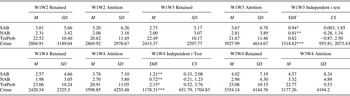
Retention and attrition rates were examined across the four time points. Across waves, retention was approximately 80% of the sample from the previous time point. This rate of retention is at the higher end of the range of retention reported for comparable high-risk, longitudinal samples, with retention rates in these studies ranging from 50% to 86% (e.g., Betancourt et al., Reference Betancourt, Borisova, Williams, Brennan, Whitfield and de la Soudiere2010; Browning, Burrington, Leventhal, & Brooks-Gunn, Reference Browning, Burrington, Leventhal and Brooks-Gunn2008; Kronenberg et al., Reference Kronenberg, Hansel, Brennan, Osofsky, Osofsky and Lawrason2010). Of the original sample of 695 mother–child dyads beginning participation at Time 1, 82% returned at Time 2 (n = 572), 67% (n = 466) at Time 3, and 61% (n = 422) at Time 4. At least three attempts were made to locate each family at each time point. Exemplifying reasons for attrition, and based on Time 4 as an example, reasons included inability to reach the family after three attempted calls (39%), the family moved with no forwarding details (36%), and the family refused to participate (16%); reasons for the remaining 9% of attrition included death of the mother, the child went to jail, or the house was demolished, vacant, or blocked up when interviewers attempted to find the family. The only differences across waves in the original sample were that families with higher SAB, NAB, and objective crime at Time 1 were less likely to return at Times 3 and Time 4 (Table 1).
Attrition and retention comparisons across all four time points

Note: W1–W4, Waves 1–4.
*p < .05. **p < .01. ***p < .001.
A supplemental set of families living in the original study areas was added to the longitudinal study at Time 3. Recruitment of new families oversampled relatively higher risk neighborhoods characterized by greater attrition. Goals were to achieve similar relative distributions of families across neighborhoods as was had at the outset of the study and to elevate the sample size in order to better support adequate representation of neighborhoods for Time 3 and any subsequent years of the longitudinal study. As anticipated, given the oversampling of families from higher risk neighborhoods, supplemental families scored higher on youth adjustment problems, SAB, NAB, and objective crime (Table 2). Of the combined 770 mother–child dyads participating at Time 3, 82% returned at Time 4 (n = 631). No differences were found between families participating and not participating at Times 3 and 4 (Table 1).
Comparisons of supplemental and W3 attrition families

Note: W1, Wave 1; W3, Wave 3; SAB, sectarian antisocial behavior; NAB, nonsectarian antisocial behavior.
*p < .05. **p < .01. ***p < .001.
Procedures: Neighborhood and family selection
The original study areas were selected to obtain a representative sample of Catholics and Protestants and variation in levels of sectarian violence, while limiting socioeconomic differences (see Cummings, Schermerhorn, et al., Reference Cummings, Schermerhorn, Merrilees, Goeke-Morey, Shirlow and Cairns2010). Consistent with the segregated nature of life in Belfast, particularly in the neighborhoods associated with historical political violence (Shirlow & Murtagh, Reference Shirlow and Murtagh2006), the majority of study participants lived in wards that were ethnically homogenous (over 90% Catholic or Protestant; Northern Ireland Statistics & Research Agency, 2011). At the same time, many study neighborhoods were interfaced, that is, they shared a border with neighborhoods predominantly populated by the other group. Although families selected for this study typically lived bordering the other community, they continued to live segregated lives (Cairns & Toner, Reference Cairns, Toner, Leavitt and Fox1993; Shirlow & Murtagh, Reference Shirlow and Murtagh2006), with this Catholic/Protestant separation permeating marital, educational, and professional relationships (Hughes et al., Reference Hughes, Campbell, Hewstone and Cairns2007).
A demographer expert in the ethnic, social, historical, and economic characteristics of Belfast identified neighborhoods varying in both historical and current politically motivated sectarian violence. To control for the possible confound of socioeconomic status, all study areas were from working-class, socially deprived wards. In Northern Ireland, all 582 wards receive a Multiple Deprivation Rank based on income, employment, health, education, proximity to services, crime, and the quality of the living environment. All of the areas included in this study were in the lowest quartile in terms of Multiple Deprivation Rank (Northern Ireland Statistics & Research Agency, 2011).
Within these targeted neighborhoods, data was collected from 35 to 40 families, and all participation was voluntary. A family was eligible to participate if there was a child between the ages of 10 and 17 years old living in the home, although a small number of families with slightly younger children were allowed to participate. For families with two or more children within the indicated age range, the youngest interested child participated. This age period was selected because children and adolescents in the target age range (a) have been shown to be aware of the social distinctions relevant to the study (Catholic/Protestant differences; Cairns, Reference Cairns1987) and (b) are likely to be informed about or exposed to sectarian and nonsectarian violence, as observers, victims, or participants. Families added at Time 3 were identified and recruited following the same procedures within the same study areas as for the original sample at Time 1.
Professional interviewers from an established market research firm conducted in-home surveys with mothers and children, which lasted approximately 1.0 and 0.5 hr, respectively. Given the close-knit nature of these communities, community leaders were first identified by the demographer expert in these areas of Belfast, and letters were sent to these community leaders informing them that we planned to contact families in their communities concerning participation in a research study of political violence, community, and family relationships and child development. Next, letters with the same description of the study were sent to families, inviting them to participate. Families were then contacted by phone or engaged door-to-door, consistent with local custom in Belfast. The confidential and voluntary nature of the study was emphasized. Interviewers were frequently from these neighborhoods or similar neighborhoods, which facilitated rapport building with participants. Before participating, mothers and children provided consent and assent, respectively; families received £20 at Times 1 and 2 and £40 at Times 3 and 4 for their participation. Research protocol and measures were approved by the institutional review boards at all participating universities.
Measures
SAB and NAB
Scales assessed child's awareness of SAB and NAB in their communities. As already noted, the measures, developed specifically for the social ecological context of Belfast, reflect a culturally relevant way to distinguish between political and everyday crime in contemporary Northern Ireland. Focus groups with mothers living in Belfast revealed that individuals living in these areas clearly distinguished between sectarian and nonsectarian threats to their communities (Taylor et al., Reference Taylor, Merrilees, Cairns and Cummings2009, Reference Taylor, Merrilees, Campbell, Shirlow, Cairns and Goeke-Morey2011). From focus group transcripts, scales were developed and tested in a pilot project with mothers in Derry/Londonderry to establish the psychometric properties, including factor analyses supporting the distinctiveness of the SAB versus NAB items and predictive validity of these measures (see Goeke-Morey et al., Reference Goeke-Morey, Cummings, Ellis, Merrilees, Schermerhorn and Shirlow2009, for a report of instrument development). Original internal consistencies from the pilot data of the two scales were .94 (SAB) and .68 (NAB). When tested together, the factor loadings were clearly distinguishable, and the two factors for SAB and NAB were moderately correlated in the pilot study, r (104) = .47, p < .001 (Goeke-Morey et al., Reference Goeke-Morey, Cummings, Ellis, Merrilees, Schermerhorn and Shirlow2009). These two scales have also been distinguished in previous papers, including consistent differences in predictive validity, that is, differences in correlates and relations with other elements of the ecosystem and adjustment problems (Cummings, Merrilees, et al., Reference Cummings, Merrilees, Schermerhorn, Goeke-Morey, Shirlow and Cairns2010; Cummings et al., Reference Cummings, Merrilees, Schermerhorn, Goeke-Morey, Shirlow and Cairns2011; Cummings, Schermerhorn, et al., Reference Cummings, Schermerhorn, Merrilees, Goeke-Morey, Shirlow and Cairns2010).
In the current analyses, child-report versions of both scales were used. Using a 5-point scale (0 = not in the last 3 months, 1 = once in the last 3 months, 2 = every month, 3 = every week, 4 = every day) youths reported on how frequently in the last 3 months a series of items occurred. The instructions were as follows: “This set of questions is about your community. For these next questions, your community refers to the [insert denominational community participant identified earlier] community. And the OTHER community refers to the [insert other] community. These next questions are about things that might happen in your community. Please report only events that actually occurred in the community, not incidents from movies or fictional television” (Cummings, Schermerhorn, et al., Reference Cummings, Schermerhorn, Merrilees, Goeke-Morey, Shirlow and Cairns2010, p. 841).
For the 12-item SAB scale, items included stones or objects thrown over walls, name calling by people from the other community, and deaths or serious injury caused by the other community (for the complete scale, see Cummings, Schermerhorn, et al., Reference Cummings, Schermerhorn, Merrilees, Goeke-Morey, Shirlow and Cairns2010). The 7-item NAB scale included items such as drunkenness, drugs being used or sold, and home break-ins (see Cummings, Schermerhorn, et al., Reference Cummings, Schermerhorn, Merrilees, Goeke-Morey, Shirlow and Cairns2010, for the complete scale). Good internal consistencies for each scale were obtained across all four time points of the present study (Cronbach αs = 0.90, 0.95, 0.96, and 0.98 for SAB and 0.73, 0.87, 0.84, and 0.95 for the NAB for Times 1, 2, 3, and 4, respectively). Correlations between SAB and NAB within each time point were .53, .67, .55, and .53 (all p < .01), respectively.
Objective crime
The crime record data were calculated using the annual rates of crime and antisocial behavior that the Police Service of Northern Ireland collects for every ward in Northern Ireland. For the current analyses, criminal offenses across all four time points were collected for each of the study wards. This assessment for each family was thus calculated as the sum of total offenses from May 2006 to April 2010 for their ward. Two caveats should be considered. First, violent criminal offenses included not only actual violence but also the threat of violence, and the severity or degree of violence is varied. Second, due to historic mistrust of the police, particularly in socially deprived and working-class areas of Belfast, which characterized the neighborhoods in the current study, underreporting of crime is common, ranging from 40% to 70% (MacGinty et al., Reference MacGinty, Muldoon and Ferguson2007; Shirlow & Ellison, Reference Shirlow and Ellison2008). For example, the Police Federation alleges that the number of attacks on national security targets in 2010 was over 300% greater than reflected in public statements by the Police Service of Northern Ireland, attempting to make Northern Ireland “appear more normal than it actually is” (BBC News, 2010).
Child adjustment problems
Total youth adjustment problems were assessed with a composite of mother and child reports on the Strengths and Difficulties Questionnaire Goodman, Reference Goodman1997). Psychometric properties of the Strengths and Difficulties Questionnaire are well established in UK samples and are preferable to the Child Behavior Checklist (Achenbach, Reference Achenbach1991) for community samples for predicting adjustment problems (Goodman & Scott, Reference Goodman and Scott1999). The total problems scale consists of 20 items, five questions for each of four subscales: emotional problems (e.g., many worries or often seems worried); peer problems (e.g., often fights with other children or bullies them); hyperactivity (e.g., restless, overactive, or cannot stay still for long); and conduct problems (e.g., steals from home, school, or elsewhere), respectively. The composite score included mother and child responses, with higher scores representing more adjustment problems. A composite variable was used for this outcome variable to reduce the possible confound of single-reporter bias. Good internal consistency for this variable was established in each of the four waves (Cronbach αs = 0.85, 0.84, 0.82, and 0.88, respectively).
Results
Overview of analyses
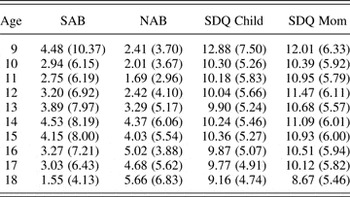
Means and standard deviations for all study variables at each age are shown in Table 3. All data were modeled using a multilevel modeling approach. Multilevel modeling is a preferred method of analyzing nested data such as repeated measures data or data clustered within communities or schools because it can accommodate the dependency of the data. More specifically, separate equations are specified for both the within- and the between-person levels of the data. This approach allows for the study of interindividual differences in intraindividual change. For the within-person variables at Level 1, the outcome variable is regressed on within-person predictors such as time and other time-varying factors in the data (i.e., time-varying covariates). The Level 1 parameters are then used as outcome variables regressed on Level 2 predictors. The data used in the current study are also nested by neighborhood and thus all Level 2 parameters are used as outcome variables at Level 3. A three-level model is used to account for the nesting of the data (either within person or within neighborhood). Ignoring this interdependence in the data can lead to incorrect or misleading conclusions regarding hypotheses of interest. An additional advantage of multilevel modeling is that maximum-likelihood estimation accurately estimates parameters with missing data, assuming that data are missing at random. All analyses were conducted using hierarchical linear modeling software (version 6.06; Raudenbush, Bryk, Cheong, & Congdon, Reference Raudenbush, Bryk, Cheong and Congdon2004). The time variable (age) and the time-varying covariates were centered at the grand mean to enhance interpretability.
Means (standard deviations) for study variables at each age
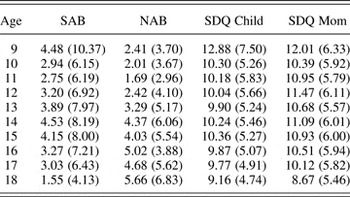
Note: SAB, sectarian antisocial behavior; NAB, nonsectarian antisocial behavior; SDQ, Strengths and Difficulties Questionnaire.
With four time points, the multilevel modeling approach fosters the examination of between-person differences in mean levels (i.e., intercepts), linear change over time, and quadratic change over time. Multiple waves of data also allow for the examination of between-person differences in other predictor variables that are also changing over time, such as exposure to SAB and NAB. However, only three random effects can be estimated with four waves of data. The examination of change over time was modeled first to determine the best fitting model for the outcome variable.
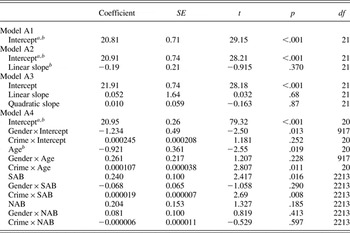
In the first step to assessing how children's adjustment problems changed as children aged across the four time points, a model with a random intercept (Model A1) was tested (see Table 4). This model only allowed for random intercepts, or variability around mean levels without taking into account change over time. Next, a model with a random intercept and a random linear slope was fitted (Model A2). This model was a significantly better fitting model compared to the random intercept model, diff χ2 (5) = 45.25, p < .001.
Results and statistical parameters for multilevel models
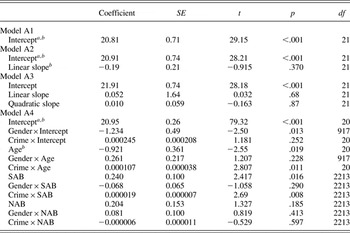
Note: SAB, sectarian antisocial behavior; NAB, nonsectarian antisocial behavior.
aA significant variance in the variance component at Level 2.
bA significant variance in the variance component at Level 3.
To further examine how adjustment problems changed as children aged, a model examining a quadratic slope (Model A3) was assessed and compared with Model A2. Adding the quadratic time parameter did not significantly improve model fit, difference in χ2 (7) = 11.88, p = .10. Thus, time was modeled with a random intercept and a random linear slope in all subsequent models.
We also examined SAB and NAB as time-varying covariates. Because only three random effects can be estimated with four waves of data, we fixed both SAB and NAB to be nonrandom (Singer & Willet, Reference Singer and Willett2003). The resulting model tests the effects of SAB and NAB on children's adjustment problems, controlling for the change in adjustment problems over time (Model A4). Gender was also added as a Level 2 predictor, and objective crime data were added as the Level 3 predictor. The equations for Model A4 follow. For Level 1,
 $$\hbox{adjustment problems} = {\rm \beta} _{0i} + {\rm \beta} _{1i}\lpar {\rm age}\rpar + {\rm \beta} _{2} \lpar {\rm SAB}\rpar + {\rm \beta}_{3} \lpar {\rm NAB}\rpar + e_{ij}.$$
For Level 2,
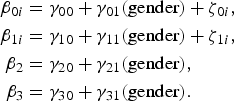 $$\eqalign{{\rm \beta} _{0i} &= {\rm \gamma}_{00}+{\rm \gamma}_{01}\lpar \hbox{gender}\rpar +{\rm \zeta} _{0i}\comma \; \cr {\rm \beta} _{1i} &= {\rm \gamma}_{10}+{\rm \gamma}_{11}\lpar \hbox{gender}\rpar +{\rm \zeta} _{1i}\comma \; \cr {\rm \beta}_{2} &= {\rm \gamma}_{20} + {\rm \gamma}_{21}\lpar \hbox{gender}\rpar \comma \; \cr {\rm \beta}_{3} &= {\rm \gamma}_{30} + {\rm \gamma}_{31}\lpar \hbox{gender}\rpar.}$$
For Level 3,
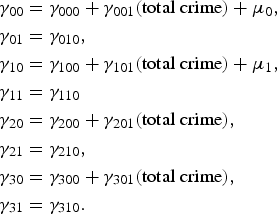 $$\eqalign{{\rm \gamma}_{00} &= {\rm \gamma}_{000} + {\rm \gamma}_{001} \lpar \hbox{total crime}\rpar +{\rm \mu} _{0}\comma \;\cr {\rm \gamma}_{01} &= {\rm \gamma}_{010}\comma \;\cr {\rm \gamma}_{10} &= {\rm \gamma}_{100} + {\rm \gamma}_{101} \lpar \hbox{total crime}\rpar + {\rm \mu}_1\comma \;\cr {\rm \gamma}_{11} &= {\rm \gamma}_{110}\cr {\rm \gamma}_{20} &= {\rm \gamma}_{200} + {\rm \gamma}_{201} \lpar \hbox{total crime}\rpar \comma \;\cr {\rm \gamma}_{21} &= {\rm \gamma}_{210}\comma \;\cr {\rm \gamma}_{30} &= {\rm \gamma}_{300} + {\rm \gamma}_{301} \lpar \hbox{total crime}\rpar \comma \;\cr {\rm \gamma}_{31} &= {\rm \gamma}_{310}.}$$
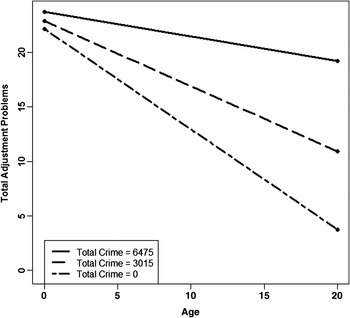
The results from this model indicate that gender (γ = –1.23, SE = 0.49, p = .013) predicts variability in intercepts, suggesting that at the average age, boys in the study have more adjustment problems compared to girls. Results also reflect that on average child adjustment problems decreased with age (β = –0.92, SE = 0.36, p = .019) and that for youths in areas with higher crime rates, the decrease in adjustment problems is less steep (γ = –0.000107, SE = 0.000038, p = .011). In other words, youths in high-crime areas are decreasing in total adjustment problems at a slower rate (see Figure 1). Examining the influence of the time-varying covariates, higher SAB (β = 0.24, SE = 0.10, p = .016) predicted more adjustment problems, but NAB was not a significant time-varying covariate. Thus, controlling for the change in adjustment problems over time, at each age, with both SAB and NAB included together in the same model, SAB but not NAB related to higher levels of adjustment problems.
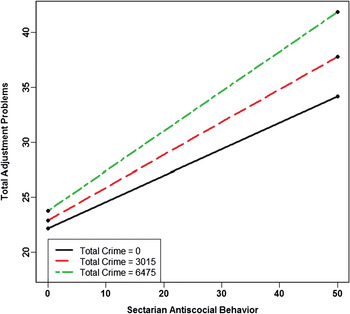
The relations between sectarian antisocial behavior (SAB) and children's adjustment problems at three levels of neighborhood crime. [A color version of this figure can be viewed online at http://journals.cambridge.org/dpp]

Objective crime was also a significant predictor of variability in the time-varying covariate of SAB (γ = 0.00002, SE = 0.000007, p = .008). The positive sign indicated that the relation between SAB and adjustment problems was stronger in areas with higher crime levels as compared to areas of lower crime. A graph of this interaction can be seen in Figure 2. The objective crime values reflect the total number of reported offenses over the course of the 4 years of the study. Neither gender nor the objective crime data were significant predictors of the variability in the relation between NAB and total problems.
The change in total problems over time at three levels of neighborhood crime.

Discussion
The current study supports the significance of politically motivated community violence for children's development in areas of historical political conflict, utilizing a multiwave, longitudinal research design. Moreover, relations between SAB and child adjustment problems were elevated in higher crime neighborhoods. The great majority of studies of political violence and children are based on cross-sectional or retrospective research designs; studies based on four or more waves of data are rare, leaving questions about trajectories of development. This study advances the investigation of the impact of social ecologies of political violence on child adjustment by assessing relations over four time points with multilevel modeling. The findings underscore the importance of differentiating elements of community contexts associated with antisocial behavior and violence (SAB vs. NAB; high-crime neighborhoods vs. low-crime neighborhoods) in conceptualizing the risk for the development of psychopathology among youths in a setting of protracted conflict.
Based on a multilevel modeling approach, with measures of NAB included in model testing, SAB predicted higher youths adjustment problems each year across the 4 years of the study. The findings further support that SAB has different links with trajectories of youth's adjustment problems than does NAB, reinforcing the notion that distinctions between these elements of the social ecology of community violence merit consideration in characterizing risk for the development of adjustment problems in Belfast neighborhoods (Taylor et al., Reference Taylor, Merrilees, Cairns and Cummings2009, Reference Taylor, Merrilees, Campbell, Shirlow, Cairns and Goeke-Morey2011). The study of SAB and NAB as time-varying covariates allows for a more reliable estimate of the predictor on the outcome than in past research based on cross-sectional or retrospective studies.
NAB was not related to children's adjustment. At least in the context of Belfast, the evidence suggests children may not be highly threatened by nonsectarian community violence, reflected in the nonsignificant relations reported with children's emotional insecurity about multiple social contexts (e.g., family and community; Cummings, Merrilees, et al., Reference Cummings, Merrilees, Schermerhorn, Goeke-Morey, Shirlow and Cairns2010, Reference Merrilees, Cairns, Taylor, Goeke-Morey, Shirlow and Cummings2011, Reference Cummings, Merrilees, Schermerhorn, Goeke-Morey, Shirlow and Cairns2012; Cummings, Schemerhorn, et al., Reference Cummings, Schermerhorn, Merrilees, Goeke-Morey, Shirlow and Cairns2010). As noted already, children's emotional insecurity is associated with dysregulation in multiple emotional and regulatory response processes, which in turn have been related to children's adjustment problems over time (e.g., Cummings, George, et al., Reference Cummings, George, McCoy and Davies2012). Based on the evidence thus far, these processes appear to be less engaged by NAB than by SAB.
The lack of relations between nonsectarian community violence and child adjustment was found despite increases in nonsectarian community violence in Belfast since the signing of the Good Friday peace accord in 1998. In Northern Ireland, as well as elsewhere (e.g., South Africa), increases in nonsectarian conflict may be a result of changes in social organizations and structures related to postaccord political processes. There are at least two possible bases for this increase in Northern Ireland. First, the Belfast Agreement committed to a reduction in policing and the removal of the army's security role. Demilitarization led to a significant removal of security surveillance and state security presence in areas of high political violence. Second, paramilitary groups agreed to end their use of punishment violence. In both instances, demilitarization led to less surveillance and direct control over citizens, and a distinct state and nonstate policing vacuum (Monaghan & McLaughlin, Reference Monaghan and McLaughlin2006; Shirlow & Murtagh, Reference Shirlow and Murtagh2006). In this sense, increases in nonsectarian community violence may sometimes constitute unintended consequences or aftermaths of peace accords, and there is reason for concern about relations between NAB and child adjustment problems.
Some inconsistent evidence supports relations between NAB and children's greater adjustment problems in Belfast (Cummings et al., Reference Cummings, Merrilees, Schermerhorn, Goeke-Morey, Shirlow and Cairns2011), and these relations may become evident in future tests including process-oriented factors that may mediate relations between NAB and child adjustment problems (Cummings, Schermerhorn, et al., Reference Cummings, Schermerhorn, Merrilees, Goeke-Morey, Shirlow and Cairns2010). Recent studies have begun to shed light on how one form or another of community antisocial behavior may have pathology-inducing power and the processes that may explain the differential effects. For example, the evidence thus far suggests that mediators of effects on adjustment problems are different, with SAB more closely related to children's emotional insecurity across settings (e.g., community and family relationships; e.g., Cummings, Merrilees, et al., Reference Cummings, Merrilees, Schermerhorn, Goeke-Morey, Shirlow and Cairns2010, Reference Merrilees, Cairns, Taylor, Goeke-Morey, Shirlow and Cummings2011; Cummings, Schermerhorn, et al., Reference Cummings, Schermerhorn, Merrilees, Goeke-Morey, Shirlow and Cairns2010), whereas the effects of NAB may involve other processes, including parental behavioral control practices (Cummings, Merrilees, et al., Reference Cummings, Merrilees, Schermerhorn, Goeke-Morey, Shirlow and Cairns2010; Merrilees et al., in press). In addition, considering the increasing prevalence of these forms of community discord over the past decade in Northern Ireland, relations between NAB and children's adjustment merit continued study.
In the current study, relations between SAB and child adjustment were particularly accentuated by higher levels of crime. One possible explanation is that higher background crime rates may amplify negative processes already associated with SAB, such as elevated emotional insecurity about the community (Cummings, Merrilees, et al., Reference Cummings, Merrilees, Schermerhorn, Goeke-Morey, Shirlow and Cairns2010, Reference Merrilees, Cairns, Taylor, Goeke-Morey, Shirlow and Cummings2011). Thus, there are substantial bases for hypothesizing possible relations of SAB to emotional insecurity, which may be accentuated in contexts of higher crime. This moderation effect for crime further underscores the importance of context for understanding child outcomes, with implications for a developmental psychopathology perspective on children's risk for adjustment problems in settings of intergroup conflict. The message is that youths growing up in areas of high crime are particularly susceptible to adjustment problems when also exposed to sectarian community violence, further identifying contexts in which children are most at risk for the development of psychopathology. One possibility is that living in areas of high crime may sensitize children to threatening community stressors, such as sectarian community violence, thereby elevating emotional and behavioral response processes associated with greater risk for the development of adjustment problems. These processes have been documented with regard to other social stressors (e.g., marital conflict; Davies, Sturge-Apple, Winter, Cummings, & Farrell, Reference Davies, Sturge-Apple, Winter, Cummings and Farrell2006; Goeke-Morey, Papp, & Cummings, Reference Goeke-Morey, Papp and Cummings2013), but study has not yet been extended to community stressors. Future research should examine process-oriented models for the joint effects of these different elements of community contexts associated with antisocial behavior and violence, including whether common mediating processes are involved and whether effects are cumulative or interactive.
It is interesting that youths in high-crime areas did experience higher rates of NAB; that is, NAB and crime rates were correlated. However, experiencing NAB in high-crime areas was not related to increased adjustment problems. One possible interpretation is that experiencing nonsectarian forms of antisocial behavior may not induce the same sensitization to crime that appears to be induced by sectarian forms of antisocial behavior. We are not suggesting that NAB is not a concern for families and youths in these areas but that the processes linking exposure to nonsectarian forms of antisocial behavior and youths outcomes are different compared to exposure to sectarian forms.
Developmental change also merits comment. Controlling for the effect of SAB and NAB on youth adjustment, adjustment problems decreased as children grew older, but less so for children in high-crime areas. The decline in adjustment problems over time for this age range is consistent with research in other contexts involving high-risk environments. For example, in urban areas of East London, children's age has been found to be negatively correlated with adjustment problems across an age range of 8- to 15-year-olds (Fagg et al., Reference Fagg, Curtis, Clark, Congdon and Stansfeld2008). Bongers, Koot, van der Ende, & Verhulst (Reference Bongers, Koot, van der Ende and Verhulst2003, Reference Bongers, Koot, van der Ende and Verhulst2004) also reported linear decreases over time for multiple adjustment problems between the ages of 4 and 18 years. However, it remains for future research to identify the substantive bases for declines in developmental trajectories of adjustment problems over time; this is a topic that warrants further study.
Certain limitations should be acknowledged. First, most children ranged between 10 and 15 years of age, reflecting our interest in studying age groups at risk for becoming participants as well as observers of sectarian conflict. Although evidence is limited on the relative vulnerability of children as a function of age to SAB or NAB, future research should further examine age as a possible vulnerability or protective factor in social ecological contexts associated with historical political violence (Muldoon, Reference Muldoon2003; Slone & Shechner, Reference Slone and Shechner2009). Additional sources of information about key constructs, for example, additional measures focused on adjustment problems in adolescence, would strengthen tests. Second, gender differences may interact with age in contributing to adjustment outcomes, which is another issue that merits further study. The findings of this study indicating higher levels of boys' adjustment problems in these contexts are troubling (see also Dubow et al., Reference Dubow, Boxer, Huesmann, Shikaki, Landau and Gvirsman2010), given the greater likelihood that boys rather than girls will become involved in interethnic conflict and violence (Ajdukovic & Biruski, Reference Ajdukovic and Biruski2008; Barber, Reference Barber2008; Dubow et al., Reference Dubow, Boxer, Huesmann, Shikaki, Landau and Gvirsman2010; Shirlow & Murtagh, Reference Shirlow and Murtagh2006). Third, to follow up on these issues, another direction is asking youths about their role in SAB or NAB, including victim, witness, or perpetrator. Social identity may also factor in these relations (Merrilees et al., in press). Fourth, the inclusion of an enrichment sample at Time 3 may have also possibly introduced bias to the trajectories of adjustment problems. These biases were controlled or minimized by using a maximum-likelihood estimation approach in the analyses, which adequately estimates missing data. However, if missingness of either the original or the enrichment samples is not at random, estimates may be biased. Fifth, culturally distinct forms of SAB may vary widely across societal contexts, so that the generalizability of these assessments to other cultures remains to be demonstrated. In each area studied, it will be important to develop culturally appropriate measures, given that expressions of political violence may be context specific (Cummings et al., Reference Cummings, Goeke-Morey, Schermerhorn, Merrilees and Cairns2009).
The implications for advancing peace processes merit consideration. Agreements between political leaders are only a start toward sustained peace processes because, as MacGinty and colleagues (Reference MacGinty, Muldoon and Ferguson2007) have pointed out, “reaching a peace deal is not the same as reaching peace.” Therefore, it is critical to understand and address the effects of political strife on communities, families, and children for any high likelihood of sustained peace because it is the children growing up today who will have to take the peace process forward in the years to come. An active role of youth is evident in ongoing intergroup discord in Belfast and many other parts of the world (Baker, Reference Baker1990; Blattman & Annan, Reference Blattman and Annan2009; Dubow et al., Reference Dubow, Boxer, Huesmann, Shikaki, Landau and Gvirsman2010; Hammack, Reference Hammack2006; Humphreys & Weinstein, Reference Humphreys and Weinstein2008; Shirlow & Murtagh, Reference Shirlow and Murtagh2006).
These results suggest that neighborhood crime imposes a great cost to youth adjustment, intensifying the direct effects of exposure to SAB. The findings also have policy implications. Although the financial and community costs of SAB, especially rioting, are largely recognized, the costs for youth mental health and individual adjustment have received less attention. Youths may be both victims and actors in contexts of sectarian discord. Public policies should aim not only to better understand the causes of sectarian violence and crime but also to understand the consequences for youths' well-being and adjustment. This more comprehensive approach, guided by empirical research, can open up a more informed debate on what sectarian crime is, and for what reasons and under what conditions it is reproduced. The present results indicate the significance of distinguishing sectarian and nonsectarian community violence when evaluating the impact of social ecologies of historical political violence on children's adjustment. The study of conflict processes at multiple levels of analysis can provide bases for better conceptualization of the impact of intergroup conflict and violence on children, with possible generalizability to sectarian and ethnic conflict in other regions. The findings support a social ecological model that recognizes the impact of neighborhood and community discord on youths' development of psychopathology in contexts of political violence. With regard to the field of violence exposure effects, the results also have implications for examining the effects of nonpolitical conflict and violence on youth. The findings suggest that measuring both neighborhood-level crime and individual exposure to violence may shed further light on the relationships between multiple levels of the social ecology and youths' adjustment.