This is the second of two articles describing the relationship between polymorphism of caprine whey protein genes and milk yield, composition and renneting properties (Dettori et al. Reference Dettori, Pazzola, Paschino, Pira and Vacca2015). The β-lactoglobulin (β-LG) is the main whey protein in most ruminant milks, it occurs in milk of other species, and is absent in many mammals, including human (Sawyer, Reference Sawyer, Fox and McSweeney2003). This protein belongs to the lipocaline family, characterised for their affinity towards hydrophobic molecules and considered as transport proteins, also involved in other kinds of biological processes, such as the synthesis of prostaglandins (Flower, Reference Flower1996). Although β-LG displays a protein structure similar to the retinol binding protein (Kontopidis et al. Reference Kontopidis, Holt and Sawyer2004), based on sulphur-containing amino acids, it is thought to play primarily a nutritional role in milk (Oftedal, Reference Oftedal2012).
The β-LG is encoded by the BLG gene, including 7 exons. Bovine β-LG has been the first lactoprotein whom polymorphism has been detected (Aschaffenburg & Drewry, Reference Aschaffenburg and Drewry1957). Since then, at least 20 allelic variants have been described at the genome level, the most frequent, in Bos taurus and Bos indicus, are the A and B variants (Godovac-Zimmermann et al. Reference Godovac-Zimmermann, Krause, Barany, Fisher-Fruhloz, Juszczak, Erhardt, Buchberger and Klostermeyer1996; Ng-Kwai Hang, Reference Ng-Kwai Hang1998). These variants show quantitative effects on milk composition and milk cheese-making properties. The A and B variants are differentially expressed in bovine milk: the BLG A produces more β-LG and less caseins than BLG B (Ng-Kwai Hang & Grosclaude, Reference Ng-Kwai Hang, Grosclaude and Fox1992). Several authors have tried to explain these differences based on polymorphism of the promoter region, showing different affinity of the two variants for AP-2 (Lum et al. Reference Lum, Dovč and Medrano1997; Kuss et al. Reference Kuss, Gogol and Geldermann2003) and c-Rel and Elk-1 transcription factors (Braunschweig & Leeb, Reference Braunschweig and Leeb2006). Braunschweig (Reference Braunschweig2007) describe a seven base pair duplication in the 5′ flanking region of the bovine BLG gene, linked to the BLG A allele, besides a number of other SNPs.
Three protein variants are known to occur at sheep β-LG, termed A, B and C, differing for their amino acid sequence (Amigo et al. Reference Amigo, Recio and Ramos2000). Polymorphisms of sheep β-LG have been associated with differences in milk heat stability, as well as milk yield and composition, renneting properties and yield and quality of cheese, in different breeds (Amigo et al. Reference Amigo, Recio and Ramos2000; Dario et al. Reference Dario, Carnicella, Dario and Bufano2008; El-Shazly et al. Reference El-Shazly, Mahfouz, Al-Otaibi and Ahmed2012). Genomic DNA variants were described in Egyptian sheep (Othman et al. Reference Othman, El-Fiky, Hassan, Mahfouz and Balabel2012).
The caprine β-LG protein sequence was first established by Preaux et al. (Reference Preaux, Braunitzer, Schrank and Strangl1979), and the relevant gene (BLG) was mapped to chromosome 11 (sintenic to bovine and homologous to sheep chromosome 3) by Hayes & Petit (Reference Hayes and Petit1993). The goat BLG gene spans about 4656 bp, with 7 exons, the sequence is reported on |GenBank NC_022303·1, 101687686.101692342, from the complete goat genome sequence CHIR_1·0 (Dong et al. Reference Dong, Xie, Jiang, Xiao, Du, Zhang, Tosser-Klopp, Wang, Yang, Liang, Chen, Chen, Zeng, Hou, Bian, Pan, Li, Liu, Wang, Servin, Sayre, Zhu, Sweeney, Moore, Nie, Shen, Zhao, Zhang, Li, Faraut, Womack, Zhang, Kijas, Cockett, Xu, Zhao, Wang and Wang2013).
Kim et al. (Reference Kim, Yu and Kim1997) analysed the goat BLG gene expression in cultured mammary and non-mammary cells, and reported that the promoter region up to −205 bp downstream transcription site is always strongly activated in all cell lines. Instead, the 5′ flanking region upstream the first 205 bp of the promoter, represses the BLG gene expression, acting as an inhibitor. This action switches to activation only in mammalian cells overtly differentiated, in response to repressive trans-acting binding factors, indicating a fine regulation of gene expression by the caprine BLG promoter. Many sequence variations were identified at the promoter (within about 2 kilo bases) of the goat BLG gene (Yahyaoui et al. Reference Yahyaoui, Pena, Sànchez and Folch2000; Graziano et al. Reference Graziano, D'Andrea, Angiolillo, Lagonigro and Pilla2003; Sardina et al. Reference Sardina, Rosa, Davoli, Braglia and Portolano2012), in addition to the coding sequences (Ballester et al. Reference Ballester, Sànchez and Folch2005) and exon-7 (which include the 3′UTR) (Pena et al. Reference Pena, Sànchez and Folch2000), but their effect on milk traits has not been clearly defined. There are no reports, in the literature, about the effect of the goat BLG gene polymorphism on milk renneting properties.
Notwithstanding the interest in the goat species due to its value as a genetic resource and for the important role assumed by goat milk in human nutrition (Balia et al. Reference Balia, Pazzola, Dettori, Mura, Luridiana, Carcangiu, Piras and Vacca2013), many indigenous goats are underutilised and the scientific knowledge about their milk production is currently insufficient (Devendra & Liang, Reference Devendra and Liang2012). The aim of the present study was to investigate, in the Sarda goat, the variability of a portion of the promoter region and the 3′UTR (exon-7) of the BLG gene, in order to assess possible association with milk yield, composition and renneting proprieties.
Materials and methods
Animals, samples procedures, analysis of milk traits and statistical analysis are described in the Materials and Methods section of the article associated to the present study (Dettori et al. Reference Dettori, Pazzola, Paschino, Pira and Vacca2015).
DNA analysis
Two distinct DNA regions were analysed. The first was a 160 bp segment localised in the promoter region (nucleotide positions c.−269 to c.−428 upstream from the translation initiation codon, ATG) of the caprine BLG gene. This DNA segment was amplified by Polymerase Chain Reaction (PCR) with the primer pair LGPF 5′-GGTCACATGGTTTGGAGGAG-3′ and LGPR 5′-AGGTGGGTGTCTGGACTCTG-3′, designed with the Primer3plus software (http://www.bioinformatics.nl/cgi-bin/primer3plus/primer3plus.cgi/). The PCR reaction included 1 U Platinum Taq DNA Polymerase (Invitrogen, Life Technologies) in 25 µl final volume, and was run with a denaturing step at 94 °C for 3 min, followed by 35 cycles [94 °C (20 s), 54·8 °C (20 s), 72 °C (20 s)] and an elongation step at 72 °C for 5 min.
The second DNA region, spanning 426 bp of the BLG gene, included exon-7, which is the last exon of the gene, plus 250 bp of the downstream 3′ flanking region. This DNA segment was amplified with the primer pair LG7F 5′-CGGGAGCCTTGGCCCCTCTGG-3′ and LG7R 5′-CCTTTGTCGAGTTTGGGTGT-3′ following Pena et al. (Reference Pena, Sànchez and Folch2000).
From each goat of the experiment, the PCR amplicons of the two DNA segments, were purified and sequenced as described in Dettori et al. (Reference Dettori, Pazzola, Paschino, Pira and Vacca2015).
Analysis of the sequencing data
The Phred/Phrap/Crossmatch softwares were used to compute data quality information from sequence traces (Ewing & Green, Reference Ewing and Green1998; Ewing et al. Reference Ewing, Hillier, Wendl and Green1998) and PolyPhred was used to compare sequences (Nickerson et al. Reference Nickerson, Tobe and Taylor1997; Bhangale et al. Reference Bhangale, Stephens and Nickerson2006). Consed was used to examine variation sites tagged by PolyPhred (Gordon et al. Reference Gordon, Abajian and Green1998, Reference Gordon, Desmarais and Green2001; Gordon, Reference Gordon, Baxevanis and Davison2004). Sequence polymorphisms were described following the Human Genome Variation Society recommendations (http://www.hgvs.org/mutnomen/). The Haploview software was used to compute minor allele frequency (MAF), observed and expected heterozygosity, and to test Hardy-Weinberg equilibrium at each polymorphic locus.
Results
Sequencing of PCR products revealed a total of 7 polymorphic sites, 3 located in the promoter region (c.−385C>G, c.−381C>T, c.−323C>T), 3 in exon 7, corresponding to the 3′UTR (c.*108G>A, c.*110G>C, c.*138_147dup) and one in the 3′ flanking region (c.*420C>A). Three nt changes were transversions (c.−385C>G, c.*110G>C, and c.*420C>A), one duplication, and the remaining were transitions. The analysed sequence was deposited on the GenBank database and was given accession number KM817769. The nucleotide changes evidenced were submitted to dbSNP (https://www.ncbi.nlm.nih.gov/SNP/) and relevant accession numbers are shown in Table 1 as SNP ID. The study population resulted in HW equilibrium for all the polymorphic sites analysed (Table 2).
SNPs at the BLG gene in Sarda goats

SNP ID, submitted SNP accession number from dbSNP. Nt, nucleotide positions relative Z33881. ObsHET, observed heterozygosity; PredHET, predicted heterozygosity; HWpval, Hardy–Weinberg P value; MAF, minor allele frequency.
† Rare allele in brackets
‡ Graziano et al. (Reference Graziano, D'Andrea, Angiolillo, Lagonigro and Pilla2003)
§ Ballester et al. (Reference Ballester, Sànchez and Folch2005)
¶ Pena et al. (Reference Pena, Sànchez and Folch2000)
Comparison between coagulating (RCT equal or lower than 30 min) and non-coagulating (RCT higher than 30 min) milk samples according to genotype at the caprine BLG gene

n, number of records (number of milk samples)
*P < 0·05; ns, non-significant
The SNPs included in the GLM model were: c.−381C>T, c.−323C>T and c.*420C>A, based on allele frequency distribution, and the number of the levels was 2, 3, and 3 respectively. Comparison between the incidence of non-coagulating and coagulating samples, made according to the farm, stage of lactation and genotype, revealed that farm and stage of lactation significantly influenced the distribution of these frequencies (P value 0·001 and 0·004, respectively), (data not shown). Among the polymorphic sites analysed, only SNP c.−381C>T showed a significant effect (Table 2), with P value after chi-square test at 0·049 and the lowest incidence of non-coagulating recorded for homozygotes TT (78 out of 1115 records).
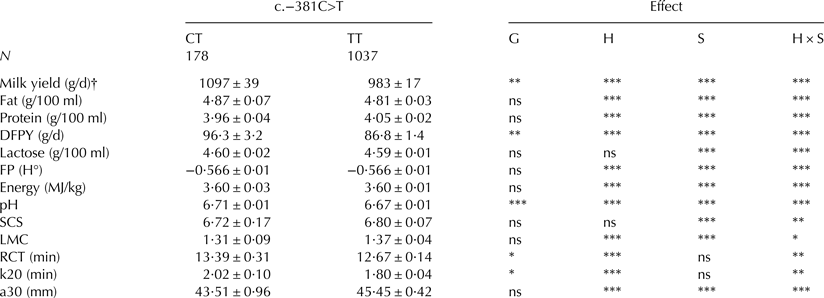
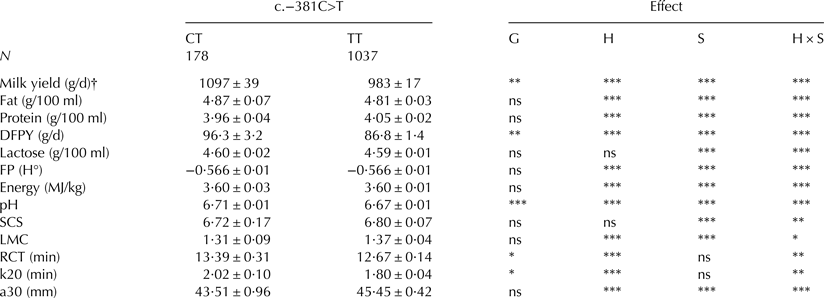
The effects of farm, stage of lactation and the interaction farm × stage of lactation significantly influenced the measured parameters (P < 0·01, P < 0·001) at each of the three SNPs, except for lactose content and SCS, which were not affected by the farm, and RCT and k20, which were not affected by the stage of lactation (Tables 3–5). The effect of genotype was focused on some traits. Goats with genotype CT at SNP c.−381C>T showed higher milk yield and DFPY (P < 0·01), higher pH (P < 0·001) and higher RCT and k20 (P < 0·05) than TT. SNP c.−323C>T significantly affected the pH value (P < 0·05), and homozygous TT goats displayed the highest value. Homozygous AA goats at c.*420C>A showed lower milk yield than AC and CC (P < 0·05), and also showed lower DFPY than AC (P < 0·01), as well as a higher pH than the CC goats (P < 0·05) (Tables 3–5).
Least square means ± standard deviation for milk traits and coagulation properties according to SNP c.−381C>T genotype (G), and significance of P values according to the effects of G, herd (H), stage of lactation (S) and interaction H × S
n, number of records (number of milk samples); DFPY, daily fat and protein yield; FP, freezing point; SCS, log2 (SCC × 10−5) + 3; LMC, log10 of total microbial count/1000; RCT, rennet clotting time; k20, rate of clot firming; a30, clot firmness
† Yield of the morning milking
*: P < 0·05; **: P < 0·01; ***: P < 0·001; ns, non-significant
Least square means ± standard deviation for milk traits and coagulation properties according to SNP c.−323C>T genotype (G), and significance of P values according to the effects of G, herd (H), stage of lactation (S) and interaction H × S

n, number of records (number of milk samples); DFPY, daily fat and protein yield; FP, freezing point; SCS, log2 (SCC × 10−5) + 3; LMC, log10 of total microbial count/1000; RCT, rennet clotting time; k20, rate of clot firming; a30, clot firmness
† Yield of the morning milking
A-B, a-bMeans with different superscripts with capital or lower case letters in each row differ significantly at P < 0·01 and P < 0·05. *: P < 0·05; **: P < 0·01; ***: P < 0·001; ns, non-significant
Least square means ± standard deviation for milk traits and coagulation properties according to SNP c.*420C>A genotype (G), and significance of P values according to the effects of G, herd (H), stage of lactation (S) and interaction H × S

n, number of records (number of milk samples); DFPY, daily fat and protein yield; FP, freezing point; SCS, log2 (SCC × 10−5) + 3; LMC, log10 of total microbial count/1000; RCT, rennet clotting time; k20, rate of clot firming; a30, clot firmness
† Yield of the morning milking
A-B, a-bSuperscripts with capital or lower case letters in each row differ significantly at P < 0·01 and P < 0·05. *: P < 0·05; **: P < 0·01; ***: P < 0·001; ns, non-significant
Discussion
Among the nucleotide changes revealed in the present investigation, c.−323C>T has been also reported in the Teramana, Palmera and Murciano-Granadina (Ballester et al. Reference Ballester, Sànchez and Folch2005) and in the Maltese and Derivata di Siria goats (Sardina et al. Reference Sardina, Rosa, Davoli, Braglia and Portolano2012). SNP c.−381C>T has been revealed for the first time by Graziano et al. (Reference Graziano, D'Andrea, Angiolillo, Lagonigro and Pilla2003) in Girgentana, Garganica, Montefalcone, Sarda, Alpine and Saanen goats, and later Sardina et al. (Reference Sardina, Rosa, Davoli, Braglia and Portolano2012) detected this polymorphic site, with low frequencies, in the Derivata di Siria breed. No variation was found at nucleotide position c.−332, where Sardina et al. (Reference Sardina, Rosa, Davoli, Braglia and Portolano2012) reported a triallelic polymorphism exclusive of the Maltese goat (referred to as −292 from transcription site) although this breed has been used in the past by farmers in Sardinia (Italy), to improve the milk yields of Sarda goats (Vacca et al. Reference Vacca, Daga, Pazzola, Carcangiu, Dettori and Cozzi2010).
SNP c.*108G>A, previously referred to as S1/S2, as well as the duplication c.*138_147dup, previously referred to as I2/I3, were initially identified by Pena et al. (Reference Pena, Sànchez and Folch2000) in both French and Spanish goats. SNP c.*108G>A has been detected also in Egyptian (Kahilo et al. Reference Kahilo, EL-Shazly, El-Khadrawy and Fattouh2014), Turkish Hair (Elmaci et al. Reference Elmaci, Oner and Koyuncu2009) and Indian goats (Kumar et al. Reference Kumar, Kumar Rout and Roy2006). In this research c.*108G>A, as well as c.*110G>C (described for the first time in this paper) showed minor allele frequency lower than 0·05, then we can consider them as rare variants in the study population.
Polymorphism c.*138_147dup describes the occurrence of a 10 bp long sequence (CCAGGCCCCT) which may be repeated twice (BLG I2 allele) or three times (BLG I3 allele) detected so far only in ruminants, while the BLG I1 allele has been reported only in non-ruminanant domestic species (Pena et al. Reference Pena, Sànchez and Folch2000). Also in the Sarda breed, the BLG I2 allele was the most frequent, while BLG I3 was rare, and only revealed in heterozygosis.
Results from statistical analysis showed an effect of the BLG gene polymorphism on milk yield, in relation to the SNPs c.−381C>T, more pronounced, and SNP c.*420C>A, together with an effect on DFPY. An effect of the β-lactoglobulin polymorphism on milk yield has been highlighted in other goat breeds (Chen et al. Reference Chen, Lan, Li, Lei, Sun, Zhang, Zheng and Zhu2005; Kumar et al. Reference Kumar, Kumar Rout and Roy2006; Kahilo et al. Reference Kahilo, EL-Shazly, El-Khadrawy and Fattouh2014), and in sheep (Amigo et al. Reference Amigo, Recio and Ramos2000), but not in cattle (Aschaffenburg & Drewry, Reference Aschaffenburg and Drewry1957).
All three SNPs tested affected milk pH, and this association was highly significant at c.−381C>T (P < 0·001), with c.−381TT homozygous goats showing lower pH and, at the same time, lower RCT and k20 than c.−381CT (P < 0·05). This is in agreement with the fact that a lower pH value reduces the electrostatic repulsion among the milk protein molecules and shortens milk coagulation time (Cheryan et al. Reference Cheryan, van Wyk, Olson and Richardson1975), and has already been observed previously (Pazzola et al. Reference Pazzola, Dettori, Pira, Noce, Paschino and Vacca2014).
The two SNPs c.−381C>T and c.−323C>T were located in a region of the proximal promoter, between np −470 and −208 from the transcription start site. According to Kim et al. (Reference Kim, Yu and Kim1997) this is a region of tissue-specific activation of the BLG promoter, in contrast with the upstream flanking sequence, which showed repressive activity. Hence, these SNPs might have an effect on the epigenetic control of the state of chromatin or might be involved in transcription factor binding site (TFBS) changes. In this regard, the analysis with Alibaba ver. 2·1 and Transfac® database revealed that SNP c.−381C>T does not affect any potential TFBS; while, at SNP c.−323C>T, the c.−323 T allele eliminates a potential SP1 binding site, which occurs with the c.−323C allele. In any case, the SNP c.−381C>T at the goat BLG gene may become a useful marker of milk yield.
The SNP c.*420C>A, downstream the 3′UTR, influenced milk yield, pH (P < 0·05) and DFPY (P < 0·01). In contrast, the three polymorphic sites at the 3′UTR showed minor allele frequency lower than 0·05, possibly indicating a stability of this region, at least in the Sarda breed. Indeed, untranslated regions can play a regulatory role in gene expression, modulating the translation efficiency and stability of mRNA, in response to proteins or microRNAs (Barrett et al. Reference Barrett, Fletcher and Wilton2012).
When considering cow milk, the changes in MCP related to the BLG genotype, are associated with variation in milk casein and whey protein content and with allele frequency variation of lactoproteins genes (Bittante et al. Reference Bittante, Penasa and Cecchinato2012). The milk casein content is indeed one of the main elements affecting MCP, together with acidity and mineral composition. Currently, the relationship between polymorphism of the BLG gene and the relative content of the goat milk proteins is unknown, while it is well documented that there is huge variability of the casein content (Vacca et al. Reference Vacca, Dettori, Piras, Manca, Paschino and Pazzola2014), which significantly affect the goat milk coagulation properties (Grosclaude et al. Reference Grosclaude, Ricordeau, Martin, Remeuf, Vassal and Bouillon1994; Pazzola et al. Reference Pazzola, Balia, Dettori, Mura, Carcangiu and Vacca2011, Reference Pazzola, Dettori, Pira, Noce, Paschino and Vacca2014). In the present paper, polymorphism of goat BLG gene did not affect the total protein content of the Sarda goat milk, and only weakly influenced renneting properties. On the other hand, the observed effect on milk yields, DFPY and pH in relation to SNP c.−381C>T might be useful as a marker in dairy goat breeding programmes.
Research supported by the RAS, Regional Government of Sardinia (P5a-Animal Biodiversity funds).