Recent evidence has demonstrated an increasing prevalence of overweight and obesity in childhood and adulthood.Reference Slyper1, 2 Obesity in childhood is strongly associated with cardiovascular risk factors, such as hypertension, type 2 diabetes mellitus, and atherosclerosis.Reference Cali and Caprio3 Such factors have been shown to inversely correlate with the number of circulating endothelial progenitor cells in adults.Reference Vasa, Fichtlscherer and Aicher4, Reference Hill, Zalos and Halcox5 Bone marrow derived endothelial progenitor cells enhance angiogenesis, promote vascular repair, and improve endothelial function.Reference Hill, Zalos and Halcox5–Reference Wollert, Meyer and Lotz10 Therefore, the number of endothelial progenitor cells may serve as a valuable surrogate biologic marker for endothelial function and cardiovascular risk in healthy persons.Reference Hill, Zalos and Halcox5
The importance and positive effects of moderate physical activity in limiting cardiovascular risk is indisputable. Physical training increases peak of oxygen uptake and the number of circulating endothelial progenitor cells in special patient populations such as those with coronary artery disease.Reference Adams, Lenk and Linke11–Reference Laufs, Urhausen and Werner13 In children and adolescents, however little is known about the correlation between physical performance and the number of endothelial progenitor cells. The aim of this study was to examine the association between values for body composition, physical fitness, and the number of endothelial progenitor cells in obese children and adolescents.
Materials and methods
Study patients
The study was approved by the Ethical Committee of the German Sport University Cologne. A total of 24 children were studied, 9 boys. They had signed on for the CHILT-III project – Children’s Health Interventional Trial – an interdisciplinary programme conducted by specialists at the German Sport University Cologne, nutritionists, psychologists, gymnasts, medical doctors. The programme is described elsewhere.Reference Graf, Kupfer and Kurth14 For this study, only the baseline data were analysed. Informed and written consent was obtained from the parents.
Anthropometric data assessment
Standard, calibrated scales, and stadiometres were used to determine height, weight, body mass index in kilogram per square metre, and the body mass index standard deviation score. For children in Germany, overweight is defined using the AGA (Arbeitsgemeinschaft Adipositas im Kindes–und Jugendalter) age and gender-specific normograms for body mass index.Reference Kromeyer-Hauschild, Wabitsch and Kunze15 Body mass index percentiles less than or equal to 90th percentiles are considered normal weight for height; exceeding the 90th percentiles to less than or equal to 97th percentiles are considered as overweight; and body mass index percentiles exceeding the 97th are defined as obese. The 90th percentile corresponds to body mass index of 25 kilogram per square metre at the age of 18 years, the 97th percentile to body mass index of 30 kilogram per square metre. Body mass index standard deviation score was calculated as:

where M(t), L(t), and S(t) are the age and gender specific parameters of the child.Reference Kromeyer-Hauschild, Wabitsch and Kunze15
The waist circumference was measured at the midpoint between the bottom of the rips and the top of the iliac crest.Reference McCarthy, Jarrett and Crawley16 Skinfold thicknesses were measured at 10 different body sites – tragus, root of tongue, chest, midaxillary, abdominal, suprailiac, subscapular, triceps, thigh, and calf – using skinfold caliper.Reference Slaughter, Lohman and Boileau17 The mean values of all 10 measured points were used.
Exercise testing
The participating children and adolescents performed an incremental exercise test on a cycle ergometer, Ergometrics er900, Ergoline, Bitz, Germany on which they exercised until exhaustion. The test was performed as previously described:Reference Graf, Kupfer and Kurth14 the initial load was 20 Watts and was increased after every 2 minutes by 0.5 Watt per height adapted reference weight.Reference Reinken, Stolley and Droese18 Patients were vigorously encouraged during the high intensity phases of the exercise programme. Gas exchange was measured breath-by-breath and the peak of oxygen uptake in litre per minute was determined through spirograph system, ZAN 600 Ergotest, Oberthulba, Germany. The results of the exercise test were related to body weight as Watts per kilogram. The peak oxygen uptake data and the respiratory quotient, VCO2 divided by VO2, of 23 of the participating children could be used. There was one missing value because of technical reasons.
Fluorescence activated cell sorting analysis
One hundred microlitres of peripheral blood collected in ethylenediamine tetraacetic acid containing tubes were incubated for 20 minutes with fluorescein isothiocyanate-conjugated anti-CD45 monoclonal antibody and phycoerythrin-conjugated anti CD-34 antibody after erythrocyte lysis. Another 100 microlitre sample was incubated with fluorescein isothiocyanate-conjugated anti CD-34 antibody and phycoerythrin-conjugated anti CD-45 antibody, Becton Dickson, Heidelberg, Germany, to exclude any bias by the choice of fluorescent dye. Five other samples of 10 microlitre of peripheral blood were incubated with fluorescein isothiocyanate-conjugated anti-CD45 monoclonal antibody and phycoerythrin-conjugated anti-IgG1 antibody, fluorescein isothiocyanate-conjugated anti-IgG1 and phycoerythrin-conjugated anti-CD-45 antibody, fluorescein isothiocyanate-conjugated anti-CD-4 and phycoerythrin-conjugated anti-CD-8 antibody, fluorescein isothiocyanate-conjugated anti-CD-34 and phycoerythrin-conjugated anti-Rat IgG-2a antibody and fluorescein isothiocyanate-conjugated anti-CD-34, and phycoerythrin-conjugated anti-IgG1 antibody. To assess the subpopulations in each case, 100 microlitre of peripheral blood were coloured with either phycoerythrin-conjugated anti VEGFR-2, KDR; Bioscience, San Diego, United States of America, antibody or anti CD-133 antibody, Miltenyi, Bergisch-Gladbach, Germany, or anti CD-117 antibody, Bioscience, San Diego, United States of America, in addition to the fluorescein isothiocyanate-conjugated anti-CD-34 antibody, Becton Dickson. For each staining procedure appropriate isotype controls were used. After lysis of red cells, the samples were centrifuged and the pellets were resuspended in 450 microlitre of phosphate buffered saline. Cells were analysed by flow cytometry, FACS Calibur, Becton, Dickson. The analysis of the CD34 positive haematopoietic cells was performed adopting the gating strategy defined by the International Society of Haematotherapy and Graft Engineering guidelines and expressed as number per million white blood cells. In order to gain reliable data for the subpopulation analysis, the data of the progenitor population were selectively acquired by only counting CD34 positive cells with a low granularity and the typical forward scatter profile. Then, the subpopulations were defined according to the corresponding isotype control. Cell counts are given as cells per million leucocytes.
Statistical analysis
Continuous data are expressed as mean and standard deviation. Gender differences were calculated by the unpaired t-test. Univariate correlations between different parameters, for example, peak of oxygen uptake and CD34 positive, were performed with the use of Spearman’s and Pearson’s correlation coefficient. All analyses were performed using the statistics system SPSS version 16.0® (SPSS Inc., Illinois, United States of America).
Results
Anthropometric data, physical performance, and endothelial progenitor cell values
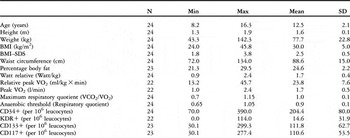
Anthropometric data, physical fitness, and endothelial progenitor cell values are provided in Table 1. There were no gender differences in the anthropometric data, the peak oxygen uptake, and the number of CD34 positive, KDR positive/CD34 positive, CD133 positive/CD34 positive, and CD117 positive/CD34 positive cells.
Children characteristics.

N, number of test persons; min, minimum; max, maximum; SD, standard deviation; BMI, body mass index; BMI–SDS, body mass index standard deviation score; VO2, oxygen uptake; m, metres; kg, kilogram; m2, square metres; cm, centimetres; ml, millilitres; min, minutes
Correlations
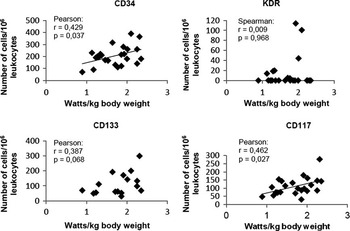
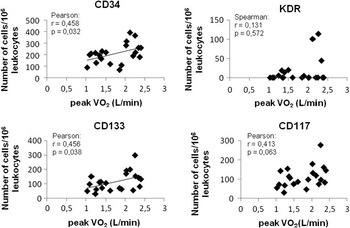
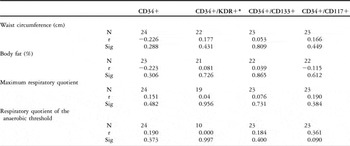
CD34 positive and CD117 positive/CD34 positive cells correlated with maximum relative Watt performance, r is equal to 0.429 and 0.462; p-value less than 0.05; Fig 1. CD34 positive and CD133 positive/CD34 positive correlated with peak of oxygen uptake, r is equal to 0.458 and 0.456; p-value less than 0.05; Fig 2. There were no correlations between endothelial progenitor cells and parameters of body composition, percentage of body fat, or waist circumference; Table 2, the maximum respiratory quotient and the anaerobic threshold; Table 2.
Correlation between maximum watt performance per kilogram body weight and the number of EPCs (CD34+: number of test persons: 24; KDR+/CD34+: number of test persons: 22; CD133+/CD34+ and CD117+/CD34+: number of test persons: 23).

Correlation between peak VO2 in L/min and the number of EPCs (CD34+: number of test persons: 22; KDR+/CD34+, CD133+/CD34+ and CD117+/CD34+: number of test persons: 21).

Pearson/SpearmanFootnote * correlation between the number of endothelial progenitor cells, parameters of body composition (waist circumference, percentage body fat), the maximum respiratory quotient and the respiratory quotient at the point of the anaerobic threshold.

N, number of test persons; r, correlation coefficient; sig, significance (two-tailed)
* Spearman correlation is used for CD34+/KDR+.
Discussion
This study provides preliminary evidence for a positive association between physical fitness and the number of endothelial progenitor cells in children and adolescents. The number of circulating CD34 positive cells and CD34/CD133 double positive cells increased with increasing peak of oxygen uptake. Previous studies have shown that physical training increases peak of oxygen uptake and the number of circulating endothelial progenitor cells in adults.Reference Adams, Lenk and Linke11–Reference Laufs, Urhausen and Werner13 In addition, the rate of endothelial progenitor cell apoptosis is decreased after exercise.Reference Laufs, Werner and Link12 To date, there are no studies that determine the association between peak of oxygen uptake and the number of endothelial progenitor cells in obese children.
Typical concomitant pathologies of obesity in childhood are endothelial dysfunction and arterial wall thickening.Reference Tounian, Aggoun and Dubern19 Vascular function is regulated by circulating cells derived from bone marrow.Reference Asahara, Murohara and Sullivan20 Hill et alReference Hill, Zalos and Halcox5 examined the relationship between the body mass index and the number of colony forming units of endothelial progenitor cells in 45 men with a age of 50 plus or minus 2 years. They found a significant correlation between endothelial function, measured by flow-mediated brachial artery reactivity, and the number of endothelial progenitor cells, r is equal to 0.59, p-value less than 0.001. Increased numbers of circulating endothelial progenitor cells improve vascular function.Reference Hill, Zalos and Halcox5, Reference Aicher, Heeschen and Mildner-Rihm6, Reference Assmus, Schächinger and Teupe7, Reference Werner, Kosiol and Schiegl9, Reference Wollert, Meyer and Lotz10 A higher physical performance and consequently an increasing number of circulating endothelial progenitor cells could possibly improve endothelial function and thereby decrease arteriosclerotic and cardiovascular risk.
In this study, no correlation was found between the parameters of body composition and the number of endothelial progenitor cells. These findings are in accordance with the results of Hill et alReference Hill, Zalos and Halcox5 Müller-Ehmsen et alReference Müller-Ehmsen, Braun and Schneider21 found an inverse relationship between the body mass index and the number of endothelial progenitor cells in adults. Desideri et alReference Desideri, De Simone and Iughetti22 evaluated different circulating molecules in obese children as indices of endothelial activation. Obesity in children was associated with increased circulating levels of sICAM-1, sVCAM-1, and sE-selectin.
A possible reason for the lack of correlation between body mass index and the number of endothelial progenitor cells in our study could be that only obese children were included. Thus, the comparison with overweight and normal weight children is missing. Furthermore, other studies excluded children and also the choice of other kind of circulating progenitor cell subtypes in different studies could be the reason for varying findings.
In our study, no gender differences in all subtypes of endothelial progenitor cells were observed. This is in accordance with a previous study of Heiss et alReference Heiss, Keymel and Niesler23, in which also no gender differences were found in two different adult populations (25 plus or minus 1 year and 61 plus or minus 2 years).
The Tanner sexual maturity rating was not assessed and a potential effect of the state of puberty on the number of endothelial progenitor cells has to be considered. Furthermore, all children were obese and no control group with normal weight children was investigated here. In addition, the number of children who took part in this study was small.
In conclusion, this study showed that improved physical fitness (higher peak of oxygen uptake and maximum relative watt performance) was associated with increased number of endothelial progenitor cells. Additional studies with a higher number of patients are needed to further examine the correlation between the values of physical performance and the number of circulating endothelial progenitor cells. If our preliminary findings were confirmed, the value of exercise for the prevention of cardiovascular diseases and the importance of physical activity besides an adequate nutrition for therapy of obesity would be further underlined. The fact that childhood obesity predicts cardiovascular events in adult lifeReference Must, Jacques and Dallal24, Reference Gunnell, Frankel and Nanchahal25 makes early intervention indispensable.
Acknowledgements
The authors are grateful to Ms Kerstin Schenk for excellent technical assistance. Financial support was obtained from the Hans and Gertie Fischer-Stiftung.