

Western European contact throughout the world produced disruptive processes in the internal dynamics of Indigenous groups (Ferguson Reference Ferguson1990a; Lee and Daly Reference Lee, Daly, Lee and Daly1999; Vayda Reference Vayda1970). In northern Patagonia and Pampa (Argentina) this contact led to an increase in interpersonal violence after the sixteenth century and even more so during the seventeenth century (Bandieri Reference Bandieri2005; Gordón Reference Gordón2011, Reference Gordón2015; Gordón and Bosio Reference Gordón and Bosio2012; Villar and Jiménez Reference Villar and Jiménez2010). The technology of fighting changed as metal weapons (e.g., swords and sabers) and firearms were introduced (Curran and Raymond Reference Curran and Raymond2021; Gordón Reference Gordón2011). Despite the abundant knowledge we have on postcontact conflicts, the pattern of interpersonal violence in small-scale societies (Silberbauer Reference Silberbauer and Singer1991) in southern South America before contact has not been thoroughly studied.
Unlike other types of injuries (e.g., cut marks from metal weapons or perforations from firearms), bone trauma caused by readily available blunt elements, such as wooden clubs or stones, provides an opportunity to evaluate the continuity of violent events over time in small-scale societies. Diverse factors are linked to a rise in violence among hunter-gatherers (e.g., Allen and Jones Reference Allen and Jones2014; Gordón Reference Gordón2011; Knauft Reference Knauft1987; Lambert Reference Lambert2002; Read and LeBlanc Reference Read and Blanc2003; Walker Reference Walker1989, Reference Walker2001). Demographic changes, which include an increase in population size and in the relative density of the groups placed around critical resources, are major causes. The increased frequency of intergroup contact can lead to an increase in conflictual events, as well as having positive benefits, such as trade and the exchange of goods, information, and people (Keeley Reference Keeley1996).
Interpersonal violence in small-scale societies has been explored in recent decades in anthropological, archaeological, and bioarchaeological studies (e.g., Flensborg and Suby Reference Flensborg and Suby2020; García-Guraieb et al. Reference García Guraieb, Goñi, Bosio, Morello, Martinic, Prieto and Bahamonde2007; Gat Reference Gat1999; Gordón Reference Gordón2011, Reference Gordón2015; Knauft Reference Knauft1987; Lambert Reference Lambert2002; Roscoe Reference Roscoe2007; Standen et al. Reference Standen, Santoro, Bernardo Arriaza, Monsalve and Marquet2020; Walker Reference Walker2001). Cross-cultural studies of hunter-gatherer groups suggest that levels of violence are low but can be identified (Ember and Ember Reference Ember and Ember2001; Keeley Reference Keeley1996). In simple societies, interpersonal violence affects both sexes and people of different ages. Women, children, or both are captured and taken as slaves or killed together with adult males, while their belongings and villages are destroyed and burned (Gat Reference Gat1999; Keeley Reference Keeley1996). This set of behaviors, also known as a raid (Gat Reference Gat1999), is a short-lasting and extremely violent incursion in which one group attacks another, normally at night, when the opponent is helpless. This pattern contrasts with the armed and organized struggles seen in complex societies (Ferguson Reference Ferguson and Haas1990b).
Societies that inhabited the southern Pampa and northern Patagonia experienced episodes of violence, as shown by several studies (e.g., Flensborg Reference Flensborg2011; Gómez Otero and Dahinten Reference Gómez Otero and Dahinten1997–1998; Gordón Reference Gordón2011, Reference Gordón2015; Politis and Madrid Reference Politis, Madrid, Berberián and Nielsen2001; Scabuzzo Reference Scabuzzo2010). Northeastern Patagonia was considered to be a buffer zone (Eerkens Reference Eerkens1999) or soft border (Curtoni Reference Curtoni2004; Martínez Reference Martínez2009): it was an area in which different groups may have used certain spaces at different times or lived there only seasonally. At the time of Spanish–Indigenous contact, there were complex interaction networks between local, extraregional, and trans-Andean groups in the Pampa and Patagonia regions (Berón Reference Berón, Bayón, Pupio, González, Flegenheimer and Frère2007; Politis and Madrid Reference Politis, Madrid, Berberián and Nielsen2001). The areas surrounding the large rivers of the region probably held large concentrations of mammals (e.g., guanaco) and human groups (Figure 1; Moscardi et al. Reference Moscardi, Rindel and Perez2020). Borrero (Reference Borrero, Berberián and Nielsen2001) thus describes rivers not as static biogeographic boundaries but rather as meeting places. It is expected that, particularly before the arrival of the Spanish, intergroup contacts frequently occurred near rivers and were related to the movement and exchange of goods and people, which would have maintained intergroup ties through both periods of conflict and peace. Patterns of violence would have been part of the social interaction network among the groups (de Waal Reference de Waal2000; Keeley Reference Keeley1996).
Distribution of archaeological human skull samples. Points indicate localities near archaeological sites (Catálogo del Museo Etnográfico Reference del Museo Etnográfico1988; Lehmann-Nitsche Reference Lehmann-Nitsche1910). Ellipses group samples for spatial analysis. (Color online)

This article has two aims. First, it assesses the level of interpersonal violence among the groups of northern Patagonia and southern Pampa during the Middle and Late Holocene by analyzing a particular type of traumatic injury—blunt force trauma (BFT)—surveyed in collections of human skulls from various archaeological locations. Second, to further test hypotheses about the kind of weapons responsible for these injuries, we compare our results with those of an experimental work (Otero and Béguelin Reference Otero and Béguelin2019).
The general expectation guiding our work is that the level of interpersonal violence remained relatively constant throughout the period studied—the last 4,000 years (with an emphasis on precontact times) in northern Patagonia and southern Pampa—as was observed in other simple societies (e.g., Allen and Jones Reference Allen and Jones2014; Keeley Reference Keeley1996; Kelly Reference Kelly2000). We expected that the incidence of BFT would not show significant diachronic changes related to sex or age at death, that most instances of BFT were not lethal, and that the objects causing them were part of the equipment of everyday life, such as wooden sticks or stones (Kelly Reference Kelly2000). A small proportion of cases of BFT would have been lethal and linked to weapons designed to hunt or to inflict violence, such as a boleadora, a tool used in the region designed to be thrown to kill and maim (Salas Reference Salas1986; Vecchi Reference Vecchi2012).
Materials and Methods
Bioarchaeological Samples
We surveyed BFT injuries in human skulls from northern Patagonia and southern Pampa (Argentina). Our sample of 977 human skulls was found in these areas: northwest Patagonia (NW-Pat; n = 45), south of Pampa (S-PR; n = 135), northeast Patagonia (NE-Pat; n = 436), and central-east Patagonia (CE-Pat; n = 361). A geographic position was assigned to the remains based on descriptions in museum catalogs (Catálogo del Museo Etnográfico Reference del Museo Etnográfico1988; Lehmann-Nitsche Reference Lehmann-Nitsche1910), which often are not precise and indicate just the nearest localities (points in Figure 1; the ellipses group samples for spatial analysis).
In addition to geographic provenance, we included variables such as chronology, probable sex, and age at death (Table 1). Based on radiocarbon dating and the presence and types of cultural modification of the skull, the sample was divided into three periods: (1) Mid-Late Holocene (4000–2500 years BP; LH-1), (2) Early Late Holocene (2500–1500 years BP; LH-2) and (3) Final Late Holocene (1500 years BP; Spanish–Indigenous contact, sixteenth century; LH-3). Skull modifications were shown to be correlated with chronology, as assessed according to the traditional system (Dembo and Imbelloni Reference Dembo and Imbelloni1938) and with morphometric information (Perez Reference Perez2006). The three artificial skull modifications found in the sample and their chronological correlation are as follows: pseudo-circular (PC) that is linked to LH-1, tabular erect plano-frontal (PF) associated with LH-2, and tabular erect plano-lambdic (PL) linked to LH-3 (Gordón Reference Gordón2011). Skulls with no artificial modification were not included in the diachronic analyses, except for those with radiocarbon dates, which we assigned to the Holocene (H; Supplemental Table 1; Gordón Reference Gordón2011). We carefully studied the skulls with taphonomic alteration to differentiate those modifications from traumatic injuries resulting from interpersonal violence (Buikstra and Cook Reference Buikstra and Cook1980; Ubelaker and Adams Reference Ubelaker and Adams1995). The results of these analyses of taphonomic alterations have been published in previous works (Gordón Reference Gordón2009, Reference Gordón2011).
Structure of the Analyzed Samples.

We established broad categories for the age at death. The group of subadult individuals (SA) includes those whose spheno-basilar suture was not fused at the time of death (Buikstra and Ubelaker Reference Buikstra and Ubelaker1994). We grouped adult individuals into the three classic categories proposed by Lovejoy and colleagues (Reference Lovejoy, Meindl, Pryzbeck and Mensforth1985) and by Buikstra and Ubelaker (Reference Buikstra and Ubelaker1994) based on the degree of closure of the sutures of the skull's lateral-anterior system: young adult (20–34.9 years; YA), middle adult (35–49.9 years; MA), and old adult (> 50 years; OA). One group of skulls could only be identified as adult (indeterminate adult, IA), and another one (indeterminate) could not be assigned to any age category.
Sex estimation was done following traditional morphoscopic techniques, based on the degree of expression of the dimorphic features of the skull: robustness of the nuchal crest, size of the mastoid, edge of the supraorbital margin, prominence of the glabella, and projection of the chin eminence (Buikstra and Ubelaker Reference Buikstra and Ubelaker1994). We also included sex estimations generated by Perez (Reference Perez2006) using geometric morphometric techniques. Given our study objectives, it was not necessary to estimate the sex of subadult individuals.
We used the following presence/absence (P/A) variables to morphologically characterize the BFTs: the presence of fractures (linear [LF], concentric [CF], and stellate [SF]), adhering bone flakes (AF), raised edges (RE), and bone loss (BL) as a result of the blow. The raised edges indicate a type of plastic deformation in which, although the bone does not recover its original shape, the applied force is not strong enough to fracture it.Footnote 1 We also recorded quantitative variables: maximum diameter (MD) and transverse to maximum diameter (TMD). The metric variables were recorded with a digital caliper (precision 0.01 mm). Small bone structures, like the nasal bones or zygomatic arch, were excluded from metric analyses because the size of the injury often exceeded that of the bone structure, making it impossible to record measurements.
Traumas were identified as premortem or perimortem based on the presence of signs of bone remodeling (Sauer Reference Sauer and Reichs1998). Characterizing an injury this way refers to the moment in which a trauma is produced—immediately before, during, or immediately after death—and not necessarily to the cause of death (Sauer Reference Sauer and Reichs1998). However, we consider it highly probable that perimortem traumas are associated with lethality. All BFT variables were surveyed following descriptions of Gordón (Reference Gordón2011), Kimmerle and Baraybar (Reference Kimmerle and Baraybar2008), and Wedel and Galloway (Reference Wedel and Galloway2014).
The frequency of BFT by sex, age, provenance, and chronology was compared by means of the chi-square and Fisher's Exact Test. To test the differences in BFT features as a whole (including both nonmetric and metric variables), between sexes and people of different ages, provenance, and chronology, we performed a permutational multivariate analysis of variance (PERMANOVA; Anderson Reference Anderson2001) with the Gower distance index (Greenacre and Primicerio Reference Greenacre and Primicerio2013).
To aid in visualizing the data and to better detect trends and groupings, we included metric and nonmetric variables in a multivariate ordination by means of the principal coordinates analysis (PCoA) method. The PCoA was made from a similarity matrix calculated with the Gower distance index on the standardized variables (Borcard et al. Reference Borcard, Gillet and Legendre2018; Legendre and Legendre Reference Legendre and Legendre2012). All variables were standardized [(x-average)/standard deviation] to remove size-related variation. Presence/absence variables, in addition to being standardized, were divided by the square root of two, a transformation to compensate for the high variance of dichotomous variables (Greenacre and Primicerio Reference Greenacre and Primicerio2013). The ordination was evaluated according to the first two axes. To assess the role of each variable in the classification, Spearman correlations (rs) were calculated among the axes and the variables. Archaeological BFTs with missing data in metric variables were excluded from the ordination.
Experimental Sample
We compared the pattern obtained from the bioarchaeological sample with the database in an experimental study using pig skulls (Otero and Béguelin Reference Otero and Béguelin2019) to help improve the interpretation of archaeological BFT. In the experimental study BFTs were produced on 20 pig skulls (Sus scrofa domestica) taken as proxies of human skulls. Before being struck, the pig heads were prepared and placed in a device designed to closely match the physical conditions present at the time of a blow to a human head. Every skull was hit with one of four different weapons. Sixty-four blows were struck: 19 by hammer, 15 by a wooden club, 15 by stone, and 15 by a boleadora. Three blows affected the same area as a previous one, thus preventing an accurate recording of those injuries. These redundant blows (RB) were counted as one, because it was not possible to distinguish one blow trace from another. Nine of the 61 blows recorded did not affect the bone material. Therefore, we considered 52 lesions for comparison with the bioarchaeological sample.
The variables analyzed, the instruments used, and the methods were the same as in the bioarchaeological sample. Our goal was not to identify a specific weapon. Rather, through probabilistic relationships, we attempted to characterize the elements used to generate the different injury patterns.
Comparison of Archaeological and Experimental Data
Experimental and archaeological data were pooled in a matrix to explore associations between both types of marks. The experimental BFT data were standardized in the same way described earlier: the PCoA was calculated after the Gower distance matrix, and all BFTs—pigs and humans—were plotted together. Statistical analyses were performed with PAST (version 4.05; Hammer et al. Reference Hammer, Harper and Ryan2001) and R (version 4.04; R Core Team 2020).
Bioarchaeological Results
BFT Frequency
Of the 977 analyzed individuals, 72 (7.37%) had at least one BFT. In 22 of these individuals (30.55%), more than one lesion was recorded. Multiple lesions were found in 15 of the 42 males with BFT (35.71%), five of the 24 females with BFT (20.83%), and two indeterminate individuals. We analyzed 97 BFTs in total (Supplemental Table 1). Table 2 presents the relative frequencies of individuals with BFTs by region, sex, age, and chronology.
Relative Frequency of BFTs by Geographical Origin, Sex, Age, and Period (each cell shows individuals with BFTs / total individuals for its category).
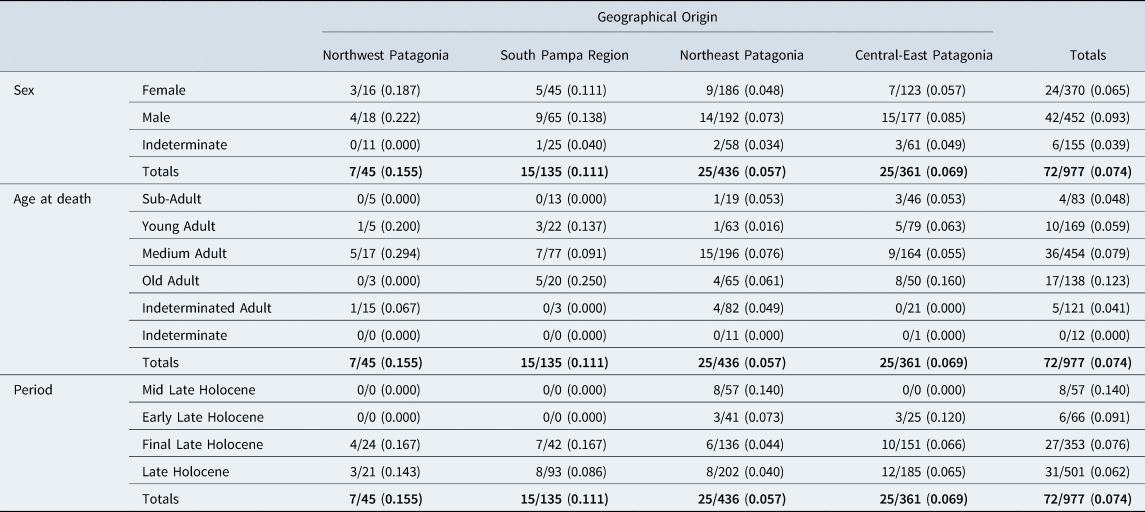
The spatial distribution of the BFTs shows some differences. Frequencies of BFTs in the NW-Pat and S-PR samples are significantly higher than in the NE-Pat (p = 0.012 and 0.032, respectively). Likewise, the frequency in the NW-Pat is significantly higher than in the CE-Pat (p = 0.043). However, the spatial distribution of perimortem injuries, which reflects the level of lethality generated by blunt weapons, does not show statistically significant differences (Figure 2). In CE-Pat, 92% of the lesions are premortem, and 8% are perimortem compared to 88% and 12%, respectively, in the NE-Pat sample. In the S-PR and NW-Pat, we found the highest levels of perimortem BFT (26.66% and 28.57%, respectively).
Bar plot showing BFT relative frequencies distribution by region discriminating between premortem and perimortem (raw data in Supplemental Table 1). (Color online)

Over time, a decrease in the frequency of BFTs is observed throughout the Holocene period: LH-1: 14.03%, LH-2: 9.09%, and LH-3: 7.64%. This decrease is clearly observed in the NE-Pat sample in which the entire temporal sequence is represented. In this sample, there is a significant difference between the LH-1 and LH-3 periods (p = 0.019) that, even when they are not contiguous moments, supports the trend. Nevertheless, when only perimortem injuries are considered, the trend reverses and suggests an increase in the frequency of BFTs: LH-1: 12.50%, LH-2: 16.66%, and LH-3: 18.51%. In this case, there is a marginally significant difference between LH-2 and LH-3 (p = 0.098). Individuals assigned to the Holocene (H) chronology were not included in the diachronic trend analyses.
Regarding the distribution by sex, although the frequencies of BFTs are higher among males (Table 2), these differences are not statistically significant. This result was obtained both in the complete sample (p = 0.141) and by geographic group (NW-Pat: p = 1.000; S-PR: p = 0.776; NE-Pat: p = 0.318; CE-Pat: p = 0.363). In terms of the lethality of BFTs, 83.33% of the lesions are premortem, and 16.66% are perimortem in both men and women. In female samples, both premortem and perimortem lesions are distributed similarly: 40% in the splanchnocranium area and 60% in the neurocranium. In contrast, among males, although there are almost no differences in the distribution of premortem BFTs (48.97% in the splanchnocranium and 51.02% in the neurocranium), there is a difference in the location of perimortem lesions: 22.22% are found in the facial area and 77.77% in the cranial vault.
Concerning the distribution by age categories, when all the geographic samples are considered, the recorded percentage of BFTs increases by age (Figure 3). When the three categories of adults are compared, there is a significant difference between those who are not contiguous in age: young adults and old adults (p = 0.049). Although this pattern varies in each geographic sample, only one case is statistically significant: among the middle and old adults from CE-Pat (p = 0.016). Adult samples pooled together (68/844) show no significant differences (p = 0.391) from subadults (4/83). It is remarkable that no perimortem BFTs were found among subadult individuals. In the subadult group, 66.66% of BFTs are in the facial area and 33.33% in the vault.
Bar plot showing BFT relative frequencies distribution by age at death.

BFT Features
Of the 97 BFT lesions analyzed, 34 have linear fractures (32.9%), 12 have concentric fractures (12.3%), and five have stellate fractures (5.1%). In addition, in seven cases (7.2%) there are adhering bone flakes. Raised edges are evident in 51 cases (52.57%). Finally, bone loss as a product of a very strong blow is found in seven cases (7.2%). Of the 97 BFTs, 79 could be completely described in morphological terms (i.e., all qualitative and quantitative variables were recorded). The BFTs that we could not measure were located in the nasal and zygomatic bones (n = 18; Supplemental Table 1). We ran the PERMANOVA analysis on the remaining 79 injuries: it did not show significant differences in the variables that describe BFT for sex (p = 0.175), age (p = 0.323), provenance (p = 0.955), and chronology (p = 0.317).
PCoA multivariate ordination displays clustering and gradients of these 79 BFTs (Figure 4). Two main groups can be identified: one in the bottom right of the plot and a second one above it. Both show elongated scatters that are somewhat parallel to each other and are situated obliquely with respect to the axes. The only variable that explains this differentiation between the two groups is the presence of raised edges (RE) in all BFTs of the first group and their absence in the second. Both groups follow a straight line, approximately parallel to the arrows corresponding to the remaining variables. Along this gradient, from right to left, BFTs accumulate P/A variables and increase in size. In the non-RE (upper) group, several cases cluster together in the top right of the plot: they lack any qualitative variable and the BFT is small. From this group to the left, BFTs have up to five qualitative variables. Most perimortem (lethal) BFTs lack RE and have at least two qualitative variables.
Ordination plot of the first two coordinates of the principal coordinate analysis made on the BFT variables of the archaeological sample. Every point represents a single BFT (number references in Supplemental Table 1). Green arrows are the projection of BFT variables with the envfit function of R vegan package. Arrows point to the main direction of the influence of the variable, whereas their lengths represent the strength of the association. (Color online)

A similar pattern is displayed by the RE group. Several BFTs cluster together at the right end of the gradient, characterized by the presence of only one variable (RE) and small size. From that cluster to the left, there are as many as three qualitative variables. Metric variables seem to be relevant to the development of the gradients, together with stellate, linear, and concentric fractures, as well as bone loss. The maximum diameter (MD) and transverse to maximum diameter (TMD) are significantly correlated (log-transformed, Pearson's r = 0.887, p = 0.000), which suggests that they increase together; that is, the BFTs are circular to oval in shape.
Perimortem Injuries
We found 14 perimortem injuries, characterized as those BFTs lacking signs of bone remodeling, of which 12 were included in the multivariate ordination (two could not be measured; see Figure 4). We expected that lethal BFTs would be placed mostly in the left (lethal) part of the multivariate plot: lacking RE and with large sizes and several qualitative variables. In the RE group, perimortem BFTs has a low frequency: they appear only twice. In BFT 16 is one of three blows to the same skull (the other two fall in the lethal group), which explains why despite being small and bearing only RE, it is considered perimortem. The other lethal blow, BFT 66, presents with three qualitative variables, one of which is raised edges, even though it is small. Most of the lethal wounds are in the group of BFTs that lack RE. Many of these BFTs have at least three qualitative variables and are large. BFTs 14 and 18 are of moderate size and have one and two qualitative variables, respectively. They seem not to be lethal features but are from skulls bearing other injuries. BFT 18 is one of three blows to individual 312. The skull of individual 307 absorbed two BFTs, 14 and 15. In BFT 14, we registered only one qualitative variable (i.e., concentric fracture), and in BFT 15, there are two variables (linear and stellate fractures). We excluded BFT 15 from the multivariate analysis because it was missing metric variables. BFT 21 is described as perimortem, having LF and SF, and being of moderate size. BFT 35 lacks qualitative variables but is described as perimortem, being the only exception to the pattern.
Comparison of Archaeological and Experimental Lesions
The results of the multivariate ordination with PCoA based on BFT variables include experimental wounds (n = 52; Supplemental Table 2) and the 79 archaeological cases presented in Figure 5. The distribution of human BFTs is similar to Figure 4. Two groups are clearly distinguished, those that have raised edges (bottom right) and those that have not (upper part of the plot). Again, both groups spread along a gradient from the right to the left. All recorded variables, qualitative and quantitative, are approximately perpendicular to RE and are associated with the gradients developed by both groups (see the arrows). Experimental BFTs display particular patterns of distribution. The non-RE group has only stone-made traces and a single case of a redundant blow (RB). Conversely, the RE group includes experimental BFTs made with all kinds of weapons and the remaining RB. Interestingly, experimental cases extend farther in the gradient of the RE group toward higher levels of damage, referring to traumatic injuries resulting from interpersonal violence (see Alfsdotter and Kjellstrom Reference Alfsdotter and Kjellström2019; Pfeiffer Reference Pfeiffer2016). As for the archaeological skulls, metric variables (MD and TMD) in the pooled sample are significantly correlated (log-transformed, Pearson's r = 0.886, p = 0.000).
Ordination plot of the first two coordinates of the principal coordinate analysis made on the BFT variables of both the archaeological sample and the experimental data (Otero and Béguelin, Reference Otero and Béguelin2019). Every point represents a single BFT (number references in Supplemental Table 1 and Supplemental Table 2). Green arrows are the projection of BFT variables with the envfit function of the R vegan package. Arrows point to the main direction of the influence of the variable, while their lengths represent the strength of the association. (Color online)

Discussion
Toward the Integration of Experimental and Bioarchaeological Features of BFTs
Blunt force traumas were morphologically characterized by qualitative and quantitative variables. Low-damage injuries were typically smaller and presented fewer qualitative variables. To model this gradient, we built a new variable—the qualitative level of damage (LoD)—that represents the number of qualitative variables present in every case. LoD ranges from 0 (no P/A variable described) to 6 (all P/A variables described). The majority of BFTs in the archaeological sample present with few qualitative variables (LoD = 0 in 21.5%; LoD = 1 [only RE] in 57.0%). Altogether, they account for 78.5% of injuries with relatively low levels of damage. The absence of qualitative variables suggests that their blows were characterized by low tension and were produced at low speeds, with heavy raw material objects capable of absorbing part of the blow that affected a relatively wide area (Galloway et al. Reference Galloway, Zephro, Wedel, Wedel and Galloway2014). In the experimental work, the only object that produced zero qualitative variables was the stone. Furthermore, 25 lesions had an LoD of 1. The object that caused the greatest frequency of LoD = 1 was the wooden club (10/11), followed by the metal hammer (7/13; a weapon that is not part of the local archaeological record), the stone (6/13), and the boleadora (2/12). Thus, many blunt instruments generated injuries with low levels of damage. In these cases, the tension was proportional to the force applied, and the bone could recover after the application of tensioning or compressing forces, leaving a superficial mark (elastic phase; see the modulus of elasticity or Young's modulus [Zephro and Galloway Reference Zephro, Galloway, Wedel and Galloway2014]). The presence of raised edges indicates that the linear relationship between stress and tension begins to decrease. In contrast, a small increase in either of these two parameters results in a large deformation, which prevents the bone from recovering its original shape because it has exceeded the elastic stress limit point at which the plastic deformation phase begins (Zephro and Galloway Reference Zephro, Galloway, Wedel and Galloway2014).
BFTs with higher LoD values are characterized by high levels of damage and larger size. Here, the linear relationship between stress and tension is rapidly lost by excessive high-speed load beyond the failure point threshold, dissipating energy solely through fractures. Once the failure point is exceeded, small load differences generate more fractures. Consequently, the presence of adhering flakes, the loss of bone fragments, or both are observed. In the experimental study, lesions with these characteristics are present in two blows from a boleadora, one from a hammer, and all three redundant blows (RB) from different objects. This information is relevant because past behaviors cannot be observed but can only be inferred. The experimental model suggests that some traumas with these characteristics in the bioarchaeological record—those causing high levels of damage—could be associated with the existence of repeated blows at the same point. Of the weapons included in the experiment, the boleadora produced the highest number of qualitative variables (27), more than the hammer (24) and nearly twice the number as the stone (14) and club (12).
Multivariate ordination of variables describing BFTs allows the identification of patterns according to the presence of qualitative variables and the size of injuries. Two groups are clearly defined, which run along a parallel gradient: they are differentiated by the presence of RE. The remaining variables contribute to developing a gradient from a low to high level of damage. Along this gradient, both the size of the BFT and the number of qualitative variables (LoD) increase. Interestingly, for the archaeological sample, the RE group gradient does not extend for long and has very few lethal BFTs (Figure 4). Conversely, the non-RE group is more spread out and contains the majority of perimortem injuries with higher levels of damage. When experimental data are added to the model, a few cases in which a stone was used but produced a low level of damage (except a single example of redundant blow) were added to this last lethal group. Most of the experimental BFTs have REs, follow the trend of the RE group, and strikingly extend more toward levels of more damage than the archaeological cases (Figure 5).
A notable result of our study is this patterning of BFTs, both archaeological and experimental, along a gradient of increasing size and level of damage. When we projected the LoD to the PCoA ordination plot of Figure 5 as lines of iso-damage, BFTs clearly spread in a line from the top right of the plot (low damage) to the bottom left, which accumulated the highest levels of damage (Figure 6).
Same ordination plot of Figure 5 with the addition of the variable LoD (number of qualitative variables: linear fracture, concentric fracture, stellate fracture, adhering bone flake, raised edges, and bone loss), which ranges from 0 to 6, fitted with smoothed two-dimensional splines (function ordisurf of vegan package in R. bs=TP; thin plates). (Color online)

Conflict and Interpersonal Violence in the Context of Regional Archaeology and Small-Scale Societies
Our results shed light on patterns of background violence among hunter-gatherers who inhabited various areas of the Pampa and Patagonia regions in Argentina. Focusing the analysis on blunt force trauma allows us to have a broader diachronic perspective than that provided by other types of injuries, such as those generated by metal weapons. Objects that could produce BFTs have been available at least since effective human occupation (Borrero Reference Borrero1994–1995) in these regions. Although there is evidence of human presence since the Early Holocene and even during the Pleistocene–Holocene transition (Barberena et al. Reference Barberena, Prates and de Porras2015; Crivelli Montero et al. Reference Crivelli-Montero, Ulises Pardiñas, Micaela Bogazzi, Fernández and Lezcano1996, among others), we consider that the effective occupation occurred around 5000–4500 years BP (Gómez Otero and Dahinten Reference Gómez Otero and Dahinten1997–1998; Gordón et al. Reference Gordón, Béguelin, Rindel, Della Negra, Hajduk, Vázquez, Cobos, Perez and Bernal2019).
The distribution of individuals with BFT is not homogeneous among the parts of the region. Population dynamics differed, especially between the coastal sector of Patagonia and the mountain sector in the west (e.g., Bernal et al. Reference Bernal, Sergio, Florencia, González and Perez2020; Favier-Dubois et al. Reference Favier-Dubois, Borella, Tykot, Salemme, Santiago, Álvarez, Piana, Vázquez and Mansur2010; Gómez Otero Reference Gómez Otero, Mandrini and Paz2003; Musters Reference Musters1997 [1869–1870]). Likewise, the north coast (NE-Pat) would have been a place of more intense intergroup contact than east-central Patagonia (CE-Pat; Gordón Reference Gordón2011; Schindler Reference Schindler1972–1978). In this sense, although northeast Patagonia has been considered as a buffer area or soft border (Curtoni Reference Curtoni2004; Martínez Reference Martínez2009), the dissipation of social tensions could also have occurred because of this area's wide-open spaces and less pronounced seasonality compared to the NW sector, where defensible resources vary seasonally (Bernal et al. Reference Bernal, Sergio, Florencia, González and Perez2020; Goñi Reference Goñi1986–1987). Similarly, social tensions might have been eased even more on the coast of central Patagonia, where not only were the ranges of action of the groups wide but also this area was very marginal to the colonial centers of power in postcontact times (Champion Reference Champion1989; Gómez Otero Reference Gómez Otero2007).
There is a high density of human burials during the last 2,500 years in the area near the mouth of the Chubut River (Gómez Otero and Dahinten Reference Gómez Otero and Dahinten1997–1998). Gómez Otero (Reference Gómez Otero, Mandrini and Paz2003) uncovered diverse archaeological evidence that the high productivity of the river acted as an attractor for human populations. The existence of BFTs, especially premortem, supports the occurrence of interpersonal violence in this area, despite its distance from the centers of power in colonial times. The region south of the Pampa and the extreme north of Patagonia were peripheral to the centers of colonial power that began to form on both sides of the Andes ranges from the beginning of the historical period.
Likewise, it is possible that this region, especially the western sector (NW-Pat), was also marginal to the Inca center of power before contact with European people (Goñi Reference Goñi1986–1987). Various lines of evidence suggest that the Colorado and Negro Rivers, and not the Chubut River, acted as contact zones between local populations, representatives of colonial society, and populations on the other side of the mountain range from very early dates (Schindler Reference Schindler1972–1978). The lowest percentage of lethality is found in CE-Pat (8% of perimortem BFT vs. 92% premortem BFT). Although the high levels of trauma registered in the southeast of the Pampa region coincide with expectations, these are based on possibly inaccurate information: only references in museum catalogs suggest that this sample may correspond, for the most part, to postcontact moments. The observations of Salas (Reference Salas1986:62) regarding the ferocity with which the Indians of the Pampean plains used boleadoras both on horseback and in hand-to-hand combat are consistent with the chronological references in the catalogs. In contrast, the other three samples (NE-Pat, NW-Pat, and CE-Pat) have chronologies that place them at various times in the Middle and Late Holocene.
When only individuals for whom we have some chronological information are compared, we found no significant differences over time. However, there is a downward trend in the percentage of premortem BFTs and an increase in the percentage of perimortem lesions. That is, the lethality of this type of injury tends to increase, but the difference is not statistically significant. In previous studies, evidence of interpersonal violence significantly increased in postcontact moments, particularly in the group of adult male individuals; this increase is linked to the frequency of metal weapon injuries (Gordón Reference Gordón2011; Gordón and Bosio Reference Gordón and Bosio2012). The trend shown by the perimortem BFTs seems to follow the previously observed pattern, but with a broad diachronic perspective; that is, the tendency to increased violence is verified from moments before contact. This supports the argument raised by Goñi (Reference Goñi, Belardi, Marina and Espinoza2000) about the exacerbation of processes that were probably developed as part of the internal dynamics of the groups and that with the arrival of Europeans to the region were finally interrupted.
No significant differences were recorded in the frequencies of BFT in male and female individuals over time. This finding is in accord with the characteristic pattern of small-scale societies (e.g., Allen and Jones Reference Allen and Jones2014; Keeley Reference Keeley1996; Kelly Reference Kelly2000). Premortem and perimortem lesions are homogeneously distributed in the skulls of women. However, among men, there is a marked tendency for perimortem lesions to be found in the cranial vault (three of four lesions are located in the vault), although in most cases they are not lethal. Regarding age, the general trend indicates a cumulative pattern of BFTs throughout life, which is expected because most of these lesions are premortem. When we compare the set of adults with subadults, the differences are not significant. It should be mentioned, however, that none of the injuries recorded in subadults were lethal.
This evidence supports the claims that internal, domestic, or ritual violence in small-scale societies or between related groups involved members of different ages and both sexes (Redfern Reference Redfern2017; Walker Reference Walker, Martin and Frayer1997). Lethality levels are, in general, low and have an adaptive role (Vayda Reference Vayda1970), helping reinforce social ties (de Waal Reference de Waal2000). As Keeley (Reference Keeley1996) points out, trade, marriage, and war between different groups move goods and people between social units; interethnic marriages in the area are mentioned in the chronicles (e.g., Musters Reference Musters1997 [1869–1870]). In North Patagonia, the practice of captivity was common prior to contact with the Spanish (Villar and Jiménez Reference Villar and Jiménez2010), and as our evidence suggests, there was a background of violence during the analyzed period (the last 4,000 years; Gordón Reference Gordón2011), with an increasing trend. These aspects suggest that the exchange of goods, people, and information would have taken place through peaceful and conflictive periods alike. In fact, several authors mention that groups from Pampa and north Patagonia maintained relationships of coexistence, complementarity, and exchange based on cultural evidence (e.g., Barrientos and Perez Reference Barrientos, Perez, Civalero, Fernández and Guráieb2004; Berón Reference Berón, Bayón, Pupio, González, Flegenheimer and Frère2007; Curtoni Reference Curtoni2006). The presence of a corridor has been proposed in the seventeenth century through the Negro and Colorado Rivers to Valdivia, Chile, a commercial center located west of the Cordillera de los Andes Mountain range. Such rivers could have served as soft borders for at least the two centuries that followed the initial European settlements. Relationships seem to have been thoroughly restricted by military policies imposed by the national state during the nineteenth century (Bandieri Reference Bandieri2005).
Conclusion
Assessing interpersonal violence in archaeological contexts requires knowing the technology available regionally that would be capable of generating BFT. In small-scale societies, it is not easy to identity weapons of war because they are usually the same objects used in daily life activities (Lambert Reference Lambert2002; Milner Reference Milner1999). However, the study of those instruments along with other lines of evidence contributes to the knowledge of conflict patterns. Many authors suggest that these societies possess a technology that is multipurpose, widespread, and nonspecific, requiring a low-energy investment in their manufacture and maintenance. These characteristics are generally linked to mobility strategies in relation to their environment (Knecht Reference Knecht and Knecht1997). Weapon tool kits used by Pampean and North Patagonian groups, particularly before Spanish–Indigenous contact, share the characteristics mentioned (e.g., Favier-Dubois et al. Reference Favier-Dubois, Borella, Manzi, Cardillo, Lanzellotti, Scartascini, Carolina, Vaz, Cruz and Caracotche2006; Gómez Otero Reference Gómez Otero2007; Vecchi Reference Vecchi2012). In our results, the majority of the BFTs are premortem (78.5%), which could have been caused by generalized weapons—objects that are not weapons but can be used as them (Walker Reference Walker1989; Kranioti Reference Kranioti2015), such as stones or wooden clubs. Perimortem marks (lethal BFTs), characterized by larger sizes and more qualitative variables, may be linked to redundant blows with improper weapons, the use of boleadoras, or both according to the results of the experimental trials (Otero and Béguelin Reference Otero and Béguelin2019) and as shown in Figure 5. In three occasions, experimental lesions characterized by a high level of damage were generated with a single blow: two were made with a boleadora and the other with the metal hammer, both designed for hitting.
In this work, we also demonstrated the usefulness of adding experimental data to our bioarchaeological study. Experimental studies can be a powerful tool for historical disciplines because they enable data to be generated from controlled conditions (Lewis Reference Lewis2008). Although Otero and Béguelin (Reference Otero and Béguelin2019) identified clear patterns from their experimental study, they also observed continuous variation in the morphology of the lesions and executions of blows. Because it is not possible to associate each injury to a specific effector with certainty, a more realistic scenario is to think of experimental designs as sources of hypotheses that allow characterization of probabilistic relationships between types of injuries and types of objects.
Although the application of experimental designs to bioarchaeological problems is a useful methodological alternative, little progress has been made at the local level and much remains to be done. We hope to create an experimental program that generates more precise data on a greater diversity of weapons and experimental analogues (i.e., ballistic gels and synbone spheres) and increases the degree of rigor in the measurement of variables such as force and impact velocity.
We hope that this article makes a contribution not only to local archaeological discussions but also methodologically. The development of an experimental line in the framework of regional research has proven to be useful in interpreting bioarchaeological data in relation to a conflict hypothesis on a local and regional scale, such as in Gordón (Reference Gordón2011, Reference Gordón2015), Gordón and Bosio (Reference Gordón and Bosio2012), Otero (Reference Otero2018), Otero and Beguelin (Reference Otero and Béguelin2019), and this study. It provides an inferential context for the identification of weapons and types of traumas present in the bioarchaeological record, not only in the study area but also in other small-scale societies.
Acknowledgments
We thank Fernando Archuby for his guidance in performing multivariate statistical analyses and Diego Rindel for critical reading of a previous version. We thank the three anonymous reviewers whose comments significantly improved this work. No permit was required.
Funding Statement
This study was funded by PI-40-A-613 UNRN grant.
Data Availability Statement
The data are presented in the Supplemental Material section. The archaeological samples are housed in the Museo de La Plata (Universidad Nacional de La Plata), and Museo Etnográfico “Juan B. Ambrosetti” (Universidad de Buenos Aires).
Competing Interests
The authors declare none.
Supplemental Material
For supplemental material accompanying this article, visit https://doi.org/10.1017/laq.2023.5.
Supplemental Table 1. Description of the Lesions (BFTs) Recorded in the Bioarchaeological Sample.
Supplemental Table 2. Description of the Lesions (BFTs) Recorded in the Experimental Sample.



