



1 Introduction
We consider the escape rate of geodesic trajectories on a hyperbolic surface
$\mathbb {D}/\Gamma $
 , where
$\mathbb {D}$
 is the open unit disk endowed with the Poincaré metric d and
$\Gamma $
 is a torsion-free Fuchsian group. The quotient space
$\mathbb {D}/\Gamma $
 is given by the set of
$\Gamma $
 -orbits
$\Gamma z=\{\gamma z|\gamma \in \Gamma \}$
 for
${z\in \mathbb {D}}$
 . The quotient metric on
$\mathbb {D}/\Gamma $
 is given by
$ d(\Gamma z_1,\Gamma z_2)=\min _{\gamma _1,\gamma _2\in \Gamma }d(\gamma _1 z_1,\gamma _2 z_2)=\min _{\gamma \in \Gamma }d(z_1,\gamma z_2)$
 for
$z_1,z_2\in \mathbb {D}$
 .
For
$z\in \mathbb {D}$
 and
$x\in \mathbb {S}^1=\{w\in \mathbb {C}||w|=1\}$
 , we denote by
$[z,x)\subseteq \mathbb {D}$
 the geodesic ray which contains z and joins z and x. For each
$x\in \mathbb {S}^1$
 and
$t\geq 0$
 , we define
$\gamma _{x}(t)$
 to be the unique point on
$[0,x)$
 satisfying that
$d(0,\gamma _{x}(t))=t$
 . Our aim is to analyze the asymptotic growth rate of the distance
$d(\Gamma 0,\Gamma \gamma _{x}(t))$
 as
$t\rightarrow +\infty $
 . The limit set
$\Lambda (\Gamma )$
 of
$\Gamma $
 is the set of accumulation points of
$\Gamma 0$
 in
$\mathbb {S}^1$
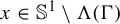
 . We shall see in Proposition 2.3 that for
 , we have
$d(\Gamma 0,\Gamma \gamma _x(t))=t+O(1)$
 , as
$t\rightarrow +\infty $
 . Due to this fact, we shall confine our analysis to
$x\in \Lambda (\Gamma )$
 . Our main objective is therefore to study, for each
$\alpha \ge 0$
 , the level sets

We use
$\dim _H$
 to denote the Hausdorff dimension with respect to the Euclidean metric on
$\mathbb {S}^1$
 . We refer to
$\alpha \mapsto \dim _{H}( \mathcal {LE}^\alpha _\Gamma )$
 ,
$\alpha \mapsto \dim _{H}( \mathcal {E}^\alpha _\Gamma )$
 , and
$\alpha \mapsto \dim _{H}(\mathcal {UE}^\alpha _\Gamma )$
 as the lower escape rate spectrum, the escape rate spectrum, and the uniform escape rate spectrum of
$\Gamma $
 . For each of the level sets, we use
$\mathrm {Ran}$
 to denote the set of
$\alpha \in \mathbb {R}$
 for which the level set is non-empty. Since
$\mathcal {UE}^\alpha _\Gamma \subseteq \mathcal {E}^\alpha _\Gamma \subseteq \mathcal {LE}^{\alpha }_\Gamma $
 and
$d(\Gamma 0,\Gamma \gamma _x(t))\leq d(0,\gamma _x(t))=t$
 , we have
$\mathrm {Ran}\,\mathcal {UE}_\Gamma \subseteq \mathrm {Ran}\,\mathcal {E}_\Gamma \subseteq \mathrm {Ran}\,\mathcal {LE}_\Gamma \subseteq [0,1]$
 . Clearly, we have
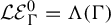
$\mathcal {LE}^0_\Gamma =\Lambda (\Gamma )$
 and
$\mathcal {UE}^0_\Gamma $
 coincides with the uniformly radial limit set
$\Lambda _{ur}(\Gamma )$
 of
$\Gamma $
 . The radial limit set of
$\Gamma $
 is
$ \Lambda _r(\Gamma )=\{ x\in \mathbb {S}^1 | \liminf _{t\geq 0} d(\Gamma 0,\Gamma \gamma _x(t))<+\infty \}.$
 It is well known [Reference Bishop and Jones3, Reference Fernández and Melián10] that

where
$\delta (\Gamma )$
 is called the Poincaré exponent of
$\Gamma $
 . A limit point in
$\Lambda _r(\Gamma )$
 corresponds to a recurrent geodesic ray, which returns to a bounded subset of
$\mathbb {D}/\Gamma $
 infinitely often, while a limit point in
$\Lambda _{ur}(\Gamma )$
 gives rise to a bounded geodesic in
$\mathbb {D}/\Gamma $
 . In comparison, for
$\alpha>0$
 , a limit point in
$\mathcal {LE}^\alpha _\Gamma $
 gives rise to a geodesic ray diverging to infinity with escape rate at least
$\alpha $
 . Bishop [Reference Bishop2] studied for
$\alpha \geq 0$
 the sets

Clearly, we have
$\Lambda _\alpha (\Gamma )=\bigcap _{\varepsilon>0}\mathcal {LE}^{\alpha +\varepsilon }_\Gamma \subseteq \mathcal {LE}^\alpha _\Gamma $
 . Bishop called
$\Lambda _0(\Gamma )$
 the linear escape set. Lundh [Reference Lundh25] has characterized
$\Lambda _\alpha (\Gamma )$
 by the rate at which
$\Gamma 0$
 approaches a limit point (see also [Reference Nicholls27, p. 23]). The parabolic limit set
$\Lambda _p(\Gamma )$
 of
$\Gamma $
 is the set of all fixed points of parabolic elements of
$\Gamma $
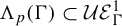
 . We shall prove in Proposition 2.3 that
$\Lambda _p(\Gamma )\subset \mathcal {UE}^1_\Gamma $
 .
From the viewpoint of coarse geometry, we can also interpret
$\Lambda _0(\Gamma )$
 and
$\mathcal {UE}^\alpha _\Gamma $
 with
$\alpha>0$
 as follows. The linear escape set
$\Lambda _0(\Gamma )$
 consists of all
$x\in \Lambda (\Gamma )$
 for which
${\Gamma \gamma _x\!:\, [0,+\infty )\rightarrow \mathbb {D}/\Gamma ;\,t\mapsto \Gamma \gamma _x(t)}$
 is a quasi-isometry. For
$\alpha>0$
 ,
$\mathcal {UE}^\alpha _\Gamma $
 consists of all
$x\in \Lambda (\Gamma )$
 for which
$\Gamma \gamma _x$
 is an
$\alpha $
 -rough similarity. In particular,
$\mathcal {UE}^1_\Gamma $
 consists of all
$x\in \Lambda (\Gamma )$
 for which
$\Gamma \gamma _x$
 is a rough isometry. We refer to [Reference Bonk and Schramm4] for the precise definitions of these notions from coarse geometry.
We shall see in Proposition 2.4 that every finitely generated Fuchsian groups has trivial escape rate spectra, so we investigate infinitely generated Fuchsian groups. In this paper, we study normal subgroups N of a generalized Schottky group G for which
$G/N$
 is isomorphic to
$\mathbb {Z}$
 . In this case, the quotient surface
$\mathbb {D}/N$
 is a
$\mathbb {Z}$
 -covering of the Schottky surface
$\mathbb {D}/G$
 . We refer to §3 for precise definitions. To state our main theorem, we define, for each
$\beta \in \mathbb {R}$
 , the generalized Poincaré exponent

Theorem 1.1. Let G be a generalized Schottky group, and let N be a normal subgroup of G such that
$G/N \simeq \mathbb {Z}$
 and
$\Lambda _p(G)=\Lambda _p(N)$
 . Then, we have
$\mathrm {Ran}\,\mathcal {LE}_N =\mathrm {Ran}\,\mathcal {E}_N= \mathrm {Ran}\,\mathcal {UE}_N= [0,1]$
 , and for all
$\alpha \in [0,1]$
 , we have

Moreover, the escape rate spectra of N are real-analytic and strictly concave on
$[0,1)$
 , continuous at
$\alpha =1$
 , and attain the maximal value
$\dim _H \Lambda (N)$
 at
$\alpha =0$
 . Furthermore, the derivative of
$\alpha \mapsto \dim _{H}(\mathcal {LE}^\alpha _N)$
 tends to
$-\infty $
 as
$\alpha $
 tends to one.
Let us explain our assumption
$\Lambda _p(G)=\Lambda _p(N)$
 in Theorem 1.1. Since every
$gN\in G/N$
 is an isometry on
$\mathbb {D}/N$
 , we can define its asymptotic translation length
${\|gN\|=\lim _{n\rightarrow +\infty }n^{-1} d(N 0,N g(0))\geq 0}$
 . We say that the
$\mathbb {Z}$
 -cover
$\mathbb {D}/N$
 of
$\mathbb {D}/G$
 is hyperbolic if
$\|gN\|>0$
 for some
 . Otherwise, it is called parabolic. It will be shown in Proposition 4.2 that the
$\mathbb {Z}$
 -cover is hyperbolic if and only if
$\Lambda _p(G)=\Lambda _p(N)$
 .
Let us discuss some immediate implications of Theorem 1.1 and how they are related to previous research. The non-triviality of the escape rate spectra implies that the group N is infinitely generated. Moreover, Theorem 1.1 determines the dimension spectrum of
$\Lambda _\alpha (N)$
 . Namely, for each
$\alpha \in [0,1)$
 , we have

As a consequence, we have
$\dim _{H}\Lambda (N)= \dim _{H} \Lambda _{ur}(N)=\dim _{H}\Lambda _0(N)$
 . Note that for an arbitrary Fuchsian group
$\Gamma $
 , Bishop [Reference Bishop2] proved that

Since the Hausdorff dimension of
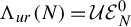
$\Lambda _{ur}(N)\kern-1pt =\kern-1pt \mathcal {UE}^0_N$
 is equal to
$\delta (N)$
 [Reference Fernández and Melián10] and
${s(0)\kern-1pt =\kern-1pt \delta (G)}$
 , Theorem 1.1 implies
$\delta (N)=\delta (G)$
 . This can also be derived from the amenability of the group
$\mathbb {Z}$
 [Reference Sharp34, Reference Stadlbauer35] or by using the ergodicity of the geodesic flow for
$\mathbb {Z}$
 -covers [Reference Rees31].
Recently, coarse-geometric properties of hyperbolic manifolds and groups have been investigated by critical exponents similar to our definition of s in (1.1). The hyperbolic metric on geometrically finite manifolds is compared with the word metric in [Reference Jaerisch and Takahasi18, Reference Kesseböhmer and Stratmann21]. Our definition of s shares some similarity with the Manhattan curve associated with pairs of Fuchsian representations of geometrically finite hyperbolic surfaces [Reference Burger6, Reference Kao20, Reference Sharp33] or pairs of metrics on hyperbolic groups [Reference Cantrell and Tanaka7]. In the latter framework, a dimension spectrum of local intersection numbers is determined as the convex conjugate of the Manhattan curve [Reference Cantrell and Tanaka7]. In contrast to these works, our focus is on metric properties of covering surfaces uniformized by an infinitely generated Fuchsian group allowing parabolic elements.
Our main theorem contributes to the multifractal analysis of non-uniformly expanding conformal dynamical systems. We refer to [Reference Pesin28] for an introduction. The uniform level sets
$\mathcal {UE}^\alpha _\Gamma $
 we consider are different from those considered previously. Our results rely on recent results of the second author [Reference Liu23, Reference Liu24] (see also [Reference Gröger, Jaerisch and Kesseböhmer12]).
The next example summarizes Propositions 7.1, 7.2, and 7.3.
Example 1.2. There exist generalized Schottky groups G and normal subgroups N with
$G/N\simeq \mathbb {Z}$
 and
$\Lambda _p(G)=\Lambda _p(N)$
 such that all of the following hold:
-
(1) $\dim _{H}(\mathcal {LE}^1_N)= \dim _{H}(\mathcal {UE}^1_N)=0$
 ;
-
(2) there exists a hyperbolic $a\in G$
with
$aN$
generating
$G/N$
such that:-
(a) the axis $\mathcal {X}_a$
of a, namely the geodesic joining the two fixed points of a, is isometrically projected to the quotient surface
$\mathbb {D}/N$
by the natural projection; -
(b)
is the N-orbit of the two fixed points of a; -
(c) $\|aN\|=\lim _{n\rightarrow +\infty }d(a^n 0,0)/n$
.
-



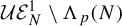 is the N-orbit of the two fixed points of a;

We are specifically interested in
$\mathcal {UE}^1_N$
 from a geometric perspective. Under the assumptions of Theorem 1.1, we have
$\mathcal {UE}^1_N\neq \varnothing $
 , so there exists a roughly isometric embedding of
$[0,+\infty )$
 into
$\mathbb {D}/N$
 . Indeed, one can see from §6.5 that
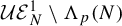
$\mathcal {UE}^1_N\supsetneq \Lambda _p(N)$
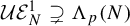 because we showed that there exists a probability measure on
 . For N in Example 1.2, the statement in condition (2)(b) shows that every
 is the image of one of the fixed points of some
 under some
$h\in N$
 . We have thus shown that if
$N\gamma _x$
 is a rough isometry, then we have three cases:
-
(1) $N\gamma _x(t)$
escapes into a funnel at infinity as
$t\rightarrow +\infty $
if ; -
(2) $N\gamma _x(t)$
escapes into a cusp as
$t\rightarrow +\infty $
if
$x\in \Lambda _p(N)$
; -
(3) $N\gamma _x(t)$
converges to
$N\mathcal {X}_a=\{N z|z\in \mathcal {X}_a\}$
and escapes towards one of the ends of
$N\mathcal {X}_a$
as
$t\rightarrow +\infty $
.


 ;





By Example 1.2(1), we have
$\dim _{H}(\mathcal {LE}^1_N)=\dim _{H}(\mathcal {UE}^1_\Gamma )=0$
 . It would be interesting to know whether this holds for generic Fuchsian groups.
As another natural question related to the interpretation using rough isometries shown above, one may ask whether there exists an isometric embedding of
$[0,+\infty )$
 into
$\mathbb {D}/N$
 . For N in Example 1.2, this is the case. Indeed, the claim (2)(a) for Example 1.2 shows that
$\mathbb {R}$
 is isometric to
$N\mathcal {X}_a$
 . We refer to [Reference Izeki13] for similar types of results in the framework of isometry groups acting on CAT(0) spaces.
Let us also comment on Example 1.2(2)(c), which asserts that
$\|aN\|$
 coincides with
$\|a\|$
 . Here,
$\|a\|$
 denotes the asymptotic translation length of the hyperbolic isometry a acting on
$\mathbb {D}$
 . Recall that for every orientation-preserving isometry g on
$\mathbb {D}$
 , its asymptotic translation length
$\|g\|$
 is precisely its minimal displacement
$\inf _{z\in \mathbb {D}}d(z,g(z))$
 , and can be evaluated using elementary hyperbolic geometry (see [Reference Beardon1, Reference Dal’Bo8]). Hence, for Example 1.2,
$\|aN\|=\|a\|$
 can be calculated.
For a general hyperbolic
$\mathbb {Z}$
 -cover
$\mathbb {D}/N$
 of
$\mathbb {D}/G$
 , we shall see in Proposition 4.2 that for each
 , we have
 , where
$\chi :G\rightarrow \mathbb {Z}$
 is an arbitrary homomorphism whose kernel is N. It would be interesting to know when this infimum is a minimum. If so, this would allow us to determine
$\|gN\|$
 as long as we can find
 attaining the minimum. This question is also closely related to ergodic optimization. In fact,
 satisfies that
$\|g\|=\|gN\|$
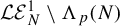
 if and only if the two fixed points of g are both in
 . It is also easy to see that a limit point
 is periodic under the induced Bowen–Series map introduced in §6.1 if and only if it is fixed by some hyperbolic
$g\in G$
 . Therefore, the existence of
 satisfying
$\|g\|=\|gN\|$
 is equivalent to the existence of a periodic orbit in
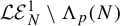 under the induced Bowen–Series map. Lemma 6.5 relates
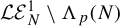 with level sets of a quotient of Birkhoff sums, so the existence of periodic orbits in
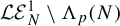 can be viewed as a problem in ergodic optimization as well.
Let us briefly comment on the methods of the proofs. Since
$\Lambda (G)=\Lambda (N)$
 , we can use the coding of
$\Lambda (G)$
 with a finite alphabet to investigate the limit set of the infinitely generated group N. By carefully investigating the asymptotic translation length in §4, we are able to reduce the analysis of the Hausdorff dimensions of the sets
$\mathcal {UE}^\alpha _N$
 ,
$\mathcal {E}^\alpha _N$
 , and
$\mathcal {LE}^\alpha _N$
 to level sets of quotients of Birkhoff sums in symbolic dynamics (see Lemma 6.5). For our results on the uniform escape rate spectrum, we use ideas from [Reference Gröger, Jaerisch and Kesseböhmer12] and [Reference Liu23, Reference Liu24]. For
$\alpha =1$
 , we use tools from ergodic optimization [Reference Jenkinson19]. The proof of Theorem 1.1 is to be given in §§6.4 and 6.5.
We expect that our results can be extended to hyperbolic
$\mathbb {Z}$
 -covers of geometrically finite hyperbolic surfaces, using the symbolic dynamics developed by Bowen and Series [Reference Bowen and Series5]. To keep the presentation simple, we have restricted our analysis to Schottky surfaces.
The outline of this paper is as follows. In §2, we provide some preliminary results for an arbitrary Fuchsian group
$\Gamma $
 . In §3, we state the definition of a generalized Schottky group G. In §4, we study the asymptotic translation length of isometries in
$G/N$
 acting on
$\mathbb {D}/N$
 . In Proposition 4.1, we establish a uniform bound which is the key to investigate the uniform escape rate spectrum. In §5, we collect some recent known facts on the multifractal analysis of Birkhoff sums for countable Markov shifts using the concept of u-dimension. In §6, we prove our main result. After setting up a suitable induced dynamical system in §6.1, we define two thermodynamic potentials in §6.2 which allow us to give a symbolic description of the escape rate spectra. Section 6.3 deals with properties of the free energy and its convex conjugate. In §6.4, we prove our main theorem for the interior of the spectra, and in §6.5, we deal with the boundary of the spectra. In §7, we discuss Example 1.2.
2 First observations on escape rate spectra
This section states and proves several facts which hold for the quotient
$\mathbb {D}/\Gamma $
 with
$\Gamma $
 being an arbitrary Fuchsian group.
First, we give an expression for the distance between two points on the quotient
$\mathbb {D}/\Gamma $
 . Throughout this paper, we adopt a widely used notation; given a metric space
$(X,d_X)$
 and two subsets
$A_1,A_2$
 of X, we define

Furthermore, for any
$x\in X$
 and
$A\subseteq X$
 , we define both
$d_X(x,A)$
 and
$d_X(A,x)$
 to be equal to
$d_X(\{x\},A)=d_X(A,\{x\})$
 . Using this notation, for any two points
$\Gamma z_1$
 and
$\Gamma z_2$
 on the quotient
$\mathbb {D}/\Gamma $
 , the distance between them is equal to

here,
$\Gamma z_1$
 and
$\Gamma z_2$
 in the expression
$d(\Gamma z_1,\Gamma z_2)$
 are regarded as subsets of
$\mathbb {D}$
 . Hence, slightly abusing the notation, we shall always write
$d(\Gamma z_1,\Gamma z_2)$
 to denote the distance between two points
$\Gamma z_1$
 and
$\Gamma z_2$
 on
$\mathbb {D}/\Gamma $
 . Since
$\Gamma z$
 is a discrete subset of
$\mathbb {D}$
 for any
$z\in \mathbb {D}$
 , we have for any
$z_1,z_2\in \mathbb {D}$
 ,

Previously, we always considered a geodesic ray which starts from
$0\in \mathbb {D}$
 . In fact, as we shall see in Proposition 2.1, we can freely change the starting point of the geodesic rays. For
$z\in \mathbb {D}$
 ,
$x\in \mathbb {S}^1$
 , and
$t\geq 0$
 , we use
$\gamma _{x,z}(t)$
 to denote the unique point on the geodesic ray
${[z,x)}$
 such that
$d(\gamma _{x,z}(t),z)=t$
 . Notice that
$\gamma _{x}(t)=\gamma _{x,0}(t)$
 for all
$x\in \mathbb {S}^1$
 and all
$t\geq 0$
 .
Proposition 2.1. For any
$z\in \mathbb {D}$
 and any
$x\in \mathbb {S}^1$
 ,

Proof. By the triangle inequality and the fact that
$d({\Gamma } z_1,{\Gamma } z_2)\leq d(z_1,z_2)$
 for all
${z_1,z_2\in \mathbb {D}}$
 , we have for all
$t\geq 0$
 ,

From the knowledge of the hyperbolic geometry, we know that
$d(\gamma _x(t),\gamma _{x,z}(t))$
 is bounded in t and our proof is thus complete.
Combining Proposition 2.1 with the fact that
$d(0,\gamma _x(t))=d(z,\gamma _{x,z}(t))=t$
 for all
${t\geq 0}$
 , we immediately have the following fact.
Corollary 2.2. For any Fuchsian group
$\Gamma $
 ,
$\alpha \geq 0$
 , and
$z\in \mathbb {D}$
 , we have

Proposition 2.3. Let
$\Gamma $
 be a Fuchsian group. Then, for any x in either
 or
$\Lambda _p(\Gamma )$
 , we have

Proof. We first treat the case where  . Then, there exists some
$t_1>0$
 such that the
$\Gamma $
 -orbit
$\Gamma 0=\{g0|g\in \Gamma \}$
 of
$0$
 lies on one side of the geodesic L through
$\gamma _x(t_1)$
 and perpendicular to the trajectory of
$\gamma _x$
 . Note that for any
$t\geq t_1$
 , the geodesic segment joining
$\gamma _x(t)$
 and any of the points in
$\Gamma 0$
 always intersects L. This implies that

Moreover, L is perpendicular to the trajectory of
$\gamma _x$
 at
$\gamma _x(t_1)$
 , so from the knowledge of the hyperbolic geometry [Reference Beardon1, §7.20], we deduce that
$\gamma _x(t_1)$
 is the point on L closest to
$\gamma _x(t)$
 . Thus, we have

for any
$t\geq t_1$
 . Since we also have
$d(\Gamma 0,\Gamma \gamma _x(t))\leq t$
 for all
$t\geq 0$
 , (2.1) holds when
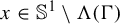 .
For
$x\in \Lambda _p(\Gamma )$
 , there exists some
$t_2>0$
 such that
$\Gamma 0$
 lies on one side of the horocycle
$\mathcal {H}$
 centered at x and passing through
$\gamma _x(t_2)$
 . This claim is valid due to the fact that a parabolic limit point can never be horocyclic [Reference Dal’Bo8, Corollary I.3.18]. Similar to the previous situation, we still have that any geodesic segment joining any of the points in
$\Gamma 0$
 and
$\gamma _x(t)$
 must intersect
$\mathcal {H}$
 for any
$t\geq t_2$
 . Moreover, the point on
$\mathcal {H}$
 closest to
$\gamma _x(t)$
 is
$\gamma _x(t_2)$
 ; see [Reference Dal’Bo8, Property I.1.19]. Hence, by the same arguments as before, we have

for any
$t\geq t_2$
 . Therefore, (2.1) also holds when
$x\in \Lambda _p(\Gamma )$
 .
If a Fuchsian group
$\Gamma $
 is finitely generated, then the dimension spectra
$\alpha \mapsto \dim _{H}(\mathcal {LE}^\alpha _\Gamma )$
 ,
$\alpha \mapsto \dim _{H}(\mathcal {E}^\alpha _\Gamma )$
 , and
$\alpha \mapsto \dim _{H}(\mathcal {UE}^\alpha _\Gamma )$
 are trivial in the following sense.
Proposition 2.4. Suppose that
$\Gamma $
 is a non-elementary, finitely generated Fuchsian group. Then,
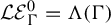
$\mathcal {LE}^\alpha _\Gamma =\Lambda _p(\Gamma )\supseteq \mathcal {E}^\alpha _\Gamma =\mathcal {UE}^\alpha _\Gamma =\varnothing $
 for
$\alpha \in (0,1)$
 . For
$\alpha \in \{0,1\}$
 , we have
$\mathcal {LE}^1_\Gamma =\mathcal {E}^1_\Gamma =\mathcal {UE}^1_\Gamma =\Lambda _p(\Gamma )$
 ,
$\mathcal {LE}^0_\Gamma =\Lambda (\Gamma )$
 and
$\dim _{H}(\mathcal {E}^0_\Gamma )=\dim _{H}(\mathcal {UE}^0_\Gamma )=\dim _{H}(\Lambda (\Gamma ))>0$
 .
The situation where
$\Gamma $
 is an elementary Fuchsian group is even simpler. For all
$\alpha $
 ,
$\dim _{H}(\mathcal {UE}^\alpha _\Gamma )=\dim _{H}(\mathcal {E}^\alpha _\Gamma )=\dim _{H}(\mathcal {LE}^\alpha _\Gamma )=0$
 because
$\Lambda (\Gamma )$
 is finite and, in particular, has zero Hausdorff dimension.
Proof of Proposition 2.4
For finitely generated
$\Gamma $
 , its limit set
$\Lambda (\Gamma )$
 is precisely the disjoint union of
$\Lambda _p(\Gamma )$
 and
$\Lambda _r(\Gamma )$
 [Reference Beardon1, Reference Dal’Bo8]. For any
$x\in \Lambda _r(\Gamma )$
 , there is a sequence
$(g_n)_{n\in \mathbb {N}}$
 of group elements in
$\Gamma $
 such that
$\lim _{n\rightarrow +\infty }g_n(0)=x$
 and

For each
$n\in \mathbb {N}$
 , define
$t_n\geq 0$
 by letting
$\inf _{t\geq 0} d(g_n(0),\gamma _x(t))=d(g_n(0),\gamma _x(t_n))$
 . Note that for any positive integer n,

so
$t_n$
 diverges to
$+\infty $
 as n tends to infinity. As a consequence, we have

for any
$x\in \Lambda _r(\Gamma )$
 . Hence,
$\mathcal {LE}^\alpha _\Gamma $
 is disjoint from
$\Lambda _r(\Gamma )$
 for
$\alpha>0$
 . From Proposition 2.3, we also know that
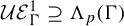
$\mathcal {UE}^1_\Gamma \supseteq \Lambda _p(\Gamma )$
 . Thus, it is easy to see that
$\mathcal {LE}^\alpha _\Gamma =\Lambda _p(\Gamma )\supseteq \mathcal {E}^\alpha _\Gamma =\mathcal {UE}^\alpha _\Gamma =\varnothing $
 for
$\alpha \in (0,1)$
 and
$\mathcal {LE}^1_\Gamma =\mathcal {E}^1_\Gamma =\mathcal {UE}^1_\Gamma =\Lambda _p(\Gamma )$
 . By definition, we also have
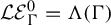
$\mathcal {LE}^0_\Gamma =\Lambda (\Gamma )$
 .
Now, it only remains to show that
$\dim _{H}(\mathcal {E}^0_\Gamma )=\dim _{H}(\mathcal {UE}^0_\Gamma )=\dim _{H}(\Lambda (\Gamma ))>0$
 . It was shown in [Reference Fernández and Melián10] that

where
$\delta (\Gamma )$
 is the Poincaré exponent of
$\Gamma $
 . The finitely generated Fuchsian group
$\Gamma $
 satisfies
$\Lambda (\Gamma )=\Lambda _r(\Gamma )\cup \Lambda _p(\Gamma )$
 , where
$\Lambda _p(\Gamma )$
 is at most countable and thus of Hausdorff dimension zero. Consequently, we have

where the last equality was shown in [Reference Bishop and Jones3]. Since
$\mathcal {UE}^0_\Gamma \subseteq \mathcal {E}^0_\Gamma \subseteq \Lambda (\Gamma )$
 , we deduce from the previous equality and (2.2) that
$\dim _{H}(\mathcal {UE}^0_\Gamma )=\dim _{H}(\mathcal {E}^0_\Gamma )=\dim _{H}(\Lambda (\Gamma ))$
 . As
$\Gamma $
 is non-elementary, we have
$\dim _{H}(\Lambda (\Gamma ))>0$
 , which completes the proof.
3 Generalized Schottky groups
In this section, we define generalized Schottky groups, whose quotient surfaces we refer to as Schottky surfaces.
3.1 Definition of generalized Schottky group G
This subsection gives the definition of the generalized Schottky group G, which is equivalent to the definition of Schottky groups in [Reference Dal’Bo8, §II.1].
For every orientation-preserving isometry
$g:\mathbb {D}\rightarrow \mathbb {D}$
 not fixing
$0$
 , we define

Clearly, its boundary in
$\mathbb {D}$
 is
$\partial R_g=\{z\in \mathbb {D}|d(z,0)=d(z,g(0))\}$
 , which is a complete geodesic in
$\mathbb {D}$
 . Moreover, one can easily check from the definition that

so
$R_g$
 ,
$\partial R_g$
 , and
$gR_{g^{-1}}$
 form a partition of
$\mathbb {D}$
 .
Definition. We say that a Fuchsian group G is a generalized Schottky group if it has a finite generating set
$G_0$
 satisfying:
-
(1) the cardinality $\#G_0$
of
$G_0$
is no less than four; -
(2) for every $a\in G_0$
, its inverse
$a^{-1}$
, which will also be denoted by
$\bar {a}$
henceforth, is also in
$G_0$
; -
(3) every $a\in G_0$
is either hyperbolic or parabolic; -
(4) $d(R_{a}\cup R_{\bar {a}},R_{b}\cup R_{\bar {b}})>0$
for any
$a,b\in G_0$
satisfying that
$a\notin \{b,\bar {b}\}$
.





In what follows, G will always be a generalized Schottky group and
$G_0$
 will always be a finite generating set of G satisfying the conditions in the above-mentioned definition. We shall denote by
$H_0$
 the set of all hyperbolic elements of
$G_0$
 and by
$\Pi _0$
 the set of all parabolic elements of
$G_0$
 . Since every member of
$G_0$
 is either hyperbolic or parabolic,
$G_0$
 can be decomposed into the disjoint union
$G_0=H_0\cup \Pi _0$
 .
Following the arguments in [Reference Dal’Bo8, §II.1], we can derive the following facts. First, the polygon  is the Dirichlet domain of G centered at
$0$
 and, in particular,
$0\in D$
 . Second, G is a free group. To be more precise, we say a word
$\omega =\omega _0\cdots \omega _{l-1}$
 over
$G_0$
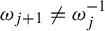
 is reduced if
$\omega _{j+1}\neq \omega _j^{-1}$
 for all
$j\in \{0,\ldots ,{l-2}\}$
 . Note that it is vacuously true that the empty word and all words of length one are reduced. Then, for every group element g of G other than the identity, there exists a unique reduced word
$\omega =\omega _0\cdots \omega _{l-1}$
 of length l such that g is equal to the product
$\omega _0\cdots \omega _{l-1}$
 . Hence, every
$g\in G$
 other than the identity is represented by a unique non-empty reduced word over
$G_0$
 . For convenience, we set the empty word to be the reduced word representing the identity of G. Sometimes, we shall simply use a reduced word
$\omega $
 over
$G_0$
 to denote a group element of G. Third, for any non-empty reduced word
$\omega =\omega _0\cdots \omega _{l-1}$
 over
$G_0$
 and any integer
$k\in \{0,\ldots ,l-1\}$
 ,

with equality if and only if
$k=l-1$
 .
3.2 Coding of
$\Lambda (G)$
and Bowen–Series map

Let
$\mathbb {N}$
 denote the set of all non-negative integers. Define the shift space to be

whose elements are called reduced sequences over
$G_0$
 . Define the left shift
$\sigma _G:\Sigma _G\rightarrow \Sigma _G$
 by
$\sigma _G(x_0x_1\cdots )=x_1x_2\cdots $
 for any
$x_0x_1\cdots \in \Sigma _G$
 . Clearly,
$\sigma _G:\Sigma _G\rightarrow \Sigma _G$
 is an irreducible subshift of finite type.
Every limit point of G can be represented by a reduced sequence over
$G_0$
 via the coding map defined in the following manner. For every
$x=x_0x_1\cdots \in \Sigma _G$
 , note that
$(R_{x_0\cdots x_{n-1}})_{n\in \mathbb {N}}$
 is a decreasing sequence of sets and the Euclidean diameter of
$R_{x_0\cdots x_{n-1}}$
 converges to zero as n tends to infinity [Reference Dal’Bo8, §II.1], so there is a unique point
$\pi (x)\in \mathbb {C}$
 such that

where
$\overline {R_{x_0\cdots x_{n-1}}}$
 is the closure of
$R_{x_0\cdots x_{n-1}}$
 taken in
$\mathbb {C}$
 for each
$n\in \mathbb {N}$
 . Clearly,

so
$\pi (x)\in \Lambda (G)$
 . This defines a map
$\pi :\Sigma _G\rightarrow \Lambda (G)$
 , which is called the coding map of
$\Lambda (G)$
 . The coding map
$\pi $
 is surjective [Reference Dal’Bo8, §II.2]. Also note that

Since G is clearly finitely generated, we have  , which implies

It is known [Reference Dal’Bo8, Proposition II.2.2] that the restriction
$\pi |_{\pi ^{-1}(\Lambda _r(G))}$
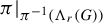 of the coding map
$\pi $
 to
$\pi ^{-1}(\Lambda _r(G))$
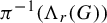 is bijective. Henceforth, for any
$x\in \pi ^{-1}(\Lambda _r(G))$
 , we shall sometimes simply write x to denote
$\pi (x)\in \Lambda _r(G)$
 and do not distinguish x and
$\pi (x)$
 .
The dynamics on the limit set
$\Lambda (G)$
 exhibits an expanding nature which can be well described by the Bowen–Series map to be defined next. We define for
$a\in G_0$
 the sets
${\Delta _a = \overline {R_a} \cap \mathbb {S}^1}$
 , where the closure is taken in
$\mathbb {C}$
 . Define
$\Delta =\bigcup _{a\in G_0} \Delta _a$
 . The Bowen–Series map
$f:\Delta \rightarrow \mathbb {S}^1$
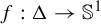 is given by

From our condition on the generalized Schottky group G, for
$a,b\in G_0$
 with
$a\neq b$
 , we have
$\Delta _a \cap \Delta _b = \varnothing $
 unless
$a\in \Pi _0$
 and
$b=\bar {a}$
 . If
$a\in \Pi _0$
 , then
$\Delta _a \cap \Delta _{\bar {a}}$
 is a singleton, given by the unique fixed point of a. Hence, f is well defined by (3.1). The limit set
$\Lambda (G)$
 and the radial limit set
$\Lambda _r(G)$
 can thus be expressed by

from which we can see that f maps
$\Lambda (G)$
 and
$\Lambda _r(G)$
 to
$\Lambda (G)$
 and
$\Lambda _r(G)$
 , respectively. Moreover, it can be checked directly from the definitions that

By our definition, for every
$a\in G_0$
 ,
$\partial R_a$
 is the perpendicular bisector of the geodesic segment joining
$0$
 and
$a(0)$
 , which implies that
$\partial R_a$
 is the isometric circle of
$a^{-1}$
 [Reference Beardon1, §7.21]. As a consequence, the Bowen–Series map f is expanding, by which we mean
$|f'|>1$
 . If
$G_0$
 contains only hyperbolic elements, in which case G is purely hyperbolic [Reference Dal’Bo8], there exists some open neighborhood O of
$\Lambda (G)=\Lambda _r(G)$
 such that the Bowen–Series map f is uniformly expanding on O, that is,
$\inf _{x\in O}|f'(x)|>1$
 . If
$G_0$
 contains parabolic elements, then
$|f'(x_p)|=1$
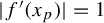 for any fixed point
$x_p$
 of a parabolic
$a_p\in G_0$
 . By the continuity of
$f'$
 , we have
$\inf _{x\in \Lambda _r(G)}|f'(x)|=1$
 , meaning that f is not uniformly expanding on the radial limit set
$\Lambda _r(G)$
 of G. By contrast, the induced Bowen–Series map
$\tilde {f}$
 to be defined in §6 is uniformly expanding on
$\Lambda _r(G)$
 .
4
$\mathbb {Z}$
-covers of Schottky surfaces

Let G be a generalized Schottky group and N be a normal subgroup of G satisfying that
$G/N$
 is isomorphic to
$\mathbb {Z}$
 . We call
$\mathbb {D}/N$
 a
$\mathbb {Z}$
 -cover of the Schottky surface
$\mathbb {D}/G$
 .
4.1 Coarse-geometric properties
Given a metric space
$(X,d_X)$
 and an isometry
${T:X\rightarrow X}$
 , the asymptotic translation length of T is defined to be

where x is an arbitrary point in X. It is easy to see that the limit in (4.1) exists and equals the infimum in (4.1), by applying Fekete’s lemma to the subadditive sequence
$n\mapsto d_X(x,T^n(x))$
 . The following facts are also straightforward. The value of
$\|T\|$
 does not depend on the choice of x and
$\|T^k\|=|k|\cdot \|T\|$
 for any
$k\in \mathbb {Z}$
 ;
$T^k$
 makes sense for negative k provided that T is bijective. Moreover, for any isometry
$S:X\rightarrow X$
 ,
$STS^{-1}$
 is also an isometry and
$\|STS^{-1}\|=\|T\|$
 .
Now, we consider isometries acting on the metric space
$\mathbb {D}/N$
 . Every element
$gN$
 of the quotient group
$G/N$
 can be naturally identified with a deck transformation on
$\mathbb {D}/N$
 , which sends every
$N z\in \mathbb {D}/N$
 to
$N g(z)\in \mathbb {D}/N$
 . We shall not distinguish between
$gN$
 and this deck transformation. Since N is a normal subgroup of G and all elements in G are isometries on
$\mathbb {D}$
 , we have for any
$g\in G$
 and
$z,w\in \mathbb {D}$
 ,

This shows that every
$gN\in G/N$
 is an isometry on
$\mathbb {D}/N$
 , so we can write
$\|gN\|$
 to denote its asymptotic translation length. The following technical proposition plays a central role in this paper.
Proposition 4.1. Suppose that
$\Lambda _p(G)=\Lambda _p(N)$
 . Then, there exists a constant C such that for all
$g\in G$
 ,

In the context of coarse geometry, two metrics
$d_1,d_2$
 on a set X are said to be roughly similar if there exists a constant
$k>0$
 such that

Define a metric
$d_N$
 of
$\mathbb {Z}$
 by setting
$d_N(m,n)=d(N 0,N g^{m-n}0)$
 for a generator
$gN$
 of
$G/N $
 and for all
$m,n\in \mathbb {Z}$
 . Clearly, Proposition 4.1 asserts that for a hyperbolic
$\mathbb {Z}$
 -cover
$\mathbb {D}/N$
 of
$\mathbb {D}/G$
 , the metric
$d_N$
 is roughly similar to the Euclidean metric on
$\mathbb {Z}$
 . Recently, [Reference Cantrell and Tanaka7] gave a criterion for rough similarity between two metrics on a non-elementary hyperbolic group in terms of the associated Manhattan curve. For elementary hyperbolic group
$\mathbb {Z}$
 , this criterion fails in general, so Proposition 4.1 is not a consequence of [Reference Cantrell and Tanaka7]. We will give a proof of Proposition 4.1 in §4.2.
Take a surjective homomorphism
$\chi :G\rightarrow \mathbb {Z}$
 satisfying that
$\ker (\chi )=N$
 . Define

for some  . Clearly,
$\unicode{x3bb} _{G|N}$
 does not depend on the choice of
 . Moreover, if some
$gN\in G/N$
 generates
$G/N$
 , we have
$\chi (g)=\pm 1$
 and, therefore,
$\unicode{x3bb} _{G|N} =\|gN\|$
 for this particular
$gN\in G/N$
 . Using Proposition 4.1, we can then show the following proposition on
$\unicode{x3bb} _{G|N}$
 .
Proposition 4.2. We have  . Moreover, we have:
-
(1) $\unicode{x3bb} _{G|N}=0$
if
$\Lambda _p(G)\supsetneq \Lambda _p(N)$
; -
(2) $\unicode{x3bb} _{G|N}>0$
if
$\Lambda _p(G)=\Lambda _p(N)$
.




Every
$g:\mathbb {D}\rightarrow \mathbb {D}$
 in the generalized Schottky group G is an isometry, so its asymptotic translation length
$\|g\|$
 is well defined. One can easily see that
$\|g\|$
 is precisely the minimal displacement of g, meaning that
$\|g\|= \inf _{z\in \mathbb {D}} d(z,g(z))$
 . When g is parabolic,
$\|g\|$
 is known to be zero; when g is hyperbolic,
$\|g\|$
 is known to be positive. For hyperbolic g, take
$\alpha ,\beta \in \mathbb {C}$
 satisfying that

for all
$z\in \mathbb {D}$
 and
$|\alpha |^2-|\beta |^2=1$
 . Then, the hyperbolicity of g implies that
$|\alpha +\bar {\alpha }|>2$
 and it is known that

In this sense, the asymptotic translation length
$\|g\|$
 of every
$g\in G$
 can be evaluated. We refer to [Reference Beardon1, Reference Dal’Bo8] for the details of the facts we previously mentioned.
Proof of Proposition 4.2
Since
$d(N z_1,N z_2)\leq d(z_1,z_2)$
 for any
$z_1,z_2\in \mathbb {D}$
 , we have
$\|gN\|\leq \|g\|$
 for all
$g\in G$
 . Thus, on the one hand, we have

On the other hand, we take
$g^{(k)}\in G$
 satisfying
$\chi (g^{(k)})=k$
 and
$d(N 0,N g^{(k)}(0))=d(0,g^{(k)}(0))$
 for each positive integer k. From (4.1), we have
$\|g^{(k)}\|\leq d(0,g^{(k)}0)$
 for every positive integer k. Hence, we have

Therefore,
$\unicode{x3bb} _{G|N}=\inf _{g\in G/N}\|g\|/|\chi (g)|$
 .
Next, we prove the last claim in Proposition 4.2. Suppose that
$\Lambda _p(G)=\Lambda _p(N)$
 . Note that
$g^{(m)}\neq g^{(n)}$
 for distinct positive integers m and n because they are in disjoint cosets of N. As G contains no elliptic elements, we have
$g^{(m)}(0)\neq g^{(n)}(0)$
 . Since the G-orbit of
$0$
 is a discrete subset of
$\mathbb {D}$
 , we thus deduce that
 is unbounded. By Proposition 4.1, there exists a constant C such that
$\|g^{(n)}N\|\geq d(N 0,N g^{(n)}0)-C=d(0,g^{(n)}(0))-C$
 for every positive integer n. Consequently,

For each positive integer n, we have
$\|g^{(n)}N\|=\unicode{x3bb} _{G|N}\cdot |\chi (g^{(n)})|=n\unicode{x3bb} _{G|N}$
 . From this fact and (4.4), we deduce that
$\unicode{x3bb} _{G|N}>0$
 when
$\Lambda _p(G)=\Lambda _p(N)$
 .
If  contains at least one parabolic element, say
$g_p$
 , then we have
$\chi (g_p)\neq 0$
 and
$\|g_p\|=0$
 . Thus, in this case,

It follows that
$\unicode{x3bb} _{G|N}=0$
 if
 contains at least one parabolic element.
4.2 Proof of Proposition 4.1
This subsection is devoted to the proof of Proposition 4.1. Throughout this subsection, we always assume that
$\Lambda _p(G)=\Lambda _p(N)$
 . In this subsection, given any two points
$z_1,z_2\in \mathbb {D}$
 , we denote by
$[z_1,z_2]$
 the closed geodesic segment joining
$z_1$
 and
$z_2$
 .
Our first step is to construct a compact subset  of the fundamental polygon D. In what follows, we shall use
$\mathfrak {E}_a\subseteq \mathbb {S}^1$
 to denote the set of the two endpoints of the complete geodesic
$\partial R_a$
 for each
$a\in G_0$
 .
Take
$a\in G_0$
 and
$x\in \mathfrak {E}_a$
 arbitrarily. If
$x\notin \mathfrak {E}_b$
 for any
 , then there is an open neighborhood
$O_{a,x}$
 of x taken in the closed unit disk
$\overline {\mathbb {D}}=\mathbb {D}\cup \mathbb {S}^1$
 such that

Here,
$G\partial D=\bigcup _{g\in G}\bigcup _{b\in G_0}g(\partial R_b)$
 is a union of complete geodesics, so (4.5) says that among all the complete geodesics contained in
$G\partial D$
 ,
$\partial R_a$
 is the only complete geodesic which is not disjoint from
$O_{a,x}$
 . Take a complete geodesic
$L_{a,x}\subseteq O_{a,x}\cap \mathbb {D}$
 which is perpendicular to
$\partial R_a$
 and let
$O^{\prime }_{a,x}$
 be the connected component of
 which is contained in
$O_{a,x}$
 . If
$x\in \mathfrak {E}_b$
 for some
 , then a is parabolic and x is the unique fixed point of a. Note that there is an open neighborhood
$O_{a,x}$
 of x taken in the closed unit disk
$\overline {\mathbb {D}}$
 such that for any complete geodesic
$L\subseteq G\partial D$
 which intersects
$O_{a,x}$
 , L must be
$\partial R_a$
 or
$\partial R_{\bar {a}}$
 or
$g(\partial R_b)$
 for some
$b\in G_0$
 and some
$g\in G$
 represented by a reduced word
$\omega $
 satisfying that
$\omega b$
 is a reduced word which begins with
$aa$
 or
$\bar {a}\bar {a}$
 . As in the previous case, we take a complete geodesic
$L_{a,x}\subseteq O_{a,x}\cap \mathbb {D}$
 which is perpendicular to
$\partial R_a$
 and let
$O^{\prime }_{a,x}$
 be the connected component of
 which is contained in
$O_{a,x}$
 . Finally, letting

for each
$a\in G_0$
 , we set

It is clear from the construction that we can take
$O^{\prime }_{a,x}$
 sufficiently small so that
 is non-empty for each
$a\in G_0$
 , from which it follows that
 is non-empty. Indeed, for every hyperbolic
$a\in G_0$
 , we may take
$O^{\prime }_{a,x}$
 sufficiently small so that the axis of a, which is the unique complete geodesic preserved by a, is disjoint from
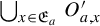
$\bigcup _{x\in \mathfrak {E}_a}O^{\prime }_{a,x}$
 ; this condition will be always assumed henceforth.
The set  we constructed above has the following properties.
Lemma 4.3.
 is compact. Moreover, for any
$g\in G$
 , we have:
-
(1)
if
$d(D,gD)>0$
and
$a_pa_p$
is not an initial block of the reduced word representing g for any
$a_p\in \Pi _0$
; -
(2)
.
 if



 .
To show Lemma 4.3, we need the following lemma, whose proof will be given in the Appendix.
Lemma 4.4. Let
$g\in G$
 . Suppose that
$d(D,gD)>0$
 . Then, we have
$d(D,gD)> d(ND,N gD)$
 if there is some
$a_p\in \Pi _0$
 such that the reduced word over
$G_0$
 which represents g contains
$a_pa_p$
 as a subword.
Proof of Lemma 4.3
For any
$a\in G_0$
 , note that
 is by construction a closed subset of
$\partial R_a$
 and bounded away from both of the two endpoints of the geodesic
$\partial R_a$
 . Therefore,
 is compact for any
$a\in G_0$
 . Since
$G_0$
 is finite,
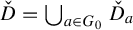 is compact as well.
Let
$g\in G$
 . Suppose that
$d(D,gD)>0$
 and
$a_pa_p$
 is not an initial block of the reduced word representing g for any
$a_p\in \Pi _0$
 . We show
 . Note that
$d(D,gD)=d(\partial D,g(\partial D))$
 ,
$\partial D=\bigcup _{a\in G_0}\partial R_a$
 , and
$G_0$
 is finite, so there are
${a,b\in G_0}$
 such that
$d(\partial R_a, g(\partial R_b))=d(D,gD)>0$
 . Thus, there are further
$z_1\in \partial R_a$
 and
${z_2\in \partial R_b}$
 such that

indeed, it is known that the geodesic segment
$[z_1,g(z_2)]$
 is perpendicular to both
$\partial R_a$
 and
$g(\partial R_b)$
 [Reference Beardon1, Ch. 7]. We claim that
 . As
$z_1\in \partial R_a$
 , we only need to show that
$z_1\notin \bigcup _{x\in \mathfrak {E}_a}O^{\prime }_{a,x}$
 . Take
$x\in \mathfrak {E}_a$
 arbitrarily. First, we consider the case where
$x\notin \mathfrak {E}_{a'}$
 for any
 . Since
$z_2\in \partial R_b$
 and
$d(\partial R_a,g(\partial R_b))>0$
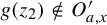
 , by our construction, we have that
$g(z_2)\notin O_{a,x}$
 , which hence implies that
$g(z_2)\notin O^{\prime }_{a,x}$
 . Since the geodesic segment
$[z_1,g(z_2)]$
 and the geodesic
$L_{a,x}$
 are both perpendicular to
$\partial R_a$
 , we have
$[z_1,g(z_2)]$
 is disjoint from
$L_{a,x}$
 , showing that
$z_1$
 and
$g(z_2)$
 are on the same side of the geodesic
$L_{a,x}$
 . As we have seen that
$g(z_2)\notin O^{\prime }_{a,x}$
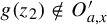 , we deduce that
$z_1\notin O^{\prime }_{a,x}$
 .
If
$x\in \mathfrak {E}_{a'}$
 for some
 , then a is parabolic and x is the fixed point of a. Recall that for any parabolic
$a_p\in G_0$
 ,
$a_pa_p$
 is assumed not to be an initial block of the reduced word representing g. Since
$z_2\in \partial R_b$
 , we have
$g(z_2)\notin O_{a,x}$
 . Repeating the same arguments we made when handling the previous case, we have that
$z_1\notin O^{\prime }_{a,x}$
 still holds when
$x\in \mathfrak {E}_{a'}$
 for some
 . Hence,
 holds in any case. As g is an isometry acting on
$\mathbb {D}$
 , (4.6) gives

which further equals
$d(D,g^{-1}D)>0$
 . Hence, by symmetry, we also have that
 . Now that we have shown that
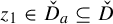 and
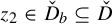 , we have

Since  , we also have
 . Therefore,
 , provided that
$d(D,gD)>0$
 and
$a_pa_p$
 is not an initial block of the reduced word representing g for any
$a_p\in \Pi _0$
 .
Finally, we show the last claim. Fix an arbitrary
$g\in G$
 and pick
$g'\in gN$
 satisfying that

If
$d(ND,N gD)=0$
 , then
$d(D,g'D)=0$
 , so
$g'$
 must be the identity or a side-pairing transformation in
$G_0$
 or a power of some parabolic
$a_p\in G_0$
 . If
$g'$
 is the identity or a power of some parabolic element of
$G_0$
 , then using our assumption that
$\Lambda _p(G)=\Lambda _p(N)$
 , we can show that
$g'\in N$
 , which implies that
$g\in N$
 as well. Hence,
 , so our last claim holds in this case. The remaining case is that
$g'\in G_0$
 is hyperbolic. Let
$z_+$
 be the point at which
$\partial R_{g'}$
 intersects the axis of
$g'$
 and
$z_-$
 be the point at which
$\partial R_{\overline {g'}}$
 intersects the axis of
$g'$
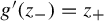
 . Then, we have
$g'(z_-)=z_+$
 . Since we took
 so that
$z_-$
 and
$z_+$
 lie in
 , we thus have

Therefore, we still have  when g is a hyperbolic element of
$G_0$
 . Hence, our last claim holds when
$d(ND,N gD)=0$
 .
Suppose that
$d(D,g'D)=d(ND,N gD)>0$
 . Since
$g'\in gN$
 , we also have
$d(ND,\, N g'D)=d(ND,N gD)$
 . Therefore, by Lemma 4.4,
$a_pa_p$
 is not a subword, and hence not an initial block, of the reduced word representing
$g'$
 for any parabolic
$a_p\in G_0$
 . By Lemma 4.3(1), we have
 . Consequently, on the one hand, we obtain

On the other hand,  because
 . We can thus conclude that
 also holds when
$d(ND,N gD)>0$
 . Our proof is now complete.
In addition to  and its properties presented in Lemma 4.3, we also need the following lemma to show Proposition 4.1.
Lemma 4.5. There exists some constant
$C_0\geq 0$
 such that for any
$g\in G$
 ,
 is superadditive.
Proof. Fix an arbitrary
$g\in G$
 . We shall define a constant
$C_0\geq 0$
 independent of the choice of g and show for this
$C_0$
 that
$n\mapsto d(ND, N g^nD)-C_0$
 is superadditive. For any positive integer m, take
$g^{(m)}\in g^mN$
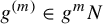 such that

Take positive integers k and l arbitrarily. Then, there exists some group element
$g^*(k,l)$
 represented by an initial block of the reduced word representing
$g^{(k+l)}$
 satisfying that

Indeed, one may take
$g^*(k,l)$
 to be the longest initial block of
$g^{(k+l)}$
 such that
$\chi (g^*(k,l))\leq k\chi (g)$
 if
$\chi (g)\geq 0$
 and take
$g^*(k,l)$
 to be the longest initial block of
$g^{(k+l)}$
 such that
$\chi (g^*(k,l))\geq k\chi (g)$
 if
$\chi (g)<0$
 .
By definition, the reduced word representing
$g^*(k,l)$
 is an initial block of the reduced word representing
$g^{(k+l)}$
 . This implies that for any
$z_1,z_2\in D$
 , the geodesic segment
$[z_1,g^{(k+l)}z_2]$
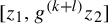 is bound to intersect
$g^*(k,l)D$
 . Take
$z_3\in g^*(k,l)D \cap [z_1,g^{(k+l)}z_2]$
 . Then, we have

It thus follows that
$d(D, g^{(k+l)}D)\geq d(D, g^*(k,l)D)+d(g^*(k,l)D, g^{(k+l)}D)$
 . Combining this with (4.7) and the fact that
$g^{(k+l)}\in g^{k+l}N$
 , we deduce that

Lemma 4.3 shows that we can replace all D appearing above by  , so we have

By the triangle inequality for the metric on the quotient surface
$\mathbb {D}/N$
 , we further have

From (4.8), we know that
$|\chi (g^{-k}g^*(k,l))|\leq \max |\chi (G_0)|$
 . Thus, we obtain

where we define

Note that the maximum in the defining equation of
$C_0$
 exists because
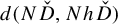 is completely determined by the value of
$\chi (h)$
 for
$h\in G$
 . Since
 is compact, it has finite diameter, which in turn implies that
$C_0$
 is finite. Subtracting
$C_0$
 from both sides of (4.9), we can conclude that
 is superadditive.
With all the facts we have so far stated, we can prove Proposition 4.1 as follows.
Proof of Proposition 4.1
Fix an arbitrary
$g\in G$
 . Since

the second half of (4.2) is straightforward, so it only remains to show the first half. Take
$C_0$
 satisfying the condition in Lemma 4.5. Then, by Fekete’s lemma, we have

Set  . Clearly, C is finite. Hence, by the triangle inequality, we have

Therefore, the first inequality in (4.2) is true as well.
5 Multifractal analysis of uniform level sets in shift spaces
Let I be a countable set with
$\#I \ge 2$
 and
$\mathbb {A}:I\times I\rightarrow \{0,1\}$
 be an incidence matrix. Let
$\sigma :\Sigma \rightarrow \Sigma $
 be the topological Markov shift with alphabet I and incidence matrix
$\mathbb {A}$
 [Reference Mauldin and Urbański26]. For
$\omega =(\omega _0,\ldots ,\omega _{k-1})\in I^k$
 , we define the cylinder set
$[\omega ]:=\{\xi \in \Sigma \mid \xi _0=\omega _0,\ldots , \xi _{k-1}=\omega _{k-1}\}$
 . The cylinder set of the empty word is defined as the shift space
$\Sigma $
 . The set of admissible words of length
$k\in \mathbb {N}$
 is defined by
$\Sigma ^k:=\{\omega \in I^k \mid [\omega ]\neq \varnothing \}$
 . The topology of
$\Sigma $
 is taken to be the one generated by all the cylinder sets.
For
$\phi :\Sigma {\kern-1pt}\rightarrow{\kern-1pt} \mathbb {R}$
 and
$n{\kern-1pt}\in{\kern-1pt} \mathbb {N}$
 , the nth ergodic sum of
$\phi $
 is the function
${S_n \phi {\kern-1pt}={\kern-1pt}\sum _{k=0}^{n-1} \phi \circ \sigma ^k}$
 . Given a function
$u:\Sigma \rightarrow (0,+\infty )$
 , define the metric
$d_u$
 on
$\Sigma $
 by

where
$x\wedge y$
 is the longest common initial block of x and y, which is possibly empty. The metric
$d_u$
 defined above gives exactly the topology generated by all the cylinder sets. We say that
$\phi :\Sigma \rightarrow \mathbb {R}$
 is Hölder continuous if there exist constants
$s>0$
 and
$C>0$
 such that for all
$x,y\in \Sigma $
 with
$|x\wedge y|\ge 1$
 , we have
$|\phi (x)-\phi (y)|\le C d_1(x,y)^s$
 [Reference Mauldin and Urbański26]. It is well known that if
$\phi :\Sigma \rightarrow \mathbb {R}$
 is Hölder continuous, then it has the bounded distortion property

The topological pressure of a Hölder continuous
$\phi $
 [Reference Mauldin and Urbański26] is defined by

For a subset
$E\subseteq \Sigma $
 , we use
$\dim _{u}E$
 to denote the Hausdorff dimension of E with respect to the metric
$d_{u}$
 [Reference Schmeling32]. For two Hölder continuous functions
$\phi :\Sigma \rightarrow \mathbb {R}$
 and
${u:\Sigma \rightarrow (0,+\infty )}$
 , we define for
$\alpha \in \mathbb {R}$
 ,

Clearly,
$\mathcal {UL}^\alpha _{\phi ,u}$
 is always a subset of
$\mathcal {L}^\alpha _{\phi ,u}$
 . In the rest of this section, we present some known results and one consequence on
$\dim _u(\mathcal {L}^\alpha _{\phi ,u})$
 and
$\dim _u(\mathcal {UL}^\alpha _{\phi ,u})$
 .
We begin with the known results on
$\dim _u(\mathcal {L}^\alpha _{\phi ,u})$
 . Define the free energy function
${q:\mathbb {R} \rightarrow \mathbb {R} \cup \{+\infty \}}$
 by

Note that q is convex, and hence,
$\mathrm {dom}(q):=\{\beta \in \mathbb {R} \mid q(\beta )<+\infty \}$
 is an interval. We use
$\partial q(\beta )$
 to denote the subdifferential of q at
$\beta $
 . With
$\mathrm {Int}$
 denoting the interior with respect to the Euclidean topology on
$\mathbb {R}$
 , we define

The convex conjugate of q is the function
$q^*:\mathbb {R} \rightarrow \mathbb {R} \cup \{ +\infty \}$
 given by

Put
$\Sigma ^*:=\bigcup _{k\in \mathbb {N}}\Sigma ^k$
 . For
$\omega ,\omega '\in \Sigma ^*$
 , we use
$\omega \omega '$
 to denote the concatenation of
$\omega $
 and
$\omega '$
 . We say that
$\sigma :\Sigma \rightarrow \Sigma $
 is finitely irreducible [Reference Mauldin and Urbański26] if there exists a finite set
$\Omega \subseteq \Sigma ^*$
 such that for all
$i,j\in I$
 , there exists
$\omega \in \Omega $
 such that
$i \omega j\in \Sigma ^*$
 .
We refer to the following Theorem 5.1 as the exhaustion principle for multifractal spectra. The theorem can be derived by the same methods as in [Reference Jaerisch and Kesseböhmer15, Corollary 1.9], where the case of an infinite conformal iterated function system (IFS) is treated. We omit the proof. Note that our u potential plays the role of the negative of the geometric potential of the conformal IFS in [Reference Jaerisch and Kesseböhmer15]. Since the conformal IFS therein is assumed to be uniformly contracting, we assume that
$\inf u>0$
 . The last assertion in Theorem 5.1 can be shown as in [Reference Jaerisch and Kesseböhmer14, Proposition 3.1].
Theorem 5.1. [Reference Jaerisch and Kesseböhmer15]
Let
$\sigma :\Sigma \rightarrow \Sigma $
 be a finitely irreducible topological Markov shift. Let
$\phi :\Sigma \rightarrow \mathbb {R}$
 and
$u:\Sigma \rightarrow (0,+\infty )$
 be Hölder continuous. Assume that
$\inf u>0$
 . Then, for any
$\alpha \in (\alpha _-, \alpha _+)$
 ,

Moreover, we have
$\mathcal {L}^\alpha _{\phi ,u}=\varnothing $
 for
$\alpha \notin [\alpha _-, \alpha _+]$
 .
Remark 5.2. It is known that Theorem 5.1 remains valid if
$\mathcal {L}^\alpha _{\phi ,u}$
 is replaced by

The proof is a straightforward covering argument, which has for instance been used also in [Reference Jaerisch and Kesseböhmer14, Proposition 3.1].
We now turn our attention to results on
$\dim _u(\mathcal {UL}^\alpha _{\phi ,u})$
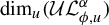 . The following theorem is taken from [Reference Liu23, Reference Liu24]. For related results, we refer to [Reference Fan and Schmeling9] and [Reference Gröger, Jaerisch and Kesseböhmer12].
Theorem 5.3. [Reference Liu23, Reference Liu24]
Let
$\sigma :\Sigma \rightarrow \Sigma $
 be an irreducible topological Markov shift with finite alphabet I. Let
$\phi :\Sigma \rightarrow \mathbb {R}$
 and
$u:\Sigma \rightarrow (0,+\infty )$
 be Hölder continuous. Then,
$\dim _u \mathcal {L}^\alpha _{\phi ,u} = \dim _u \mathcal {UL}^\alpha _{\phi ,u}$
 for any
$\alpha \in \mathbb {R}$
 .
We are now in the position to derive the main result of this section.
Theorem 5.4. Let
$\sigma :\Sigma \rightarrow \Sigma $
 be a finitely irreducible topological Markov shift. Let
$\phi :\Sigma \rightarrow \mathbb {R}$
 and
$u:\Sigma \rightarrow (0,+\infty )$
 be Hölder continuous. Assume that
$\inf u>0$
 . Then, for any
$\alpha \in (\alpha _-, \alpha _+)$
 ,

Proof. Let
$\alpha \in (\alpha _-, \alpha _+)$
 . By Theorem 5.1, we have

Since by (5.1) the metric
$d_u$
 restricted to
$\Sigma \cap F^{\mathbb {N}}$
 is equivalent to the metric
$d_{u|_{\Sigma \cap F^{\mathbb {N}}}}$
 for every
$F\subseteq I$
 finite, we obtain from Theorem 5.3 that

Since
$\mathcal {UL}^\alpha _{\phi ,u}\subseteq \mathcal {L}^\alpha _{\phi ,u}$
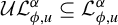 , the proof is complete.
6 Proof of Theorem 1.1
6.1 Induced Bowen–Series map and its associated Markov shift
Recall that
$H_0\subseteq G_{0}$
 denotes the set of hyperbolic generators and
$\Pi _{0}\subseteq G_{0}$
 the set of parabolic generators. For any integer
$m\geq 1$
 and
$\omega =\omega _{0}\cdots \omega _{m-1}\in G_0^m$
 , we define

The following inducing scheme is well known (see e.g. [Reference Bowen and Series5, Reference Jaerisch and Takahasi17]). Define

The inducing time
$\rho :\tilde {\Delta } \rightarrow \mathbb {N}$
 is given by
$\rho |_{\tilde {\Delta }_\omega }=1$
 for
$\omega \in H_0$
 and
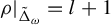
$\rho |_{\tilde {\Delta }_\omega }=l +1$
 for
$\omega =\gamma ^{l +1}g$
 with
$l\in \mathbb {N}$
 and
 . The induced Bowen–Series map is given by

Note that
$\bigcap _{n=0}^\infty \tilde f^{-n}(\tilde {\Delta })=\Lambda _r(G)$
 .
The restriction of the induced Bowen–Series map
$\tilde f$
 to
$\Lambda _r(G)$
 is conjugate to a Markov shift
$\tilde {\sigma }:\tilde {\Sigma }\rightarrow \tilde {\Sigma }$
 in the following way. Define an incidence matrix
$\tilde {\mathbb {A}}:\tilde {I}\times \tilde {I}\rightarrow \{0,1\}$
 by letting

for any
$\omega ,{\tau }\in \tilde {I}$
 . Let
$\tilde {\sigma }:\tilde {\Sigma }\rightarrow \tilde {\Sigma }$
 be the topological Markov shift with alphabet
$\tilde {I}$
 and incidence matrix
$\tilde {\mathbb {A}}$
 . This Markov shift
$\tilde {\sigma }$
 is finitely irreducible [Reference Mauldin and Urbański26]. Define
$\tilde {\pi }:\tilde {\Sigma }\rightarrow \Lambda _r(G)$
 by

for any
$\xi =\xi _0\xi _1\cdots \in \tilde {\Sigma }$
 , where
$\xi _j\in \tilde {I}$
 for each
$j\in \mathbb {N}$
 . Then,
$\tilde {\pi }$
 is a homeomorphism and the following diagram commutes.

6.2 Potentials
So far, we have introduced two dynamical systems on
$\Lambda _r(G)$
 . One is the Bowen–Series map
$f:\Lambda _r(G)\rightarrow \Lambda _r(G)$
 and the other is the induced Bowen–Series map
$\tilde {f}:\Lambda _r(G)\rightarrow \Lambda _r(G)$
 . Henceforth, for any
$g:\Lambda _r(G)\rightarrow \mathbb {R}$
 and any
$n\in \mathbb {N}$
 , the nth ergodic sum with respect to f will be denoted by
$S_ng=\sum _{k=0}^{n-1}g\circ f^k$
 , while the nth ergodic sum with respect to
$\tilde {f}$
 will be denoted by
$\tilde {S}_ng=\sum _{k=0}^{n-1}g\circ \tilde {f}^k$
 . For a potential
$g:\Lambda _r(G) \rightarrow \mathbb {R}$
 , we define the induced potential
$\tilde {g}:\Lambda _r(G)\rightarrow \mathbb {R}$
 by

for any
$x\in \Lambda _r(G)$
 . For example, we have
$\rho =\tilde {1}\circ \tilde {\pi }$
 , where
$1:\Lambda _r(G)\rightarrow \mathbb {R}$
 denotes the constant function one. For each
$n\in \mathbb {N}$
 , define
$\rho _n:\Lambda _r(G) \rightarrow \mathbb {R}$
 as
$\rho _n=\tilde {S}_n \tilde {1}$
 . In particular, we have
$\rho _0=0$
 and
$\rho _1=\rho $
 . From the definitions above, one can easily check that for every
$x\in \Lambda _r(G)$
 and any
$n\in \mathbb {N}$
 ,

Now, we introduce three potentials which will play central roles in the proofs of our main results. Recall that
$\chi :G\rightarrow \mathbb {Z}$
 is a surjective group homomorphism, whose kernel is precisely N. By a slight abuse of notation, we define a potential
$\chi :\Lambda _r(G)\rightarrow \mathbb {Z}$
 as follows. Given an arbitrary
$x\in \Lambda _r(G)$
 , we define
$\chi (x)=\chi (x_0)$
 , where the radial limit point
$x\in \Lambda _r(G)$
 is identified with the unique reduced sequence
$x_0x_1\cdots $
 over
$G_0$
 (see §3.2). Further define a potential
$\psi :\Lambda _r(G)\rightarrow \mathbb {R}$
 by

The geometric potential
$\zeta :\Lambda _r(G) \rightarrow \mathbb {R}$
 is for
$x\in \Lambda _r(G)$
 given by

Since the sides of the fundamental domain R of G are the isometric circles of the side-pairings, it follows that
$\zeta>0$
 . It is also clear that
$\zeta $
 is continuous. For the induced geometric potential
$\tilde \zeta :\tilde {\Sigma }\rightarrow \mathbb {R}$
 , more can be said as follows. For the proof of the following proposition, we refer to [Reference Kesseböhmer and Stratmann21, Lemma 3.4] and [Reference Jaerisch and Takahasi17, §5].
Proposition 6.1. [Reference Jaerisch and Takahasi17, Reference Kesseböhmer and Stratmann21]
The induced geometric potential
$\tilde \zeta :\tilde {\Sigma }\rightarrow \mathbb {R}$
 is Hölder continuous with respect to
$d_1$
 on
$\tilde {\Sigma }$
 . Moreover, we have
$\inf \tilde \zeta>0$
 .
For
$n\in \mathbb {N}$
 , we define
$\tau _n:\Lambda _r(G) \rightarrow \mathbb {R}$
 by
$\tau _n=S_n \zeta $
 . Thus, by (6.1), we have
${\tau _{\rho _n(x)}(x)=\tilde {S}_n \tilde {\zeta }(x)}$
 for all
$n\in \mathbb {N}$
 and
$x\in \Lambda _r(G)$
 . The following estimates are well known (see e.g. [Reference Floyd11, Reference Kesseböhmer and Stratmann21]).
Proposition 6.2. The following statements hold.
-
(1) $\sup _{x\in \Lambda _r(G)}d(x_0 \cdots x_{n-1}0,\gamma _x(\tau _n(x)))\in O(\log n)$
as
$n\rightarrow \infty $
; -
(2) for any $x\in \Lambda _r(G)$
,
$d(x_0 \cdots x_{n-1}0,\gamma _x(\tau _n(x)))\in O(1)$
as
$n\rightarrow \infty $
if and only if $$ \begin{align*} \sup \{\rho_{m+1}(x)-\rho_m(x)|m\in\mathbb{N}\}=\sup \{\rho(\tilde{\sigma}^m(x))|m\in\mathbb{N}\}<+\infty; \end{align*} $$
-
(3) $\sup _{x\in \Lambda _r(G)}d(x_0 \cdots x_{\rho _n(x)-1}0,\gamma _x(\tau _{\rho _n(x)}(x)))\in O(1)$
as
$n\rightarrow \infty $
.








We are now able to approximate distances on
$\mathbb {D}$
 and
$\mathbb {D}/N$
 with ergodic sums in the following manner. By Proposition 6.2 and the triangle inequality, we have


for any
$x\in \Lambda _r(G)$
 . In addition, if
$\Lambda _p(G)=\Lambda _p(N)$
 , we have

for any
$x\in \Lambda _r(G)$
 . To see this, note that when
$\Lambda _p(G)=\Lambda _p(N)$
 , Proposition 4.1 is applicable and yields

By the definition of
$\unicode{x3bb} _{G|N}$
 and the fact that
$\chi :G\rightarrow \mathbb {Z}$
 is a homomorphism, we have

for all  . Combining the previous two formulas, we obtain (6.4).
6.3 Critical exponents and free energy
Until the end of this section, we shall always assume that
$\Lambda _p(G)=\Lambda _p(N)$
 . Note that
$\tilde {\psi }$
 is bounded.
As
$\tilde {\sigma }:\tilde {\Sigma }\rightarrow \tilde {\Sigma }$
 is conjugate to the induced Bowen–Series map
$\tilde {f}$
 , the tools in §5 can be applied to the dynamical system
$\tilde {f}:\Lambda _r(G)\rightarrow \Lambda _r(G)$
 . We use
$\mathcal {P}$
 to denote the topological pressure with respect to the induced Bowen–Series map
$\tilde {f}:\Lambda _r(G)\rightarrow \Lambda _r(G)$
 . The free energy function q associated with
$\tilde {\zeta }$
 and
$\tilde {\psi }$
 is for each
$\beta \in \mathbb {R}$
 given by

It is easy to see that q is convex. Define

Proposition 6.3. The free energy function
$q:\mathbb {R}\rightarrow \mathbb {R}$
 is real-valued, even, real-analytic, and strictly convex. Moreover, we have
$\alpha _-=-\alpha _+$
 and
$\alpha \mapsto -q^{*}(\alpha )$
 is an even function, which is strictly concave and real-analytic on
$(\alpha _{-},\alpha _{+})$
 and satisfies
${\lim _{\alpha \rightarrow \pm \alpha _{+}}(q^*(\alpha ))'=\pm \infty }$
 .
For the sake of convenience, we will use the following notation in the proofs given in this section. For sequences of positive reals
$(a_n)$
 and
$(b_n)$
 , we write
$a_n \asymp b_n$
 if there exists a constant
$C>0$
 such that for all
$n\in \mathbb {N}$
 ,
$C^{-1} \le a_n / b_n \le C $
 .
Proof. We first show that q is real-valued and real-analytic. When
$\Pi _0=\varnothing $
 ,
$\tilde {f}=f:\Lambda _r(G)\rightarrow \Lambda _r(G)$
 is uniformly expanding and conjugate to a topological Markov shift with finite alphabet. For this case, we refer to [Reference Pesin and Weiss29] for a proof. Now, we only need to treat the case where
$\Pi _0\neq \varnothing $
 . Since
$\tilde {\psi }$
 is bounded, we have
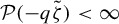
$\mathcal {P}(-q\tilde {\zeta }+\beta \tilde {\psi })<\infty $
 if and only if
$\mathcal {P}(-q\tilde {\zeta })<\infty $
 . Since
$\tilde \zeta $
 is Hölder continuous by Proposition 6.1, it follows from [Reference Mauldin and Urbański26, Proposition 2.19] that
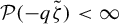
$\mathcal {P}(-q\tilde {\zeta })<\infty $
 if and only if
${\sum _{\omega \in \tilde {I}}\exp (-q\sup \tilde {\zeta }|_{[\omega ]})<\infty }$
 . By well-known estimates from hyperbolic geometry [Reference Bowen and Series5], we have for each
$q\in \mathbb {R}$
 ,
$\sum _{{\omega \in \tilde {I}}}\exp (-q\sup \tilde {\zeta }|_{[\omega ]})\asymp \sum _{\ell \in \mathbb {N}}\ell ^{-2q}$
 . Hence,
$\mathcal {P}(-q\tilde {\zeta }+\beta \tilde {\psi })<\infty $
 if and only if
${q>1/2}$
 . It follows that for every
$\beta \in \mathbb {R}$
 ,

For each
$\beta \in \mathbb {R}$
 and
$q_{1}<q_{2}$
 , we have

Since
$\inf \tilde {\zeta }>0$
 by Proposition 6.1, it follows that
${\lim _{q\rightarrow +\infty }\mathcal {P}(-q\tilde {\zeta }+\beta \tilde {\psi })=-\infty }$
 . Since
$q\mapsto \mathcal {P}(-q\tilde {\zeta }+\beta \tilde {\psi })$
 is convex and finite on
$(1/2,+\infty )$
 , the intermediate value theorem implies the existence of a unique
$q(\beta )\in \mathbb {R}$
 satisfying
$\mathcal {P}(-q(\beta )\tilde {\zeta }+\beta \tilde {\psi })=0$
 for each
${\beta \in \mathbb {R}}$
 , so q is real-valued. Since
$\mathcal {P}$
 is real-analytic and
$(\partial /\partial q)\mathcal {P}(-q\tilde {\zeta }+\beta \tilde {\psi })\le -\inf \tilde {\zeta }<0$
 [Reference Mauldin and Urbański26], it follows from the implicit function theorem that q is real-analytic.
Next, we show that
$\mathcal {P}(-q\tilde {\zeta }+\beta \tilde {\psi })=\mathcal {P}(-q\tilde {\zeta }-\beta \tilde {\psi })$
 for all
$q,\beta \in \mathbb {R}$
 . Note that for any
$\tilde {f}$
 -periodic
$x\in \Lambda _r(G)$
 , there is some hyperbolic
$g\in G$
 such that x is one of its two fixed points. Based on this fact, we define
$\iota (x)$
 as the unique point in
$\Lambda _r(G)$
 satisfying that there is a hyperbolic
$g\in G$
 such that
$\{x,\iota (x)\}$
 is the set of fixed points of g. This definition is valid because all group elements of G fixing x form a cyclic subgroup of G, and thus share common fixed points. Clearly,
$\iota ^2(x)=x$
 holds for any
$\tilde {f}$
 -periodic
$x\in \Lambda _r(G)$
 . Moreover, for any positive integer n and any
$\tilde {f}$
 -periodic
$x\in \Lambda _r(G)$
 satisfying
$\tilde {f}^n(x)=x$
 , we have
$\tilde {f}^n(\iota (x))=\iota (x)$
 ,
$\rho _n(x)=\rho _n(\iota (x))$
 , and

where we identify a reduced word over
$G_0$
 with a group element of G. Since
$d(0,g0)=d(0,g^{-1}0)$
 and
$\chi (g)=-\chi (g^{-1})$
 for any
$g\in G$
 , we deduce from (6.3) and (6.4) that

Consequently, for any
$q,\beta \in \mathbb {R}$
 ,

It is shown in [Reference Jaerisch, Kesseböhmer and Lamei16] that for any
$\phi :\Lambda _r(G)\rightarrow \mathbb {R}$
 , we have

Hence, using the facts about
$\iota $
 we pointed out, we have for any
$q,\beta \in \mathbb {R}$
 ,

Thus,
$q(\beta )=q(-\beta )$
 for any
$\beta \in \mathbb {R}$
 . From this and the convexity of q, it follows that q attains its minimum at
$0$
 . It is well known that q is either strictly convex or affine. Suppose for a contradiction that q is affine. Then, by symmetry,
$q(\beta )=q(0)$
 for all
$\beta \in \mathbb {R}$
 . This contradicts the fact that
$\mathcal {P}(\beta \tilde {\psi })\rightarrow +\infty $
 as
$\beta \rightarrow +\infty $
 .
Now that we have shown that q is even and real-analytic, it follows that
$\alpha _-=-\alpha _+$
 . The properties of the convex conjugate
$q^*$
 are immediate consequences of the corresponding properties of q.
The next lemma reveals the relation between the function q and the function s defined in the introduction.
Lemma 6.4. For every
$\beta \ge 0$
 , we have
$s(\beta )=q(\beta )$
 . For every
$\alpha \ge 0$
 , we have
$-q^*(\alpha )=\inf _{\beta \ge 0} \{s(\beta )-\alpha \beta \}$
 .
Proof. By [Reference Jaerisch, Kesseböhmer and Lamei16, Corollary 2.2, Remark 2.4, and Corollary 3.5], we have for any
$\beta \in \mathbb {R}$
 ,

For
$\beta \geq 0$
 , on the one hand, we have

while on the other hand, by (6.6), we also have

It thus follows that for
$\beta \ge 0$
 , we have

Here, we note that the range of q can be restricted to non-negative numbers because
${q(\beta )\geq q(0)=\dim _{H}(\Lambda (G))\geq 0}$
 for all
$\beta \in \mathbb {R}$
 . By [Reference Jaerisch, Kesseböhmer and Lamei16, Corollary 2.2, Remark 2.4, and Corollary 3.5], we have


It is not difficult to see that

Hence, for each
$\beta \ge 0$
 , we have
$q(\beta )=s(\beta )$
 , which proves the first assertion.
To prove the second assertion, let
$\alpha \ge 0$
 . Since q is even by Proposition 6.3, we have for
$\beta <0$
 ,
$q(\beta )-\alpha \beta \leq q(-\beta )+\alpha \beta $
 . Therefore,
$-q^{*}(\alpha )=\inf _{\beta \in \mathbb {R}}\{ q(\beta )- \alpha \beta \} =\inf _{\beta \ge 0}\{ q(\beta )- \alpha \beta \}$
 . Hence, by the first assertion,
$-q^{*}(\alpha )=\inf _{\beta \ge 0}\{ s(\beta )-\alpha \beta \}$
 . The proof is complete.
6.4 Escape rate spectrum and its range
For each
$\alpha \in \mathbb {R}$
 , we set

Lemma 6.5. Assume that
$\Lambda _p(G)=\Lambda _p(N)$
 . Then, for all
$\alpha \geq 0$
 , we have

Proof. The second inclusion is clear. To show the first, take
$x\in \Lambda _r(G)$
 from the left-hand side of the first inclusion arbitrarily. By (6.1), we have for any
$\alpha \geq 0$
 ,

Combining this with (6.3), (6.4), and Proposition 6.2(3), we have

Also notice that the induced sequence
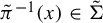
$\tilde {\pi }^{-1}(x)\in \tilde {\Sigma }$
 is in
$F^{\mathbb {N}}$
 for some finite
$F\subseteq \tilde {I}$
 , which implies that
$\sup _{n\in \mathbb {N}}\{\rho _{n+1}(x)-\rho _n(x)\}<+\infty $
 . Since
$\zeta $
 is bounded,

Further note that
$\tau _m(x)$
 is monotonically increasing in m and diverges to infinity as
${m\rightarrow +\infty }$
 , so
$\sup _{t\geq 0}\inf _{n\in \mathbb {N}}|t-\tau _{\rho _n(x)}(x)|<+\infty $
 . Combining this fact with (6.7) and the fact that
$d(N z,N w)\leq d(z,w)$
 for all
$z,w\in \mathbb {D}$
 , we obtain

by using the triangle inequality. This shows the first inclusion we claim.
Now, it only remains to prove the third inclusion in Lemma 6.5. For
$\alpha =0$
 , our assumption
$\Lambda _p(N)=\Lambda _p(G)$
 implies

Now, let
$\alpha>0$
 and
 . Since
$y\in \Lambda _r(G)$
 , we have that
$\tau _{\rho _n(y)}(y)=\tilde {S}_n\tilde {\zeta }(y)$
 tends to infinity as
$n\rightarrow +\infty $
 . Hence,

By (6.1) and (6.4), this yields

Since
$\alpha> 0$
 , this in particular shows that either
$\tilde {S}_n\tilde {\psi }(y)>0$
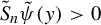 for sufficiently large
$n\in \mathbb {N}$
 or
$\tilde {S}_n\tilde {\psi }(y)<0$
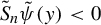 for sufficiently large
$n\in \mathbb {N}$
 . For the former case, we have
$y\in \mathcal {L}^{\geq \alpha }_{\tilde {\psi },\tilde {\zeta }}$
 ; for the latter case, we have
$y\in \mathcal {L}^{\leq -\alpha }_{\tilde {\psi },\tilde {\zeta }}$
 .
In the proof of Theorem 1.1, we will need the following lemma. We postpone its proof to the Appendix, as it uses the notation from other sections.
Lemma 6.6. Suppose that
$\Lambda _p(G)=\Lambda _p(N)$
 . Then,
 is non-empty.
Proof of Theorem 1.1
Proposition 6.3 states that q is real-analytic and strictly convex, so its derivative
$q'$
 exists and is monotonically increasing. Define
$\alpha _\pm =\lim _{\beta \rightarrow \pm \infty }q'(\beta )$
 . By Proposition 6.3, we have
$\alpha _+=-\alpha _->0$
 . Let
$\alpha \in [0,\alpha _+)$
 . Our goal is to show that

Note that this gives the desired formula in Theorem 1.1 because we have
$-q^*(\alpha )=\inf _{\beta \ge 0} \{s(\beta )-\alpha \beta \}$
 by Lemma 6.4 and
$\mathcal {UE}^\alpha _N\subseteq \mathcal {E}^\alpha _N\subseteq \mathcal {LE}^\alpha _N$
 .
We now turn to the proof of (6.8). By Lemma 6.5 and Theorem 5.1, we have
$\dim _{H}\mathcal {UE}_{N}^{\alpha }\ge -q^*(\alpha )$
 . Here, we have used that the metric
$d_{\tilde \zeta }$
 on
$\tilde {\Sigma }$
 is equivalent to the Euclidean metric on
$\Lambda _r(G)$
 . Moreover, by Lemma 6.5, we have

Hence, to complete the proof of (6.8), it suffices to show
$\dim _H (\mathcal {L}^{\ge \alpha }_{\tilde {\psi },\tilde {\zeta }}\cup \mathcal {L}^{\le -\alpha }_{\tilde {\psi },\tilde {\zeta }})\le -q^*(\alpha )$
 . Since
$q'(0)=0$
 by Proposition 6.3, it follows from Theorem 5.1 and Remark 5.2 that

By Proposition 6.3, we have
$\max \{-q^*(\alpha ), -q^*(-\alpha ) \}=-q^*(\alpha )$
 . The proof of (6.8) is thus complete.
Next, we show
$\alpha _+=1$
 . By (6.8), we have
$[0,\alpha _+)\subseteq \mathrm {Ran}\,\mathcal {UE}_N$
 . Since
$\mathrm {Ran}\,\mathcal {UE}_N\subseteq [0,1]$
 , it follows that
$\alpha _+ \le 1$
 . Combining Theorem 5.1, Lemma 6.5, and Lemma 6.6, we also have
$\alpha _+\geq 1$
 . Hence,
$\alpha _+=1$
 . It then follows that
$[0,1)\subseteq \mathrm {Ran}\,\mathcal {UE}_N\subseteq \mathrm {Ran}\,\mathcal {LE}_N\subseteq [0,1]$
 .
The analytic properties of the escape rate spectrum for
$\alpha \in [0,1)$
 follow from Proposition 6.3. The proof of the main theorem is complete except for the boundary point
$\alpha =1$
 , which will be investigated in the next subsection.
6.5 Boundary of escape rate spectrum
In this subsection, we analyze the Hausdorff dimension of
$\mathcal {UE}^1_N$
 and
$\mathcal {LE}_{N}^1$
 . Our argument uses zero-temperature limits of equilibrium states. Throughout this subsection, we identify
$\tilde {f}:\Lambda _r(G)\rightarrow \Lambda _r(G)$
 with
$\tilde {\sigma }:\tilde {\Sigma }\rightarrow \tilde {\Sigma }$
 via
$\tilde {\pi }:\tilde {\Sigma }\rightarrow \Lambda _r(G)$
 so that every function and every Borel measure on
$\Lambda _r(G)$
 can be considered to be defined on
$\tilde {\Sigma }$
 . Let
$\tilde {\mu }_\beta $
 denote the equilibrium state of the induced potential
$-q(\beta )\tilde {\zeta }+\beta \tilde {\psi }$
 for each
$\beta \in \mathbb {R}$
 . It is known that
$\tilde {\mu }_\beta $
 is a Gibbs measure for
$-q(\beta )\tilde {\zeta }+\beta \tilde {\psi }$
 [Reference Mauldin and Urbański26]. Given any
$\tilde {\sigma }$
 -invariant Borel probability measure
$\nu $
 on
$\tilde {\Sigma }$
 , we define its Kolmogorov–Sinai entropy to be

Lemma 6.7. The family
$\{\tilde {\mu }_\beta |\beta> 0\}$
 of equilibrium states is tight.
Proof. Since
$\alpha _{+}=1$
 by the proof of Theorem 1.1, we have

Hence, since
$\tilde {\psi }$
 is bounded, it follows that

By [Reference Kesseböhmer and Urbański22, Lemma 3.2], we conclude that
$\{ \tilde {\mu }_{\beta }\mid \beta>0\}$
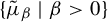 is tight.
Now that we have the tightness of
$\{\tilde {\mu }_\beta |\beta>0\}$
 , the Helly–Prohorov theorem guarantees the existence of a strictly increasing sequence
$(\beta _m)_{m\geq 1}$
 of real numbers and a Borel probability measure
$\tilde {\mu }$
 on
$\tilde {\Sigma }$
 satisfying that
$\lim _{m\rightarrow +\infty }\beta _m=+\infty $
 and
$\tilde {\mu }_{\beta _m}$
 weak* converges to
$\tilde {\mu }$
 . We fix such a sequence
$(\beta _m)_{m\geq 1}$
 and
$\tilde {\mu }$
 until the end of this section. We begin with the following lemma.
Lemma 6.8. All of the following statements hold.
-
(1) There exists a finite set $F\subseteq I$
such that
$\tilde \mu (\tilde {\Sigma } \cap F^{\mathbb {N}} )=1$
. -
(2) $\limsup _{m\rightarrow +\infty }h(\tilde {\mu }_{\beta _m})\le h(\tilde {\mu })$
. -
(3) $0<\lim _{m\rightarrow +\infty }\int _{\tilde {\Sigma }}\tilde {\zeta }\,{d}\tilde {\mu }_{\beta _m}=\int _{\tilde {\Sigma }}\tilde {\zeta }\,{d}\tilde {\mu }<+\infty $
. -
(4) $0<\lim _{m\rightarrow +\infty }\int _{\tilde {\Sigma }}\tilde {\psi }\,{d}\tilde {\mu }_{\beta _m}=\int _{\tilde {\Sigma }}\tilde {\psi }\,{d}\tilde {\mu }<+\infty $
.





Proof. The first two assertions are shown in [Reference Kesseböhmer and Urbański22, Proposition 4.3]. To show the last two, first note that
$\tilde {\psi }$
 is a bounded continuous function, so by the weak* convergence of
$(\tilde {\mu }_{\beta _m})_{m\geq 1}$
 to
$\tilde {\mu }$
 , we have
$\lim _{m\rightarrow +\infty }\int _{\tilde {\Sigma }}\tilde {\psi }\,{d}\tilde {\mu }_{\beta _m}=\int _{\tilde {\Sigma }}\tilde {\psi }\,{d}\tilde {\mu }$
 , which is finite due to the boundedness of
$\tilde {\psi }$
 . Since we also have

we deduce that

Combining this with (6.9), we have
$\int _{\tilde {\Sigma }}\tilde {\psi }\,{d}\tilde {\mu }>0$
 . The proof is thus complete.
Proof of Theorem 1.1 (continued)
We are now in the position to prove the lower bound
$\dim _{H}(\mathcal {UE}^1_N)\ge -q^*(1)$
 . Let
$\alpha _m=q'(\beta _m)$
 for all
 and note that

Since
$\lim _{m\to \infty }\alpha _m=1$
 , it follows from Lemma 6.8(2) and (3) that

By employing standard arguments involving the mass distribution principle (see for instance [Reference Przytycki and Urbański30, Theorem 9.1.11]), we only need to show that
$\tilde {\mu }(\mathcal {UE}^1_N)=1$
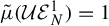 . Since
$\limsup _{n\rightarrow +\infty } \tilde {S}_n\tilde {\psi }/\tilde {S}_n\tilde {\zeta }\le \alpha _+=1$
 , we conclude that for any
$\tilde {x}\in \tilde {\Sigma }$
 ,

Let
$F \subseteq \tilde {I}$
 be a finite set satisfying
$\tilde \mu (\tilde {\Sigma } \cap F^{\mathbb {N}} )=1$
 whose existence is guaranteed by Lemma 6.8(1). Since
$\tilde {\psi }$
 and
$\tilde {\zeta }$
 are Hölder continuous, from the tools in ergodic optimization [Reference Jenkinson19], we have that
$(\tilde {\psi }-\tilde {\zeta })|_{\tilde {\Sigma } \cap F^{\mathbb {N}}}$
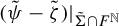 is cohomologous to a non-positive function, which means that there exists a Hölder continuous function
$\phi :\tilde {\Sigma } \cap F^{\mathbb {N}}\rightarrow \mathbb {R}$
 such that

By the
$\tilde {\sigma }$
 -invariance of
$\tilde {\mu }$
 , we have
$\int _{\tilde {\Sigma }\cap F^{\mathbb {N}}} (\phi \circ \tilde {\sigma }-\phi ) \,{d}\tilde {\mu }=0$
 . This observation, along with Lemma 6.8 (3), (4), and the equality (6.9), implies that

where the second equality holds because
$\tilde {\mu }(\tilde {\Sigma }\cap F^{\mathbb {N}})=1$
 . Combining this with (6.10), we have

Since
$\tilde {\sigma }$
 preserves
$\tilde {\mu }$
 , we further have

Since
$\phi $
 is bounded, we have

Hence,
$\tilde {\mu }(\mathcal {UE}^1_N)=1$
 . This shows that
$\mathcal {UE}^1_N$
 is non-empty and has Hausdorff dimension no less than
$-q^*(1)$
 . Let us turn to the upper bound. By a standard covering argument, we obtain

By Proposition 6.3, we have
$-q^*(1)=-q^*(-1)$
 . Hence, by Lemma 6.5, we have
$\dim _{H}(\mathcal {LE}_{N}^1)\le -q^*(1)$
 . The proof is complete.
7 One concrete example
In this last section, we study a concrete example.
7.1 Example and its properties
Let G be a generalized Schottky group with generating set
$G_0$
 . Throughout this section, suppose that there exists a hyperbolic generator
$a\in G_0$
 satisfying

Our definition of generalized Schottky groups guarantees that
$\partial R_{\bar {a}}$
 is perpendicular to
$\mathcal {X}_a$
 , so we have

Therefore, (7.1) is equivalent to the existence of
$a\in G_0$
 such that
$d(\partial R_b,\partial R_{b'})>d(\partial R_{\bar {a}},\partial R_a)/2$
 for any
 and
$b'\in \{\bar {a},a\}$
 .
To prove the existence of a generalized Schottky group G satisfying (7.1), let
$G^{(0)}$
 be a generalized Schottky group with generating set
$G^{(0)}_0$
 which contains a hyperbolic element a. Then, for a sufficiently large integer m, we have
$d(\partial R_{\bar {a}},b^m\partial R_{b})>\|a\|/2$
 and
$d(\partial R_{a},b^m\partial R_{b})>\|a\|/2$
 for any
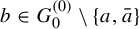 . Note that
$b^{2m+1}(\bar {b}^m\partial R_{\bar {b}})=b^m\partial R_b$
 for all
 . Hence, condition (7.1) is satisfied for the generalized Schottky group G generated by

Define a homomorphism
$\chi :G\rightarrow \mathbb {Z}$
 by letting
$\chi (a)=1$
 and
 . Then, for any
$g\in G$
 , represented by a reduced word
$\omega $
 over
$G_0$
 , we have

Take N as the kernel of
$\chi $
 . Clearly, the quotient group
$G/N$
 is generated by
$aN$
 and
${\unicode{x3bb} _{G|N}=\|aN\|}$
 . Moreover, if
$G_0$
 contains parabolic elements, then for each parabolic
${g\in G}$
 , there are parabolic
$a_p\in G_0$
 ,
 , and
$h\in G$
 such that
$g=ha_p^kh^{-1}$
 [Reference Dal’Bo8, Property II.1.9]. Since
$\chi (a_p)=0$
 for all parabolic
$a_p\in G_0$
 , we have that
 contains no parabolic elements and, thus,
$\Lambda _p(G)=\Lambda _p(N)$
 . Hence, all the claims in Theorem 1.1 hold for our example.
The properties of
$\mathbb {D}/N$
 are summarized in Propositions 7.1, 7.2, and 7.3. The proofs will be postponed to §7.2. The first property of
$\mathbb {D}/N$
 is related to Proposition 4.2, which states that
 . For the particular G and N we consider in this section, the infimum is a minimum and the following proposition describes when the minimum is attained.
Proposition 7.1. For any  ,
$\unicode{x3bb} _{G|N}=\|g\|/|\chi (g)|$
 if and only if there exist
${h\in G}$
 and
 such that
$g=ha^kh^{-1}$
 . In particular, we have
$\unicode{x3bb} _{G|N}=\|a\|$
 .
As
$\|a\|$
 can be easily calculated by using the formula (4.3), Proposition 7.1 shows how to evaluate
$\unicode{x3bb} _{G|N}$
 for our example.
The second property of
$\mathbb {D}/N$
 gives an explicit expression of
$\mathcal {UE}^1_N$
 . To state it, we define
$\Lambda (a)\subseteq \mathbb {S}^1$
 as the limit set of the cyclic group generated by a. Since a is hyperbolic,
$\Lambda (a)$
 contains precisely two elements. One is
$aa\cdots \in \Lambda (G)$
 and the other is
$\bar {a}\bar {a}\cdots \in \Lambda (G)$
 . We define
$G\cdot \Lambda (a)=\{gx|g\in G,\,x\in \Lambda (a)\}$
 , and
$N\cdot \Lambda (a)$
 is defined similarly. Then, for our example,
$\mathcal {UE}^1_N$
 can be described explicitly as follows.
Proposition 7.2. We have
$\mathcal {UE}^1_N = \Lambda _p(N)\cup G\cdot \Lambda (a)=\Lambda _p(N)\cup N\cdot \Lambda (a)$
 . In particular,
$\mathcal {UE}^1_N$
 is countable.
Denote by
$\mathcal {X}_a$
 the axis of a. Then, we have the following proposition.
Proposition 7.3. For any two
$z_1,z_2\in \mathcal {X}_a$
 , we have
$d(N z_1,N z_2)=d(z_1,z_2)$
 .
7.2 Proof of the properties
In this subsection, we prove Propositions 7.1, 7.2, and 7.3. Before we proceed to prove them in the reverse order, we prepare the following lemma.
Lemma 7.4. For any
$g\in aN$
 :
-
(1) $d(\partial R_{\bar {a}},g\partial R_{\bar {a}})=\|a\|$
if
$g=a$
; -
(2) $d(\partial R_{\bar {a}},g\partial R_{\bar {a}})\geq \|a\|+2c_0>\|a\|$
if
$g\neq a$
.


Proof. The first claim is precisely (7.2), so we only need to prove the second claim.
For  , let
$\omega $
 be the reduced word over
$G_0$
 representing g. For the sake of convenience, we set
$\omega _{-1}=a$
 and
$\omega _{|\omega |}=\bar {a}$
 . Since
 , there are
${k,l\in \{0,\ldots ,|\omega |-1\}}$
 such that
 and
$\{\omega _{k-1},\omega _{l+1}\}\subseteq \{\bar {a},a\}$
 . Apparently,
$k\neq l+1$
 . Moreover, note that every geodesic segment joining
$\partial R_{\bar {a}}$
 and
$\omega \partial R_{\bar {a}}$
 must intersect
$\omega _0\cdots \omega _{j}\partial R_{\overline {\omega _{j}}}$
 for all
$j\in \{-1,\ldots ,|\omega |\}$
 . Therefore,

showing the second claim.
Proof of Proposition 7.3
Let z be the point at which the geodesic
$\partial R_{\bar {a}}$
 and
$\mathcal {X}_a$
 intersect. We claim that

for any
$n\in \mathbb {Z}$
 . This claim apparently holds when
$n=0$
 . Also note that (7.3) holds if and only if
$d(N z,N a^{-n} z)=d(z,a^{-n}z)$
 , since
$N a^{-n}:\mathbb {D}/N\rightarrow \mathbb {D}/N$
 and
$a^{-n}:\mathbb {D}\rightarrow \mathbb {D}$
 are isometries. Therefore, it suffices to prove (7.3) for positive n.
Given an arbitrary positive integer n, let
$\omega $
 be a reduced word over
$G_0$
 which, considered as a group element of G, is in
$a^nN$
 and satisfies
$d(z,\omega z)=d(N z,N a^nz)$
 . Note that there exist reduced words
$\omega ^{(1)},\ldots ,\omega ^{(n)}$
 over
$G_0$
 such that:
-
(1) $\omega ^{(j)}$
, considered as a group element of G, is in
$aN$
for any
$j\in \{1,\ldots ,n\}$
; -
(2) the last symbol appearing in $\omega ^{(j)}$
is a for all
$j\in \{1,\ldots ,n\}$
; -
(3) their concatenation $\omega ^{(1)}\cdots \omega ^{(n)}$
is reduced as well and is an initial block of the reduced word
$\omega $
.





Indeed, we can define
$\omega ^{(1)},\ldots ,\omega ^{(n)}$
 by letting
$\omega ^{(1)}\cdots \omega ^{(j)}$
 be the shortest initial block of
$\omega $
 which is in
$a^jN$
 for all
$j\in \{1,\ldots , n\}$
 . Then, as we argued in the proof of Lemma 7.4, we can show that

Since
$\omega ^{(j)}\in aN$
 for all
$j\in \{1,\ldots ,n\}$
 , we deduce from Lemma 7.4 that

where the equality above holds because z is on the axis
$\mathcal {X}_a$
 of a. Since
$z\in \partial R_{\bar {a}}$
 , on the one hand, we have

Since
$d(N w_1,N w_2)\leq d(w_1,w_2)$
 for all
$w_1,w_2\in \mathbb {D}$
 , we also have, on the other hand,
$d(N z,N a^nz)\leq d(z,a^n z)$
 . Consequently, (7.3) holds for any positive integer n. Thus, as we argued in the beginning of this proof, (7.3) holds for all
$n\in \mathbb {Z}$
 .
Now, we can show Proposition 7.3. Let
$z_1$
 and
$z_2$
 be two arbitrary points on the axis
$\mathcal {X}_a$
 of a. Then, there exist distinct
$n_1,n_2\in \mathbb {Z}$
 such that
$z_1$
 and
$z_2$
 lie on the geodesic segment joining
$a^{n_1}z$
 and
$a^{n_2}z$
 . Without loss of generality, we assume that
$d(z_1,a^{n_1}z)\leq d(z_2,a^{n_1}z)$
 . Then, on the one hand, we have

On the other hand, using the fact that (7.3) holds for any
$n\in \mathbb {Z}$
 , we obtain

Thus, by the triangle inequality and the fact that
$d(N w_1,N w_2)\leq d(w_1,w_2)$
 for all
$w_1,w_2\in \mathbb {D}$
 , we have

Combining this with (7.5), we see that
$d(N z_1,N z_2)=d(z_1,z_2)$
 .
Proof of Proposition 7.2
Let z be the point at which
$\partial R_{\bar {a}}$
 and the axis
$\mathcal {X}_a$
 of a intersect. For each
$x\in \Lambda (G)=\Lambda (N)$
 ,
$\gamma _{x,z}:[0,+\infty )\rightarrow \mathbb {D}$
 is defined in the same way as in §2.
We begin with showing
$\mathcal {UE}^1_N\subseteq \Lambda _p(N)\cup G\cdot \Lambda (a)$
 . Take an arbitrary x from
 . Then,
$\chi (x_0\cdots x_{n-1})=\sum _{j=0}^{n-1}\chi (x_j)$
 diverges to
$+\infty $
 or
$-\infty $
 as
$n\rightarrow +\infty $
 . For every positive integer k, define

where
$s=1$
 if
$\sum _{j=0}^\infty \chi (x_j)=+\infty $
 and
$s=-1$
 otherwise. Since
$\max _{b\in G_0}|\chi (b)|=1$
 for our example,
$n(k)$
 is well defined. It also follows that
$x_{{n(k)-1}}=a$
 if
$\sum _{j=1}^\infty \chi (x_j)=+\infty $
 , and
$x_{{n(k)-1}}=\bar {a}$
 otherwise. Further for each positive integer k, define
$t_k$
 as the unique positive number satisfying

Also, set
$t_0=0$
 for convenience. Then,
$t_k\leq t_{k+1}$
 for any positive integer k. Moreover, for any integer
$k\geq 2$
 ,

If
$\sum _{j=1}^\infty \chi (x_j)=+\infty $
 , note that
$x_{{n(j)-1}}=a$
 and
${x_{n(j)}\cdots x_{n(j+1)-1}}\in aN$
 for any positive integer j. Hence, by Lemma 7.4, we have for any integer
$k\geq 2$
 ,

If
$\sum _{j=1}^\infty \chi (x_j)=-\infty $
 , we have
$x_{{n(j)-1}}=\bar {a}$
 and
${x_{n(j)}\cdots x_{n(j+1)-1}}\in a^{-1}N$
 for all
 . Hence, by Lemma 7.4, we have for any integer
$k\geq 2$
 ,

From the inequalities above, we see that
$x\in G\cdot \Lambda (a)$
 follows from

The estimate in (7.6) can be proved as follows. Note that z is on the axis
$\mathcal {X}_a$
 of a and
${x_0\cdots x_{n(k)-1}}\in a^kN \cup a^{-k}N$
 for any positive integer k. Hence, by Proposition 7.3, for any positive integer k, we have

Since
$x_{{n(k)-1}}\in \{\bar {a},a\}$
 for any positive integer k and a is hyperbolic, we deduce from Proposition 6.2(3) that

Since
$x\in \mathcal {UE}^1_N$
 , using Corollary 2.2, we have

Therefore, (7.6) holds, showing that
$x\in G\cdot \Lambda (a)$
 . Since x is taken arbitrarily from
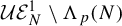 , we deduce that
$\mathcal {UE}^1_N\subseteq \Lambda _p(N)\cup G\cdot \Lambda (a)$
 .
For any
$g\in G$
 and any
$y\in \Lambda (a)$
 , note that
$\gamma _{g(y),g(z)}(t)\in g\mathcal {X}_a$
 for all
$t\geq 0$
 . Thus, by Proposition 7.3, we obtain for all
$t\ge 0$
 ,

Moreover,
$g(y)$
 is fixed by
$gag^{-1}$
 , which is hyperbolic, so by the discreteness of G,
$g(y)$
 is not a fixed point of a parabolic element of G, meaning that
$g(y)\notin \Lambda _p(N)$
 . Therefore, by Corollary 2.2, we have
$g(y)\in \mathcal {UE}^1_N$
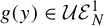 . Since g and y are taken arbitrarily, we have
${G\cdot \Lambda (a)\subseteq \mathcal {UE}^1_N}$
 . Proposition 2.3 shows that
$\Lambda _p(N)\subseteq \mathcal {UE}^1_N$
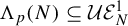 . Therefore, we have shown that
$G\cdot \Lambda (a)=\mathcal {UE}^1_N$
 .
Since N is a subgroup of G, we have
$N\cdot \Lambda (a)\subseteq G\cdot \Lambda (a)$
 . Conversely, for any
$g\in G$
 and
$y\in \Lambda (a)$
 , note that
$ga^{-\chi (g)}\in N$
 and

Therefore, we also have
$G\cdot \Lambda (a)\subseteq N\cdot \Lambda (a)$
 . The proof is thus complete.
Proof of Proposition 7.1
Fix an arbitrary
$z_0\in \mathcal {X}_a$
 . For all
$n\in \mathbb {Z}$
 , note that
$a^n(z_0)\in \mathcal {X}_a$
 , so
$N a^n(z_0)\in N \mathcal {X}_a$
 . Then, by Proposition 7.3, we have

which shows our claim.
Acknowledgements
We thank the referee for their careful reading of the manuscript and giving useful suggestions. J.J. was supported by the JSPS KAKENHI 21K03269 and 24K06777.
A Appendix. Proofs of supplementary lemmas
A.1 Proof of Lemma 4.4
As in §4.2, we always assume in this subsection that  contains no parabolic elements.
Proof of Lemma 4.4
If
$\Pi _0=\varnothing $
 , then our claim is vacuously true. Hence, for the rest of the proof, we assume that
$\Pi _0$
 is non-empty.
Let g be an element of G satisfying
$d(D,gD)>0$
 and
$a_p$
 be in
$\Pi _0$
 . Suppose that the reduced word representing g is of the form
$\omega a_p^2\omega '$
 , where
$\omega $
 and
$\omega '$
 are reduced words over
$G_0$
 . Here,
$\omega $
 and
$\omega '$
 can be empty words. Indeed,
$\omega $
 and
$\omega '$
 cannot be both empty because
$d(D,gD)>0$
 . Denote by l and
$l'$
 the length of
$\omega $
 and
$\omega '$
 , respectively.
Henceforth, we identify the elements of G with the reduced words over
$G_0$
 representing them. Take
$z_1\in \partial R_{{\omega _0}}$
 and
$z_4\in g(\partial R_{{\overline {\omega ^{\prime }_{l'-1}}}})$
 satisfying that

Note that the geodesic segment
$[z_1,z_4]$
 must intersect the geodesics
$\omega (\partial R_{a_p})$
 and
$\omega a_p(\partial R_{a_p})$
 at say
$z_2$
 and
$z_3$
 , respectively. This, in particular, implies that
$d(z_1,z_4)=d(z_1,z_2)+d(z_2,z_3)+d(z_3,z_4)$
 . Define
$z^{\prime }_3=\omega a_p^{-1}\omega ^{-1}(z_3)\in \omega (\partial R_{a_p})$
 and
$z^{\prime }_4=\omega a_p^{-1}\omega ^{-1}(z_4)\in \omega a_p\omega '(D)$
 . Clearly,
$\omega a_p^{-1}\omega ^{-1}$
 is a parabolic element of G. Hence,
$\omega a_p^{-1}\omega ^{-1}$
 preserves the horocycles centered at its fixed point. In particular,
$z_3$
 and
$z^{\prime }_3$
 are on the same horocycle centered at the fixed point of
$\omega a_p^{-1}\omega ^{-1}$
 ; denote this horocycle by
$\mathcal {H}$
 . Given a horocycle and a geodesic with one endpoint being precisely the center of the horocycle and a point z on this geodesic, the point on the horocycle which is closest to z is the unique point at which the horocycle and the geodesic intersect [Reference Dal’Bo8, Property I.1.19]. From this fact, we deduce that
$d(z_2,z_3)>d(z_2,z^{\prime }_3)$
 , because
$\omega (\partial R_{a_p})$
 is a geodesic with one endpoint being the center of the horocycle
$\mathcal {H}$
 ,
$z_2\in \omega (\partial R_{a_p})$
 ,
$z_3\in \mathcal {H}$
 , and
$z^{\prime }_3$
 is the point at which
$\mathcal {H}$
 and
$\omega (\partial R_{a_p})$
 intersect. Also note that
$\omega a_p^{-1}\omega ^{-1}$
 is an isometry, so
$d(z_3,z_4)=d(z^{\prime }_3,z^{\prime }_4)$
 . Combining all we obtained in this paragraph and the fact that
$d(z_1,z_4){=d(\partial R_{\omega _0},g(\partial R_{\overline {\omega ^{\prime }_{l'-1}}}))}=d(D,gD)$
 , we have

Recall that
$z_1\in D$
 and
$z^{\prime }_4\in \omega a_p\omega '(D)$
 , so

Finally, since
$a_p\in N$
 , we have
$\omega a_p\omega '$
 and
$g=\omega a_p^2\omega '$
 are in the same coset of N, which implies that

Combining this inequality with (A.1), we conclude that
$d(D,gD)>d(ND,N gD)$
 , provided that the reduced word representing g has
$a_p^2$
 as a subword for some parabolic
$a_p\in G_0$
 .
A.2 Proof of Lemma 6.6
The proof of Lemma 6.6 uses the notions introduced in §4. Throughout this subsection, we still identify a group element of G with the reduced word representing it.
Lemma A.1. For any
$g,h\in G$
 with h being an initial block of g, we have

where  is the diameter of the compact subset
 of
$\mathbb {D}/N$
 .
Proof. Take
$g,h\in G$
 with h being an initial block of g arbitrarily. Note that every geodesic segment joining D and
$gD$
 must intersect
$hD$
 , so

By Lemma 4.3 and the triangle inequality, we have

Proof of Lemma 6.6
For each positive integer k, take
$g^{(k)}$
 from the coset
$\chi ^{-1}(\{k\})$
 of G such that

For every positive integer k,
$g^{(k)}$
 is hyperbolic because
 contains no parabolic elements. We make one more observation about
$g^{(k)}$
 . For every
$g\in G$
 , define

where
$|g|$
 is the length of the reduced word g. For hyperbolic
$g\in G$
 , it is easy to show that
$\ell (g)$
 is a positive integer and
$g_0\cdots g_{\ell (g)-1}$
 must be an initial block of the reduced sequence over
$G_0$
 which represents the attracting fixed point of g. Moreover, since
${\chi :G\rightarrow \mathbb {Z}}$
 is a homomorphism, we have
$|\chi (g)|\leq \ell (g)\max |\chi (G_0)|$
 . Hence, for
$g^{(k)}$
 defined previously, we observe that

For each  , take
$x^{(k)}\in \Lambda (G)$
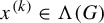 as a unique attracting fixed point of
$g^{(k)}$
 . Since
$\Lambda (G)$
 is compact, the sequence
$(x^{(k)})_{k\geq 1}$
 has at least one accumulation point, say
${x\in \Lambda (G)}$
 . Define

Then, Lemma 4.4 shows that
$x\in I_1^{\mathbb {N}}\cap \tilde {\Sigma }\subseteq \Lambda _r(G)$
 , because every initial block of the reduced sequence
$x_0x_1\cdots $
 over
$G_0$
 representing x is an initial block of
$g^{(l)}_0\cdots g^{(l)}_{\ell (g^{(l)})-1}$
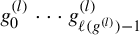 for some large integer l; the existence of l is guaranteed by the divergence of
$\ell (g^{(k)})$
 to the positive infinity as k approaches infinity. Thus, for any
 , applying Lemma 4.3 and Lemma A.1 to
$x_0\cdots x_{n-1}$
 and some
$g^{(l)}$
 for which
$g^{(l)}_0\cdots g^{(l)}_{\ell (g^{(l)})-1}$
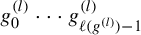 contains
$x_0\cdots x_{n-1}$
 as an initial block, we deduce that

Due to the compactness of  , we have

Finally, since
$x\in I_1^{\mathbb {N}}\cap \tilde {\Sigma }$
 , from the previous inequality and Proposition 6.2, we conclude that

showing that  and, in particular,
 is non-empty.



