Although the majority of patients affected by severe acute respiratory syndrome coronavirus-2 present with primarily respiratory pathology, cardiac injury was described in a minority in the initial phase of the pandemic.Reference Wang, Hu and Hu1 Children predominantly experience a milder course than adults, with low mortality.Reference Dong, Mo and Hu2–Reference Alsaied, Tremoulet and Burns4 However, a subset present with a multisystem inflammatory illness with a variable degree of cardiac involvement.Reference Whittaker, Bamford and Kenny3,Reference Riphagen, Gomez and Gonzalez-Martinez5–Reference Belhadjer, Méot and Bajolle7 The Royal College of Paediatrics and Child Health,8 Centres for Disease Control in the USA,9 and World Health Organization have all provided case definitions.10 The Royal College of Paediatrics and Child Health refers to paediatric inflammatory multisystem syndrome temporally associated with severe acute respiratory syndrome coronavirus-2 (PIMS-TS), whereas the Centres for Disease Control and World Health Organization refer to multisystem inflammatory syndrome in children. These case definitions permit phenotypic overlap with infectious and non-infectious hyperinflammatory conditions. The majority of children with multisystem inflammatory syndrome in children have received intravenous immunoglobulin with or without corticosteroids,Reference Alsaied, Tremoulet and Burns4 and most have made an excellent short term recovery.Reference Verdoni, Mazza and Gervasoni6,Reference Belhadjer, Méot and Bajolle7,Reference Julie Toubiana, Poirault and Corsia11
From a cardiac perspective, there is overlap between the above case definitions, Kawasaki diseaseReference Verdoni, Mazza and Gervasoni6 and acute myocardial injury without features of Kawasaki disease.Reference Belhadjer, Méot and Bajolle7 Although the term “Kawasaki-like” has been used, there appear to be significant discrepancies between multisystem inflammatory syndrome in children and classical Kawasaki disease in clinical and laboratory features as well as demographics.Reference Whittaker, Bamford and Kenny3,Reference Shekerdemian, Mahmood and Wolfe12,Reference Shulman13 It is more likely that multisystem inflammatory syndrome in children represents a clinically distinct immune-mediated inflammatory disorder, akin to that described in adults with cytokine storm.Reference Consiglio, Cotugno and Sardh14 Additionally, several authors have reported coronary artery involvement, with a wide discrepancy in incidence.Reference Whittaker, Bamford and Kenny3,Reference Capone, Subramony and Sweberg15–Reference Ramcharan, Nolan and Lai17
We describe a cohort of children referred to the paediatric inflammatory cardiology service at Great Ormond Street Hospital for Children NHS Foundation Trust from the end of February 2020. This service accepts referrals for Kawasaki disease and other paediatric inflammatory diseases associated with cardiac involvement. We have compared the clinical and laboratory features of this cohort, with particular emphasis on clinical characterisation based on the multisystem inflammatory syndrome in children definition, severe acute respiratory syndrome coronavirus-2 exposure status, and cardiac involvement (including rates of coronary artery abnormalities (CAA)), with historic referrals to our service spanning comparable calendar months in 2019. We additionally present the first published data regarding follow-up of cardiac pathology in children affected by multisystem inflammatory syndrome in children.
Materials and methods
Patients
This study includes all patients referred to the inflammatory cardiology service at Great Ormond Street Hospital from 20/02/2020 until 20/06/2020 (the 2020 cohort). Great Ormond Street Hospital is a large tertiary/quaternary children’s hospital in London, UK, which receives referrals from a large local catchment area and beyond. A proportion of the cohort has been previously reported in case series,Reference Whittaker, Bamford and Kenny3,Reference Davies, Evans and Kanthimathinathan16 but this is the first analysis of acute and medium-term cardiac outcomes. The starting point reflects the first referral to our service after the first recognised case of severe acute respiratory syndrome coronavirus-2 in the United Kingdom (31/1/2020). Mean follow-up was 103 days. For the purposes of comparison to previous referrals, our institutional database was used to identify all new referrals to the service in 2019 (the 2019 cohort). Prior to this, referrals were not centralised and therefore not comparable to the 2020 cohort. Data included demographics, clinical features, and radiological and laboratory investigations; datasets were limited due to the retrospective nature of the study, and numbers of patients with specified values (n) are given throughout. Because we included all referrals to our inflammatory cardiology service within the timeframe, the 2020 cohort includes patients who did not meet diagnostic criteria for multisystem inflammatory syndrome in children or Kawasaki disease. No patients from either cohort were excluded.
Cardiac status
Echocardiograms were reviewed offline by a single observer (FK), and z-scores were calculated based on the Boston dataset.Reference McCrindle, Li and Minich18 Coronary artery abnormalities were defined as a z-score of ≥2.5 and severe coronary artery abnormalities as z-score of ≥5.Reference McCrindle, Rowley and Newburger19 Left ventricular ejection fraction was determined by single-plane parasternal short axis M-Mode evaluation. In subsequent analysis, the 2020 cohort was divided into two groups based on those with normal left ventricular systolic function (defined as a worst left ventricular ejection fraction of ≥55%) versus those with reduced left ventricular systolic function (defined as worst left ventricular ejection fraction < 55%), and compared in terms of clinical features, requirement for ICU and invasive support, anti-inflammatory or disease-modifying therapy, severe acute respiratory syndrome coronavirus-2 laboratory status and coronary artery abnormalities. Serial electrocardiograms were obtained. For the purpose of the QT interval analysis, we used the Bazett formula. Corrected QT interval exceeding 450 ms in males and 460 ms in females was considered prolonged. Significant QTc prolongation was defined as QTc > 500 ms.
Statistical methods
Statistical analysis was performed with SPSS Statistics 22 (IBM, Armonk, NY, USA). All continuous data were tested for normality with the Shapiro–Wilk test; data are given as mean (± S.D.) or median (interquartile range) accordingly. Two-group comparisons of means of normally distributed data were analysed with the unpaired Student’s t-test, and non-normally distributed data with Mann–Whitney U-test. Categorical data were analysed using Fisher’s exact test. A p-value of <0.05 was considered significant.
Ethical considerations
In all instances, in-patient and out-patient referrals were reviewed retrospectively; as such, formal ethical approval was waived (Great Ormond Street Hospital ethics committee reference 20HL25).
Results
General overview of the 2020 cohort
Referral rates
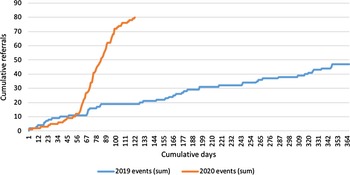
In the four-month study period, 80 patients were referred, at a rate of 19.8 patients/30 days. This represented a five-fold increase compared to 2019 (47 patients; 3.9 patients/30 days) (Fig 1). Since Kawasaki disease is a seasonal disease with winter and spring peaks,Reference Burns, Herzog and Fabri20 the referral rate was also calculated for the three months with the highest rate in 2019, which at 19 referrals from January to March (6.3 referrals/30 days) represented a frequency of approximately one-third that of the 2020 cohort.
Number of referrals to the inflammatory cardiology serviceat Great Ormond Street Hospital - 2019 versus 2020.

Baseline demographics
The 2020 cohort was significantly older than the 2019 cohort (median age 9.07 [IQR 4.29–12.00] versus 2.38 [IQR 0.98–5.06] years), and more likely to be of Black, Asian, or minority ethnic group origin (60/76 (78.9) versus 25/42 (59.5%), p = 0.032); there was no difference in sex distribution (54/80 (67.5%) male versus 29/47 (61.7%) male, p = 0.564).
Clinical status
Of the 2020 cohort, 52 (65%) required admission to hospital, with a median stay of 8 days. The median duration of fever was 7 days. Twenty-seven (33.75%) patients required supplemental oxygen, 19 (23.75%) required respiratory support (defined as high flow supplemental oxygen, continuous positive pressure, or mechanical ventilation), 39 (48.75%) were admitted to ICU, and 22 (27.5%) required inotropic support. One patient required V-A ECMO.
Although we were unable to capture the same degree of descriptive data with respect to hospital admissions for the 2019 cohort, none of them required ICU admission, inotropic support, or ECMO support.
Additionally, a significant proportion of children in the 2020 cohort had severe symptoms not commonly experienced in patients with Kawasaki disease. These included encephalopathy in 14 (17.5%) and gastrointestinal symptoms in 57 (71.25%).
Biochemical parameters in the 2020 cohort
Cardiac biomarkers
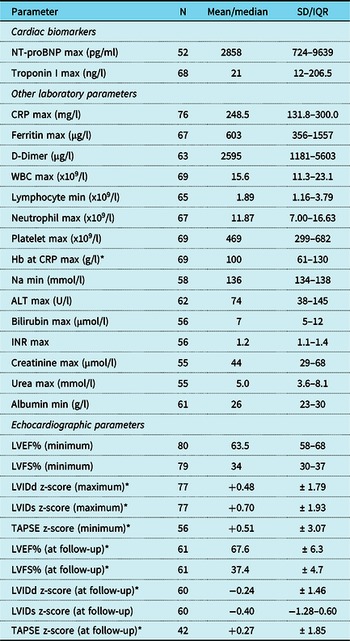
Cardiac biomarkers were elevated in a significant proportion of the 2020 cohort (Table 1). Peak N-terminal pro B-type natriuretic peptide was over 1000 pg/ml in 34 of 52 (65.3%) patients tested and exceeded 10,000 pg/ml in 12 (23.1%) (median 2858 pg/ml). Troponin I was raised in 37 of 68 (54.4%), with 26 (38.2%) patients having a level over 100 ng/l, and 6 (8.8%) with a level over 1000 ng/l (median 21 ng/l).
Objective parameters of the 2020 study cohort

The majority of the data was non-normally distributed.
Key: ALT – alanine transferase; CRP – C-reactive protein; Hb – serum haemoglobin; INR – International normalised ratio; IQR – interquartile range; LVEF – left ventricular ejection fraction; LVFS – left ventricular fractional shortening; LVIDd – left ventricular internal diameter in diastole; LVIDs – left ventricular internal diameter in systole; max – maximum; min – minimum; Na – serum sodium; NT-proBNP – N-terminal pro B-type natriuretic peptide; SD – standard deviation; TAPSE – tricuspid annular plane systolic excursion; WBC – white blood cell count
* Parameters were normally distributed.
Inflammatory markers and other parameters
C-reactive protein and D-Dimer were markedly elevated in the cohort, with a more modest increase in serum ferritin. The white blood count and neutrophil count were also significantly elevated, with a modest increase in the platelet count and reduced lymphocytes. Renal and hepatic function was largely unimpaired (Table 1).
Assessment of cardiac function in the 2020 cohort
General overview of the 2020 cohort
The majority of patients did not demonstrate echocardiographic evidence of significant left ventricular dilatation or systolic dysfunction. Only 13 (16.25%) had an left ventricular ejection fraction < 55% at any time. Likewise, there was no significant evidence of left ventricular dilatation – only 16 (20.77%) patients demonstrated a worst LV diastolic diameter (left ventricular IDd) z-score of >2, and only 6 (7.79%) patients >3. The median left ventricular internal diameter in diastole z-score was 1.79. RV systolic function was similarly preserved, with only 12 (21.43%) patients demonstrating a lowest TAPSE z-score of <−2, and only 9 (16.07%) patients <−3. The median TAPSE z-score for the cohort was 1.85 (Table 1).
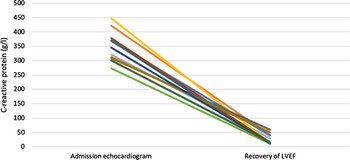
Of the 13 patients with reduced left ventricular systolic function, one died 6 days after admission from thrombotic complications. Due to the temporal association with the severe acute respiratory syndrome coronavirus-2 pandemic, this patient was referred to our service and is therefore included in our cohort. However, on retrospective review, diagnostic criteria for multisystem inflammatory syndrome in children or Kawasaki disease were not met. All 12 remaining patients demonstrated complete resolution of systolic dysfunction within 10 days (mean 5.25 days ± 2.7). This coincided with a rapid reduction of CRP in all patients (median CRP fell from 333.5 to 15.5; p = 0.002) (Fig 2).
CRP levels in patients with cardiac dysfunction: CRP on admission versus CRP on the day of echocardiographic normalization of cardiac function.

Comparison of patients with reduced versus normal left ventricular systolic function in the 2020 cohort
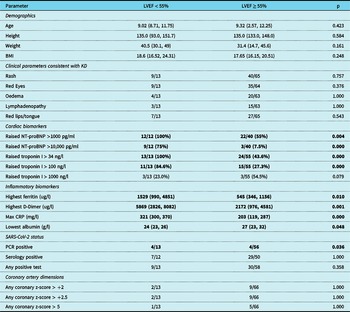
There was no statistically significant difference in baseline demographics between patients with normal versus reduced left ventricular systolic function in terms of age, height, weight, or body mass index (BMI) (Table 2). Only one out of 15 patients of White ethnicity had left ventricular ejection fraction < 55% (7.7%), whereas 12 of 48 patients of Black, Asian, or minority ethnic group ethnicity (20%) were affected. The proportions were not statistically different (Pearson’s chi-square 1.684 [p = 0.194]).
Comparison of demographics, clinical, and objective parameters between children with reduced versus normal left ventricular systolic function

Bold indicates statistically significant differences.
All continuous data is non-normally distributed and reported as median (interquartile range).
Key: BMI – body mass index; CRP – C-reactive protein; KD – Kawasaki disease; LVEF – left ventricular ejection fraction; NT-proBNP – N-terminal pro B-type natriuretic peptide; SARS-CoV-2 – severe acute respiratory syndrome coronavirus-2; PCR – polymerase chain reaction.
There was no statistically significant difference in the prevalence of clinical symptoms associated with Kawasaki disease; specifically, mucocutaneous symptoms or lymphadenopathy. With regard to symptoms not usually seen in Kawasaki disease, there was a statistically significant increase in the prevalence of abdominal symptoms in the cohort of children with reduced left ventricular systolic function. Increases in the prevalence of neurologic symptoms and encephalopathy did not reach statistical significance.
There was no statistically significant difference between groups in duration of pyrexia or hospital stay. However, a higher proportion of the group with reduced left ventricular systolic function required supplementary oxygen, PICU admission, and respiratory or inotropic support.
Children in the group with reduced left ventricular systolic function were more likely to have significantly elevated serum N-terminal pro B-type natriuretic peptide and troponin I. Median peak N-terminal pro B-type natriuretic peptide and troponin I in the group with reduced left ventricular systolic function were significantly elevated compared to the latter group (Table 2). Children with reduced left ventricular systolic function had evidence of more significant elevation of biochemical markers of systemic inflammatory response (CRP, D-dimer, ferritin) than children with normal left ventricular systolic function. They also demonstrated more significant hypoalbuminaemia (Table 2).
Children with reduced left ventricular systolic function were more likely to have elevated white blood cell and neutrophil counts. The median WBC and neutrophil counts were significantly elevated in the group with reduced left ventricular systolic function compared to those with normal left ventricular systolic function. The lymphocyte count, platelet count, and haemoglobin level were not statistically significantly different between the two groups.
There was no statistically significant evidence of worse renal or hepatic dysfunction between the two groups. Although children with reduced left ventricular systolic function had higher median urea values than children with normal function, neither group demonstrated evidence of significant renal dysfunction.
There was a higher proportion of positive severe acute respiratory syndrome coronavirus-2 upper respiratory swab PCR in the group with reduced left ventricular systolic function. However, there was no statistically significant difference between the groups in terms of the proportion of children with positive serum severe acute respiratory syndrome coronavirus-2 specific IgG or the proportion who had any positive severe acute respiratory syndrome coronavirus-2 test (Table 2).
A higher proportion of children with reduced left ventricular systolic function received corticosteroid therapy (100% versus 68.2%, p = 0.016). However, there was no statistically significant difference in the proportion of children in either group receiving other immunomodulating therapy. No children in the cohort received Remdesivir (supplementary data).
Coronary artery abnormalities in the 2019 and 2020 cohort
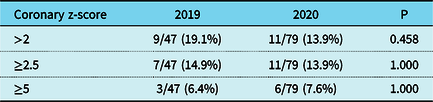
The absolute numbers of patients with coronary artery abnormalities is shown in Table 3. The proportion of patients with coronary artery dilatation was 13.9% (11 patients) in the 2020 cohort in comparison to 19.1% (9 patients) in the 2019 cohort. This result did not reach statistical significance. Similar observations were made in the proportions of coronary artery aneurysms and severe coronary artery aneurysms. There was no significant difference in the prevalence of coronary artery dilatation, aneurysms, or severe aneurysms between patients with reduced versus normal left ventricular systolic function (Table 2).
Comparison of coronary artery dilatation in the 2020 study cohort versus 2019 cohort

ECG changes in the 2020 cohort
In the 2020 cohort, 75 patients had at least one ECG performed. Arrhythmia was recorded only in 4 (5.33%) patients (three patients had first degree AV block, one patient had junctional rhythm). Sixteen patients developed transient T wave flattening/inversion, which subsequently normalised. QTc prolongation occurred in nine (17.33%) patients and was likely to be due to QTc prolonging drugs in two cases. In two (2.67%) children, the QTc was >500 ms. The QTc normalised in all nine patients during follow-up.
Discussion
We present unique medium-term cardiac follow-up data regarding children referred to our inflammatory cardiac service during the severe acute respiratory syndrome coronavirus-2 pandemic. We observed a threefold increase in referrals to our service in 2020 compared to the busiest months in 2019. There was no statistically significant difference in the proportion with coronary artery abnormalities and severe coronary artery abnormalities, indicating a degree of phenotypic overlap with Kawasaki disease. However, the frequency of left ventricular systolic dysfunction, inotropic, and ventilatory support requirement and other symptoms including encephalopathy and gastrointestinal symptoms in the 2020 cohort are not consistent with Kawasaki disease. Additionally, the 2020 cohort was older, with a higher proportion of Black, Asian, or minority ethnic group ethnicity. It is therefore likely that multisystem inflammatory syndrome in children represents a novel inflammatory syndrome. The broad case definitions likely inadequately distinguish multisystem inflammatory syndrome in children (or PIMS-TS) from Kawasaki disease, and we therefore emphasise the importance of considering the differential diagnosis of Kawasaki disease (and other infectious and non-infectious hyperinflammatory conditions). If Kawasaki disease is suspected clinically, evidence-based European treatment guidance should be followed.Reference de Graeff, Groot and Ozen21
Most children referred for assessment of multisystem inflammatory syndrome in children did not demonstrate significant systolic dysfunction. In the small proportion of patients with important systolic dysfunction, the mechanism of dysfunction was likely myocardial stunning from pro-inflammatory cytokine storm rather than direct viral myocarditis. This is supported by the rapid normalisation of echocardiographic parameters even in those with initially severe left ventricular systolic dysfunction, paralleled by rapid reduction of inflammatory biomarkers (in contrast with viral myocarditis,Reference Canter and Simpson22 which demonstrates slower as well as non-universal recovery). Although a systematic review of the literatureReference Ahmed, Advani and Moreira23 published in 2021 recorded a higher frequency of VA-ECMO cannulation, the authors do acknowledge that mortality is very low, consistent with our experience of rapid recovery for even severely affected children. Lastly, one of our patients underwent an endomyocardial biopsy, which did not demonstrate lymphocytic myocarditis,Reference Laurence, Haini and Thiruchelvam24 consistent with reports from adult literature.Reference Peretto, Sala and Caforio25 These findings are supported by another recent small seriesReference Patnaik, Jain and Ahmed26 which demonstrated a return to normal left ventricular systolic function in all children followed to between 12 and 16 weeks post-discharge.
We have reported a lower proportion of children with coronary artery anomalies than other reports of multisystem inflammatory syndrome in children.Reference Davies, Evans and Kanthimathinathan16,Reference Ramcharan, Nolan and Lai17 This may be because we have utilised published definitions of coronary dilatation and coronary aneurysms, as opposed to including patients with coronary artery prominence or perivascular echo-brightness. We feel that this is appropriate because perivascular echo-brightnessReference Yu, Jang and Ko27 has been shown to be poorly discriminatory of Kawasaki disease and – along with mild ectasia – may occur in other conditions such as juvenile idiopathic arthritisReference Binstadt, Levine and Nigrovic28 and sickle cell disease.Reference Nicholson, Hsu and Colan29
Our study has several important limitations, including its retrospective nature and relatively small sample size. In addition, the broad inclusion criteria and the opportunistic sampling method render the cohort prone to bias.
We conclude that the majority of patients with multisystem inflammatory syndrome in children are unlikely to encounter long-term cardiac sequelae, based on the low incidence of severe coronary artery pathology and complete recovery of myocardial dysfunction in even the most severely affected patients.
Acknowledgements
We would like to acknowledge the teams of physicians, nurses and nurse specialists, and allied health workers at Great Ormond Street Hospital who have responded tirelessly and selflessly to the severe acute respiratory syndrome coronavirus-2 pandemic. Without their expert care for these children, this paper would not have been possible. Collaboration between the cardiology, ICU, general paediatrics, rheumatology, and infectious diseases was vital in the care of such complex patients and in the creation and revision of this work.
Financial support
This research received no specific grant from any funding agency, commercial or not-for-profit sectors.
Conflicts of interest
None.
Ethical standards
Institutional Review Board approval was obtained (20HL25).
Contributors
FK, CL, JS, AJAG, TB, PB, AH, SS, KM, AB, SK: all made substantial contributions to the conception of the work, data acquisition, analysis, and interpretation; drafting and revising the work for important intellectual content, final approval of the submitted manuscript.