More than five decades ago, Frank Thistlethwaite (Reference Thistlethwaite1960) issued his famous and far-reaching challenge to historians of migration. Most of the research agenda that he proposed then has been accomplished; a whole symposium in 1986 was devoted to an assessment of the contributions his essay had inspired over the course of 25 years (Vecoli and Sinke Reference Vecoli and Sinke1991). However, one point on his agenda still requires additional work.
Thistlethwaite cautioned US scholars against assuming their country was the automatic or self-understood destination of European emigrants, and urged closer attention to alternatives, especially in South America (1991 [Reference Thistlethwaite1960]: 23–25). In the ensuing decades, some excellent comparative work has been done, particularly on Italians (Baily Reference Baily1983, Reference Baily1999; Gabaccia Reference Gabaccia2000; Klein Reference Klein1983). There is a fine study of the acculturation of Germans in Brazil, though largely focused on the World War I era that the author had previously covered for the United States (Luebke Reference Luebke1987). The magisterial work of Moya on Spanish migration to Argentina (1998) is of less relevance here because it involves a quasicolonial movement within the same language and culture. There is a good general treatment of immigration to Latin America (Mörner Reference Mörner1985), and one brave scholar has attempted to treat all the major sources and destinations of transatlantic migrations (note the plural form) in a comparative framework (Nugent Reference Nugent1992). Wegge (Reference Wegge2002) provides a very nuanced analysis of emigration selectivity compared to the source population of Hesse, but does not attempt to distinguish between various destinations. Little attention in any of these studies has been given to the sorting-out process—what affected the choice of destinations—particularly for a group such as the Germans.
As it turns out, Thistlethwaite's caveat to US historians was less justified with respect to Germans than it was with some other nationalities, particularly those speaking Romance languages. Close to 90 percent of those leaving Germany for transoceanic destinations in the century before World War I chose the United States. Even so, that leaves a group of more than half a million migrants whose alternative decisions need to be explained and whose impact on other societies needs to be assessed (Nugent Reference Nugent1992: 64). This essay addresses both halves of the problem—first, what distinguished those Germans who “went south” to Latin America (or down under to Australia, the other main alternative destination) from those who remained in familiar latitudes on their way to the United States. But the first half of the question cannot entirely be separated from the second: what kind of people migrated affected how they were able to integrate into Latin American or other host societies. And the kind of niches they found or failed to find certainly affected the decisions of subsequent migrants.
Competing Explanations
There are several explanations or hypotheses about migrants’ choice of destinations, though few have been formulated with much precision. The first might be called, in the language of the computer age, “the United States as default option.” This comes close to the ethnocentrism that Thistlethwaite warned about, assuming the United States is the automatic destination of emigrants unless a drastic deterrent factor such as the US Civil War intervened (Köllmann and Marschalck Reference Köllmann and Marschalck1976: 502–8; Marschalck Reference Marschalck1973: 42–51, 105). A second explanation might be called the “emigration follows commerce” view. Here the assumption is that the trading patterns of emigrant ports strongly influenced emigrants’ destinations (Hansen Reference Hansen1940: 179–95; Ward Reference Ward1971: 51–83).Footnote 1 Also worth mentioning is the “human capital” explanation—that emigrants tend to choose destinations that match the economic specializations of their place of origin, so that they can continue along similar occupational lines (Runblom and Norman Reference Runblom and Norman1976: 249–52).Footnote 2 Given the high number and proportion, not just of Spanish and Portuguese, but also of Italians who migrated to Latin America rather than the United States, one might hypothesize that Catholics generally, also from confessionally mixed areas such as Germany, would be more attracted to such nations where their religion predominated than were Protestants of the same origins.Footnote 3 German nationalists in particular have favored the “recruitment and propaganda” explanation, often using this rationalization to deny that migration reflected serious socioeconomic strains and dislocations in the country of origin.Footnote 4 The other side of the nationalist coin, of course, is German efforts at colonization to provide alternatives to US immigration. Finally, there is an explanation that has proven to be quite compelling in explaining North American patterns of settlement, the “chance plus chain” migration theory. That is, wherever the initial migrants from a given local area happen to settle (whether brought there by chance, propaganda, recruitment, or other indeterminate factors), unless they meet with a complete disaster they will continue to attract others from their locality and form a local concentration (as first formulated by MacDonald and MacDonald Reference MacDonald and MacDonald1964).Footnote 5
If the United States indeed became the default option for German emigrants by the mid-nineteenth century, it was not because it had been so all along. In the 1820s, when emigration rates began to revive after a generation-long hiatus imposed by the American and French revolutions and the Napoleonic Wars, Brazil could compete on a fairly equal basis with the United States. The places of earliest settlement continued as the largest German concentrations in Brazil (Luebke Reference Luebke1987: 9–13; Willems Reference Willems1946: 114). The areas near the Moselle River, where the recruitment of the 1820s was concentrated, continued beyond mid-century to be a leading source of German emigration to South America, above all presumably Brazil.Footnote 6
As late as the 1860s, the “default option” for emigrants from Birkenfeld (an exclave of Oldenburg in the middle of the Trier District not far from Luxemburg) was Latin America rather than North America. Official statisticians explained this phenomenon with the following remark: “Thus far the emigration flow from the Principality of Birkenfeld, on account of the business connections with Brazil for the purpose of purchasing stones for agate polishing, has gone more to South than to North America.” Such trade connections bear further investigation, but it should be noted that Birkenfeld was also one of the prominent areas of recruitment for Brazilian mercenaries and migrants in the 1820s. A generation later, from 1855 to 1860, still 70 percent of its nearly 500 emigrants went to Latin America, and except for two persons headed for Australia, the rest to North America. From 1861 to 1864 while the United States was engulfed in Civil War, the Latin American portion was even higher, 87 percent. The time series is too short and irregular to judge whether emigrants were substituting between north and south. However, in 1864 Latin emigration was down to one lone individual, though only nine went to the United States that year (Statistische Nachrichten 1867: 286, 164–77).
Unfortunately, the time series breaks off at this point, making it impossible to say whether 1864 represents a temporary blip or a permanent turning away from Latin America. The drop-off in the surrounding Trier District, however, suggests that it may have been a turning point. The Prussian Kreis or county of Simmern, immediately adjacent to Birkenfeld, shows a similar south to north shift in destinations. Already in the 1820s, Simmern had contributed 45 emigrants to Brazil. The “hungry forties” saw another upsurge, with 407 emigrants, 93 percent of the total, going to Brazil. Emigration in the 1850s was double that of the 1840s, but now for the first time a majority of more than 70 percent went to the United States. Nor did the Civil War make much difference; 1863 was the last year that Brazilian emigration from Simmern exceeded 10 annually. Hereafter the North American lead expanded to 78 percent of the total during the 1870s and reached 95 percent in the 1880s (Diener Reference Diener1938: 107, 123). As was the case with migration to Brazil, there were counties in Germany where, instead of 90 percent or more of the emigrants heading for the United States as usual, for several decades, even after the Civil War, more emigrants headed for Australia than for any other destination. The direction of migrations was even more polarized at the town level. This had little or nothing to do with the occupational structure at either source or destination, but a great deal to do with where the initial immigrants from a given locale happened to locate, often largely by chance (Reich Reference Reich1997: 131–34).
Hamburg sent a much higher proportion of its emigrants to Latin America than Bremen, but the evidence suggests that emigration may have been driving trade as much as vice versa. Authorities in Bremen were much more welcoming than their counterparts in Hamburg toward Brazilian recruitment agents in the 1820s, hoping that this would stimulate their commerce with Latin America, although these hopes proved to be vain. Hamburg engaged in much more commerce with Latin America than Bremen did, but even the Bremen ships trading in that area carried very few passengers, only 11 per voyage on average in the years 1862 to 1867, compared to an average of some 300 on voyages to North America (Engelsing Reference Engelsing1961: 117–23; Marschalck Reference Marschalck1987: 106). So, the “emigration follows commerce” hypothesis proves to be of little help in explaining the destinations of those sailing from German ports.
A history of German colonization efforts in Latin America (or elsewhere for that matter) proves to be hardly migration history at all, but rather a history of ideas, policies, and bureaucratic initiatives that had minimal effects on the real world. Despite nearly a century of German colonization efforts in Central America, and notwithstanding a respectable German business presence, Guatemala was the only country in Central America with as many as 1,000 German settlers by the eve of World War I (Schoonover Reference Schoonover1998: 223–24).
Summing up the evidence from my earlier work with aggregate statistics, mostly from the German side, one can see some modest effects of recruitment from the Latin American and Australian side in areas that did not yet have an established migration tradition, particularly in the short run and especially if free passage was offered to emigrants. But the Brazilian evidence also confirms the German proverb, “Lies have short legs.” If recruiters’ promises were not fulfilled, emigration to a non-US destination could drop precipitately from one year to the next. Still, many of the Brazilian recruits were sufficiently satisfied with what they encountered that they set up migration chains from some areas of Germany that lasted for decades, although over the course of the nineteenth century the bulk of immigration also from these areas shifted to the Northern Hemisphere. There is strong evidence on both the micro- and the macrolevel that the “chance and chain” migration model applies to Brazil as well as to North America. On the macrolevel, one sees evidence in the fact that areas of heavy migration to South America (which primarily meant Brazil in the mid-nineteenth century) were scattered rather haphazardly across the map of Prussia. However, from one decade to the next, there was a good deal of continuity in the proportion of a district's emigration that was directed southward (Kamphoefner Reference Kamphoefner1999, Reference Kamphoefner2000).Footnote 7 As will be shown in greater detail, German immigration to Brazil appears rather similar to its counterpart in the rural Midwest, both in its social composition and in its patterns of settlement and acculturation.
But there was also another type of Brazilian German, which a standard work on this immigration describes as “Reichsdeutsche—subjects of the German Kaiser—who disdained Brazilian citizenship. Many in this group were educated, middle-class persons. Not a few were associated with German firms in Brazil and displayed the attitudes of sojourners in a strange land who looked forward to the day when they could return to their mother country” (Luebke Reference Luebke1987: 31).Footnote 8 If this element made up only a minority of Germans in Brazil, concentrated in cities like Rio de Janeiro, it probably constituted the majority of those who chose more unusual destinations in South America and other parts of the world.
This brings to mind the association pointed out by Thomas Archdeacon (Reference Archdeacon1983: 139): the higher the proportion of males, the greater the return migration rates.Footnote 9 One is also reminded of Peter Marschalck's distinction between “socioeconomic” and “economic-speculative” migrations: the former a mass migration, pushed more than pulled, consisting largely of families from lower-class or lower-middle-class origins, with the goal of settlement; the latter a migration of individuals not suffering economic pressure, with the goal of greater profits and ultimate return.Footnote 10 As the title of Magnus Mörner's book on Latin America reminds us, return migration could involve both (merchant) adventurers and proletarians, but there is evidence that Germans were more concentrated among the merchants. Indeed, a study of the few Germans who migrated to Mexico characterizes them as “trade conquistadors” who “usually came as young single males with a limited personal stake in the host society” and “anticipated a stay in Mexico of relatively short duration” (Buchenau Reference Buchenau2001: 27–28; Reference Buchenau2004: 7–8).
While these indicators are too scattered to form a conclusive case, they are bolstered by evidence on migrant selectivity from the German side. There was indeed regional or local selectivity of the emigration to rural Brazil, but of a purely random sort that had nothing to do with social structure. The two leading areas of recruitment, the Hunsrück-Moselle region in the southwest and Pomerania in the northeast, represent two extremes of physical and social geography. The Hunsrück was a hilly, almost mountainous region characterized by poor soil and diminutive peasant holdings.Footnote 11 Pomerania, with its vast rye fields stretching across the North German Plain, represented the extreme of Junker latifunda and dependent agricultural laborers (and the Westfalian area from which the colony of Teutonia was recruited fell midway between the two, in both geography and social structure). It seems unlikely that emigrants from these areas to rural Brazil differed appreciably from their neighbors with North American destinations.
Even from the limited evidence available from aggregate statistics, the high proportion of males among emigrants to more exotic destinations stands in striking contrast to the more even sex ratios characteristic of family migration to North America. This data also suggests that migration to alternative destinations involved a positive selectivity compared to emigration to the United States, perhaps because of the higher information costs involved, as well as the higher cost of passage to Latin America and particularly Australia, unless it was subsidized.Footnote 12
Perspectives from Individual-Level Emigration Data
Individual-level data confirms these patterns and reveals further nuances. The data used for this investigation consists of emigration files from two German archives (Düsseldorf and Wolfenbüttel) that were computerized in job-creation projects under directors who were archivists rather than social scientists. One data set referred to here as the Rhineland data consists of all migration files from the Düsseldorf, Cologne, and Aachen districts of the Prussian Rhine Province (now part of the state of North Rhine-Westphalia). The other set consists of emigration files from the formerly sovereign Duchy of Braunschweig (now part of Lower Saxony). These are samples of convenience rather than having any particular association to places of destination. They include two of the three main divisions of German agricultural society: The Rhineland forms part of the southwest German pattern with inheritance customs of equal division among heirs and relatively small peasant holdings; Braunschweig falls into the Northwest German pattern of single child inheritance, resulting in a bipolar rural society divided between relatively large peasant farmers and increasing numbers of tenants tilling tiny plots and engaging in cottage industry. No data was available from anywhere east of the Elbe where great estates and a subservient peasantry prevailed.Footnote 13 Both data sets essentially cover the long nineteenth century beginning in the 1820s and ending in 1913, and include only cases of overseas migration.
Both data sets required extensive cleaning up, coding, and categorizing from their raw archival form before they could be used (see Methodological Appendix for details). The two are structured somewhat differently; the Rhineland data defines its cases as individuals, the Braunschweig data as emigration cases involving one registrant who may or may not be accompanied by other family members. Age, sex, and occupation data are thus available only for the registrant, not for any accompanying persons. The Rhineland data covers about 30,000 individuals; the Braunschweig data about 10,000 emigration cases representing perhaps 20,000 persons. Nearly all cases specify a continent of destination, but only one-fifth or so also include more details such as the country, state, or town, which had to be deciphered and classified.
It was apparent even from aggregate data that the United States was not always the “default option” for German emigrants. This was further confirmed by individual-level data. Of the 22 Rhinelanders who emigrated before 1830, nine were destined for South America (defined here as anywhere south of the United States) and only eight for North America, though in the 1830s the concentration on North America reached an all-time high of 97 percent. Even in the 1830s, only 83 percent of Braunschweig emigrants were bound for North America, in contrast to a 95 percent level over the entire period. There is little consistency in time patterns from the two areas. While Braunschweig emigrants show a slow but steady drop in the North American percentage from decade to decade after their peak in the 1840s, the Rhinelanders had their ups and downs, showing a higher proportion in the 1880s and 1890s than they had in the two decades before. Emigrant numbers were down sharply after 1900, but of this cohort, only 75 percent of the Rhinelanders and a mere 58 percent of the Braunschweigers noted North American destinations, though some of the others were bound for Asia or Africa rather than Latin America or Australia.
Gender and Family Contrasts
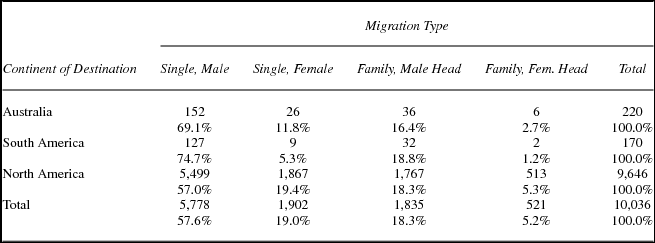
The gender and family makeup of the emigration differed greatly from one destination to another. The Braunschwieg data does not allow calculation of overall sex ratios, but it allows one to classify emigration cases into four types: single males, single females, and families headed by males and females respectively (table 1).Footnote 14
Gender and family composition of Braunschweig emigration cases by destination

North American migration (the overwhelming majority of it headed for the United States) was characterized by the lowest proportion of single males and by higher proportions of both single females and families headed by women. If one breaks down South America by specific destinations, one sees that virtually all the female and family migrants from Braunschweig were headed for Brazil, whereas 87 percent of the emigration cases to other Latin American destinations involved single males.
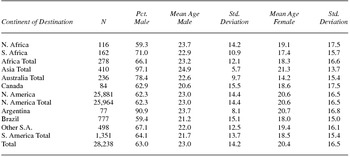
The structure of the Rhineland data does not allow one to distinguish between individual and family migration, but does offer the advantage of allowing the computation of exact sex ratios (once some 1,100 different first name combinations had been classified by gender). Here, too, one sees that the lowest proportions of males were found among emigration to the most common destinations (table 2). Overall, the Rhineland emigration was 63 percent male; because North America made up such a large share of the total, it was only slightly lower at 62.3 percent. All the other continents showed higher figures; for “settler” destinations such as South America or North Africa (i.e., Algeria), the difference was relatively small, with male proportions of 64.1 percent and 66 percent, respectively. The Australian bound were 78 percent male, those bound for Asia 97 percent, while the 20 persons with Caribbean destinations (not included in the table) were all male.
Sex and age distribution of Rhineland emigrants by destination

When one further subdivides continents, it becomes apparent that emigrants to exotic destinations were overwhelmingly male, whereas some “settler” destinations attracted a more balanced sex ratio than even North America. Brazil comes in at just 59 percent male. The next lowest figure in South America was for those who specified nothing more than the continent, many of whom were no doubt headed for these popular destinations as well. By contrast, the Argentine contingent, smaller than the Brazilian by a factor of 10, was more than 90 percent male. The handful of Rhinelanders bound for Costa Rica, Honduras, Ecuador, Columbia, Venezuela, Paraguay, and Uruguay were 100 percent male, whereas those bound for Guatemala, the next leading destination after Brazil, showed a 50:50 gender split.
While the Rhineland data does not distinguish between individual and family migration, one could expect that family migration exhibits a lower mean but a higher standard deviation than would be true of individual migration because with families there would be at least a 20-year age gap between parents and children. These distinctions show up clearly between male migrants to common as opposed to more exotic destinations, whereas females bound for every continent showed relatively high standard deviations for age (13 years or more for every subgroup), indicating that most of them emigrated as families with children rather than independently. Mean male ages lay in a narrow range from 21 to 25 years for various continents of destiny, but the standard deviations varied over a range of 10 years. North America and South America showed the highest standard deviations (i.e., the most family migration), followed by Africa, and when one looks at individual countries, Brazil and Algeria show standard deviations higher than North America, whereas the rest of their continents show lower age dispersions indicative of fewer children. The lowest standard deviations of age were found among the Caribbean bound, less than four years, while for the Asian bound it was also below six, and less than 10 even among those bound for Australia. This provides yet another piece of consistency between Rhineland and Braunschweig emigrants to various destinations.
The Braunschweig data also demonstrates the limited effects of recruitment and propaganda. One might have expected a disproportionate preference for Brazil among emigrants from Braunschweig. After all, one of its natives was Dr. Hermann Blumenau, who wrote a guidebook on Brazil and in 1850 founded a colony in Santa Catarina Province of southern Brazil that bore his name (Blumenau-Niesel Reference Blumenau-Niesel2000; Luebke Reference Luebke1987: 14, 21–22). However, a mere 1.2 percent of Braunschweig's emigrants (less than half the Rhineland figure of 2.7 percent) were bound for Brazil, and from Amt Harzburg, where Blumenau's hometown was located, there were only two cases of emigration to South America, but a dozen or more to Australia. Still, Dr. Blumenau appears to have had some influence on his fellow Braunschweigers, for nearly one-third of those bound for Brazil and more than half of those who gave specific destinations did list Blumenau as their goal. It is also surprising that Australia attracted relatively few emigrants from Braunschweig. The adjacent Harz mining area of Clausthal had sent more than 1,100 emigrants to Australia between 1848 and 1854, subsidized by interest-free “loans” from the Hanoverian government—few of which were ever repaid (Vollmer Reference Vollmer1998; more detail in Vollmer Reference Vollmer1995). But although this recruitment area was literally intertwined with Braunschweig territory, the idea of Australian migration appears not to have spread there.
Urban-Rural Contrasts
Both data sources also confirm another tendency first noted from aggregate statistics: Urbanites were about twice as likely to venture beyond North America as rural dwellers. From the Duchy of Braunschweig in aggregate, all but 5 percent of the emigrants had North American destinations; for the cities of Braunschweig and Wolfenbüttel (with populations of about 50,000 and 10,000, respectively, in 1867), the figure was nearly double that, with 9.5 percent bound elsewhere. Rhinelanders in general were slightly less concentrated on North America, which attracted all but 8 percent of the total emigration. Here too, urbanites were more likely to venture farther afield. In the more rural Aachen and Cologne districts, not even 5 percent of the emigrants registered destinations outside North America; in the Düsseldorf District that forms the heart of the industrial Ruhr region, more than 11 percent looked beyond North America, while with emigrants registered by the police in the cities of Cologne, Aachen, and Duisburg (and presumably residing there), the figure climbs to 17 percent. This suggests that the better informed, and more highly qualified, emigrants were the most likely to venture beyond the United States, a tendency that is further confirmed by examining the occupational structure.
Occupational Patterns
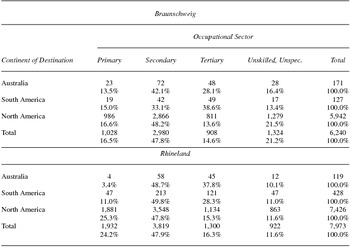
Occupations of emigrants were classified into the three sectors of the economy (table 3): primary, secondary, and tertiary, plus a fourth category of unskilled occupations such as maid or day laborer or Knecht (servant) that do not allow distinctions between agricultural and other types of employment (or may in fact involve casual labor in various sectors).
Occupational sector distribution of male German emigrants by destination

Even such a broad categorization proves to be quite revealing. This analysis deals only with male occupations because so few women emigrated independently to anywhere except the United States, and most of them were subsumed under just a handful of occupational titles. The male occupational structure reveals a considerable degree of consistency between emigrants from Braunschweig and the Rhineland. In both cases, the secondary sector, consisting largely of artisans but also including industrial workers, made up 48 percent of the emigrants. The tertiary sector, commercial and administrative occupations, made up 15 percent from Braunschweig and not quite 18 percent from the Rhineland. Rhinelanders were slightly more heavily concentrated in the primary, that is agricultural sector, and Braunschweigers in the “unskilled, unspecified” group, but this may reflect simply a difference of terminology rather than any major structural difference. From both regions, North America or the United States proved especially attractive to persons in the agricultural sector, or in the “unskilled, unspecified” category that probably consists mostly of life-cycle agricultural servants. Persons employed in the tertiary sector, particularly in commercial occupations, and those in specialized technical occupations, were most drawn to exotic destinations. Both Braunschweig and the Rhineland sent a fair number of soldiers, and some officers and other administrators, into colonial service in the Dutch East Indies (not included in table 3), but most of those in the tertiary sector bound for South America or Australia were merchants or professionals. This occupational group was much less prominent among persons going to the United States than of those bound for any other destinations. As was observed with other characteristics in the preceding text, also in their occupational profile emigrants to Brazil most resembled the North American bound.
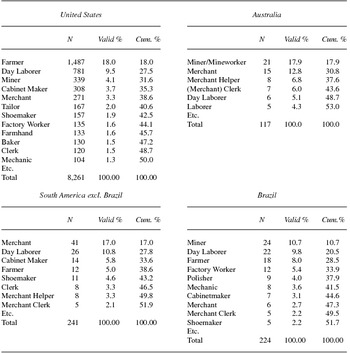
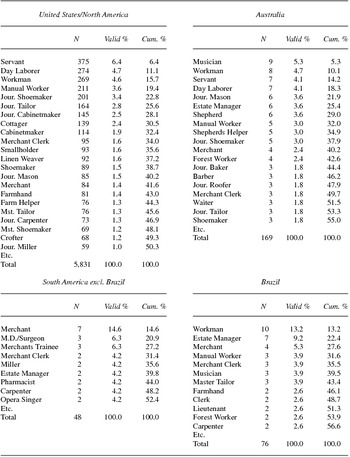
This becomes apparent when one examines the individual occupational titles that constitute the top half of the frequency distribution for emigrating males (table 4).
Leading occupations of male Rhineland emigrants by destination

With Rhinelanders bound for the United States, farmers were by far the leading occupation, constituting 18 percent of the total, with day laborers in second place and miners in third, not surprising given that the recruitment area included the Ruhr District. The other leading occupations fall mostly in the skilled artisan and unskilled manual categories, with only merchants and clerks from the commercial sector, together accounting for less than 5 percent of those with US destinations.
Excluding those bound for Brazil, those with more exotic South American destinations were a very elite group, with merchants the number one occupation accounting for more than one-sixth of the total, and together with three lower-ranking commercial occupations constituting more than one-fourth of all male emigrants. As with the US bound, day laborers were the second most frequent occupation, but farmers constitute a much smaller contingent, only ranking in fourth place. Skilled artisans made up the rest of the top two quartiles.
Those with Brazilian destinations pose some interesting contrasts, showing little positive selectivity. The leading occupations were miners and day laborers, and other industrial jobs and a couple of artisan skills also figure prominently. Although ranked third, farmers accounted for less than half the share they did among those with US destinations. Merchants and their assistants came to less than 6 percent, no more prominent than among those headed north.
The Rhinelanders destined for Australia were heavily concentrated in time, occupation, local origins within the province, and, in the instances where it was listed, specific destinations down under, all of which point to a recruitment effort that has thus far eluded documentation. The year 1877 saw some 63 Rhinelanders depart for Australian destinations, more than the total of the previous two decades; the next two years added 26 and 16 more. Of those leaving in 1877, Queensland was the stated destination of all but 2 of the 46 who were more specific than merely Australia, and except for two day laborers, all 19 who listed occupations professed to be miners. And among those listing no occupations, some 20 came from places in and around Essen known for their association with coal mining. Not coincidentally, Queensland was experiencing a mining boom in the 1870s, and this group was doubtless recruited and perhaps subsidized. But except for this brief period, the scattering of Rhinelanders bound for Australia, about four per year, were concentrated in the commercial sector and bound for major cities if they listed destinations at all. This bimodal distribution is reflected in leading occupations of those bound for Australia: miners and common laborers, on the one hand, merchants and those aspiring to be, on the other, and few in between.Footnote 15
The occupational patterns of emigrants from Braunschweig (table 5) show many commonalities with those seen among Rhinelanders. The four leading occupations of the US bound all fell into unskilled, undifferentiated manual labor category, though in fact many of them probably worked in agriculture. The next three were skilled artisan occupations, but still at the journeyman level (the Braunschweig occupational titles were highly differentiated). Linen weavers were almost certainly drawn from the declining handloom trade. The only master artisans among the leading occupations were tailors and shoemakers, trades with minimal capital requirements. The only farming occupations that imply heads of family, cottager, smallholder, and crofter, consist of people with little or no landholdings. Merchants clerks and merchants are the sole commercial occupations in the top 50 percent, but together they account for only 3 percent of the total. As with Rhinelanders, emigration to North America was least selective with respect to occupational profile.
Leading occupations of male Braunschweig emigrants by destination

Except for those bound for Brazil, emigrants to South America were dominated by the commercial sector, with merchants leading the pack and together with their assistants, comprising one-quarter of all male occupations. Within this small group were also found professionals such as doctors, pharmacists, and even a pair of opera singers. The sole agricultural and artisan occupations are both rather elite. Although workmen figured most prominently among emigrants to Brazil, the commercial sector was also well represented, with merchants in third place and together with clerks accounting for 12 percent of the total. But there were more artisans and unskilled workers headed for Brazil than elsewhere in South America. Braunschweigers bound for Australia were a larger and less selective group than those headed for South America, but still showed more positive selectivity than US emigrants. Merchants and their clerks, for example, were slightly more prominent. The bulk of leading occupations fell into the unskilled manual or artisan categories, and here the predominance of journeymen is apparent. But there are a couple of specialized occupations that deserve further comment in the following text.
One can also approach the selectivity issue based on which occupational practitioners were most likely to emigrate elsewhere than to the United States. Out of 127 occupational titles that occurred 10 or more times among Braunschweigers, the occupation of merchant (Kaufmann) was sixth from the bottom in preference for North America; of the 156 merchants, 25 percent recorded other destinations (this includes a few bound for Africa and Asia and not included in table 5). Musicians were the least likely of any occupation to go to the United States; 40 percent went elsewhere. Three different designations for merchant's clerks or trainees accounted for 258 individuals, 13 percent of whom looked beyond North America. By contrast, there were very few agricultural occupations where less than 97 percent went to North America.
Two of the exceptions bear noting. Eighth and ninth from the bottom were the German occupation titles Ökonom and Schaeferknecht, neither of which sent as much as 80 percent of their numbers to North America; the related occupations of Ökonomieverwalter and Schäfer also fell below 90 percent. The one occupation means shepherd or shepherd's helper; the file of one shepherd who emigrated to Australia in 1857 included the remark that there was a “great demand for shepherds in Australia.” Except for these shepherds, almost all those with primary sector occupations headed for Brazil or Australia designated themselves as Ökonom or occasionally Ökonomieverwalter: a term etymologically related to economist, but usually meaning “gentleman farmer” or someone trained to oversee an agricultural estate (and translated as estate manager in the tables). Most of such people with Brazilian destinations were headed for the Blumenau colony, among them a doctor's son and a pastor's son: not your normal peasant agriculturist.
While the Rhineland terminology is quite undifferentiated, in the Braunschweig area there are various terms that allow one to identify landowning peasants and gain some idea of the size of holdings. Not that it made much difference: None of these categories of landowners sent less than 97 percent of their numbers to North America, and of more than 400 peasants proprietors, only five listed destinations elsewhere. But poor tenant cottagers were even more unanimous; out of 186 cases, every single one was North America bound.
A third emigration data set from the Osnabrueck District is structured similarly to the Braunschweig data, but it provides few insights because it includes only a handful of cases who ventured beyond the United States. However, what few there were bound for Latin America conform to the overall profile sketched in the preceding text: disproportionately male, single, bourgeois, and urban in both their sources and destinations.Footnote 16 Emigrants from this district bound for Australia were similarly rare, only 35 cases, with all but five of the registrants male, and nearly half from the district capital, although they showed few distinctive occupational characteristics.Footnote 17
Perspectives from Data at the Destinations
The rest of this essay focuses on the countries of destination, and attempts to construct a comparative profile of Germans settling in South and North America as well as Australia, to the extent that this is possible from available immigration and census data. For the United States, we have for every decade since 1850 both a wealth of published decennial census data broken down by country of origin, as well as the Integrated Public Use Microdata Series (IPUMS) manuscript census samples at a density of 100:1 or better.Footnote 18 For Argentina there were only three censuses, during the period of interest, 1869, 1895, and 1914, but there are well-constructed public use samples from the first two and some useful published results from the third.Footnote 19 The Australian censuses from 1891 to 1911 provide good information on sex and religion, but unfortunately do not break down occupations by birthplace.Footnote 20 For Brazil the first halfway reliable census was from 1920, from which there are some limited published results, mostly by sex and location.Footnote 21 Also included are a few calculations based on published returns from the Mexican census of 1900 as an example of an exotic destination attracting only a few Germans.Footnote 22
Sex Ratio
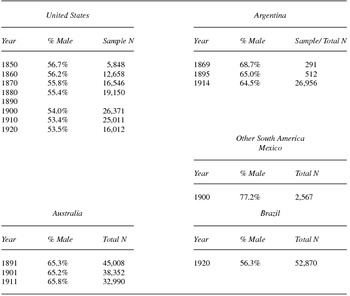
One characteristic that was systematically tallied in South American censuses, and is now available for the United States through the IPUMS samples, is a gender breakdown (table 6).
Sex ratios of the German-born census population

This data confirms and reinforces the findings from German emigration records. From the earliest censuses on, the United States stands out for the relatively balanced sex ratio among its immigrants, whereas the more exotic the destination, the greater the male preponderance. As can be seen from the table, even in 1850 the proportion of males among US Germans was less than 57 percent, and it steadily declined to less than 54 percent in 1910, with just a negligible uptick by 1920. Even Brazil, the South American country with the largest German immigration and the most “normal” population profile, showed a greater male surplus in 1920 than the United States as early as 1860.Footnote 23 This was all the truer of Argentina, whose Germans were more than two-thirds male in 1869 and still more than 64 percent male as late as 1914.
Similarly, Germans in Australia were nearly two-thirds male as late as 1911. The tiny German population of Mexico, numbering barely 2,500 in 1900, was even more skewed, with males comprising more than three-fourths of the total. It bears further investigation just what lay behind the female preference for the United States, whether better access to information; better established and more secure travel routes; or a market for, and social acceptability of, domestic service also for white women. But in any case, the US immigration stands out, and appears more pronounced in census figures than was apparent from emigration or immigration data because men had a higher propensity for temporary, return, and repeat migration than women, and return migration was higher from other destinations than from the United States.
Religious Selectivity among Argentine and Australian Immigrants
The factor of religious confession, while not totally irrelevant, proves to be of little importance in affecting the destination of Germans. Although there is little evidence of Catholic Germans favoring Latin America, there is stronger evidence for German Protestants favoring Australia (or perhaps for Australia favoring Protestants among the German immigrants they recruited and sometimes subsidized because both came into play in much of early migration to Australia).Footnote 24 Of German arrivals to Argentina during the two decades after 1876, only a 44 percent minority were Catholic. By contrast, 72 percent of the Belgians, 76 percent of the Austrians, a surprising 85 percent of the Swiss, 97 percent of the French, and reportedly all the Italians and Spaniards were Catholic; the English were the only recorded group with a lower Catholic proportion than Germans. The 1895 census sample even shows Germans surpassing the British at 80 percent Protestant, though caution is warranted given the small sample and a missing data quota above one-third.
Of some 32,000 Germans in Australia in 1911, including 30,000 classified as Christian, more than half of the latter claimed the transplanted denomination of Lutheran, along with 11,000 with various other Protestant affiliations, but not even 3,900 were Catholics (and fewer than 550 “Hebrews”). So only one-eighth of Australian Germans were Catholic, confirming indications from the German side (Census of the Commonwealth of Australia 1914, 2.2: 242–43).Footnote 25 In North America, the multitude of German-language parishes among both Catholics and various Protestant denominations offers ample evidence against religious selectivity (Religious Bodies, 1906, Part I: 110–21). No official figures are available from the United States, but the best evidence suggests that between three-fifths and two-thirds of the Germans there were Protestant (Conzen Reference Conzen, Helbich and Kamphoefner2004: 77–78). So, German Catholics were only slightly more inclined to choose Argentina than their Protestant or Jewish compatriots, and Germans in Australia show a much greater preponderance of Protestants than their US counterparts, though it may have been the recruiters rather than the recruited who made that choice.
Metropolitan Concentration
Despite their reputation as capable farmers, Germans throughout the nineteenth century were overrepresented in US cities and underrepresented on the farms. One might expect this to be even more the case with Germans in Latin America. But at least with respect to the concentration in the largest metropolis—New York City and the capital cities of Brazil and Argentina—the similarities outweighed the differences. Germans were even somewhat more concentrated in New York than they were in the Brazilian and Argentine capitals, but in all cases the indexes of representation lay somewhere around 200. One country that did show a stark contrast was Mexico, where the small German contingent showed an index of 700 (i.e., a sevenfold overrepresentation) in Mexico City. So, in urban concentration, and in segregation levels generally, Germans in most states of North and South America show more similarities than differences. Australia does stand apart in this respect. Although Germans were slightly overrepresented in Adelaide and its suburbs, the city where they were most concentrated (index = 110, where parity = 100), nationwide they made up only three-fourths of their quota in the six leading metropolitan areas (index = 76), and not even two-thirds of their quota (index = 64) in the biggest city of Sidney (Census of the Commonwealth of Australia 1914, 2.2: 115–19; 297–98). Although considerable numbers of these Germans no doubt became farmers, most of the mining in Australia also took place outside the major metropolitan areas.
Occupation upon Arrival in Argentina
For Argentina, we have an occupational breakdown of immigrants arriving during the last quarter of the nineteenth century for Germans and other leading nationalities. Because there is no similar US information available from published sources, this data was simply percentaged and converted to indexes of representation showing how Germans stood apart from the Argentine immigrant stream overall (table 7).
Occupational concentrations of German and total immigration to Argentina, 1876–97

The bulk of immigration was agricultural, more than 70 percent if one combines the categories of agriculturists and colonists, the latter presumably bound for organized agricultural colonies. Germans showed similar tendencies, but to a lesser extent. Although overrepresented among colonists (and gardeners), they were underrepresented among the much larger group of agriculturalists so that their combined index in the primary sector comes to 92. Germans reached only three-fifths of their quota in the more arduous occupations of day laborers and masons. While slightly above quota among artisans (presumably skilled) and the small group of “artists,” and with twice their share of “other” and presumably more specialized occupations, Germans particularly stood out among the merchant class, with an index of 262. While we cannot compare these figures to arrivals in the United States, we can at least say that Germans contrasted positively with other immigrants to Argentina in their occupational profile.
US and Argentine Census Occupations
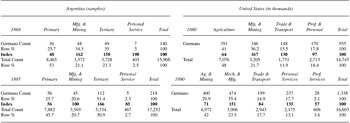
Because immigrants did not always continue with the occupations they registered upon arrival, it may prove revealing to examine occupational niches in the census population. Published Latin American censuses usually provide a rather detailed occupational breakdown, but they distinguish only between natives and immigrants, and not between the various nationalities among them. Fortunately for Argentina, there are nationwide manuscript census samples for 1869 and 1895, and for the United States there is roughly comparable published data from 1880 and 1890 (table 8).
Occupational sector concentrations of Germans in Argentina and the United States

The Argentine samples included only a couple of hundred Germans and must be used with caution, but they are at least large enough to reveal sectorial concentrations. The US Census offers similar categories, if not entirely consistent, in relation to the entire universe of males in the 1880 labor force, and to white males in 1890. Despite these limitations, some trends are clear from the indexes of representation, the boldfaced lines in table 8. Germans were underrepresented in agriculture in both societies, but more so in Argentina, where they hardly exceeded half of “parity,” as compared to two-thirds or more in the United States. The category of personal and domestic service is too small in Argentina to warrant attention, and is further obscured by lumping domestics together with professionals in the 1880 US data. Both absolute and relative, the heaviest concentration of Germans in Argentina is in the tertiary sector, probably above all in the commercial branch. While Germans in the United States also made a respectable showing in “trade and transport,” even registering slightly above parity in 1880, by 1890 their heaviest representation both absolute and relative was in the “mechanical and manufacturing” sector, which also encompassed artisanship (but in contrast to 1880 excluded mining). Thus, the occupational concentrations in the New World reflect to a considerable extent the contrasts observed among those departing for these destinations. In other words, the typical German in the United States was a skilled artisan, whereas by 1895 half the Germans in Argentina were employed in the tertiary, and above all the commercial, sector.
The Argentine census of 1895 provides two other variables, real estate ownership and nine different occupational ranks, that shed additional light on the German niche in the occupational hierarchy. In absolute terms, more than one-third of the Germans were counted among the “middling self-employed”; in relative terms, they were overrepresented by 50 percent in this category. It included both independent artisans and retail merchants, but given the patterns observed in the preceding text, one suspects that many of these Germans were in the commercial class. Other indicators of socioeconomic position prove contradictory. Despite having the lowest mean age, adult male Germans ranked slightly above the Argentine national average, and also surpassed other major immigrant groups, in terms of their occupational ranks position on the census nine-point scale in both 1869 and 1895.Footnote 26 However, with respect to real estate (bien raíz), only 18 percent of adult male Germans were registered as owners in 1895, barely three-fourths of the national average (index = 76), and also ranking below Italians and French, though above some other foreign nationalities. Despite a less favorable occupational profile, adult German males in the 1870 US Census fared much better, with 41 percent owning real estate, only one point below the national average, although with a mean age of 49, these Germans fell 10 years above the US average, and were 11 years older than the average German in Argentina. One explanation is that many Germans never intended to stay permanently in Argentina; their return rates in this era were twice as high as for Germans in the United States (Kamphoefner Reference Kamphoefner2000: 210).
Literacy and Numeracy as Measures of Social Capital
The US and Argentine censuses also provide measures of illiteracy, showing a slight advantage for Germans in the former. Only 4 percent of adult male Germans were reported as illiterate in the 1870 US Census, while their compatriots in Argentina come in at 5 percent in 1895, with 8 percent reporting illiteracy in 1869. However, the literacy variable is among the least reliable of US Census variables, and we have no indication of the educational level of those who were literate, which would appear from occupational profiles to favor those headed south. However, the published Argentine census does give a breakdown on individual immigrant groups by sex and yearly ages, something that can also be obtained from US censuses from the IPUMS samples (IPUMS USA). This allows us to compare the amount of age heaping in the two ethnic populations, thus providing a rough estimate of their degree of numeracy (and presumably literacy).Footnote 27
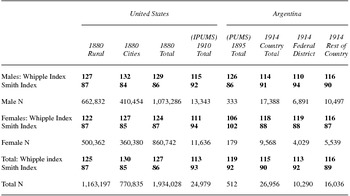
Before discussing the results in table 9, let us briefly consider the methodology. In a census population recording true ages, there should be a uniform distribution of the population over the 10 possible final digits, each with roughly 10 percent of the total. However, as anyone who has worked with historical census populations knows, a much higher than average proportion reported their ages in multiples of 10 or 5, and to a lesser extent in even rather than odd numbers. Demographers have devised several indexes to measure the degree of age heaping. The Whipple Index is based on the proportion of all reported ages with the final digits of 0 and 5, assuming they should constitute 20 percent of the total. However, it ignores the tendency in Western cultures to favor even over odd digits, which the Smith Index captures by measuring the proportion of final digits reported as odd numbers other than five, assuming they should constitute 40 percent of the total. In both measures, 100 equals parity, but with opposite polarity: the higher the Whipple Index, and the lower the Smith Index, the greater the degree of age heaping (Smith Reference Smith1960: 155–59; Spoorenberg and Dutreuilh Reference Spoorenberg and Dutreuilh2007: 729–41).Footnote 28
Index of age heaping among Germans in the United States and Argentina

In an immigrant population, these indexes may also reflect to some extent the degree of acculturation and facility in communicating with census takers. Given their relative numbers, census takers were more likely to be fellow Germans in the United States than elsewhere. Given that English is a Germanic language in its basic elements, and its cardinal numbers are more nearly cognate to the German than the Spanish, one can assume that lower age heaping in Latin countries was a sure sign of better qualified immigrants. Over the course of time, age heaping could be expected to go down as education levels back home went up, and German immigration gradually waned, so that the average German in the census had a longer tenure and thus greater opportunities for linguistic assimilation. This would apply less to South America, which attracted increasing proportions of German immigrants after 1890 compared to earlier decades.
The results in table 9 generally confirm these time trends for US immigrants, with age heaping decreasing somewhat between 1880 and 1910.Footnote 29 Overall, the patterns of age heaping are similar for Germans in Argentina and the United States. The two indexes vary slightly, but based on the Whipple Index, German males in Argentina come off better than those in the United States in both the earlier and later time periods, while the Smith Index shows them virtually tied. With this data one can also look at internal variation. Surprisingly in view of their relative educational opportunities, German women in the United States come off better than men; in Argentina (except for 1895 when the N is very small), it is the other way around. One can also examine urban and rural contrasts, or in the case of Argentina, the Federal District around Buenos Aires versus the rest of the country. As expected, the urban population comes off better in Argentina, especially with males, whereas in the United States the rural population surprisingly shows less age heaping than the residents of cities with 25,000 or more inhabitants. This probably reflects a concentration of Germans in artisan and industrial jobs in US cities, whereas their compatriots in Argentina were more prominent in commercial and professional occupations. The patterns of age heaping thus provide further confirmation that the positive selectivity of immigration to Argentina was somewhat greater than that to the United States, especially when one considers that language differences and length of residence probably worked against Germans who went south.
Conclusions
What remains of the various explanations of emigrant destinations proposed at the outset of this article, and how distinctive were the German niches north and south? The United States was obviously not the default option for German emigrants at all times and places; there were locales and time periods where a majority of those departing chose South American or Australian destinations. Emigration did not necessarily follow commerce; often it was the other way around. There is only slight evidence to suggest that Catholic Germans were more attracted to Latin America than were Protestants, although Germans bound for Australia were disproportionately Protestant. But emigration to Australia may have depended as much on whom the Australians were willing to subsidize as on who wished to migrate there. While recruitment and propaganda played a somewhat greater role in immigration to South America than to the north, its effectiveness was limited to a relatively circumscribed set of conditions, and it had little influence once other migration traditions had been established in a locale. Moreover, it exerted a major impact on Latin American society only when the initial recruits were satisfied enough to draw other relatives and friends after them. Particularly to rural Brazil, there is ample evidence of chain migrations lasting for decades, and producing the same kinds of local and regional concentrations previously observed among various nationalities in the United States, especially in rural areas.
Simultaneous and subsequent to this chain migration, a more selective group of individuals was embarking on transoceanic journeys that blur the edges of international migration—on the borderline between extended business trips and temporary sojourns in foreign cities, particularly ports, for several years. This small group was as atypical of the cross-section of German emigrants as the chain migrants were typical. But they appear to have constituted a majority of German immigrants to Argentina, and probably the preponderance of those going to Mexico and other more exotic Latin American destinations. As one scholar writes, “like the Andean and Central American countries, Mexico represented a case of ‘qualitative’ rather than ‘quantitative’ immigration” (Buchenau Reference Buchenau2004: 16). The evidence presented here would appear to directly contradict the “human capital” model. The emigrants from the most developed areas of Germany preferred destinations in the less developed parts of the globe (though they probably concentrated in the leading cities of these underdeveloped areas).
The biggest question mark remains the largest German contingent in South America, that in Brazil.Footnote 30 Their sex ratio fell between that in North America and that in more exotic Latin destinations; their occupational selectivity was also less pronounced than for the rest of the Southern Hemisphere. But without recourse to nationwide data or manuscript census samples, it will prove difficult to systematically compare the German economic niche in Brazil with that in other countries of South or North Americas.
Methodological Appendix
The two emigrant data sets from the Prussian RhinelandFootnote 31 and the Duchy of BraunschweigFootnote 32 were acquired in machine-readable form from German archives, but each was structured somewhat differently, and both required considerable cleaning up, recoding, and restructuring before they could be used for the purposes of this investigation. The main difference in the two is that the Rhineland data defines its cases as individuals, though it fails to note whether they are emigrating alone or in family groups, whereas the Braunschweig file defines its data cases as administrative cases and includes systematic information only on the prime registrant, who may or may not be accompanied by other family members. Age, sex, and occupation data are thus available only for the registrant, but usually not for accompanying persons (if there are any).
Neither of the data sets included sex as a variable; instead this had to be assigned based on first names, which are very gender specific in the German language, as are occupational designations (the equivalent of waiter or waitress in English). For the Braunschweig data, occupational names were used to classify everyone with occupations, while those without were classified manually. With the Braunschweig data, only the gender of the registrant or head of family was coded, though it was also noted whether he or she was emigrating alone or as a head of family. Thus, it is not possible to obtain an overall gender breakdown of the emigration.
Detailed destinations were recorded in only about one-fifth of the Rhineland cases and even fewer of the Braunschweig ones (only 1,102 cases included US destinations as specific as a state, while 8,097 simply gave America and 478 North America; a mere 11 specified Canada), but continent of destination was almost always given.
One problem with both data sets was that many individuals were duplicated because they encompassed documents from two or more levels of administration. Similar strategies were used in both cases to eliminate them without throwing away useful information. First, data were sorted alphabetically; then lagged variables were used to compare successive cases and construct indexes of how many characteristics were identical. Then two sets of criteria were used to define repeaters, one more stringent and the other more lenient. Then cases that came up as duplicates by one standard but not by the other were examined and classified manually. While the Rhineland data contained only doubles and a handful of triples (which were all weighted at 0.5 in the analysis), in the Braunschweig data some individuals appeared as often as eight times, some with slightly different information. Sometimes, too, it was hard to tell if a person emigrated twice, or if it simply took an extra year or two to carry out the intention. Occasionally, return migration was noted in the comments, but where no other information was included, it was assumed that dates more than two years apart represented return migration and were treated as two separate cases. Once duplicates had been identified, all cases involving the same individual were given a unique identification number. Then the SPSS Aggregate procedure was used to consolidate the cases, recording the maximum and minimum values for age, destination codes, occupational code, and so forth. In the great majority of instances these proved to be identical.
No emigration register is 100 percent complete, but apparently officials both in Braunschweig and in the Rhineland attempted to register clandestine emigrants as well as those who left with official permission. The same is true of Hessian emigrants studied by Wegge (Reference Wegge2002). The Braunschweig lists sometimes include comments such as “clandestinely emigrated,” “without permission,” and the like. There were approximately 180 such cases among the 2,350 for which comments are recorded, nearly 8 percent, or a scant 2 percent of the total cases including those without comments. No such comments are included in the Rhineland data set, but evidence from the neighboring province of Westphalia show that Prussian officials made a vigorous attempt to record clandestine as well as officially sanctioned emigrants. For the years 1882 through 1884, there were 8,077 emigrants with official permission and 9,508 without from the Prussian Rhine Province (also including the Koblenz and Trier districts absent from this data set). This comprises 88 percent of all Rhineland emigrants recorded in ports of departure, a much higher proportion than with eastern provinces of Prussia, and thus less of a source of distortion. (Zeitschrift des Preussischen Statistischen Bureaus 1885: 165–68). But given the incomplete character of such enumerations, individual-level and aggregate data from countries of destination provide an additional check by encompassing all migrants including the unauthorized (minus any return migration that may have ensued in the interim).