Introduction
The recession that began in 2008 is the sixth major recession in the United Kingdom since 1920.Footnote 1 It presents a double challenge to the delivery of legal aid. Increased unemployment, the most evident social consequence of recession, extends eligibility for legal aid. Unemployment is also associated with increased vulnerability to problems involving people's legal rights (e.g. Pleasence, Reference Pleasence2006), which feeds demand for legal aid services.
It is unclear how prolonged or deep the recession, which began in 2008, will be. Nevertheless, it has already had profound consequences. In the three months to June 2009, 277,000 redundancies were reported; a 118 per cent increase on the same period for the preceding year (Office for National Statistics, 2009), though down slightly from the previous quarter (Office for National Statistics, 2009). This equates to more than 1 per cent of all employees being made redundant. During the three months to June 2009, the unemployment rate rose to 7.8 per cent, up 0.7 per cent from the previous quarter and 2.4 per cent from a year earlier (Office for National Statistics, 2009).Footnote 2 The European Commission forecasts that the UK unemployment rate will rise to 9.4 per cent in 2010 (Directorate-General for Economic and Financial Affairs, 2009).Footnote 3 This equates to around 500,000 additional people being unemployed. With the UK unemployment benefit claimant rate rising along with unemployment (from 709,000 to 1,582,700 between July 2008 and July 2009), the number of people eligible for legal aid is set to increase substantially.Footnote 4
It has been found previously that unemployment is associated with a higher likelihood of experiencing rights-related problems (Pleasence, Reference Pleasence2006). For example, 55 per cent of unemployed respondents to the 2004 English and Welsh Civil and Social Justice Survey reported one or more rights problems, compared to ‘39 per cent of the remainder of respondents of working age’ (p. 21). In particular, unemployment was found to be associated with problems concerning employment, welfare benefits, money, housing, neighbours and domestic violence. It might be expected, therefore, that the prevalence and incidence of such problems will escalate during recession.
Importantly, though, unemployment and becoming unemployed are different. Unemployment describes a state of affairs, while becoming unemployed is a life event. Becoming unemployed has immediate consequences. It is likely to bring about a negative change in income, which may then lead to debt problems (Genn, Reference Genn1999; Kempson, Reference Kempson2002; Edwards, Reference Edwards2003; Moorhead et al., Reference Moorhead and Robinson2006; Pleasence et al., Reference Pleasence, Balmer, Buck, Smith, Patel, Pleasence, Buck and Balmer2007; Turley and White, Reference Turley and White2007). Thus, as Edwards (Reference Edwards2003) has reported, the last major UK recession brought about ‘the last significant increase in CAB debt enquiries’ (p. 8). When debt problems manifest in rent or mortgage arrears, people's homes become threatened. Ultimately, this may result in homelessness (e.g. Rossi, Reference Rossi1989; O'Flaherty and Wu, Reference O'Flaherty and Wu2006). Becoming unemployed may also lead to a change of status in relation to welfare benefits.
Income reduction or job loss may also bring about rights-related problems that are not monetary in nature. As Becker et al. (Reference Becker, Landes and Michael1977) argued influentially, in the context of marital stability, ‘couples separate when the utility expected from remaining married falls below the utility expected from divorcing and possibly remarrying’ (p. 1142). Consequently, an individual's optimal economic strategy would ‘include divorce contingent on the realization of unfavourable outcomes’ (p. 1143). Such outcomes include, as Becker et al. and others (e.g. Boheim and Ermisch, Reference Boheim and Ermisch2001) have found, a partner's income unexpectedly decreasing. However, Charles and Stevens’ (Reference Charles and Stevens2004) study of US panel survey data has suggested that there is some subtlety to the association between job loss and partnership stability. They found, for example, that the divorce hazard did not increase following plant closure, but only in relation to smaller-scale lay-offs. They suggested that ‘a spouse may more reasonably draw a negative inference about a partner's discipline and temperament (factors that affect both the person's ability to keep a job and their fitness as a mate in purely noneconomic terms) from the fact that he was personally fired than from the fact that his plant ceased operating’ (p. 519). Thus, the overall effect of recession-related job loss on partnership stability may not be so great as Becker et al.'s (Reference Becker, Landes and Michael1977) original economic model would suggest.
Reflecting the above, a recent Ministry of Justice (2009: 6) study has suggested that the recession has already ‘clearly increase[ed] demand for legal advice . . . particularly . . . in the social welfare categories of law (debt, housing and welfare benefits) and some family law areas’. In keeping with this, the Citizens Advice Bureau has reported a substantial increase in demand for advice on redundancy, debt problems, rent arrears and welfare benefits between April 2008 and March 2009,Footnote 5 and the Legal Services Commission has reported a considerable increase in legal aid ‘matter starts’ relating to housing, debt, benefits, employment and family for the financial year to April 2009 (Legal Services Commission, 2009).
Of course, any increase in demand for legal aid services comes at a time of considerable pressure on public spending and on legal aid budgets. In consequence, while an additional £13 million was allocated to the Legal Services Commission in November 2008, for the provision of an additional 50,000 cases of debt help and 20,000 cases of housing help stemming from the recession, the recession will present a major challenge to the effective delivery of legal aid services over the coming years.
The current study
In this study, we examine the relationship between unemployment and the experience of rights problems. In particular, and for the first time, we investigate both the state of unemployment and job loss. We hypothesise that (i) unemployment is associated with increased prevalence and incidence of rights problems; (ii) job loss is associated with higher prevalence of rights problems – particularly money, welfare benefits, housing and family-related problems – than unemployment. We also suggest the scale of impact of future job losses stemming from the current recession on the prevalence and incidence of rights problems and demand for legal aid services.
Methods
Sources of data
Data in the present study come from the English and Welsh Civil and Social Justice Survey (CSJS). The CSJS, a nationally representative survey of the adult population of England and Wales, provides detailed information on the nature, pattern and impact of people's experience of rights problems and the use and success of problem resolution strategies (Pleasence, Reference Pleasence2006).
The CSJS is a substantially developed form of Genn's (Reference Genn1999) landmark Paths to Justice survey. Both surveys, though, have their origins in a tradition of ‘legal need’ surveys dating back, coincidentally, to the United States’ recession of the 1930s (Clark and Corstvet, Reference Clark and Corstvet1938), details of which are set out in Pleasence et al. (Reference Pleasence, Buck, Goriely, Taylor, Perkins and Quirk2001: 7–27).
The CSJS sample was drawn by randomly selecting residential addresses from 504 postcode sectors, spread throughout England and Wales. In total, 10,537 adult respondents (aged 18 years or older), living in 6,234 households, were interviewed face-to-face in their own homes between January 2006 and January 2009. The household response rate was 78 per cent (83 per cent where successful contact was made with an adult occupant), and the cumulative eligible adult response rate was 58 per cent. The response rate compares with other large-scale social surveys, such as the Expenditure and Food Survey (53 per cent in 2007 – Department for Environment, Food and Rural Affairs, 2008) and Family Resources Survey (60 per cent in 2006/7 – Daniel, Reference Daniel2007). All interviews were arranged and conducted by BMRB Social Research. The mean interview duration was 25 minutes, though interviews could be considerably longer if rights problems were identified.
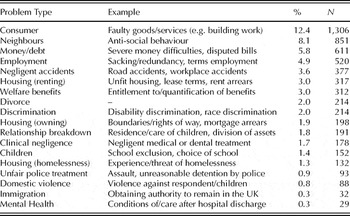
All respondents were asked if they had experienced a problem, in the three years to the date of interview, that had been ‘difficult to solve’ in each of 18 distinct problem categories. For the two most recent problems identified in each category, respondents were asked (if necessary) to indicate the nature of the problemsFootnote 6 and specify whether, and from where, they had sought advice about them. The interview was carefully constructed to limit the problems reported to those to which legal principles can be applied. Problem categories are listed in Table 1, along with examples of the 106 constituent problem types and the proportion of respondents reporting having experienced one or more problems in each category. As can be seen, in the case of employment problems, respondents were asked specifically about sacking and redundancy.
Percentage and number of CSJS respondents reporting one or more problems of each category and examples of constituent problem types

All respondents were also asked for a range of details about themselves and the household in which they resided. These included employment status, along with changes in employment status over the survey reference period.
Seventy-four per cent of CSJS respondents of working age were in employment, compared to the UK Labour Force Survey estimate, for 2007, of 75 per cent.Footnote 7 The unemployment rate within the sample was 4.1 per cent, compared to the 2007 UK Labour Force Survey estimate of 5.4 per cent.Footnote 8 The unemployment claimant rate was 1.5 per cent, compared to the equivalent (mean) Office for National Statistics estimate, for 2006 to 2008, of 2.1 per cent.Footnote 9
Analysis
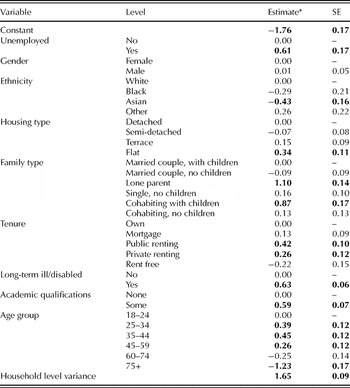
First, we employed regression analysis to test the influence of unemployment and a range of further social and demographic predictors upon the likelihood of respondents having experienced a rights problem.Footnote 10 The unemployment variable, derived from employment status data within the CSJS, identified respondents who were looking for paid work or a government training scheme, or waiting to take up paid work they had already obtained at the time of interview. The full set of predictors used are set out in Table 2.
Multilevel binary logistic regression model examining likelihood of reporting a rights problem on the basis of a range of social and demographic predictor variables

Notes: * Statistically significant terms (p < 0.05) highlighted in bold.
Second, we used the same form of analysis to test the influence of (i) unemployment (as defined above), (ii) becoming unemployed (defined as occurring when respondents moved from ‘in paid employment or self-employed (or temporarily away)’ to ‘looking for paid work or a Government training scheme’ during the survey reference period) and (iii) reporting a problem concerning sacking/redundancy upon the likelihood of respondents having experienced a non-employment-related rights problem.
Third, we compared the overall prevalence and incidence of non-employment-related problems (in general and by problem category) for respondents who were unemployed, became unemployed and reported a problem concerning sacking/redundancy.
Fourth, we briefly examined patterns of advice seeking for employment problems, problems concerning sacking/redundancy and other rights problems.
Finally, using findings on rights problem prevalence from the CSJS (for both those reporting sacking/redundancy problems and those who became unemployed during the survey reference period), we illustrate the impact that increased job losses are likely to have on the overall prevalence of rights problems and demand for legal services.
Results
Unemployment and the experience of rights problems
Table 2 sets out findings from our first regression analysis. It details the likelihood of reporting one or more rights problems, on the basis of a range of respondents’ social and demographic characteristics, including unemployment. As can be seen, a broad range of characteristics had a significant impact upon the likelihood of respondents reporting problems. Housing density, tenure type, ethnicity, academic attainment, health status and family status were all found to be significant predictors of problems. Problems became most common for respondents aged between 25 and 44. These results are in line with earlier findings and reflect, in large part, ‘the frequency of experience of the “defining circumstances” from which [rights problems] can arise’ associated with different groups within the general population and different ‘stages of life’ (Pleasence, Reference Pleasence2006: 26). Though, inevitably, they will also reflect differences in ‘understanding, perception and attitude towards what constitutes a problem that is “difficult to solve”‘ (Pleasence, Reference Pleasence2006: 22; Genn and Paterson, Reference Genn and Paterson2001).
Importantly, unemployment at the time of interview was also found to increase significantly the likelihood of reporting rights problems.Footnote 11 Based on simulation from the model in Table 2,Footnote 12 it could be calculated that whereas a mean of 46 per cent of respondents who were (say) single, white, male, childless, living in privately rented terraced housing, aged between 25 and 34, and who had no illness or disability, some academic qualifications and were not unemployed could be expected to report rights problems,Footnote 13 the figure would rise to 58 per cent if such a person were unemployed.Footnote 14
In simple percentage terms (i.e. using raw data rather than the model), 48.1 per cent of unemployed respondents reported a rights problem, compared to 35.3 per cent of other respondents.
Unemployment, becoming unemployed and being sacked or made redundant
One hundred and thirty nine CSJS respondents reported ‘difficult to solve’ rights problems concerning being sacked or made redundant. By definition, this group all reported employment problems, so the majority of the results set out below are restricted to ‘non-employment problems’.
When the analysis behind Table 2 was restricted to non-employment problems, being unemployed at the time of interview remained a significant predictor of rights problems.Footnote 15 However, when the unemployment status variable was replaced by, first, a variable indicating whether respondents became unemployed during the survey reference period and, then, a variable indicating whether respondents reported a problem concerning sacking/redundancy, the effect of job loss was found to be even greater.Footnote 16
As would be expected in light of the models detailed above, 42.8 per cent of unemployed respondents reported one or more non-employment-related rights problem, compared to 33.6 per cent of other respondents. However, an even greater disparity was observed in the case of those who reported becoming unemployed or a problem concerning sacking/redundancy. Thus, 49.8 per cent of those who became unemployed during the survey reference period reported at least one non-employment-related rights problem, compared to 33.4 per cent of other respondents. The figures were 62.3 per cent and 33.5 per cent in the case of those reporting a sacking/redundancy problem.
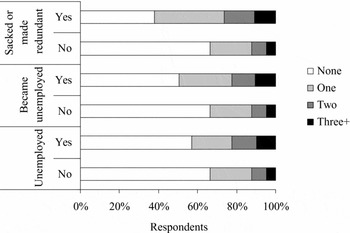
Figure 1 shows the number of non-employment-related problems split by whether or not respondents were unemployed at the time of interview, became unemployed during the survey reference period and reported a problem concerning sacking/redundancy. The figure confirms that respondents who had a problem concerning sacking/redundancy more often reported problems and, also, multiple problems, than others.
Number of problems (excluding employment problems) by whether or not respondents were unemployed, whether they became unemployed and whether or not they reported a problem concerning being sacked/made redundant.

Including all problems, 64.4 per cent of those who reported a problem associated with being sacked or made redundant had multiple problems. This compares to 55.8 per cent for those who became unemployed and had one or more problem, 58.8 per cent for those who were unemployed at the time of interview and had one or more problem and just 37.7 per cent for other respondents with one or more problem.
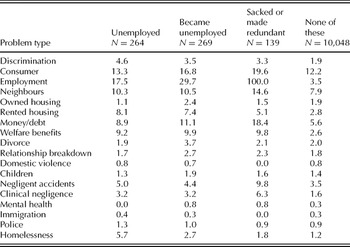
Table 3 shows the prevalence of problems for each of the 18 problem categories included in the CSJS. Separate rates are shown for those who were unemployed at the time of interview, became unemployed during the survey reference period, reported a sacking/redundancy problem and who fell into none of these groups. As is evident, those respondents who were unemployed, became unemployed during the survey reference period or reported a sacking/redundancy problem reported high levels of social welfare problems, such as those concerning welfare benefits, money/debt, anti-social neighbours, housing and homelessness. But there were some notable differences in the pattern of problems reported. Those who became unemployed or reported sacking/redundancy problems reported money/debt problems more often than those who were simply unemployed at the time of interview.Footnote 17 They also reported problems concerning owned housing more often, and homelessness less often, than those who were simply unemployed. Moreover, those who became unemployed reported divorce and problems ancillary to relationship breakdown more often than those who were simply unemployed. Finally, those who reported sacking/redundancy problems also reported particularly high levels of negligent accidents and clinical negligence.
Percentage reporting each problem types: reported for unemployed respondents, those who became unemployed, those with a problem with being sacked/made redundant and all other respondents

Problem-solving strategy
As has been observed consistently elsewhere (Pleasence, Reference Pleasence2006), problem-solving strategy varies considerably by type of rights problem. Employment problems, and particularly those concerning being sacked or made redundant, were characterised by a particularly high percentage seeking advice compared to rights problems in general. For employment problems overall, 62.1 per cent obtained advice, with 69.9 per cent for problems concerning being sacked or made redundant. For all non-employment problems, 48.1 per cent obtained advice. There was also evidence that respondents with problems concerning being sacked or made redundant also sought advice from a greater number of advisers. For problems with being sacked/made redundant, advice was most commonly sought from trade unions/professional bodies (29.2 per cent of problems), solicitors (28.5 per cent of problems) and Citizens Advice Bureaux (27.0 per cent of problems). As shown above, those with problems concerning being sacked or made redundant also reported a significant number of non-employment-related problems, though there was no evidence of elevated levels of advice seeking for these problems (45.5 per cent).
Impact of unemployment and rights problems concerning sacking/redundancy
Across the three-year survey reference period, respondents who reported sacking/ redundancy problems reported a mean 1.1 employment problems and 2.2 problems in total, compared to 0.04 and 0.6 problems, respectively, for others. Respondents who became unemployed during the survey reference period reported a mean 0.3 employment problems and 1.3 problems in total, compared to 0.05 and 0.6 problems, respectively, for others.
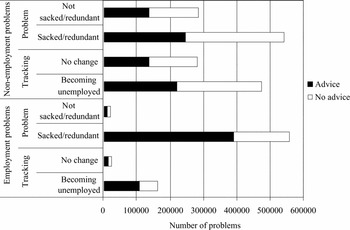
Figure 2 shows the number of employment problems and non-employment problems that would be expected for 500,000 persons coming to experience a rights problem concerning sacking/redundancy or becoming unemployed. Figure 2 also shows the number of problems that would lead to advice, on the basis of currently observed advice-seeking behaviour (taking into account variations in advice seeking for each population group, and the high rates of advice seeking for employment problems (and particularly problems concerning sacking/redundancy).
Number of employment and non-employment rights problems (and number of acts of advice) expected for 500,000 respondents, split by whether or not they have a problem concerning being sacked/made redundant and whether or not they become unemployed.

In all, over a three-year period, 500,000 people experiencing problems concerning sacking/redundancy could be expected to experience around 1,100,000 rights problems in total, with 610,000 leading to obtaining advice. Five hundred thousand people becoming unemployed could be expected to experience around 630,000 rights problems, with 320,000 leading to obtaining advice. In contrast, 500,000 respondents not experiencing a problem concerning sacking/redundancy or not becoming unemployed would probably experience only around 300,000 problems, with 150,000 leading to obtaining advice.
Thus, each 500,000 people who experience sacking/redundancy problems might be expected to experience an additional 800,000 problems over a three-year period, compared to people who do not experience sacking/redundancy problems. For each 500,000 people becoming unemployed the figure would be around 310,000 problems. In terms of additional problems for which advice might be expected to be sought, the figures would be around 400,000 and 150,000 respectively.
Discussion
In line with our hypotheses, our findings confirm that unemployment is associated with increased prevalence of rights problems. They also indicate that job loss (measured by both change in employment status and reports of sacking/redundancy problems) is associated with greater prevalence and incidence of rights problems than unemployment. Our findings indicate that job loss is associated with higher prevalence of some social welfare-related problem types than unemployment, but the picture is mixed at individual problem level. Reflecting changed circumstances, those who lost jobs reported money/debt problems more often than those who were simply unemployed at the time of interview. Reflecting differences in their demographic profile, they also reported problems concerning owned housing more often, and homelessness and problems concerning rented housing less often, than those who were simply unemployed. Away from social welfare-related problems, and again in line with our hypotheses, our findings indicate that job loss is associated with higher prevalence of divorce and problems ancillary to relationship breakdown than unemployment. Lastly, our findings also indicate that sacking/redundancy problems are associated with higher levels of negligent accidents and clinical negligence, suggesting that illness, injuries and/or disability may contribute to the risk of problematic sacking or redundancy.
A major implication of our findings is that the current recession will lead, through escalating job losses, to a substantial increase in the prevalence and incidence of rights problems, in demand for related legal services and, as social welfare and family-related rights problems are central to increased problem prevalence and incidence, in demand for legal aid services. This increased demand can also be expected to continue for some time after the economy starts to improve.
Just under 90 per cent of the 31,368,000 economically active persons in the United Kingdom (April to June 2009 (ONS, 2009)) live in England and Wales. On the basis of the additional 1.6 per cent increase in unemployment forecast by the European Commission for 2010 (Directorate-General for Economic and Financial Affairs, 2009), it can be estimated that there will be a further net increase of around 500,000 unemployed persons in England and Wales in 2010, many of whom will have faced redundancy. Some others will also face redundancy. Between April and June 2009 over 275,000 redundancies were reported, a higher figure than the 220,000 net increase in unemployed persons recorded for the same period.
A rudimentary application of our findings to the figures in the previous paragraph suggests – if sacking/redundancy problems provide a measure – that the effect of redundancies and rising unemployment in the remainder of 2009 and 2010 could be an increase in incidence of up to a million rights problems over the next three years, or even more, as the CSJS is likely to under-report problem incidence (Pleasence et al., Reference Pleasence, Balmer, Buck and Sandefur2009). However, without an indication of such things as the proportion of redundancies that constitute problems that are ‘difficult to solve’, the effect of the economic climate on the association between job losses and rights problem prevalence or on people's perceptions of problems (e.g. whether problems are ‘difficult to solve’) an accurate estimate of the impact of the recession is not possible. The actual increase might be much lower.
In terms of demand for legal services, our findings indicate that around half of any additional rights problems brought about by the recession are likely to lead to advice being obtained. Not all this advice will be of a legal nature and not all will be provided by traditional legal service providers, such as solicitors, Law Centres and advice agencies. However, much of it will be, and the disproportionate increase in the incidence of social welfare law and family law problems is likely to disproportionately impact on the demand for legal aid services.
Of course, some of those who face recession fuelled problems, but do not go on to obtain advice, may actually require assistance in order to avoid the worst effects of their circumstances. This failure to obtain advice may be for a variety of reasons. People may not understand their position or options, or lack broader capacity to address their problems without formal assistance (Pleasence, Reference Pleasence2006; Public Legal Education and Support Task Force, 2007; Buck et al., Reference Buck, Pleasence and Balmer2008). People may also eschew advice due to ‘shame, a sense of insufficient power, fear, gratitude [or] frustrated resignation’ (Sandefur, Reference Sandefur, Pleasence, Buck and Balmer2007: 127). Thus, even in the face of escalating demand, if legal services are to benefit those people adversely affected by the recession who would not naturally think to access legal services, then those services need to reach out to them. This could involve placing services in locations such as workplaces that are closing (e.g. Gallagher et al., Reference Gallagher, Peoples and Crowe2003), in addition to more common awareness raising and outreach efforts (Buck, Reference Buck, Buck, Pleasence and Balmer2009).
Our findings also suggest that those people who lose jobs as part of the current recession and experience multiple rights problems may experience a pattern of problems different from that associated with unemployment.
Earlier studies have stressed the benefit of ‘a degree of coordinated management’ (Moorhead et al., Reference Moorhead and Robinson2006: 90) in the delivery of related legal services (e.g. Pleasence et al., Reference Pleasence, Balmer, Buck, O'Grady and Genn2004a; Pleasence, Reference Pleasence2006; Moorhead et al., Reference Moorhead and Robinson2006). For example, as well as the benefit of greater proactivity and timeliness in the identification of related problems by professionals, there is also the benefit of averting the ‘referral fatigue’ (Pleasence, Reference Pleasence2006: 119) that sees a greater likelihood of people giving up their search for advice each time they are directed from one adviser to another.
Government efforts to more effectively integrate legal services in areas of social welfare law are today focused on the development of Community Legal Advice centres (CLACs) and networks (CLANs). These are intended to provide either a ‘one-stop shop’ for those facing multiple social welfare law problems, or more effective co-ordination and referral between complementary social welfare law advisers (Legal Services Commission, 2006). However, while the CLAC model has been described as ‘the logical extension of the integrated services model’ (Ministry of Justice, 2009: 64), it is important that the development of integrated services continues to be informed by our emerging understanding of patterns of problem clustering, that the means employed to integrate services are determined with specific reference to local circumstances, and that, where CLACs or CLANs are implemented, concerns about, for example, the impact of current CLAC/CLAN funding and commissioning on wider and third sector funding and the development of local legal services markets (Ministry of Justice, 2009) continue to be reviewed.Footnote 18 It is also important that legal services continue to integrate with wider public services more generally. In the case of job loss, the reasons for this are readily apparent. For example, there is ample evidence that job loss is associated with ill health. While to some extent this can be attributed to an increased likelihood of those in ill health becoming unemployed, it is evident that becoming unemployed (and anticipating becoming unemployed) can also increase morbidity (e.g. Bartley, Reference Bartley1988, Reference Bartley1994, Reference Bartley2005). Rights problems have also been shown to be associated with ill health (Pleasence et al., Reference Pleasence, Balmer, Buck, O'Grady and Genn2004b; Pleasence et al., Reference Pleasence, Balmer and Buck2008; Pleasence and Balmer, Reference Pleasence and Balmer2009). In the United Kingdom, Citizens Advice Bureaux already provide outreach information or advice services in over 1,000 health settings (Citizens Advice, 2006). Indeed, in 2007/8, Citizens Advice Bureaux received £4.4 million funding from Primary Care Trusts (Ministry of Justice, 2009).
While the pressure on public spending and on legal aid budgets is unlikely to recede any time soon, it is clear from the above findings, and our earlier findings on the impact of rights problems and their role in processes of social exclusion (e.g. Buck et al., Reference Buck, Pleasence and Balmer2005; Pleasence et al., Reference Pleasence, Buck, Balmer and Williams2007), that legal aid, and legal services (both generalist and specialist) more generally, have a role to play in mitigating the negative consequences of the current recession. The legal aid scheme was born out of the upheaval brought about by the Second World War. It will be no less vital in the face of the current recession.