Civic engagement is ready for the dustbin. That judgment might surprise the scholars, journalists, educators, and community leaders for whom civic engagement has become a household word. Since Robert Putnam first popularized the term in his 1993 classic, Making Democracy Work, it has spread through the pages of newspapers, internet sites, academic books and journals, and mainstream political discourse.Footnote 1 Politicians praise it; foundations fund its study and implementation; educational institutions encourage their students to undertake it. Nongovernmental institutions (NGOs) promote its growth in developing democracies. But like other buzzwords, civic engagement means so many things to so many people that it clarifies almost nothing. Thus I come to bury civic engagement, not to praise it.
Scholars use “civic engagement” to describe activities ranging from bowling in leagues to watching political television shows, writing checks to political advocacy groups, and participating in political rallies and marches.Footnote 2 For many journalists, public officials, and political activists civic engagement can mean everything from charitable giving to associational membership, political participation, artistic expression, or community service.Footnote 3 Some maintain that civic engagement has declined in the United States and other liberal democracies over the past 40 years. Others disagree, contending that civic engagement has simply changed its shapes and forms.Footnote 4 We cannot easily judge these disputes because their advocates consistently talk past one another, using “civic engagement” to describe entirely different things. The conflicting parties do agree on one point: whatever civic engagement is, we need as much as we can get. But they are confused about its meaning and wrong about its value.
This essay advocates the end of civic engagement. Not the end of political participation, social connectedness, associational membership, voluntarism, community spirit, or cooperative and tolerant moral norms but rather the umbrella term, civic engagement, used to encompass all of those topics while clarifying none. Civic engagement as it is currently used includes political, social, and moral components, or the entire “kitchen sink” of public and private goods. It exemplifies Giovanni Sartori's concern about “conceptual stretching,” or “the distortion that occurs when a concept, applied to new cases, does not fit the new cases.”Footnote 5 The stakes go beyond mere semantics. Words frame our debates, shape our research agendas, and affect the ways in which we view the world. When our words yield “vague, amorphous conceptualizations” rather than widely accessible concepts—concepts that mean something similar for most people most of the time—we cannot easily study, operationalize or discuss the social and political phenomena that surround us.Footnote 6 Civic engagement thwarts easy study or discussion; it fares poorly on most of the criteria that John Gerring proposes for evaluating conceptual “goodness,” including coherence, depth, and field utility.Footnote 7 Sartori and Gerring provide all the rope needed to hang civic engagement, which began its short life as an overly-elastic concept and has only been stretched further over time. In conversations about “making democracy work”—the subject of Putnam's excellent landmark work and also this essay's overarching theme—civic engagement confuses more than it illuminates, and hence it must go.
Only half of the term merits early retirement. We should put civic to rest while coming to grips with engagement. “Civic” simply means that a subject pertains to citizenship or a city, so it can easily be subsumed under the rubric of “political” without any loss of conceptual clarity.Footnote 8 In fact, clarity prevails when we stop stretching “civic” to mean sociable, helpful, or trusting, as so often happens in civic engagement scholarship. But engagement possesses untapped potential, and part of my purpose is to tap it. Engagement is a uniquely appropriate term for discussing how to make democracy work, but only if we understand its full significance. At present we do not. Literally, engagement entails a combination of attention and energy (or activity), the two primary components of political governance or any intensely interactive relationship.Footnote 9 When we worry about declining engagement, which we have done at increasing rates over the past 15 years, we are actually worrying about the elusiveness of our attention and energy—and well we might.Footnote 10 Since the era of ancient Greece, democracies have struggled to maintain these same resources. Attention involves selectively focusing one's wits on subjects that generate special interest or demand redress; activity involves following through on the subjects attended to, investing energy in their maintenance or resolution.Footnote 11 Democracy's citizens must indeed be engaged, which is to say attentive and active. But attentive to what? Active in which ways? That vague rubric, “civic,” gives us little indication.
When sociologists laud “civic engagement” they commonly mean what I call social or moral engagement, people's attention and energies invested in social groups and networks or focused on moral reasoning and follow-through. When political theorists and political scientists laud “civic engagement” they often focus on what I call political engagement, people's attention to and activity in political issues and processes. These are issues and processes that necessitate interaction with the polity (the state) or any level of government. But democracy may actually flourish with only middling levels of political engagement if it is rich in social and moral engagement. That possibility goes against the belief, common among participatory democrats, that we need as much political attention and activity as we can get. But rather than disparage political engagement, we should recognize the costs as well as the benefits of promoting it and should remember that democracy requires a variety of dispositions, values and behaviors. We should be asking which kinds of engagement—political, social, or moral—make democracy work, and how they might be promoted. Civic engagement is dead; long live political, social, and moral engagement.Footnote 12
Some might doubt whether we can or should distinguish between political, social, and moral involvements. Not only can we, but Hannah Arendt is right in asserting that we ignore those distinctions at our peril. To Arendt, politics comprises the space of human freedom and “the social” must not infect its domain.Footnote 13 Arendt's “social” denotes a realm of human life marked by necessity that opposes freedom: bodily needs and desires, biological functions, love, pity, compassion, and ideologies or “race theories” based on biological essentialism.Footnote 14 Her category of the “social” thus includes economics, which must be barred from consideration in the free political realm. Politics, conversely, involves people coming together freely to strive greatly, act boldly, and—in the shining light generated by free individuals acting cooperatively—reveal their distinctiveness and find meaning in their lives. I demur from Arendt's idiosyncratic characterizations of the political and the social but I agree with her overarching point: politics loses all meaning if anything and everything can fall within its purview.
Arendt also stresses the vital importance of judgment and “thinking what we are doing,” traits and orientations that resemble what I call “moral engagement.”Footnote 15 In the absence of judgment—in the presence of “thoughtlessness” —people can condone or perform egregious actions, with Adolf Eichmann representing the thoughtless individual par excellence. Footnote 16 Thoughtless individuals still possess cognition, of course, which Arendt describes as mere “instrumental reason” divorced from courage, conviction, or moral sense. She implies that in an era of scientific breakthroughs and nuclear capabilities, unless citizens and officials muster the moral resolution to “think what we are doing”—unless we pay attention to, and act in accordance with, legitimate moral principles—we may end the world with a bang, not a whimper.Footnote 17
Alexis de Tocqueville, an earlier student of democratic polities, also distinguishes social and moral from political involvements, but with a more traditional understanding of “the political.” Tocqueville defines political associations as groups “by which men seek to defend themselves against the despotic action of the majority or the encroachments of … power.” He distinguishes these from social groups or “civil associations,” groups in civil society “which have no political object.”Footnote 18 To put Tocqueville's insights in my terms, not all social engagement is political. Tocqueville further recognizes that neither political nor social or civil associations will always promote moral virtues such as generalized tolerance or mutual respect; in other words, not all political and social engagement involves meaningful moral engagement. Political associations can actually encourage moral disengagement because, as Tocqueville witnessed in France, “by the single act of uniting” citizens can make “a complete sacrifice of their judgment and free will,” which “greatly diminishes their moral strength.”Footnote 19
My purpose in distinguishing between political, social, and moral engagement is not to stake out an essentialist claim about the “nature” of this or that attentive activity. One trend in contemporary political theory has moved in the opposite direction, as scholars have challenged traditional boundaries between political and unpolitical in order to expand the former significantly. Feminist theorists such as Carol Pateman insist on “making the personal political” because traditional public/private distinctions have rendered certain issues, of great importance for social justice, ineligible for political intervention or reform.Footnote 20 Vaclav Havel suggests that apparently private decisions and actions can connect with and influence political outcomes.Footnote 21 I do not contest those claims. The personal or private can indeed be political, if and when citizens seek to express personal decisions or influence previously “private” issues through the polity's organs: political processes and institutions. Until then, their pursuits are either unpolitical or pre-political.Footnote 22 They might be of intense interest to political scientists and political theorists, but we should not conflate them with attentive activity that directly engages political processes and institutions if we care about establishing a coherent, far-reaching dialogue across academic disciplines.
I propose such distinctions to help us think and talk more clearly about “making democracy work.” Conceptual clarity and agreement affect our ability to diagnose problems and prescribe solutions cooperatively. What kinds of orientations, activities, and relationships should friends of democracy be concerned to promote? When we cannot distinguish between political and apolitical (or pre-political) engagements—and when we cannot even be certain what “engagement” entails—we build an academic Tower of Babel one essay at a time.Footnote 23 Civic engagement has become just such a tower, with countless scholars at work on its scaffolding sans mutual appreciation or cooperation.
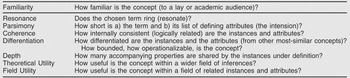
To grasp civic engagement's grave shortcomings, consider John Gerring's eight criteria for evaluating conceptual “goodness” (refer to table 1). Gerring's standards bolster the case that common sense initiates: civic engagement lacks conceptual coherence, parsimony, depth, differentiation and utility.

Civic engagement evinces familiarity and resonance, the first two of Gerring's criteria. But the concept lacks parsimony; its list of defining attributes exhausts memory and patience. It also lacks coherence. What thread could coherently link bowling in leagues, voting alone, writing checks to political candidates or interest groups, attending dinner parties, creating politically conscious artwork, volunteering at soup kitchens, attending church and watching politically relevant television programs, all of which have been counted as forms of civic engagement?
Nor is civic engagement differentiated or easily operationalizable. One would be hard pressed to distinguish its attributes from those of similar concepts such as social networking and “social capital,” political participation, civic virtue, and even friendship. Operationalizing civic engagement becomes as difficult as operationalizing any “kitchen sink” concept, because it means measuring a vast array of phenomena and attributes. Civic engagement fares just as poorly on the criterion of conceptual depth. Only surface similarities link the instances grouped under its umbrella. Some phenomena labeled “civic engagement” involve attention but little activity; some involve activity but little attention; some involve a political component while lacking a social component; others involve a social component while lacking a political component; and some involve a strong, liberal-democratic moral component while others do not.Footnote 24
Civic engagement also disappoints in the area of theoretical utility. The modifier “civic” has such broad connotations that no one is quite sure what it means. It allows anyone who invokes it to evoke something of special interest to that party—social connectedness, political participation, sociable norms, and so on. Finally, for some of the same reasons that civic engagement lacks conceptual depth it also lacks field utility for those within political science and sociology who address pressing questions about making democracy work. Some use civic engagement to measure political activity, some to measure social connectedness, and some to gauge citizens' commitment to their communities. The result is that rather than giving these scholars a common vocabulary, civic engagement leaves them talking past each other.Footnote 25
While “civic engagement” fares poorly with all but two of Gerring's criteria—familiarity and resonance—my proposed replacements of political, social, and moral engagement satisfy far more of the same criteria without ceding ground on the criterion of resonance. Civic engagement “rings” or resonates with contemporary sensibilities, but my proposed replacements do not sound alien. Civic engagement retains only one advantage over its political, social, and moral cousins: greater familiarity, stemming from its media saturation. But by the end of this article its familiarity may breed contempt.
Some concepts achieve familiarity through longstanding use. Not so with civic engagement, which originated quite recently. Civic engagement struck a chord from the outset, and its resonance among scholars and ordinary citizens accounts for part of its meteoric rise to prominence and familiarity. But part of the term's appeal lay in its ambiguity. From its inception, civic engagement meant different things in different situations, and its early elasticity invited a slew of further stretching. Unlike terms and concepts whose origins are shrouded in the distant past, civic engagement is of such recent birth that we can glimpse some of the factors, present from the beginning, that invited both widespread use and confusion.Footnote 26
Prior to 1993 civic engagement appeared only rarely in scholarly discourse, and almost never in American political discourse or popular media.Footnote 27 On rare occasions it was used in a manner totally unlike its current usages, with civic adhering to its dictionary definition, “of or pertaining to the city,” and engagement denoting an appointment or meeting. Accordingly, one Australian writer praised his city's conscientious mayor for spending her birthday amid city hall meetings, “with her first civic engagement at 10 a.m.”Footnote 28 An American university chancellor reminisced about her tenure, in which she was “privileged to find rewarding professional responsibilities, fulfilling civic engagements, and numerous kindred spirits.”Footnote 29 But apart from those occasional usages, civic engagement played no significant role in public discourse about democracy's health.
One landmark book changed the rhetorical landscape. Robert Putnam's Making Democracy Work (Reference Putnam, Leonardi and Nanetti1993) emphasized “civic engagement” and “social capital” in comparing northern Italy's economic and political successes with southern Italy's relative shortcomings. In that study, “civic” acquired an extraordinary breadth, encompassing social connectedness, sociability, and interpersonal trust, as well as issues relating to politics and citizenship. Engagement came to mean involvement of any kind, whether passive (paying attention to social and political affairs) or more active (investing energy in social or political affairs). Putnam found that northern Italy's rich “civic engagement”—its citizens' participation in voluntary associations, diverse friendship circles, and formal political processes—corresponded with much higher levels of trust and reciprocal norms, and far greater political and economic efficiency, than in the “civically disengaged” regions to the south. Northern Italy's vibrant array of social and political groups contributed toward what Putnam called a “civic community.” Southern Italy's relative dearth of associational life contributed to an “uncivic” community, rife with political corruption, economic stagnation, and “feelings of exploitation, dependency, and frustration.”Footnote 30 In other words, high civic engagement accompanied desirable political, economic, and moral results; low civic engagement accompanied the opposite. Scholars began to take note, and civic engagement entered their discourse and research.Footnote 31
But while Putnam's analysis set the agenda for an entire new field of useful research in political and social science, it accidentally gave rise to a seminal confusion by conflating “civic engagement” and “social capital.” In Making Democracy Work “social capital” means “features of social organization, such as trust, norms, and networks, that can improve the efficiency of society by facilitating coordinated actions.”Footnote 32 What kinds of “norms and networks” did Putnam have in mind? Norms and networks of civic engagement, which, in turn comprised “an essential form of social capital.Footnote 33 To be fair, Putnam probably intended “civic engagement” not as a form but as a source of social capital. According to his analysis “civic engagement” meant those associative involvements—whether political or not—that enmesh individuals in “networks and norms” of trust and reciprocity and hence generate social capital.Footnote 34 Thus, in Making Democracy Work, Putnam's “civic engagement” encompassed participation in mass political parties as well as neighborhood associations, choral societies, sports clubs, guilds, unions, and literary societies.Footnote 35 It also involved a moral component—norms of trust and reciprocity—along with its political and social elements.Footnote 36
Two years after publishing his Italian study, Putnam introduced civic engagement to a broader audience by focusing on twentieth-century U.S. history. In a series of influential articles he argued that Americans' civic engagement, now defined as “involvement with the lives of our communities,” had steadily declined over several decades' time. Civic engagement continued to encompass political participation, associational memberships, informal socializing, citizens' trust in government, and interpersonal trust, and Putnam found all five to be trending sharply downward.Footnote 37 His data seemed to affirm many citizens' generalized complaint or “gut feeling” that America's social and political life were not what they had once been.Footnote 38 And since in Putnam's Italian study low civic engagement correlated with very poor economic and political outcomes, his findings in the U.S. seemed cause for alarm. In short order civic engagement became a cause célèbre.
Soon, federally-funded research initiatives began measuring the “Nation's Index of Civic Engagement,” as well as “How Civic Disengagement Weakens America and What We Can Do About It.”Footnote 39 NGOs won grants to promote civic engagement in emerging democracies.Footnote 40 In the academic world, Harvard's Theda Skocpol formed an interdisciplinary “Civic Engagement Project” to study American political development. High school and college educators augmented traditional classroom offerings with “civic engagement” internships and created campus centers to encourage students' extracurricular civic engagement. At University of California–Los Angeles, civic engagement became an academic subject in its own right, a concentration in which students could minor.Footnote 41
The term caught on outside of the policy and academic communities, as well. In 1995 the national weekly People Magazine devoted a three-page spread to Putnam's civic engagement thesis, remarkable coverage for a scholarly project.Footnote 42 Writers in regional and national newspapers increasingly discussed the apparent spread of “civic disengagement” and potential solutions, such as a hip-hop artist's “message of civic engagement” for urban youth.Footnote 43 By the time Putnam published his Reference Putnam2000 book Bowling Alone, which summarized and expanded upon his earlier findings, regional and national newspapers were regularly chronicling perceived trends of civic disengagement and urging citizens and officials to stem the tide.
Not everyone agreed with Putnam's U.S. assessment. But even the dissenting voices generally disagreed only on the question of civic engagement's alleged decline rather than on its meaning or value. Some critics maintained that civic engagement still thrived but had changed shapes and locations.Footnote 44 According to their line of thought, involvement with Little League Baseball might have shrunk but youth soccer leagues had taken its place. Nationally networked Parent Teacher Organizations (PTAs) might have diminished, but independent Parent Teacher Organizations (PTOs) had filled the void. And while venerable, fraternal and sororal organizations such as the Elks, Rotary and DAR might have lost many members, small “self-help” groups provided outlets for those who sought to connect and engage civically—although no one thought to specify what that meant.Footnote 45
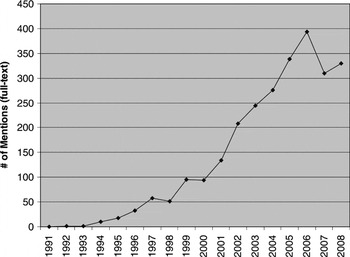
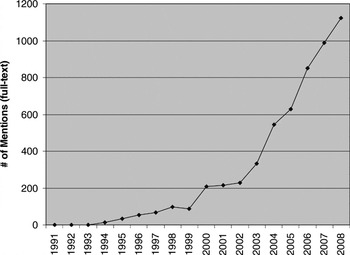
Figures 1 and 2 illustrate civic engagement's remarkably rapid ascension from obscurity to commonplace topic in scholarly articles and U.S. newspapers. In each medium, civic engagement began attracting notice around or after 1993, the year of Putnam's first book on the subject.
Civic engagement in peer-reviewed articles (full-text)
Source: ProQuest.

Civic engagement in U.S. newspapers (full-text)
Source: Lexis-Nexis Academic.

Why did civic engagement catch on so quickly and widely in the late twentieth century? Its subject matter was certainly nothing new. Following the eighteenth and nineteenth centuries' industrial revolutions, theorists such as Tocqueville, Marx, Durkheim, and Tönnies worried about the dispersal of rooted agrarians into masses of urban laborers. They lamented a perceived decline in social connectedness, traditional values, and political solidarity. Other intellectuals expressed similar worries amid the early twentieth century's social and economic upheavals, which included the growth of vast cities, the vicissitudes of economic depression and the travail of world wars. Yet none of the words coined to discuss those concerns—isolation, atomization, alienation, and anomie, for example—captured the popular and scholarly imaginations as broadly or quickly as civic engagement and disengagement, which are used in ways that encompass all of the others.Footnote 46 In Gerring's terms, civic engagement resonated with scholars and with the general public, and its deep resonance led to widespread familiarity. But its resonance and familiarity, in the absence of conceptual parsimony and differentiation, encouraged so many people to adopt civic engagement for such a wide range of purposes that it soon lost conceptual coherence. Yet the term's widespread use increased its familiarity, which encouraged further usage and watered down conceptual coherence all the more.
One likely reason for the term's easy resonance resides in the word “civic” itself. Literally, civic means “of, pertaining, or proper to citizens,” or to “citizenship,” or to “a city, borough, or municipality.” But it has come to connote a variety of other subjects as well, almost all of them having positive associations: sociability, public spiritedness, and cooperative norms, for example.Footnote 47 And while few people agree on the word's exact meaning, most seem to agree about what “civic” opposes: narrow individualism, isolationism, or an exclusive focus on oneself or one's intimates. (Note that I am not referring to the antonyms of civic, which might be something like rural or alien, but to the concepts excluded or opposed by civic's connotations.) The word's combination of benevolence and ambiguity contributed to civic engagement's broad appeal yet also contributed to our current confusion.
But “engagement” has played a role as well. Even without the “civic” modifier, engagement has become a buzzword in its own right. Engagement connotes intensive interaction, which almost everyone wants to promote in some capacity—witness the recently coined terms “community engagement,” “psychological engagement,” “academic engagement,” “consumer engagement,” “corporate engagement,” and even “digital engagement.” More specifically, engagement connotes activity and attention, an investment of energy and a consciousness of purpose. But because we can use engagement in three related but different senses, the term invites its own kind of conceptual stretching. That stretching has contributed to civic engagement's distortion but need not hinder future studies of political, social, and moral engagement if scholars and citizens pay attention to the distinct senses and their appropriate uses.
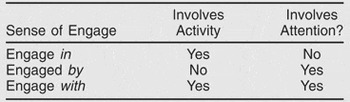
“Engage,” used as a transitive verb, conveys an impression of interactivity, entanglement, and commitment of resources (with energy and attention the resources most often in play). In common parlance, one can engage in an activity, engage with a subject, or be engaged by a subject. “Engaging in” encompasses any kind of participation in any kind of activity, but not necessarily attentive activity. Engaging in an activity can mean rote repetition or perfunctory performance; one can engage in paper-pushing, ditch-digging, or idle gossip. Conversely, the passive sense of “engaged by” implies attention or interest without accompanying activity.Footnote 48 One can be engaged by a painting, a television show, or a charismatic speaker. “Engaged by” is the verb form for spectators. Finally, “engaging with” tells us not only that an activity is being undertaken but undertaken attentively, as one engages with an interlocutor, a team member, or an intellectual or moral dilemma.
In summary, and as illustrated in table 2 above, the sense of engage in implies attention without activity, the sense of engaged by implies attention without activity, and the sense of engage with implies activity as well as attention.
Senses of engage

Too often, writers contemplating civic (or other forms of) engagement invoke these three senses interchangeably.Footnote 49 Scholars who consider politicized television viewing as a form of civic or political engagement are drawing upon the passive sense of being engaged by a subject.Footnote 50 Television programs with political content might draw viewers' attention to political affairs, but watching television entails little if any political activity.Footnote 51 Conversely, those scholars who count political donations as a measure of civic or political engagement draw upon the sense of “engage in.” Donating money via check or online payment involves a brief investment of the donor's energy and very little attention to political affairs.Footnote 52 In fact, contributions to advocacy groups are generally a delegation of attention, payment to a third party who will attend to one's concerns.Footnote 53 Finally, holding or running for office, attending town hall meetings, or participating in political rallies represent political engagement in the sense of “engaging with” political affairs, a combination of political attention and activity.
Thus, scholars who use engagement to denote a particular activity to be counted or measured often under-specify what it comprises: is it attention alone, activity alone, or both activity and attention? Hence they risk talking past one another, as one person claims that political engagement (meaning passive attention) is up while another claims that political engagement (meaning active participation) is down. But that apparent difficulty could be overcome if we simply recognize that attention and activity undergird all of our concerns with engagement, and take pains to indicate which resources are at stake in a given instance of political engagement. Scholars could still refer to television watching as a form of political engagement, but should also specify which of the two essential resources, attention and activity, are at play. The goal would be for professors and practitioners to recognize the resources that underlie the buzz word “engagement” and to orient their studies toward measuring activity and attention.
But engagement can be stretched conceptually for another reason as well. Engagement can refer to a particular action or to a generalized condition, Footnote 54 yet scholars seldom specify which sense they intend (and sometimes oscillate between them). When describing a particular episode or action, engagement can mean activity alone, attention alone, or a combination of the two. But as a generalized condition engagement always means a combination of activity and attention. In other words, engagement as a particular action can utilize the senses of engage in, engaged by, and engage with, but engagement as a general condition only utilizes the sense of engage with. Footnote 55 A politically engaged populace must be attentive to and active in political affairs, processes, and institutions. No one would call a citizenry politically engaged—meaning a generalized condition of political engagement—if citizens only paid attention to political affairs, processes, and policies but never took action to influence matters or raise their voices in support or protest. The same objection holds for a citizenry in which people participate perfunctorily, voting out of obligation, habit, or fear, yet pay no attention to political affairs and processes and hence have no idea of what their activities mean or express. Activity without attention is something like rote activity or “going through the motions.” A bored schoolchild grudgingly completing an assignment may be academically active but is certainly not engaged with her studies.Footnote 56 In political life, activity without attention might describe the perfunctory voting of a nineteenth-century Tammany Hall supporter, who casts a ballot for the prescribed city candidate in return for a Christmas ham. It also might describe Benjamin Rush's vain exhortation that nineteenth-century America mold its citizens into “republican machines” or “unquestioning paragons of cooperation and self-sacrifice.”Footnote 57 The perfunctory voter and the “republican machine” are both politically engaged in a manner of speaking, investing energy in political activities. But we would worry if everyone undertook political activities perfunctorily, acting from force of habit without thinking for themselves. Perfunctory participation has no obvious connection to those political capacities involving critical judgment.
Passive attention and judgment have limits of their own. To be sure, widespread attention to political affairs without accompanying political activity might advance the goal of democratic legitimacy, if one were to construe the viewers' silence as tacit consent. But passive viewers, even if they engage in internal debate, remain on the outside. As if in agreement, the National Commission on Civic Renewal calls its final report on civic disengagement “A Nation of Spectators,” and Rick Valelly characterizes Putnam's America as “Couch Potato Democracy.”Footnote 58 Martin Luther King, Jr. summarizes the distinction between passive attention and engaged citizenship as manifested in the civil rights movement: “When legal contests were the sole form of activity, the ordinary Negro was involved as a passive spectator. His interest was stirred, but his energies were unemployed. Mass marches transformed the common man into the star performer…”Footnote 59 Were political engagement as a general condition to comprise only passive attention to political affairs, unaccompanied by political activity, many of democracy's most cherished goals would go unfulfilled. Political spectatorship by itself has no obvious connection to the goals of legitimacy, fair representation, and citizen vigilance against governmental or factional abuses. Attention and activity both matter when we speak and write about the condition of engagement. Indeed, when we focus our attention on attention and activity, we can ensure that our studies of politically, socially, or morally engaged populations actually measure the relevant characteristics.
Political Engagement
As should be apparent by now, political engagement refers to attentive activity directly involving the polity—whether at the local, state, or national level—or any “activity that is intended to or has the consequences of affecting, either directly or indirectly, government action.”Footnote 60 Thus, political engagement encompasses most of the activities that we normally associate with political participation or citizenship: voting, contacting representatives, contributing financially to representatives or interest groups, following political issues (via any media format), associating with groups intended to influence political outcomes, attending rallies or demonstrations intended to influence political outcomes, or running for (or holding) political office. Political engagement as a particular episode could involve only political attention, only political activity, or both of them together, but political engagement as a generalized state must represent attention to political affairs and processes as well as activity aimed at actualization.
Political engagement subsumes civic engagement, because if “civic” is construed as “relating to the city,” then the polity subsumes the city. And if “civic” is construed as “relating to citizenship,” then “the political” encompasses issues relating to citizenship as well.Footnote 61 While political engagement subsumes civic engagement, it differs from social engagement; political actions and involvements do not always require multiple parties. Many regard solitary voting as the paradigmatic political act.Footnote 62 Not only voting but donating to political candidates or causes, writing letters or e-mails to elected officials or op-ed pages, and following politics via mass media: all of these activities can be undertaken by oneself.Footnote 63 Even Aristotle, widely cited by civic republican enthusiasts, does not hold politics to be intrinsically social. In the Politics he describes kingship as a “true” form of political rule, yet the ruling activity of one virtuous individual does not involve collective, political deliberation.Footnote 64
Political engagement encompasses all of the attentive activities that citizens' duties require, without the difficulties that “civic engagement” encounters. Consider the case of political activism undertaken by non-citizens. On May 1 of 2006, thousands of Mexican workers staged El Gran Paro Estadounidense, the Great American Strike or Boycott, hoping to shape American immigration policy. How could we call their efforts “civic engagement” when many of them were not citizens in the first place? Nor were they attempting simply to influence their local city, but rather to capture national attention and influence national policy. If we switch political with civic engagement we lose the conceptual problems altogether, because citizens and non-citizens alike can try to influence political processes and outcomes.
Social Engagement
Social engagement encompasses all manner of associational involvements. It means attentive activity in what Tocqueville calls “those associations in civil life which have no political object,” as well as informal socializing and personal friendships.Footnote 65 Thus social engagement is conceptually distinct from political engagement, although as discussed above the two can be combined. But social engagement occurs more commonly without a political component; most of our everyday social engagements are unpolitical. Repeated social engagement may produce what Putnam and others call “social capital,” or relationships of trust and reciprocity, and social capital tends to correlate with political engagement.Footnote 66 Thus while social engagement may not be political in itself, it certainly can be pre-political; it can be a resource that fosters or facilitates political engagement.Footnote 67
Tocqueville's Old Regime and the Revolution provides a cogent distinction between the political engagement of citizens and the social engagement of associational members. Tocqueville contrasts the voluntary associations predominant in sixteenth-century with those found in eighteenth-century France, and finds that only the earlier era's groups evinced political orientations. Associational members in the sixteenth century, “after having taken care of the business of their own associations among themselves, constantly met with all the other inhabitants to deliberate together about the general interests of the city.” But by the eighteenth century, members of French voluntary associations “had almost entirely withdrawn into themselves, for the acts of municipal life had become rare, and were always executed by individuals.”Footnote 68 Any coincidence between social and political engagement was circumstantial rather than logically necessary.
In Democracy in America Tocqueville worries about the tendency for democracy to foster individualism, a self-absorbed withdrawal from public concerns and political engagement. But in the Old Regime he finds “no individuals who did not belong to a group and who could consider themselves absolutely alone,” yet nonetheless “each one of the thousand little groups of which French society was composed thought only of itself” and of “matters which directly affected it.” Thus, eighteenth-century France was rife with social engagement but also with what Tocqueville calls “collective individualism,” and a notable absence of political attention or cooperation.
Sheri Berman describes a similar phenomenon in Weimar Germany, where a flourishing civil society worked at cross-purposes with public-spirited political citizenship. As with Tocqueville's France and its “thousand little groups,” Weimar Germany's many voluntary associations “served to hive their memberships off from each other and contribute to the formation of what one observer called ‘ferociously jealous small republics.’”Footnote 69 Berman, like Tocqueville, describes pernicious effects that may ensue when widespread social engagement is divorced from state-sanctioned political processes and institutions: “Germans threw themselves into their clubs, voluntary associations, and professional organizations out of frustration with the failures of the national government and political parties, thereby helping to undermine the Weimar Republic and facilitate Hitler's rise to power.”Footnote 70
Only when we distinguish between political and social engagements rather than compressing them under a single “civic engagement” banner can we draw helpful lessons from the French and German experiences. Those records suggest that widespread social engagement combined with radical political disengagement—in other words, the generation of “social capital” among people who either cannot or will not translate their energies into political voice and action—can imperil democratic stability. Further, neither social nor political engagement is itself sufficient for political stability; democracies require responsive political institutions through which citizen engagement can be channeled, lest pent-up demand for redress explode into violence or chaos.
Moral Engagement
The category of moral engagement waits in the wings, involved with some but not all political and social engagement. Moral engagement encompasses attention to, and activity in support of, a particular moral code, moral reasoning, or moral principles. This category is the most subtle and difficult to define, but represents a crucial distinction nonetheless. We should first note that, like social and moral engagement, moral engagement can represent either a particular episode or a general condition. As the former, moral engagement can mean either attention to a moral code or activity relating to a moral code or both. As the latter, moral engagement means a combination of attention, and activity relating to, moral codes or moral reasoning. At the societal level, scholars will care about the widespread condition of moral engagement, but that might be gauged by measuring many different instances of episodic moral engagement (whether attention, activity, or both).
As a general condition, moral engagement involves not only an orientation or state of character but also moral activity or follow-through. A morally engaged individual possesses a disposition to act on his or her moral principles; she possesses virtues of character in addition to any intellectual virtues. As Aristotle writes of moral actions, moral engagement involves doing the right thing while being committed to the reasons that justify for the action.
But for actions expressing virtue to be done temperately or justly [and hence well] it does not suffice that they are themselves in the right state. Rather, the agent must also be in the right state when he does them. First, he must know [that he is doing virtuous actions]; second, he must decide on them, and decide on them for themselves; and third, he must also do them from a firm and unchanging state.Footnote 71
In Aristotle's account, incontinent individuals lack virtue because they either fail to perform moral actions or they “go through the motions” without cognizance of the moral justification. In my terms, they either lack moral activity or moral attention. Even if one acts rightly, “saying the words that come from knowledge is no sign [of fully having it] … Hence we must suppose that incontinents say the [moral] words in the way that actors do … [merely] saying the words, as the drunk says the words of Empedocles.”Footnote 72
To restate, moral engagement as a condition means more than simply going through the moral motions. Friends of liberal democracy cannot relish the prospect of a citizenry habitually undertaking morally laudable activities without any attention to the underlying moral justification or rationale. In the absence of moral reasoning, nothing guarantees that citizens' future actions will be morally desirable. Such citizens would be morally docile, in George Kateb's terms, available for mobilization into any activity without the intermediary of moral judgment regarding its ultimate worth.Footnote 73 On the other hand, attention to moral principles without acting to actualize them would be a kind of moral spectatorship, a refusal to act on one's own moral dictates. In his “Letter from a Birmingham Jail” Martin Luther King, Jr. condemns precisely this kind of moral passivity: “We will have to repent in this generation not merely for the hateful words and actions of the bad people but for the appalling silence of the good people.”Footnote 74
Of course, even moral engagement conceptualized as attention and activity does not ensure morally desirable outcomes. Even the best intentions, and morally defensible reasoning and actions, can lead to unintended consequences. And if moral engagement with defensible moral codes can end badly, all the more so for moral engagement with indefensible moral codes. In Aristotle's Politics the good citizen in an unjust regime undertakes activities morally sanctioned by his fellows yet nonetheless commits injustice because he engages with faulty principles.Footnote 75 Extremists of many backgrounds have practiced religious, racial or ethnic oppression while motivated by, and closely attentive to, a set of moral dictates—illiberal moral dictates, but moral dictates nonetheless.Footnote 76 Thus, we might claim that stable liberal democracies require a certain kind of moral engagement from its citizens, involving attention and activity relating to moral principles such as toleration, reciprocity and law-abidingness. The exact content of democratic moral engagement is a matter for extensive debate that lies outside this article's scope.Footnote 77 And while democracy might require a certain kind of moral engagement, it also requires responsible institutions to rectify those instances in which even democratic moral engagement produces undemocratic and illiberal outcomes.
Because widespread democratic moral engagement is more of an aspiration than an imminent reality, and also because even liberal-democratic moral engagement is subject to misapplication, liberal democracies require stable and responsive political institutions and an established rule of law not only to encourage moral engagement among the citizenry and representatives, but to prevent the damaging consequences that could result from misguided, oppressive, and pernicious moral engagement.
Most important, moral engagement does not equal political or social engagement, because not all moral engagement has a political or social component. Moral engagement certainly can accompany social or political engagement; religious communities and close friendships combine attention and activity relating to social dynamics and moral principles, and civil rights marches bring together political, social, and moral elements. But often they part company. Jewish tradition values the practice of anonymous charity, in which neither the recipient nor the benefactor knows the other's identity.Footnote 78 Tocqueville's Memoir on Pauperism provides a further example. Tocqueville distinguishes between “two kinds of welfare,” one of which is “produced and regulated by society,” conceived and administered by people in their collective capacity, involving moral and social engagement. But the second kind of welfare “is a private virtue” that “escapes social action” and “leads each individual, according to his means, to alleviate the evils he sees around him.” In other words, the second kind of welfare involves moral engagement without social or political aspects.Footnote 79
When Nancy Rosenblum criticizes “liberal expectancy,” she means to chide those who assume (without basis) that social engagement will always produce desirable moral engagement.Footnote 80 History provides many examples of politically or socially engaged individuals tragically lacking in moral engagement, from Ku Klux Klan members to Adolf Eichmann (Nazi Germany's model citizen but Hannah Arendt's primary example of one who did not “think what he was doing”).Footnote 81 To conflate political or social engagement with moral engagement is to ascribe more to political and social involvement than they can sustain, conceptually or historically.Footnote 82
Of course, all social engagement includes at least a modicum of moral engagement among associates. League bowlers must subscribe to minimal, shared norms of behavior among each other. But subscribing to relevant norms of group behavior comprises a very thin kind of morality indeed, not just a quantitative but a qualitative difference from moral engagement as I have described it. In addition to being thin, the minimal moral engagement among some group members can also be narrow: it can extend no further than the relevant group, and thus can be of questionable utility for democratic politics. Putnam captures this nuance by distinguishing between “bridging (or inclusive) and bonding (or exclusive)” social capital.Footnote 83 The former denotes “networks [that] are outward looking and encompass people across diverse social cleavages,” and can promote tolerant norms toward a broad range of people. The latter denotes associations or networks that “are, by choice or necessity, inward looking and tend to reinforce exclusive identities and homogenous groups”; these are useful “for undergirding specific reciprocity and mobilizing solidarity.” He means that social engagement does not always entail generalizable moral engagement, precisely the point that Plato taught two thousand years earlier when he reminded us that even pirates or thieves require a modicum of justice among themselves, although they do not extend their code to ill-fated outsiders.Footnote 84
Civil Engagement
For the sake of conceptual clarity we must identify instances in which political, social, and moral engagements occur independently, but in practice they often coincide. One combination merits a separate discussion and perhaps its own category: the social-moral engagement of public-spirited, cooperative problem-solving, which I propose to call “civil engagement.” Not only does that term resonate with the commonplace concept of “civil society”—the cooperative space between governmental and purely private affairs—but it meshes with Alexis de Tocqueville's typology. Tocqueville uses “civil” to describe associations that, while not concerned with political processes or institutions, pursue their members' common ends cooperatively. He maintains that only citizen action, rather than political force, can “[refresh] the circulation of feelings and ideas among a great people.” Tocqueville's Americans engage civilly when they “have conceived a sentiment or an idea that they want to produce before the world,” such as the “one hundred thousand men [who] had publicly promised never to drink alcoholic liquor” in an effort to influence their fellow citizens by collective example rather than governmental coercion.Footnote 85 J. G. A. Pocock supports this distinction between “civil,” meaning social-moral, and civic or political engagement. Pocock depicts eighteenth-century Edinburgh as experiencing a “proliferation of Spectatorial clubs and societies, practicing the virtues of polite conversation and enlightened taste while discussing the economic, cultural and even … the moral improvement of Scottish life,” which represented a change from the more explicitly political engagement of an earlier era. In Pocock's terms, “the locus of virtue shifted decisively from the political and military to that blend of the economic, cultural and moral”; in other words, the locus of virtue shifted “from the civic to the civil.”Footnote 86
“Civil engagement” as I have conceptualized it represents the kind of social-moral engagement that Tocqueville and many contemporary scholars feel to be particularly important for democracies' flourishing. It possesses familiarity and resonance because of its association with the vast “civil society” literature, and it lacks the pitfalls that have accompanied previous attempts to distinguish cooperative voluntarism from political engagement.Footnote 87 As an example of such pitfalls, Zukin et al. call cooperative voluntarism “civic engagement” and political involvement “political engagement,” but their terminology invites as much confusion as it resolves.Footnote 88 In addition to the linguistic confusion involved with contrasting civic and political when the two terms overlap so enticingly, Zukin's “civic engagement” includes any kind of associational membership or social engagement in addition to explicitly moral, community-oriented involvements. In other words, it includes involvement in bowling leagues as well as in soup kitchens. Thus the authors inadvertently re-constitute Putnam's original difficulty of conflating concepts. At one pole, their “civic engagement” may confuse scholars and citizens because we so commonly associate “civic” with “political.” At the other pole, their “civic engagement” blends indistinguishably into the social. “Civil engagement” lacks these problems and helps us to think more clearly about making democracy work.
Conclusion
Replacing civic engagement with political, social, and moral varieties (and augmenting them with civil engagement as well) helps us to think and talk more clearly about making democracy work. At present, many scholars associate high “civic engagement” with a range of desirable outcomes, often implying that the former somehow promotes the latter, but they wrongly give the same credit to political attention and activity as to social and moral engagement.Footnote 89 Virtually all of the available research suggests a positive correlation between social capital—which encompasses what I have called social and also moral engagement—and economic and governmental efficiency, high-performing schools, life satisfaction, and even life expectancy.Footnote 90Political engagement as I have defined it—attention to and activity in political processes and affairs—bears no necessary connection to any of those phenomena. Italy, Indonesia, and South Africa all evince much higher levels of political interest and turnout than the United States, but much lower levels of social capital and social (and civil) engagement—and they rank lower in measures of economic and governmental efficiency, life satisfaction, public health, and other features allegedly correlated with so-called “civic engagement.”Footnote 91 Political attention and activity often correlate with social capital and what I have called social and civil engagement, but when they diverge—when societies feature either high social capital or high levels of political attention and activity, but not both—those democracies with high levels of social engagement and social capital almost always fare better in the relevant measures of efficiency, satisfaction, public health, and perceived legitimacy.
Political engagement still has many things to recommend it, and democracy would not be democracy unless citizens invested at least some attention and activity to politics. Further, the worthy ideals of political legitimacy and fair representation would be much better served by higher political participation and turnout among groups that traditionally have been less active and vocal.Footnote 92 But promoting political engagement will require money, time, and other scarce resources. And because many people freely choose political disengagement,Footnote 93 promoting widespread change might also require legal coercion, which liberal democracies cannot undertake lightly.Footnote 94
Thus, anyone advocating very high political engagement for all citizens must explain not only what it is but why liberal democracies must have it in spades. This article has addressed the first question; we should understand political engagement as a combination of attention to and activity in political affairs—affairs which require or demand interaction with political organs or institutions—which can (but need not) be combined with social or moral engagement. It remains to inquire into the relative values of these kinds of attentive activity. Is political engagement intrinsically valuable for human beings, constitutive of human flourishing, as certain civic republican theorists state or imply?Footnote 95 Is it instrumentally valuable for citizens of democracy, conducive to a range of goals such as stability, fairness, political legitimacy, and efficiency, as some political scientists have suggested? Must citizens be politically engaged all the time or only episodically? Perhaps liberal democracies can flourish with relatively low levels of political engagement if they also feature continuously high social and moral engagement—which can be channeled into political engagement should the circumstances warrant—and political institutions able to process that episodic engagement and respond satisfactorily. Perhaps liberal democracies do require high and widespread political engagement for the sake of fair representation and political legitimacy. These are questions for further research. But we cannot began to answer them if we do not know how to pose them clearly. Clarity issues a simple demand: that civic give way to political, social and moral engagement.