Introduction
Although the hiring rate of older workers differs greatly across countries, older unemployed people are generally less likely to find employment (Organisation for Economic Co-operation and Development 2006). Data from the European Union (2004–07) show that younger individuals (aged 25–34) are almost nine times more likely to find employment after one year of being without a job than older individuals (aged 55–64) (European Commission 2010). Since job search behaviour is an important predictor of finding employment (Kanfer, Wanberg and Kantrowitz Reference Kanfer, Wanberg and Kantrowitz2001), it is important to know whether job seekers of different ages determine their search behaviour in a different way. At the moment, little is known about the moderating role of age in general job search models. In their meta-analysis, Kanfer, Wanberg and Kantrowitz (Reference Kanfer, Wanberg and Kantrowitz2001) concluded that several studies on job search solely focus on graduates and no studies are based on samples involving job seekers aged 55 or older. Although several more recent studies use samples including job seekers older than 55 (e.g. van Hooft et al. Reference van Hooft, Born, Taris and van der Flier2005; Zacher Reference Zacher2012), it is still unclear to what extent age is important in explaining predictor–outcome relationships in the context of job search. In this study, we examine the moderating role of age in relationships between antecedents and indicators of job search using a particular sample of 240 Belgian job seekers who were at the start of an outplacement programme. Although generally outplacement is optional in the case of job loss, in Belgium, employees aged 45 or older who lose their job are legally entitled to an outplacement programme paid for by their employer. A similar regulation holds for younger workers employed in an organisation with at least 20 employees in the case of collective redundancies due to corporate restructuring. They have to participate in the outplacement programme to remain entitled to unemployment benefits. As all respondents have recently lost their job and initiated their search for work, they are in a similar stage of the unemployment process. Therefore, in this study, unemployment duration cannot bias the results.
We investigate two dependent variables reflecting two complementary aspects of job search and both correlating positively with employment success (Wanberg, Zhang and Diehn Reference Wanberg, Zhang and Diehn2010): job search intensity and wage flexibility. While search intensity is one of the most often studied job search dimensions in the psychological job search literature (Kanfer, Wanberg and Kantrowitz Reference Kanfer, Wanberg and Kantrowitz2001; Saks Reference Saks, Brown and Lent2005), wage flexibility is a key concept in the economic search literature that has only recently been introduced in the psychological literature (Wanberg, Zhang and Diehn Reference Wanberg, Zhang and Diehn2010). It concerns the gap between the job seekers’ last wage and their reservation wage, i.e. the minimum wage they are prepared to accept (cf. McFadyen and Thomas Reference McFadyen and Thomas1997). Studying both search intensity and wage flexibility integrates the psychological and economic literatures on job search. This integration rarely happens in empirical studies (Kanfer, Wanberg and Kantrowitz Reference Kanfer, Wanberg and Kantrowitz2001). Still, search intensity and wage flexibility capture complementary dimensions of the search process: search intensity reflects the depth of the search, whereas wage flexibility refers to the range of jobs that people actually consider to accept, i.e. the breadth of the search. Moreover, despite their particular focus, both economic and psychological job search theories discern similar antecedents reflecting job seekers’ valuation of work (e.g. employment commitment, financial hardship) and individuals’ expectation of finding employment (e.g. re-employment efficacy) (McFadyen and Thomas Reference McFadyen and Thomas1997). Yet, empirical studies tend to include only one dimension of job search and usually control for job seekers’ age thereby assuming similar relationships for job seekers of different ages. Still, Carstensen's socio-emotional selectivity theory (Carstensen Reference Carstensen1995, Reference Carstensen, Heckhausen and Dweck1998; Lang and Carstensen Reference Lang and Carstensen2002) and the motivational theory of lifespan development (Heckhausen, Wrosch and Schulz Reference Heckhausen, Wrosch and Schulz2010) question this assumption by stating that motivational and decisional processes tend to change as people age. Recently, Zacher (Reference Zacher2012) supported these theories in the context of job search by identifying age as a moderator of the positive relationship between proactive personality and job search intensity: the relationship was stronger at higher compared to lower ages. This study uses these theoretical frameworks to examine whether age moderates the relationships between three independent variables (namely employment commitment, financial hardship and re-employment efficacy), and two dependent variables, namely their job search intensity and wage flexibility.
This study adds to the job search literature by integrating concepts from the psychological and economic literature in one research model, presented in the following section. It moreover questions if studied relationships between antecedents and aspects of job search hold equally for job seekers of different ages. Finally, by studying individuals that are at the start of an outplacement programme, all respondents are in a similar stage of the unemployment process and we can assess the hypothesised relationships in a more accurate way.
Hypothesised model
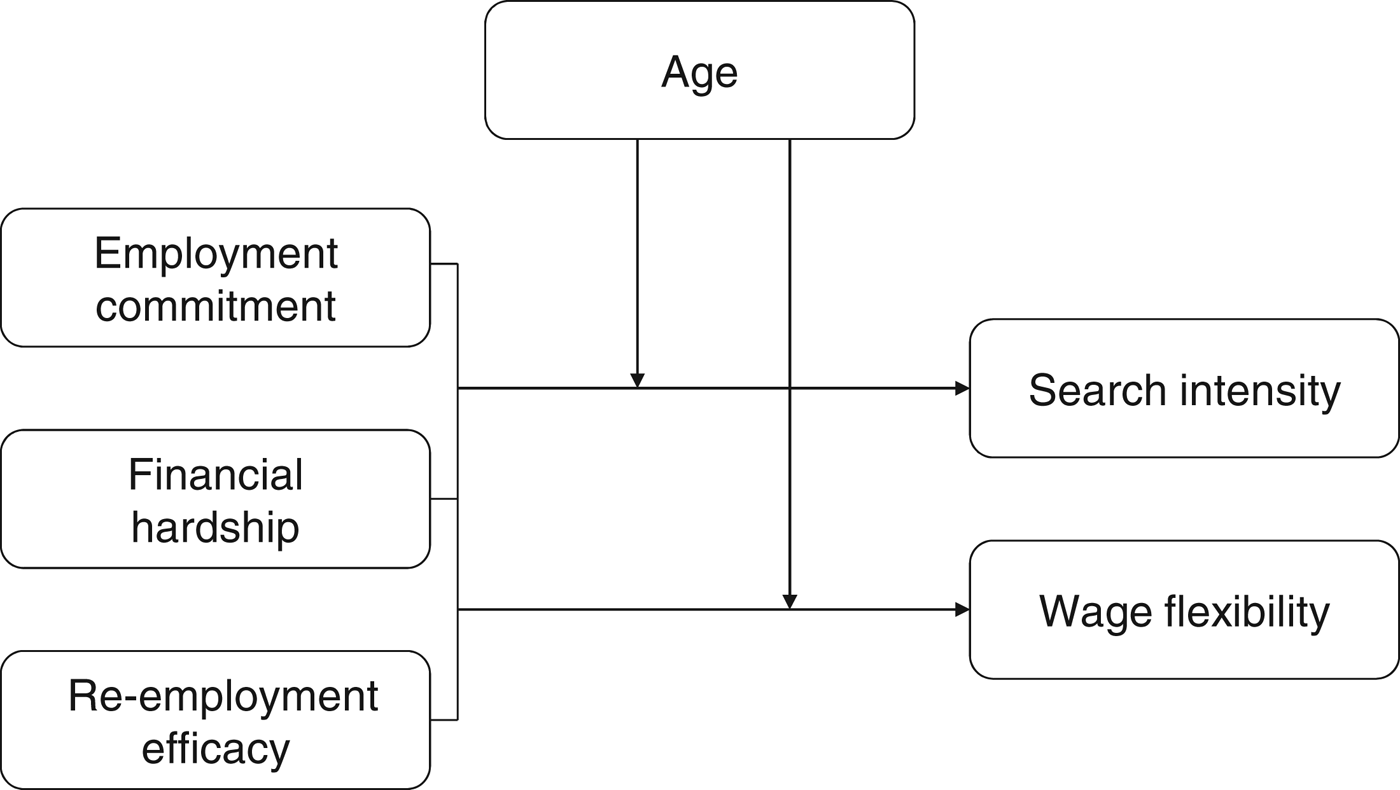
In their review of economic and psychological models of job search, McFadyen and Thomas (Reference McFadyen and Thomas1997) conclude that both disciplines discern similar antecedents. First, they focus on job seekers’ valuation of work – be it financially or not. Studies examining antecedents of job search have repeatedly identified employment commitment and financial hardship as ‘job search motives’ (e.g. Ginn and Arber Reference Ginn and Arber1996; Kanfer, Wanberg and Kantrowitz Reference Kanfer, Wanberg and Kantrowitz2001; Šverko et al. Reference Šverko, Galić, Seršić and Galešić2008). Employment commitment reflects the importance or centrality of employed work to an individual beyond the income it provides (Kanfer, Wanberg and Kantrowitz Reference Kanfer, Wanberg and Kantrowitz2001; Saks Reference Saks, Brown and Lent2005). Financial hardship refers to the extent of economic difficulties one foresees due to insufficient financial resources to meet personal and family needs (Šverko et al. Reference Šverko, Galić, Seršić and Galešić2008; Wanberg, Zhang and Diehn Reference Wanberg, Zhang and Diehn2010). Wanberg, Zhu and van Hooft (Reference Wanberg, Zhu and van Hooft2010: 790) consider financial hardship an extrinsic indicator of goal valence since ‘employment is viewed as a means toward the end of solving financial hardship’. Since job seekers with high employment commitment value employment because it is intrinsically important to them beyond the income it provides, employment commitment is considered a more intrinsic indicator of goal valence. Nevertheless, in their meta-analysis, Kanfer, Wanberg and Kantrowitz (Reference Kanfer, Wanberg and Kantrowitz2001) found that both indicators of goal valence had a similar effect on job search behaviour. While psychological studies usually include both employment commitment and financial hardship, economic studies focus on the financial value of work (McFadyen and Thomas Reference McFadyen and Thomas1997). Secondly, in line with expectancy–value theory (Vroom Reference Vroom1964), both streams of literature recognise that individuals’ expectation of finding employment also influences their search behaviour. Although this factor has only rarely been studied as an antecedent of search behaviour, we include re-employment efficacy in addition to employment commitment and financial hardship. Re-employment efficacy concerns ‘the confidence in one's ability to find an acceptable job’ (Wanberg, Zhu and van Hooft Reference Wanberg, Zhang and Diehn2010: 789). Figure 1 shows our conceptual model. In what follows, we describe the components of the model and how they relate.
The research model.

The role of employment commitment and financial hardship
In the psychological literature, Kanfer, Wanberg and Kantrowitz (Reference Kanfer, Wanberg and Kantrowitz2001) define job search as a dynamic, self-regulated process in which job seekers undertake multiple search activities to achieve the goal of finding employment. According to the social cognitive theory of self-regulation (Bandura Reference Bandura1991) and expectancy–value theory (Vroom Reference Vroom1964), individuals allocate more resources (e.g. time, effort) to goals they consider important, i.e. in the case of high goal valence. Empirical studies repeatedly find a positive relationship between employment commitment and search intensity (Kanfer, Wanberg and Kantrowitz Reference Kanfer, Wanberg and Kantrowitz2001; Šverko et al. Reference Šverko, Galić, Seršić and Galešić2008) and between financial hardship and search intensity (Kanfer, Wanberg and Kantrowitz Reference Kanfer, Wanberg and Kantrowitz2001; van Hooft and Crossley Reference van Hooft and Crossley2008).
While psychological models speak in terms of goal valence, individuals’ pursuit of maximum utility, i.e. maximum lifetime income, is at the centre of economic models (McFadyen and Thomas Reference McFadyen and Thomas1997). The lower the value attached to work, for whatever intrinsic or extrinsic reason, the higher the wage necessary to leave unemployment, i.e. the reservation wage (Mortensen Reference Mortensen, Ashenfelter and Layard1986). Furthermore, job seekers highly valuing work may maximise their chance of finding employment by being more flexible towards job offers to target a larger set of jobs and so increase their chance of finding employment (McFadyen and Thomas Reference McFadyen and Thomas1997). Although the role of employment commitment is mainly ignored in economic research, several studies found that liquidity constraints negatively relate to job seekers’ reservation wage and thus positively relate to their wage flexibility (Bloemen and Stancanelli Reference Bloemen and Stancanelli2001; Nattrass and Walker Reference Nattrass and Walker2005).
The moderating role of age
While there seems to be a consensus on how employment commitment and financial hardship relate to search intensity and wage flexibility, the strength of these relationships may be influenced by the job seeker's age. Carstensen's socio-emotional selectivity theory (Carstensen Reference Carstensen1995, Reference Carstensen, Heckhausen and Dweck1998; Lang and Carstensen Reference Lang and Carstensen2002) states that the perceived time perspective changes with individuals’ age. As people grow older, they more and more come to realise that the ‘time left’ is limited and so is the time frame to obtain the utility of work or activities other than work. This awareness is likely to have motivational consequences. Perceived time pressure may stimulate individuals to allocate more resources and accomplish highly valued goals while they can. So, older job seekers with high levels of employment commitment or financial hardship may increase the intensity of their search in order to find a job within the time frame. Accordingly, they may also increase their chances of finding a job by demonstrating more wage flexibility in order to target a wider range of jobs (McFadyen and Thomas Reference McFadyen and Thomas1997; Mortensen Reference Mortensen, Ashenfelter and Layard1986). On the contrary, if spending time with family or making time for hobbies is valued more highly than finding employment, ageing individuals may prefer using the time left to pursue those goals and leave the labour market. In that case, we assume perceived time pressure may make them unwilling to spend time and energy searching for work. Hence, they may search less intensively and demonstrate less wage flexibility. This reasoning thus suggests that the positive relationships between indicators of goal valence (employment commitment and financial hardship) and job search intensity or wage flexibility become stronger as job seekers age.
• Hypothesis 1a: The positive relationship between employment commitment and search intensity gets stronger with job seekers’ age.
• Hypothesis 1b: The positive relationship between employment commitment and wage flexibility gets stronger with job seekers’ age.
• Hypothesis 2a: The positive relationship between financial hardship and search intensity gets stronger with job seekers’ age.
• Hypothesis 2b: The positive relationship between financial hardship and wage flexibility gets stronger with job seekers’ age.
Re-employment efficacy and search intensity
Multiple conflicting theories apply to the relationship between people's confidence in their ability to find an acceptable job, i.e. their re-employment efficacy, and their search intensity. One group of theories strengthens the assumption of a positive relationship between re-employment efficacy and search intensity, whereas the other hypothesises a negative relationship. We discuss both alternative groups of theories and specify why they may apply to different age groups.
On the one hand, social cognitive theory (Bandura Reference Bandura1991) and expectancy–value theory (Vroom Reference Vroom1964) predict that higher re-employment efficacy stimulates job search intensity as it positively affects job seekers’ affect and motivation to engage in job search. Since job seekers with low re-employment efficacy may feel discouraged and unmotivated, they may reduce search intensity to avoid difficult, unsatisfying tasks, especially since individual actions are often more driven by their own perception of a situation than by the actual reality (De Witte and Näswall Reference De Witte and Näswall2003).
On the other hand, control theory (Powers Reference Powers1973, Reference Powers1991) predicts a negative relationship between re-employment efficacy and search intensity. It states that behaviour is triggered by the perceived gap between the goal state, i.e. re-employment, and the perceived current state. Job seekers negatively assessing their situation may believe that extra effort (i.e. more intensive job search) is needed to remove the perceived discrepancy (Carver Reference Carver2006; Powers Reference Powers1991). Job seekers with high re-employment efficacy, on the contrary, may belief that their goal is within reach and may therefore search less intensively and even postpone search behaviour (Carver Reference Carver2003, Reference Carver2006). Empirical studies on the relationship between re-employment efficacy and search intensity are scarce and inconsistent. While Wanberg, Zhu and van Hooft (Reference Wanberg, Zhang and Diehn2010) found no effect of re-employment efficacy on the time spent in job search the next day, other studies seem to support control theory finding a negative impact of re-employment efficacy on search intensity (van Hooft et al. Reference van Hooft, Born, Taris, van der Flier and Blonk2004; Vansteenkiste et al. Reference Vansteenkiste, Lens, De Witte and Feather2005). The results may be inconsistent due to different relationships in different situations or for different groups. Based on the motivational theory of lifespan development (Heckhausen, Wrosch and Schulz Reference Heckhausen, Wrosch and Schulz2010), we assume job seekers’ age to be of influence.
The moderating role of age
According to the motivational theory of lifespan development (Heckhausen, Wrosch and Schulz Reference Heckhausen, Wrosch and Schulz2010), goal engagement depends on the opportunities to attain a goal and on the ‘developmental deadline’, i.e. the time available to attain the goal (relating to job seekers’ age). If there is still sufficient time to the deadline, Hechkausen, Wrosch and Schulz (Reference Heckhausen, Wrosch and Schulz2010) argue that people with constrained opportunities for goal achievement (i.e. lower re-employment efficacy) will more intensively use control strategies to attain their goal (i.e. finding employment). They may, for instance, invest more time, effort or skills into pursuing their goal. Based on this idea, we assume a negative relationship between re-employment efficacy and job search intensity among younger people since they are not reaching a deadline. This negative relationship is also in line with Powers’ control theory. However, if the deadline is approaching, Heckhausen, Wrosch and Schulz (Reference Heckhausen, Wrosch and Schulz2010) argue that people with low opportunities may consider the goal to be no longer feasible within the given time frame. In that case, they may disengage from the goal in order to protect themselves from failure. Goal disengagement is a likely option for older job seekers with low re-employment efficacy since they are facing a deadline. Moreover, as people grow older, they are more inclined to avoid actions harming their self-concept (Kanfer and Ackerman Reference Kanfer and Ackerman2004). In addition, Heckhausen, Wrosch and Schultz (Reference Heckhausen, Wrosch and Schulz2010) claim that disengagement will be facilitated if an alternative goal is within reach. In the case of older job seekers, this may be (early) retirement. We therefore hypothesise that as people grow older they will be more likely to disengage from job search and search less intensively in the case of low re-employment efficacy. This is also in line with the findings of Wuebbeke (Reference Wuebbeke2011) indicating that a lack of employment prospects was the main reason for older unemployed people to withdraw from the labour market. This positive relationship between re-employment efficacy and job search intensity is related to the ideas of social-cognitive theory (Bandura Reference Bandura1991) and expectancy–value theory (Vroom Reference Vroom1964).
So, following the above reasoning, we assume a shift from a negative relationship between re-employment efficacy and job search intensity at younger age to a positive relationship as people grow older:
• Hypothesis 3a: The relationship between re-employment efficacy and search intensity is negative among younger job seekers, while it is positive among older job seekers.
Re-employment efficacy and wage flexibility
Since higher re-employment efficacy reflects job seekers’ confidence in their ability to find employment, it is likely to strengthen the belief of having a strong negotiating position with future employers. This may result in higher wage claims and lower wage flexibility. According to the principles of ‘value-based pricing’ (Hinterhuber Reference Hinterhuber2004), the idea of having a high ‘market value’ may lead one to believe it is justified to demand a higher wage and be less flexible. Furthermore, economic job search theory (e.g. Mortensen Reference Mortensen, Ashenfelter and Layard1986) states that job seekers with low re-employment efficacy can compensate for their weak labour market position by undertaking actions that yield more job offers (like increasing search intensity), but also by being more flexible when deciding which offers are adequate and can be accepted. Hence, job seekers with low re-employment efficacy may increase their wage flexibility in order to target a wider range of jobs and increase their chance of finding employment.
In the economic job search literature, the limited number of empirical studies examining how individuals’ perceived re-employment chances influence their reservation wage are inconclusive. Walker (Reference Walker2003) finds that the difficulty job seekers expect when looking for work does not affect the reservation wage. Yet, Christensen (Reference Christensen2001) and Pannenberg (Reference Pannenberg2010) conclude that unemployed job seekers set a higher reservation wage when they expect to have good re-employment chances, while in a previous study Pannenberg (Reference Pannenberg2007) found that only risk-averse job seekers register lower reservation wages when they think it is hard to find a job.
The moderating role of age
Based on the motivational theory of lifespan development (Heckhausen, Wrosch and Schultz Reference Heckhausen, Wrosch and Schulz2010), we also expect age to moderate the relationship between re-employment efficacy and wage flexibility. We assume that younger people with low re-employment efficacy will develop strategies to attain their goal of finding employment. Demonstrating wage flexibility in order to enlarge the set of acceptable jobs may be such a strategy. This assumed negative relationship between re-employment efficacy and wage flexibility among younger job seekers is in line with economic job search theory. On the contrary, we expect older job seekers with low re-employment efficacy to be more likely to disengage from finding a job. Following labour supply theory (Killingsworth Reference Killingsworth1983), they could do this by setting their reservation wage at a high level so hardly any job would be acceptable. Hence, claiming high wages may be a way of demonstrating their goal disengagement. We therefore come to the following hypothesis:
• Hypothesis 3b: The relationship between re-employment efficacy and wage flexibility is negative among younger job seekers, while it is positive among older job seekers.
Methods
Procedure and sample
The data for this study were collected in Flanders, the Dutch-speaking region of Belgium, in collaboration with the outplacement agency Ascento. In 2011, outplacement counsellors of Ascento asked new candidates for outplacement at their intake interviews to participate in the study. All 377 job seekers willing to participate received an email containing a link to the online questionnaire; 275 of them completed the survey (73%). Since we excluded observations with missing values, the final sample contains 240 observations.
All participants in the study were entitled to an outplacement programme after losing their job. In Belgium, individuals are legally entitled to outplacement in two cases. First, when the employees losing their job are 45 years or older, employers are legally bound to inform them of their right to participate in outplacement. The employer has to bear the costs of the programme. Moreover, employees have to accept any outplacement programme offered by their employer and, if no programme has been offered, claim one. They may lose their unemployment benefits when neglecting this duty. Second, in the case of collective redundancies, organisations with at least 20 employees are obliged to re-orientate all employees towards another job, among other things by offering them outplacement. Again, unemployment benefits may be lost when the employees do not participate in the outplacement programme.
The respondents’ age varied from 26 to 59 years old; 12 per cent were younger than 35 and 46 per cent were 45 years or older. Ninety-six per cent of the participants younger than 45 lost their job because their department or the entire organisation was shut down. The other four participants (4%) experienced job loss due to restructuring following from the economic or technical problems of the organisation. While 48 per cent of the respondents aged 45 or older lost their job because their department or the entire organisation was shut down, 34 per cent experienced job loss as their employer experienced some sort of economic or technical problems and 18 per cent had to leave the organisation because their employer was unsatisfied with their performance or competences.
The sample was mainly masculine (67%). Regarding education, 33 per cent of the respondents did not have a high school degree, 49 per cent had a high school degree and 18 per cent had a bachelor's or master's degree. Despite the divergent profiles, all respondents were asked to participate in the study in the first session of their outplacement programme, usually starting at the beginning of the unemployment spell. Therefore the time spent in unemployment cannot bias the results and we can estimate the model in an accurate way.
Measures
Employment commitment
We used the scale from Rowley and Feather (Reference Rowley and Feather1987) to measure employment commitment (Cronbach's α=0.84). The respondents rated eight items on a five-point Likert scale (1=totally disagree; 5=totally agree). Example items are: ‘Even if I won a great deal of money in the lottery, I would want to continue working somewhere’ and ‘Being unemployed is about the worst thing that ever happened to me’.
Financial hardship
Three items (Vinokur and Caplan Reference Vinokur and Caplan1987) rated on a scale ranging from 1 (not at all difficult) to 5 (extremely difficult) were used to measure financial hardship (Cronbach's α=0.91). A sample item is: ‘How difficult is it for you to live on your total household income right now?’
Re-employment efficacy
Consistent with the measure used by Wanberg, Zhu and van Hooft (Reference Wanberg, Zhu and van Hooft2010), re-employment efficacy was assessed by means of five items (Cronbach's α=0.88). The items ask about the expected difficulty to (1) find another job; (2) find a job corresponding to one's knowledge, skills and expertise; (3) find a job that matches one's interests; (4) find a job paying as much as the current job; and (5) find a job of the same level as the current job. The response scale ranged from 1 (very difficult) to 5 (very easy).
Search intensity
Job search intensity was assessed with a ten-item measure based on the validated job search scale developed by Blau (Reference Blau1994; Cronbach's α=0.88). We added one item on the use of the internet to include new job search methods. Respondents had to indicate on a five-point scale how many times they had performed various search activities over the preceding three months: never, rarely (one or two times), occasionally (three to five times), frequently (six to nine times) or very frequently (at least ten times). Sample items are ‘prepared or revised my resume’, ‘talked with friends or relatives about possible job leads’, ‘sent out resumes to potential employers’ and ‘contacted an employment agency’.
Confirmatory factor analysis showed that the factor structure fits the data well (χ2(1)=491.86 (p<0.001); Root Mean Square Error of Approximation (RMSEA)=0.05; Standardised Root Mean Square Residual (SRMR)=0.07; Comparative Fit Index (CFI)=0.94). Since all items loaded significantly on their intended constructs (p<0.001) and the sample was too small to test a structural equation model with latent factors (Nunnally Reference Nunnally1967; Westland Reference Westland2010), we calculated scale scores based on item averages to estimate a path model.
Wage flexibility
First, we asked respondents at what percentage of a full-time job they would like to work (100 per cent if they were looking for full-time employment) to convert wages for part-time jobs to their full-time equivalent. Second, we asked respondents about their reservation wage, using the question: ‘How high does the net monthly salary of such a job (full time or part time) at least have to be for you to accept the job?’ This question is consistent with other studies using self-reported reservation wages (e.g. Bloemen and Stancanelli Reference Bloemen and Stancanelli2001; Nattrass and Walker Reference Nattrass and Walker2005). Next, following Wanberg, Zhang and Diehn (Reference Wanberg, Zhang and Diehn2010), we subtracted the reservation wage from the last wage to determine wage flexibility. A positive value corresponds to a reservation wage below the last wage. We used the logarithm of the reservation wage and the last wage (both net full-time equivalents in euros) to control for any scale effects resulting from the wide variation in the wage variables compared to other variables. Moreover, as we preferred a relative measure over an absolute measure to see how job seekers’ wage claims relate to their last wage in terms of percentage, we divided the difference by the last wage and multiplied the result by 100. So the higher the wage flexibility percentage, the higher the wage concession one wants to make.
Age
Age was included as a continuous variable that, like the other independent variables, was mean-centred before calculating the product terms representing the interactions (Aiken and West Reference Aiken and West1991).
Control variables
Gender and educational level were included because of their known associations with job search intensity and wage flexibility. Male, higher-educated job seekers were found to search more intensively (Kanfer, Wanberg and Kantrowitz Reference Kanfer, Wanberg and Kantrowitz2001) and register higher reservation wages (Prasad 2000, 2003). The gender variable was dichotomous with 0=female and 1=male. We coded three educational levels: (1) low, i.e. no high school degree; (2) average, i.e. a high school degree; and (3) high, i.e. a bachelor's or master's degree. Since wage demands may be influenced by a person's seniority in the organisation (Hofler and Murphy Reference Hofler and Murphy1994) and we want to assess the role of age accurately, we also include the number of years the job seekers have worked with their previous employer as a control variable in the analyses focusing on wage flexibility.
Analysis
The research model was tested using path analysis as it allows the estimation of the hypothesised relationships in a simultaneous way (Procedure CALIS in SAS Version 9). We compared the fit of the models with and without interactions using the Akaike Information Criterion (AIC). The model including age as moderator had a better fit than the one without interactions as it had a lower AIC value. The analyses showed that it fits the observed data well (χ2(1)=1.73 (p=0.19); RMSEA=0.06; SRMR=0.01; CFI=1.00).
Results
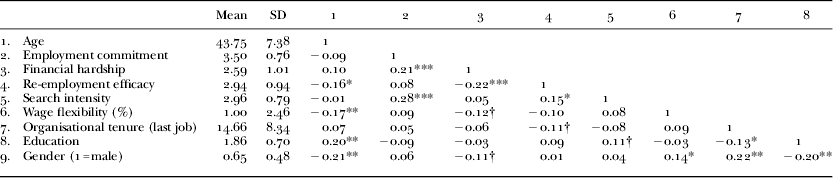
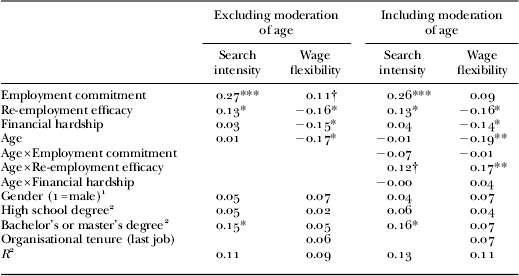
Table 1 shows the means, standard deviations (SD) and correlations between the studied variables. Note that search intensity and wage flexibility are not correlated even though they are both part of individuals’ search strategy. Table 2 shows the standardised results of the path analysis.
Means, standard deviations (SD) and intercorrelations of the study variables
Note: N=240.
Significance levels: † p<0.10, * p<0.05, ** p<0.01, *** p<0.001.
Results of the path analysis (standardised coefficients)
Notes: N=240. 1. Reference category is female. 2. Reference category is no high school degree.
Significance levels: † p<0.10, * p<0.05, ** p<0.01, *** p<0.001.
Although employment commitment is positively associated with search intensity (β=0.26, p<0.001), the relationship does not depend on job seekers’ age. Hypothesis 1a is not supported. This also holds for hypothesis 1b as we did not find a relationship between employment commitment and wage flexibility.
Table 2 shows that financial hardship does not relate to search intensity (Hypotheses 2a). Although we found a relationship between financial hardship and wage flexibility, hypothesis 2b is not supported because it predicted a positive instead of negative relationship (β=−0.14, p<0.05) and age does not moderate the relationship.
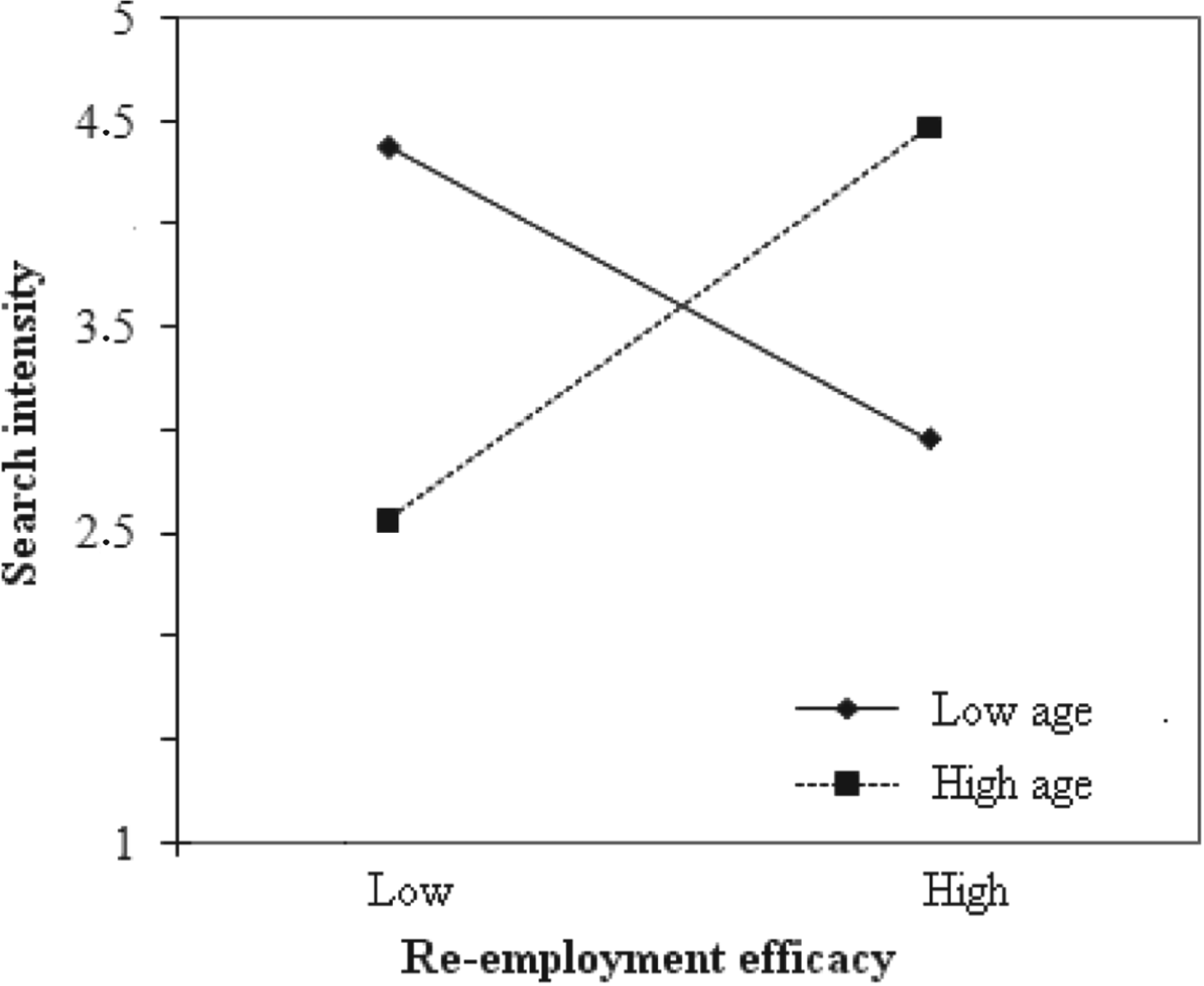
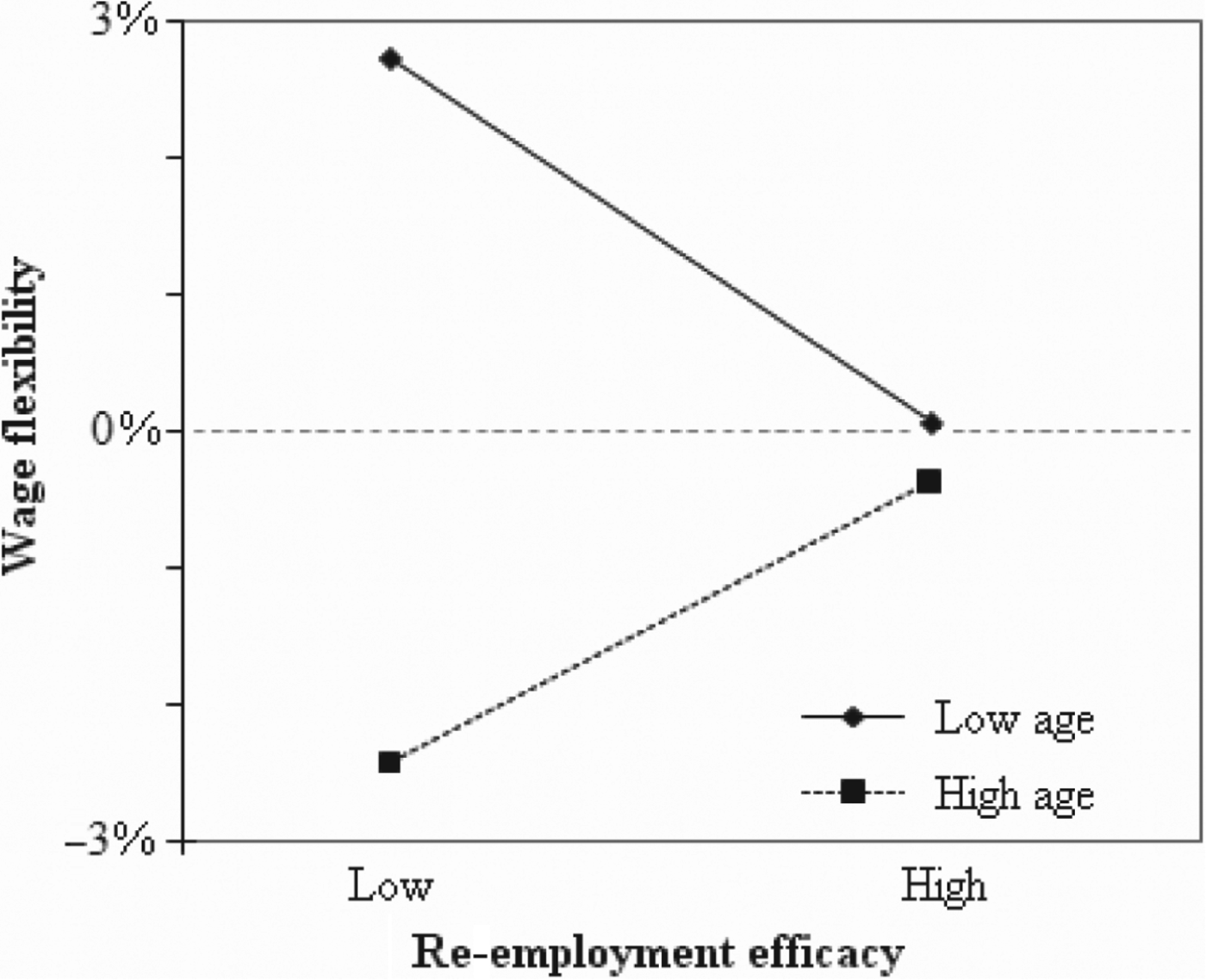
The results indicate that re-employment efficacy relates to both search intensity and wage flexibility. Moreover, both relationships are moderated by job seekers’ age. The interaction effects are plotted in Figures 2 and 3 for low (i.e. one SD below the mean) and high (i.e. one SD above the mean) values of re-employment efficacy. Figure 2 supports hypothesis 3a, stating that re-employment efficacy relates to search intensity in a negative way among younger job seekers, while the relationship is positive for older job seekers. Furthermore, simple slopes analysis reveals a marginally significant relationship for job seekers with low age (one SD below the mean; β=−0.76, p=0.11) and a positive relationship for job seekers with high age (one SD above the mean; β=0.10, p<0.05).
Age as moderator of the relationship between re-employment efficacy and search intensity.
Age as moderator of the relationship between re-employment efficacy and wage flexibility.
Additionally, Figure 3 and simple slopes analysis support hypothesis 3b as wage flexibility relates negatively to re-employment efficacy for younger job seekers (one SD below the mean; β=−1.42, p<0.01), while there is a positive relationship for older job seekers (one SD above the mean; β=1.11, p<0.05). Note that older job seekers generally have lower wage flexibility. Younger individuals’ wage flexibility is 5 per cent higher than the one of older job seekers when re-employment efficacy is low.
Discussion
Our analyses supported previous research (Kanfer, Wanberg and Kantrowitz Reference Kanfer, Wanberg and Kantrowitz2001; Šverko et al. Reference Šverko, Galić, Seršić and Galešić2008) indicating that employment commitment positively relates to search intensity. However, contrary to what we expected, age does not moderate the relationship. Although moving towards the retirement age may change people's time perspective (Carstensen Reference Carstensen1995, Reference Carstensen, Heckhausen and Dweck1998), workers of different ages are equally activated by the intrinsic importance attached to work. Furthermore, we did not find a relationship between employment commitment and wage flexibility, irrespective of job seekers’ age. Apparently, as employment commitment increases, job seekers tend to search more intensively rather than increasing their wage flexibility.
Financial hardship turned out to play a complementary role as it only relates to wage flexibility. Regardless of their age, job seekers lower their wage flexibility as they experience more financial difficulties. While being more flexible increases one's chance of finding employment (Bloemen and Stancanelli Reference Bloemen and Stancanelli2001; Mortensen Reference Mortensen, Ashenfelter and Layard1986), it may also lead to a job with a wage that does not suffice to fulfil one's financial obligations. Nevertheless, our analyses cannot rule out the possibility that job seekers compromise on other levels, like the geographical region one targets, working hours or benefits.
Re-employment efficacy relates to both search intensity and wage flexibility. Moreover, the nature of the relationship depends on job seekers’ age. This is in line with the motivational theory of lifespan development (Heckhausen, Wrosch and Schulz (Reference Heckhausen, Wrosch and Schulz2010). As hypothesised, younger job seekers show higher search intensity and higher wage flexibility when their re-employment efficacy decreases. This negative relationship also supports control theory (Powers Reference Powers1973, Reference Powers1991) as action is taken to reduce the distance to the goal state of finding re-employment. Additionally, our analyses confirm that re-employment efficacy positively relates to search intensity and wage flexibility for older job seekers. Lower levels of re-employment efficacy may incite older job seekers to disengage from job search because it might be too hard to attain the goal within the given time frame. Higher levels of re-employment efficacy appear to stimulate older job seekers to search intensively and increase their wage flexibility in order to achieve their attainable goal given the approaching deadline. Therefore, as job seekers age, social-cognitive theory (Bandura Reference Bandura1991) and expectancy–value theory (Vroom Reference Vroom1964) rather than control theory (Powers Reference Powers1973, 1991) apply to the relationship between re-employment efficacy and dimensions of job search. Since this study uses a sample consisting of respondents that recently lost their job and initiated their search for work in an outplacement programme, the sample is homogenous on these characteristics and results are not biased by unemployment duration.
Contribution to theory and practice
This study reveals that it is highly relevant to integrate concepts from the psychological and economic search literature in one study (McFadyen and Thomas Reference McFadyen and Thomas1997). While this integration rarely happens in empirical studies (Kanfer, Wanberg and Kantrowitz Reference Kanfer, Wanberg and Kantrowitz2001), we find that both job search intensity and wage flexibility relate to employment commitment, financial hardship and re-employment efficacy. It is highly relevant to study both aspects of job search and gain insight into the strategy job seekers use to find re-employment. Additionally, this study adds to literature on older individuals’ labour market situation. Overall, both psychological and economic studies on job search implicitly presume that the studied relationships are similar for job seekers from different ages. This study shows that this assumption only holds for some relationships as the role of re-employment efficacy changes with job seekers’ age.
From a practical point of view, this study shows how job seekers’ search intensity and wage flexibility can be interfered with. Since employment commitment generally relates to search intensity in a positive way, it offers policy makers an instrument in their search for measures to activate older job seekers. This particularly applies to the Belgian labour market, which is characterised by an ‘early exit culture’, wherein early retirement is socially accepted from a certain age (Guillemard Reference Guillemard2003). For instance, in 2010, Belgian workers on average retired at age 59.5 (cf. data from the National Institute of Statistics) while the official age of retirement is 65. Moreover, since attractive alternative pathways to retirement are available, people may consider work to be one of multiple options (Organisation for Economic Co-operation and Development 2006). As the presence of an early exit culture and alternative pathways to retirement may reduce the importance of work for older job seekers, it is important to take measures to maintain and increase employment commitment in late career as it is an important predictor of search intensity and the chance of finding employment (Ginn and Arber Reference Ginn and Arber1996; Kanfer, Wanberg and Kantrowitz Reference Kanfer, Wanberg and Kantrowitz2001).
One can also interfere with job seekers’ re-employment efficacy to steer their search intensity and wage flexibility. While high levels of re-employment efficacy may incite younger job seekers to become over-confident, it stimulates older job seekers to increase their search intensity and wage flexibility. Since research has shown that these two aspects of job search positively impact the chance of finding a job (Bloemen and Stancanelli Reference Bloemen and Stancanelli2001; Kanfer, Wanberg and Kantrowitz Reference Kanfer, Wanberg and Kantrowitz2001), it is important to increase older job seekers’ confidence in their capacity to find employment. While job counsellors may help identify career opportunities, employers may help increase re-employment efficacy by creating opportunities.
Finally, we note that in case of high re-employment efficacy, job seekers of different ages turn out to have similar levels of wage flexibility. Yet, this does not mean that they demand similar (absolute) wages. As wage flexibility measures how people's reservation wage relates to the previous wage and older job seekers often earned higher wages in their previous job (e.g. because of seniority wages), they may still claim higher wages in future jobs compared to younger job seekers.
Limitations and future research
This study has some limitations that should be taken into account in future research. First, the cross-sectional design of the study does not allow testing of the causality implied by the model. Longitudinal data would moreover make it possible to make a distinction between age-related differences and cohort differences. An optimal design would examine individuals’ job search behaviour from the first day of their search until they find re-employment. Previous research concluded that the chance of finding employment increases with search intensity (Kanfer, Wanberg and Kantrowitz Reference Kanfer, Wanberg and Kantrowitz2001) and decreases as the reservation wage increases, i.e. wage flexibility decreases (Bloemen and Stancanelli Reference Bloemen and Stancanelli2001). Yet, the effectiveness of search behaviour may depend on the job seeker's age. Wanberg, Watt and Rumsey (Reference Wanberg, Watt and Rumsey1996) concluded, for instance, that the positive relationship between search intensity and the chance of finding employment does not apply to job seekers over 40. Future research can verify how search intensity and wage flexibility affect the chance of finding a job for job seekers of different ages.
Second, the results apply to unemployed adult job seekers who used to be employed and should not be generalised to graduates looking for work or to employed job seekers. Moreover, the participants were at the start of an outplacement programme, mostly after experiencing collective redundancies. However, at the time of the survey, the outplacement counselling had not started. Hence, it cannot have had a direct impact on the results of this study. At most, there may have been an indirect effect caused by the prospect of participating in the outplacement programme. Still, the type of job loss may signal worker quality to future employers. Research, for instance, shows that workers displaced in mass layoffs received higher post-unemployment wages than workers individually laid off (Gibbons and Katz Reference Gibbons and Katz1991). Hence, the type of job loss may affect job seekers’ wage flexibility. Moreover, unemployed job seekers turn out to search less actively when redundancy was involuntary (Waters Reference Waters2007). Therefore, future research should verify whether the results can be generalised to other types of job seekers. Since all hypotheses are built using universal theoretical frameworks, all the studied relationships can be expected to apply in other contexts from a theoretical point of view.
Third, our study has been conducted in Belgium. Lifespan theories, such as socio-emotional selectivity theory and the motivational theory of lifespan development, assume that people change as they age. From this theoretical point of view, the studied relationships remain valid in other welfare regimes/geographical areas. However, several characteristics of the Belgian labour market may impact the effect sizes and the slopes of the relationships. Since Belgium has an early exit culture, job seekers may at a relatively young age experience an approaching deadline. Moreover, although early exit schemes are being restricted, older Belgian job seekers may still have the opportunity to leave the labour market at a relatively early age (from 52 to 60 years, depending on several conditions). These alternatives may incite them to disengage from job search. Consequently, while the results can be expected to remain valid based on lifespan theories, the strength of the relationships may differ in more active ageing cultures. Future research could examine the effect of different institutional settings on the relationship between antecedents and indicators of job search among different age groups.
Acknowledgements
We would like to thank Dorien Vanhercke (KU Leuven, Work, Organisational and Personnel Psychology) as well as the outplacement agency Ascento for collecting the data among job seekers entering an outplacement programme. This study would not have been possible without their help. This study is based on confidential survey data collected via voluntary participation. It complies with the ethical code of the KU Leuven and the Belgian privacy law (http://www.privacycommission.be/). The Belgian privacy commission approved the collection and processing of the personal data (registration number 78659). This publication results from research project n° G.0086.08N funded by the Research Foundation – Flanders (FWO). It was also financially supported by the Research Fund KU Leuven.