His love for all things beautiful aside, Kingfisher also wants to ensure his public image is well-received […]
– In ‘The Most Beautiful Bird’; Wild Wise Weird (Vuong Reference Vuong2024)
Introduction
Human civilizations have long been accustomed to using products made from animal skin and fur, such as clothing, accessories, blankets, furniture and decorations. Early humans knew to use dead animals’ skin and fur to protect their bodies from physical impacts and low temperatures. Besides natural survival purposes, humans in complex societies also innovate with animal skin and fur for social survival purposes (Vuong Reference Vuong2022). Attractive appearances and possessions made from natural products, including animals, soon became important parts of human culture, including with regards to aspects such as aesthetics, social power and spirituality. For example, fur has been considered a luxury good from ancient times until today, both for its quality of utility and for it representation of social distinction (Csaba & Skjold Reference Csaba and Skjold2018).
Setting aside the moral debate over the usage of animal-based products, harvesting and consuming them in an unsustainable manner can be problematic in the long term (Nguyen & Jones Reference Nguyen and Jones2022). There has been an average 68% decline in population sizes across 21 000 monitored populations of 4392 species between 1970 and 2016 (World Wildlife Fund 2020). Many environmental scientists argue that a sixth mass extinction is underway, driven primarily by unsustainable human activities, including the consumption of products made from fur and leather (Kolbert Reference Kolbert2014, Pievani Reference Pievani2014, Aiama et al. Reference Aiama, Carbone, Cator and Challender2016, Cowie et al. Reference Cowie, Bouchet and Fontaine2022).
Animal-based products are derived primarily from two sources: domesticated or farmed animals and wild animals. Unsustainable harvesting of animal fur and leather from either source can significantly contribute to biodiversity loss (Aiama et al. Reference Aiama, Carbone, Cator and Challender2016). For instance, the demand for leather products places substantial pressure on the livestock sector, such as cattle farming (Aiama et al. Reference Aiama, Carbone, Cator and Challender2016). Increased livestock production can directly and indirectly drive biodiversity loss by causing ecosystem degradation, including deforestation for grazing and croplands, agricultural intensification, desertification, climate change, the spread of invasive species and the decline of animal genetic resources (Opio et al. Reference Opio, Gerber and Steinfeld2012). In addition, poaching and the trade of wild animals for fashion products are major contributors to species decline. While most animals used in fashion are captive-bred (e.g., crocodiles), some species, such as monitor lizards and pythons, are predominantly sourced from the wild (Luiselli et al. Reference Luiselli, Bonnet, Rocco and Amori2012, Hughes Reference Hughes2021). Of the 100 million animals reared and killed annually for the fur trade, 15% are wild-sourced. This high demand has led to the extinction of species such as the sea mink and Falkland Island fox, and it has placed others, including fur seals, vicuñas and otters, under severe threat (Hughes Reference Hughes2021).
Overall, the current industrial system of making products from animal skin and fur is unsustainable, and it includes some practices that are considered not only ethically questionable but also environmentally harmful. Despite the recent shift in awareness towards what is often termed ‘eco-fashion’, a substantial part of the luxury and fashion industry involving fur products is still conducive to non-sustainable consumption (Ramchandani & Coste-Maniere Reference Ramchandani, Coste-Maniere and SS2017). Wild fur harvesting (e.g., hunting, trapping) and trading have become much more restricted today compared to in previous centuries, but regulations are not fully effective, leaving open the opportunity for continuous exploitation (Tapper & Reynolds Reference Tapper, Reynolds, Taylor and Dunstone1996).
Given the environmental impacts of unsustainable animal product consumption, psychological studies have explored consumer behaviour regarding such products from various perspectives. Unlike instinct-driven actions in other animals, human consumption behaviours are heavily influenced by reasoned intentions. The theory of planned behaviour (TPB), an extension of the earlier theory of reasoned action (TRA), is frequently employed in social sciences to examine the link between human intention and behaviour (Ajzen Reference Ajzen1991, Madden et al. Reference Madden, Ellen and Ajzen1992).
Summers et al. (Reference Summers, Belleau and Xu2006) applied the TRA to study consumer behaviour towards apparel made from alligator leather, a controversial luxury product. They found that attitudes, subjective norms, controversy perceptions (social acceptance) and fashion involvement predicted female consumers’ purchase intentions. Similarly, Paul et al. (Reference Paul, Modi and Patel2016) demonstrated that the TPB mediates the relationship between environmental concern and green product purchase intentions. Using the TPB, Jung and Oh (Reference Jung and Oh2019) identified that intentions to purchase eco-friendly faux leather apparel align with pro-environmentalism and social responsibility, which are key elements of consumers’ belief systems.
Moreover, recent studies suggest that sociocultural values also drive human mental processes and behaviours. For example, Liu et al. (Reference Liu, Liu, Pérez, Chan, Collado and Mo2020b) showed that social pressure plays the most significant role in shaping consumers’ intentions to purchase ethical fashion, while trust and knowledge also contribute. Shin and Jin (Reference Shin and Jin2021) revealed that status-seeking consumers display high purchase intentions for both genuine fur coats and faux fur alternatives, although any perceived stigma affects only genuine fur coats. However, we believe that no studies have examined how the interactions between perceptions of biodiversity loss consequences and the belief in its existence and significance are associated with animal skin and fur consumption.
We applied the mindsponge theory to conceptualize how perceptions of biodiversity loss and related beliefs interact to influence animal skin and fur consumption. Originally developed to study acculturation, this theory likens the mind to a sponge that selectively absorbs values deemed beneficial while rejecting those considered harmful or irrelevant (Vuong & Napier Reference Vuong and Napier2015). It has been extended through insights from quantum mechanics and Shannon’s information theory (Shannon Reference Shannon1948, Rovelli Reference Rovelli2018, Vuong & Nguyen Reference Vuong and Nguyen2024a). The updated theory suggests that various forms of information, such as perceptions and beliefs, interact within the mind to generate perceived value and mental outcomes, including preferences and behaviours (Vuong & Nguyen Reference Vuong and Nguyen2024b). Thus, it provides a robust reasoning model for understanding complex psychological processes that involve multiple interacting factors, such as perceptions of biodiversity loss, beliefs about its existence and assessments of its significance (Nguyen et al. Reference Nguyen, Nguyen, Jin, Nguyen, La, Le and Vuong2023b, Vuong et al. Reference Vuong, Duong, Sari, La and Nguyen2024).
Vietnam is located in the Indo-Burma biodiversity hotspot, but its biodiversity loss situation is severe. Compared to the first Vietnam Red List published in 1992, the 2007 edition of the Vietnam Red List recognized 882 vulnerable and endangered species (418 animals and 464 plants), representing an increase of 22% (161 species; Ministry of Natural Resources and Environment 2014). Vietnam is also among the top five processing hubs for wildlife products, including products in the fashion category (e.g., furs and hide), according to an analysis of the 20-year UN Comtrade database (Andersson et al. Reference Andersson, Tilley, Lau, Dudgeon, Bonebrake and Dingle2021). However, the association between urban residents’ perceptions and personal interests and actual consumption behaviours related to skin and leather products in Vietnam remains largely understudied. While existing research has acknowledged the use of such products (Drury Reference Drury2011, Natusch & Lyons Reference Natusch and Lyons2014, Davis et al. Reference Davis, Willemsen, Dang, O’Connor and Glikman2020, Rizzolo Reference Rizzolo2020), such studies mainly focus on the sociopsychological drivers behind the consumption of wild meat and traditional medicinal items, with limited attention having been given to skin and leather products specifically.
The current study of Vietnamese urban residents aimed to utilize Bayesian mindsponge framework (BMF) analytics to address three research questions: (1) Are Vietnamese urban residents with higher perceived consequences of biodiversity loss less likely to be interested in consuming products made from animal fur and leather? (2) Do Vietnamese urban residents with higher perceived consequences of biodiversity loss obtain fewer numbers of products made from animal fur and leather? (3) Do the effects of Vietnamese urban residents’ perceptions of biodiversity loss on their personal preferences and actual consumption vary according to their beliefs about the existence and significance of biodiversity loss?
Methods
Theoretical foundation and assumptions
Given the complexity of this study, we employ the mindsponge theory (Vuong & Napier Reference Vuong and Napier2015, Vuong Reference Vuong2023) as the theoretical foundation. This is a dynamic information-processing theory that conceptualizes how the mind filters and processes information. Based on the theory’s reasoning, we assumed that if people perceive biodiversity loss as costly by knowing its adverse consequences, they will be less likely to absorb information that is associated with biodiversity loss, such as using products made from animal fur and leather, resulting in more negative attitudes (personal preferences) towards such products and actual consumption (ownership of fewer products).
However, subjective cost–benefit judgements are also greatly driven by the interactions of newly absorbed information with value systems sculptured by individuals’ mindsets, or sets of highly trusted values/beliefs (Vuong et al. Reference Vuong, Nguyen and La2022b). In other words, the cost–benefit judgements regarding similar pieces of information can be different if they interact with different value systems. As a result, we also assumed that the effects of perceptions regarding biodiversity loss consequences on personal preferences and ownership of products made from animal fur and leather would vary depending on individuals’ beliefs in biodiversity loss. In particular, it was expected that in the scenario in which urban residents believe biodiversity loss is real and a major problem, there would be effects of biodiversity loss perceptions on personal preferences and actual consumption; on the other hand, when urban residents believe biodiversity loss is not real or not a significant problem, there would not be effects of biodiversity loss perceptions.
Model construction
Dataset and selected variables
We analysed samples from a dataset of 535 Vietnamese urban residents’ wildlife consumption behaviours, multifaceted perceptions and interactions with biodiversity-related concepts (Nguyen Reference Nguyen2021). Exponential non-discriminative snowball sampling was employed for survey collection. Urban residents’ responses were collected through an online survey over 2 months using Google Forms from 18 June to 8 August 2021. Before filling in the questionnaire, respondents were asked to read and agree to the consent form that specified the study aims, questionnaire components and participant confidentiality. Because the survey collection was not funded, it is not bound by any contractual duties and could wholly prioritize the obligations to safeguard participants (Brittain et al. Reference Brittain, Ibbett, de Lange, Dorward, Hoyte and Marino2020). Gift cards with values ranging from USD 1 to 10 were sent to 200 randomly selected respondents when the survey collection was completed. Initially, 581 responses were received. However, Nguyen (Reference Nguyen2021) curated and removed unqualified data, resulting in 535 eligible responses from 34 urban areas across Vietnam.
Most respondents resided in the two largest cities in Vietnam: Ho Chi Minh (64.86%) and Hanoi (20%); 58.31% of the respondents were female, accounting for a greater percentage than their male counterparts (41.12%). The mean age was 33.80 years. A majority of respondents reported that they had spent most of their lives in urban zones (84.86%), while 10.09% and 4.86% of respondents reported having spent most of their lives in suburban and rural areas, respectively. The respondents’ occupational backgrounds were diverse, ranging from accountants, activists and actors to employees, students and retirees.
The respondents in this study were predominantly well-educated, with 63.18% holding an undergraduate degree and 21.87% possessing a post-graduate degree. Given that a 2020 labour survey indicated that only 22.1% of the national workforce in urban centres holds a bachelor’s degree or higher (General Statistics Office of Vietnam 2022), the proportion of respondents who had received some higher education (85.05%) in this study significantly exceeds the national urban average. Consequently, the sample may not be fully representative of the broader urban population in Vietnam, as it is skewed towards more highly educated individuals. Interpretations of the findings should, therefore, be made with caution, acknowledging this demographic bias.
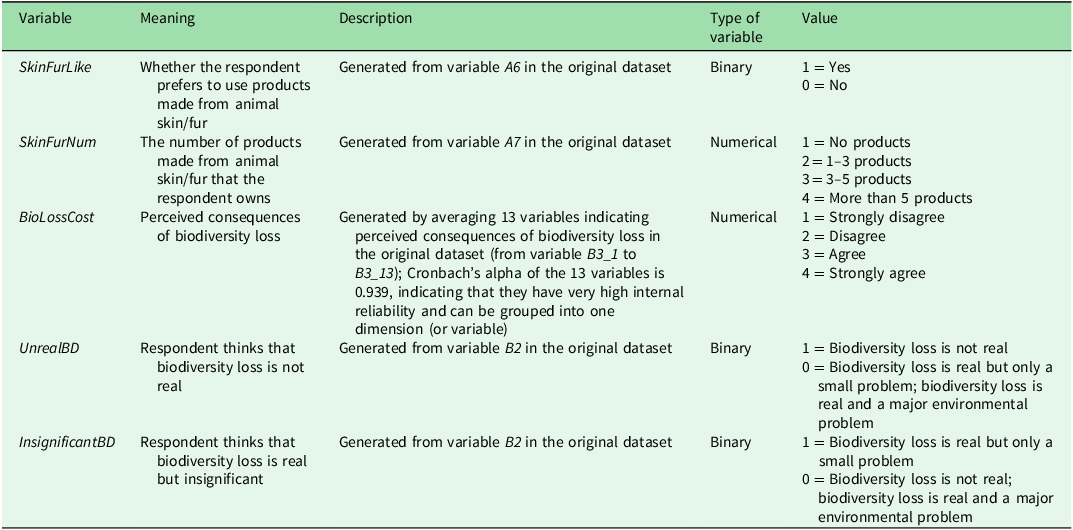
For this study’s analysis, five variables were retrieved and generated from the original dataset (see Table 1).
Variable description.

Statistical models
To test our assumptions, we constructed two analytical models. Model 1 was designed to examine the associations of urban residents’ perceived consequences of biodiversity loss and animal skin and fur product preferences in varying scenarios of biodiversity loss beliefs. Regarding urban residents’ beliefs about biodiversity loss, there are three scenarios: the respondent thinks that biodiversity loss is not real; the respondent thinks that biodiversity loss is real but only a small problem (insignificant); and the respondent thinks that biodiversity loss is real and a major environmental problem (significant).
Model 1 was constructed as follows:
 $$SkinFurLike \sim\;normal\left( {\log \left( {{{{\mu _i}}} \over{{1 - {\mu _i}}}} \right),\sigma } \right)$$
 $$\begin{align}\log \left( {{{{\mu _i}}} \over{{1 - {\mu _i}}}} \right) &= {\beta _0} + {\beta _1}*BioLossCos{t_i} + {\beta _2}*BioLossCos{t_i}\\&\,\,\,\,\,\,\,\,*UnrealB{D_i} + {\beta _3}*BioLossCos{t_i}\\&\,\,\,\,\,\,\,\,*InsignificantB{D_i}\end{align}$$
 $$\beta \sim\;normal\left( {M,S} \right)$$
The probability around the mean
 $\log \left( {{{{\mu _i}}}\over{{1 - {\mu _i}}}} \right)$
was determined by the shape of the normal distribution, where the width of the distribution is specified by the standard deviation
 $\sigma $
.
 ${\mu _i}$
represents the probability that resident
 $i$
prefers to use products made from animal skin/fur. The interaction between
 $BioLossCost$
and
 $UnrealBD$
was added to the model to examine the outcome of preference in the first scenario. In contrast, the interaction between
 $BioLossCost$
and
 $nsignificantBD$
was added to examine this outcome in the second scenario. When both the interaction terms were 0, the remaining effect of
 $BioLossCost$
on
 $SkinFurLike$
represented the outcome in the third scenario. Model 1 had three coefficients,
 ${\beta _1}$
to
 ${\beta _3}$
, the intercept,
 ${\beta _0}$
, and the standard deviation of the ‘noise’,
 $\sigma $
. The coefficients of the predictor variables were distributed as a normal distribution around the mean, denoted
 $M$
, and with the standard deviation denoted by
 $S$
.
Model 2 was designed to examine the associations of urban residents’ perceived consequences of biodiversity loss and the number of owned animal skin and fur products in varying scenarios of biodiversity loss beliefs. It was constructed as follows:
 $$SkinFurNum\;\sim\;normal\left( {\mu, \sigma } \right)$$
 $$\begin{align}{\mu _i} &= {\beta _0} + {\beta _1}*BioLossCos{t_i} + {\beta _2}*BioLossCos{t_i}*UnrealB{D_i} \\&\,\,\,\,\,\,\,+ {\beta _3}*BioLossCos{t_i}*InsignificantB{D_i}\end{align}$$
 $$\beta \;\sim\;normal\left( {M,S} \right)$$
 ${\mu _i}$
of Model 2 represented the number of animal skin and fur products owned by resident
 $i$
.
Analysis and validation
The BMF was applied, combining mindsponge-based reasoning with Bayesian inference (Nguyen et al. Reference Nguyen, La, Le and Vuong2022). The BMF followed the parsimonious principle, favouring simpler models with fewer variables, which may lead to higher uncertainties. Bayesian inference addressed this by treating unknown parameters probabilistically (Gill Reference Gill2014), allowing us to focus on key issues. Markov chain Monte Carlo (MCMC) algorithms supported this process by generating large samples from the model’s posterior distribution, enabling flexible model fitting, including interactions (Dunson Reference Dunson2001, Cowles Reference Cowles2013, Wagenmakers et al. Reference Wagenmakers, Marsman, Jamil, Ly, Verhagen and Love2018). Additionally, Bayesian estimation and visualization of credible intervals offered a useful alternative to p-values, addressing concerns over reproducibility in the social sciences and psychology (Halsey et al. Reference Halsey, Curran-Everett, Vowler and Drummond2015, Open Science Collaboration 2015, Camerer et al. Reference Camerer, Dreber, Holzmeister, Ho, Huber and Johannesson2018).
Bayesian analysis incorporates prior knowledge (e.g., experience, evidence) to guide estimation. To minimize subjectivity, we used uninformative priors (flat distributions), which provide the least amount of prior information to the model estimation (Diaconis & Ylvisaker Reference Diaconis, Ylvisaker, Bernardo, DeGroot, Lindley and Smith1985). In addition, the model’s robustness was also tested using the ‘prior-tweaking’ technique (Vuong et al. Reference Vuong, Ho, Nguyen, Thang Hang, Vuong and Khuc2021). An informative prior (normal distribution with mean 0 and standard deviation 0.2) reflecting our disbelief in the proposed effects was employed. The model was deemed robust if the posterior outcomes were consistent across both priors.
We employed several techniques to validate the simulated posteriors. The first step involved validating the convergence of Markov chains through the diagnostic statistics’ effective sample size (n_eff) and Gelman shrink factor (Rhat). Commonly, if the n_eff value is greater than 1000 and the Rhat value is equal to 1, the model’s Markov chains can be deemed convergent. Then, the convergence was also diagnosed through graphical figures, such as trace plots.
Bayesian analyses were conducted using the open-source bayesvl package in R due to its accessibility, user-friendly interface and strong pedagogical value (La & Vuong Reference La and Vuong2019). The package also generates clear graphics for result presentation and supports result replication. All models were fitted with the following MCMC setup: 5000 iterations, 2000 warm-up iterations and 4 Markov chains. Data files and code snippets are available for transparency and reproduction at https://zenodo.org/records/14637101 (Vuong Reference Vuong2018, Reference Vuong2020).
Results
Model 1: preference for products made from skin/fur
All of the diagnostic statistics of Model 1 showed good signals of model convergence (Table 2). In particular, the parameters’ n_eff values were greater than 1000, and their Rhat values were equal to 1. All of the Markov chains fluctuated around the equilibrium around a central equilibrium, indicating the convergence of simulated samples after the warm-up period and before the 2000th iteration (Fig. S1).
Model 1’s simulated posteriors.

The estimated posterior results using uninformative priors show that BioLossCost had a negative impact on SkinFurLike (
 ${M_{BioLossCost}}$
= –0.19 and
 ${S_{BioLossCost}}$
= 0.20), while BioLossCost*UnrealBD and BioLossCost*InsignificantBD had positive impacts on SkinFurLike (
 ${M_{BioLossCost*UnrealBD}}$
= 0.33 and
 ${S_{BioLossCost*UnrealBD}}$
= 0.21;
 ${M_{BioLossCost*InsignificantBD}}$
= 0.29 and
 ${S_{BioLossCost*InsignificantBD}}$
= 0.16).
The posterior distributions of three coefficients showed, specifically, that although a large part of BioLossCost’s 89% highest posterior density interval (HPDI) lay on the negative side of the origin, a small proportion of it was still distributed on the positive side, indicating that the negative effect of BioLossCost on SkinFurLike only had moderate reliability (Fig. 1). In contrast, the 89% HPDIs of BioLossCost*UnrealBD and BioLossCost*InsignificantBD were located on the positive side of the origin, suggesting the high reliability of these effects.
Model 1’s estimated posterior distributions using uninformative priors. The probability distributions of the parameters are displayed, with the mode having the highest probability parameter. The illustration’s bottom thick black line shows 89% of the distribution of the highest posterior density interval (HPDI).

When simulated using informative priors reflecting our disbelief in the associations between predictor and outcome variables, the magnitudes of the parameters’ mean values decreased. Nevertheless, their patterns remained similar to the simulated results using uninformative priors. Therefore, it is plausible that the effect patterns of BioLossCost, BioLossCost*UnrealBD and BioLossCost*InsignificantBD were robust or not sensitive to prior adjustment.
To aid interpretation, we calculated and visualized the probability of preferring animal skin and fur products (Fig. 2). In scenarios in which people believed that biodiversity loss is either unreal or real but insignificant, greater awareness of its consequences increased preference (green and blue columns, respectively, in Fig. 2). However, when people viewed biodiversity loss as real and significant, heightened awareness led to a decreased preference for animal skin/fur products (yellow column in Fig. 2).
Estimated probabilities of being interested in products made from animal fur and skin based on different biodiversity loss beliefs and perception scenarios. The x-axis represents the urban residents’ level of agreement on the consequences of biodiversity loss, while the y-axis represents the probability of preferring animal skin/fur products.

Model 2: ownership of products made from skin/fur
The diagnostic values of Model 2 indicated a good convergence signal of the Markov chains. All parameters’ n_eff values were higher than 6000, and their Rhat values equalled 1. The trace plots also confirmed the convergence of the model simulation, suggesting that posterior results can be interpreted (Fig. S2).
The analysis reveals that BioLossCost*UnrealBD had no impact on SkinFurNum (
 ${M_{BioLossCost*UnrealBD}}$
= 0.00 and
 ${S_{BioLossCost*UnrealBD}}$
= 0.05). BioLossCost and BioLossCost*InsignificantBD were positively associated with SkinFurNum (
 ${M_{BioLossCost}}$
= 0.02 and
 ${S_{BioLossCost}}$
= 0.04;
 ${M_{BioLossCost*InsignificantBD}}$
= 0.12 and
 ${S_{BioLossCost*InsignificantBD}}$
= 0.04). These effect patterns were robust even when the priors were modified to reflect our disbelief in the effects (Table 3).
Model 2’s simulated posteriors.

The reliability of the associations of BioLossCost and BioLossCost*InsignificantBD with SkinFurNum was checked through their posterior distributions (Fig. 3). Specifically, most of the simulated samples of BioLossCost were located around the origin of the x-axis, displaying an ambiguous pattern of BioLossCost’s effect on SkinFurNum. However, almost all of the simulated samples of BioLossCost*InsignificantBD were located on the positive side of the y-axis’s origin, confirming that the effect was highly reliable.
Model 2’s two-dimensional density plot of BioLossCost and BioLossCost*InsignificantBD. The x-axis and y-axis reflect the value distributions of iterative samples of BioLossCost and BioLossCost*InsignificantBD, respectively. The area with the highest density of the iterative samples shows the highest probability values that the coefficients have.

To aid interpretation, we plotted the estimated number of owned skin/fur products based on beliefs and perceptions of biodiversity loss consequences in Fig. 4. For those who believed that biodiversity loss was insignificant, a higher degree of its perceived consequences was correlated with owning more products made from skin/fur (blue column in Fig. 4). In contrast, for those who viewed biodiversity loss as a major problem or denied its existence, ownership remained unaffected by perceptions of its consequences (yellow and green columns, respectively, having equal height in Fig. 4).
The estimated number of owned animal skin and fur products based on different biodiversity loss beliefs and perception scenarios. The x-axis represents the urban residents’ level of agreement on the consequences of biodiversity loss, while the y-axis represents the number of animal skin/fur products owned.

Discussion
We show that well-educated urban people’s preferences for animal skin/fur products are negatively associated with perceived biodiversity loss consequences (Model 1), consistent with previous research linking environmental knowledge to pro-environmental attitudes (Rajapaksa et al. Reference Rajapaksa, Islam and Managi2018, Geiger et al. Reference Geiger, Geiger and Wilhelm2019, Janmaimool & Khajohnmanee Reference Janmaimool and Khajohnmanee2019, Liu et al. Reference Liu, Teng and Han2020a, Ienna et al. Reference Ienna, Rofe, Gendi, Douglas, Kelly and Hayward2022). However, for individuals who believed that biodiversity loss was not real or insignificant, this effect was reversed: the more they agreed with the consequences of biodiversity loss, the more they preferred fur/skin products. While this may seem counterintuitive, it becomes clearer when we consider how beliefs interact with knowledge in subjective cost–benefit evaluations.
Perceptions of negative consequences typically reduced preferences for behaviours that cause such impacts due to perceived costs, but only if these consequences were accepted as trusted values in people’s mindsets. In other words, knowledge must be believed to be valuable in order to influence subsequent evaluations (Vuong et al. Reference Vuong, Nguyen and La2022b). Otherwise, knowledge can temporarily reside in the mind’s buffer zone, awaiting further assessment, without influencing core values. Without belief in biodiversity loss, its perceived consequences represent memorized information without subjective acceptance. When such information is continuously reinforced by its persistent presence in the surrounding environment, it can become a cliché with no practical significance. This is like a student memorizing facts for a test without understanding or believing them. Especially in the context of this study, Vietnamese people’s high degree of cultural additivity allows individuals to hold new values without significant cognitive dissonance, even if those values conflict (Vuong et al. Reference Vuong, Bui, La, Vuong, Nguyen and Ho2018, Nguyen & Jones Reference Nguyen and Jones2022).
For individuals who do not believe in the existence or impacts of biodiversity loss, absorbing information about its negative consequences can increase cognitive dissonance. When existing beliefs conflict with new, poorly accepted values, exposure to pro-environmental information may backfire. This effect is similar to how perceived greenwashing triggers scepticism and negative reactions in consumers (Rahman et al. Reference Rahman, Park and Chi2015, Szabo & Webster Reference Szabo and Webster2021), or how some people disregarded COVID-19 warnings despite being aware of them, going on to engage in risky behaviours (Ullah et al. Reference Ullah, Khan, Tahir, Ahmed and Harapan2021, Vuong et al. Reference Vuong, Le, La, Nguyen, Ho, Van Khuc and Nguyen2022a). In these cases, individuals are aware of the information but choose not to believe it.
We also show that the moderating effect of complete disbelief is stronger than beliefs of insignificance, aligning with our reasoning (Model 1). This suggests that when one’s beliefs closely match objective reality (e.g., biodiversity loss impacts), the perceptions better align with natural ecological processes. According to the ecomindsponge framework (Nguyen et al. Reference Nguyen, Le and Vuong2023a), an individual’s subjective sphere of influence must have a low deviation from its corresponding objective sphere of influence (physical interactions) to develop a healthy, eco-friendly mindset. Shifting collective societal values towards an eco-surplus culture, in which environmental protection and restoration are viewed as prerequisites for socioeconomic well-being, psychological health and long-term sustainability, hinges on this (Vuong Reference Vuong2021, Vuong & Nguyen Reference Vuong and Nguyen2024a). Conversely, stronger disbelief, when exposed to contradicting information, reinforces perceptions of reality in the opposite direction, increasing cognitive dissonance and subjective sphere deviation. As a result, individuals in these groups may develop more extreme preferences to filter out contradicting information and reduce cognitive dissonance, making them more likely to consume animal-based products.
Unlike Model 1, in Model 2 there were much more complex relationships between the actual number of animal-based products owned (a behavioural measure) and perceived consequences and beliefs about biodiversity loss. For those who believed in biodiversity loss but viewed its significance as minor, higher perceived consequences were associated with owning more animal-based products. However, no such effect was observed among those who denied the existence of biodiversity loss.
Several factors can explain the unexpected results of Model 2. Pro-environmental behaviours are complex and are influenced by multiple, often unexamined factors (Kollmuss & Agyeman Reference Kollmuss and Agyeman2002). Consumption behaviours are probably shaped by more cost–benefit filtering layers than consumption attitudes or preferences, and mental values must reach specific thresholds to be translated into behaviour. In Vietnam, especially regarding luxury goods, consumption is affected by various sociocultural influences, such as Confucian values, as well as the perceptions of younger generations (Ha & Tam Reference Ha and Tam2015, Le & Quy Reference Le and Quy2020, Jain Reference Jain2024). Other ‘passive’ reasons for product ownership, such as inheritance or gifts, may also be contributors. Future research should explore the direct motivations and circumstances behind such product ownership in order to gain deeper insights into this issue.
Given the demographic profile of the study sample, our findings provide important insights into how predominantly highly educated individuals process biodiversity-related information and express preferences for and ownership of animal skin and fur products. While education is often associated with greater environmental awareness and pro-environmental behaviour, our results indicate that education alone is not sufficient to drive behavioural change. Even among individuals with high educational levels, preferences and consumption behaviours related to wildlife-derived products vary considerably depending on underlying belief systems. This finding may help explain the results of previous studies in Vietnam (Drury Reference Drury2011, Sandalj et al. Reference Sandalj, Treydte and Ziegler2016, Shairp et al. Reference Shairp, Veríssimo, Fraser, Challender and MacMillan2016, Nguyen & Jones Reference Nguyen and Jones2022) that identified highly educated individuals as key consumers of wildlife products, not only due to social status and prestige but also because of how their beliefs influence the internalization of environmental information.
We suggest that while raising environmental awareness is important, doing so without considering personal beliefs can undermine its effectiveness. At best, it may diminish the impact of environmental campaigns; at worst, it may fuel ‘information wars’ waged by conspiracy theorists, such as biodiversity loss and climate change deniers. In Vietnam, where social status and appearance heavily influence consumption decisions, environmental knowledge alone may not be enough to change preferences regarding luxury goods such as fur and leather. A better understanding of psychological pathways and information processing could improve the effectiveness of pro-environmental marketing campaigns (Lim Reference Lim2016, Gupta et al. Reference Gupta, Lim, Verma and Polonsky2023). However, shifting collective beliefs is challenging; even with the abundance of scientific facts in today’s digital age, some highly educated individuals who understand the importance of biodiversity loss consequences still choose to own wildlife-derived products. Effective policies require a deep understanding of the psychological mechanisms that underpin behaviour, especially among those with high educational levels. As highly educated individuals often occupy leadership roles or influence public discourse, targeting this group effectively could generate spillover effects in broader societal norms and consumption patterns.
In modern society, the value of animal skin and fur is no longer linked to survival, but rather is shaped by sociocultural and economic factors. But are these values worth the destruction of the natural world? This question echoes the concerns of environmental advocates. Therefore, supporting fundamental interdisciplinary research in sociocultural and environmental psychology is essential to understanding the human–nature relationship better and to creating evidence-based policies that align environmental values with human values (Nguyen & Vuong Reference Nguyen and Vuong2025).
The sample’s proportion of highly educated individuals – substantially higher than the national urban average – constrains its representativeness of the broader population of Vietnamese urban residents. The high proportion of degree-holders may be partly due to the use of exponential non-discriminative snowball sampling, which probably reached individuals connected to higher education institutions or professional networks. As a result, the findings may primarily capture the perceptions and behaviours of a more educated and socioeconomically advantaged segment of the urban population.
The online data collection presumably excluded individuals with limited internet access or lower digital literacy. This will have further biased the sample towards highly educated respondents and may explain the underrepresentation of less educated or socioeconomically disadvantaged groups, who might hold different beliefs, values or consumption behaviours related to wildlife products. Thus, the results should be interpreted with caution and not generalized to all urban populations in Vietnam. Future research should adopt more inclusive sampling strategies (e.g., random sampling, mixed-mode data collection and targeted outreach) to achieve greater representativeness across educational, occupational and socioeconomic groups.
Furthermore, we were unable to explore in detail how perceptions and beliefs about biodiversity loss directly influence actual consumption behaviours of animal-based products. Given the complexity of this type of information processing, qualitative research with in-depth interviews could be a useful approach to employ in future studies. Our focus on urban residents means that the motivations for using fur or leather products are probably linked to luxury rather than survival. However, in rural areas of Vietnam, people may use animal skin and fur for practical purposes such as making warm clothing or bags. Future research could therefore compare these populations to gain a deeper understanding of the human–nature relationship across different circumstances of living.
Supplementary materials
The supplementary material for this article can be found at https://doi.org/10.1017/S037689292500013X.
Code and data availability statement
All data and code snippets of this study were deposited at a Zenodo server for transparency and reproduction (https://zenodo.org/records/14637101).
Acknowledgements
The authors thank the Editor-in-Chief, Professor Nicholas VC Polunin, for his thorough editing and valuable guidance, which have significantly enhanced the quality of our manuscript. The authors also thank the anonymous reviewer for their constructive comments and insightful suggestions, which greatly improved the clarity, coherence and overall presentation of the work.
Author contributions
Conceptualization, Q-HV and M-HN; methodology, M-HN; software, M-HN; validation, Q-HV, TEJ and M-HN; formal analysis, TEJ and M-HN; investigation, M-HN; resources, M-HN; data curation, M-HN; writing – original draft preparation, Q-HV and M-HN; writing – review and editing, Q-HV and M-HN; visualization, M-HN; supervision, Q-HV; project administration, Q-HV. All authors have read and agreed to the published version of the manuscript.
Financial support
This research did not receive any specific grant from funding agencies in the public, commercial or not-for-profit sectors.
Competing interests
The authors declare that they have no known competing financial interests or personal relationships that could have appeared to influence the work reported in this paper.
Ethical standards
Not applicable.
Informed consent statement
Written informed consent has been obtained from the participants.