




No CrossRef data available.
Article contents
Serial effects are optimal
Published online by Cambridge University Press: 10 January 2019
Abstract
In the target article, Rahnev & Denison (R&D) use serial effects as an example of suboptimality. We show here that serial effects can be beneficial to perception, serving to reduce both error and response times in a near-optimal fashion. Furthermore, serial effects for stable attributes are positive, whereas those for changeable attributes are negative, demonstrating that they are engaged flexibly to optimize performance.
Information
- Type
- Open Peer Commentary
- Information
- Copyright
- Copyright © Cambridge University Press 2018
References
Alais, D. & Burr, D. (2004) The ventriloquist effect results from near-optimal bimodal integration. Current Biology 14(3):257–62. doi:10.1016/j.cub.2004.01.029.Google Scholar
Beierholm, U., Shams, L., Ma, W. J. & Koerding, K. P. (2008) Comparing Bayesian models for multisensory cue combination without mandatory integration. Paper presented at the Advances in Neural Information Processing Systems 20 (NIPS 2007).Google Scholar
Burr, D. & Cicchini, G. M. (2014) Vision: efficient adaptive coding. Current Biology 24(22):R1096–98. doi:10.1016/j.cub.2014.10.002.Google Scholar
Cicchini, G. M., Anobile, G. & Burr, D. C. (2014) Compressive mapping of number to space reflects dynamic encoding mechanisms, not static logarithmic transform. Proceedings of the National Academy of Sciences of the United States of America 111(21):7867–72. doi:10.1073/pnas.1402785111.Google Scholar
Cicchini, G. M., Arrighi, R., Cecchetti, L., Giusti, M. & Burr, D. C. (2012) Optimal encoding of interval timing in expert percussionists. Journal of Neuroscience 32(3):1056–60. doi:10.1523/JNEUROSCI.3411-11.2012.Google Scholar
Cicchini, G. M. & Kristjánsson, Á. (2015) Guest editorial: On the possibility of a unifying framework for serial dependencies. i-Perception 6(6). doi:10.1177/2041669515614148.Google Scholar
Cicchini, G. M., Mikellidou, K. & Burr, D. (2017) Serial dependencies act directly on perception. Journal of Vision 17(14):6. doi:10.1167/17.14.6.Google Scholar
Cicchini, G. M., Mikellidou, K. & Burr, D. C. (2018) The functional role of serial dependencies. Proceedings of the Royal Society B: Biological Sciences 285:20181722. doi:10.1098/rspb.2018.1722.Google Scholar
Ernst, M. O. & Banks, M. S. (2002) Humans integrate visual and haptic information in a statistically optimal fashion. Nature 415(6870):429–33. Available at: http://dx.doi.org/10.1038/415429a.Google Scholar
Fischer, J. & Whitney, D. (2014) Serial dependence in visual perception. Nature Neuroscience 17(5):738–43. Available at: http://dx.doi.org/10.1038/nn.3689.Google Scholar
Frund, I., Wichmann, F. A. & Macke, J. H. (2014) Quantifying the effect of intertrial dependence on perceptual decisions. Journal of Vision 14(7):9. doi:10.1167/14.7.9.Google Scholar
Jazayeri, M. & Shadlen, M. N. (2010) Temporal context calibrates interval timing. Nature Neuroscience 13(8):1020–26. doi:10.1038/nn.2590.Google Scholar
Liberman, A., Fischer, J. & Whitney, D. (2014) Serial dependence in the perception of faces. Current Biology 24(21):2569–74. doi:10.1016/j.cub.2014.09.025.Google Scholar
Roach, N. W., Heron, J. & McGraw, P. V. (2006) Resolving multisensory conflict: A strategy for balancing the costs and benefits of audio-visual integration. Proceedings of the Royal Society B: Biological Sciences 273(1598):2159–68. doi:10.1098/rspb.2006.3578.Google Scholar
Taubert, J., Alais, D. & Burr, D. (2016) Different coding strategies for the perception of stable and changeable facial attributes. Scientific Reports 6:32239. doi:10.1038/srep32239.Google Scholar
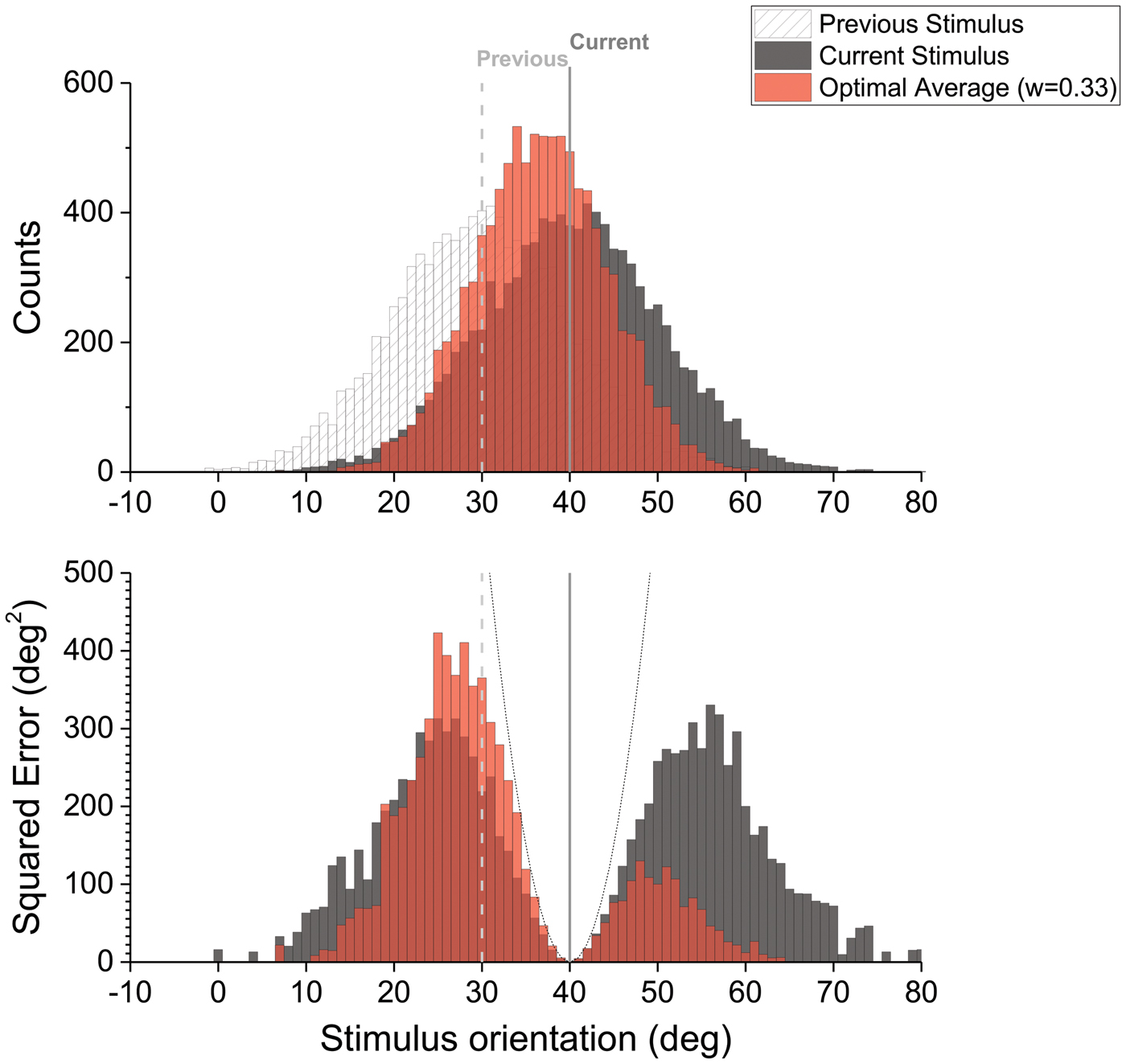
Figure 1. Serial dependence can be optimal. We illustrate the behavior of a noisy observer (σ = 10°) who is bound to estimate a stimulus at 40° orientation and can make optimal use of the previous trial which was at 30°. Response distributions are displayed in the top panel (black, memoryless model; red, model with serial dependence) and show a slight shift of responses toward the previous trial with a tightening of the distribution. Bottom panel shows the histograms of squared error cost: The overall error of the model taking advantage of serial dependencies is smaller than that of the memoryless model.
Target article
Related commentaries (27)
Satisficing as an alternative to optimality and suboptimality in perceptual decision making
The standard Bayesian model is normatively invalid for biological brains
We read with great interest the article by Rahnev & Denison (R&D), reporting both a wide coverage of the issue of optimality in perception, as well as the many instances in which optimality has been hard to prove. One example of non-optimality for the authors is serial dependence, the influence of previous stimuli on current responses, in a sequential task (Burr & Cicchini Reference Burr and Cicchini2014; Cicchini et al. Reference Cicchini, Anobile and Burr2014; Cicchini & Kristjánsson Reference Cicchini2015; Fischer & Whitney Reference Fischer and Whitney2014; Frund et al. Reference Frund, Wichmann and Macke2014; Liberman et al. Reference Liberman, Fischer and Whitney2014). The authors speculate that because the experimental setting prescribes independence between trials, it is suboptimal to carry over information from the previous trial. The only possibility they see is that perhaps the perceptual system is attuned to a general rule of continuity, which accidentally spills over into laboratory performance.
We encountered serial effects while studying perception of numerosity, finding that subjects were strongly biased toward the previous estimate, by up to 20% (Cicchini et al. Reference Cicchini, Anobile and Burr2014). Importantly, at higher numerosities – where sensory resolution is lower – the serial effects were larger. This prompted us to investigate the effect with a standard Bayesian model in which the previous sensory experience can be considered an extra source of information (Fig. 1).
Serial dependence can be optimal. We illustrate the behavior of a noisy observer (σ = 10°) who is bound to estimate a stimulus at 40° orientation and can make optimal use of the previous trial which was at 30°. Response distributions are displayed in the top panel (black, memoryless model; red, model with serial dependence) and show a slight shift of responses toward the previous trial with a tightening of the distribution. Bottom panel shows the histograms of squared error cost: The overall error of the model taking advantage of serial dependencies is smaller than that of the memoryless model.
Simulations show that in the case of similar successive stimuli, this strategy is beneficial, as the uncertainty associated with the current judgment may benefit from integrating information from the past. According to our model, previous sensory experience should be weighted, taking into account the sensory resolution of the current and previous stimulus (σ curr, σ prev) along with the difference in intensity between two presentations (d): $w_{prev} = \; \displaystyle{{\sigma _{curr}^2} \over {\sigma _{curr}^2 + \sigma _{curr}^2 + d^2}}$. This simple rule states that whenever there is multiple, congruent information, it is beneficial to blend it, without needing assumptions of continuity or meta-priors.
This model of optimal performance provided a good fit to the numerosity data set (Cicchini et al. Reference Cicchini, Anobile and Burr2014). We went on to apply it successfully to orientation reproduction tasks (Cicchini et al. Reference Cicchini, Mikellidou and Burr2017; Cicchini et al. Reference Cicchini, Mikellidou and Burr2018). In this experiment, we collected individual measures of precision and predicted (with zero degree of freed model and no further assumptions) subject behavior, obtaining an excellent fit both of the amount of serial dependence, as well as the range of orientation differences over which the effect occurs (Cicchini et al. Reference Cicchini, Mikellidou and Burr2018). With the same data set, we also measured the benefit of serial dependence. We compared trials that were preceded by an identical stimulus (maximal dependence) and those preceded by a stimulus 45 degrees apart (when serial dependence waned). As predicted, we found a reduction of the squared error, about 45%, when serial dependence was maximal. We also compared response times and found that they were up to 60 ms faster for identical than for differing preceding stimuli. Overall, the two results show that the serial presentation of similar stimuli led to a genuine increase of information in the system. This latter result was totally unexpected as our model was developed starting from optimal cue integration literature (Alais & Burr Reference Alais and Burr2004; Beierholm et al. Reference Beierholm, Shams, Ma and Koerding2008; Cicchini et al. Reference Cicchini, Arrighi, Cecchetti, Giusti and Burr2012; Ernst & Banks Reference Ernst and Banks2002; Jazayeri & Shadlen Reference Jazayeri and Shadlen2010; Roach et al. Reference Roach, Heron and McGraw2006) and was meant to optimize response error without considering time limits.
A final example that serial dependence does not result merely from a passive, no-optimal stickiness of the system is the demonstration that stimuli can induce either positive or negative serial dependencies, depending on their usefulness to the task in hand. Taubert et al. (Reference Taubert, Alais and Burr2016) asked subjects to judge both the gender and expression (happy/sad) of sequentially presented faces. Strong positive serial dependence was found for gender – a stable attribute of a face that does not change over time. In the same experiment, with the same face stimuli, negative serial dependence was observed for expression, a labile attribute that changes frequently and rapidly, where the information is often in the change. Carrying over signals of expression from previous exposure would be of little help for the task in hand, and the system does not do it. This is a very clear demonstration that serial dependence is not an automatic result of the sluggishness of the system, but an active and flexible strategy to improve, and possibly optimize, perception.
Overall, we believe that the Bayesian framework has several merits for brain science. First, it encourages researchers to think of the brain as a statistical observer who accumulates information, and second, because it has helped to discover several strategies to obtain the same performance with fewer resources, such as removal of redundancy from retinal images to be transmitted via a small optic nerve. We agree with the authors that optimality is a loose concept and cannot be the only principle working in the brain; however, it has proved to provide an excellent framework with which to uncover the mechanisms of an organism that started evolving 200 million years ago.