International treaty negotiations typically end with a treaty being signed. This is sometimes a newsworthy event where heads of state participate in a signing ceremony: for example, the Rio Summit on Environment and Development of 1992 concluded with the signing of two important United Nations (UN) Conventions—the Convention on Biological Diversity and the Framework Convention on Climate Change—by the great majority of the 172 participating governments. In most cases, however, signature is more low-key, and is likely only to be noted by policy makers and affected interest groups in the countries concerned. But does treaty signature actually matter? Signature is not ascribed much legal importance in the process of treaty making insofar as only ratification obliges a state to comply with the treaty under international law.Footnote 1 While signing might have symbolic significance, it is difficult to understand its role in the treaty process from a rational actor perspective. However, we argue that signature does matter: when a number of states simultaneously sign a treaty, this conveys important information to domestic veto players, and therefore facilitates treaty ratification.
Our argument is that signing a treaty signals to other states and domestic audiences that action on an issue is necessary. This information can persuade potential domestic veto players to ratify when they would not otherwise have done so. In choosing to sign, states take into account not only what they know about the issue, but also what other states involved in the negotiation know. We label this pooled expertise of states the weight of international opinion. In the light of the weight of international opinion, domestic veto players update their prior beliefs (cf. Igoe Walsh Reference Igoe Walsh2007), and may eventually ratify a treaty that they would not have otherwise accepted – if, for example, the same policy had been proposed as part of domestic legislation. Just as the expertise of US Congressional committees influences the views of the median legislator (Gilligan and Krehbiel Reference Gilligan and Krehbiel1990; Bendor and Meirowitz Reference Bernauer, Kalbhenn, Koubi and Spilker2004), so the pooled expertise of leaders signing a treaty may shift domestic veto players’ support for ratification.
Our theoretical argument sheds new light on the importance of international law, demonstrating that international legal action may succeed when purely domestic action would fail. Like domestic legislation, ratification of a treaty requires majorities or super-majorities in legislatures, and must often pass through multiple domestic veto players—for example, both houses of a bicameral legislature, regional assemblies in federal systems like Germany or constitutional courts as in the Czech Republic (Elkins, Ginsburg and Melton Reference Elkins, Ginsburg and Melton2010). Powerful lobby groups can also veto ratification if they think their interests would be adversely affected (Falkner Reference Falkner2012). These veto players must therefore be persuaded that treaty ratification is beneficial. With such a veto player the weight of international opinion counts for more than the views of its own executive, because it sums the information held by more actors. Other things equal, domestic veto players may be persuaded to ratify an international agreement when they would have blocked domestic legislation. Seen in this light, the treaty signing stage is of considerable significance, because it may open up gridlocked domestic political agendas.
While treaty ratification and its effects have been intensively studied (e.g., Neumayer Reference Neumayer2002; Roberts, Parks and Vasquez Reference Roberts, Parks and Vásquez2004; von Stein Reference von Stein2005; von Stein Reference Vreeland2008; Vreeland Reference Ward2008; Simmons Reference Simmons2009; Bernauer et al. Reference Bendor and Meirowitz2010), little attention has been paid to the relationship between treaty signature and ratification. Focusing on what happens after a treaty has been tabled for signature, we examine how a state’s decision to ratify a treaty is affected by the pooled expertise of its signatories. Our empirical contribution is to show that the weight of international opinion—represented by the expertise of states initially signing environmental treaties—positively influences a state’s likelihood of ratifying a treaty.
We begin by locating our contribution in the literatures on treaty commitments and international signaling. In the third section we develop our argument regarding the weight of international opinion. In the fourth section we test our hypothesis. In a data set of 126 international, plurilateral and regional environmental agreements (Bernauer et al. Reference Bendor and Meirowitz2010), we show that treaties are more likely to be ratified when signatories included many states with technical and environmental expertise. We conclude by discussing some broad implications of international treaty signature as a signaling device.
Treaties as Signaling Devices
Most of the existing literature examines state-to-state signaling, in which states use treaties to signal the importance of an issue, or their own intentions, to other states. Suppose that a treaty will only be signed by states which intend to carry through their treaty commitments, because signing is too costly for untrustworthy states, for reputational or other reasons. Then a treaty signals to other states that you are trustworthy (Lipson Reference Lipson1991; Fearon Reference Fearon1997; Morrow Reference Morrow2000).Footnote 2 By signing a treaty, a state may also reveal information about its domestic audience costs of non-compliance (Espínola-Arredondo and Muñoz-García Reference Espínola-Arredondo and Muñoz-García2011). Powerful states can use treaties to bring pressure to bear on reluctant weaker states (Roberts, Parks and Vasquez Reference Roberts, Parks and Vásquez2004; Schneider and Urpelainen Reference Schneider and Urpelainen2013); and signing may signal that they are willing to use their power. By ratifying a treaty, states signal to other states that any domestic opposition to implementation can be overcome (Abbott and Snidal Reference Abbott and Snidal2000). State-to-state signaling is a plausible explanation of how treaties can facilitate cooperation between states. But we argue that it is by no means the whole story, and that it neglects interactions between the international and domestic levels that are important for securing domestic actors’ consent for international cooperation.
There is some informal discussion of signaling to domestic actors.Footnote 3 In the domains of human rights (Hafner-Burton, Victor and Lupu Reference Hafner-Burton, Victor and Lupu2012) and climate change (Fredriksson and Gaston Reference Fredriksson and Gaston2000) leaders sign a treaty to signal to their domestic audiences their commitment to treaty-related action. Hollyer and Rosendorff (Reference Hollyer and B. Rosendorff2012) argue that some autocrats ratify human rights treaties to signal to domestic opponents their resolve to hold on to power and not to comply, thereby increasing their tenure. Treaty negotiation and ratification may generate information that helps overcome objections by domestic veto players in situations where there are knowledge asymmetries between leaders and domestic audiences (Milner Reference Milner1997). Recent empirical work on the ratification of environmental treaties shows that information revealed in the process of negotiation and ratification may change domestic actors’ views about whether national action is required or desirable. Perrin and Bernauer (Reference Perrin and Bernauer2010; also see Bernauer et al. Reference Bendor and Meirowitz2010) find evidence for bandwagon effects depending on the numbers of other ratifying states in the region or income group.Footnote 4 Leinaweaver (Reference Leinaweaver2011) finds that the effect of being a signatory significantly reduces the impact of partisanship on subsequent ratification, which he takes as evidence for information transfer. Unlike us, these authors do not account for variation in states’ issue expertise.
Our Argument: Signing as a Signal
We formalize our argument about the weight of international opinion as a signaling game between one or more executives (i.e., presidents or governments) and their domestic veto players. We contrast the treaty ratification process with the alternative of passing domestic legislation. Formal proofs are in Appendix A: here we simply provide our theoretical assumptions and results. We highlight why international action may succeed where purely domestic action would be vetoed; and clarify when signing is (and is not) informative to veto players.
To recap, we argue that political executives must persuade domestic veto players of the importance of policy action on an issue, whether by participating in international negotiations or by tabling purely domestic legislation. While introducing legislation signals that an executive considers an issue important, that alone may not persuade veto players, who may have different preferences and/or prior beliefs, and who may view the executive as biased and/or cognitively fallible. However, if executives from many countries simultaneously sign a treaty, then this can potentially provide a stronger signal: not just one, but many actors believe that action is important. This stronger signal can persuade domestic vetoes to support policy change.
First, we assume that policy is complex and political actors’ cognitive resources are limited: therefore, there is uncertainty about the effect of policy action. In particular, we focus on a single binary policy, which is aimed at addressing an issue; with some probability, the policy will be beneficial to states that introduce it; otherwise, the policy will bring no benefit but only costs. Policy makers are uncertain what the true state of affairs is. We make no distinction between the seriousness of the issue and the efficacy of the policy: policy makers may either be uncertain whether the underlying issue is serious, or whether the policy is appropriate to address an issue which is known to be serious.
Second, we assume that different actors experience different net costs of introducing a policy. For example, “greener” politicians will weigh the regulatory costs and ecological benefits of environmental regulation differently than political actors with ties to a business constituency. Thus, each executive, and each domestic veto player, has a different cost for introducing legislation and an expected payoff for acting. These costs can reflect not only objective beliefs about policy, but also political preferences and ideological commitments, such as preferences for international cooperation or skepticism toward human-induced climate change.
Domestic veto players often have less policy expertise than executives. Legislatures face a collective action problem in acquiring issue expertise (Gilligan and Krehbiel Reference Gilligan and Krehbiel1990), executives, on the other hand, have access to policy experts. State agencies such as the US Environmental Protection Agency are legally obliged to provide information and expertise to executives, whereas legislators’ access to this know-how is more mediated. On highly technical issues such as the environment, this is likely to result in information asymmetries, although some legislators may specialize in the issue. Our third simplifying assumption is that only executives receive a private signal about the policy, while domestic veto players must rely on their prior. Again, what matters is not our simplifying assumption that vetoes do not get a signal, but the weaker condition that they do not already know all the information known by all executives worldwide, and can therefore be persuaded by that information and by actions which signal it.
We also assume that executives from different countries have different levels of expertise. Executives from developed countries with high levels of scientific expertise will be more informed about the policy’s effects than those from countries with a weak scientific base; countries deeply affected by a particular issue, such as fisheries policy for countries with a large fishing industry, will have more expert executives than unaffected countries; and countries with long experience of environmental treaty implementation will have more knowledge and expertise available than countries with less experience.
Our model explicitly assumes away any policy interdependencies across states: the benefit of the policy in a given country is independent of whether other countries introduce the policy. To be clear, we believe that treaty ratification typically does involve international externalities (Axelrod and Keohane Reference Axelrod and Keohane1985). However, our assumption allows us to show that our signaling rationale for treaty signature exists even in the absence of other, more substantive policy reasons for coordinated action, such as externalities. Below, we argue that relaxing the assumption of independent policy benefits would further strengthen the signaling rationale for treaty signature.
Lastly, our game form embodies assumptions about the politics of the treaty process. After a state’s executive (or her diplomatic representatives) has signed, the treaty is submitted for ratification. Then each domestic veto players decides whether to allow ratification of the treaty having observed which other executives have signed it. As any veto player (by definition) can block action, it is a country’s most skeptical veto player that must be convinced. For expositional brevity we sometimes call this player “the legislature,” but nothing hangs on this.
The domestic legislation and international treaty routes involve different knowledge conditions. The treaty route involves a public signing event in which many countries participate. This makes countries’ commitment visible to domestic veto players, via, e.g., reports in the media. For example, climate change agreements have received considerable media attention (Schmidt, Ivanova and Schäfer Reference Schmidt, Ivanova and Schäfer2013). By contrast, if domestic legislation is introduced, we assume that domestic veto players do not observe action in other countries—a strong assumption, but one which captures the direction of the difference we expect.
Note that both signing a treaty and introducing domestic legislation are more than just “cheap talk.” Both actions have real effects, in that they can lead to legislation being implemented. A country’s executive will only take either action if it genuinely believes that legislation is necessary.Footnote 5
Under the above assumptions, an executive which introduces domestic legislation will pass it only if its own expertise is enough to convince the country’s most skeptical veto. An executive with a very strong preference for action—strong enough that it always prefers legislation to pass, whether or not its private information indicates that the policy is appropriate—will not be able to credibly signal information to domestic audiences. Even a more neutral executive may simply lack enough expertise to persuade domestic vetoes that the policy is appropriate.
However, if executives from many countries sign a treaty, then this can generate a more powerful signal that the treaty’s policy is the right response. The signal does not necessarily incorporate the expertise of each and every signing country, as in equilibrium, some executives may free-ride on the expertise of others—a phenomenon known in domestic politics as the swing voter’s curse (Feddersen and Pesendorfer Reference Feddersen and Pesendorfer1996). However, we show computationally in Appendix B that in general the strength of the signal is highly correlated with the sum of the expertise of all signatories. This result leads us to our main hypothesis.
Hypothesis: The likelihood of a legislature ratifying a treaty increases with the summed expertise of the signatory countries.
Next, consider the effect of an increase in the number of domestic veto players. Recall that the relevant actor is the most skeptical veto player in a country. Suppose that the number of veto players in this country increases by one. Clearly, the signal strength required to persuade the most skeptical veto can only stay the same or increase. How will this change the marginal effect of an increase in pooled expertise? In Appendix B, we show that an increase in the number of veto players can either increase or decrease this marginal effect. We therefore test empirically for the interaction between expertise and number of veto players but are agnostic about the direction of result.
Relaxing the Assumptions
We now ask what happens when we relax our assumptions. In the basic model, domestic veto players have no private information about the policy. This is unrealistic. If veto players receive their own private signal about the policy, then the effects are ambiguous. A veto player who is wholly uninformed about the issue and who perceives high costs of action might never ratify a treaty, even one signed by countries with great policy expertise. The same veto player, after having received its own reasonably accurate signal that the policy is beneficial, might be persuaded to sign. However, as a domestic veto player gets more accurate information about the issue, it eventually ceases to rely on information from others. In the limit, a domestic veto player who knows for sure whether the policy is appropriate will accept legislation only if it is, whether the domestic legislation or the treaty route is taken, and irrespective of the expertise of other parties. At this point our argument would no longer apply. Our theory requires, and we maintain, that in many policy areas, domestic veto players are less well informed than this. As an example, consider a domestic veto whose signal is exactly as accurate as the executive’s, and who is a priori skeptical about the policy, in the sense that before receiving any signals, she would not prefer the policy to be implemented. The executive alone can never persuade this veto to act against her own signal. For, if the veto receives a negative signal about the policy, then a positive signal from the executive simply brings her back to her skeptical prior. Only the treaty route may provide enough information to override such a veto’s negative signal.
In our model, countries benefit from the policy (if it is appropriate) irrespective of whether other countries take action. In reality, treaties often serve to coordinate action on issues where there are externalities. Transboundary pollution can be dealt with better if many countries simultaneously commit to environmental measures. Indeed, the literature treats this coordination as a central reason for the existence of international treaties (and we agree). To consider this aspect, suppose that each country’s benefit from introducing an appropriate policy increases with the number of other countries that do so. Now, there will be two benefits to taking the treaty route, compared with introducing legislation on a country-by-country basis. First, the signal of expertise will be stronger, as before. Second, this stronger signal will lead each country to expect more other countries to ratify the treaty. This will encourage the country to ratify, which in turn will encourage other countries, and so on. Thus, with positive externalities, the information benefits of treaties, and the marginal effect of signatories’ expertise, are likely to increase.
The model assumes that treaty signature is costless, and its only effect is to allow the country’s legislature to ratify the treaty. Both these assumptions are challengeable. Failure to pass a treaty, after a highly publicized signing process, can cause audience costs for executives, both with the international community and among domestic publics for whom the issue is salient. On the other hand, legislatures may be able to introduce domestic legislation irrespective of the treaty’s status, and countries may accede to an existing treaty without having been a signatory. These facts push in different directions. If acceding to a treaty is as easy as ratifying, then signing a treaty is pure “cheap talk” and can convey nothing. On the other hand, audience costs of signing a treaty may serve to demonstrate the executive’s belief that the policy is appropriate, in line with a costly signaling logic. Then, treaty signature may convey useful information even if it does not affect the legislature’s ability to accede or ratify.
Lastly, we assume that the content of the treaty is fixed at the start of the game. In fact, we know that treaty content is negotiated with one eye on domestic veto players (Putnam Reference Putnam1988; Mo Reference Mo1995; Brown and Urpelainen Reference Brown and Urpelainen2015). Moreover, domestic vetoes may pre-empt the treaty from reaching the international agenda at all, if it takes certain specific forms to which they are opposed (Barrett Reference Barrett2003, 148). This complicates the analysis, as now not only the set of signing executives, but also the content of the treaty itself, might convey information to domestic vetoes. One way of thinking about this is that in the existing set-up, executives choose between signing the treaty, and signing no treaty. A more complex model would allow a range of possible treaties, taking weaker or stronger measures to deal with the underlying issue, with executives negotiating to find a treaty that all are willing to sign (including a possible “null” treaty that takes no meaningful action). Legislatures would then observe the treaty signature and choose whether to ratify.
We believe that in such a more complex model, our basic insight would still hold. So long as executives who desire a stronger policy (conditional on their private information) will want to sign stronger treaties; the strength of the treaty signed will be positively correlated with executives’ private information. Legislatures will in turn be more influenced by this information if it comes from executives with issue expertise, that is, accurate signals. Thus, allowing treaty content to be negotiated may generate further predictions, but should not reverse our hypothesis.
Empirical Analysis
Outcome Variable and Estimation Technique
To test the effects of signing on the likelihood of treaty ratification, we use environmental treaty ratification data from Bernauer et al. (Reference Bendor and Meirowitz2010).Footnote 6 The data set includes 255 multilateral, plurilateral and regional treaties (covering conventions, protocols and amendments) and spans the period 1952–2000.
Because our argument focuses on the relationship between treaty signature and ratification, we study only treaties that require two separate approval steps, signature and ratification, and exclude treaties which lack an explicit signature step—protocols and amendments in particular. This leaves us with 126 environmental treaties, which require both signature and ratification.
Finally, while the data set includes environmental treaties, some of the treaties are not narrowly environmental in focus, but are also concerned with other issues (e.g., the Aarhus Convention touches upon human rights). This does not present a problem for us as our argument is not restricted to any substantive domain. However, we account for treaty heterogeneity by stratifying our models for issue areas of treaties (see “robustness checks”).
To study ratification data, we use event history analysis. Event history analysis is particularly suited to study the change in status from non-ratification to ratification of a given treaty. It not only considers which states ratify a treaty, but also takes into account the time lapse until ratification occurs. Moreover, event history analysis accounts for the fact that observed data is incomplete.Footnote 7 Time to ratification cannot be observed in full and remains unknown for some states, due to censoring and truncation of data (Klein and Moeschberger Reference Klein and Moeschberger2003). We are faced with fixed and random right-censoring as well as left-truncation. Fixed right-censoring refers to states that had not ratified a particular treaty at the end of the analysis in December 2000; random right-censoring refers to states that ceased to exist before the end of the analysis in 2000, for example, Czechoslovakia (state termination in 1992). Left-truncation exists for successor states (e.g., of Yugoslavia and the Soviet Union), as these states enter late into the database.
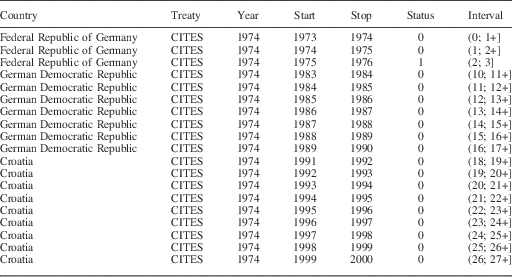
Another important feature of the event history method is its applicability to data with “multiple events per subject” (Therneau and Grambsch 2000). We need to allow for the possibility that each state can ratify any number of our set of treaties in any given year the treaty was open for ratification. In order to account for this, we organized our ratification data as count data following Andersen and Gill (AG) (Reference Andersen and Gill1982). The data takes the form of country-treaty-year, with years being formulated as intervals indicating the start and end of the count. The year count ends with the occurrence of an event for any given country and treaty (represented by “status” equaling 1), resulting in a varying length of the count for any country-treaty.Footnote 8 Table 1 illustrates the count structure of our ratification data in more detail, providing also examples for right-censoring and left-truncation.
Excerpt of the Count Data

Note: Federal Republic of Germany is an untruncated and uncensored data example; German Democratic Republic is random right-censored (ceased to exist in 1989); and Croatia is left-truncated (exists since 1991) and fixed right-censored (no ratification at the end of period of analysis).
Treaty: CITES=Convention on International Trade in Endangered Species of Wild Fauna and Flora; Year=year in which treaty opened for ratification; Start=begin of the year count; Stop=end of the year count; Status: 1=ratification; 0=no ratification; Interval=the interval (start, stop] is open on the left and closed on the right; it indicates begin and end of the count (based on the year 1974 when treaty opened for ratification) for each treaty within a country. +indicates the incomplete nature of the data (no event or right-censoring).
The AG approach assumes that observations for a subject are mutually independent, meaning that the likelihood of a state ratifying a treaty is unaffected by any of its earlier ratification decisions (Box-Steffensmeier and Zorn Reference Box-Steffensmeier and Zorn2002, 1073–74; Therneau and Grambsch 2000, 185–86). Following this, state a can ratify treaty x without or before ratifying treaty y, and state b can ratify treaty y without or before ratifying treaty x.Footnote 9 We also account for correlated groups of observations (non-independence of multiple ratifications per country) by clustering on states, applying robust sandwich variance estimators based on a grouped jackknife (Box-Steffensmeier and Jones Reference Box-Steffensmeier and Jones2004, 158).Footnote 10
We run Cox proportional hazards regression models, with a partial likelihoodFootnote 11 modified to take account of the presence of left-truncated and right-censored data (Tableman and Kim Reference Therneau and Grambsch2004).Footnote 12 In the Cox model the hazard ratio is the measure of effect; it is the exponential of the regression coefficient. This gives the proportional change in the ratification rate due to a one-unit change in a given covariate.Footnote 13
Explanatory Variables
Our hypothesis states that the greater the weight of international opinion in favor of action, the more likely a state is to ratify a treaty, because domestic veto players are more likely to be convinced of the desirability of this action.
To test this claim, we first need to operationalize the group of initial signatories. For each of the treaties in our sample we coded when states signed the treaty, if they did so (based on Center for International Earth Science Information Network 2006; cross referenced with Mitchell Reference Mitchell and Hensel2007). Our formal model assumes a coordinated signing event. In practice, such an event does not always happen and signatures may continue to accumulate for some time. However, signing is usually bunched in the first year of the life of a treaty; and typically treaties are only open for signature for a limited period—often a year. Over the treaties analyzed here, around 80 percent of the states that signed did so in the first year after opening for adoption. We therefore define states that sign within the first year as “first signers” of a treaty, for which the binary variable first_sign is 1 and 0 otherwise.
Next, we need to measure our main explanatory variable—states’ knowledge of environmental issues, which is a challenge. We develop four alternative measures. The most direct measure of a country’s environmental expertise is its research output in this discipline. SCImago (2015) provides several measures of countries’ research output categorized by Scopus subject areas. We started with the number of documents published by each country in each year categorized as environmental science.Footnote 14 For each treaty, we summed across the group of first signers the number of documents reported by SCImago for those countries in the first year of signing. This variable is denoted by docs_i_sign. It captures the summed environmental expertise of first signers, on the assumption that contacts between the research community and the government are well-developed and executives listen to advice. Although the variable provides a good measure of environmental science output, unfortunately its temporal coverage is quite limited, starting in 1996.
For each treaty, we summed across the group of first signers the number of patents lodged by each country in the year of first signing (World Bank 2015).Footnote 15 This patent variable is denoted by patent_i_sign and is standardized to avoid small coefficients. The bivariate correlation between patent_i_sign and docs_i_sign is 0.915. This suggests that countries’ expertise in environmental science is highly correlated with their general expertise in the natural sciences and technology. Because the temporal coverage of patent_i _ sign is much greater, allowing us to make full use of the ratification data going back to 1961, we report results using patent_i_sign rather than docs_i_sign.
Another, more informal, type of expertise relevant for regulating and adapting to environmental problems is based on experience and tacit knowledge. Countries with long experience in implementing key environmental treaties are likely to be in a better position to judge impacts. Our second proxy experience_i_sign reflects this aspect of expertise, and captures the collective experience of first signers with major multilateral environmental treaties. The variable is measured as the standardized number of years a country has accumulated since ratifying nine key environmental treaties as identified in the Institute for Agriculture and Trade Policy (IATP) treaty database (Institute for Agriculture and Trade Policy 2005).Footnote 16 As before, the variable is then summed over the group of first signers for a given treaty.
Finally, we also test for issue-specific knowledge focusing on a narrower domain of environmental regulation, marine treaties. Our proxy measure for issue-specific expertise, marine_i_sign, is the ratio of coastline to land area (Central Intelligence Agency (CIA) 2013), summed over first signers. The idea is that maritime states have a greater incentive to gather knowledge on maritime issues. While past treaty experience measured by experience_i_sign could be correlated with omitted variables, such as an early signer’s concern for the environment or central position in relevant international networks (Ward 2006), marine_i_sign, by contrast, is likely to be exogenous to most forms of international power.
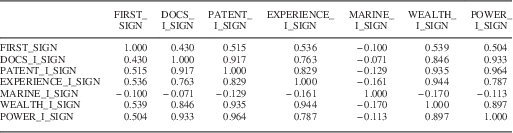
We also control in our models for obvious confounders. Because the number of patents might just capture the general international influence of wealthy countries, not something specific about their knowledgeability, we constructed a control variable wealth_i_sign reflecting the wealth of first signers. Similarly, because countries that produce many patents tend to be large and powerful, a country’s number of patents might be associated with its power position in the international system. To control for this correlation we constructed power_i_sign. Both variables are constructed in the same way as patent_i_sign. wealth_i_sign gives the summed gross domestic product (GDP) per capita of countries belonging to the group of first signatories in the year of signing (World Bank 2015). power_i_sign gives first signers’ summed military capability scores (the Composite Index of National Capability) from the Correlates of War Project (Singer, Bremer and Stuckey Reference Slantchev1972). As shown in Table 2, the correlations between these three variables are relatively high.
Correlation Matrix
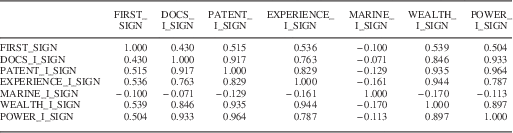
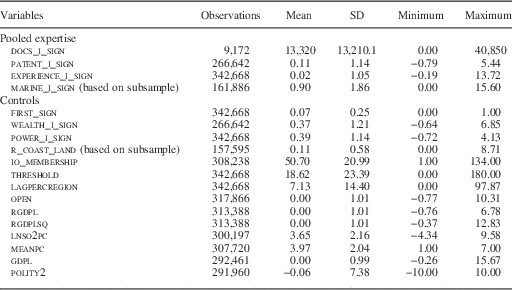
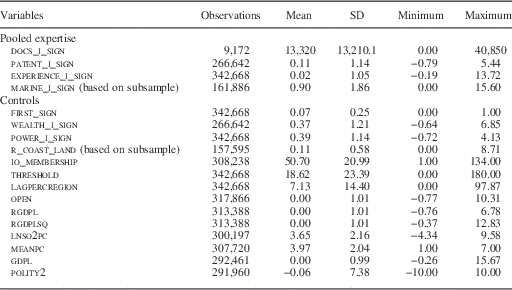
In models testing for issue-specific knowledge by marine_i_sign, we control for a state’s own coastline to land area ratio, r_coast_land (CIA 2013). We also include a number of other relevant factors largely following Bernauer et.al. (Reference Bendor and Meirowitz2010). We include international influences on treaty ratification, measured as the number of international organizations (IO_membership) a state belongs to (cf. Neumayer Reference Neumayer2002). Because a state may be more likely to ratify when other states have already done so (Simmons Reference Simmons2000), we include the number of other states that have already ratified, both globally (threshold); and in the state’s region (lagperegion). We control for trade intensity—the sum of exports and imports divided by gross national product (open)—as it might affect ratification negatively due to the possible effects of environmental provisions on international competitiveness. We also include real income per capita relative to baseline year 2005 US$ (rgdpl), calculated using the Laspeyres method from Penn World Table, and its square (rgdplsq) (Heston, Summers and Aten Reference Heston, Summers and Aten2009).Footnote 17 To capture whether a state is more likely to ratify as its environment deteriorates, we use sulfur dioxide emissions per capita, logged (lnso2pc) as a general indicator for environmental quality (Bernauer et al. Reference Bendor and Meirowitz2010). We test for the effects of democracy by mean scores on Freedom House’s political and civil rights index (meanpc) (Freedom House 2015),Footnote 18 and the size of states’ economy (gdpl) on ratification (Heston, Summers and Aten Reference Heston, Summers and Aten2009). Descriptive statistics for all explanatory variables are presented in Table 3.
Descriptive Statistics
Results
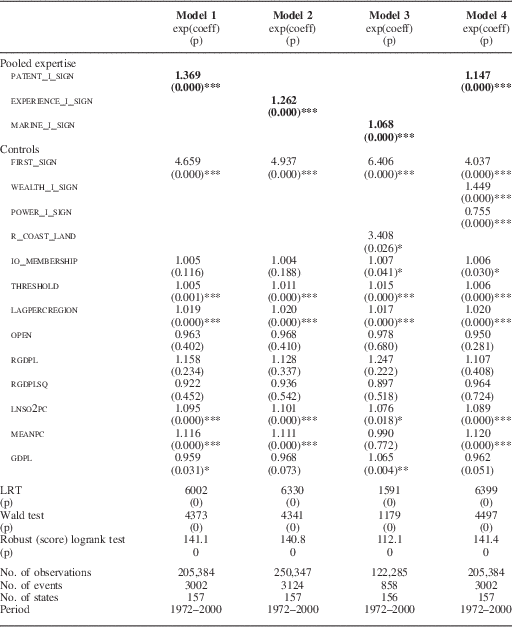
In Table 4 we present four models. All models test our hypothesis regarding the effect of signatory countries’ pooled expertise on the likelihood of a state ratifying a treaty, using our alternative measures of expertise. In all models we include the controls introduced above. Given that the controls do not show any unexpected directions of effects, we focus here on the interpretation of our key explanatory variables—patent_i_sign, experience_i_sign and marine_i_sign. In Appendix C, Table 6, we also present equivalent models without the controls (except for first_sign and r_coast _ land in models including marine_i_sign). Overall, the coefficient values and significance levels were reasonably stable across the reduced and full variants of all our models.Footnote 19
Cox Proportional Hazards Regression Models for Treaty Ratification
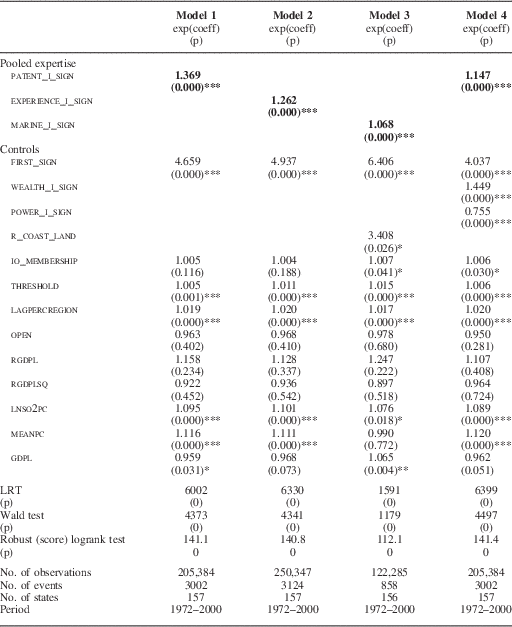
Note: The likelihood ratio test (LRT) assumes independence of observations within a cluster (country), the Wald and robust score tests do not. Exp(coef) is the exponential of the coefficient which is the hazard ratio. ***p≤0.001, **p≤0.01, *p≤0.05.
Model 1 includes patent_i_sign. In this model, the hazard ratio for patent_i_sign is >1 and significantly different from one at the 0.001 level. (A hazard ratio of 1 indicates that a variable has no effect on treaty ratification. A ratio of more than 1 indicates that the variable increases the likelihood of ratification.) Increasing the pooled expertise of first signers by 1 SD increases the likelihood of ratifying a treaty by 37 percent.Footnote 20 This supports our hypothesis: the weight of international opinion among the group of first signers increases the propensity to ratify.
Model 2 uses the collective experience measure experience_i_sign. The collective experience of first signers with key multilateral environmental treaties has a substantial effect on other states’ ratification likelihood (an increase by 1 SD results in a 26 percent increase of the ratification likelihood); this effect is statistically significant at a 0.001 level.
In model 3, we test the effect of issue-specific knowledge with marine_i_sign. Though the treaties we deal with cover quite diverse environmental issues, around 50 percent of them concern maritime issues and fishing. States with extensive coastlines are likely to have more knowledge and expertise on these issues than predominantly landlocked states. We fit model 3 for a subsample of marine and fishing treaties. We include marine_i_sign (the sum of signatories’ marine-related expertise, as proxied by their coast-land ratio), and, in addition to the previous controls, a measure for a state’s own coastline to land area ratio, r_coast_land. For both variables we found significant and positive effects, although the effect for marine_i_sign is statistically stronger than for r_coast_land (which is statistically significant only at a 0.05 level). Thus, when it comes to issue-specific knowledge there is also evidence for the pooled expertise effect.
Finally, in model 4 we also tested whether the effect of pooled expertise measured by patent_i_sign holds against the inclusion of measures reflecting wealth (wealth_i_sign) and the power position of first signers (power_i_sign). Again, we find a significant and positive effect for pooled expertise increasing the ratification likelihood by 15 percent (given a 1 SD increases in the variable).Footnote 21
Robustness Checks
To confirm our results regarding the effect of signatories’ expertise on ratification, we conducted several robustness checks and fitted numerous models, which we show in Appendix C.
First, because our modeling framework involving multiple events is quite complex, we ran bootstrap simulations as an additional cross-check for model 1 from Table 4, based on sampling with replacement. In each of the 199 runs, we fitted the model to a random sample of treaties from the original data. In order to test whether the variables have a significant effect, we constructed empirical 95 percent confidence intervals of the parameter estimates from the posterior distribution. The simulation results (Appendix C, Figure 1) confirm that our key variables patent_i_sign from Model 1 has a significant and positive effect on the likelihood of ratification (0 is not within the confidence interval).
Second, the Cox proportional hazards models in Table 4 assume one baseline hazard for all treaties, which, however, address different issues in environmental regulation. Thus, we stratified our models on a categorical issues variable allowing the baseline hazard to vary across treaties. This variable differentiates between ten areas of environmental regulation: general/governance; atmosphere; hazardous substances; marine environment; nature conservation and terrestrial living resources; energy; nuclear safety; marine living resources; freshwater sources; and conflict and disasters. The stratified models closely resemble those in Table 4, indicating that our major results hold across different areas of environmental regulation (model 1 stratified on issues is shown in Appendix C, Table 7).
Third, to account for potential correlation of ratifications patterns by treaty rather than country we refitted all our models with a cluster on “treaties.” Clustering our observation on treaties, however, does not alter our major result for pooled expertise. In Appendix C, Table 7, we present Model 1 clustered on treaties.
Fourth, we also refitted models from Table 4 including the full set of controls, controlling for regime type with polity2 rather than meanpc. All those estimations confirm the major findings presented in Table 4, and do not alter our results in any substantial way (see Appendix C, Table 7).
Finally, we estimated several models to examine whether an increase in the number of domestic veto players alters the effect of pooled expertise on states’ propensity to ratify. Although our theory does not make a directional prediction for domestic constraints, we tested empirically for the interaction between expertise and veto players, measured as the level of constraint on the executive.Footnote 22 However, we did not find a substantively important effect of domestic constraints in either direction.
Conclusion
We argue that the signing of treaties is more than a political ritual. Our theory predicts that the greater the weight of international opinion signaled by initial signatories, the greater the chance that the treaty will subsequently be ratified. Our theory highlights a non-obvious reason for choosing an international treaty over domestic legislation: international treaties may sway domestic veto players if they distrust their own leader. Empirically, we provide evidence that the weight of international opinion does, indeed, increase the chances of subsequent ratification of environmental treaties. Our theory suggests that potential vetoes are swayed by the pooled expertise of signatories. Qualitative case studies using process tracing would allow us to better understand the precise causal mechanism that underlies our finding. Where vetoes are defined by the constitution as in the case of second chambers cited above, it should be possible to carry out such research by examining debates and reports, and by carrying out interviews.
Although our empirical results concern environmental treaties, effects should also operate in other domains, such as international human rights treaties. Even if democratic states can act alone on human rights (Simmons Reference Simmons2009; Simmons Reference Singer, Bremer and Stuckey2010), international treaty signature may remove domestic legislative roadblocks and facilitate the treaty route. Thus, our analysis complements constructivist accounts of how human rights norms arise (e.g., Risse and Sikkink Reference Risse and Sikkink1999). States use the weight of international opinion strategically to persuade domestic veto players about a norm.
Our findings counteract prevalent skepticism regarding the significance of international treaties. Some argue that it is hard to understand why states incur the costs of treaty negotiation when domestic action would suffice or when one state’s action would not affect the payoffs of others. For instance, why must established democracies ratify human rights treaties when their independent judiciaries provide credible commitment at the domestic level (Simmons Reference Singer, Bremer and Stuckey2010)?Footnote 23 Other argue that states only sign shallow agreements that do not matter and that are consistent with what they intend to do anyway for domestic reasons (Downs, Rocke and Barsoom Reference Downs, M. Rocke and N. Barsoom1996), and the design of treaties may reflect this (von Stein Reference von Stein2005; Mitchell Reference Mitchell and Hensel2009). Our model suggests that treaties persuade domestic veto players, even if the treaty does not go beyond what leaders would do for purely domestic reasons. Pooling information at the international level and then transferring it to the domestic level by highly visible signals is an important function of international legal processes.