Introduction
The southwestern Atlantic margin is a key area for understanding global ocean circulation (Figure 1). The superficial circulation is dominated by the Brazil Current (BC), which transports the Tropical Water (TW) at the surface and the South Atlantic Central Water (SACW) at pycnocline levels (da Silveira et al. Reference da Silveira, Bernardo, Lazaneo, Amorim, Borges-Silva, Martins, Santos, Dottori, Belo, Martins, Guerra and Moreira2023). The BC corresponds to the western component of the South Atlantic Subtropical Gyre (SASG) (Marcello et al. Reference Marcello, Wainer and Rodrigues2018). At intermediate levels (600–1800 m water depth), the area is influenced by the Antarctic Intermediate Water (AAIW) and Upper Circumpolar Water (UCPW), while between 1800 and 3000 m it is affected by the flow of the North Atlantic Deep Water (NADW) and the Lower Circumpolar Water (LCPW) (da Silveira et al. Reference da Silveira, Bernardo, Lazaneo, Amorim, Borges-Silva, Martins, Santos, Dottori, Belo, Martins, Guerra and Moreira2023). Both AAIW and NADW play a crucial role in the Atlantic Meridional Overturning Circulation (AMOC), thereby being critical for global heat transport (Liu and Tanhua Reference Liu and Tanhua2021; Xu et al. Reference Xu, Chassignet, Dong and Baringer2022).
A. Location of the samples and distribution of phosphate along the Atlantic Ocean and their relationship with the main currents flowing into the Santos Basin. B. Temperature-Salinity (T-S) diagram representative of the southwestern Atlantic continental margin. Abbreviations: Brazil Current (BC), Intermediate Western Boundary Current (IWBC), Deep Western Boundary Current (DWBC), Tropical Water (TW), South Atlantic Central Water (SACW), Antarctic Intermediate Water (AAIW), Upper Circumpolar Deep Water (UCPW), and North Atlantic Deep Water (NADW). Data source: Schlitzer (Reference Schlitzer2025).

Figure 1 Long description
Panel A: A heatmap shows the distribution of phosphate along the Atlantic Ocean. The horizontal axis represents latitude from 60 degrees South to 60 degrees North, and the vertical axis represents depth in meters. The color gradient indicates phosphate concentration in micromoles per kilogram, ranging from blue (low) to red (high). Key currents such as the Brazil Current (BC), Intermediate Western Boundary Current (IWBC), and Deep Western Boundary Current (DWBC) are labeled. Panel B: A scatter plot represents the Temperature-Salinity (T-S) diagram for the southwestern Atlantic continental margin. The horizontal axis shows salinity in practical salinity units (psu), and the vertical axis shows temperature in degrees Celsius. The color gradient indicates depth in meters, ranging from blue (shallow) to red (deep). Key water masses such as Tropical Water (TW), South Atlantic Central Water (SACW), Antarctic Intermediate Water (AAIW), Upper Circumpolar Deep Water (UCPW), and North Atlantic Deep Water (NADW) are labeled.
The Santos Basin is a marginal basin that developed after the breakup of Gondwana (Cobbold and Meisling Reference Cobbold and Meisling2001; Contreras et al. Reference Contreras, Zühlke, Bowman and Bechstädt2010). Geomorphologically, it occupies the arc-shaped sector of the southwestern Atlantic margin, between 23o00’S and 28o00’S (Zembruscki Reference Zembruscki and Chaves1979). Regarding late Quaternary sedimentary processes, there are still conflicting aspects involving sediment sources (de Mahiques et al. Reference de Mahiques, Violante, Franco-Fraguas, Burone, Barbedo Rocha, Ortega, Felicio dos Santos, Mi Kim, Lopes Figueira and Caruso Bícego2021; Razik et al. Reference Razik, Govin, Chiessi and von Dobeneck2015) and the transport of particles towards the deep sea (Figueiredo Jr et al. Reference Figueiredo, Carneiro and Filho2023; Santos Filho et al. Reference Filho, Figueiredo, Carneiro, Dias and Ramalho2022; Schattner et al. Reference Schattner, Lobo, López-Quirós, Passos Nascimento and Mahiques2020, Reference Schattner, Rocha, Ramos, Shtober-Zisu, Lobo and de Mahiques2024).
As a contribution to the discussion of late Quaternary processes, our focus in this work is on radiocarbon data from ca. 120 to 2000 m below sea level (mbsl), corresponding to the upper to middle continental slope. This bathymetrical sector encompasses the main water masses from the southwestern Atlantic margin.
Materials and methods
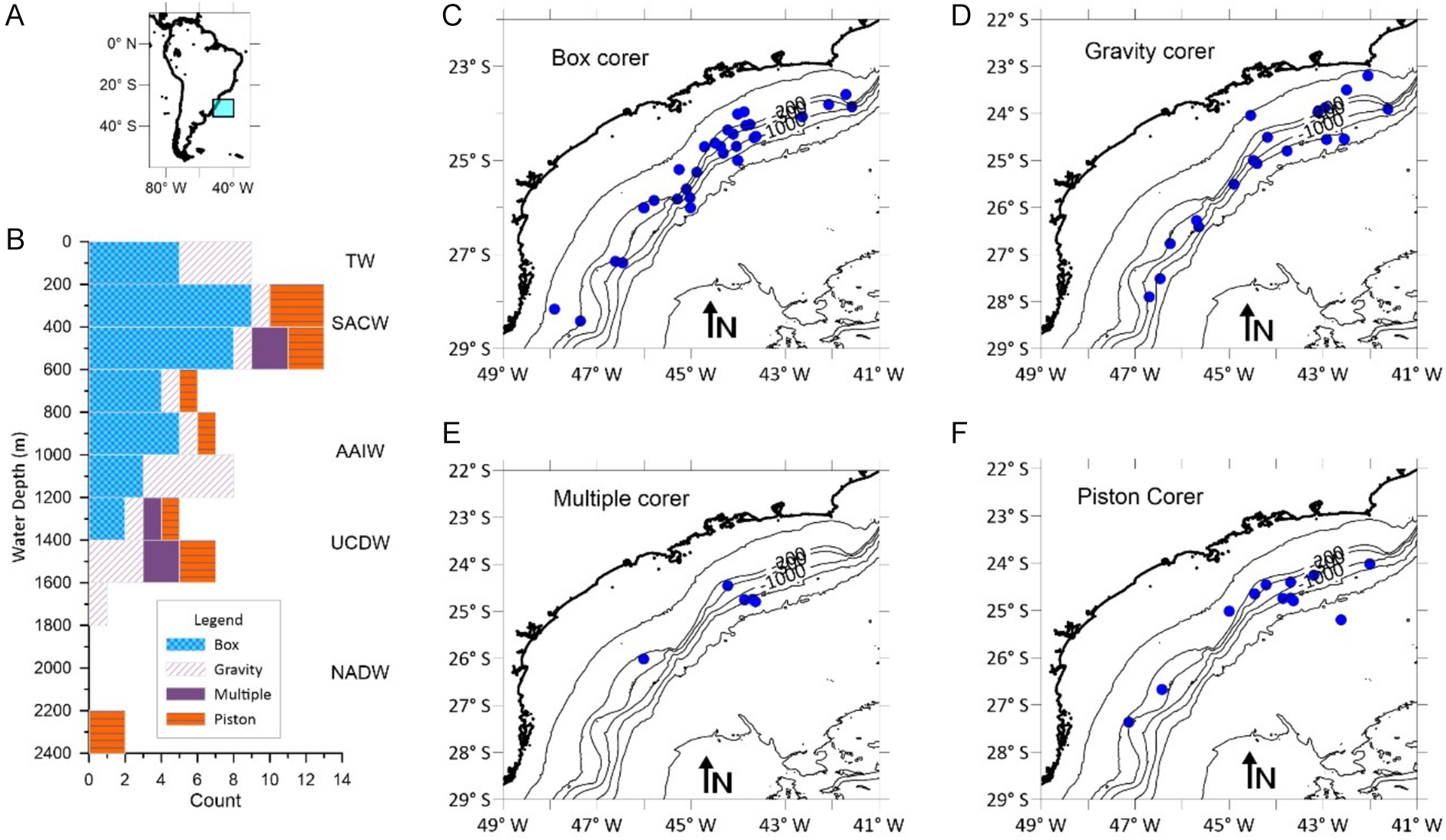
Existing radiocarbon data in sediment samples from the continental margin of the Santos Basin, here defined as the sector of the southwestern Atlantic margin between latitudes 23o00’S and 29o00’S and 41o00’W and 49o00’W, were compiled. New, unpublished data from samples retrieved between those coordinates were also included. A total of 70 sampling stations were considered, divided into the following sampling devices: box corer (36), multiple corer (4), gravity corer (15), and piston corer (15) (F. This sampling universe encompasses 195 published and 69 new radiocarbon ages.
The pre-treatment of carbonate samples involved washing the material with deionized water to remove organic sediments and debris, followed by crushing and etching with HCl. For organic sediments, the pre-treatment involved crushing, followed by HCl treatment to remove carbonates.
The AMS Lab procedure at Beta Analytic (Miami, USA), where most of the new samples were analyzed, is detailed at https://www.radiocarbon.com/beta-lab.htm (last accessed on 11 December 2025. The AMS measurement is done on graphite produced by hydrogen reduction of the CO2 sample over a cobalt catalyst. The CO2 is obtained by combusting the sample at 800 °C and under a 100% oxygen atmosphere. The AMS result is corrected for total fractionation using machine graphite δ13C. Solid organics are sub-sampled and converted to CO2 with an elemental analyzer (EA). Water and carbonates are acidified in a gas bench to produce CO2. Both the EA and the gas bench are connected directly to an isotope-ratio mass spectrometer (IRMS).
Radiocarbon ages obtained for calcium carbonate samples (i.e., foraminifers, corals, and bivalves) were calibrated using the Calib software, version 8.2 (Stuiver et al. Reference Stuiver, Reimer and Reimer2021), with the Marine20 curve (Heaton et al. Reference Heaton, Köhler, Butzin, Bard, Reimer, Austin, Bronk Ramsey, Grootes, Hughen, Kromer, Reimer, Adkins, Burke, Cook, Olsen and Skinner2020, Reference Heaton, Bard, Bronk Ramsey, Butzin, Hatté, Hughen, Köhler and Reimer2022) and a regional (ΔR) reservoir effect of 28 ± 52 yr (Alves et al. Reference Alves, Macario, Souza, Pimenta, Douka, Oliveira, Chanca and Angulo2015). 67 published and two new organic carbon-based radiocarbon dating samples were calibrated using SHCal20 (Hogg et al. Reference Hogg, Heaton, Hua, Palmer, Turney, Southon, Bayliss, Blackwell, Boswijk, Bronk Ramsey, Pearson, Petchey, Reimer, Reimer and Wacker2020).
Apart of the new radiocarbon ages, presented here for the first time, the following studies were considered for this date list: Mollenhauer et al. (Reference Mollenhauer, McManus, Benthien, Müller and Eglinton2006), Mangini et al. (Reference Mangini, Godoy, Godoy, Kowsmann, Santos, Ruckelshausen, Schroeder-Ritzrau and Wacker2010), de Mahiques et al. (Reference de Mahiques, Sousa, Burone, Nagai, Silveira, Soutelino, Ponsoni and Klein2011), Sortor and Lund (Reference Sortor and Lund2011), Pivel et al. (Reference Pivel, Santarosa, Toledo and Costa2013), Chiessi et al. (Reference Chiessi, Mulitza, Groeneveld, Silva, Campos and Gurgel2014), de Almeida et al. (Reference de Almeida, de Mello, Costa and Toledo2015), Santos et al. (Reference Santos, Lessa, Venancio, Chiessi, Mulitza, Kuhnert, Govin, Machado, Costa, Toledo, Dias and Albuquerque2017), Portilho-Ramos et al. (Reference Portilho-Ramos, Cruz, Barbosa, Rathburn, Mulitza, Venancio, Schwenk, Ruhlemann, Vidal, Chiessi and Silveira2018), Ramos et al. (Reference Ramos, dos Santos, Schattner, Figueira, Bícego, Lobo and de Mahiques2019), Luz et al. (Reference Luz, Santos, Eglinton, Montluçon, Ausin, Haghipour, Sousa, Nagai and Carreira2020), Souza et al. (Reference Souza, Carvalho, Escamilla, Barreto, Freitas, Silva and Baptista Neto2020), Santos et al. (Reference Santos, Kim, Trevizani, Oliveira, Maly, Ramos, Figueira and Mahiques2022), and Alvarenga et al. (Reference Alvarenga, Paladino, Gerotto, DeMenocal, Iwai, Sousa, Figueira, Mahiques and Nagai2022). In some cases, the same radiocarbon data were reported in more than one paper; in these cases, we considered the earliest papers as references.
Results
Figure 2 illustrates the distribution of all samples in the dataset. Geographical coordinates, water depth, laboratory number, type of material, δ13C, and δ18O (when provided in the original papers), as well as conventional and calibrated radiocarbon ages (median and 2σ Interval), are presented in Supplementary Table S1. It is worth noting that several cores did not provide all the information required for a comprehensive database (i.e., δ13C, δ18O, laboratory number, etc.).
A. Location of the study area in the context of the South American continent. B. Histogram presenting the water depth distribution of the samples considered in this work. Approximate positions of water masses are based on Liu and Tanhua (Reference Liu and Tanhua2021). C–F. Location of the samples per sampling devices used in this work. C. Abbreviations: Tropical Water (TW), South Atlantic Central Water (SACW), Antarctic Intermediate Water (AAIW), Upper Circumpolar Deep Water (UCDW), and North Atlantic Deep Water (NADW)

Considering the cores containing four or more radiocarbon dates and no age inversions, ten (NAP63-1, GL854, 7485, RJ1501, RJ1502, GEOB6201-5, 779, 780, 863, and 875) span the Marine Isotope Stage 3 (MIS3). Eight cores (KNR-159-5-36GGC, PC-PRIMA, 777, 778, and 861) cover the MIS2 and the last deglacial period, and three cores (GEOB2107-5, 6630, 6613) are limited to the mid- to late Holocene.
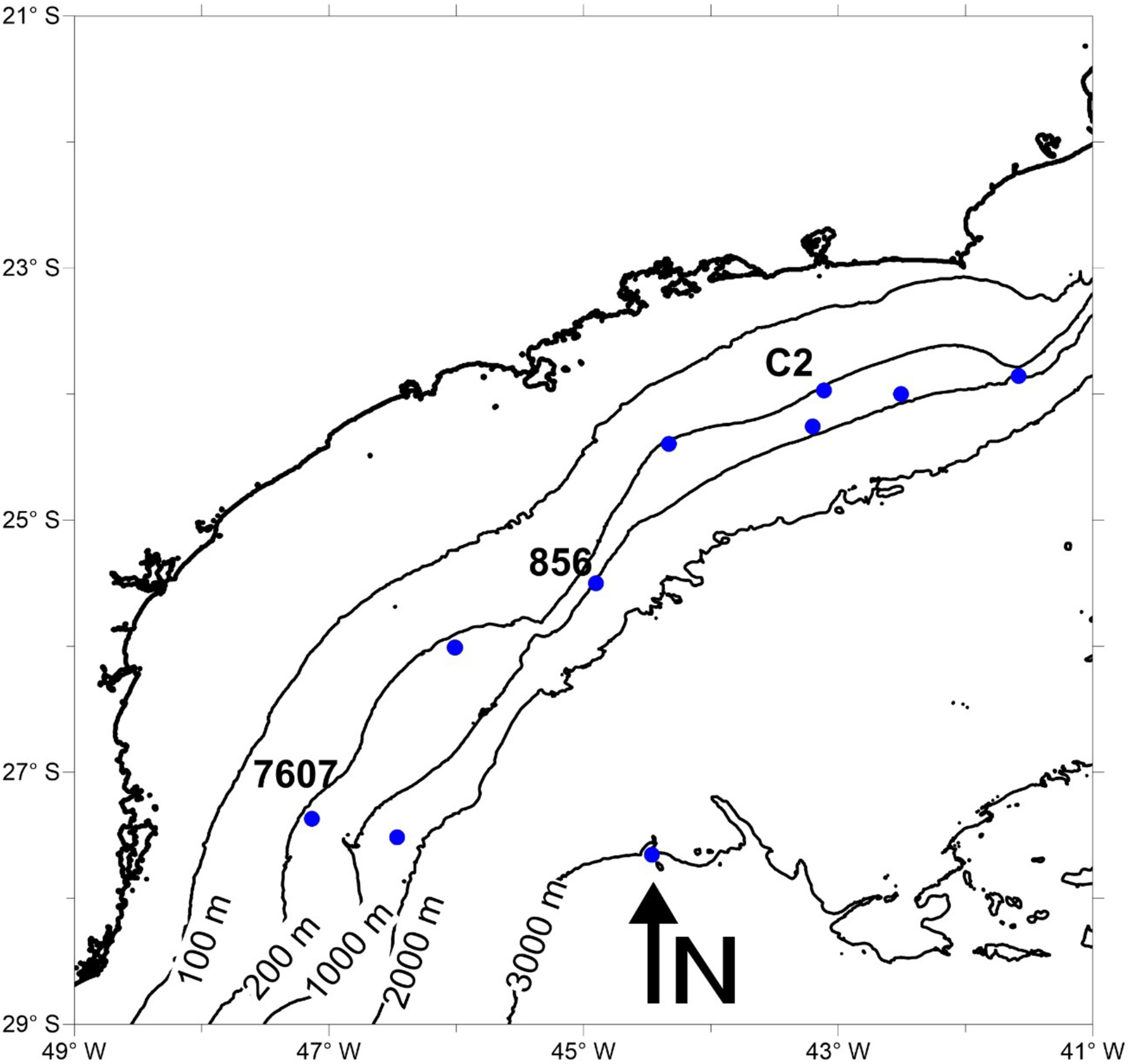
The lack of a significant number of age inversions (marked with asterisks in the table) confirms the potential of the dataset in further paleoceanographic and paleoenvironmental studies. Figure 3 presents the location where at least one sample exhibited age inversion. Nevertheless, only two cores presented the majority of samples with age inversions (856 and 7607). The presence of age inversions in the southern part of the area corroborates the occurrence of turbidites in this sector of the SW Brazilian margin (Schattner et al. Reference Schattner, Rocha, Ramos, Shtober-Zisu, Lobo and de Mahiques2024). Core C2 (Mangini et al. Reference Mangini, Godoy, Godoy, Kowsmann, Santos, Ruckelshausen, Schroeder-Ritzrau and Wacker2010) presents age inversions at its base, thus suggesting the occurrence of a gravitational (turbiditic?) flow occurring between 26,500 and 25,600 cal BP.
Location of the samples in which at least one age inversion was observed. Cores C2, 856, and 7607 exhibit age inversions along the majority of their sedimentary column.

Final remarks
This date list complements the Atlantic dataset published by Waelbroeck et al. (Reference Waelbroeck, Lougheed, Vazquez Riveiros, Missiaen, Pedro, Dokken, Hajdas, Wacker, Abbott, Dumoulin, Thil, Eynaud, Rossignol, Fersi, Albuquerque, Arz, Austin, Came, Carlson, Collins, Dennielou, Desprat, Dickson, Elliot, Farmer, Giraudeau, Gottschalk, Henderiks, Hughen, Jung, Knutz, Lebreiro, Lund, Lynch-Stieglitz, Malaize, Marchitto, Martinez-Mendez, Mollenhauer, Naughton, Nave, Nurnberg, Oppo, Peck, Peeters, Penaud, Portilho-Ramos, Repschlager, Roberts, Ruhlemann, Salgueiro, Sanchez Goni, Schonfeld, Scussolini, Skinner, Skonieczny, Thornalley, Toucanne, Rooij, Vidal, Voelker, Wary, Weldeab and Ziegler2019). It reorganizes all of the radiocarbon information presented in several publications from the last ca. 20 years. Several studies lacked complete data, highlighting the need to standardize radiocarbon information across the area.
This date list offers an excellent potential for further studies, especially those focused on the interplay between the late Quaternary dynamics and depositional processes. The data can be used by any researcher working on the southwestern Atlantic margin, constituting a comprehensive source of information.
Supplementary material
To view supplementary material for this article, please visit https://doi.org/10.1017/RDC.2026.10207
Acknowledgments
Thanks are due to the crew and researchers of the R/V Alpha Crucis for their help in collecting sediment cores during cruises NAP, Talude I, Talude II, Contornitos, Mudbelts II, and SANBIF I. We are thankful to Ms. Aislyn Alvarenga and Julia Sambugaro Ribeiro for separating foraminifera tests. L.Z.O.F. acknowledges the São Paulo Research Foundation (FAPESP) for grant no. 2024/18181-6. R.H.N. and M.M. de M. recognize the National Council for Scientific and Technological Research (CNPq) for research grants 307106/2022-5 and 303847/2023-9, respectively. This work was funded by the São Paulo Research Foundation (FAPESP), grant no. 2020/14356-5.
Declaration of competing interests
The authors declare that they have no known competing financial interests or personal relationships that could have influenced the work reported in this paper.
Ethics statement
The authors confirm that the current work does not involve human subjects, animal experiments, or any data collected from social media platforms.
Credit author statement
L.Z.O.F. was responsible for literature revision, data organization, writing, and revising. R.H.N., S.H.M.S., and P.A.L.F. contributed to the conception, writing, and revision of the manuscript. M.M. de M. was responsible for conceiving the paper, securing project funding, organizing the data, writing, and revising the manuscript.