The 2006 midterm elections were nothing short of stunning. Republicans lost control of both chambers of Congress. More surprising than Democratic gains in the House were their gains in the Senate. In order to achieve a majority in the Senate the Democrats needed to reelect all of their incumbents and elect Democrats in three out of four competitive states, all of which had supported George W. Bush in the 2004 presidential elections (Missouri, Montana, Tennessee, and Virginia). Riding a wave of public discontent associated with the president's Iraq War policy, Democrats beat incumbents in Missouri, Montana, and Virginia to take a slim one-seat majority in the Senate. Democrats organized the Senate in the 110th Congress, with the support of two independents—Bernie Sanders (VT) and Independent Democrat Joseph Lieberman (CT).
Democrats rose to power on a wave of voter discontent, but their ability to translate that discontent into substantive legislation in the Senate that would change the direction of the president's policies requires more than electoral success. Leading the Senate is complex. Producing legislation that satisfies emboldened Democrats at the grassroots and the expectant independents who thrust the Democrats into power, in the context of the arcane rules and delicate politics of the institution, will prove tricky. So far the public seems dissatisfied with the inability of the Democrats to significantly change the direction of the war in Iraq.
In this essay we discuss the difficulties of leading the Senate at this point in America's political history. We focus on two interrelated challenges that Senate leaders face: Leading inside the Senate and leading outside the Senate. Leading inside the Senate is a function of three factors: 1) the Senate rules; 2) the ideological make up of the body, and; 3) the skills of individual leaders. We devote special attention to the selection of Trent Lott (MS) as the Republican whip. His selection reflects competing goals within the Republican Conference. On the one hand, Senate Republicans would like to support President Bush and thwart Democratic legislative initiatives, especially those aimed at changing Iraq War policy. On the other hand, the leadership is seeking to regain majority status, which means protecting vulnerable moderates. This difficult balancing act required a seasoned leader like Lott.
Leading outside the Senate refers to the ability of Senate leaders to shape the public debate (Kelly 1995a). Senate leaders seek to gain support from their partisan colleagues by shaping the public opinion context in a way that 1) inspires support for partisan policy positions and; 2) causes opposition Senators to work across the aisle in support of the majority's policy positions. Here we focus on the public debate over the Iraq War and Democratic and Republican efforts to frame the debate to achieve policy success. We conclude by arguing that significant domestic and foreign policy change awaits the final and overwhelmingly conclusive action of American voters in some future election. Until then, gridlock will characterize the Senate and Washington politics.
Inside-Outside Leadership: Context Matters
Senate leaders confront the problem of leading inside the Senate. Their ability to lead is constrained (at the least) by the rules of the Senate and the collective preferences of their members. Far from being simple followers, however, leaders seek to shape the preferences of their partisan colleagues by framing the debate such that constituency preferences harmonize with partisan policy preferences.1
For a discussion of how the House leadership has sought to accomplish this see Harris 2007.
Inside Leadership
The rules of the Senate present unique advantages for individual senators and for cohesive Senate minorities. Unanimous consent requires that all senators agree on critical motions like the motion to proceed to consideration of a bill; a single senator can stop the consideration of a bill through a simple objection from the floor. It provides the minority leader with a potent tool to slow the legislative process and force the majority to compromise. Empowering the minority leader to use this power on the behalf of the Republican Conference allows individual Republican senators to avoid blame for obstructing popular legislation.
Unanimous consent is the foundation of the filibuster. A filibuster is an attempt to modify or kill legislation on the floor by refusing to end debate and allow a vote. Rule XXII of the Senate allows the body to invoke cloture ending debate and, eventually forcing a vote. However cloture requires a supermajority (60 members) in the Senate and is only likely when there is broad support for the underlying legislation. As long as a significant minority can withhold 41 votes from the cloture motion, debate continues.2
In recent history the legislation is typically set aside to allow for consideration of other legislation.
Like Senate leaders of old, Reid has attempted to force the Republicans' hand by requiring that the Senate stay in session and observe the filibuster; this strategy has proven a failure.
The Senate rules provide potent weapons for a cohesive minority. The math is simple: Up to eight Republicans can defect on any cloture vote (assuming Democratic unanimity) and the filibuster will remain in force.4
The math was made more simple by the absence of Democratic Senator Tim Johnson (SD), who was absent from the Senate for much of 2007 after a life-threatening brain aneurysm.
Adding to the problems faced by Democratic Majority Leader Harry Reid (NV) is the proliferation of presidential candidates on the Democratic side of the Senate. Four of the eight Democratic presidential candidates are sitting members of the Senate (Joseph Biden [DE], Hillary Clinton [NY], Christopher Dodd [CT], and Barack Obama [IL]). This circumstance poses tactical challenges for Reid, and his whip, Richard Durbin (IL). With many Senators out campaigning, holding votes poses a challenge; given their slim majority, Reid and Durbin must schedule votes to accommodate this raft of far-flung presidential aspirants. The aspirants may seek to use the Senate floor as a forum for position-taking in the presidential race; each may have distinct preferences for the legislative issues that the Senate will consider, a desire to sponsor amendments that will help their cause—perhaps undermining their opponents—and the proclivity to use amendments in an attempt to get candidates on “the record.” Reid and Durbin must negotiate this treacherous terrain without appearing to favor one or another of the candidates.5
Durbin is, of course, endorsing his home state colleague Obama, but this is likely viewed as a necessity. Reid has not endorsed any presidential candidate at this stage.
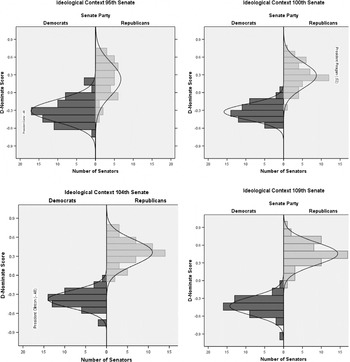
This Senate is a study in the steady ideological polarization of congressional politics in recent decades. This Senate is not only closely divided numerically, but is also ideologically divided. Using nominate scores we contrast the Senate at four time points: 1) the 95th Congress (1977–1978), Democratic majority, Democratic president; 2) the 100th Congress (1987–1988), Democratic majority, Republican president; 3) the 104th Congress (1993–1994), Republican majority, Democratic president, and; 4) the 109th Congress (2005–2006), Republican majority, Republican president. Figure 1 illustrates the ideological distribution of members of the Senate during these four Congresses. We also indicate the president's ideological position for each of these periods.

The Changing Ideological Context of the US Senate, Selected Congresses, 1977–2005
Note: Negative values of D-Nominate indicate liberal policy positions, positive values indicate more conservative policy positions.
These graphs indicate the polarization of the Senate into two relatively homogeneous ideological partisan camps. During the 95th Congress the Senate was characterized by considerable overlap between the two Senate parties; the most conservative Democrats were located at about the median position of the Republican Conference, and the most liberal Republicans at the center of the Democratic distribution. By the 100th Congress, the Senate parties were drifting apart, though a number of conservative Democrats and liberal Republicans occupied the center of the ideological spectrum, providing prospects for bipartisan compromise. By the 104th Congress, the extent of party polarization becomes apparent; just a handful of conservative Democrats and liberal Republicans populated the political center.6
Changes in the polarization and homogeneity in the Senate between the 95th to the 104th Congresses is mostly explained by a striking trend toward a more conservative Republican Party and an only slightly more liberal Democratic Party. During this period, the Senate Democratic median moved left from −.34 to −.38 while the Republican median moved right from .25 to .37 (see Figure 1). The inter-party differential (the difference between the middle of the majority and minority) increased over this period from .59 to .75.
Complete nominate scores are not available for the 110th Congress so we use the more reliable coordinates for the 109th Congress.
It is within this ideological context that Senate leaders attempt to run the Senate. Controversial legislation that perturbs partisan divisions will produce successful filibusters and highly partisan votes. Each of the Senate leaders can count on nearly unanimous support of their party on the floor and the advantage goes to the minority, which can stall floor action through the use of the unanimous consent rule, the filibuster, and the defeat of repeated cloture motions by the majority party. Both leaders are also constrained by their members in that there is little support or incentive on either side to compromise.
Further complicating the ideological context of the Senate is the position of President Bush relative to the majority party and chamber ideological medians. George W. Bush is significantly to the right of the majority median in the Senate (+1.03), more distant from the majority median than any president in the past 30 years. While his positions during the 109th Congress had the effect of moving Senate Republicans to take positions slightly to the right of their preferred positions, he is well to the right of Senate Democrats making the likelihood of compromise on significant issues remote. This is especially true given the inter-party differential, which is at a high-water mark for the last 30 years.
The leadership team of Majority Leader Harry Reid and Assistant Majority Leader (Whip) Richard Durbin led the Democrats in the 109th Congress; they returned unchallenged to those positions in the 110th Congress.8
In fact, Reid is only the fifth Democratic leader in the post-Lyndon Johnson Senate, indicating the stability of the Senate Democratic leadership over the past five decades.
As the Republicans moved to complete their leadership team, Trent Lott announced his intention to challenge for the position of assistant Republican leader (whip). Lott was deposed as Republican leader four years earlier following a speech in which he made comments with perceived racist overtones. Throughout the year, Lott's attempt at a return to the leadership had been rumored and most of his campaigning for the job was sub rosa. Lamar Alexander (TN) had announced his intention to seek the position months earlier. His campaign for the position was highly public, and he was widely viewed as likely to assume the job since no competitor publicly emerged. In something of a surprise, Lott emerged as a public candidate late in the process and won the election by a single vote.
Competitive Senate leadership races are fairly rare, and systematic analysis of voting in these races even rarer (for an exception see Kelly 1995b).9
In fact, systematic analysis of House leadership votes is also fairly rare (but see Green 2006, and Green and Harris 2007).
In the race against Alexander, Lott had several attributes that recommended him for the position of whip. First, his previous service as the Republican leader made him familiar with the rules of the Senate and the need to craft coalitions across the Conference, and he had past experience working with Reid, who served as former Democratic Leader Tom Daschle's whip before becoming the Democratic leader. Lott had served in the House of Representatives from 1979 to 1983 with a number of future senators, and had served as the Republican whip in the House before arriving in the Senate. Despite his strongly conservative and partisan predispositions, Lott had ample opportunity to prove his sensitivity to the needs of individual members through his House and Senate service.
Lott changed the way that the Senate Republican whip operation worked by introducing a much more personal service orientation when he became whip for the first time in 1995 (Bradbury, Davidson, and Evans 2006). His predecessor (Alan Simpson [WY]), Lott claimed, had delegated much of the work of counting votes and persuading senators to the staff of then Republican Leader Bob Dole (Lott 2005, 120). Lott sought to create the whip operation in the image of his House operation: “I told Dole that we were in a tough spot. If we were going to win close votes … we'd need much the same whip organization as we had in the House: one that would provide the members with serious listeners, a friendly shoulder, even counseling” (121).
Alexander, a former governor, education secretary, and presidential candidate, had not previously served in Congress and only had his five years of Senate service to prove himself to his colleagues. While somewhat more liberal than Lott,10
Alexander's nominate score for the 109th Congress was .45 compared with Lott's .54; the mean for the Republican Conference (only returning members) was .47.
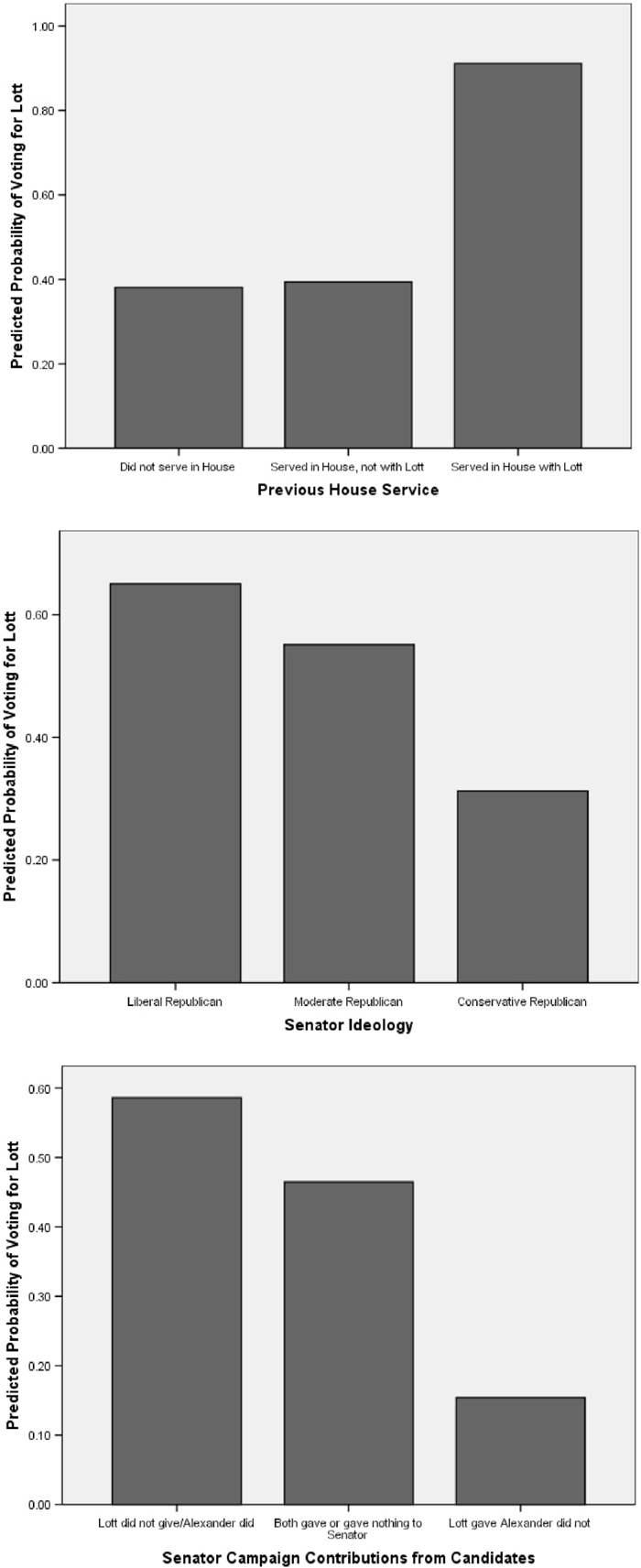
Alexander's lack of House service did not seem to hurt his support among Republican senators (he polled the same number of votes from members with previous House service); Lott's previous House service with seven senators gave him an advantage: six of those seven supported Lott. We also examined support for Alexander and Lott by ideology. The results seem anomalous. The more-conservative Lott tended to draw votes from more-liberal Republicans, while the more-moderate Alexander drew more-conservative votes. This supports our contention that Lott's history of working across his Conference, and being well attuned to the challenges that liberal Republicans face back in their states, ultimately got him elected to the post. In many ways the role played by the Republican whip is more important to the careers of liberal Republican members from competitive states than it is for senators from states that are more solidly Republican. The whip plays a key informational role on difficult floor votes. The more-politically moderate members typically have more of an interest in accurate vote counts, as they are often forced to decide whether to vote with their states (and their electoral interests) or with their parties. Moderate senators therefore may value experience, trust, and communication skills in a whip over more moderate ideological perspective.
As an additional step we modeled support for Lott as a function of four variables: Previous House service with Lott, ideology (as measured by nominate scores), campaign contributions made to members by Lott and Alexander,11
The campaign contribution variable takes on three values: Members to whom Alexander contributed and Lott did not, members to whom both men either gave or did not give, and those members to whom Lott contributed and Alexander did not.
Tabular results are available from the authors upon request.

Predicted Probabilities of Support for Lott by House Service with Lott, Ideology, and Campaign Contributions
In sum, Lott's victory is less surprising than some Washington observers suggested. Lott held several advantages in the race and used them to good effect. With the Senate leadership teams in place by mid-November the sides turned to the difficult job of running the Senate and legislating.
Outside Leadership
Legislative politics are broadly defined by the existing issue agenda (Kingdon 1984). The issue agenda is the universe of problems that are considered pressing by the public, policy elites, and legislators. Legislative responses to the issue agenda become the focus of conflict in legislative politics as interest groups, policy entrepreneurs, party leaders, and the president battle to gain support for their policy preferences. Like presidents and other political actors, congressional leaders seek to influence public opinion in an effort to provide more comfortable opportunities for their partisans to support party positions in the legislature (Kelly 1995a; Harris 2007). Congressional party leaders compete with one another and with the president to shape public opinion. A president has a decided advantage because he demands more focused media attention and can offer a more focused message. By contrast, congressional leaders tend to draw less media attention, speak with less relative authority, and must compete with members of their own party who are often working at cross-purposes and with opposition party messaging operations.
Despite the competition, party leaders do seek to influence the debate by offering “issue frames” within which the public may come to understand issues in distinct ways that favor their legislative positions. Drawing on the political communications literature, Harris (2007) identifies four types of issue frames used by political leaders. Causal frames offer theories for social problems and imply policy solutions. Group-centric frames seek to influence public perceptions of “who wins and who loses” given a specific policy response. Episodic frames underlie attempts to frame issues as “us versus them” battles by focusing on specific individual cases. Finally, conflict frames are characterized by the use of “wedge issues” that attempt to split existing coalitions between political supporters and the legislative parties.
Political actors employ these different frames to seek advantage for their preferred policies. If the party leadership is able to achieve a political advantage on a policy issue, they will provide vital public support for their partisans in the legislature and present political pressure for the opposition party to support their policy preferences. Effective outside leadership can ease the problems of inside leadership by breaking down opposition to majority party legislative proposals.
No issue looms larger in the 110th Congress than the war in Iraq. President Bush and congressional Democrats have engaged in a pitched battle to control the “issue frame” throughout most of George W. Bush's presidency. The president's speech to the nation on September 13, 2004, and the Democratic response, given by Senator Jack Reed (RI), provide an excellent opportunity to illustrate how the president and Senate Democrats are attempting to use these issue frames to capture public opinion.13
As with any classification scheme, analysts will differ over its application. Here we merely seek to illustrate that political actors seek to frame political issues to influence how political audiences understand political problems and programmatic responses.
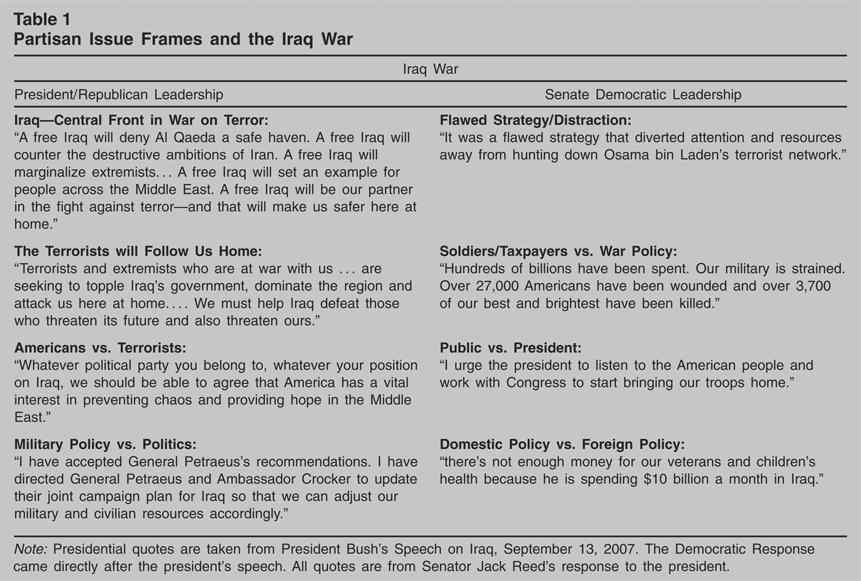
Table 1 contrasts the rhetoric of the president and Senator Reed according to the categories identified above. The causal frame provides an opportunity to explain why the nation is at war in Iraq. The Republican argument for the war is anchored in the threat of domestic terrorism and the “war on terror.” As the president has frequently intoned, “Iraq is the central front in the war on terror.” He argues that the “cause” of the war is a need to defeat terrorism and “secure the homeland.” Democrats have sought to reframe the war as a devastating policy blunder on the part of the president that has caused an increased risk of terrorism at home and abroad. In short, they argue that we are in Iraq because the president miscalculated and put into motion a civil war that has trapped the country.
Partisan Issue Frames and the Iraq War

In the group-centric frame, the president paints a picture of Americans as the potential victims of failure in Iraq, arguing that the consequences of withdrawal from Iraq will be a surge in domestic terrorism. The terrorists will “follow us home” and the country will be subject to more September 11th-like attacks. Democrats offer a competing frame for continued engagement in Iraq. They argue that the American people lose as a result of the president's policy, specifically the American taxpayer who is footing the $10 billion a month bill for the war, and the soldiers who are wounded and killed in Iraq.
The Democratic leadership seeks to utilize the episodic frame to focus the attention of the public on the seeming unwillingness of the president to be responsive to public opinion, despite the fact that a majority of the public believes that the war was a mistake, and few trust the president to bring the war to a swift and successful conclusion. President Bush, they argue, is ignoring popular opinion. President Bush argues that public disillusionment with the war should lead all Americans, regardless of party, to a policy that addresses America's vital interests in the Middle East.
Finally, the president seeks to undermine Democratic proposals by portraying them as driven by short-term political concerns. His decision making, by contrast, is driven by his concern for the common good and founded on sound military policy. “Who,” he implicitly asks, “do you trust: Our military leaders or politicians who are looking for advantage in the next election?” On this public opinion seems clear. In a recent New York Times poll, voters were asked whom they trust “with successfully resolving the war in Iraq?”: 68% of Americans said they trust the military on Iraq, 21% trust Congress, and only 5% trust the president. This provides solid ground for the president's Senate allies to stand on; simply put, “Senate Republican are standing with the military leaders on the ground.” In this case the conflict frame provides a firewall for Republicans. In order to neutralize the argument, Democrats would need to successfully argue that there is good reason to question the motives of military leaders; specifically, that military decisions are being made for the benefit of the White House and are not based on sound military principles.
Conclusions
Assuming control of the Senate in the midterm elections posed a significant challenge for Democrats. Public expectations were high. Yet the rules of the Senate and highly polarized parties make it difficult to produce significant policy change with such a slim majority. Republican leaders, on the other hand, drew significant advantage from the rules through their ability to block Democratic legislation, while at the same time allowing liberals in their Conference—especially those seeking reelection in 2008—to support Democratic positions. Senate gridlock was almost guaranteed by the existence of two polarized and homogeneous party contingents. Senate Republicans were further blessed with the selection of a highly partisan, yet pragmatic, whip with the skills to hold together a nearly cloture-proof minority, especially on war-related legislation. It is largely due to Trent Lott's ability to accommodate Republican moderates that Republicans have been able to provide a cohesive front to Democratic challenges.
Democratic leaders have taken an active role in trying to shape the public policy debate. This is most obvious on Iraq War policy. Harry Reid and Senate Democrats realize that they are in the majority due to discontent with Republican war policies. Legislative challenges to the president are necessary to satisfy the Democratic base and the independents who delivered the majority. Facing a daunting internal context, Democrats have sought to shape public opinion by offering their own frame for Republican policies. To some extent this has been successful. Americans tend to trust the Democrats over the Republicans on war policy. However, the president has been successful in framing ultimate decisions in Iraq as a function of “military policy” (the commanders on the ground) not “political decisions” made by the “politicians in Washington.” In this battle the Democrats have been less successful to date: voters trust the military when it comes to Iraq.
With less than a year before the 2008 presidential elections it is hardly risky to predict that the Senate will accomplish nothing on other significant policy issues (e.g., health care), will remain gridlocked on Iraq, and will only be able to move forward on “must pass” and non-controversial legislation. A strong partisan surge in either direction in 2008 could break the deadlock. While initial indications are for a strong Democratic surge in 2008, it is unlikely that post-election Senate politics will witness any significant changes in the near future.