

Is globalization good for wine drinkers in the United States? Seven years ago, in an article published in the Journal of Wine Economics, Gokcekus and Fargnoli (Reference Gokcekus and Fargnoli2007) answered this question in the affirmative. Based on statistical analyses of Wine Spectator's Top 100 lists from 1988 to 2005, they found that the increased presence of wines from relatively new wine- producing countries provided more variety, with little to no compromise in quality. And, most importantly, prices were pushed down. Overall, American wine drinkers were better off.
Since 2005, the Wine Spectator has continued to publish its Top 100 list by taking into account the same four factors—score, price, availability, and the x-factor—excitement. But not everything has remained the same. There has been a global recession and an increased use of social media by American wine drinkers (Gokcekus and Finnegan, Reference Gokcekus and Finnegan2013). It is conceivable that these two developments have made American wine drinkers more conscious of prices and more informed about the quality of wines from different countries and regions. During the same period, the wave of globalization in the world wine markets did not wane (Anderson and Nelgen, Reference Anderson and Nelgen2011a, Reference Anderson and Nelgen2011b). Furthermore, wine producers and marketers have had seven years to revisit and update their strategies to produce better wines and build a better reputation in the American wine market. Accordingly, we ask the following question: How have the average real price, variety, and quality of the wines in the Top 100 lists changed since 2005?
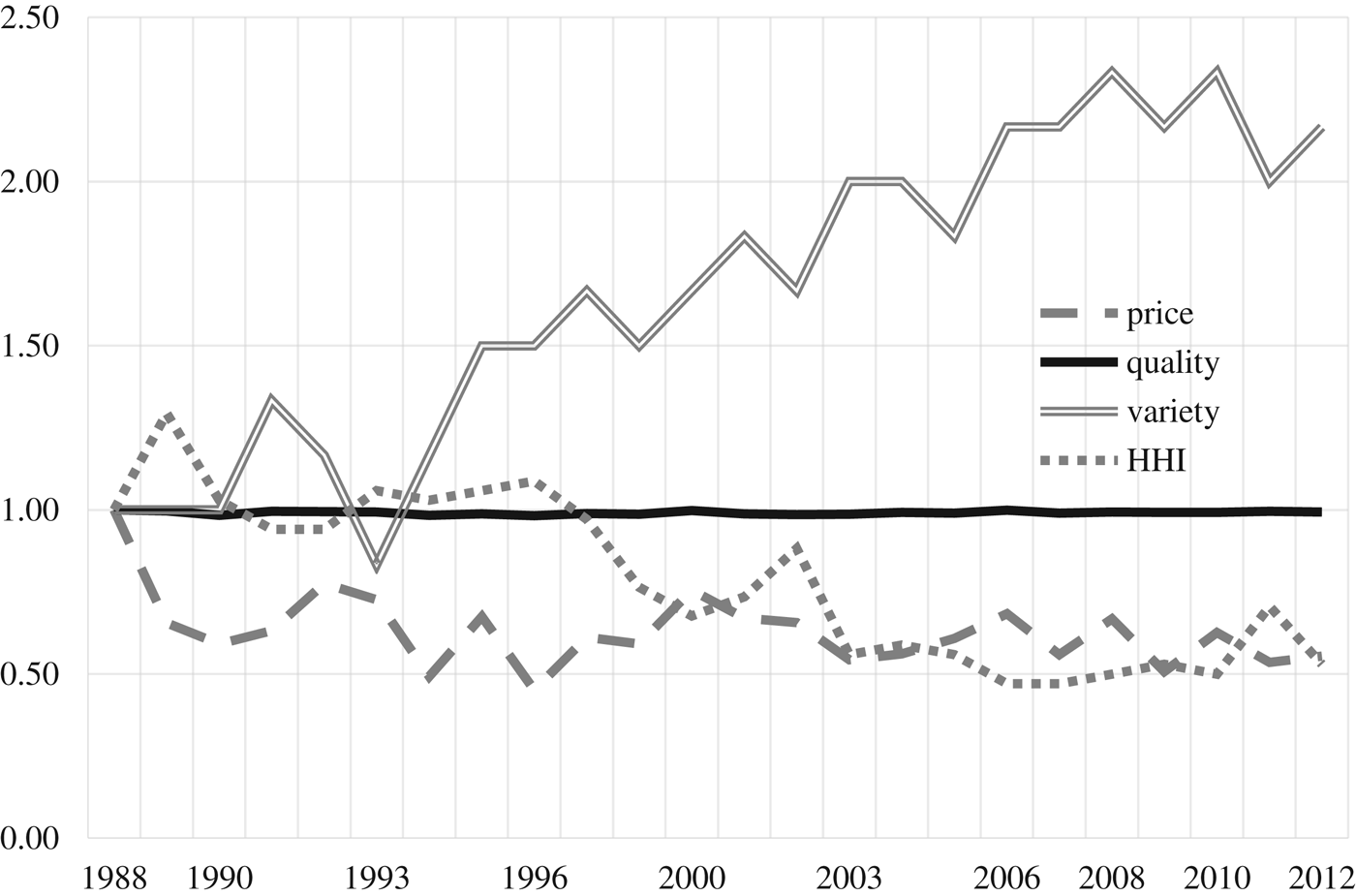
As shown in Figure 1, the quality, represented by the average rating of the Top 100 lists, has not changed at all. The dark line representing quality is a straight horizontal line, and the average rating hovered around 93 points within an extremely narrow range.Footnote 1
Average Real Price, Herfindahl-Hirschman Index Quality, and Variety of the Top 100 List, 1989–2012

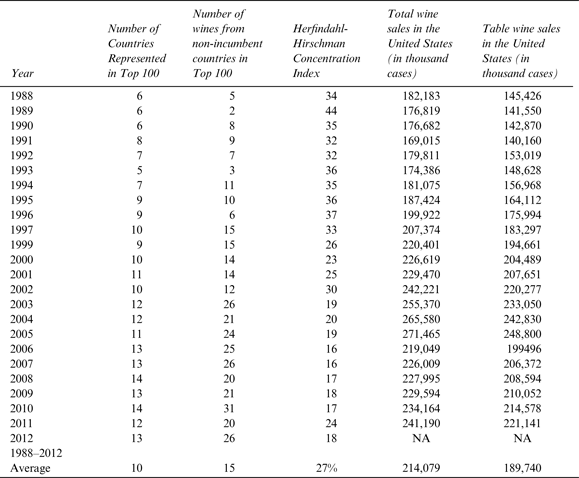
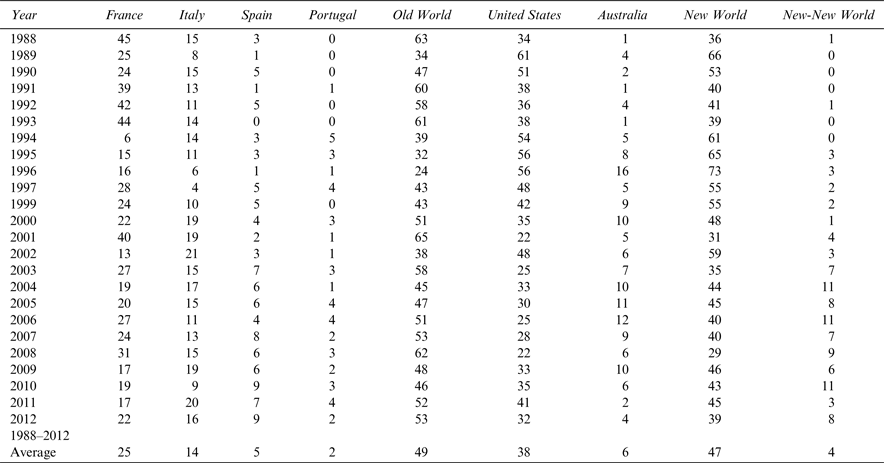
The variety, shown by the number of countries represented in the Top 100 list, increased from six countries in 1988 (France, Italy, Lebanon, New Zealand, Spain, and the United States) to eleven countries in 2005 (Argentina, Australia, Chile, France, Germany, Italy, New Zealand, Portugal, South Africa, Spain, and the United States). As Figure 1 shows, this number continued to grow. Specifically, the number of countries in the Top 100 lists jumped to 13 in 2006. In five of the next six years until 2012, there were either 13 or 14. After 2005, there were three newcomers to the Top 100 lists: Canada, Greece, and Israel. In addition to the increased number of countries in the list, Spain and Portugal significantly expanded their presence. For instance, they had two to three wines in 1990s, and then five to six in early 2000s; starting in the late 2000s, we consistently found eight to nine wines from Spain in the list. Portugal's consistent appearance with two to four wines in the later years was dramatically different from their occasional appearances in the earlier years.
The changes in the Herfindahl-Hirschman Index (HHI)Footnote 2 also reflects these two developments—an increased number of countries in the list and a more consistent and stronger showing by countries such as Spain and Portugal. As Figure 1 indicates, the HHI declined from 34% in 1988 to 19% in 2005. It went down further in 2006, to 16%, and has since remained relatively stable. In other words, the Top 100 list not only has become significantly less concentrated but has moved away from the U.S. Department of Justice's classification of “highly concentrated” and become firmly anchored into the classification of “moderately concentrated.”
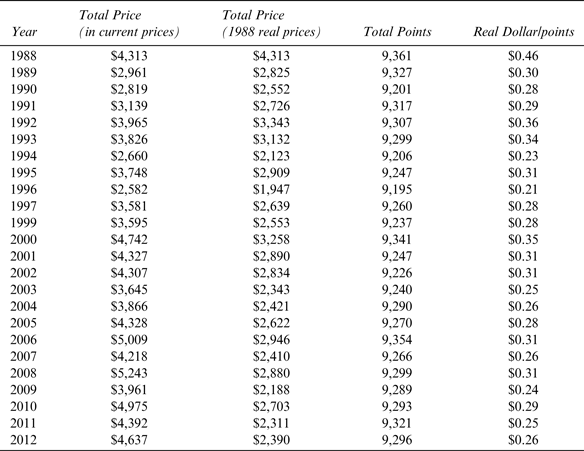
After 2005, the most striking development was in prices. The average real price for a wine in the 1988 Top 100 list was $43. In 2005, the price was $26 (in 1988 dollars). Following some up and down changes over the next three years, from $29 in 2006 back to $29 in 2008, the average real price ended up at $23 in 2011 and $24 in 2012. Simply put, the average real price continued to diminish between 2006 and 2012 but at a faster rate. The average price declined from 2006 to 2012 by 3.4% per annum, which is 1.19 times the rate of decline from 1988 to 2005, 2.9% per annum.
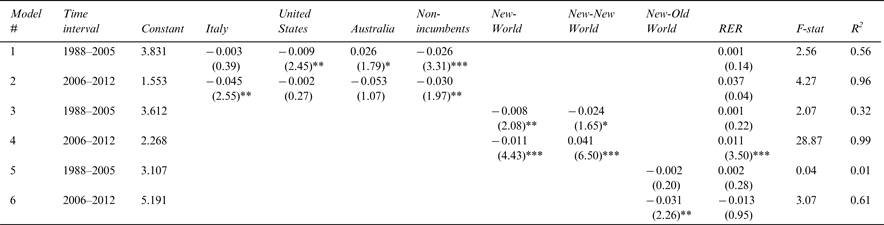
To determine the effect of having more wines from different countries or of groups of countries on price, we ran the same regressions used by Gokcekus and Fargnoli (Reference Gokcekus and Fargnoli2007). We also included RER (real effective exchange rate) as an explanatory variable to take into account the effect of the real exchange rate changes on price.Footnote 3 The results are shown in Table 1. The results indicate that the forces of globalization that put downward pressure on price are still in place. Replacing a French wine with an Italian wine lowered the average real price by 4.5% and with a wine from a non-incumbent country (countries other than France, Italy, Australia, and the United States) by 3.0%. (For the period 1988–2005, an Italian wine did not have a statistically significant effect; replacing a French wine with an American wine lowered the average real price by 1.0% and with a non-incumbent wine by 2.6%.)
Price Effects of Country of Origin Changes Regression results—ln(Price t) is the Dependent Variable
Robust t-values in parentheses; significance levels (one-tailed):*** 1%, ** 5%, and * 10%. Models 1 and 2 report the effect of replacing a French wine with an Italian, American, or Australian (incumbent countries) wine or with a wine from a non-incumbent country. Models 3 and 4 report the effect of replacing an Old World wine (from Austria, France, Germany, Italy, Portugal, and Spain) with a New World (Australia, New Zealand, and the United States) or New–New World (Argentina, Chile, Hungary, Lebanon, South Africa, Israel, Canada, and Greece) wine.
After 2005, replacing an Old World wine with a New World wine lowered the average real price by 1.1%. Furthermore, replacing an Old World wine with a New-New World wine actually raised the average real price by 4.1%. (For the period 1988–2005, replacing an Old World wine with a New World wine lowered the average real price by 1.0%, and with a New-New World wine by 2.4%)
When we put these two sets of results together (the negative effect on the average real price by replacing a French wine with an Italian wine and the positive effect of replacing an Old World wine with a New-New World wine) with what has been reported about Spain, Portugal, and Italy, we started to think that perhaps the second decade of the globalization in wine markets (Anderson and Nelgen, Reference Anderson and Nelgen2011b) affected the Top 100 list in a different manner. The primary drivers that pushed prices down may have been heavy investment in technology, research, and human capital, benefits from European Union subsidies, higher controls on the quantity and quality of grapes, modernization of their wine-making processes, and the launching of aggressive marketing strategies in the United States (Martinez-Carrion and Medina-Albaladejo, Reference Martinez-Carrion and Medina-Albaladejo2010; Panzone and Simoes, Reference Panzone and Simoes2009; Thach and Cuellar, Reference Thach and Cuellar2007). Another consideration was presented by Anderson and Wittwer (Reference Anderson and Wittwer2013), who have documented the effect of bilateral RER fluctuations on the source and prices of wines in the importing countries’ markets.Footnote 4 In our analysis, we do not find statistically significant price effects of exchange rates. The countries that gained ground (Spain, Portugal, and Italy) and the country that lost ground (France) are all eurozone countries. Beyond the effect of bilateral RER fluctuations, since 2005, it seems that wines from Italy, Spain, and Portugal—three Old World countries with a new approach—lowered the average real price of the Top 100 list.
To further check the validity of this claim, the effect of having one more wine from these three—what we will call New-Old World countries—on the average real price, we estimated one more regression model. As presented in Table 1, the regression result shows that, after 2005, having one more New-Old World wine reduced the average real price by 3.1%. (For the period 1988–2005, replacing another wine with a New-Old World wine did not have a significant effect on the real price.)
To summarize, as demonstrated in the previous study on the 17 years leading up to 2005, there was no change in quality between 2006 and 2012. There was more variety and, perhaps most importantly, the average real price of the Top 100 list declined even faster. However, rather than wines from the New-New World and Non-incumbent countries, it was wines from New-Old World that were primarily responsible for these beneficial changes—greater variety and more affordable wines in the Top 100 List—for American wine drinkers.
Appendix
Prices and Points of the Wine Spectator's Top 100 List, 1988–2012
Various Statistics for the Wine Spectator's Top 100 List, 1988–2012, and Wine Sales in the United States
Composition of the Wine Spectator's Top 100 List, 1988–2012