1 Introduction
Third-wave sociolinguistic research has increasingly sought to describe the social meaning of variation, as opposed to identifying broad correlations between variants and macro-level socio-demographic categories (see inter alia Moore Reference Moore2003; Campbell-Kibler Reference Campbell-Kibler2010; Eckert Reference Eckert2012; Lawson Reference Lawson2014; Levon Reference Levon2016; Drummond Reference Drummond2018). Within this line of inquiry, scholars have documented the ways in which features are deployed to convey specific interactional stances and social personae. However, whilst there is a great deal of third-wave research on phonological variation (e.g. Campbell-Kibler Reference Campbell-Kibler2010; Lawson Reference Lawson2014; Kirkham & Moore Reference Kirkham and Moore2016), there is comparably less research which examines the social meaning of discourse-pragmatic (henceforth DP) features (but see Moore & Podesva Reference Moore and Podesva2009; Bucholtz Reference Bucholtz2010; Drager Reference Drager and Pichler2016 for notable exceptions). Indeed, the bulk of the existing research tends to focus on describing the evolution of DP features, analysing their formal and functional characteristics. When the sociolinguistic distribution of these features has been considered, scholars have tended to explore patterns of variation in terms of macrosocial correlations (e.g. Andersen Reference Andersen2001; Corrigan Reference Corrigan, Amador-Moreno, McCafferty and Vaughan2015; Aijmer Reference Aijmer2015; Palacios Martínez Reference Martínez and Ignacio2015), as opposed to interrogating the social meaning of that variation.
In this article, I add to a growing body of third-wave perspectives on DP variation by examining the variant form, function and distribution of an underexamined aspect of speech – what Norrick (Reference Norrick2009) terms ‘attention signals’ (henceforth ASs). This category refers to those features which fulfil the explicit function of eliciting an individual's attention, such as hey or oi. In what follows, I examine data collected during a year-long sociolinguistic ethnography of an East London youth group to explore the variation in the AS system. I focus specifically on the use of an innovative AS – ey – in the speech of some of the adolescents. This leads me to argue that the appearance of this feature can only be understood in relation to its interactional functions and with reference to the Community of Practice (CofP; Lave & Wenger Reference Lave and Wenger1991) who use ey most. Specially, I examine the use of this variant amongst a group of young males who refer to themselves as ‘gully’. Exploring the discursive functions of ey across the dataset, I argue that this AS fulfils a specific interactional purpose – that of indexing authoritative or ‘dominant’ stance. Finally, I interpret these practices in relation to masculinity and broader patterns of language variation in East London (cf. Multicultural London English [MLE]; Cheshire, Kerswill, Fox & Torgersen Reference Cheshire, Kerswill, Fox and Torgersen2011).
2 Discourse-pragmatic variation
The term ‘DP features’ refers to those syntactically optional elements of speech which typically do not contribute to the propositional content or truth-conditional meaning of an utterance but are generally considered to have important discourse functions (Fox Tree Reference Fox Tree2010). DP features are inherently multifunctional such that their distribution depends on the ‘linguistic co-text as well as the sequential, situational and cognitive context’ (Pichler Reference Pichler2013: 4). Scholars have examined a range of DP features and functions, such as the invariant tag innit (Palacios Martínez Reference Martínez and Ignacio2015; Pichler Reference Pichler and Pichler2016b), adverbs like and actually (Corrigan Reference Corrigan, Amador-Moreno, McCafferty and Vaughan2015; Drager Reference Drager and Pichler2016; Waters Reference Waters and Pichler2016; D'Arcy Reference D'Arcy2017) and quotatives he was like and this is me (Cheshire et al. Reference Cheshire, Kerswill, Fox and Torgersen2011; Drummond Reference Drummond2018).Footnote 2 Although these features have distinct discourse functions, they can be subsumed under the macro-category of DP features on the basis that they fulfil one or more of the following purposes: to express speaker stance, to structure discourse elements and/or aid utterance interpretation (Pichler Reference Pichler2013: 4).
However, whilst there is a rich body of research that examines the variable conditioning of phonological and morphosyntactic features, there is comparatively less work on DP variation. This empirical gap can largely be understood in relation to the methodological difficulties of applying the notion of the sociolinguistic variable to the study of DP variation (see Terkourafi Reference Terkourafi2011; Pichler Reference Pichler2013; Reference Pichler and Pichler2016b; Levon Reference Levon2016; Waters Reference Waters and Pichler2016). The sociolinguistic variable is a foundational theoretical construct that describes the alternation of linguistic forms that share the same meaning. Although this approach can be unproblematically applied to the study of phonological and morphosyntactic features, it cannot straightforwardly be applied to DP variation. First, unlike other variables, DP features do not constitute a closed class of possible variants. Second, since DP features are optional in discourse, it is not possible to circumscribe all possible candidates for inclusion in the analysis (i.e. the envelope of variation) – a prerequisite of the Principle of Accountability (Labov Reference Labov1972).
Nevertheless, in recent years, scholars have developed novel approaches to address these methodological challenges. Recent research has advocated adopting a ‘hybrid’ approach, where DP variants are isolated on the basis of their shared functions in discourse, as well as their similar form and position in the utterance (Pichler Reference Pichler and Pichler2016b; Waters Reference Waters and Pichler2016). The effectiveness of this approach has been demonstrated across a range of speech contexts and research has uncovered the structured heterogeneity in the variable patterning of a diverse number of DP features (see inter alia Mendoza-Denton Reference Mendoza-Denton2008; Pichler Reference Pichler2013; Buchstaller Reference Buchstaller2014; Denis & Tagliamonte Reference Denis, Tagliamonte and Pichler2016; Pichler Reference Pichler2016a).
More recently, a growing body of third-wave research has examined the stylistic potential of DP features. A case in point is Moore & Podesva's (Reference Moore and Podesva2009) analysis of tag questions at Midlan High School in Bolton. In that analysis, the authors demonstrate that whilst speakers use tag questions in discursively similar ways, the design and response to the tag is conditioned by the speakers’ CofP membership. For instance, the Eden Village CofP – a group defined by their trendy ‘teen’ style – exhibit more agreement in turn-medial position when responding to question tags than their peers. The authors interpret these patterns to be part of a more general ‘feminine style’ which is enacted by members to build the ‘girly girl’ image that their group identity is contingent on (Reference Moore and Podesva2009: 478).
Other third-wave research has examined how DP features are recruited in the process of stance-taking – that is, the interactional process in which speakers adopt an alignment towards some discourse element, interlocutor or object (Du Bois Reference Du Bois and Englebretson2007). For instance, in her research on youth language at a high school in California, Bucholtz (Reference Bucholtz2010) examines the use of quotatives (e.g. be all) in relation to the speaker's social group membership and the interactional stance they were seen to assume. Bucholtz finds that be all is used by nonpreppy teenagers when adopting a negative stance, whereas amongst preppy girls it was primarily used to convey a neutral stance. The association of stances with distinct styles can be considered a consequence of what Du Bois (Reference Du Bois2002) terms ‘stance accretion’. That is, the act of habitual stance-taking leads to the formation of more enduring styles and it is these styles that speakers primarily draw on in interaction.
Nevertheless, though research has demonstrated the stylistic potential of these features, in comparison to other domains, DP variation remains underexamined. This is perhaps not more apparent than for the DP system that I analyse in this article – the ASs (Norrick Reference Norrick2009).
2.1 Attention signals (ASs)
ASs are a micro-level category of DP features that includes words such as hey and oi which are typically appended to the left periphery (LP) in turn initial position (Schourup Reference Schourup1985; Norrick Reference Norrick2009) where they ‘attract the attention of someone not in immediate contact with the speaker’ (Dubois Reference Dubois1989: 351). Although they can occur in isolation, ASs frequently precede vocatives and often co-occur with requests, e.g. hey! Mike hand me the spanner. They can also occur in utterances where no intention is implied, such as in rhetorical sentences, e.g. oi! What do you think you're doing?!. Although ASs are often fully lexicalised (hey!, oi!), other verbal and non-verbal sounds such as whistling, coughing and grunts, can fulfil similar functions.
However, in comparison to other DP features such as oh or like (see inter alia Corrigan Reference Corrigan, Amador-Moreno, McCafferty and Vaughan2015; Drager Reference Drager and Pichler2016; Waters Reference Waters and Pichler2016; D'Arcy Reference D'Arcy2017), there is a virtual absence of literature on ASs. The paucity of research on these features is presumably due to the relative infrequency of these tokens. The spoken BNC1994 (Hoffmann et al. Reference Hoffmann, Evert, Smith, Lee and Prytz2008), for instance, lists the frequency of the AS oi at 27.95 instances per million words (pmw), compared with the discourse marker oh which occurs 5021.2 times pmw. It is possible that the low rate of ASs is reflective of data collection procedures, given that these features are unlikely to be elicited in the sociolinguistic interview. This article circumvents these issues by examining data collected from naturalistic self-recordings.
2.1.1 The social meaning of ASs
Given the lack of research on these DP features more generally, it is unclear as to whether ASs can accrue social-indexical meaning. There is, however, some anecdotal evidence to suggest that ASs, like other DP features, can exhibit sociolinguistic differentiation. A case in point is that of oi, where in London the AS has been historically associated with working-class Cockney speakers. For instance, in a survey of the variety in the 1950s, Franklyn notes that oi is ‘intensely Cockney’ (Reference Franklyn1953: 259), while Robb (Reference Robb2012: 469) observes that the interjection became a stereotypical ‘catchphrase’ of Cockney music hall entertainers in the 1930s.
More recently, the AS oi has emerged as a symbol of working-class solidarity and resistance. In the 1980s, the East London band the Cockney Rejects released the song ‘Oi! Oi! Oi!’, which subsequently inspired the growth of a subgenre of punk rock, stylised as ‘Oi!’. As an aggressive style of rock music, Oi! was a fiercely political genre that was embraced by working-class youth, uniting punks and skinheads alike. Songs produced in the genre lyrically documented the hardships faced by the community, including unemployment and the struggle for workers’ rights (Robb Reference Robb2012). Thus, in spite of the lack of research on ASs, it is reasonable to assume based on the development of oi that ASs are able to accrue social-indexical meaning in much the same way as other DP features (cf. Mendoza-Denton Reference Mendoza-Denton2008; Moore & Podesva Reference Moore and Podesva2009). It is this possibility that I explore in more detail in this article focusing specifically on the AS ey.
3 Ey
This section introduces the AS /ʌɪ/ ~ /eɪ/, which I represent orthographically as ey. Footnote 3 To my knowledge, there is no existing research on this AS. It is therefore necessary to provide a description of the form and function of this feature. All examples are taken from self-recorded data collected during a year-long sociolinguistic ethnography of an East London youth group which I describe in more detail in following sections.
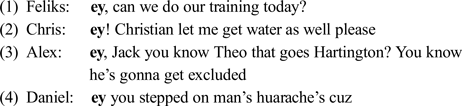
Preliminary exploration of ey seems to suggest that it is used overwhelmingly in turn-initial position where it appears to function as an AS, such as in (1)–(4):

In all four examples, ey appears to be used much like hey or oi, in that it functions as an attempt to attract another speaker's attention. Even though the discourse contexts in which ey appears are diverse – a question in (1) and (3), a request in (2) and a statement in (4) – the primary function of ey as an AS is clear. Popular definitions of this feature on social media also seem to substantiate this claim. One contributor to the online crowdsourced Urban Dictionary defines this feature as ‘a loud yell in order to gain the attention of other people’, while another explains that it is ‘a term used to catch someone [sic] attention when you don't know their name’ (Urbandictionary.com 2003; 2005).
As in examples (1)–(4), ey typically occurs at the left periphery (LP), such that its scope extends rightward over the following proposition. This provides additional support for my claim that ey is similar both in scope and function to other ASs such as hey and oi. See (5) and (6), for example:

Although ey is typically observed at the LP in turn-initial position as in the previous examples, there are a few instances of this feature in turn-medial and final positions. However, even in these non-canonical positions, the attention-seeking function is maintained, as in (7) and (8).

In (7), ey is found in turn-medial, clause-initial position. Still, the scope of the AS extends rightward (this is my goal) and the ‘attentional’ function is clear.Footnote 4 In (8), ey occupies utterance-final position and its scope extends leftward – a position more typically associated with the question tag eh. However, in this example, it is more likely that Feliks is attempting to encourage his addressee to look at this one than to elicit confirmation of what he had just said (cf. right-periphery tags; Denis & Tagliamonte Reference Denis, Tagliamonte and Pichler2016). Thus, whilst ey can exhibit the positional and scopal properties of other DP features, it still appears to function as an AS in these contexts.
Before I explore the function of ey further, it is necessary to note that, like other DP features such as hey, ey is multifunctional and does not always fulfil the function of an AS. In the following analysis, I exclude 84 tokens of ey as these tokens do not meet the functional criteria of an AS that I have outlined in preceding sections. Rather, these tokens appear to solely enhance the speaker's engagement in the discourse context by signalling their excitement or interest, as opposed to eliciting an interlocutor's attention. Most often, these tokens occur in highly emotive situations, such as where the speaker is engaged in listening to a song or is admiring an individual's skill.
(9) Daniel: ey! ey! That's a skank, you know
For example, in extract (9), while listening to a Grime track on YouTube, Daniel uses ey twice before declaring the song a skank (‘a good song’). Whilst the form, position and scope of this token are similar to the AS ey, it does not seem – at least according to the intonation and discourse context – that this token is being used to explicitly attract the interlocutor's attention. First, it is phonetically distinct from the AS ey as it is marked by an exaggerated lengthening of the diphthong offglide, [ɪː], and falling intonation of the utterance. Second, unlike the AS ey, these tokens are not attached to a proposition that requires the interlocutor's attention. Rather, these tokens appear to function much like the non-attentional use of hey, as it is used in pop music where the sole function of this feature is to increase participation and audience engagement (see Robinson Reference Robinson2017). Similar functions of ey can be also found in GrimeFootnote 5 – a genre of music that emerged in the London in the early 2000s which depicts the lived realities of working-class life (Boakye Reference Boakye2017). It is therefore possible that the two functions of ey, whilst distinct, are in some way socially and etymologically related. In what follows, I focus solely on the AS function of ey.
4 Research context
The data for this study are drawn from a twelve-month blended ethnography (Androutsopoulos Reference Androutsopoulos2008) of an East London youth group, referred to throughout as ‘Lakeside’ (Ilbury Reference Ilbury2020). Between October 2016 and October 2017, I conducted ethnographic fieldwork that tracked 25 adolescents across offline (i.e. at the youth group) and online (i.e. on social media) space. The purpose of this research was to provide a socially nuanced account of language variation in East London in reference to the macro-level descriptions of the emerging ‘multiethnolectal variety’, MLE (Cheshire et al. Reference Cheshire, Fox, Kerswill, Torgersen, Ammon and Mattheier2008; Cheshire et al. Reference Cheshire, Kerswill, Fox and Torgersen2011).
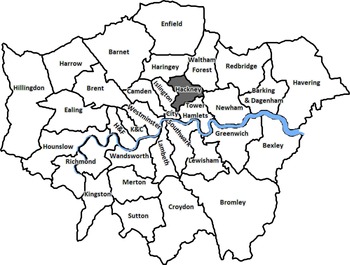
During my time at Lakeside, I assumed the role of ‘youth worker’. This involved setting up nightly activities as well as assisting in the running of the club. The youth group is based in an East London neighbourhood in Hackney, an inner-city borough (see figure 1) that has historically been associated with high levels of crime and deprivation. Although much of the borough has undergone extensive regeneration (Lees, Slater & Wyly Reference Lees, Slater and Wyly2008), the estate where Lakeside is based – and where most of the young attendees lived – continues to see higher levels of deprivation than elsewhere (Ilbury Reference Ilbury2021).
The Inner East London borough of Hackney (shaded) within the wider conurbation of Greater London (GLA 2020, contains Ordnance Survey data © Crown copyright and database rights)

In this article, I focus on data collected from my offline ethnography. Data comprise hundreds of fieldnotes and over 34 hours of self-recordings. Self-recordings were conducted by issuing participants a lapel microphone and a Zoom H2N recorder. During the recording, the individual was permitted to continue participating in the schedule of activities as usual. Participants were recorded in a range of different settings including arts and crafts sessions and time spent in the computer suite. Recorded topics were diverse but were largely discussions of social activities, school, as well as phatic communication amongst friends.
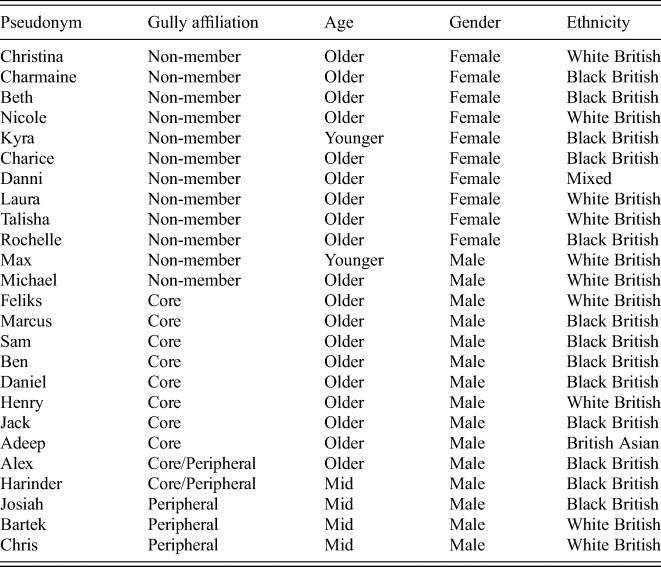
To analyse the social context of the youth group, I ethnographically immersed myself in the community, observing interactions between the young people, and participating in activities outside Lakeside. This enabled me to categorise speakers into emic social categories that emerged during my fieldwork. Of interest to the current analysis, is the exclusively male CofP that referred to themselves as ‘gully’ – a term borrowed from Jamaican Creole referring to the ‘streets’ or, more strongly, ‘a ghetto or slum’ (Jamaican Patwah Reference Patwahn.d.). The social relevance of this label is both in its association with an ethnic variety of English (Jamaican English/Creole) and its semantics, which suggest some orientation towards the ‘street’ or, in the British context, the ‘Road’ – the mundane practices of urban life (see Bakkali Reference Bakkali2018). While we may be tempted to interpret this term and its relevance to the group as directly referencing the ethnic identity of its members, the group included individuals with diverse heritage, both Black and White, with and without Caribbean heritage (see table 1). Thus, although ethnicity appears to be highly relevant to this CofP, its influence appears to be only indirect.
Meso-level social characteristics of speakers

In practice, the gully maintained an ingroup orientation that was generally characterised by an ‘anti-establishment’ stance. A small minority participated in low-level crime, whilst most of the group indexed this stance in more superficial ways by refusing to participate in the organised activities run by the club. Instead, they would often spend club time hanging out in the social areas of the club where they would engage with Hip-Hop, Grime and other music genres that are often labelled ‘urban’ (e.g. Ilan Reference Ilan2015; Boakye Reference Boakye2017). They would also spend a great deal of their time watching YouTube videos and engaging with urban subcultures via social media. Their fashion style was largely influenced by the latest trends in sportswear fashion and they would often wear designer brands and tracksuits.
Participation in the gully CofP was gradient. Though some members committed to embodying the core practices and values of the group, others engaged with this group passively, adopting a more limited repertoire of ingroup values and practices. For instance, as a peripheral member, Chris divided his time between the gully CofP and others who seldom interacted with the rest of the group.
Membership of this category, along with other socio-demographic characteristics of speakers, is summarised in table 1. As the table shows, the gully identity is largely dependent on the individual's gender – as an exclusively male group – and age –with most of the members defined as ‘olders’ (i.e. over the age of 12). Nevertheless, although these social characteristics describe this identity to some extent, they cannot exclusively explain gully membership. For instance, the adoption of stereotypically ‘mature’ practices such as swearing and engaging in certain music cultures were more important in defining an ‘older’ than chronological age. The ‘mid’ age category describes those individuals who are seen to variably engage with both olders and youngers.
Before describing the methodological approach of this article, it is necessary to clarify why I refer to the cultural orientation of the gully CofP as ‘urban’, given the potentially problematic connotations of this label. Indeed, in media, the term ‘urban’ is often used pejoratively as a euphemism for ‘Black’ (e.g. Eddo-Lodge Reference Eddo-Lodge2017: 195). This is not my intention here. Rather, I use ‘urban’ to refer to a particular alignment towards a non-mainstream (even underground) subculture that depicts the lived experiences of inner-city communities (Gunter Reference Gunter2008; Ilan Reference Ilan2015). When defined in these terms, ‘urban culture’ includes an orientation towards the ‘Road’ (Bakkali Reference Bakkali2018) but also includes engaging with music styles such as Grime music and Drill, since these genres are intrinsically ‘musical expressions of urban environments and urban lived experiences’ (Barron Reference Barron2013: 532).
5 Coding and analytical procedure
The quantitative analysis presented here is based on data from the self-recordings of the 25 adolescents. Following the principles outlined in Waters (Reference Waters and Pichler2016), I develop a ‘bespoke’ method to explore the variable system of ASs. This leads me to consider the functional equivalence of these features and their phonetic shape in defining the envelope of variation. Thus, though I acknowledge the potential challenges of treating DP features as sociolinguistic variables, like Levon (Reference Levon2016: 142) in his analysis of the discourse functions of High Rising Terminals (HRTs), I ‘take advantage of the heuristic value of variationist tools’ to uncover the social distribution of ASs.
I therefore include in the variable context any word which fulfils the functional criteria of an AS, based on the definition of this DP feature outlined in earlier sections. This includes forms such as hey, oi, yo and the focus of this article, ey. Only those tokens which function solely to attract the interlocutor's attention were included in the analysis. Thus, tokens which fulfil some other function (e.g. (9)) were not counted. The distinction between attention seeking and other discourse functions of these tokens was made based on a careful examination of the interactional context. ASs are generally produced with a greater intensity (i.e. they are often shouted) and they typically elicit a response from the interlocutor. Structurally, they generally occur at the LP taking rightward scope over the following proposition (Norrick Reference Norrick2009).
In addition, non-lexicalised ASs (e.g. whistling) are excluded. Although these features are potentially meaningful in their own right, they are omitted from the current analysis not only due to their relative infrequency, but also because of the difficulty in isolating these signals from other background noise(s) in the recordings.
Unlike other variable analyses of DP features, I do not exclude repeated tokens. Whilst this may seem unusual, I maintain that this methodological decision is motivated exactly by Waters’ (2016) arguments: that variationist analyses of DP features must be tailored to the specific function of the phenomena under study. Since ASs are commonly found in repeated sets by virtue of their function, I do not exclude repeated tokens. Rather, each instance of an AS was individually recorded.Footnote 6
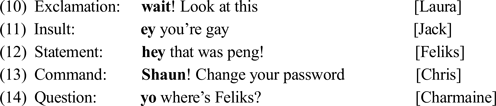
After extracting all ASs, the tokens were coded for a variety of linguistic and social factors. Linguistic factors included ‘position of token’ and ‘discourse context’. The position of the token was coded as either turn ‘initial’, ‘medial’ or ‘final’ to determine whether ASs habitually occur turn initially (e.g. Norrick Reference Norrick2009). To explore the interactional conditioning of ASs, I coded the discourse function of the containing proposition as either ‘exclamation’, ‘insult’, ‘statement’, ‘command’ or ‘question’. The coding schema that I adopt is based on that used in Gold and Tremblay's (Reference Gold and Tremblay2006) analysis of Canadian eh. These categories represent the three main utterance types (‘declarative’, ‘interrogative’, ‘imperative’), with the addition of ‘insult’ and ‘exclamation’ to capture the pragmatic differences between these interactions and other declarative clauses. In coding for discourse type, I consider the token as part of the broader interactional sequence in which it occurs along with the intonation of the utterance (for similar approaches see Levon Reference Levon2016 on High Rising Terminals and Denis & Tagliamonte Reference Denis, Tagliamonte and Pichler2016 on right-periphery tags). Examples of the different discourse contexts and the AS types (VP: wait; NP: Shaun; ey, hey, yo) are presented in (10)–(14).

In addition to these linguistic factors, I include several binary factors to examine the social distribution of ASs. These include CofP identity of addressee: ‘gully’ vs ‘non-gully’; CofP identity of speaker: ‘gully’ vs ‘non-gully’; age: ‘younger/mid’ vs ‘older’; and gender: ‘male’ vs ‘female’.
To assess the significance of the linguistic and social factors, a series of binomial mixed-effects regression models were built in R, using the lme4 package (Bates et al. Reference Bates, Mächler, Bolker and Walker2015; R Core Team 2020). In each model, ‘speaker’ is included as a random effect to account for the relative strength of the individual's variable system. Models were manually stepped down using log-likelihood tests from ‘maximal’ models containing all factors to those which contained only significant factors. In the following sections, my analyses and interpretations are based on ‘best fit’ models.
6 Analysis
6.1 Distributional analysis
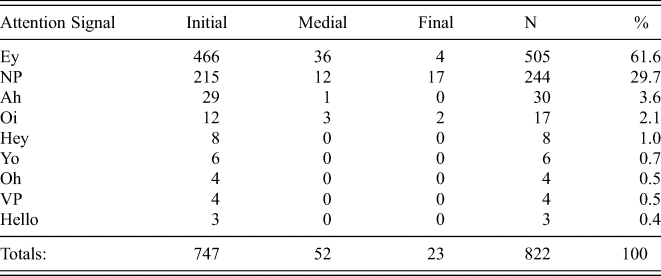
A total of 822 ASs were identified in the dataset. Table 2 provides the overall rates of the ASs and their distribution across turn position. This shows that the innovative marker and the subject of this analysis – ey – is by far the most frequent signal, constituting over half (61.6%, n=506) of the variation. After ey, noun phrases (NPs) are the most frequent ASs (29.7%, n=244). What we may expect to be the typical ASs, hey and oi, are actually highly infrequent, accounting for just 1% (n=8) and 2.1% (n=17) of the data overall. Thus, though oi may have once been a stereotypical AS in East London, it seems that this form has now been supplanted by the innovative form, ey – at least for those at Lakeside.
Distribution of ASs across turn position

While the variable system of ASs appears to be in flux, the positional constraints on these features appears to be relatively robust with the majority of the ASs (90.9%, n=747) found in turn-initial position. This observation is in line with other descriptions of similar DP features such as interjections (Norrick Reference Norrick2009). Though some of the more frequent ASs exhibit more variability in position, turn-final and medial tokens are rare, accounting for just 9.1% (n=75) of the variation.
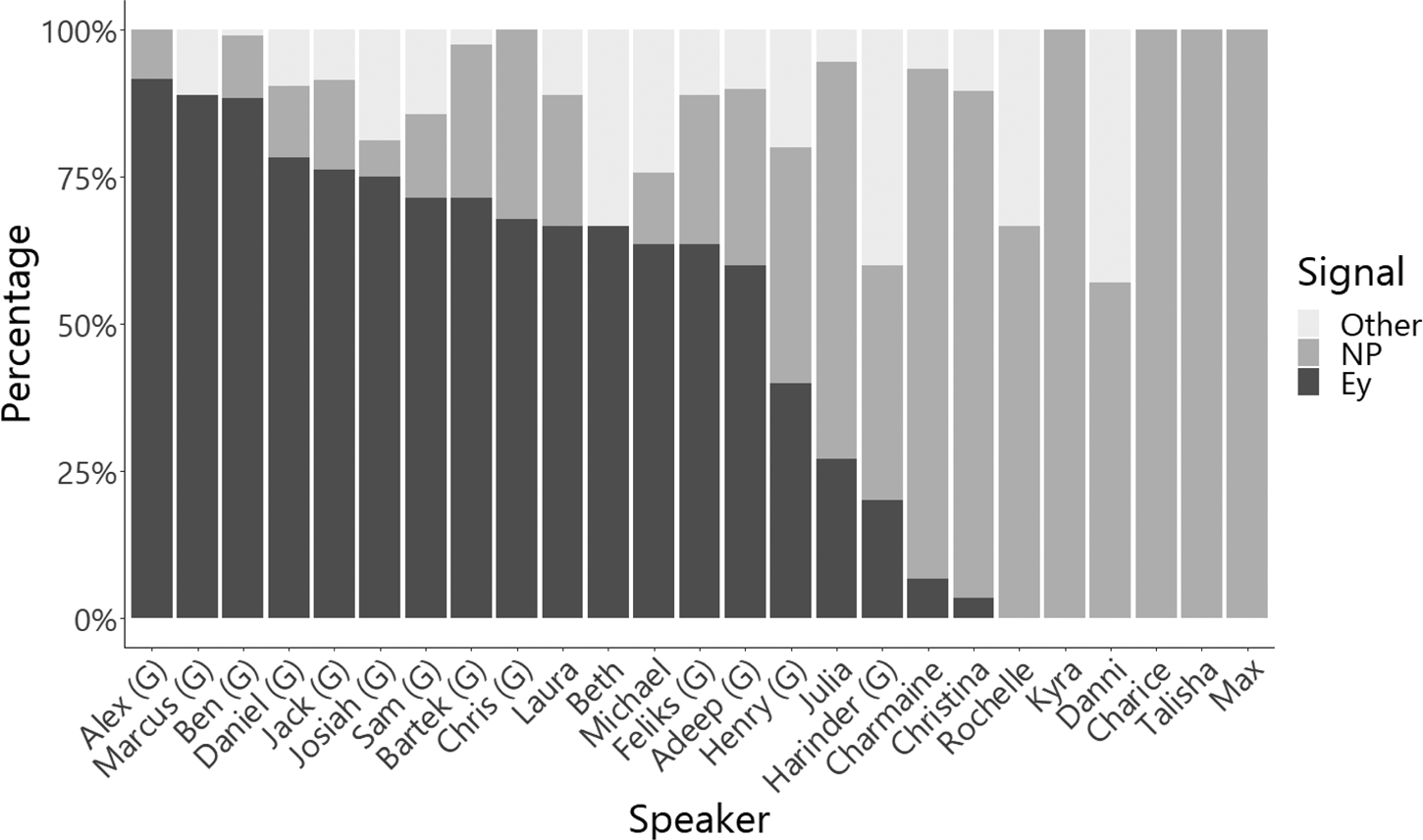
Figure 2 shows the distribution of ASs by speaker. Since ey and NPs (e.g. vocatives) far exceed the rate of other ASs, these are represented individually, while the minor variants are subsumed into a single category: ‘Other’. As figure 2 shows, rates of ey are incredibly variable across individual speakers. Though there are no categorical users, for most of the male speakers, ey appears to be their primary AS. Only one male, Max, does not use ey. There is more variation in the girls’ use of ey. There are some speakers who use multiple strategies of attention signalling (e.g. Laura), whilst others do not use ey at all (Rochelle, Danni, Charice, Kyra, Talisha). However, it is gully members who seem to use ey the most (see figure 2).
Distribution of ASs by speaker. (G) indicates gully CofP membership

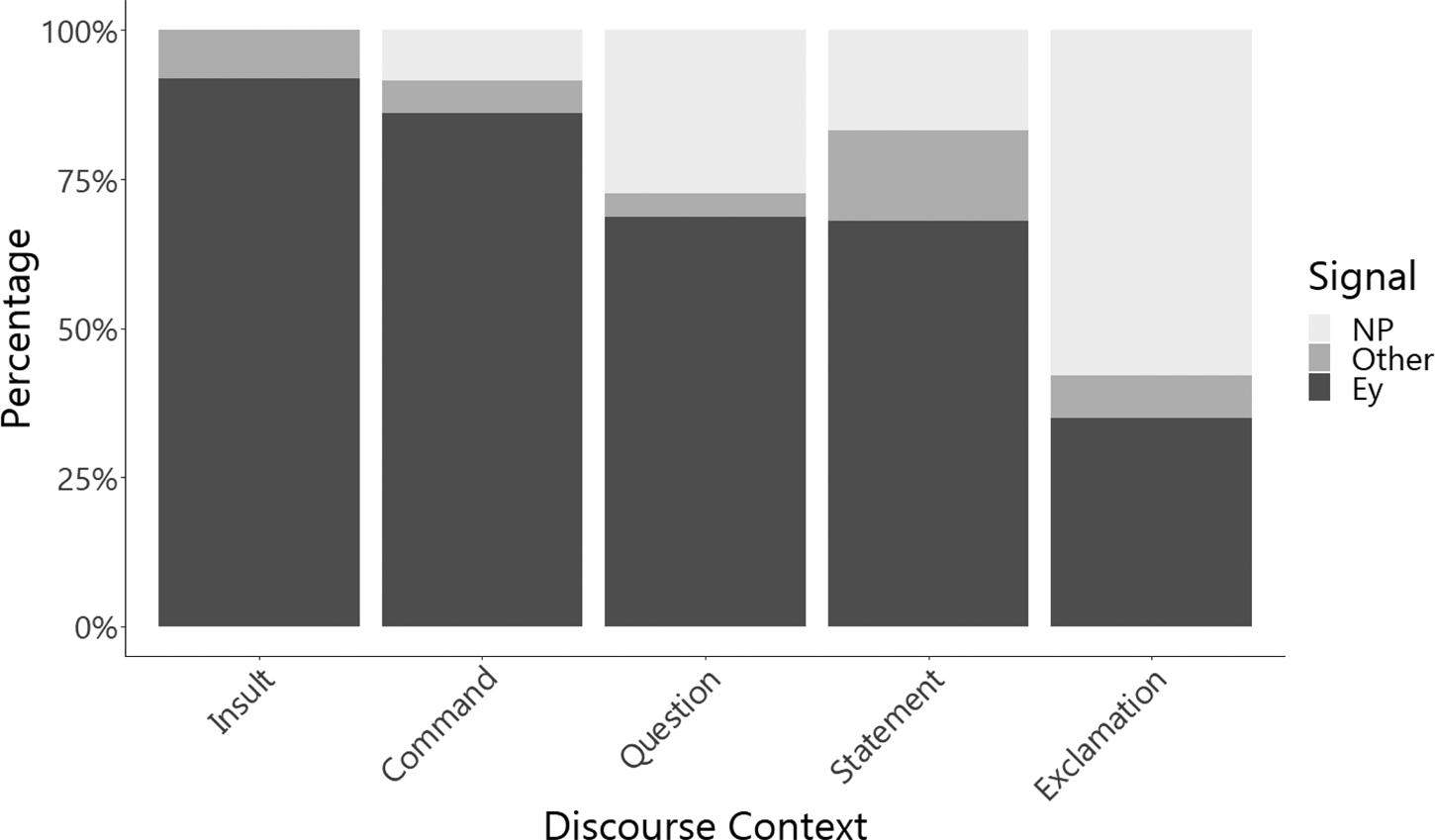
Turning to the effect of discourse context on the variable realisation of the AS, figure 3 shows that the rate of ey is influenced by the five contexts in different ways. Specifically, the occurrence of ey appears to be conditioned by a hierarchy, occurring least in the discourse contexts of exclamations and most in insults (exclamations < statements < questions < commands < insults). Whilst ey is relatively uncommon in exclamations (35.0%, n=98/280), it is considerably more frequent in insults and commands, accounting for 94.6% (n=35/37) and 86.1% (n=142/165) of all ASs used in these discourse contexts. In the two remaining contexts, ey appears to be moderately frequent, with this AS used 68.6% (n=70/102) of the time in questions and 68.0% (n=162/238) of the time in statements. I explore why ey may be conditioned by specific discourse contexts in later sections. First, I turn to statistical analyses of the variability in ASs to examine the relative strength of the social and linguistic factors on the realisation of ey.
Distribution of ASs and discourse context

6.2 Statistical analyses
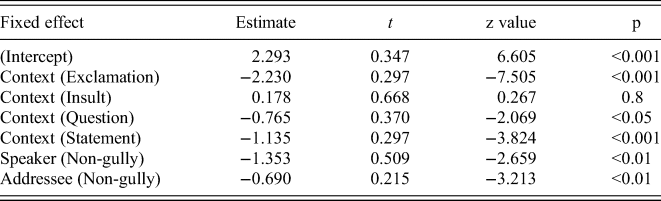
Data from 19 speakers (those who produced ey) totalling 763 tokens were entered into a binominal logistic regression model. ‘Speaker’ was selected as a random effect to account for uneven sample sizes across speakers and any speaker-specific factors. Since all participants who produced ey are ‘olders’, age is not entered into the model. Similarly, due to the correlation of gender and gully membership, gender of speaker is not assessed. In all models, ey was selected as the predictor value vs ‘other’ (i.e. NPs, oi, hey and other minor variants).
The model of ‘best fit’ is presented in table 3. ‘Position’ is not selected as significant. Given the similar distribution of the position of ASs across initial, medial, and final contexts (table 2), this finding is to be expected. The model presented in table 3 shows that there is a significant effect of context, addressee identity and the CofP membership of the speaker. Specifically, ey is both significantly more likely to be used by gully members than by non-gully members (p<0.01) and when the addressee is also a gully member (p<0.01). Thus, ey is both directly (used primarily by members) and indirectly (used in interactions with other members) associated with the gully CofP, largely confirming the distributional observations noted earlier.
Best-fit binomial mixed-effects regression model for ASs

Number of observations: 763, groups: Speaker (19, SD = .8)
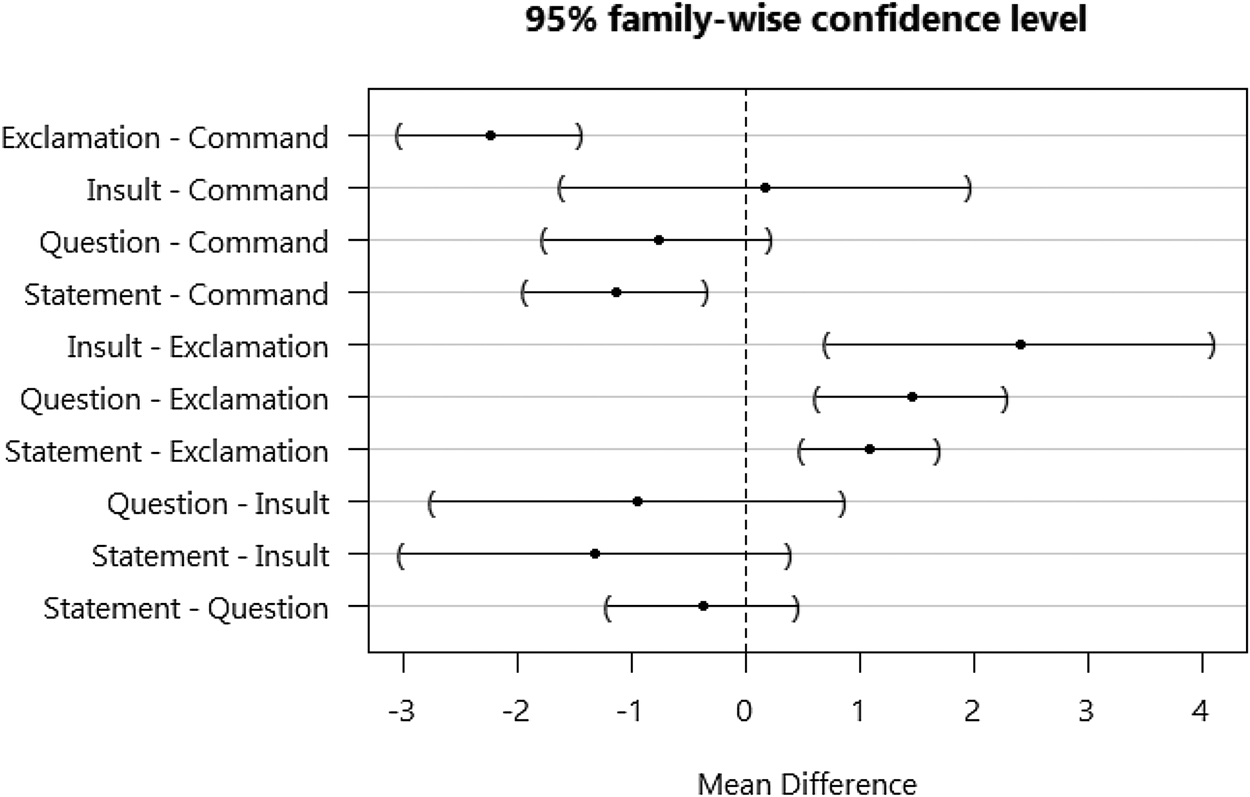
The relationship between discourse context and ey, however, is somewhat more complex. To determine whether there exist significant differences between group means, a post-hoc Tukey HSD test was run on the data. This test accounts for the possibility of a type 1 error (i.e. a false positive) that could arise during pairwise comparisons. The test was executed using the glht function in R from the multcomp package (Hothorn Reference Hothorn2019) and applied to the model of best fit (table 3), taking into account the random effect of speaker (see figure 4).
Figure 4 shows confidence intervals for the difference in means across discourse context pairs. If the confidence intervals do not cross the zero (i.e. dashed) line, the group can be interpreted as significantly different. The graph therefore shows the significance of the factor level ‘exclamation’ versus all other discourse contexts. In other words, the use of ey is strongly disfavoured in exclamatory contexts. This is, perhaps, surprising given that earlier accounts of ASs indicate that these DP features are most often associated with exclamatory discourse contexts (Norrick Reference Norrick2009: 889). It is therefore possible that this AS is being used in discursively different ways to other ASs. Further inspection of figure 4 shows that there are additional constraints on ey. While there is a significant difference between statements and commands, there is no detectable difference between insults and commands. In other words, it appears that ey has become strongly associated with the discourse contexts of insults and commands. It is this possibility that I explore in the next section.
Tukey HSD test: significance of discourse context

6.3 Interactional analyses
Although the distributional analyses presented above can shed light on the social distribution and broad discursive function of ey, it remains unclear as to why this feature appears to have become associated with specific discourse contexts. Similarly, the distributional facts alone cannot explain why gully members use this feature more than their peers. To answer these questions, I now turn to interactional analyses of ey, focusing exclusively on the two main discourse contexts in which this feature is found: commands and insults. While there are clear structural and functional differences between commands, which are typically imperatives, and insults, which are generally statements, these discourse types are comparable in that they are both highly face-threatening interactional contexts (Brown & Levinson Reference Brown and Levinson1987). As a type of imperative, commands compel the addressee to complete some action, thus threatening the negative face needs of the interlocutor. Insults, on the other hand, are typically positive face-threatening acts since they are intended to abuse or scorn the addressee.
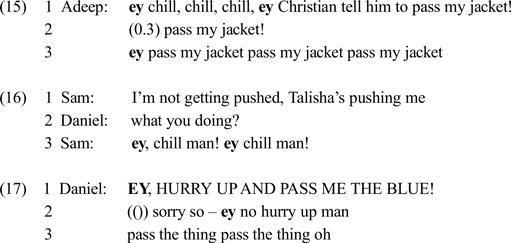
To explore the interactional function of ey, I first examine this AS in the context of commands. By definition, commands imply a dominant, authoritative or peremptory order, involving the submission of an individual to another. The AS ey precedes commands in (15)–(17):

In these extracts, we see that ey prefaces bald, on-record negative face-threatening requests. The AS is first used to elicit the addressee's attention before commanding that individual to carry out some action (e.g. chill ‘calm down’).
In (15), Ali is teasing Adeep by playfully stealing his jacket. In line 1, Adeep uses ey before commanding him to calm down and return the jacket. Realising that his appeal is futile, he requests me, as an adult with more authority, to tell him to pass [his] jacket (lines 1–2), again using ey to attract my attention and thus support his request. In line 3, he addresses Ali directly, prefacing his command with ey before repeating his request.
The excerpt in (16) is taken from an altercation in which another individual (Liam) is attempting to barge his way into the computer room (lines 1–2). As the altercation unfolds, Sam commands Liam to chill (line 3), using ey to preface his request. He repeats his command, again using ey to exert his dominance and, ultimately, request that his friend calm down.
In (17), with the group involved in an arts and crafts sessions, Daniel commands some individual to pass him the blue paint (line 1), using ey to preface this request.Footnote 7 Responding to the delay in line 2, Daniel reasserts his command again using ey to elicit the addressee's attention. Here, ey is used to deploy a stance that is both confrontational – as a request to pass the blue paint – and dominant – that it be passed quickly.
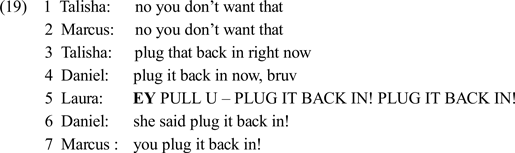
In all three contexts, ey appears to be used not only to attract the interlocutor's attention but also to exert a particular stance – dominance – to command the addressee to fulfil some action or request (i.e. to return a jacket, to chill, to pass the paint). One possibility, then, given the social distribution of this feature, is that the dominant stance evoked through ey is specific to the gully. However, this hypothesis is not borne out by the data. Rather, it seems that non-members use ey in much the same ways as ingroup members. Indeed, when ey is used by other young people, it is generally found in those contexts in which the individual is attempting to exert some control over another individual, such as in (18) and (19).

In (18), some of the younger members of the club are playing a PlayStation game, which Julia has been tasked with overseeing. The game involves the use of a virtual reality (VR) camera that traces the outline of the player and transposes their movements to the character on the screen. In the excerpt, Julia struggles to get the camera to focus on the player (line 1). After some time, she manages to fix the issue and announces that the game is ready to play (line 2). However, as they begin to play, another member of the group who is not involved in the activity continually moves back into the game area which causes the VR camera to lose focus. In line 4, with the individual once again stepping back into the scope of the camera, Julia commands him to not COME BACK IN THE SCREEN! (line 4), prefacing her command with ey. Here, it appears that her use of ey can be explained by my previous arguments. That is, by evoking the stance that ey conveys (dominance), Julia asserts her bestowed authority as a ‘supervisor’ and commands the individual to stay away from the screen.

A similar interaction is found in (19). In the extract, Marcus is annoying Talisha by jokingly stealing her possessions and mimicking her (line 1). Teasing her, Marcus disconnects Talisha's phone from the charger. Realising that her phone is no longer charging, Talisha commands Marcus to: plug that back in right now (line 3). With the request seemingly unsuccessful, Daniel repeats Talisha's request, adding the intimate address term bruv to ‘soften’ the effect of the command, appealing to their shared ingroup status (cf. Adams Reference Adams2018). With Marcus continuing to resist their requests, Laura attempts to explicitly command his attention using ey, before directing him to plug the phone back in (line 5). Finally, Daniel reiterates the request by reporting Talisha's initial command (line 6).
The extracts in (18) and (19) therefore seem to suggest that, even when used by non-gully speakers, the discursive function of ey is maintained. For both ingroup and outgroup speakers, ey appears to be used not only to attract the interlocutor's attention but also as a way to evoke a dominant stance that permits the speaker to assert a level of authority over that individual and, ultimately, seek their cooperation. In (18) this is that the game would be played without interruption and in (19), it is that the phone would be left on charge.
A possible alternative explanation is that ey is not indexing a dominant stance per se, but is used instead to mitigate the negative politeness associated with insults and commands. Although this is certainly a reasonable suggestion, this explanation does not seem to fully account for the range of interactional contexts in which ey is used. First, in (18) the heightened intensity of Julia's command as well as her appeals to the errant individual shows that she has no reason to hedge the confrontation. Second, in (19) we see the appearance of ey only after the other individuals in the room have attempted to command Marcus to plug the charger back in. If ey was used to mitigate negative face threats, then it is unlikely that this feature would occur after the on-record commands in these two contexts. Similarly, this alternative explanation cannot account for the use of ey in the context of insults, as in (20).

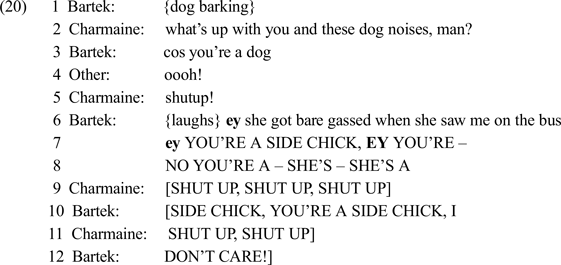
The exchange in (20) is taken from a longer disagreement between Charmaine and Bartek. The excerpt opens with Bartek imitating a dog barking. When Charmaine addresses his behaviour (line 2), Bartek responds by directly insulting her (line 3). He then launches into a narrative where he recalls seeing Charmaine on the bus, claiming she was bare gassed (‘excited’) to see him. As he continues to narrate the story, Bartek switches addressee, reporting the incident to the others in the room, indicated through the third-person pronoun she (line 6). Later, in lines 7–10, he returns to addressing Charmaine when he refers to her a side chick (i.e. a ‘mistress’).
Although it is not entirely clear why Bartek initiates this argument, in other conversations he had complained that Charmaine wasn't ‘cool’ enough to be part of the ingroup and he disapproved of her hanging around with the ‘olders’. It is therefore clear that the exchange in (20) should be interpreted as a bald on-record insult (Brown & Levinson Reference Brown and Levinson1987), directly intended to cause offence to Charmaine. Thus, I argue that Bartek's main intention in this interaction is to distance Charmaine from himself and his friends by exerting his ingroup status (i.e. dominance). In line 6, we see clear evidence of this ‘distancing effect’, indicated by the use of the third-person singular pronoun she, which Bartek uses to report the story to the other ‘ingroup’ members in the room whilst explicitly isolating Charmaine from this narrative altogether.
However, Bartek's attempts to elicit agreement from the others in the room appear to be unsuccessful. In lines 7–10, his speech is littered with false starts and he continually repeats his assessment – difficulties which suggest that he is unable to acquire the conversational floor. His assessment is further disrupted when Charmaine, upset with Bartek's criticisms, repeatedly shouts SHUT UP (lines 9 and 11). The repetition of ey in this context seems to coincide with his difficulties of appealing to the others to accept his assessment of Charmaine. Here, the stance potential of ey – dominance – is evoked by Bartek as he struggles to maintain and renegotiate the conversational floor. In doing so, Bartek attempts to find mutual ground (solidarity) amongst his peers by convincing them of Charmaine's incompatibility with the ingroup.
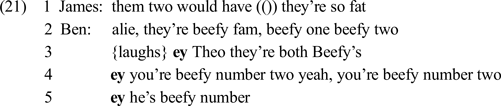
However, although this account can explain the use of ey in insults directed at outgroup members, it does not explain why this feature is significantly associated with interactions between gully members. One possibility is that there is a difference in the types of insults that are used in ingroup and outgroup interaction. Indeed, close analysis of the surrounding interactional contexts of insults by ingroup members suggests that these exchanges cannot be read as ‘true insults’ in that they are not intended to cause direct offence (cf. extract (20)). Rather, the insults used by ingroup members appear to be interpreted as ‘banter’ – an exchange of playful remarks. For instance in (21), James, Ben and Theo are discussing two friends, who they brand beefy one and beefy two in reference to their larger stature (line 2). One of those friends is Harinder, who is sitting with the group. Here, the assessment fat (line 1) and the corresponding label beefy (line 2) could both be interpreted as bald on-record insults, much like the side chick label applied to Charmaine earlier. However, unlike the insult in (20), when these labels are applied to Harinder in line 4, indicated by the shift from third-person they to second-person you, he does not resist this evaluation. This suggests that it is not directly interpreted as an ‘insult’, but rather it appears that this interaction is a display of ‘banter’.

Throughout this passage ey is used in discursively similar ways to (20). In line 3, we see that the use of ey, directly follows an evaluation which Theo does not respond to. In line 4, Ben repeats his statement, using ey to elicit support for his evaluation from his interlocutors. When the person reference shifts from they to you, ey again appears as part of this exchange of banter, with the repeated use of this AS (lines 4 and 5) intended to draw attention to his evaluation of Harinder as beefy one.
What I would argue here, then, is that when ey functions as part of this type of exchange amongst gully members, it has an intrinsic interpersonal function (Nichols Reference Nichols2017), where the banter strengthens, not weakens, social bonds (cf. (20)). For this group, banter is a conversational norm which is utilised as an exclusionary mechanism that prevents certain individuals from participating in this CofP (e.g. Decapua & Boxer Reference Decapua and Boxer1999). However, in these contexts, the interactional function of ey and its dominant stance is nevertheless preserved as, rather than othering the speaker (cf. (20)), it is deployed to manage social hierarchies within the ingroup.
This interpretation not only explains the influence of the discourse context on the variable realisation of the AS, but it also accounts for social distribution of ey. As the only perceptible CofP at Lakeside, it is possible that ey has become the preferred AS used by gully members exactly because of its stylistic potential. That is, ey becomes an interactional device that is useful in managing the boundaries of the gully social identity. Thus, I argue, the association of ey with this CofP is the consequence of ‘stance accretion’ (Du Bois Reference Du Bois2002), where the ‘dominant’ stance that ey indexes is habitually deployed by this CofP. For gully members, I argue, this stance is particularly useful as it permits these individuals to perform a central facet of the gully identity: hegemonic masculinity.
To explain the link between ey, its dominant stance and the gully identity, I draw inspiration from research which has examined how variable features are implicated in the performance of hegemonic masculinity. A case in point is Kiesling's (Reference Kiesling1998) analysis of (ING) in an all-male fraternity. In that research, Kiesling argues that higher rates of the apical nasal variant [n] in the speech of some of the men can be related to the indexical potential or the ‘vernacular power’ (Reference Kiesling1998: 84) of this feature in indexing ‘working-class cultural models and confrontational stances’ (Reference Kiesling1998: 69). Kiesling links these stances to the performance of hegemonic masculinity, arguing that the use of [n] is part of the display of physical power, characterised by dominance and solidarity. Similar themes are also examined in Lawson's (Reference Lawson2014) ethnography of male peer groups where he contends that the use of TH-fronting by speakers of the ‘Ned’ CofP contributes to the development of an ‘anti-establishment’ stance and their performance of ‘tough’ masculinity. Here, I suggest that ey is being used in discursively similar ways. That is, ey is used most frequently by gully members to deploy a dominant stance as part of a more general performance of hegemonic masculinity that the gully identity is dependent on.
Returning now to the exchanges of banter between the gully in which ey occurs, it is now possible to link the ‘inclusionary/exclusionary mechanism’ of this speech act to the performance of hegemonic masculinity. As Nichols notes in her work on banter in an all-male rugby club, when used amongst the ingroup, banter not only delimits group boundaries, but functions as a ‘marker of being able to “make it” as one of the lads’ (Reference Nichols2017: 169). I would suggest that when ey is used in banter amongst the gully, it is being used in a very similar way. Specifically, I suggest that, in this context, ey functions as part of a display of ingroup bonding, what Kiesling (Reference Kiesling2005: 712) has referred to as ‘camaraderie’ – or ‘homosociality by alliance’.
This function, however, is perhaps most evident in those exchanges of banter where behaviours, norms and values are subverted as incompatible with ingroup values. This includes interactions in which stereotypically gendered qualities such as physical traits of strength and power are reinforced as positive attributes of masculinity (Nichols Reference Nichols2017). For instance, in the following exchanges, ey precedes some assessment that delimits certain behaviours and norms as incompatible with the gully identity:

In excerpts (22) and (23), the ‘deviant’ behaviour is homosexuality, with the action labelled gay. In (22), Bartek uses this label to refer to an individual who had shown him a video on a mobile phone. In (23), Daniel uses this label to describe Marcus’ behaviour, after Marcus had become excited at the prospect of shaking a jar containing a glittery liquid. In both instances, the label gay is not intended to refer to the (purported) sexual orientation of the addressee but, rather, is applied to individuals and behaviour that are deemed to be ‘deviant’ and therefore incompatible with ingroup norms and values. In these extracts, the insult is prefaced by ey. Here, I argue that this AS is being used as part of a broader performance of masculinity, in which the signal ey is used to deploy a dominant stance that simultaneously establishes the speaker's position within the ingroup, while distancing that individual from behaviour deemed ‘problematic’ (i.e. gay; see also Drummond Reference Drummond2018). By emphasising behaviour as incompatible with group norms, the speaker reinforces the dominant and normative values of the ingroup, thus increasing solidarity amongst those who belong to this CofP.
7 Conclusion
This article has examined variation in the system of ASs in the speech of young people in an East London youth group. By focusing on one AS – ey – I demonstrate that this feature is significantly associated with a specific CofP – the gully – both in terms of its distribution and its use amongst interactions between the ingroup. Examining the interactional contexts in which ey occurs, I have suggested that this feature is primarily used in commands and insults to evoke a ‘dominant’ stance. By deploying this stance, speakers can assert their authority over other individuals to achieve certain interactional and social ends. Further, I have suggested that when used in these contexts, ey functions as part of a management of identities that serves to build ingroup and outgroup ties, such as in the case of the playful banter exchanged between members of the ingroup. Lastly, I have argued that the higher frequency of ey amongst the gully can be attributed to the process of ‘stance accretion’ (Du Bois Reference Du Bois2002), wherein the indexical value of ey in deploying a dominant stance is regularly valued by members of the gully as a way of performing hegemonic masculinity – a fundamental facet of this identity.
Finally, the analysis presented here demonstrates the stylistic potential of one subclass of DP features – the Attention Signals. Future research should therefore consider not only the distribution of these and other DP features, but also the social meaning of these variants. This will allow us to uncover the ways in which DP features – like phonological and morphosyntactic variables – are variably recruited in the broader sociolinguistic project of personae construction and management.