


In 1939, Daniel Ellison, a Republican, was elected to his final term in the Baltimore City Council after nearly 20 years of service. Members of his party, naturally, sought election to the council in the terms that followed, yet, despite these attempts, no Republican has won a seat in the chamber since Ellison departed.Footnote 1 In fact, in recent terms, the Republican Party has been unable to even field a full slate of candidates, with those who do run rarely garnering more than 20% of the vote. As a result, for over 75 years, the Democratic Party has completely controlled politics in the city, with no credible out-party opposition within elections or government. While the extent and duration of this single-party dominance in Baltimore is particularly extreme, the city is hardly an anomalous example. Indeed, the United States has a long history of single-party dominance at both the state and local levels of government (Key Reference Key1949; Schleicher Reference Schleicher2007). With increasing partisan and geographic polarization (Bishop Reference Bishop2009; McCarty, Poole, and Rosenthal Reference McCarty, Poole and Rosenthal2006), moreover, these types of contexts are again increasingly common across the country, such that as of the 2016 election there were 22 states in which one party held at least a veto-proof majority in the state legislature, along with a significant and growing number of local governments with overwhelmingly one-party councils.
This lack of two-party competition in many contexts at the state and local level in the United States has considerable implications for the stability of democratic politics and the quality of representation. Indeed, political scientists have long argued that stable party coalitions, in direct competition with each other, are critical for ensuring responsible governance because they provide voters with the opportunity to choose among competing policy programs (APSA 1950). This competitive choice is important because it makes it easier for voters to attribute proposed policies and policy outcomes with specific candidates and parties, thereby lowering the barriers to participation and facilitating democratic accountability at the ballot box. Empirically, this theory of competitive party coalitions aligns with a substantial body of scholarship on one-party dominance in the American South, the bulk of which suggests that without credible out-party competition, southern politics devolved into chaotic factionalism, with elite coalitions shifting across issues and the policymaking process largely favoring the “haves” over the “have-nots” as a result (Aldrich and Griffin Reference Aldrich and Griffin2018; Key Reference Key1949; LeBlanc Reference LeBlanc1969; Patterson Reference Patterson1962). Yet, for many reasons, the Solid South is a unique political context, and we have relatively limited evidence on this question from beyond its borders. In turn, it remains unclear whether party competition is indeed a requirement for highly organized, responsible democratic governance and, if so, how competition facilitates this stability in elite behavior.
In this paper, I address these questions by examining the relationship between party competition in the electorate and the stability of the coalitions that form in government. To do so, I draw on a novel set of legislative records from the local level, which includes nearly 350,000 recorded roll-call votes from 151 city and county councils across the country. Unlike data from the state and national legislatures, data on legislative behavior at the local level has never before been systematically collected for such an extensive set of municipal governments. Yet, there are important benefits to studying legislative institutions and elite behavior at this level. Indeed, although local politics has long been argued to be constrained, with limited space for partisanship and party conflict in the process of government (Peterson Reference Peterson1981), recent work has documented that local policy and elite preferences on local issues are increasingly partisan in nature (de Benedictis-Kessner and Warshaw Reference de Benedictis-Kessner and Warshaw2016; Einstein and Glick Reference Einstein and Glick2016; Einstein and Kogan Reference Einstein and Kogan2015; Tausanovitch and Warshaw Reference Tausanovitch and Warshaw2014), making this domain a perfect test case for questions related to parties and party competition.
Furthermore, for this paper in particular, studying the local level provides better leverage to test the mechanisms through which competition is associated with coalitional stability. Specifically, because many local governments are formally nonpartisan—meaning there are no party primaries, party identification is not listed on the ballot, and party organizations are significantly less likely to be active (Adrian Reference Adrian1959; Anzia and Meeks Reference Anzia and Meeks2016)—it allows me to test whether having party organizations institutionalized within the electoral and governing system is necessary in order to structure elite competition. This is important because—given the increasing nationalization of local politics (Hopkins Reference Hopkins2018)—partisan elections and local party organizations may simply not be as necessary to organize politics as prior work has argued (Jenkins Reference Jenkins1999; Wright and Schaffner Reference Wright and Schaffner2002); rather, competition among partisan ideologues within a nonpartisan or one-party dominant system may very well yield the same patterns of low-dimensional behavior that scholars have found exclusively in competitive, partisan governments.
To evaluate the stability of the legislative coalitions across the cities and counties in my data, I use roll-call votes from each council to estimate the dimensionality of legislative behavior. If coalitional stability depends on the presence of partisan electoral competition, then voting coalitions should be more one-dimensional in contexts in which the electorate is evenly balanced between the parties. In cities and counties that use partisan elections that is precisely the relationship I observe: across multiple measures of both party competition and legislative dimensionality, I find that elite behavior is more one-dimensional in contexts where the electorate is evenly balanced between the parties. In practice, this low-dimensionality means that individual votes are highly predictable and that voting coalitions are stable across issues. In contrast, I find no evidence of a relationship between party competition in the electorate and legislative voting behavior in formally nonpartisan governments. Indeed, despite the recent evidence of local nationalization, I find that voting behavior in most nonpartisan contexts is relatively disorganized. This difference across institutional environments suggests that partisan elections—and the party organizations that nearly always come with them—are critical to structuring elite competition, such that their absence in nonpartisan governments impedes long-term cooperation.
To account for concerns that the types of individuals who hold office in partisan and nonpartisan governments may be fundamentally different, I supplement my primary analysis with an examination of the ideological leanings of local legislators. Specifically, using a unique survey of 720 municipal officials, I compare the ideological extremity of council members in similarly competitive partisan and nonpartisan contexts across two ideological dimensions, showing that there is essentially no relationship between the competitive balance among the parties in the electorate and ideologically extreme preferences in either context. Importantly, the nearly identical trends across partisan and nonpartisan governments suggest that the types of individuals who run and win in local partisan and nonpartisan elections are quite similar, meaning that underlying differences in the preferences of elites across contexts are unlikely to explain the relationship between party competition and legislative dimensionality.
My findings contribute to our understanding of political parties and legislative institutions and they shed new light on the formal legislative process in municipal governments across the United States. In particular, my results suggest that—given both the increasing trend toward one-party dominance and the significant number of cities and counties in the United States that use nonpartisan election systems—the context within which legislative bargaining occurs at this level is often highly unstable. This instability is important because it means that voters will rarely be able to rely on partisan cues at the ballot box (if even formally provided) because those cues are only likely to be dependable predictors of legislative behavior in contexts with partisan electoral competition. This disconnect has the potential to create significant hurdles for representation (e.g., Davidson and Fraga Reference Davidson and Fraga1988; Schaffner, Streb, and Wright Reference Schaffner, Streb and Wright2001; Wright Reference Wright2008), and it raises numerous questions for future research about the capacity for democratic accountability and the viability of nonpartisan alternatives to parties in a broad set of municipal governments across the country.
How Electoral Competition Influences Party Coalitions
Political scientists have long argued that electoral competition is one of the key features influencing the structure of the party system and the relationship among elites within government (Aldrich Reference Aldrich1995; Key Reference Key1949; Schlesinger Reference Schlesinger1985). The underlying logic is that competition creates insecurity in the pursuit and retention of elected office. This insecurity, in turn, influences the incentives of members to cooperate with each other, resulting in more cohesive voting within legislatures, legislative coalitions that are easier for voters to hold accountable, and, ultimately, better representation.
The bulk of the empirical evidence for the relationship between party competition and the structure of legislative coalitions, specifically, stems from studies of the Solid South. Writing in the 1940s, for example, Key (Reference Key1949) observed that the cohesiveness of the Democratic Party in each of the southern states varied with the level of competition, such that in places where the Republican Party represented a credible electoral threat—even if minor—the Democratic Party had greater incentive to work together. Where the Republican Party was largely absent, however, Democratic Party politics degraded into chaotic factionalism, with unstable intraparty coalitions shifting over time and across issues.
Subsequent work analyzing the development of two-party systems in the South and the role of competition in structuring state legislative politics more generally—for example, if there were stable cleavages, whether they were present in patterns of voting, and on which issues they crystallized—largely supported Key’s argument, with the introduction of competition typically coinciding with an increase in intraparty cohesion (Broach Reference Broach1972; Harmel and Hamm Reference Harmel and Hamm1986; Havens Reference Havens1957; Patterson Reference Patterson1962).Footnote 2 In fact, even beyond the Solid South scholars have noted that levels of partisan voting vary with patterns of electoral competition, both in Congress over time and cross-sectionally in the states (Carroll and Eichorst Reference Carroll and Eichorst2013; Schlesinger Reference Schlesinger1985).
Importantly, however, the coalitional instability documented in these studies contrasts starkly with what we typically observe in partisan governments in the United States. Indeed, empirically, elite conflict in American politics is often described as being stable and “low-dimensional” (Shor and McCarty Reference Shor and McCarty2011), meaning that members of the same party nearly always vote together and voting coalitions rarely diverge from their strict partisan boundaries. Yet, Key’s findings, in tandem with the work that followed, suggest that this feature of party government may not be inevitable. Rather, in certain contexts, such as when the electorate overwhelmingly favors one party and competition is minimal, we should expect legislative behavior to become detached from the party and for other lines of conflict to emerge.
Party Competition in Partisan and Nonpartisan Governments
All of the existing evidence documenting a relationship between party competition and coalitional stability comes from formally partisan governments. Yet, despite the near universal use of partisan election systems at the state and national levels, approximately 70% of local governments use nonpartisan election systems instead (Svara Reference Svara2003). By definition, this means that party primaries are not a part of the electoral process and party affiliation is not listed on the ballot. In practice, however, nonpartisan elections also diminish or eliminate the role of party organizations in elections and government. Indeed, in many cases, party organizations are simply not present under nonpartisanship (Adrian Reference Adrian1959; Bledsoe and Welch Reference Bledsoe and Welch1987). Moreover, even when they are, they are typically less active and influential than their partisan counterparts, lack the type of collective responsibility that comes with having party labels on the ballot, and have no institutional advantages over other local interest groups (Adrian Reference Adrian1959; Anzia and Meeks Reference Anzia and Meeks2016; Cutright Reference Cutright1963; Hawley Reference Hawley1973; Pelissero and Krebs Reference Pelissero and Krebs1997). As Adrian (Reference Adrian1959, 458) concludes “in most nonpartisan elections, organizations identified with the major political parties are of little or no importance in determining the outcome and most candidates are not active participants in political party activities.”
These organizational differences across partisan and nonpartisan governments raise the question: with the increasing nationalization of subnational politics in the United States, will the trends related to competition documented in previous studies hold in nonpartisan contexts today? Indeed, though party organizations may not be formally part of the electoral and governing system in nonpartisan governments, with the strength of modern partisanship nationally and the increasingly ideological direction of politics locally, simply being in an area that is evenly split between the parties may be sufficient to make partisanship a salient feature of electoral competition. While this hypothesis contrasts with early work finding relatively disorganized, high-dimensional voting behavior in both the nonpartisan Confederate Congress and nonpartisan Nebraska legislature (Jenkins Reference Jenkins1999; Welch and Carlson Reference Welch and Carlson1973; Wright and Schaffner Reference Wright and Schaffner2002), it is consistent with both empirical evidence from more recent terms of the Nebraska legislature demonstrating an increase in partisan polarization (Masket and Shor Reference Masket and Shor2015) and theoretical work examining the conditions under which party in the electorate can translate into partisan outcomes under nonpartisanship (Krehbiel, Meirowitz, and Romer Reference Krehbiel, Meirowitz and Romer2005).
Whether we see similar patterns of elite behavior within partisan and nonpartisan governments, however, likely depends on the mechanism underlying competition and coalitional stability. If stability requires strong, active party organizations, then there is little reason to expect partisanship in the electorate to influence elite coalitions in nonpartisan contexts regardless of the level of competition; if, however, stability stems from the preferences of individual lawmakers, then we would expect to see similar levels of coalitional stability in both contexts. In the following two sections, I discuss these two potential mechanisms in further depth and explain how each yields differing predictions for partisan and nonpartisan contexts.
Partisan Electoral Competition and Party Organizations
The first mechanism through which competition might facilitate coalitional stability centers on the way in which competition interacts with formal party organizations. Specifically, when electoral competition represents either a credible threat to the majority party’s power or a realistic opportunity for the minority party to win office, party organizations have a greater incentive to invest in and leverage the electoral and legislative tools at their disposal to improve their members’ electoral prospects (Harmel and Hamm Reference Harmel and Hamm1986; Schlesinger Reference Schlesinger1985). As Schlesinger (Reference Schlesinger1985) argues, the more competitive the electoral context, the more valuable organization becomes for members of the party because they simply cannot rely on party identification to win office.
There are two critical pieces to this logic: first, that party organizations can leverage electoral and legislative tools to influence member behavior, and second, that the use and effectiveness of these tools varies with the threat of electoral loss. To the first point, there is a significant body of scholarship that demonstrates the significance of party organizations and party activity for member behavior. On the electoral side, for example, parties engage in a broad range of activities to support the election of their members, including fundraising, endorsements, turning out the vote, and developing and informing voters of the party brand (Cohen et al. Reference Cohen, Karol, Noel and Zaller2008; Hassell Reference Hassell2015; Key Reference Key1942; Snyder and Ting Reference Snyder and Ting2002). These activities, which scholarship on local politics suggests are not exclusive to national parties (Bledsoe and Welch Reference Bledsoe and Welch1987; Eldersveld Reference Eldersveld1995; Krebs Reference Krebs1998, Reference Krebs2005), can decrease the costs of running for office, help voters understand the differences among their choices at the polls, and minimize the need to cultivate a personal vote (Primo and Snyder Reference Primo and Snyder2010), making them quite valuable to members of the party seeking election. This value, in turn, creates the incentive for members to support the party’s agenda to ensure that the party continues to provide this type of assistance.
In addition, on the legislative side, political parties can also develop and leverage tools within the legislative chamber to improve the party’s electoral fortunes and hold individual members accountable for deviating from the party line. For example, a large body of scholarship argues that parties manipulate the legislative agenda for electoral gain, limiting issues that might divide the party from reaching the floor (Cox and McCubbins Reference Cox and McCubbins1993, Reference Cox and McCubbins2005). This form of agenda control is particularly effective in tandem with strong committees (Anzia and Jackman Reference Anzia and Jackman2013), which might explain why partisan local governments are significantly more likely to have institutionalized committee systems than their nonpartisan counterparts (Pelissero and Krebs Reference Pelissero and Krebs1997). Furthermore, parties can also use both selective benefits and targeted punishments to shape member behavior (Cann and Sidman Reference Cann and Sidman2011; Rohde Reference Rohde1991). For example, to incentivize cooperation, party leaders can offer positions of power or prestige, increased resources, or help getting a piece of legislation through the chamber. They can also, of course, strip a member of any of these perks or block the progress of important legislation as punishment. And indeed, the evidence suggests that these types of incentives, perhaps in combination with electoral organizing, do influence member behavior (Ansolabehere, Snyder, and Stewart Reference Ansolabehere, Snyder and Stewart2001; Snyder and Groseclose Reference Snyder and Groseclose2000).
While these electoral and legislative tools are certainly valuable for party organizations, there are two reasons to believe that their use and effectiveness will vary with the threat of electoral loss. First, because these types of organizing are costly, parties will only have an incentive to engage in them when they are challenged or have a realistic chance at winning office (Schlesinger Reference Schlesinger1985). For example, Harmel and Hamm (Reference Harmel and Hamm1986) document how the introduction of two-party competition in Texas led to growth in the organizational capacity of each party within the legislature, with each party hoping to increase the likelihood that they would ultimately win enough seats to hold a majority. As Representative Bob Bush explained at the time, “When Texas was a one-party state, it wasn’t necessary to identify yourself and what you stood for” to win election (Harmel and Hamm Reference Harmel and Hamm1986, 84). With competition, however, members needed to differentiate themselves from the out-party to win office and newly bolstered party organizations had both the incentives and resources to facilitate this process.Footnote 3
Second, changes in the level of competition alter the incentive structure for individual members of a legislature, decreasing the power of the carrots and sticks that parties wield. For example, given that parties exist—whether wholly or in part—to facilitate reelection, then absent strong, credible electoral competition, parties will become less significant for a member’s electoral prospects. As a result, there is less benefit to the member for adhering to the party line when it conflicts with their preferences because doing so is less likely to affect their electoral future. Indeed, while party-provided pork and committee power are certainly valuable, in a context where the electorate overwhelmingly favors one party they are unlikely to significantly improve a member’s electoral fortunes, particularly relative to the cost of adhering to the party line, and so members will have less of an incentive to sacrifice for them. Consider, for example, former New York City Councilmember Charles Barron. In 2010, he challenged fellow Democrat and Speaker Christine Quinn for leadership of the chamber, losing 48 to 1.Footnote 4 Quinn subsequently stripped Barron of his committee chairmanship and his $10,000 “lulu” stipend. Yet, given that he was an incumbent Democrat in a highly Democratic city, Barron had little reason to cooperate to win these perks back, and he instead continued to challenge the Democratic leadership and foster dissent within the party thereafter.Footnote 5
Ultimately, if electoral competition affects the influence and activity of party organizations—whether because individual members have less of an incentive to support the party’s agenda absent an electoral threat or because the party itself has less of an incentive to organize member behavior—then we should only see a relationship between competition and coalitional stability in governments that use partisan elections because those are the contexts where party organizations are embedded within the electoral and governing system. Thus, when elections are partisan and the electorate is evenly balanced between the parties, party coalitions should be more cohesive and voting behavior should be more one-dimensional. As the electorate becomes increasingly imbalanced, however, coalitions in these contexts should shift more frequently, meaning that voting behavior will be more multidimensional. In contrast, in nonpartisan governments, where organizations are either absent or significantly less active to begin with, elite behavior should be relatively disorganized regardless of the capacity for local party competition. Thus, any differences between elite behavior in partisan and nonpartisan contexts should grow smaller or disappear as the balance between the parties in the electorate grows increasingly lopsided.
Partisan Electoral Competition and Elite Preferences
The preceding logic suggests that—when the electorate is evenly balanced and competition between the parties is high—party organizations will have an incentive to develop and leverage electoral and legislative tools to facilitate the election of their members. This organizational effort, in turn, fuels greater cohesion within the party and thus more stability in legislative coalitions across conflicts. However, while a mechanism based on party organizations is certainly plausible, legislative stability might also arise as a function of how competition influences the preferences and priorities of the members who run and serve.
The logic for a preference-based mechanism is rooted in two key features of legislative behavior: first, strong, active party organizations—either in the legislature or as electoral-mobilizers—are not inherently necessary for partisan-based voting. As Krehbiel (Reference Krehbiel1993, Reference Krehbiel2007) has long argued, parsing the effect of party often suffers from a problem of observational equivalence, such that models based on the preferences of individual members can often explain outcomes interpreted as party influence. This is important because with the increasing nationalization of American politics (Hopkins Reference Hopkins2018), local governments are likely to be populated by ideological partisans regardless of the presence or activity of local party organizations. Indeed, scholars of local government have shown that partisan policy outcomes are common in contexts that use both partisan and nonpartisan elections alike (de Benedictis-Kessner and Warshaw Reference de Benedictis-Kessner and Warshaw2016; Einstein and Glick Reference Einstein and Glick2016; Einstein and Kogan Reference Einstein and Kogan2015). If these partisan-oriented preferences drive elite behavior, then we would expect voting within councils where the electorate is evenly balanced between the parties—regardless of whether they are formally partisan or nonpartisan—to be relatively organized, with stable ideological coalitions voting together over time.
Second, if elite preferences and voting behavior are oriented around partisanship, then—even in the absence of local party organizations—competition may still influence the relative salience of party and the need for elected officials to vote in an ideologically constrained manner. For example, when the electorate is evenly balanced, candidates will be able to better differentiate themselves during campaigns based on partisan affiliation and ideological compatibility such that these features will be more salient to voters and thus more important for voting decisions at the polls, even in nonpartisan contexts. This increase in the salience of party with competition is consistent with recent evidence that party competition appears to exacerbate polarization (Aldrich and Battista Reference Aldrich and Battista2002; Hinchliffe and Lee Reference Hinchliffe and Lee2016), making partisanship a more important factor for legislative behavior and representation (Bonica and Cox Reference Bonica and Cox2018; Carroll and Eichorst Reference Carroll and Eichorst2013).
In contrast, when the electorate strongly favors one party, politicians will need to develop electoral constituencies around other groups and interests.Footnote 6 As a result, partisan considerations may simply become less important for legislator decision making, leading to less stable coalitions within the legislative chamber regardless of electoral system. As Patterson (Reference Patterson1962, 200) explains, without “party as a reference group, the legislator is likely, consciously or unconsciously, to respond to different pressures in different voting areas.” In turn, members will deviate specifically in circumstances when the preferences of important electoral constituencies conflict with their partisanship. At the local level, specifically, where a variety of groups have been shown to influence the political process and where policy tends to be more allocational in nature (Trounstine Reference Trounstine2016), these types of cross-cutting constituencies may be particularly likely to form. Indeed, if the focus of debates is often on where resources are devoted or who benefits most from a service, then it creates the opportunity for coalitions to shift according to the specific locations or groups involved, particularly absent a clear partisan or ideological out-group.
Empirically, if this type of preference-based mechanism underlies differences in the stability of legislative coalitions, it should be observable by comparing across governments that use partisan and nonpartisan election systems. Specifically, because nonpartisan governments are significantly less likely to have strong party organizations active within local politics, if—regardless of the election system—legislative behavior becomes more multidimensional as the electorate increasingly leans toward one party, then it suggests that the relationship is rooted more in the preferences of individual council members than party organizations. In contrast, if this relationship is only present in contexts that use partisan elections, then it would suggest that the mechanism is rooted more in features of the institutional environment in partisan election systems, such as the presence and activity of strong party organizations.
Data
To evaluate the relationship between party competition in the electorate and coalitional stability in government, I draw on an original collection of legislative records from 151 city and county councils across the United States.Footnote 7 In total, the collection includes nearly 350,000 recorded roll-call votes and approximately one million unique legislative actions. Nearly all of this data was extracted directly from official government websites that city and county clerks use to publicly manage their legislative records. As a result, for each government in the sample, I have information about every bill that has been proposed since that government’s online system was activated, such as who the sponsor was, how the bill fared in committee, what the final outcome was, and—if it received a vote—how each member voted. While the specific details that are included for each bill can vary somewhat across governments, with smaller governments being less likely to provide intervening legislative information, the records are generally similar because nearly all of the municipalities in my sample use the same records management platform known as ‘Legistar.’
While the size of the sample may seem modest in comparison with the total number of local governments in the United States, it is important to emphasize that the collection is unprecedented for studies of local politics. Very few scholars have used data of this kind and, when they have, it has typically included only a handful of cities over a short period of time. Yet, the substantial amount of institutional variation at this level provides significant advantages, even if the full population of local governments is not available. Most relevant for this study is the large number of governments that use nonpartisan election systems, because without a nonpartisan baseline it is impossible to know whether legislative outcomes are a function of parties as institutions or simply differences in preferences across partisan legislators (Krehbiel Reference Krehbiel2007).
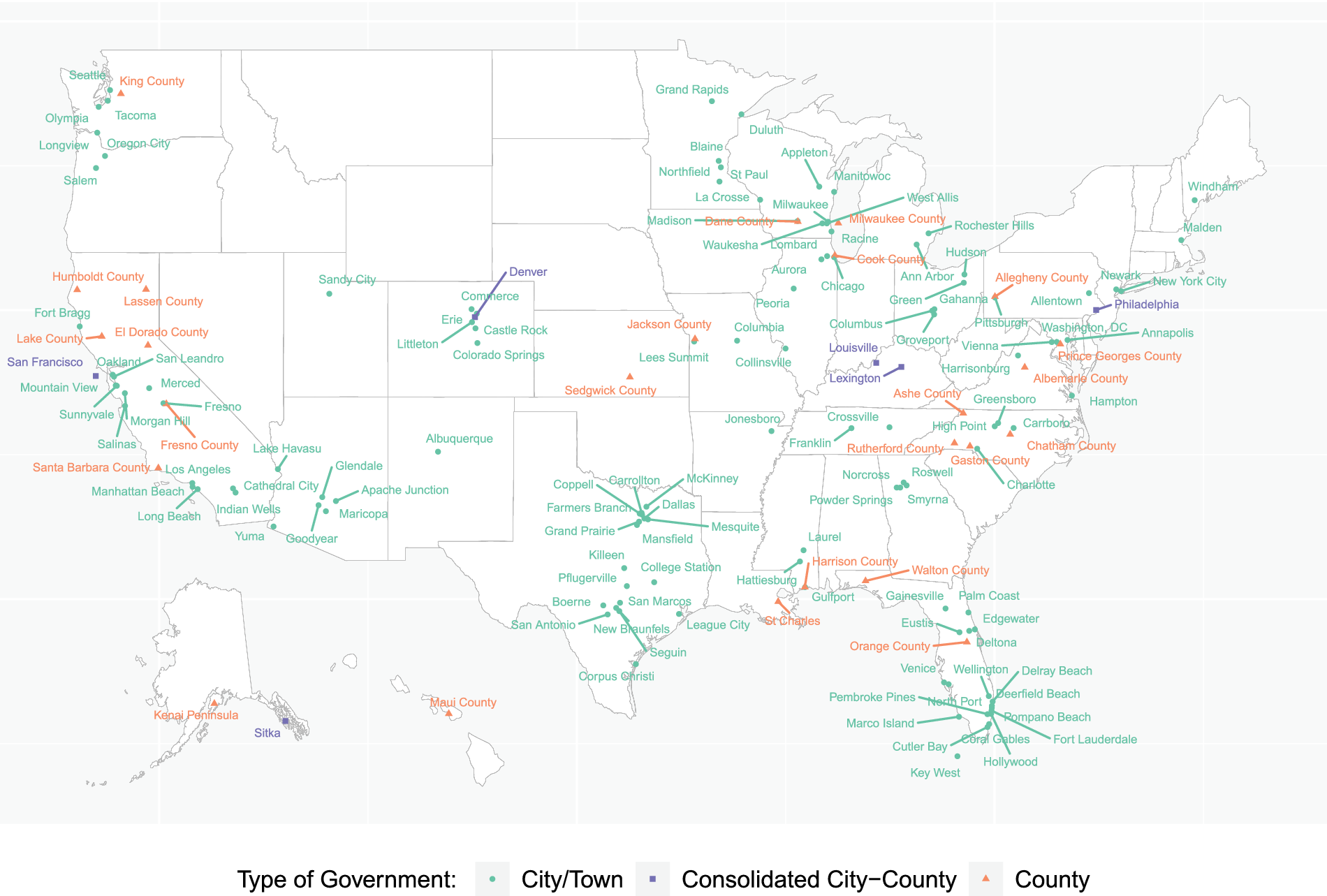
Figure 1 depicts the full geographic distribution of the cities and counties in the sample, categorized by the type of government. As the map shows, the sample covers a broad cross-section of U.S. municipal governments, with at least one local government from 32 states and the District of Columbia. On average, the number of local governments included from each state is correlated with a state’s population; however, there are exceptions and the sample is not perfectly representative of local governments at-large. For a comparison of the cities and counties in the sample to the population, see Online Appendix B.1.Footnote 8 In general, however, the local governments included in the sample are larger, more diverse, more highly educated, and have a wider range of functional responsibilities than cities and counties overall. In many ways, these differences make perfect sense: the types of local governments that will opt into a records management platform are precisely those that have more business to manage. However, despite this imbalance between the sample and population, there is generally less imbalance between the partisan and nonpartisan cities and counties included in the sample, and I account for it where possible through covariate adjustment and, in Online Appendix C.6, matching. Still, given the sample, the results may not generalize to municipalities at-large and are instead most likely to be representative of large, diverse cities and counties with broad policy portfolios.
Map of All Cities and Counties Included in Sample

Measuring Coalitional Stability
In order to examine the relative organization of legislative behavior across local governments, I estimate the dimensionality of voting for each city and county council. Measures of dimensionality are perfectly suited to exploring questions of legislative organization because they capture the stability of legislative coalitions. Thus, if all conflict is functionally between two parties or organized around a single cleavage, then a legislature will tend to be one-dimensional; if, however, coalitions and preferences are less stable, shifting from issue to issue, multiple dimensions will be required to explain patterns of voting at a similar rate.
Unlike most studies that typically treat dimensionality as the first stage in the analysis of legislative roll calls, I focus on this concept exclusively, paying particular attention to the strength of the first dimension. I do this because analyzing the ideal points by themselves might yield misleading conclusions in a highly unstable context. Indeed, imagine that I simply scaled the votes for all of the councils in my data independently and found that, using a one-dimensional model, Republicans tend to be on the right and Democrats tend to be on the left regardless of the level of party competition. Given those results, we may falsely infer that party structures politics the same in competitive and noncompetitive environments. Yet, if imbalanced competition does indeed fuel coalitional instability, other salient cleavages, such as race or class, will become more important as one party increasingly dominates. Empirically, this might mean that only half of the votes in a chamber are explained by partisanship rather than 80% or more. By focusing on the explanatory power of the first dimension, it allows me to explore this phenomenon more systematically across the full cross-section.
To construct a measure of this kind, I first fit a one-dimensional spatial model for each council separately using all of the records in my data from January 2012 through April 2017.Footnote 9 To conduct the scaling, I use the nonparametric optimal classification method developed by Poole (Reference Poole2000).Footnote 10 Next, to evaluate the fit of the spatial model, I use the aggregate proportional reduction in error (APRE) statistic. This statistic measures how effective an n-dimensional spatial model is at classifying vote choices relative to a null model where all legislators vote in the majority.Footnote 11 Thus, the APRE statistic accounts for the fact that some votes—such as those where many legislators are in the majority—are easy to predict by benchmarking the spatial model against an assumption of unanimity. In turn, if the APRE from a one-dimensional model—which is measured on a zero to one scale—is high for a particular city, it indicates a more stable, one-dimensional voting space. In contrast, when the APRE is low, it suggests a more unstable legislative environment.
By evaluating the APRE statistic in this manner, it transforms dimensionality into a relative concept. This is useful because evaluating dimensionality often relies heavily on subjective researcher judgment (Aldrich, Montgomery, and Sparks Reference Aldrich, Montgomery and Sparks2014) and can yield misleading conclusions about the explanatory power of a simple model. For example, a legislature may be one-dimensional, but if that dimension only explains 50% of the votes in the chamber, then it is still a relatively unstructured legislative environment where votes are difficult to predict. And indeed, this is hardly an insignificant point: both over time in Congress and across the state legislatures, there is substantial variation in how well a one-dimensional spatial model explains voting.Footnote 12 This variation across contexts is important because it suggests that in some legislatures and in some time periods legislators are more willing to defect than others, which has direct implications for the power of organizations like parties and the ability of citizens to ultimately hold their representative accountable.
To ensure that the results presented in this paper are not driven by the choice of the APRE as a fit statistic, I include results for two alternative measures in Online Appendix C.1: the share of the variance explained by the model’s first dimension and the percentage of the nay votes correctly classified by the model. Higher values of these two statistics indicate a more one-dimensional voting space, and the results using these alternative measures align strongly with those presented in the main text.
Competition and the Dimensionality of Local Conflict
In this section, I evaluate the relationship between partisan electoral competition and the dimensionality of local legislative politics. For all of the analyses in the main text, I follow Hinchliffe and Lee (Reference Hinchliffe and Lee2016) and operationalize party competition as partisan imbalance in local presidential voting. To construct this measure, I take the absolute value of the 2008 Democratic presidential vote margin for each local government.Footnote 13 Thus, a value of 0 indicates local presidential results that were perfectly balanced between Barack Obama and John McCain in 2008, while a value of 1 indicates perfect one-party voting. One potential concern with this measure might be that presidential vote share does not map onto patterns of party competition for local offices. However, recent evidence from ballot images suggests that voters choose candidates of the same party for offices at the top and bottom of the ticket at generally high rates, particularly in our current polarized era (Kuriwaki Reference Kuriwaki2019).Footnote 14 Furthermore, in Online Appendix C.2, I show that the results are the same when I use two alternate measures of competition: ideological imbalance in the electorate—based on estimates from Tausanovitch and Warshaw (Reference Tausanovitch and Warshaw2014)—and imbalance in local party identification, estimated using a multilevel regression with poststratification model akin to Warshaw and Rodden (Reference Warshaw and Rodden2012).Footnote 15
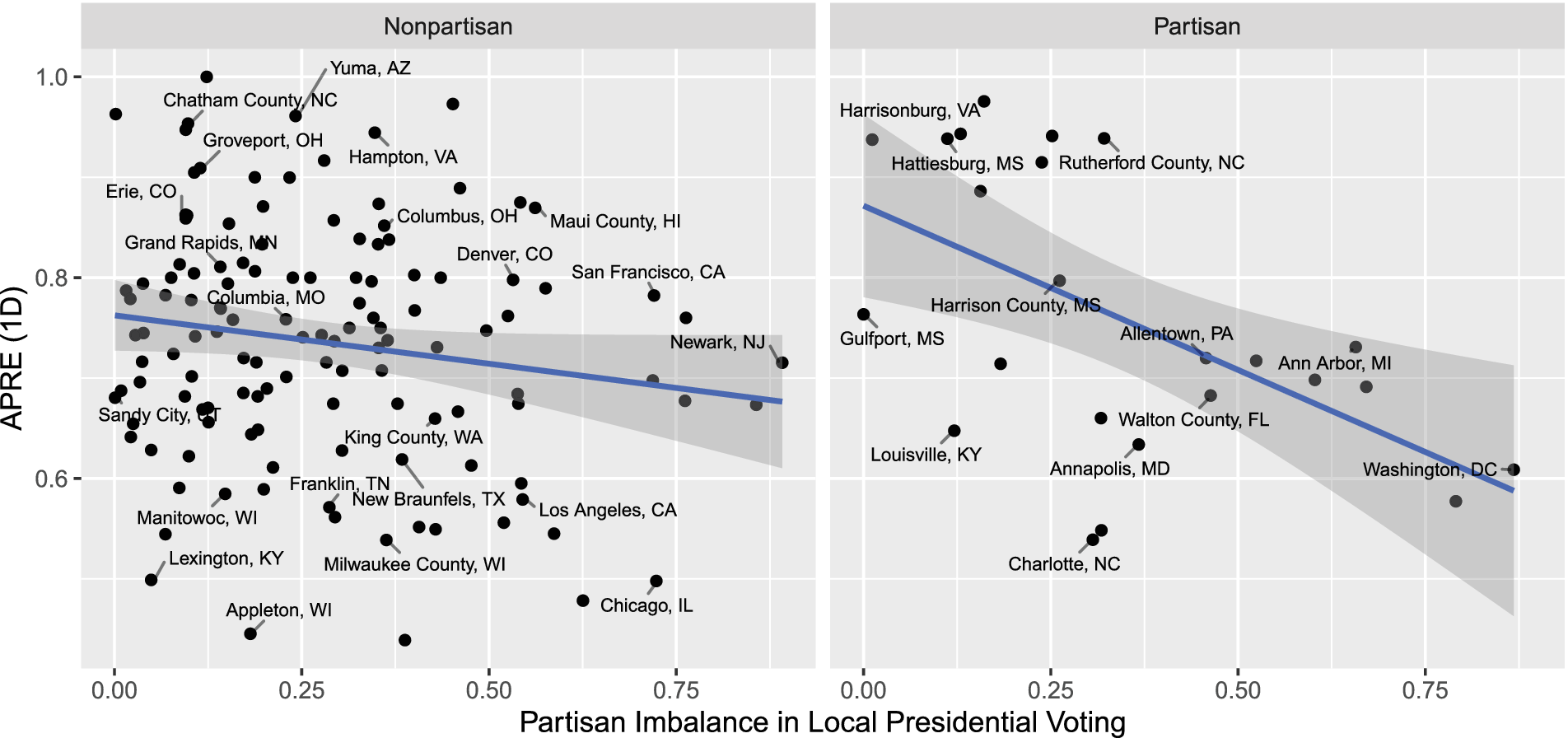
In Figure 2, I first present the simple bivariate relationship between my measure of presidential partisan imbalance and legislative dimensionality, with partisan governments in the right panel and nonpartisan governments in the left panel. Because party organizations are more likely to be active in cities and counties that use partisan elections, we should see the predicted relationship in which competitive parties reduce the dimensionality of conflict on the right but not the left. In the bivariate case, this is precisely the pattern we observe, with essentially no relationship between the relative skew in presidential voting and the APRE statistic in nonpartisan councils but a strong, negative relationship in partisan councils.
Bivariate Relationships between Partisan Imbalance and APRE by Election System

On one hand, the relationship documented for partisan councils is consistent with a long literature arguing that one-party dominance will provide the opportunity for intraparty factions to emerge. On the other hand, that there is no relationship for nonpartisan councils means that this instability is specifically related to the use of partisan elections. This difference is consistent with a theory of party organizations, whereby parties in less competitive, electorally imbalanced contexts have both fewer incentives to organize and less influence to constrain intraparty conflict.
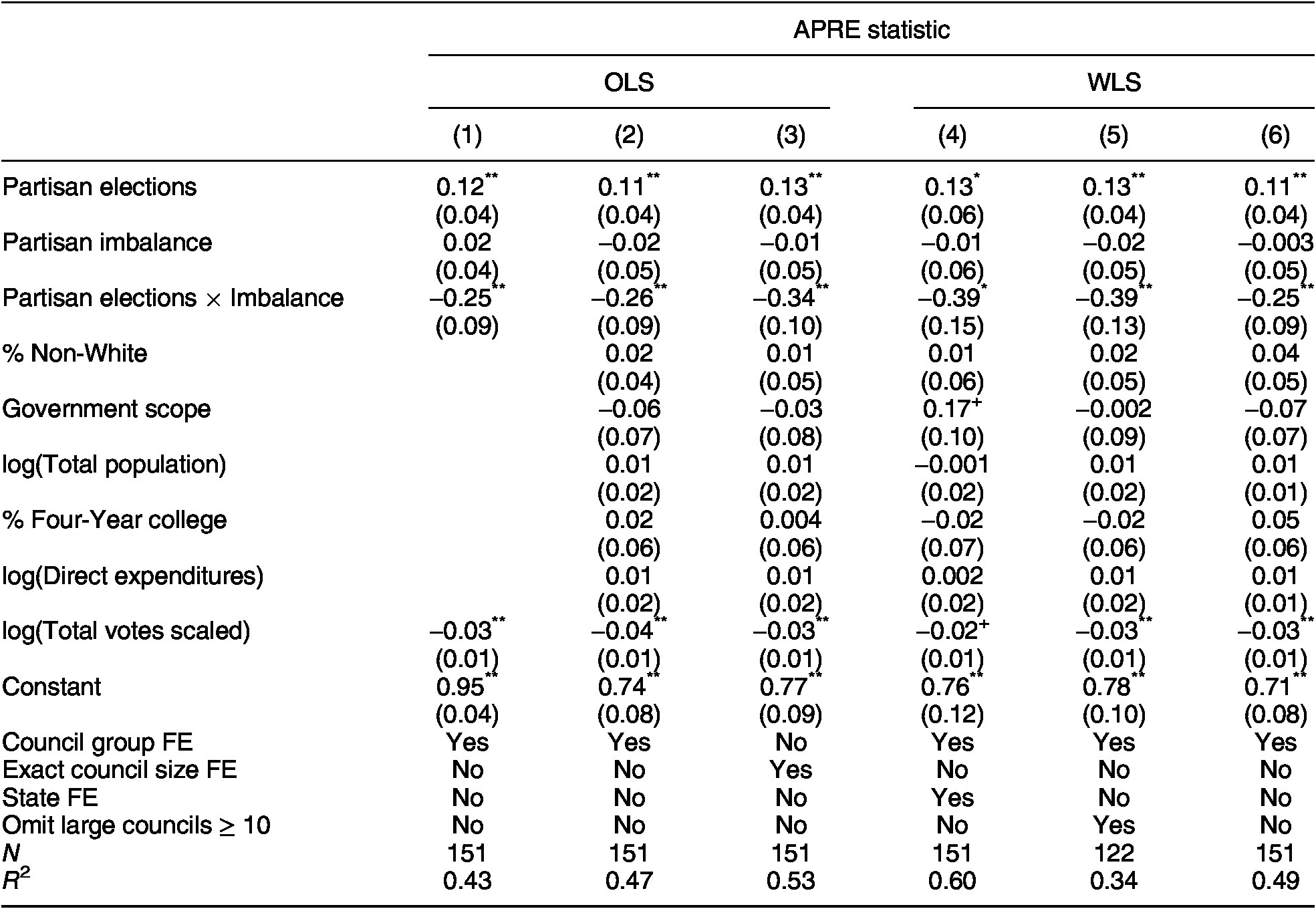
Next, to better account for factors that might be confounding the simple relationships presented in Figure 2, I conduct a series of multivariate regressions using the one-dimensional APRE as the dependent variable and an interaction term between my measure of partisan imbalance and an indicator for a municipality using partisan elections. I include this interaction term to estimate the relationship separately for partisan and nonpartisan governments, just as in Figure 2. Table 1 presents the results from these models. In column 1, I control only for factors that are likely to affect measurement of the fit of the spatial model, including council size and the total number of votes scaled.Footnote 16 In the subsequent columns, I add political, economic, and social factors that the literature suggests might either shape the potential for conflict or alter the representational pressures on individual legislators. First, I include a set of demographic measures to capture the size and diversity of each local area, including a logged measure of population size, the percentage of residents with a four-year college degree, and the share of the population that is a racial minority. Second, given the broad variation in functional responsibilities across cities and counties, I include a measure of the scope of government authority (Oliver Reference Oliver2012). To construct this measure, I follow Hajnal and Trounstine (Reference Hajnal and Trounstine2014) and use spending data from the 2012 Census of Governments to identify the share of 25 different spending categories for which each local government has positive spending. In addition, I also include a logged measure of direct general expenditures to capture the size of government beyond the number of functional responsibilities.
Relationship between Partisan Elections, Partisan Imbalance in the Electorate, and Legislative Unidimensionality

Note: +p < 0.1; *p < 0.05; **p < 0.01.
Across all models, the relationship between the use of partisan elections and the APRE statistic is positive and substantively large. Accounting for the presence of the interaction term with the level of partisan imbalance, this means that in competitive contexts that use partisan elections, voting coalitions are substantially more stable than in similar nonpartisan contexts, with APRE statistics that are 0.11 to 0.13 higher, on average. This represents an approximately one-standard deviation increase in APRE when elections are partisan and the electorate is evenly balanced between the parties, which corresponds with an 11 to 13 percentage point decrease in error when predicting votes using the spatial model. In practice, this magnitude is similar to the increase in explanatory power from adding a second dimension to models of congressional roll calls during the period where race is known to have been an important cross-cutting divide (Aldrich, Montgomery, and Sparks Reference Aldrich, Montgomery and Sparks2014).
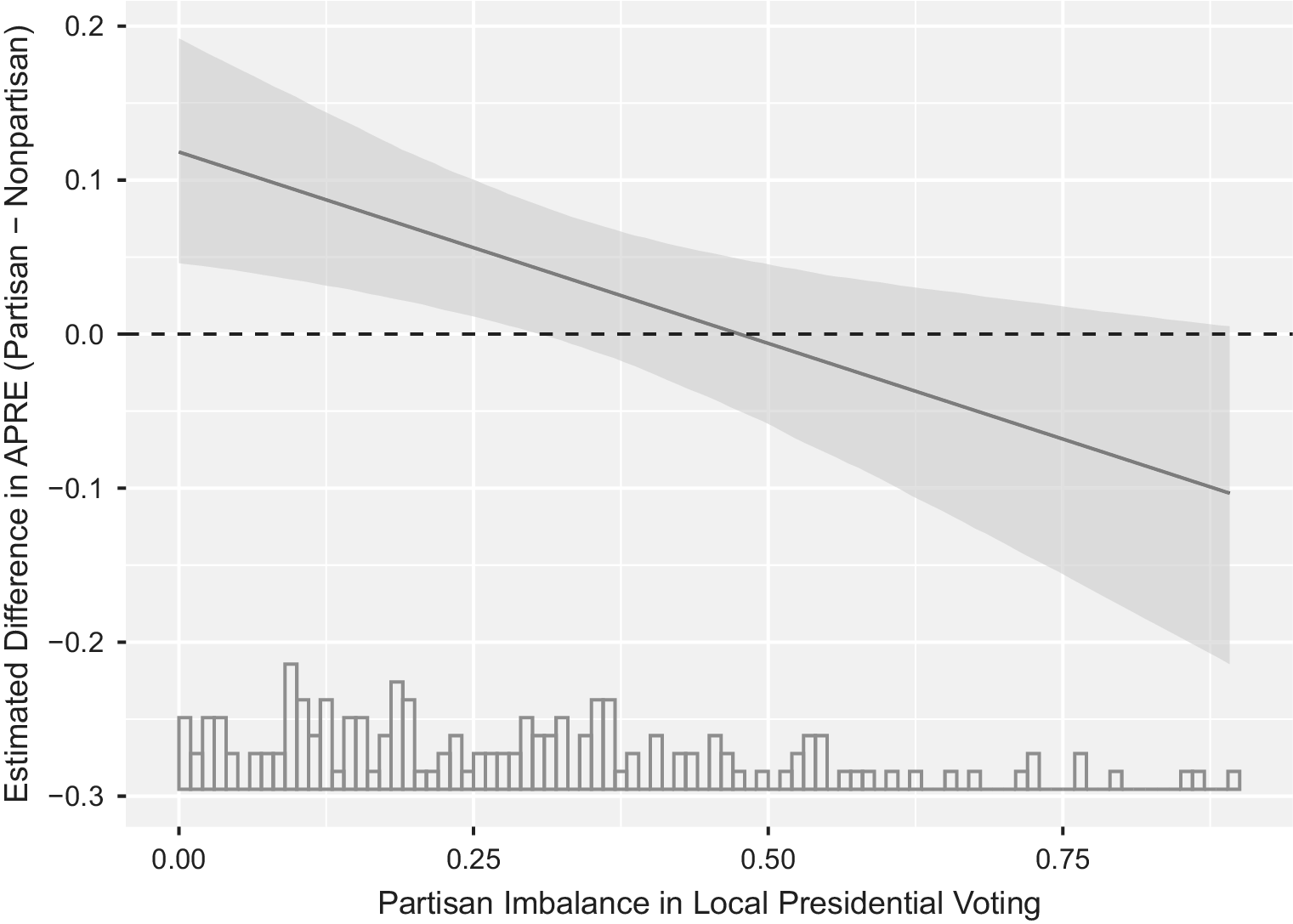
However, as the large negative coefficient on the interaction term indicates, when elections are partisan and the electorate overwhelmingly favors one party, this increase in coalitional stability disappears. In fact, Figure 3, which plots the marginal difference in the APRE statistic between partisan and nonpartisan governments across all values of partisan imbalance, highlights that for the cities and counties where the electorate strongly favors one party, those that use partisan elections are no more organized than their nonpartisan counterparts. In contrast, as the baseline coefficient on partisan imbalance shows, there is no relationship, on average, between the balance between the parties in the electorate and legislative dimensionality in nonpartisan contexts.
Marginal Difference in Dimensionality between Partisan and Nonpartisan Governments across All Levels of Partisan Imbalance

As the second to sixth columns of Table 1 show, these relationships all hold when I add the aforementioned covariates into the model, incorporate exact council size or state fixed effects, run the model exclusively on small councils, and account for potential differences in variance by weighting observations according to their total number of contested votes.Footnote 17 In Online Appendix C, I also show that the findings hold within samples of the population that lean toward each party, when I use continuous measures of council size instead of group fixed effects, when I drop large cities or small councils, when I incorporate additional control variables (e.g., a municipality’s history of machine politics, racial diversity, economic inequality), and when I conduct the analysis on a matched sample of partisan and nonpartisan governments.
Competition and the Preferences of Local Officials
The differences across partisan and nonpartisan governments in the preceding analysis suggest that the use of partisan elections—and, by extension, the party organizations that nearly always come with them—are central to the relationship between competition and elite behavior. Yet, one of the potential problems with this analysis is that it assumes the underlying pool of elected officials across partisan and nonpartisan contexts is similar conditional on the balance between the parties in the electorate. If this assumption is wrong—for example, if more ideologically extreme council members hold office in competitive partisan municipalities—then those differences in preferences may underlie the differences in elite behavior across contexts.
The logic underlying this type of alternative explanation requires both that extremists be more likely to hold office in contexts with credible party competition and that ideological extremism might influence estimates of dimensionality independent of any influence of the election system or party organizations. There is evidence suggesting that both are possibilities. For example, studies of state and national elections have found that when the costs to running for office are high—such as in a competitive partisan government, where the differences across parties are highly salient—moderates will be less willing to run, precluding voters from even having the chance to elect them (Hall Reference Hall2019; Thomsen Reference Thomsen2017). These types of pressures may be further exacerbated by the use of partisan primaries, where the electorate may be more ideologically extreme and thus prefer more extreme candidates (Polsby Reference Polsby1983). Both of these factors are consistent with recent work demonstrating that polarization is more severe in more competitive electoral environments (Aldrich and Battista Reference Aldrich and Battista2002; Hinchliffe and Lee Reference Hinchliffe and Lee2016).
If these patterns of ideological extremism translate to the local context, then this may explain the findings in the previous section in two different ways. First, if ideological constraint is correlated with extremism such that estimates of ideology are typically more predictive for those further away from the center (Lauderdale Reference Lauderdale2010), then legislative environments with more extremists will be more one-dimensional than those without them. In other words, if moderates are simply more likely to defect on issues idiosyncratically, then electing more ideologically extreme candidates will yield seemingly more stable coalitions regardless of what party organizations do. Second, recent work has documented a systematic relationship between polarization and dimensionality such that roll-call scaling methods estimate a legislative body as being more one-dimensional if it is more polarized along a particular dimension, even with simulated data where the true dimensionality is known (Aldrich, Montgomery, and Sparks Reference Aldrich, Montgomery and Sparks2014). In turn, even if a local council has two equally important dimensions of conflict, we may falsely infer a one-dimensional space when scaling roll-call votes because legislators are simply more polarized along one of the dimensions.Footnote 18 Neither of these possible mechanisms has anything to do with party organizations or the use of partisan elections, specifically; rather, they stem from the distribution of local officials’ preferences.
To evaluate this alternative explanation, I use survey-based estimates of ideology from Bucchianeri et al. (Reference Bucchianeri, Carney, Enos, Lakeman and Malina2017). These estimates, which cover 720 local officials from 463 unique city councils, were constructed by applying “basic space” scaling to a set of 12 local policy questions (Poole Reference Poole1998).Footnote 19 These questions, which cover issues like housing, public services, and economic growth, follow Einstein and Glick (Reference Einstein and Glick2016) and are framed in terms of policy trade-offs. For example, for housing, council members were asked to indicate how much they agreed or disagreed with the following statement using a standard five-point Likert scale:
Cities should invest in affordable housing, even if it negatively influences neighboring property values.
After scaling the full battery of policy questions, two issue dimensions emerge, the first corresponding to partisanship and the second associated with preferences for market-based public policy solutions (e.g., charter schools, service privatization, etc.). Throughout this section, I use ideology estimates from both of these dimensions to assess the relationship between party competition and ideologically extreme preferences. Using both estimated dimensions is important in this context because—when elections are nonpartisan or the electorate favors one party—members may express more moderate views precisely on those issues that are less inherently partisan to begin with. Analyzing only the partisan dimension of conflict, however, would miss these types of ideological differences.One challenge to using survey-based ideology estimates in this context, however, is that because not all council members respond from each council, it is impossible to estimate polarization along either dimension directly for any particular city. To account for this problem, I focus my analysis specifically on differences in the relative extremity of council members’ ideal points as a function of their context. To do so, I take the absolute value of each member’s ideal point for both estimated dimensions and use these measures as the dependent variable in my analysis.
Ideological Extremity in Partisan and Nonpartisan Councils
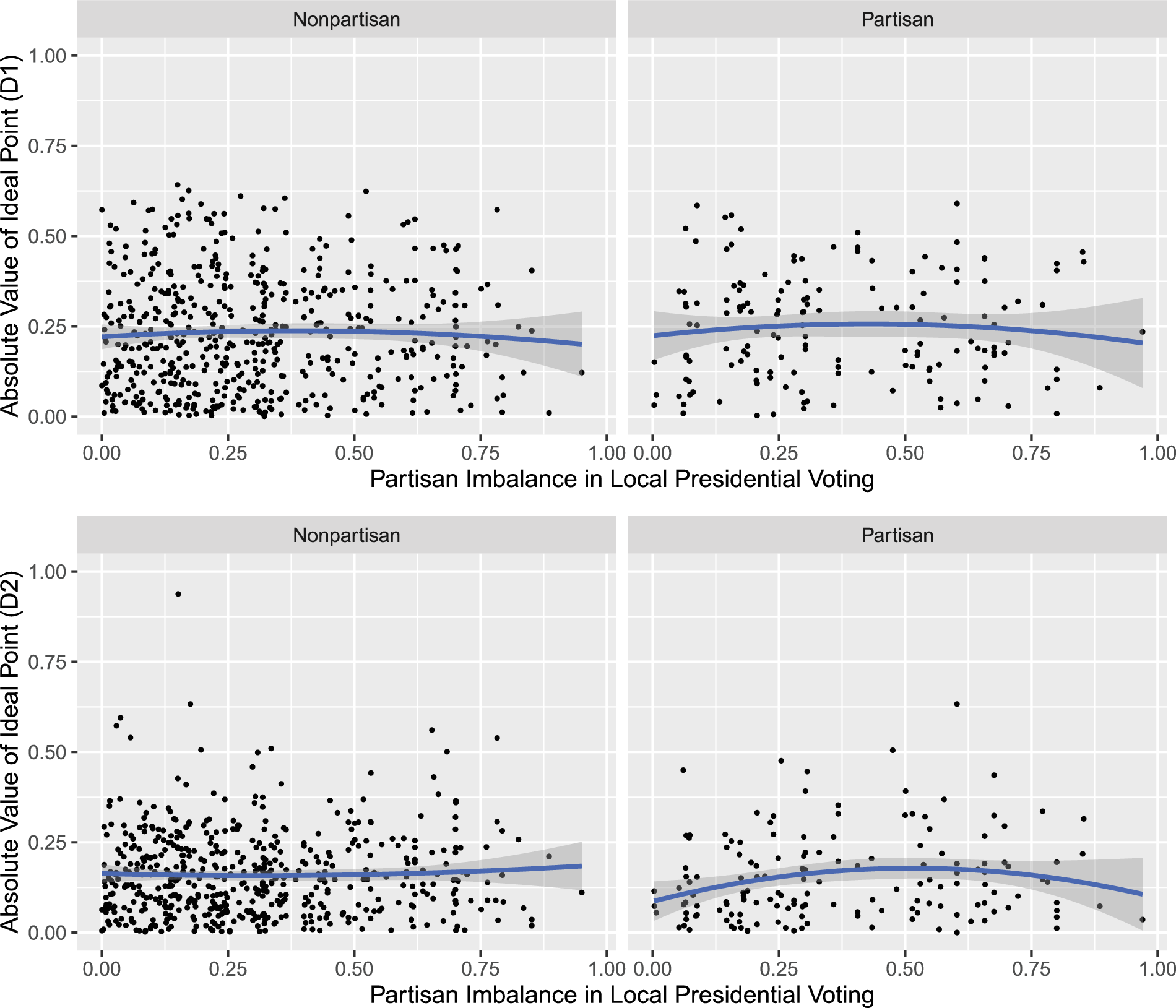
If differences in preferences across legislators were driving the results in the previous section, we would expect to see more ideologically extreme local council members in competitive partisan contexts. To test this hypothesis, Figure 4 depicts the bivariate relationship between partisan imbalance in local presidential voting and the ideological extremity of council member ideal points for those serving in nonpartisan and partisan governments, respectively. To calculate ideological extremity, the first row uses the ideal points from the first estimated dimension and the second row uses the ideal points from the second dimension. As Figure 4 shows, for partisan governments, there is essentially no relationship between the relative skew in local presidential voting and ideological extremity, regardless of the ideological dimension, such that council members in more one-party dominant contexts are nearly identical to their counterparts in two-party contexts, on average. Moreover, as the right two panels show, this flat relationship is also present in nonpartisan governments, with little apparent difference across the two institutional contexts. This similarity in trends implies that the ideological distribution of council members in partisan and nonpartisan governments is similar and casts doubt on the hypothesis that ideologically extreme preferences underlie the higher levels of coalitional stability found in competitive, institutionally partisan governments.
Two-Party Competition and the Ideological Extremity of Council Members in Two Dimensions

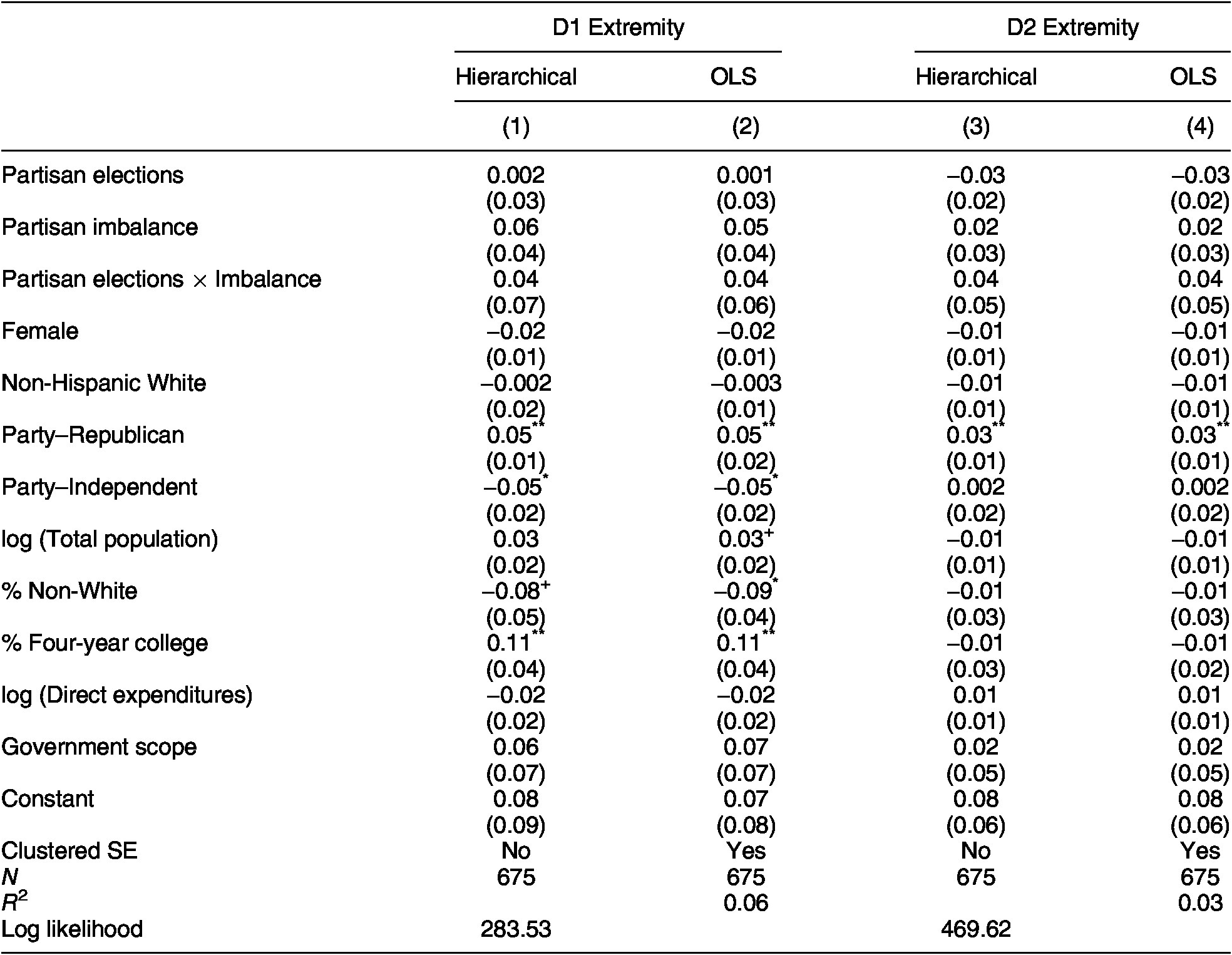
To account for factors that might be confounding the simple bivariate relationship, Table 2 presents results from a series of regressions in which the absolute value of each council member’s first and second dimension ideal points are used as the dependent variables. As with the analysis in the previous section, I include an interaction term between the use of partisan elections and local partisan imbalance to estimate the trends separately for partisan and nonpartisan governments. The first and third columns model this relationship hierarchically, with covariates at both the individual council member and city level. The second and fourth columns omit the group-level intercepts and instead cluster the standard errors by city. Modeling the relationship in one of these two ways is necessary to account for correlation among council members responding from the same city. For all specifications, I include a set of legislator-specific covariates, including sex, race, and party. In addition, I also include all of the city-level covariates used in the previous section, with the exception of council size and the total number of contested votes, which were used to account for error in measuring dimensionality.
Relationship between Local Party Competition and Ideological Extremity

Note: +p < 0.1; *p < 0.05; **p < 0.01.
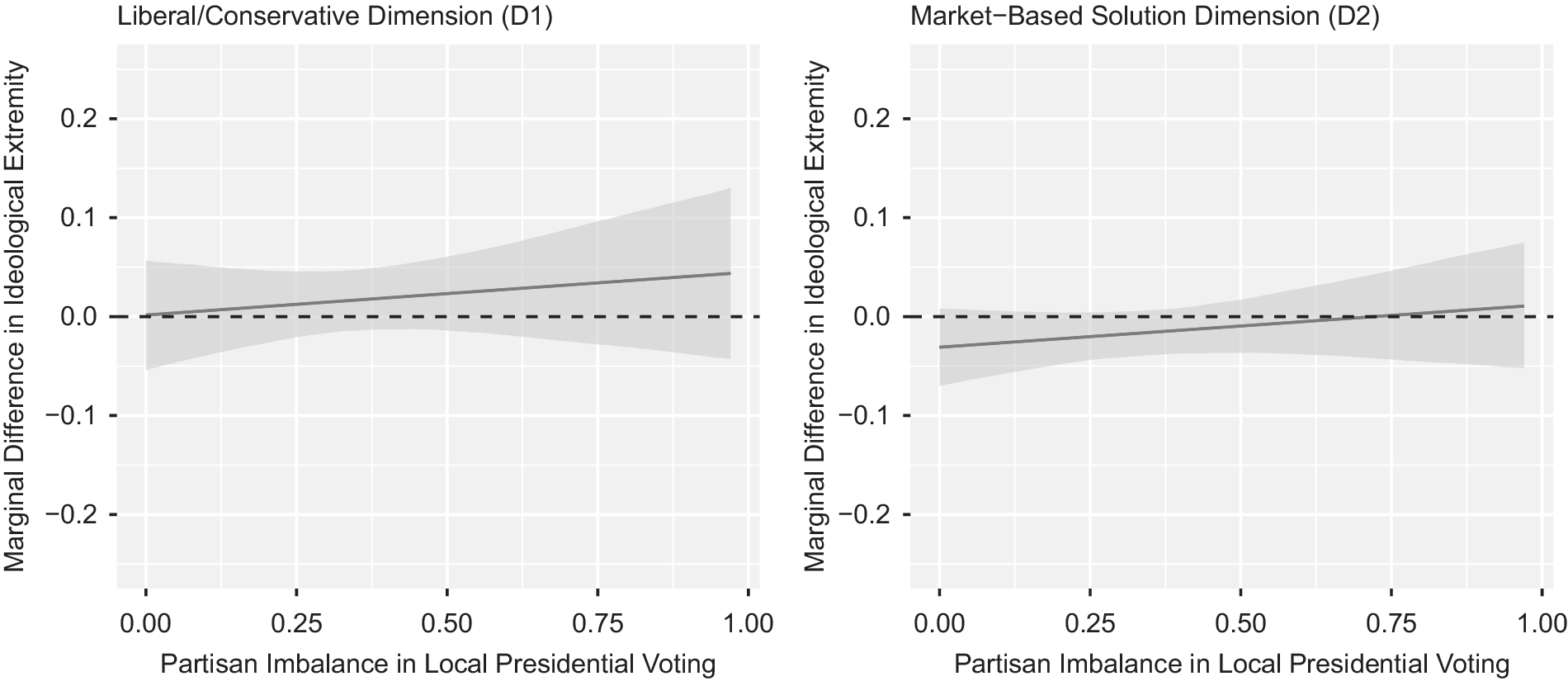
Consistent with the raw data, Table 2 shows little evidence of a difference in the relationship between the balance between the parties in the electorate and ideological extremity across partisan and nonpartisan governments. This is true for both ideological dimensions and regardless of the model specification. Figure 5 illustrates this point by depicting the marginal difference in ideological extremity between council members elected to partisan and nonpartisan governments across all levels of partisan imbalance. While there is some evidence of an increasing trend, such that elected officials in partisan governments are more extreme than nonpartisan officials as the electorate increasingly favors one party, the largest differences are at the highest values of partisan imbalance, where there are fewer observations and the variance is substantial.
Marginal Difference in Ideological Extremity between Council Members from Partisan and Nonpartisan Governments across Levels of Partisan Imbalance

Of course, a lack of a statistically significant relationship is not itself evidence of no relationship, so in Online Appendix D.3, I use the TOST method of equivalence testing to generate bounds for the differences in ideological extremity (Rainey Reference Rainey2014). For the most competitive of contexts—where we would expect to see a large difference if preferences were driving the results in the previous section—we can reject differences greater than 0.05 and 0.06 in magnitude for the first and second dimension, respectively. These magnitudes represent bounds of approximately one-third and one-half of a standard deviation. Given that these are the maximum differences, it suggests that—even if there are some differences in extreme preferences across council members in partisan and nonpartisan governments—they are likely to be substantively small.
Taken together, the evidence in this section suggests that the types of politicians who run and win at the local level tend to have similarly extreme preferences regardless of institutional context. This similarity across partisan and nonpartisan governments suggests that differences in preferences cannot explain the differences in dimensionality in the previous section because there are not any particularly large differences in preferences to begin with.
Discussion
In this paper, I have argued that party competition in the electorate and institutionally partisan government are critical components of a stable, low-dimensional legislative system. Specifically, the empirical analysis shows that—for governments that use partisan elections—as one party increasingly dominates in the electorate, elite voting behavior is less one-dimensional. This means that voting coalitions within each council are more likely to shift from issue to issue. Importantly, this relationship is not present within nonpartisan councils and I find no evidence that elected officials in either nonpartisan or uncompetitive environments are less ideologically extreme than their competitive, partisan counterparts. Given that party organizations are far more likely to be present and active in governments that use partisan elections, these differences across contexts suggest that competition influences legislative coalitions through party organizations.
Collectively, my findings suggest that many governments in the United States fail to meet the necessary criteria to facilitate party-based accountability. Indeed, given that the vast majority of governments at this level either lack credible two-party competition or use nonpartisan election systems, it means that few municipalities in practice provide voters with sufficiently reliable indicators of a candidate’s subsequent legislative behavior. This absence of clear, informative partisan cues, in turn, has the potential to impede selection, attribution, and accountability processes and, thereby, hinder representation.Footnote 20
In addition, beyond their implications for accountability and representation, my findings also have practical implications for the study of elites and elite preferences. Specifically, my results demonstrate that scholars studying one-party and nonpartisan legislative environments need to ensure that their measurement strategy accounts for the unique political dynamics of these contexts, particularly the often multidimensional nature of legislative conflict. In practice, this means that scholars can neither simply ignore secondary dimensions of municipal conflict nor assume that measures of preferences using different inputs (e.g., votes, survey responses, donors) will necessarily be as highly correlated as they are at other levels.
While these features are sure to create challenges for cross-sectional work in nonpartisan and one-party contexts, they should also be viewed as an opportunity to delve deeper into the substantive meaning of the cleavages and conflicts that emerge absent partisan elections and credible partisan electoral competition. At the local level specifically, these types of descriptive questions are particularly important as scholars of urban politics have documented an array of group-based cleavages that are important for local electoral politics, such as race, class, and economic growth (Browning, Marshall, and Tabb Reference Browning, Marshall and Tabb1986; Hajnal and Trounstine Reference Hajnal and Trounstine2014; Molotch Reference Molotch1976; Stone Reference Stone1989). Given the salience of these divides for local electoral politics, it is reasonable to think that they might gain traction when one (or no) party rules. However, in which contexts and under what conditions they do so remains unclear. Future work, in turn, should continue to leverage newly available sources of local data to better understand the dynamics of legislative politics without two-party competition and to explore the substantive reality of these contexts for representation and governance.
Supplementary Materials
To view supplementary material for this article, please visit http://dx.doi.org/10.1017/S0003055420000386.Replication materials can be found on Dataverse at: https://doi.org/10.7910/DVN/2CITBJ10.7910/DVN/8ZT2ID.







Comments
No Comments have been published for this article.