1. Introduction
Explanations in many biological fields take the form of descriptions of ‘underlying mechanisms’. Such explanations are typically very detailed and do not include laws or lawlike generalizations. Mechanistic explanations (MEx) of this sort are offered for DNA synthesis, cell metabolism, organismal development, and many other biological phenomena. MEx do not resemble logical derivations, nor do they ‘cover’ wide domains of phenomena. The question thus arises: in virtue of what are mechanistic descriptions explanatory? One promising answer is that their explanatory power stems from accurate representation of causal relations in living systems. Mechanisms are defined (roughly) as complex causal systems of multiple interacting components.Footnote 1 So it is reasonable to suppose that MEx are a kind of causal explanation. Many philosophers of biology endorse this view, using Woodward's (Reference Woodward2003) manipulability theory to explicate the causal concepts involved. This article also assumes Woodward's analysis (see sec. 3). But, I will argue, MEx are not causal explanations.
This claim goes against the best-developed account of MEx in biology currently on offer: that of Craver (Reference Craver2007), which focuses on neuroscience. Craver's causal-mechanical account is based on detailed study of experimental practices in neuroscience, relating these to norms for MEx and the causal features of mechanisms. Alongside its considerable strengths, the causal view has three significant weaknesses. First, it leaves the target of explanation ambiguous, which in turn muddies the view of MEx. Second, the causal-mechanical account omits the ‘direction’ of MEx, from parts to whole. And third, it leaves the issue of modularity in biological mechanisms unresolved. An alternative account of MEx for experimental biology avoids all three problems. The central concept of this new account is jointness. The term refers to interdependence among a mechanism's components, which work together to produce results that are not produced by the same components when separated. Emphasizing interdependency and complex-formation among components, rather than dependency relations between cause and effect, yields a more satisfying account of the structure and norms of MEx in experimental biology. ‘Experimental biology’ refers to molecular, cellular, and developmental biology broadly construed, including diverse fields of ‘bench biomedicine’ (e.g., immunology, virology, stem cell, and cancer research) as well as neuroscience. This is a sprawling, continuously expanding domain of science, with myriad interdisciplinary connections. Understanding its explanations is vital: to make sense of experimental biology on its own terms, facilitate effective interdisciplinary connections, and guide fruitful applications.Footnote 2
This article approaches the task in three main parts. The first (secs. 2–3) summarizes earlier philosophical work on MEx in biology; the second (sec. 4) critiques the best-developed account of MEx currently on offer; and the third (secs. 5–6) offers a positive alternative. The argument is as follows. Section 2 presents the consensus view of mechanisms, using an example from stem cell biology to illustrate key features. Section 3 shifts the focus to explanation, sketching the view of MEx that follows from the consensus view of mechanisms. I then present Craver's causal-mechanical account of MEx in detail. As the latter makes use of Woodward's manipulability theory of causal relations, the core ideas of that theory are also summarized. Section 4 notes three problems for Craver's account of MEx in experimental biology, which concern the explanandum, interlevel explanatory relation, and representation of components in terms of modularity constraints. Section 5 proposes an alternative that addresses all three objections, analyzing MEx in terms of jointness. The final substantive section sketches a model of explanation that grounds the ‘joint account’ of MEx.
2. Consensus View of Mechanisms
Philosophers have proposed a number of definitions of ‘mechanism’. For example:Footnote 3
Mechanisms are entities and activities organized such that they are productive of regular changes from start or set-up to finish or termination conditions. (Machamer, Darden, and Craver Reference Machamer, Darden and Craver2000, 3)
A mechanism underlying a behavior is a complex system which produces that behavior by the interaction of a number of parts according to direct causal laws.Footnote 4 (Glennan Reference Glennan1996, 52)
A mechanism is a structure performing a function in virtue of its component parts, component operations, and their organization. The orchestrated functioning of the mechanism is responsible for one or more phenomena. (Bechtel and Abrahamsen Reference Bechtel and Abrahamson2005, 423)
These definitions concur on the essential features of a mechanism. First, all emphasize the causal, productive character of relations among components. Machamer et al.'s “entities and activities” correspond to Bechtel and Abrahamsen's “parts and operations” and Glennan's “parts and direct causal laws.” Organization is another essential feature. Causally active components are organized so as to give rise to an entire sequence of “regular changes from start to … finish” (Machamer et al.), an overall “behavior” (Glennan), or “one or more phenomena. (Bechtel and Abrahamsen). Though the concepts of cause and organization both need further analysis, there is strong consensus that a mechanism is a complex causal system with multiple components, which interact to produce some overall phenomenon.
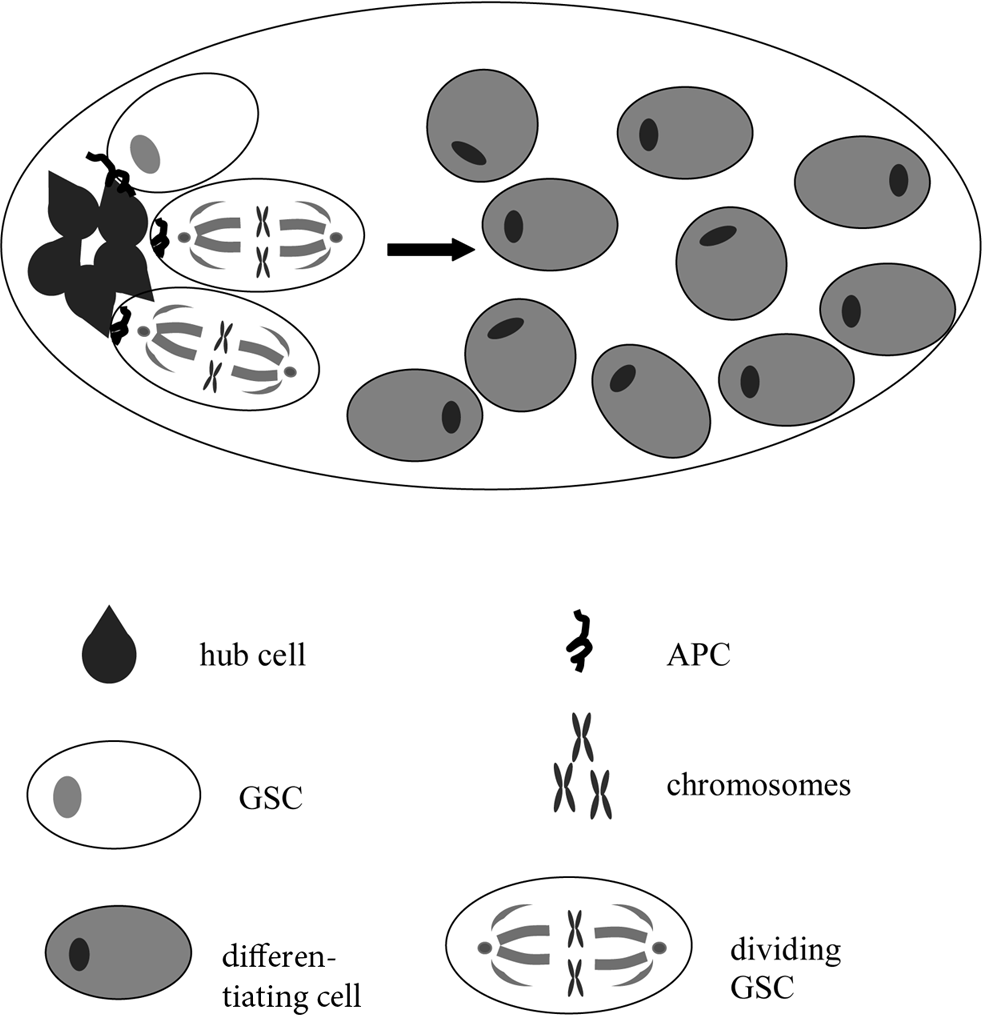
Phenomena of experimental biology (see sec. 1) are often explained in terms of underlying mechanisms. Consider, for example, ‘stemness’, which refers to the distinctive ability of stem cells to both self-renew and differentiate, maintaining a developmental ‘store’ as well as giving rise to more specialized cells. The mechanism of stemness in testes of the fruit fly Drosophila melanogaster is one of the best characterized to date. A brief, simplified description illustrates the key features of mechanisms in experimental biology (fig. 1).Footnote 5 During fly development, the testis forms as a tube with a clump of somatic cells at one end: the ‘hub’. Approximately 10 cells (termed GSC, for ‘germline stem cell’) attach to the hub via adhesion molecules expressed on cell surfaces. These surface molecules are attached in turn to proteins that span the cell membrane, allowing chemical signals to pass from hub cells to GSC. Signaling proceeds via a sequence of minor chemical changes to proteins that alter their structure and function (details omitted, for brevity). Within a cell, signals initiate cascades of further chemical reactions. The GSC-signaling pathway, termed ‘Jak-STAT’,Footnote 6 emanates only from the hub. So GSC are only found at this end of the testis, and their number is limited to roughly 10 at any given time. Other testis cells (including hub cells themselves) make a protein that inhibits the Jak-STAT pathway. When a hub-attached GSC divides, its chromosomes condense, replicate, and line up in the center of the cell. At each end of the cell, a centrosome or ‘spindle’ acts as a pole, drawing one copy of each chromosome toward itself. The two centrosomes define the plane of division along which the GSC splits in two. A set of proteins termed ‘APC’ anchor the centrosome near the hub-GSC boundary. When cell division begins, the centrosome duplicates and the new copy migrates to the opposite end of the cell. The plane of division is therefore such that one progeny cell remains attached to the hub, while the other is physically separated from it. Separation from the hub interrupts Jak-STAT signaling, initiating differentiation. Differentiating germ cells migrate toward the other end of the testis, eventually forming sperm. So each division produces one new GSC attached to the hub like the parent, and one differentiating cell, which begins a new sequence of interactions and changes, culminating in spermatogenesis. Such is the (simplified) mechanistic description of stem cell capacities in Drosophila testes.
Sketch of the GSC (germline stem cell) mechanism in Drosophila testis. Note that only three GSC are shown (fewer than most testes examined).

The GSC example illustrates the key features of mechanisms, according to the consensus view. The mechanism consists of many diverse parts: molecules, cells, proteins, and subcellular structures (see fig. 1, bottom). These material parts engage in a variety of causal activities, including binding, phosphorylation, migration, division, and replication. Together, all these tightly orchestrated interactions yield an overall phenomenon: GSC self-renewal and differentiation. The distinction between parts and the overall phenomenon reveals the hierarchical, or multilevel, structure of mechanisms. Mechanisms of interest for experimental biology include (at least) two such levels. But the notion of a mechanistic level remains somewhat mysterious, resisting analysis in terms of size, containment, mereology, or biological organization.Footnote 7 The GSC case illustrates this point for size and biological organization. Components run the gamut from cells, small molecules, macromolecules (proteins and DNA), and subcellular structures. Chemical bonds, cell to cell interactions, arrangement of chromosomes, and even the geography of the testis are included. The example also highlights the importance of spatiotemporal localization for components.Footnote 8 The entire mechanism is contained within the testis, an organ. Within this organic context, components’ causal relations dovetail with their spatiotemporal position. For example, stages of cell division interlock with relative positions of cell types and the operation of molecular signaling pathways. The description traces all these orchestrated interactions, verbally and diagrammatically.
With these considerations, the consensus view can be stated as follows:
(Mc) A mechanism M consists of multiple diverse components (x's) engaging in causal relations or activities ('s) such that x's and 's are spatially and temporally organized so as to produce some overall phenomenon.Footnote 9
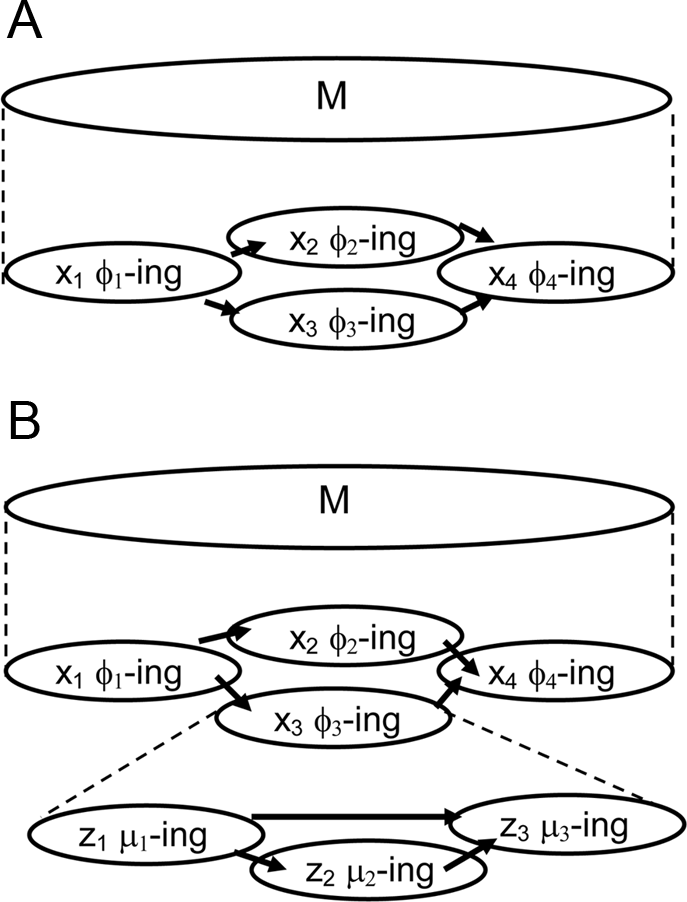
Like the biological mechanisms that furnish its examples, Mc lends itself to diagrammatic representation (fig. 2A). Furthermore, a working component of a mechanism (x ϕ-ing) may itself be a complex system of causally interacting parts—a mechanism in its own right (fig. 2B). Similarly, a mechanism M may be a component of a still higher-level mechanism. The biological world, as we understand it, is rife with hierarchies of this sort. The next task is to understand how description of a mechanism amounts to an explanation.
Consensus view of mechanisms (after Craver Reference Craver2007; Craver and Bechtel Reference Craver and Bechtel2007). A, Two levels: component x's and overall mechanism M. B, Three levels: component z's of mechanism x3, and component x's of mechanism M.

3. Mechanistic Explanation
Any explanation consists of an explanandum that is explained, an explanans that does the explaining, and a relation connecting the two. The consensus view (Mc) suggests that the explanatory structure of MEx mirrors the hierarchical structure of mechanisms described:
| explanandum | M |
| relation | causal? |
| explanans | ϕ-ing x's and their organization |
The explanandum is a description of the overall phenomenon of interest, the explanans a description (verbal, diagrammatic, or both) of the interacting parts that produce it. The term ‘produce’ suggests that the connecting relation is causal. However, as I argue below (in sec. 4), there is good reason to reject this idea. But even this preliminary sketch makes plain that MEx do not conform to the traditional view: that scientific explanation consists in deriving a statement of the explanandum from a general law and initial conditions, which together comprise the explanans. On this traditional account, logical derivation is the connecting relation, and explanation is closely associated with prediction; the epistemic role of explanation is to show that a phenomenon of interest is to be expected. Since laws are traditionally defined as universal exceptionless generalizations of wide scope, explanations invoking them subsume a phenomenon of interest to the wider domain ‘covered’ by the law.
Universal exceptionless generalizations are conspicuously absent from MEx. Their lack of generality has several facets. First, even quite substantial proportions of exceptions are tolerated. For example, only about 80% of GSC divisions have a plane of division parallel to the hub-GSC binding site. So the GSC mechanism only works as described in ≤80% of cases. But this MEx is still accepted as successful, and even exemplary. The GSC case also illustrates a second mode of disregard of generality, which is typical of MEx in experimental biology. Some parts of the GSC MEx describe very general features, such as the arrangement of chromosomes and subcellular structures exhibited by dividing cells (fig. 1). But others, such as the interaction of Jak-STAT signaling and the hub and APC positions, may well be restricted to one organ in one species. These general and specific descriptions do not play different roles in the MEx, analogous to laws and initial conditions, respectively. The mechanistic description does not begin with a general account of cell division and proceed to add more specific conditions, until self-renewal and differentiation are accounted for. Instead, general and specific features of the case are mingled.
The scope of the GSC explanation is also very limited, at least for now. Drosophila is a classic model organism, one of the most studied in all biology. The testis is a relatively simple organ, morphologically and developmentally. GSC are unusually simple stem cells, giving rise only to one differentiated cell type. The phenomenon to be explained, GSC self-renewal and differentiation, is therefore among the most tractable in all stem cell biology, and so a good candidate for MEx. For the same reason, it is a good model system, which might be (cautiously) generalized to stem cells in other species and organs. But this generalizing project requires MEx of GSC as a first step. The GSC MEx itself does not include or presuppose any general claims about stem cells or the mechanisms underlying their distinctive abilities. Finally, though the explanatory connection in MEx remains to be clarified, it is not plausibly represented as logical derivation. MEx in experimental biology lack the elegant simplicity of derivational explanations. Instead, they bristle with details about parts of organisms (cells, organs, molecules, organelles, etc.) and their intricate causal and spatiotemporal organization. MEx in experimental biology do not secure predictions, subsume many diverse phenomena, or invoke general laws.
MEx do, however, describe causal relations. So the classic alternative to law-based explanation seems obviously correct in this case: to explain a phenomenon via mechanistic description is to reveal how it fits into “the causal structure of the world” (Salmon Reference Salmon1989).Footnote 10 Of course, there are many theories of causality. However, many philosophers of biology interpret the causal relations relevant to MEx in terms of Woodward's (Reference Woodward2003) manipulability theory.Footnote 11 They have good reason to do so. The manipulability theory analyzes causality as a relation between values of variables, X and Y: X causes Y if and only if there is a possible manipulation of some value of X, under idealized experimental conditions, such that the value of Y changes. This is a counterfactual account of causality, hinging on what would happen to the values of variables in an idealized experiment, or intervention. An intervention I on variable X with respect to variable Y is a causal process that determines the value of X in such a way that, if the value of Y changes, then the change in Y occurs only in virtue of the change in X.Footnote 12
The concept of an intervention provides a regulative ideal for experiments aimed at discovering causal relations: approximate the conditions of ideal experimental interventions. Insofar as they meet this standard, experiments reveal genuine patterns of counterfactual dependence among sets of entities and their properties, that is, causal relations. Because invariance is required only under some, not all, interventions, causal explanations need not include general laws. The range of interventions under which a dependency relation between values X and Y holds may be broad or narrow. Woodward's theory thus offers an appealing analysis of causal relations revealed by experiment, in biology as well as other fields. It augments the consensus view above by clarifying the causal aspect of mechanisms. In the remainder of this article, ‘cause’ and its cognates refer to the concept analyzed by the manipulability theory.
Craver (Reference Craver2007) extends Woodward's theory to account for norms of MEx and to explicate the relation between mechanistic levels.Footnote 13 He defends a “central criterion of adequacy” for MEx: “account fully” for the explanandum-phenomenon in terms of component entities whose real existence is justified by multiple criteria; causal relations (activities) validated by experiment; and causal, spatial, and temporal organization of entities and activities (139). An account is “full” if and only if it describes all relevant components of a mechanism. Causal relevance is in turn analyzed in terms of “mutual manipulability” (152–60).Footnote 14 A working component (x ϕ-ing) is relevant to an overall mechanism's behavior (M Ψ-ing) if the latter can be manipulated by intervening on x's ϕ-ing and x ϕ-ing can be manipulated by intervening on M Ψ-ing. A component is irrelevant to a mechanism if neither x's ϕ-ing nor M Ψ-ing can be manipulated by intervening on the other. These two sufficient conditions link the hierarchical structure of MEx to experimental practices in neuroscience, which employ both ‘top-down’ and ‘bottom-up’ strategies to detect components of mechanisms. So Craver's account elaborates the consensus view as follows:
| explanandum | M Ψ-ing |
| relation | constitution (explicated as mutual manipulability) |
| explanans | ϕ-ing x's and their causal, spatial, temporal organization |
4. Three Problems
Though Craver's account has significant advantages over law-based views, it is not fully satisfactory. It suffers from three problems, all of which concern causality (in Woodward's sense) in relation to the hierarchical structure of mechanistic levels. First, the explanandum is ambiguous. It is widely recognized that there are no mechanisms simpliciter, but only mechanisms for some phenomenon X. The phrase ‘mechanism for X’ marks the target of explanation. In experimental biology, ‘X’ usually refers to a complex behavior or function, such as glycolysis, memory, or cell division, conceived in causal terms (M Ψ-ing, in Craver's terminology). However, the phrase ‘mechanism for X’ can refer either to the mechanism's working or to its outcome, effects produced by the working mechanism. Such ambiguity is prevalent in biology, where the same term commonly refers to both, for example, growth, reproduction, infection, death.Footnote 15 So confusion arises about the explanandum of MEx. Is it the mechanism's working (M Ψ-ing), or phenomena caused by its working (downstream effect(s) P)? The answer has consequences for MEx. If downstream effects are the target, MEx structure matches that of causal relations. But if a complex system is the target, MEx track constitutive rather than causal relations. This is a particular problem for Craver, who views MEx as constitutive but uses causal concepts to explicate their norms and structure.
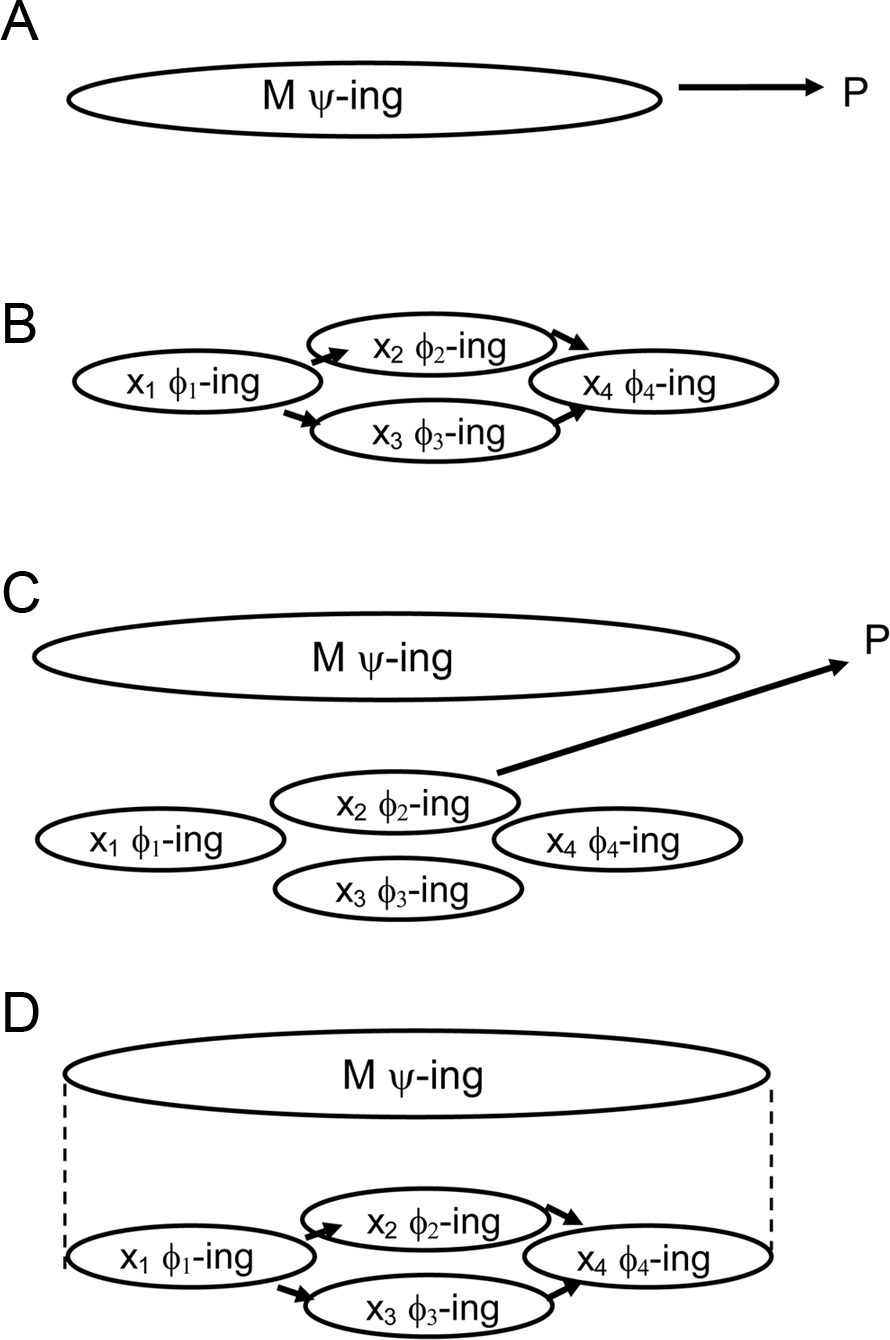
To see the difficulty, it is helpful to consider separately the causal relations at different mechanistic levels (fig. 3). At the higher level, an overall mechanism M works (Ψs) and thereby produces phenomenon P; more simply, M Ψ-ing causes P (fig. 3A). On the theory assumed here, this means that an intervention on M Ψ-ing changes the value of P. At the component level, spatiotemporally localized parts of the mechanism (x's) play causal roles (ϕ-ing), such that a change in any x's ϕ-ing makes a difference to some other component(s) (fig. 3B). Connecting the two levels as cause-and-effect takes the form of a dependency relation between a ϕ-ing x and P, which specifies the difference that intervening on a mechanism's components makes to its effects (fig. 3C). The two levels, upper and lower, then offer alternative causal explanations of P. So, if downstream effects are the explanandum, the manipulability theory diagnoses MEx as a special case of causal explanation. On the other hand, if the working mechanism itself is the target of explanation (3d), then upper and lower levels do not offer alternative causal explanations of P. Instead, MEx offer “constitutive explanations” (to use Craver's term) of a higher-level mechanism, in terms of its parts. Craver's own examples, and many others, support the constitutive view of MEx. Yet the causal view is not explicitly ruled out, and reliance on the manipulability theory tends to encourage it. Ambiguity concerning explananda highlights internal tension in the causal-mechanical account of MEx, which reflects the situation in philosophy of biology more generally.
Levels of causal relations in MEx.

A second problem is that explication of interlevel constitution in terms of causal relations (“mutual manipulability”) does not account for the ‘bottom-up’ direction of MEx. The latter is a basic feature of this mode of explanation, presupposed in scientists’ focus on underlying mechanisms. Yet mutual manipulability requires both top-down and bottom-up dependency relations, to establish or rule out causal relevance of a component (see sec. 3). This ‘mutualism’ reflects the design of experiments aimed at discovering mechanisms and testing MEx. An overall system may be manipulated, to reveal effects on its parts, or a part may be manipulated, to reveal effects on its overall mechanism. Woodward's theory offers a satisfying analysis of these practices. The problem arises from extending this analysis to the interlevel relation between mechanistic levels, representation of which connects explananda and explanans in MEx.
It is important to note that Craver does not simply conflate constitutive and causal relations. Such conflation is blocked by a further thesis, that causal relations do not cross mechanistic levels (Craver and Bechtel Reference Craver and Bechtel2007). The argument for this thesis is intuitive, but persuasive. If the interlevel relation in mechanisms were simply causal, then intervening on a mechanism M would cause a change in one or more components along a pathway I → M → x, and intervening on one or more components would cause a change in M along a pathway I → x → M. But, intuitively, an intervention on an overall mechanism does not cause a change in one or more components. Rather, such an intervention is a change in one or more of its components, and vice versa (I → M iff I → x). Accordingly, mutual manipulability conditions do not define or fully analyze the constitution relation as causal. Instead, Craver's account explicates the multilevel structure of MEx by “close analogy” with and “extension of causal relevance” (2007, 152, 162).
However, the delicate distinction between causation and constitution does not account for the part-to-whole direction of MEx. Though constitution is not conflated with causal dependence, the regulative ideal of causal relevance is explicated in terms of mutual manipulability—which runs both ways, top-down and bottom-up. The causal-mechanical account leaves obscure why description of components explains a higher-level mechanism (or its effects), and not the reverse as well.Footnote 16 If Craver's account is correct, scientists would do just as well to look for “overarching” as underlying mechanisms. One reply is that, in practice, experimental biologists do look both ‘up and down’ mechanistic levels. And so they do—when they are discovering mechanisms. Strategies for mechanism discovery are the starting point for much philosophical work on biological mechanisms, including that of Craver and colleagues.Footnote 17 The result is an account of MEx oriented toward practices by which scientists construct and test models of real-world mechanisms. The causal-mechanical account succeeds in grounding and articulating norms for experimental practices that integrate different mechanistic levels within a single explanatory framework. But it does not tell us how these MEx, once constructed, explain higher levels in terms of lower ones.
A third problem concerns constraints on a mechanism's components, as represented in MEx, entailed by the manipulability theory. These constraints take the form of modularity theses. ‘Modularity’ here refers to the in principle independence of different components of a mechanism: a component of a mechanism is modular if and only if it is possible in principle to intervene on its activities independently of other components of the mechanism. That is, modular components can in principle be independently experimentally manipulated.Footnote 18 Woodward (Reference Woodward2002) proposes modularity as a constraint on components of a mechanism as represented in MEx. This constraint may be interpreted in several ways.Footnote 19 The weakest modularity thesis states that for x to be a component of a mechanism M, it must be in principle possible to intervene on its activities independently of other components. More precisely:
Mod-1: If xi is a component of mechanism M, then there is a conceivable intervention on xi that changes its ϕ i-ing independently of other components of M.
Mod-1 is very plausible. If we cannot conceive of changing any of a component's properties or behaviors independently of other constituents of a mechanism, then why conceive it as a distinct component at all? If we can conceptually individuate a working component of a mechanism (x ϕ-ing), then we can conceive an experiment that ‘surgically’ intervenes on x to change its ϕ-ing, without altering other components. A simple example would be to remove x from the rest of the mechanism and observe the effects. Description of such ‘thought-experiments’ for each part of some mechanism M yields a ‘parts list’ for M.
If a component of mechanism M is modular in the sense of Mod-1, then the generalization describing its productive activity (x ϕ-ing) can, in principle, change independently of generalizations describing productive activities of other components. Generalizations of this sort describe the results of hypothetical experiments that isolate or ‘surgically’ manipulate components of M. A second, stronger modularity thesis relates the ‘conceptually separable’ activity of a component to the overall mechanism, via a modular causal generalization:
Mod-2: If xi is a component of mechanism M, then a modular causal generalization relates xi ϕ i-ing and M Ψ-ing.
On Craver's account, this condition is trivially satisfied, since a mechanism is constituted by its components—a change in any one of them is a change in the overall mechanism. These coordinated changes can be represented as a causal generalization relating changes in the two variables. However, as causal relations do not cross mechanistic levels, according to Craver, a Mod-2 generalization is better understood as describing the causal role of xi within the overall mechanism M rather than representing a causal relation between xi ϕ i-ing and M Ψ-ing. On this interpretation, Mod-2 is satisfied just in case xi ϕ i-ing can be described independently of other x ϕ-ings within M. This is a weak condition, met by any intelligible mechanistic description of working components. If no activity whatsoever can be attributed to a component, independently of its mechanistic partners, then there seems no reason to distinguish it as a component at all. This is just the counterpart of Mod-1 for causal activities, a minimal individuation condition for components of MEx.
Interlevel causal generalizations do hold between components of a mechanism and a phenomenon P produced by the working mechanism. This idea is captured by a third modularity thesis, relating xi ϕ i-ing and effects of M Ψ-ing:
Mod-3: If xi is a component of mechanism M, then a modular causal generalization relates xi ϕ i-ing and P.
Mod-3 requires only that each working component of M make some causal contribution to P that can be represented independently of the causal contributions of other components to P. Again, this requirement is very plausible. If changes in xi ϕ i-ing bring about no change whatsoever in any effect of M Ψ-ing, that could be represented as a causal generalization, then there seems no reason to include xi as a component of M. That is, any feature of a mechanism that does not satisfy Mod-3 is irrelevant, for the explanatory purpose at hand. Mod-3 generalizations are causal and explanatory: a change in xi ϕ i-ing produces a change in P. But they explain how P changes, not how M Ψs. Here again tension arises between the multilevel and manipulationist aspects of Craver's account. Together, Mod-3 generalizations for all the components of a mechanism M yield a fine-grained counterfactual account of how to produce particular outcomes from M. It is not clear, however, that these generalizations are collectively equivalent to a mechanistic explanation.
A final modularity thesis asserts that they do:
Mod-4: If xi is a component of mechanism M, then the MEx of M Ψ-ing (P) includes a modular causal generalization relating xi ϕ i-ing to M Ψ-ing (P).
If Mod-4 is correct, then only modular MEx ‘get the causal story right’.Footnote 20 If this is the case, then MEx, which aim to correctly describe causal relations among components that together produce an overall phenomenon, should consist of modular causal generalizations. So, if Mod-4 holds, MEx are causal explanations, in the “interventionist” sense (Woodward and Hitchcock Reference Woodward and Hitchcock2003). Such explanations reveal what a phenomenon of interest depends on, answering ‘what-if-things-had-been-different?’ questions about the values of variables within a fixed range of invariance (see sec. 3). But MEx, prima facie, are concerned with a different kind of question, which, following Woodward, we might term a ‘how-does-it-work?’ question. This contrast signals the third problem for the causal-mechanical account: MEx in experimental biology may not be modular causal explanations. Insofar as this claim is dubious, the causal-mechanical account fails to explicate the component-level of MEx.
And this strong modularity thesis is dubious indeed. Unlike Mods-1–3, Mod-4 is not entailed by the manipulability theory. Mods-1–3 specify necessary conditions for a component of a mechanism (Mod-1) that participates in causal relations within that mechanism (Mod-2) and causally contributes to its overall effects (Mod-3). As noted above, all are plausible constraints on components described in MEx, which follow from Woodward's manipulability theory and definition of modularity. However, these three innocuous modularity theses do not impose sufficient constraints on the component-level to account for MEx. What they leave out is organization of working components. Mod-4 does constrain mechanistic organization, stipulating that the correct description of causally interacting components that constitute an overall mechanism is a set of modular causal generalizations. But Mod-4 follows from the manipulability theory only given a substantive further assumption: that the modular causal generalizations that in principle individuate components of a mechanism and their causal roles in relation to effects—the ways we conceptualize them as distinct, relevant components—are the very same causal generalizations that figure in MEx.
For experimental biology, at least, there is reason to doubt this assumption. Mod-4 asserts that an MEx is just a fine-grained counterfactual account of how to produce particular outcomes, summarized as a set of causal dependency relations linking components with an overall mechanism. But MEx in biology also describe interdependencies among components. In physiological, cellular, and molecular mechanisms, as we understand them, the behavior of isolated components is not a good guide to their behavior together, and their behavior in one context is not a good guide to their behavior in others. The Jak-STAT pathway, for example (sec. 2), leads to quite different outcomes in different clusters of cells. The same molecular components can induce or inhibit expression of a particular gene, depending on other molecules with which they interact. More examples are given in the next section. The key point is that, by committing to Mod-4, the causal-mechanical account of MEx excludes an important aspect of biological mechanisms. Yet weaker modularity theses, though plausible, do not account for MEx.
Together, these three problems undermine the causal-mechanical account of MEx. Though satisfying as an account of how mechanistic models are constructed and tested in experimental fields, it leaves questions about the explanandum, interlevel relation, and representation of components—all the major parts of MEx—unresolved. The target of explanation is ambiguous, the bottom-up direction of MEx elided, and modularity constraints that overcome these obstacles are not supported by the manipulability theory or what we know of biology. The next section turns these criticisms in a positive direction, offering a new account of MEx.
5. Jointness
The core concept of this new account is ‘jointness’.Footnote 21 The term refers to precisely the feature excluded by Mod-4: interdependence among causally active components of a mechanism. Such interdependencies are prominent features of MEx in experimental biology: a polymerase protein binds a DNA promoter sequence to initiate RNA synthesis; multiple testes cells cluster together to form a signaling hub that determines the plane of GSC division; a lymphocyte encountering a pathogen initiates an immune response; and so forth. Descriptions of these and myriad other biological mechanisms, offered as explanations of higher-level phenomena, are rife with causally significant interactions involving two or more components. Jointly acting components, I argue, display the basic structure of MEx in experimental biology.
A classic example of jointness is the “lock-and-key” model of enzyme action. Fischer's original model hypothesized a unique substrate for each enzyme, which upon binding catalyzes a unique chemical reaction. Though the ‘one-enzyme, one-substrate’ model is long since disconfirmed, the lock-and-key relation remains a prominent motif in many biological explanations, including MEx of enzyme catalysis.Footnote 22 The latter describe formation of a complex made up of two components: enzyme and substrate, which are held together by weak chemical bonds. The enzyme-substrate complex plays a causal role distinct from either component alone, catalyzing a reaction that would not otherwise occur at a physiologically significant rate. Crucially, this causal role is played by the components together, that is, jointly. Enzyme catalysis depends on the ‘lock-and-key fit’ between molecular components of this simple biochemical mechanism. An enzyme-substrate complex forms in virtue of these components’ complementary shapes and biochemical properties, given certain spatiotemporal conditions. The lock-and-key analogy refers to these properties. I will refer to the ‘fit’ or complementarity among such properties as ‘meshing’.Footnote 23 Causally active complexes, and description of meshing properties on which they depend, are ubiquitous in MEx of biochemical pathways, antigen-antibody binding, cell-signaling pathways, the core processes of molecular genetics (DNA replication, transcription, and translation), and many other biological phenomena. Complexes in the GSC example (sec. 2) include the hub (an association of cells), the substrate of Jak-STAT signaling (a hub cell, adhesion molecule, and a GSC), the APC (a set of proteins), and the various DNA-RNA-protein complexes involved in chromosome duplication and cell division. Examples can easily be multiplied.
The prevalence of jointly acting complexes in MEx of experimental biology suggests that such complexes have explanatory significance. I propose that descriptions of jointly acting complexes, their formation and dissociation, and meshing properties are the ‘building blocks’ of MEx in experimental biology. In the examples above, jointness is associated with causal activity. Again, I here assume Woodward's manipulability theory, on which causal relations hold between a cause and an effect, represented as variables that can take diverse values. Jointness is a different relation, holding between causal partners that together produce some effect.Footnote 24 The latter could be represented as a value (or range of values) taken by an effect variable. But jointness is not a property of the effect, which could be represented by some such value. Instead, jointness concerns the causal role played by a complex of components, that is, ϕ-ing. The following formula begins to clarify the concept:
(J1) Components x1 … xn jointly ϕ, where ϕ is some causal activity, if and only if the complex x1 … xn ϕ's, and uncomplexed x's do not ϕ.
‘Uncomplexed x's’ include each component alone, as well as multiple x's that do not form a complex.
As J1 merely swaps the notion of jointness for that of a causally active complex, this is not very illuminating. However, the notion of a complex, in experimental biology, gives us more to work with. The causal role of complexes within a mechanism requires (i) that each component contributes in some way to the overall mechanism and (ii) that these contributions ‘fit’ with one another. Modularity conditions (sec. 4) specify the first. It is the second that clarifies the notion of a complex. Complex-formation requires that components fit together, like gears of a machine, in virtue of meshing properties:
(J2) Components x1 … xn form a complex if and only if x1 … xn mesh in virtue of properties {p1, p2, … pn}.
Meshing properties are a prerequisite for complex-formation.Footnote 25 Putting J1 and J2 together affords a rough definition of jointness (for simplicity, only the two-component case is presented):
(J3) Components x1 and x2 jointly ϕ if and only if (i) x1 has properties that mesh with those of x2 and vice versa,Footnote 26 (ii) x1 and x2 form a complex x1x2 in virtue of their meshing properties, (iii) complex x1x2 ϕs, and (iv) neither x1 nor x2 ϕs individually.
So defined, joint activity within mechanisms has three significant features. First, jointness depends on properties of the individual components, x1 and x2. A complex x1x2 forms in virtue of these meshing properties. Second, meshing involves just those components; no ‘exogenous’ initiating activity is required. This contrasts with representation of the action of interlocking gears (the exemplar of meshing parts) as a linear causal chain. Such a chain begins with a ‘push’ from some outside source. The interlocking arrangement of gears then transmits the productive activity through the rest of the mechanism.Footnote 27 For jointness, in contrast, the distinctive causal role of a complex x1x2 depends not on some incoming antecedent cause but on the complementarity of components. The causal activity, ϕ-ing, depends on a particular kind of interaction between x1 and x2. In this sense, joint ϕ-ing ‘arises from within’, out of interacting components. Third, joint ϕ-ing requires a permissive environment, a context in which the complex x1x2 can actually form. The most obvious requirement, at least in biological mechanisms, is spatiotemporal proximity such that components interact with one another. But in any particular case, many other background conditions must also be satisfied. To summarize: joint causal activity is bottom-up, interactive, and presupposes a context that enables complex-formation.
These three features are characteristic of complexes within biological mechanisms, as currently understood. Causal descriptions of component-complexes within a mechanism satisfy a ‘jointness’ condition:
(J4) Components x1 and x2 jointly ϕ in mechanism M if and only if (J3), and x1x2 ϕ-ing is partly constitutive of M Ψ-ing.
J4 augments the consensus view of MEx, in a way that goes beyond Craver's central criterion of adequacy (sec. 3). MEx that satisfy J4 describe individual components and their activities, the meshing properties that allow components to form complexes, spatiotemporal arrangements that determine which complexes do form, causal activities of complexes, and (often) dissociation of complexes. The requirement that a jointly acting complex “partly constitute” the overall working mechanism needs clarification, however. To partly constitute a mechanism is to be included in the wider complex that constitutes that mechanism. This shifts the focus from jointly acting complexes within a mechanism, to the mechanism itself as a jointly acting complex. The latter notion is entirely compatible with the consensus view: an overall mechanism M is a causally active (Ψ-ing) complex of interacting parts (ϕ-ing x's). Causal relations between productive x's and their effects are understood in terms of manipulability, as in Craver's account. This view goes beyond its predecessor, however, in providing a positive account of mechanistic organization, from the bottom-up. The three features of jointness, applied to an overall mechanism, explicate the basic structure of MEx: bottom-up and interactive, within a permissive context or environment.
A mechanism's working, its overall behavior, can be defined as the joint activity of its interacting components. So the basic ideas of (Mc) can be reframed as a jointness condition:
(JM) Components x1, … xn jointly Ψ as mechanism M, if and only if (i) x1, … xn form causally active complexes (ϕ 1-ing, … ϕ m-ing) in virtue of meshing properties, (ii) these entities and activities are organized so as to constitute M Ψ-ing, and (iii) x1, …xn do not Ψ individually.
Condition JM explicates the key features of mechanisms: part-whole hierarchy, interactive organization, and an overall context fixed by boundaries of M. This ‘joint account’ is compatible with Craver's causal-mechanical view, including its norms of accuracy and causal relevance, if the latter is understood as an account of MEx construction and testing in experimental biology. The joint account explicates MEx as explanations, not in terms of causal dependency, but constitutive interdependency. Condition JM articulates the basic criterion for MEx: show that a mechanism of interest satisfies this condition, by describing how its components interact to jointly constitute the overall working mechanism. A good MEx shows how working components fit together into complexes, by describing the features in virtue of which they mesh, and so make up a complex whole, which plays a distinct causal role. So although description of causal relations is important, the crux of MEx is representation of the constitution relation.
The joint account, summarized in JM, avoids all three problems discussed above. The ‘collaborative’ aspect of mechanisms in experimental biology, elided by Mod-4, is the central feature of MEx in these fields. Because jointness depends on meshing properties of diverse components, mechanistic descriptions that conform to JM proceed ‘from the bottom-up’. The joint account thus captures the directionality of MEx. Finally, it resolves ambiguity concerning the target of explanation: the overall mechanism (M Ψ-ing) rather than its downstream effects (P).Footnote 28 The explanandum is a description of M Ψ-ing, and the explanans a description of components x1,…xn ϕ 1,…ϕ m-ing, organized to constitute M Ψ-ing. To summarize the joint account:
| explanandum | M Ψ-ing |
| relation | constitution (explicated as jointness) |
| explanans | jointly ϕ-ing x's, their meshing properties, and permissive environment |
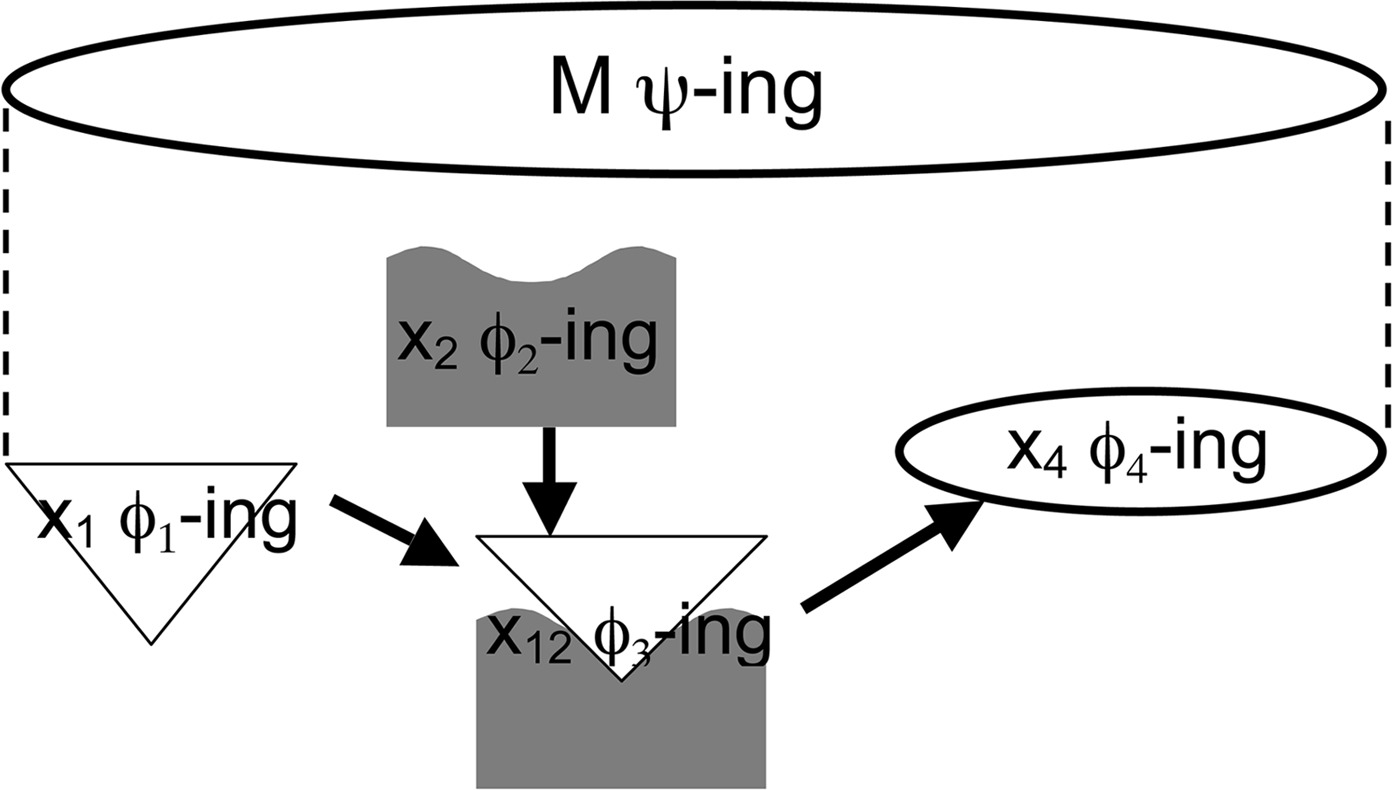
In experimental biology, this description includes jointly causal complexes, as well as requirements for complex-formation: meshing properties and particular spatiotemporal arrangements of components (fig. 4). On this view, an MEx is not a causal explanation of P but a constitutive explanation of M Ψ-ing, in terms of M's working parts.
Schematic of the joint account of MEx in experimental biology.

Importantly, the joint account does not elide the causal aspect of mechanisms. Rather, it places these aspects in proper context. To see this, consider again the multiple levels of causal relations relevant to MEx (sec. 4). At the higher level, an overall working mechanism (M Ψ-ing) causes phenomenon P. Biology is rife with such causal claims, which take the form of generalizations; for example, cell division produces two cells, long-term potentiation increases synapse strength. Such causal generalizations are not MEx, however, but potential explananda for MEx. At the component level, material parts (x's) play causal roles (ϕ-ing) such that each x ϕ-ing has some effect on other components. Many of these effects involve formation of complexes, so meshing properties as well as the distinct causal roles of complexes are included (fig. 4). The component level for a given MEx, therefore, can itself involve multiple levels of complexes and meshing components. The overall mechanism is just the most inclusive complex, of a given set of components. An MEx describe all these working components and how they are organized to constitute the overall mechanism as a whole. But this description, though it includes causal relations, does not compete with the higher-level causal claim, ‘M Ψ-ing causes P’. The two are not alternative causal explanations of P. This is borne out by biological practice; molecular and biochemical details of GSC and Jak-STAT, for example, do not trump or replace stem cell activities as causes of testis development. Instead, the higher-level claim identifies a particular mechanism as a cause of P. Description of its working parts indicates how the mechanism brings P about. So the joint account fleshes out the idea that MEx answer ‘how does it work?’ questions: they do so by placing causal descriptions in context. MEx presuppose, but are distinct from, causal explanations.
6. Unification and Causal Structures
The next task is to articulate the model of explanation associated with the joint account. Here the original question returns: in virtue of what is a mechanistic description (now conceived in terms of jointness) explanatory? This section makes a start on the answer. As explicated above, MEx answer 'how-does-it-work?’ questions about some M Ψ-ing, where M is a complex system of causally interdependent parts. These explanations exhibit the constitution relation by describing causal systems at two levels, aligning them such that higher- and lower-level descriptions are represented as identical. When presented with such an explanation, one can see (literally, when the MEx is in diagrammatic form) that an overall mechanism is just its organized, jointly acting components, and vice versa. This identification has some similarity to traditional reduction. But the latter concept is so associated with logical relations between theories that it would be misleading to characterize MEx as a form of reduction. A more perspicuous (though still loaded) term is unification. MEx unify causal descriptions at different levels, bridging the gap between part and whole.
It is important to distinguish this view from explanatory unification in Kitcher's sense (Reference Kitcher1981).Footnote 29 Kitcher's account of explanatory unification shares with the covering-law theory the idea of explanation as logical derivation. On his view, unifying explanations use a single argument pattern to derive descriptions of many diverse phenomena. So explanatory unification for Kitcher is by an argument pattern, of a wide array of phenomena. Unifying explanations of this sort are simplifying devices, which systematize “brute facts” into a scientific worldview. MEx also have a systematizing role, but not one that hinges on derivational argument. Their mode of unification instead lends itself to visual representation. Furthermore, as illustrated in the GSC example (sec.2), MEx do not typically ‘cover’ a wide domain of phenomena. The explanatory connection between mechanistic levels concerns the mechanism of interest, whether the latter is a feature of living things or restricted to only a few artificial contexts. Finally, within their domain, broad or narrow, MEx connect rather than simplify. What they connect are not facts per se but causal descriptions. MEx systematize causal descriptions in a hierarchical structure, with multiple levels defined by the constitution relation. They aid understanding of causal relations by modeling them as hierarchies of complexes. MEx are not causal structures (as that term is usually understood), but they do structure causes.
On this account, MEx are closely associated with, but distinct from, causal explanation according to the manipulability theory (“interventionism”). The latter shows what some phenomenon of interest depends on, and thereby answers a range of questions about phenomenon Y's value. The range of counterfactual circumstances for which answers can be given is fixed by the range of invariance under interventions of the causal relation between some causal factor X and Y.Footnote 30 Causal explanation thus rests on the ability to support counterfactuals, not about other objects that stand in the same relation as that between X and Y but about hypothetical values of X and Y themselves (Woodward and Hitchcock Reference Woodward and Hitchcock2003, 19–20). MEx are similarly focused on “the system at hand” (21). However, ‘the system’ in MEx is conceived as a hierarchy of causal descriptions. MEx can therefore be improved on at least two dimensions: breadth and depth. Explanatory depth increases with the number of levels, explanatory breadth with expansion of a mechanism's boundaries. Both bring together more components and causal relations into a multilevel structure.
Here the contrast with interventionism is instructive. Interventionist explanations are “deeper” when invariance under changes in background conditions is “transformed” to invariance under interventions on variables that figure in the dependency relationship at issue (Hitchcock and Woodward Reference Hitchcock and Woodward2003, 188). That is, more of what the phenomenon of interest depends on is made explicit. MEx reveal not sources of dependence but features that allow diverse components to work together, given appropriate background conditions. They are improved not by increasing the range of invariance under intervention of causal relations described but by increased breadth or depth. This is done by making complexes parts of one another's environment, thereby transforming background conditions into parts of a mechanism. Like more traditional unifying explanations, MEx increase understanding by revealing connections among many diverse parts. But these connections are not simple and cannot be concisely stated. Unlike law-based explanations, MEx are built up from details of meshing components and diverse causal relations, revealing how these parts are unified to jointly constitute an overall working mechanism.
Though this treatment is necessarily brief, it suffices to indicate the strengths of the joint account. Summarized by condition JM, the joint account elaborates the consensus view (Mc), clarifies the relation of MEx and causal explanation, and lays the groundwork for an alternative model of unifying explanation. Further work is needed to determine the scope of the joint account, in particular whether it can be generalized beyond experimental biology. Conversely, it will be important to examine how MEx relate to other modes of explanation in experimental biology and to deepen the comparison with the interventionist account. Finally, limiting cases of MEx, in experimental biology or other fields, should shed more light on their essential features and help further refine JM. The concept of ‘mesh’, in particular, could be clarified along several lines: identifying the main varieties of meshing properties, distinguishing degrees or kinds of mesh among components, and examining more closely the connections between mesh, jointness, and MEx. All these are issues for future work. For now, I conclude with a brief summary of this article's main claims and argument.
7. Conclusion
There is strong consensus, among philosophers of biology, that MEx describe mechanisms composed of diverse working parts (ϕ-ing x's) and their spatial, temporal, and causal organization. There is less consensus as to why such mechanistic descriptions are explanatory. Traditional accounts of scientific explanation, invoking the generality and predictive rigor of laws, have little purchase on experimental biology, where mechanistic descriptions abound. Craver's causal-mechanical account hews closely to practices of mechanism discovery in neuroscience and experimental biology more generally, extending Woodward's manipulability theory of causal relations to the multilevel structure of MEx. However, these advantages are offset by three problems, which motivate an alternative to the causal account.
The alternative, joint account proposed here avoids ambiguity about the explanandum, explicates the bottom-up direction of MEx, and highlights interdependence rather than modularity of a mechanism's components. It makes sense not only of the prominence of complexes within mechanistic descriptions in experimental biology but also of the hierarchical structure and emphasis on interactions among diverse components in these explanations. It clarifies both the target of explanation and the relation of MEx to causal explanations. If the joint account is correct, then MEx do not aim to identify causes but to show how those causes work, within a framework of part-whole hierarchy. This conception of mechanisms highlights a hitherto neglected aspect of their organization, parts working together, and reveals the link between this prominent feature of biological mechanisms and the hierarchical structure of MEx. On the joint account, MEx are bottom-up explanations that align causal descriptions at different levels, unifying these levels by exhibiting the constitution relation. What is explained is how a mechanism works, while the explanans is a description that exhibits constitution of the overall mechanism by its organized working components. Explanatory depth increases with additional hierarchical levels, while extending the boundaries of a mechanism increases explanatory breadth.