In her Keynote Article in this issue, Paradis explores the nature of bilingual language acquisition by examining the question of possible similarities between children learning a second language (L2) and children with specific language impairment (SLI) who are monolingual or bilingual. She evaluates the maturation model of Rice (Reference Rice, Rice and Warren2004), the extended optional infinitive (EOI) model, that focuses on children's acquisition of finiteness marking during the early childhood period. Paradis alludes to the issue of how to deal with the nonparallels between chronological age and acquisition in the comparison of L2 and SLI language acquisition within maturational models. I explore that issue further in this Commentary, using the available growth templates drawn from the work on English-speaking typically developing children and children with SLI for projected possible growth trajectories for bilingual and L2 children, with and without SLI.
Maturational effects on L2 were hypothesized earlier by Johnson and Newport (Reference Johnson and Newport1989) as critical period effects, such that young children are better L2 learners than adults. My maturational model (Rice, Reference Rice, Rice and Warren2004; cf. Wexler Reference Wexler, Lightfoot and Hornstein1994, Reference Wexler1998) takes up the issue from the perspective of longitudinal growth trajectories of typically developing children compared to children with SLI, in the domains of finiteness marking, mean length of utterance (MLU), and vocabulary acquisition (cf. Rice, Redmond, & Hoffman, Reference Rice, Redmond and Hoffman2006). This is a developmental maturational model, one that hypothesizes underlying neurocognitive mechanisms that set the conditions for language acquisition, conditions that must accommodate environmental influences such as the languages to which a child is exposed. The general conclusions from the available evidence and formal analyses of growth curve trajectories are that children with SLI follow the same growth trajectories as younger control children across multiple dimensions of language acquisition. Finiteness marking is distinctive because children with SLI perform at levels lower than younger comparison children at equivalent levels of MLU, indicating a delayed onset of finiteness acquisition that is out of synchrony with the generally delayed onset of language acquisition evident in MLU and vocabulary acquisition. It is as if the acquisition system has two relevant controls: one is benchmarked to the onset of the growth cycles (where the X axis intersects the Y axis of the growth curve) and the second is benchmarked to the trajectory of change over time. Onset and growth trajectories differ across different dimensions of language (cf. Rice et al., Reference Rice, Redmond and Hoffman2006). MLU and vocabulary acquisition during this period are strongly linear, with equal increments of growth per chronological unit, whereas finiteness acquisition is curvilinear, more like an S-shaped curve with an initial period of acceleration followed by a more linear upward trajectory with a period of deceleration as asymptote, or ceiling, is reached. The picture is of both weakness and robustness on the part of the children with SLI. The weakness is related to the onset of acquisition, and the robustness is related to the parallels in the growth trajectories, as if once the acquisition processes are in play, the children with SLI need no more time to acquisition than the typically developing children, at least during the early childhood period of acquisition.
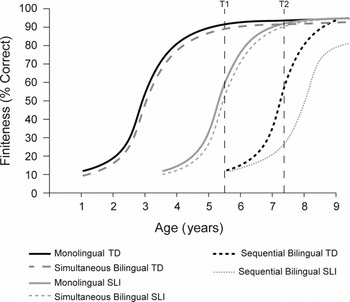
This is illustrated in Figure 1 with English as a target language, for young children acquiring English finiteness markers, consisting of third person singular -s, past tense regular or irregular forms, copula and auxiliary BE, and auxiliary DO. The curve is an idealized representation of the combined average of morphemes, which is drawn from previously reported experimental longitudinal evidence (Rice, Wexler, & Hershberger, Reference Rice, Wexler and Hershberger1998) and the cross-sectional norms of the Test of Early Grammatical Impairment (Rice & Wexler, Reference Rice and Wexler2001). As indicated in Figure 1, in typically developing monolingual children the system appears around 24 months (Hadley & Short, Reference Hadley and Short2005) and accelerates in consistency of use between 3 and 4 years, when it begins to level off as it approaches adult levels of grammatical accuracy in simple clauses around 4 years (cf. Rice & Wexler, Reference Rice and Wexler2001). Children with SLI are delayed 2 years or more in the acquisition of finiteness markers, although, on average, they seem to “catch up” to obligatory use of the forms following the same growth trajectories of their younger comparison group.
Figure 1.A finiteness versus age comparison.
Let us now evaluate the parallels between SLI and bilingual/L2 acquisition trajectories from these growth templates. Figure 1 projects growth of children simultaneously acquiring two languages, adopting the definition of Paradis' Keynote Article as “children who learn both languages in the home or through early childcare experiences before the age of 3 years, 0 months (3;0).” In comparison, sequential bilinguals are often children who begin learning the L2 at school entry, with a chronological offset between first language (L1) and L2 onset. The caveat for Figure 1 is that longitudinal documentation of growth trajectories for bilingual children is sparse. As is evident in Paradis, we must rely largely on cross-sectional data or case studies to piece together a preliminary version of longitudinal growth trajectories. The exercise here is to assume that the generalizations from the maturational model of the EOI hold for the trajectory of increased accuracy in obligatory use of finiteness markers, and to examine how this could play out relative to chronological age and reported acquisition evidence for bilingual children with or without SLI. That is, we assume that bilingual children are drawing on acquisition mechanisms in the same way as monolingual children, and that bilingual children with SLI demonstrate similar difficulties in onset but robustness in acquisition trajectories similar to monolingual children with SLI.
Beginning with simultaneous bilingual children who are typically developing, the growth trajectory in Figure 1 plots the growth corresponding to the generalizations of Paradis from cross-sectional evidence of finiteness marking: children simultaneously acquiring two languages from the outset follow the growth and age-referenced levels of accuracy in each of their two languages as monolingual children (see also Genesee, Paradis, & Crago, Reference Genesee, Paradis and Crago2004, pp. 49 and 73). This supports the assumptions of the maturational model, and also highlights that there is no apparent “penalty” for bilingualism; children's language acquisition mechanisms are sufficiently robust to handle more than one language at onset.
This characterization also seems to extend to simultaneous bilingual children with SLI, as suggested by the evidence reviewed by Paradis. Figure 1 shows parallel growth for simultaneous bilingual children with SLI acquiring English compared to monolingual children with SLI. Consider the import of the growth perspective of bilingual SLI. It suggests a delayed onset across both languages, with English no more delayed for the simultaneous bilingual acquisition than for the monolingual acquisition; the profile of weaknesses and strengths characteristic of SLI shows in each language in the ways they are manifest in monolingual children, with the characteristic delayed onset of finiteness marking for bilingual English-speakers similar to English-speaking monolingual children with SLI (although not necessarily the same as for the L2, which will mirror the age trajectories of typically developing children, as shown by Paradis, Crago, Genesee, & Rice, Reference Paradis, Crago, Genesee and Rice2003). It is also noteworthy that the time to the target grammar is similar. This suggests two predictions for more detailed longitudinal outcomes: a delayed onset of English is expected to be characteristic of children with SLI acquiring English simultaneously with another language, and the expected time to acquisition will be similar to the interval required by monolingual English-speaking children with SLI.
Now we take up the scenario of children learning an L2 sequentially, with onset at an age beyond the expected onset of language acquisition and an L1 acquisition underway. As we consider growth curves for these children, we must consider the age at which children are introduced to the L2 and the number of months or years of exposure. For purposes of illustration, the growth curve projected in Figure 1 starts at school entry, at roughly 5;6, designated as Time 1 (T1). The estimated amount of exposure is roughly 2 years, indicated as Time 2 (T2) at roughly 7;6. The estimated level of performance on finiteness accuracy at T2 is 60%, based on the longitudinal data displayed in Paradis' figure 1a and 1b for a group of typically developing L2 children with 24 months of exposure beginning at an average age of 5;4, including children from a variety of L1 languages. These data can be compared to the cross-sectional data in Guitiérrez-Clellen, Simon-Cereijido, and Wagner's (Reference Gutiérrez-Clellen, Simon-Cereijido and Wagner2008) report of finiteness accuracy in a sample of Spanish-speaking English L2 children with a mean age of 5;7 and exposure to English prior to school entry. Their sample of L2 children yielded a mean of 62% for finiteness marking, although roughly 2 years younger than the 7;6 of the children sampled by Paradis at the same level of accuracy. The point here is that the picture becomes more complicated for maturationally guided trajectories in the scenarios applicable to sequential bilingualism, with possible variations in age of exposure and amount of time of exposure.
In the Paradis longitudinal example, notice that the 60% average level of accuracy for the sequential bilingual children at 7;6 can be compared to the approximately 60% levels reported by Rice et al. (Reference Rice, Wexler and Hershberger1998) for monolingual unaffected English-speaking children at 3 years of age and monolingual English-speaking children with SLI at 5;6. Notice that the slope of the final phase of acquisition, from the 60% level onward, for the sequential bilingual typically developing group is drawn in Figure 1 with a slightly accelerated growth trajectory relative to the monolingual growth curves. This is meant to capture the possibility that the time to consistent use in obligatory contexts may be less for L2 children, as they close in on the target grammar. Older L2 children, relative to younger L1 children, can bring to their L2 acquisition more advanced neurocognitive abilities, greater social resources, and greater experience and knowledge of linguistic systems, all of which can be assets to boost the acquisition of an L2.
It remains to be determined by longitudinal evidence, but it is possible that developmental maturational mechanisms that have guided L1 can boost elements of L2 language acquisition. This is evident in some of the details of English L2, as reported in detail in Paradis, Rice, Crago, and Marquis (Reference Paradis, Rice, Crago and Marquis2008). One is an advantage for unbound morphemes as finiteness markers (copula and auxiliary BE and auxiliary DO) relative to inflectional morphemes (third person -s and past tense -ed) for the L2 group, in contrast to the more even profile of monolingual children's acquisition of the morpheme set. Another example is evidence of more creative errors of overregularization of BE forms in the L2 group, as in “*I'm black hair” or “I'm a show you.” It must be noted the overall rate of overt errors such as these is small, even in the L2 group (8% in their spontaneous samples), and not attested for all children in the L2 group, but noteworthy because they are seldom observed in samples from L1 children. Finally, L2 children showed a marked advantage for grammatical judgments of omissions or errors of finiteness marking relative to L1 children, suggesting they were acquiring a metalinguistic awareness of English grammatical rules before they were consistently implementing the rules in their production of English. This pattern is unlike that seen in younger English L1 learners, whose grammatical judgments tend to align with their production data. It appears that finiteness omission is characteristic of SLI, whereas creative errors are more characteristic of an English language learner, providing important clinical cues for differentiating grammatical differences attributable to SLI versus L2.
Keeping these observations in mind, there seems to be an echo of the maturational template for L1 growth in L2 acquisition, but age-related advantages and previous language acquisition could modulate the template toward faster acquisition. During early childhood multiple factors could align to accelerate L2 acquisition into a growth curve with a slightly steeper slope of acquisition than the L1 growth curve.
The picture may not be as optimistic for sequential bilingual children with SLI acquiring language during the early school-age period, as illustrated in the farthest curve to the right in Figure 1. Here the available evidence is very limited; the data of Paradis (see her figures 1a and 1b and 2a and 2b) are the only longitudinal data of this sort known to this author. However, we can draw upon the two children's data of the Paradis study to see that one child, WLLS, does not close the gap with the typically developing L2 children for finiteness marking after 23 months of exposure to English. At approximately 7;6, his acquisition of finiteness is just above 20% usage in obligatory contexts in simple clauses on a composite measure of finiteness marking, as shown in Figure 1, which is mostly attributable to a very low performance on inflectional affixes marking finiteness.
The lack of finiteness acquisition in this L2 child with SLI is consistent with longitudinal outcome data for late-talking monolingual English-speaking children first assessed at 24 months and later assessed at 7 years of age (Rice, Taylor, & Zubrick, Reference Rice, Taylor and Zubrick2008). In comparisons of the group of children with a history of late language emergence versus a control group of children without this history, the group of children with late language emergence had significantly lower levels of language performance at 7 years. Furthermore, finiteness markers yielded the highest effects sizes for significant group differences compared to conventional standardized assessments. Third person singular -s and past tense significantly differentiated the groups for the percentage of children with language impairments, as did a grammatical judgment task evaluating judgments of omitted finiteness marking. This evidence provides important longitudinal outcome data attesting to the likelihood that children with SLI at 7 years of age were likely to have late language emergence at 24 months, and were likely to have protracted difficulties in acquisition of finiteness marking.
New evidence beyond 7 years of age indicates protracted unresolved tolerance for omitted finiteness markers, that is, performance below the adult grammar levels achieved by age peers. Rice, Hoffman, and Wexler (in press) continued their longitudinal study of the sample of monolingual English-speaking children with SLI and younger control children of Rice et al. (Reference Rice, Wexler and Hershberger1998) and Rice, Wexler, and Redmond (Reference Rice, Wexler and Redmond1999), previously studied for omitted finiteness markers in simple declarative contexts from ages 5 to 8 years. The recent study reports on longitudinal assessments over 9 years, with a mean age of 7;8 at the outset and assessments to 15 years. The children completed grammatical judgment tasks featuring omitted BE copulas or auxiliaries or DO auxiliaries in questions, an extension to questions of the declarative tasks used in Rice et al. (Reference Rice, Wexler and Redmond1999, Reference Rice, Taylor and Zubrick2008). The SLI group demonstrated no appreciable gain in performance to 15 years of age, over 9 times of assessment. Whatever advantages were to be had by repeated exposure to the assessment instruments were not sufficient to overcome the protracted limitations in grammatical judgments of forms that appear frequently in everyday conversational English. Throughout the time of assessment the SLI group sustained flat performance around 0.75–0.80 A′, whereas the control children were at 0.90–0.95 A′ throughout. The earlier findings from the same group of children with SLI documented that, as a group, they reached near-adult levels on finiteness markers in simple declarative clauses by 8 years. The persistent poor performance on question judgments demonstrates that if the affected children had not reached typical levels in finiteness marking by 7;8 for questions they were not likely to increase their performance levels subsequently. Likewise, the case of WLLS raises the possibility that if a child acquiring English as an L2 sequentially does not have finiteness markers at near-adult levels of obligatory use by 7;6, then the prognosis is guarded for subsequent mastery.
In their seminal study of critical period effects in L2 learning, Johnson and Newport (Reference Johnson and Newport1989) drew several conclusions relevant to the predictions for sequential bilingual children with or without SLI. They concluded that subjects who arrived in the United States before the age of 7 reached native performance on a grammaticality judgment test of English grammar. For arrivals after age 7, there was a linear decline in performance up through puberty. Among the grammatical morphemes assessed, performance on past tense, auxiliaries, third person singular, wh-questions and yes/no questions was significantly correlated with age of arrival, such that later arrival age was associated with more errors of judgment.
The intriguing issue for the sequential bilingual children with SLI is whether they can mobilize the linguistic resources needed to acquire the L2 if they cannot “close the gap” quickly, before encountering a maturational leveling of acquisition rates that appears around the age of 7;6 to 8 years, as shown by the monolingual children with SLI in judgments of omitted finiteness markers in simple questions (Rice et al., in press).
CONCLUDING COMMENTS, CAVEATS, AND A CALL FOR LONGITUDINAL COMPARATIVE STUDIES
Paradis argues that consideration of the interface of bilingualism and SLI, two conditions that vary from typical acquisition, can provide valuable new critical insights for interpretive theories of language acquisition and impairment, as well as clinical implications for children with SLI who are also bilingual. In the spirit of her message, Figure 1 provides an extension of the developmental maturation model of finiteness marking drawn from EOI theory to lay out possible relationships of the X axis of chronological age with the Y axis of grammatical growth in simultaneous and sequential L2 acquisition in children with or without SLI. Powerful similarities in growth trajectories in the early childhood period cannot be ignored. Children with SLI follow the expected growth trajectory of typically developing children even when they are older and more cognitively and socially mature and with more extensive learning experiences. Young simultaneous bilingual children with SLI follow the expected growth trajectories for each of their two languages, even though the surface grammatical properties of the two languages emerge at different ages in monolingual acquisition. This suggests that one of the most significant elements early on is the onset of language acquisition, and the maturationally guided mechanisms that set the infrastructure for onset, which determines the starting point for the growth trajectories. In contrast, the maturational boosters for the growth trajectory during the younger period may lose thrust as children age and encounter a steady-state limitation to their grammatical growth, whether it is a matter of SLI (individual differences in language acquisition ability), L2 (individual differences in ability to acquire languages sequentially), or an intersection of both conditions.
Some caveats must be stated. One is that Figure 1 illustrates the acquisition of a single target language, English, and maturational models, by definition, must be tested across languages. The protracted period of English finiteness acquisition provides an extended growth trajectory that has contributed to the detection of similarities and differences in SLI and L2 acquisition. The point here is that the growth–age relationship evident in English is not intended as a universal maturational age linkage across all languages; such age linkage will depend on the ways the relevant grammatical properties are expressed in a given language. The model does predict that for a given language there will be within-language parallels among typically developing, SLI and L2 acquisition patterns as schematized in Figure 1. It is now widely recognized that the actual age of acquisition on the X axis of given grammatical forms is likely to vary across languages, as a function of the ways the grammar of a given language is structured. Further, finiteness marking is not, by definition, an exclusive potential feature of grammar that could demonstrate growth parallels in SLI and bilingualism. It remains to be determined if other grammatical features of languages, yet to be described, could function as markers of SLI and show parallel growth trajectories of SLI and L2.
A second caveat applies to the available evidence base. Regrettably, we have meager evidence relative to what is needed to sort out developmental trajectories and similarities across typical development, SLI and L2 trajectories, across different age ranges. Yet there is no doubt that this information will be immensely useful in trying to account for how children can be very slow in getting started on language acquisition and yet very robust in how they follow expected growth trajectories, and what accounts for a diminishment in the acquisition acceleration by around 7–8 years, whether it is monolingual acquisition of children with SLI or sequential L2 acquisition by SLI children. Models of language acquisition should be held accountable for growth trajectory evidence, and able to project predicted patterns of growth. Figure 1 is a contribution to that standard, an example that surely will be modified by the collection of relevant longitudinal evidence yet to be reported.





 You have
Access
In her Keynote Article in this issue, Paradis explores the nature of bilingual language acquisition by examining the question of possible similarities between children learning a second language (L2) and children with specific language impairment (SLI) who are monolingual or bilingual. She evaluates the maturation model of Rice (Reference Rice, Rice and Warren2004), the extended optional infinitive (EOI) model, that focuses on children's acquisition of finiteness marking during the early childhood period. Paradis alludes to the issue of how to deal with the nonparallels between chronological age and acquisition in the comparison of L2 and SLI language acquisition within maturational models. I explore that issue further in this Commentary, using the available growth templates drawn from the work on English-speaking typically developing children and children with SLI for projected possible growth trajectories for bilingual and L2 children, with and without SLI.
Maturational effects on L2 were hypothesized earlier by Johnson and Newport (Reference Johnson and Newport1989) as critical period effects, such that young children are better L2 learners than adults. My maturational model (Rice, Reference Rice, Rice and Warren2004; cf. Wexler Reference Wexler, Lightfoot and Hornstein1994, Reference Wexler1998) takes up the issue from the perspective of longitudinal growth trajectories of typically developing children compared to children with SLI, in the domains of finiteness marking, mean length of utterance (MLU), and vocabulary acquisition (cf. Rice, Redmond, & Hoffman, Reference Rice, Redmond and Hoffman2006). This is a developmental maturational model, one that hypothesizes underlying neurocognitive mechanisms that set the conditions for language acquisition, conditions that must accommodate environmental influences such as the languages to which a child is exposed. The general conclusions from the available evidence and formal analyses of growth curve trajectories are that children with SLI follow the same growth trajectories as younger control children across multiple dimensions of language acquisition. Finiteness marking is distinctive because children with SLI perform at levels lower than younger comparison children at equivalent levels of MLU, indicating a delayed onset of finiteness acquisition that is out of synchrony with the generally delayed onset of language acquisition evident in MLU and vocabulary acquisition. It is as if the acquisition system has two relevant controls: one is benchmarked to the onset of the growth cycles (where the X axis intersects the Y axis of the growth curve) and the second is benchmarked to the trajectory of change over time. Onset and growth trajectories differ across different dimensions of language (cf. Rice et al., Reference Rice, Redmond and Hoffman2006). MLU and vocabulary acquisition during this period are strongly linear, with equal increments of growth per chronological unit, whereas finiteness acquisition is curvilinear, more like an S-shaped curve with an initial period of acceleration followed by a more linear upward trajectory with a period of deceleration as asymptote, or ceiling, is reached. The picture is of both weakness and robustness on the part of the children with SLI. The weakness is related to the onset of acquisition, and the robustness is related to the parallels in the growth trajectories, as if once the acquisition processes are in play, the children with SLI need no more time to acquisition than the typically developing children, at least during the early childhood period of acquisition.
This is illustrated in Figure 1 with English as a target language, for young children acquiring English finiteness markers, consisting of third person singular -s, past tense regular or irregular forms, copula and auxiliary BE, and auxiliary DO. The curve is an idealized representation of the combined average of morphemes, which is drawn from previously reported experimental longitudinal evidence (Rice, Wexler, & Hershberger, Reference Rice, Wexler and Hershberger1998) and the cross-sectional norms of the Test of Early Grammatical Impairment (Rice & Wexler, Reference Rice and Wexler2001). As indicated in Figure 1, in typically developing monolingual children the system appears around 24 months (Hadley & Short, Reference Hadley and Short2005) and accelerates in consistency of use between 3 and 4 years, when it begins to level off as it approaches adult levels of grammatical accuracy in simple clauses around 4 years (cf. Rice & Wexler, Reference Rice and Wexler2001). Children with SLI are delayed 2 years or more in the acquisition of finiteness markers, although, on average, they seem to “catch up” to obligatory use of the forms following the same growth trajectories of their younger comparison group.
A finiteness versus age comparison.
Let us now evaluate the parallels between SLI and bilingual/L2 acquisition trajectories from these growth templates. Figure 1 projects growth of children simultaneously acquiring two languages, adopting the definition of Paradis' Keynote Article as “children who learn both languages in the home or through early childcare experiences before the age of 3 years, 0 months (3;0).” In comparison, sequential bilinguals are often children who begin learning the L2 at school entry, with a chronological offset between first language (L1) and L2 onset. The caveat for Figure 1 is that longitudinal documentation of growth trajectories for bilingual children is sparse. As is evident in Paradis, we must rely largely on cross-sectional data or case studies to piece together a preliminary version of longitudinal growth trajectories. The exercise here is to assume that the generalizations from the maturational model of the EOI hold for the trajectory of increased accuracy in obligatory use of finiteness markers, and to examine how this could play out relative to chronological age and reported acquisition evidence for bilingual children with or without SLI. That is, we assume that bilingual children are drawing on acquisition mechanisms in the same way as monolingual children, and that bilingual children with SLI demonstrate similar difficulties in onset but robustness in acquisition trajectories similar to monolingual children with SLI.
Beginning with simultaneous bilingual children who are typically developing, the growth trajectory in Figure 1 plots the growth corresponding to the generalizations of Paradis from cross-sectional evidence of finiteness marking: children simultaneously acquiring two languages from the outset follow the growth and age-referenced levels of accuracy in each of their two languages as monolingual children (see also Genesee, Paradis, & Crago, Reference Genesee, Paradis and Crago2004, pp. 49 and 73). This supports the assumptions of the maturational model, and also highlights that there is no apparent “penalty” for bilingualism; children's language acquisition mechanisms are sufficiently robust to handle more than one language at onset.
This characterization also seems to extend to simultaneous bilingual children with SLI, as suggested by the evidence reviewed by Paradis. Figure 1 shows parallel growth for simultaneous bilingual children with SLI acquiring English compared to monolingual children with SLI. Consider the import of the growth perspective of bilingual SLI. It suggests a delayed onset across both languages, with English no more delayed for the simultaneous bilingual acquisition than for the monolingual acquisition; the profile of weaknesses and strengths characteristic of SLI shows in each language in the ways they are manifest in monolingual children, with the characteristic delayed onset of finiteness marking for bilingual English-speakers similar to English-speaking monolingual children with SLI (although not necessarily the same as for the L2, which will mirror the age trajectories of typically developing children, as shown by Paradis, Crago, Genesee, & Rice, Reference Paradis, Crago, Genesee and Rice2003). It is also noteworthy that the time to the target grammar is similar. This suggests two predictions for more detailed longitudinal outcomes: a delayed onset of English is expected to be characteristic of children with SLI acquiring English simultaneously with another language, and the expected time to acquisition will be similar to the interval required by monolingual English-speaking children with SLI.
Now we take up the scenario of children learning an L2 sequentially, with onset at an age beyond the expected onset of language acquisition and an L1 acquisition underway. As we consider growth curves for these children, we must consider the age at which children are introduced to the L2 and the number of months or years of exposure. For purposes of illustration, the growth curve projected in Figure 1 starts at school entry, at roughly 5;6, designated as Time 1 (T1). The estimated amount of exposure is roughly 2 years, indicated as Time 2 (T2) at roughly 7;6. The estimated level of performance on finiteness accuracy at T2 is 60%, based on the longitudinal data displayed in Paradis' figure 1a and 1b for a group of typically developing L2 children with 24 months of exposure beginning at an average age of 5;4, including children from a variety of L1 languages. These data can be compared to the cross-sectional data in Guitiérrez-Clellen, Simon-Cereijido, and Wagner's (Reference Gutiérrez-Clellen, Simon-Cereijido and Wagner2008) report of finiteness accuracy in a sample of Spanish-speaking English L2 children with a mean age of 5;7 and exposure to English prior to school entry. Their sample of L2 children yielded a mean of 62% for finiteness marking, although roughly 2 years younger than the 7;6 of the children sampled by Paradis at the same level of accuracy. The point here is that the picture becomes more complicated for maturationally guided trajectories in the scenarios applicable to sequential bilingualism, with possible variations in age of exposure and amount of time of exposure.
In the Paradis longitudinal example, notice that the 60% average level of accuracy for the sequential bilingual children at 7;6 can be compared to the approximately 60% levels reported by Rice et al. (Reference Rice, Wexler and Hershberger1998) for monolingual unaffected English-speaking children at 3 years of age and monolingual English-speaking children with SLI at 5;6. Notice that the slope of the final phase of acquisition, from the 60% level onward, for the sequential bilingual typically developing group is drawn in Figure 1 with a slightly accelerated growth trajectory relative to the monolingual growth curves. This is meant to capture the possibility that the time to consistent use in obligatory contexts may be less for L2 children, as they close in on the target grammar. Older L2 children, relative to younger L1 children, can bring to their L2 acquisition more advanced neurocognitive abilities, greater social resources, and greater experience and knowledge of linguistic systems, all of which can be assets to boost the acquisition of an L2.
It remains to be determined by longitudinal evidence, but it is possible that developmental maturational mechanisms that have guided L1 can boost elements of L2 language acquisition. This is evident in some of the details of English L2, as reported in detail in Paradis, Rice, Crago, and Marquis (Reference Paradis, Rice, Crago and Marquis2008). One is an advantage for unbound morphemes as finiteness markers (copula and auxiliary BE and auxiliary DO) relative to inflectional morphemes (third person -s and past tense -ed) for the L2 group, in contrast to the more even profile of monolingual children's acquisition of the morpheme set. Another example is evidence of more creative errors of overregularization of BE forms in the L2 group, as in “*I'm black hair” or “I'm a show you.” It must be noted the overall rate of overt errors such as these is small, even in the L2 group (8% in their spontaneous samples), and not attested for all children in the L2 group, but noteworthy because they are seldom observed in samples from L1 children. Finally, L2 children showed a marked advantage for grammatical judgments of omissions or errors of finiteness marking relative to L1 children, suggesting they were acquiring a metalinguistic awareness of English grammatical rules before they were consistently implementing the rules in their production of English. This pattern is unlike that seen in younger English L1 learners, whose grammatical judgments tend to align with their production data. It appears that finiteness omission is characteristic of SLI, whereas creative errors are more characteristic of an English language learner, providing important clinical cues for differentiating grammatical differences attributable to SLI versus L2.
Keeping these observations in mind, there seems to be an echo of the maturational template for L1 growth in L2 acquisition, but age-related advantages and previous language acquisition could modulate the template toward faster acquisition. During early childhood multiple factors could align to accelerate L2 acquisition into a growth curve with a slightly steeper slope of acquisition than the L1 growth curve.
The picture may not be as optimistic for sequential bilingual children with SLI acquiring language during the early school-age period, as illustrated in the farthest curve to the right in Figure 1. Here the available evidence is very limited; the data of Paradis (see her figures 1a and 1b and 2a and 2b) are the only longitudinal data of this sort known to this author. However, we can draw upon the two children's data of the Paradis study to see that one child, WLLS, does not close the gap with the typically developing L2 children for finiteness marking after 23 months of exposure to English. At approximately 7;6, his acquisition of finiteness is just above 20% usage in obligatory contexts in simple clauses on a composite measure of finiteness marking, as shown in Figure 1, which is mostly attributable to a very low performance on inflectional affixes marking finiteness.
The lack of finiteness acquisition in this L2 child with SLI is consistent with longitudinal outcome data for late-talking monolingual English-speaking children first assessed at 24 months and later assessed at 7 years of age (Rice, Taylor, & Zubrick, Reference Rice, Taylor and Zubrick2008). In comparisons of the group of children with a history of late language emergence versus a control group of children without this history, the group of children with late language emergence had significantly lower levels of language performance at 7 years. Furthermore, finiteness markers yielded the highest effects sizes for significant group differences compared to conventional standardized assessments. Third person singular -s and past tense significantly differentiated the groups for the percentage of children with language impairments, as did a grammatical judgment task evaluating judgments of omitted finiteness marking. This evidence provides important longitudinal outcome data attesting to the likelihood that children with SLI at 7 years of age were likely to have late language emergence at 24 months, and were likely to have protracted difficulties in acquisition of finiteness marking.
New evidence beyond 7 years of age indicates protracted unresolved tolerance for omitted finiteness markers, that is, performance below the adult grammar levels achieved by age peers. Rice, Hoffman, and Wexler (in press) continued their longitudinal study of the sample of monolingual English-speaking children with SLI and younger control children of Rice et al. (Reference Rice, Wexler and Hershberger1998) and Rice, Wexler, and Redmond (Reference Rice, Wexler and Redmond1999), previously studied for omitted finiteness markers in simple declarative contexts from ages 5 to 8 years. The recent study reports on longitudinal assessments over 9 years, with a mean age of 7;8 at the outset and assessments to 15 years. The children completed grammatical judgment tasks featuring omitted BE copulas or auxiliaries or DO auxiliaries in questions, an extension to questions of the declarative tasks used in Rice et al. (Reference Rice, Wexler and Redmond1999, Reference Rice, Taylor and Zubrick2008). The SLI group demonstrated no appreciable gain in performance to 15 years of age, over 9 times of assessment. Whatever advantages were to be had by repeated exposure to the assessment instruments were not sufficient to overcome the protracted limitations in grammatical judgments of forms that appear frequently in everyday conversational English. Throughout the time of assessment the SLI group sustained flat performance around 0.75–0.80 A′, whereas the control children were at 0.90–0.95 A′ throughout. The earlier findings from the same group of children with SLI documented that, as a group, they reached near-adult levels on finiteness markers in simple declarative clauses by 8 years. The persistent poor performance on question judgments demonstrates that if the affected children had not reached typical levels in finiteness marking by 7;8 for questions they were not likely to increase their performance levels subsequently. Likewise, the case of WLLS raises the possibility that if a child acquiring English as an L2 sequentially does not have finiteness markers at near-adult levels of obligatory use by 7;6, then the prognosis is guarded for subsequent mastery.
In their seminal study of critical period effects in L2 learning, Johnson and Newport (Reference Johnson and Newport1989) drew several conclusions relevant to the predictions for sequential bilingual children with or without SLI. They concluded that subjects who arrived in the United States before the age of 7 reached native performance on a grammaticality judgment test of English grammar. For arrivals after age 7, there was a linear decline in performance up through puberty. Among the grammatical morphemes assessed, performance on past tense, auxiliaries, third person singular, wh-questions and yes/no questions was significantly correlated with age of arrival, such that later arrival age was associated with more errors of judgment.
The intriguing issue for the sequential bilingual children with SLI is whether they can mobilize the linguistic resources needed to acquire the L2 if they cannot “close the gap” quickly, before encountering a maturational leveling of acquisition rates that appears around the age of 7;6 to 8 years, as shown by the monolingual children with SLI in judgments of omitted finiteness markers in simple questions (Rice et al., in press).
CONCLUDING COMMENTS, CAVEATS, AND A CALL FOR LONGITUDINAL COMPARATIVE STUDIES
Paradis argues that consideration of the interface of bilingualism and SLI, two conditions that vary from typical acquisition, can provide valuable new critical insights for interpretive theories of language acquisition and impairment, as well as clinical implications for children with SLI who are also bilingual. In the spirit of her message, Figure 1 provides an extension of the developmental maturation model of finiteness marking drawn from EOI theory to lay out possible relationships of the X axis of chronological age with the Y axis of grammatical growth in simultaneous and sequential L2 acquisition in children with or without SLI. Powerful similarities in growth trajectories in the early childhood period cannot be ignored. Children with SLI follow the expected growth trajectory of typically developing children even when they are older and more cognitively and socially mature and with more extensive learning experiences. Young simultaneous bilingual children with SLI follow the expected growth trajectories for each of their two languages, even though the surface grammatical properties of the two languages emerge at different ages in monolingual acquisition. This suggests that one of the most significant elements early on is the onset of language acquisition, and the maturationally guided mechanisms that set the infrastructure for onset, which determines the starting point for the growth trajectories. In contrast, the maturational boosters for the growth trajectory during the younger period may lose thrust as children age and encounter a steady-state limitation to their grammatical growth, whether it is a matter of SLI (individual differences in language acquisition ability), L2 (individual differences in ability to acquire languages sequentially), or an intersection of both conditions.
Some caveats must be stated. One is that Figure 1 illustrates the acquisition of a single target language, English, and maturational models, by definition, must be tested across languages. The protracted period of English finiteness acquisition provides an extended growth trajectory that has contributed to the detection of similarities and differences in SLI and L2 acquisition. The point here is that the growth–age relationship evident in English is not intended as a universal maturational age linkage across all languages; such age linkage will depend on the ways the relevant grammatical properties are expressed in a given language. The model does predict that for a given language there will be within-language parallels among typically developing, SLI and L2 acquisition patterns as schematized in Figure 1. It is now widely recognized that the actual age of acquisition on the X axis of given grammatical forms is likely to vary across languages, as a function of the ways the grammar of a given language is structured. Further, finiteness marking is not, by definition, an exclusive potential feature of grammar that could demonstrate growth parallels in SLI and bilingualism. It remains to be determined if other grammatical features of languages, yet to be described, could function as markers of SLI and show parallel growth trajectories of SLI and L2.
A second caveat applies to the available evidence base. Regrettably, we have meager evidence relative to what is needed to sort out developmental trajectories and similarities across typical development, SLI and L2 trajectories, across different age ranges. Yet there is no doubt that this information will be immensely useful in trying to account for how children can be very slow in getting started on language acquisition and yet very robust in how they follow expected growth trajectories, and what accounts for a diminishment in the acquisition acceleration by around 7–8 years, whether it is monolingual acquisition of children with SLI or sequential L2 acquisition by SLI children. Models of language acquisition should be held accountable for growth trajectory evidence, and able to project predicted patterns of growth. Figure 1 is a contribution to that standard, an example that surely will be modified by the collection of relevant longitudinal evidence yet to be reported.
ACKNOWLEDGMENTS
Preparation of this paper was funded by the National Institutes of Health (P30DC005803, R01DC001803, and R01DC005226) to Mabel Rice and by the University of Kansas Intellectual and Developmental Disabilities Research Center (P30HD002528).