1 Introduction
One of the important questions in the field of theoretical and experimental studies of argon plasmas is the loss of global ionization with the addition of H2 molecules to the argon plasma, and the understanding of the role of metastable atoms and molecules appearing in the Ar/H2 plasma (Ostrikov et al. Reference Ostrikov, Yoon, Rider and Vladimirov2007). The impact of the well-bound molecular cation ArH+ on the ionic chemical process in the Ar/H2 plasma (Mitchell et al. Reference Mitchell, Novotny, LeGarrec, Florescu-Mitchell, Rebrion-Rowe, Stolyarov, Child, Svendsen, El Ghazaly and Andersen2005) was noted long ago in a study of direct current discharges. The effect of adding a certain amount of hydrogen to argon on the results of the analysis of glow discharges is an important task of analytical chemistry and, in particular, in inductively coupled plasma mass spectrometry (ICP-MS). The usage of the Ar/H2 mixture in ICP-MS has a number of indisputable advantages, such as the low cost of argon gas and the high first potential of ionization of argon. In addition, there is evidence of the positive effect in the formation of the ArH+ molecular cation on analysis, since these cations contribute to the enhancement of the analytical signal through collisions or charge transfer (Shibata, Fudagawa & Kubota Reference Shibata, Fudagawa and Kubota1992). However, the practical application of the Ar/H2 mixture is associated with some difficulties, caused by the side formation of ions, in particular, ArH+. Accurate measurement of the ˆ39K, ˆ40K and ˆ41K isotope ratios using the ICP-MS method is a non-trivial task, due to the generation of ˆ40Ar+ and ˆ40ArH+ ions, which obstruct the determination of ˆ40K and ˆ41K isotopes, respectively (Li, Beard & Li Reference Li, Beard and Li2016).
Despite the high temperature of the Ar/H2 plasma there is experimental evidence confirming the presence of molecular ions in the plasma such as Ar2+,ArH+,Ar2H+ etc. (Houk et al. Reference Houk, Fassel, Flesch, Svec, Gray and Taylor1980; Kimura & Kasugai Reference Kimura and Kasugai2010). It was found that the density of the ArH+ cation abruptly increases with the addition of 5 %–10 % hydrogen fraction whereas the ion density decreases as the hydrogen content further increases. At the moment, it has already been established that, with an increase of concentration of hydrogen in a plasma, the electric current, as well as the density and flux of electrons, Ar+ ions, metastable argon atoms, decrease significantly, and the densities of side-produced ions, in particular ArH+, pass through the maximum (Bogaerts Reference Bogaerts2002).
Furthermore, the thermodynamic modelling (Maltsev, Morozov & Osina Reference Maltsev, Morozov and Osina2019) of a direct current glow discharge has demonstrated an ionic distribution with a predominance of Ar+, ArH+ and H2+ particles while insignificant quantities of H+ and H3+ were predicted (Bogaerts & Gijbels Reference Bogaerts and Gijbels2002). There are a lot of data about cross-sections and rate coefficients (Murphy Reference Murphy2000; Jimenez-Redondo et al. Reference Jimenez-Redondo, Cueto, Domenech and Herrero2014) for numerical studies of argon–hydrogen discharges. It is in particular known that the cold Ar/H2 plasma used in glow discharges is capable of generating cations ArH+ according to the reactions (Jimenez-Redondo et al. Reference Jimenez-Redondo, Cueto, Domenech and Herrero2014) with different rate constants (Anicich Reference Anicich1993)  $k$ (in
 $\text{cm}^{3}~\text{s}^{-1}$)
 $$\begin{eqnarray}\displaystyle & \displaystyle \text{Ar}+\text{H}_{2}^{+}=\text{ArH}^{+}+\text{H}\quad k=2.1\times 10^{-9}, & \displaystyle\end{eqnarray}$$
 $$\begin{eqnarray}\displaystyle & \displaystyle \text{Ar}+\text{H}_{3}^{+}=\text{ArH}^{+}+\text{H}_{2}\quad k=3.7\times 10^{-10}, & \displaystyle\end{eqnarray}$$
 $$\begin{eqnarray}\displaystyle & \displaystyle \text{Ar}^{+}+\text{H}_{2}=\text{ArH}^{+}+\text{H}\quad k=8.9\times 10^{-10}. & \displaystyle\end{eqnarray}$$
Accounting for all possible reaction pathways that can occur in an argon–hydrogen glow discharge is essential to make qualitative predictions of the effect of hydrogen on the discharge behaviour and analytical characteristics. At the moment, there are a number of studies devoted only to the calculation of the transport properties of the main processes in an argon plasma (Murphy Reference Murphy2000; Rat et al. Reference Rat, André, Aubreton, Elchinger, Fauchais and Vacher2002). However, to our best knowledge, no information has been obtained yet regarding the direct collision of a proton with an argon atom. Furthermore, the transport coefficients are a prerequisite to carrying out a numerical simulation of thermal plasma properties. In turn, experimentally obtaining such information is associated with some difficulties, which makes the first principle calculation of thermodynamic, transport and kinetic properties preferable (Capitelli, Bruno & Laricchiuta Reference Capitelli, Bruno and Laricchiuta2013).
2 Ab initio analytical Ar-H+ potential
As is well known, the most reliable estimate of the bulk transport properties of colliding atomic systems in a wide energy range indispensably requires an accurate knowledge of the corresponding pair potentials  $U$ in a wide range of internuclear distances
 $r$ (Medvedev et al. Reference Medvedev, Meshkov, Stolyarov and Heaven2018). In general, a multi-potential approach is also needed in order to account for the contribution of a large number of the molecular electronic states converging to both ground and excited atomic states. However, in the particular case of the collision of a proton and an argon atom only the single (ground)
 $X^{1}\unicode[STIX]{x1D6F4}^{+}$ state of the ArH+ cation (argonium) is really important since the excited states, which converge to the neutral Ar atom and a proton, are located in the very high energy range
 $({>}11~\text{eV})$ above the ground state (Stolyarov & Child Reference Stolyarov and Child2005).
In the present work, the required potential energy curve for the ground electronic state of the ArH+ molecule was constructed in the fully analytical form using the highly accurate ab initio adiabatic energies recently calculated in the entire range of internuclear distances (Terashkevich et al. Reference Terashkevich, Pazyuk, Stolyarov and Wiebe2019). Specifically, the  $X^{1}\unicode[STIX]{x1D6F4}^{+}$ state potential of ArH+ was analytically represented using the Chebyshev polynomial expansion (CPE) (Busevica et al. Reference Busevica, Klincare, Nikolayeva, Tamanis, Ferber, Meshkov, Pazyuk and Stolyarov2011):
 $$\begin{eqnarray}U(r)=-\frac{\displaystyle \mathop{\sum }_{k=0}^{m}c_{k}T_{k}(y(r))}{1+(r/r_{\text{ref}})^{n}},\end{eqnarray}$$
where  $T_{k}$ are the Chebyshev polynomials of the first kind (Mason & Handscomb Reference Mason and Handscomb2003), depending, in the internuclear range
 $r\in [r_{\text{min}},+\infty ]$, on the reduced radial variable
 $y(r)\in [-1,1]$ as:
 $$\begin{eqnarray}y(r)=\frac{r^{2}-r_{\text{ref}}^{2}}{r^{2}+r_{\text{ref}}^{2}-2r_{\text{min}}^{2}},\end{eqnarray}$$
where  $r_{\text{ref}}>r_{\text{min}}\geqslant 0$ is a reference distance chosen as the centre of the polynomial expansion (2.1).
The advantages of the CPE representation (2.1) are the correct asymptotic behaviour of the potential at large distances as well as its linearity with respect to the main fitting parameters, i.e. the polynomial coefficients  $c_{k}$. Moreover, the Chebyshev orthogonal polynomial basis set provides well-established convergence properties (Press et al. Reference Press, Teukolsky, Vetterling and Flannery1999) leading to the decreasing absolute magnitude of the expansion coefficients
 $|c_{k}|$. As a result, it becomes possible to interpolate practically any shape of internuclear potential with an uncertainty which is significantly lower than the estimated systematic error at the original ab initio points.
It is easy also to check that the asymptotic behaviour of the CPE potential (2.1) in the long-range region can be described as:
 $$\begin{eqnarray}U(r)\simeq -\frac{C_{n}}{r^{n}}-\frac{C_{n+2}}{r^{n+2}}+\cdots \,,\end{eqnarray}$$
where  $C_{n}$ are the well-known dispersion coefficients, which, in the current case, are simple analytical functions of the CPE parameters,
 $$\begin{eqnarray}\displaystyle & \displaystyle C_{n}=r_{\text{ref}}^{n}\mathop{\sum }_{k=0}^{m}c_{k}, & \displaystyle\end{eqnarray}$$
 $$\begin{eqnarray}\displaystyle & \displaystyle C_{n+2}=2(r_{\text{min}}^{2}-r_{\text{ref}}^{2})r_{\text{ref}}^{n}\mathop{\sum }_{k=1}^{m}k^{2}c_{k}. & \displaystyle\end{eqnarray}$$
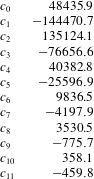
The resulting polynomial coefficients  $c_{k}$ given in table 1 are obtained in the framework of a linear least squared fitting procedure constrained by the conditions (2.4) and (2.5). The required dispersion coefficients
 $C_{4}=9.4960\times 10^{4}\;(\text{cm}^{-1}\times \unicode{xC5}^{4})$ and
 $C_{6}=1.2193\times 10^{5}~(\text{cm}^{-1}\times \unicode{xC5}^{6})$ are borrowed from Coxon & Hajigeorgiou (Reference Coxon and Hajigeorgiou2016).
The fitting polynomial coefficients  $c_{k}$ (in
 $\text{cm}^{-1}$) of the CPE potential (2.1) constructed for the ground state of the ArH+ cation. The left boundary of the expansion
 $r_{\text{min}}=0.5~\unicode{xC5}$, the reference distance
 $r_{\text{ref}}=1.6~\unicode{xC5}$ and the leading degree of the long-range expansion
 $n=4$ are the fixed parameters of the model. Equilibrium distance
 $r_{e}=1.2804~(\unicode{xC5})$. The parameter
 $\unicode[STIX]{x1D70E}=0.9147~(\unicode{xC5})$ is the distance between the particles at which the interaction potential is zero:
 $U(\unicode[STIX]{x1D70E})=0$.

3 Collision integrals and transport coefficients
In accordance with the Chapman–Enskog formalism (Chapman & Cowling Reference Chapman and Cowling1958) the transport properties of dilute gaseous media can be related to collision integrals taken in the reduced form (Hirschfelder, Curtiss & Bird Reference Hirschfelder, Curtiss and Bird1964)
 $$\begin{eqnarray}\unicode[STIX]{x1D70E}_{RS}^{2}\unicode[STIX]{x1D6FA}^{(l,s)\ast }(T)=-\frac{2(l+1)}{\unicode[STIX]{x03C0}[2l+1-(-1)^{l}](s+1)!}\int _{0}^{\infty }\text{e}^{-x}x^{s+1}Q^{(l)}(x)\,\text{d}x,\end{eqnarray}$$
where  $l$ and
 $s$ are integer numbers,
 $x\equiv E/k_{B}T$ is the reduced energy,
 $k_{B}$ is Boltzmann’s constant,
 $T$ is the temperature (K),
 $\unicode[STIX]{x1D70E}_{RS}$ is the rigid sphere cross-section and
 $E$ is the relative kinetic energy of collisions.
Under the classic approximation, the collision cross-section  $Q^{(l)}$ as a function of collision energy
 $E$ is determined as:
 $$\begin{eqnarray}Q^{(l)}(E)=2\unicode[STIX]{x03C0}\int _{0}^{\infty }(1-\cos ^{l}\unicode[STIX]{x1D712})b\,\text{d}b,\end{eqnarray}$$
where  $b$ is an impact parameter of collision and
 $\unicode[STIX]{x1D712}$ is the scattering angle,
 $$\begin{eqnarray}\unicode[STIX]{x1D712}(b,E)=\unicode[STIX]{x03C0}-2b\int _{r_{m}}^{\infty }\frac{\text{d}r}{r^{2}\sqrt{F(r,b,E)}}.\end{eqnarray}$$
Here,  $r_{m}$ is the root of the transcendental equation
 $$\begin{eqnarray}F(r,b,E)\equiv 1-\frac{b^{2}}{r^{2}}-\frac{U(r)}{E}=0,\end{eqnarray}$$
where  $U(r)$ is the rotationless effective internuclear potential. For a numerical calculation of the triple integrals above the FORTRAN computer program (O’Hara & Smith Reference O’Hara and Smith1971; Taylor Reference Taylor1979) has been used.
In the frame of Chapman–Enskog theory, it is also possible to estimate temperature-dependent transport coefficients for the colliding  $\text{H}^{+}-\text{Ar}$ system studied, such as the diffusion coefficient
 $D$ (in
 $\text{cm}^{2}~\text{s}^{-1}$), viscosity
 $\unicode[STIX]{x1D702}$ (
 $\text{g}~\text{cm}^{-1}~\text{s}^{-1}$) and thermal conductivity
 $\unicode[STIX]{x1D706}$ (
 $\text{cal}~\text{cm}^{-1}~\text{s}^{-1}~\text{K}^{-1}$)
 $$\begin{eqnarray}\displaystyle & \displaystyle D(T)\approx 2.628\times 10^{-3}\frac{\sqrt{0.5T^{3}\unicode[STIX]{x1D707}^{-1}}}{p\unicode[STIX]{x1D70E}^{2}\unicode[STIX]{x1D6FA}^{(1,1)\ast }}, & \displaystyle\end{eqnarray}$$
 $$\begin{eqnarray}\displaystyle & \displaystyle \unicode[STIX]{x1D702}(T)\approx 2.6693\times 10^{-5}\frac{\sqrt{2\unicode[STIX]{x1D707}T}}{\unicode[STIX]{x1D70E}^{2}\unicode[STIX]{x1D6FA}^{(2,2)\ast }}, & \displaystyle\end{eqnarray}$$
 $$\begin{eqnarray}\displaystyle & \displaystyle \unicode[STIX]{x1D706}(T)\approx 1.9891\times 10^{-4}\frac{\sqrt{0.5T\unicode[STIX]{x1D707}^{-1}}}{\unicode[STIX]{x1D70E}^{2}\unicode[STIX]{x1D6FA}^{(2,2)\ast }}, & \displaystyle\end{eqnarray}$$
where  $\unicode[STIX]{x1D707}=(m_{H}m_{Ar})/(m_{H}+m_{Ar})$ is the reduced molecular mass (in
 $\text{g}~\text{mol}^{-1}$),
 $p$ is the pressure (in atm) and
 $\unicode[STIX]{x1D70E}$ is the parameter of the interaction potential (in Å) (see table 1).
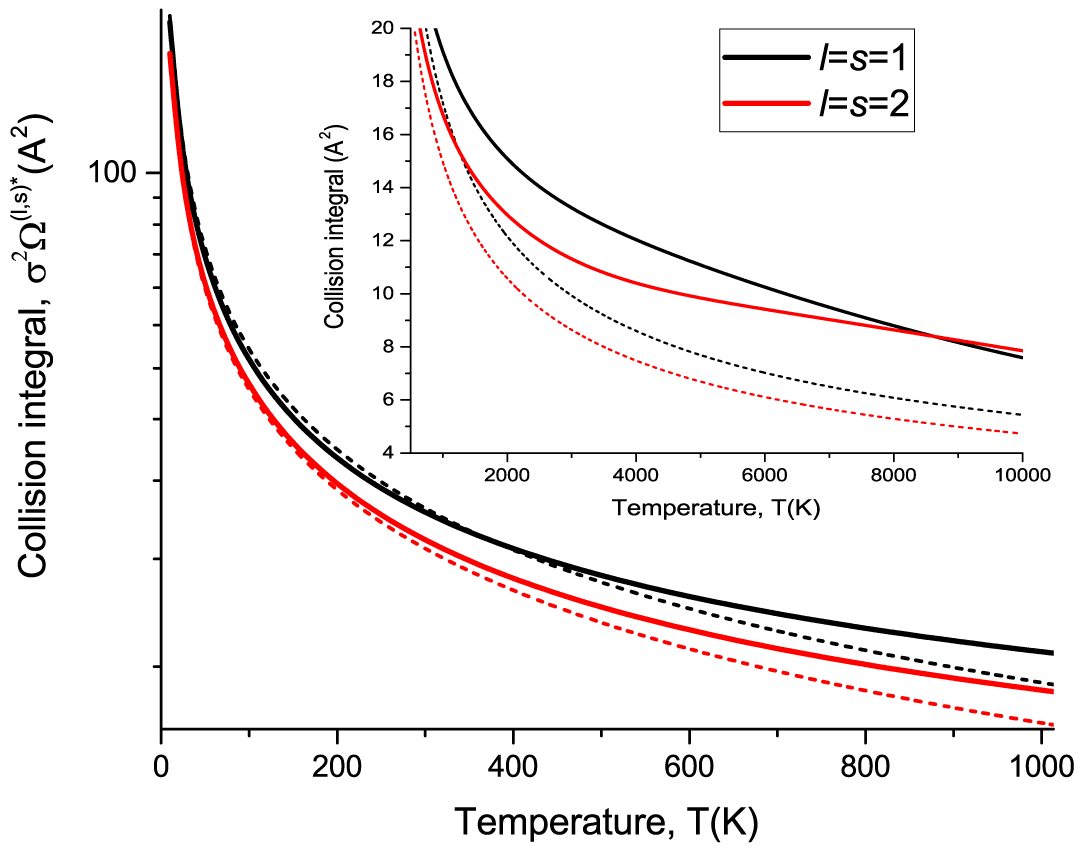
The collision integrals  $\unicode[STIX]{x1D70E}^{2}\unicode[STIX]{x1D6FA}^{(l,s)\ast }$ calculated under the classical approximation for the colliding
 $\text{H}^{+}-\text{Ar}$ system by means of the ab initio ground ArH+ state potential represented analytically in the entire range of internuclear distances (solid lines). The alternative results of the simplest polarization model are depicted by dashed lines.

The rate constant  $k_{c}$ (in
 $\text{cm}^{3}~\text{s}^{-1}$) characterizing the collision frequency of an Ar atom with a proton can be also estimated (Troe Reference Troe1979) using the
 $l=s=2$ collision integral
 $$\begin{eqnarray}k_{c}(T)\approx \sqrt{\frac{8k_{B}T}{\unicode[STIX]{x03C0}\unicode[STIX]{x1D707}}}[\unicode[STIX]{x03C0}\unicode[STIX]{x1D70E}^{2}\unicode[STIX]{x1D6FA}^{(2,2)\ast }].\end{eqnarray}$$
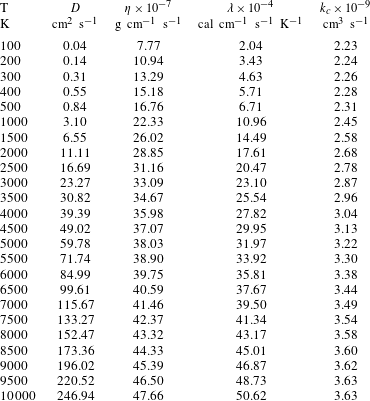
Diffusion coefficient ( $D$), viscosity (
 $\unicode[STIX]{x1D702}$), thermal conductivity (
 $\unicode[STIX]{x1D706}$) and collision rate constant (
 $k_{c}$) evaluated for the colliding
 $\text{H}^{+}-\text{Ar}$ system in the temperature range
 $T\in [100,10\,000]~(\text{K})$.

4 Results and discussion
The reduced collision integrals  $\unicode[STIX]{x1D70E}^{2}\unicode[STIX]{x1D6FA}^{(l,s)\ast }$ (in
 $\unicode{xC5}^{2}$) (Bruno et al. Reference Bruno, Catalfamo, Capitelli, Colonna, De Pascale, Diomede, Gorse, Laricchiuta, Longo and Giordano2010) were calculated for
 $l=1,2$ and
 $s=1,2$, parameters in the kinetic temperature range
 $T\in [100,10\,000]$ (in K) using the asymptotically corrected analytical CPE potential
 $U(R)$ constructed in § 2 for the ground state of the ArH+ molecular system. The resulting functions (for the cases of
 $l=s=1$ and
 $l=s=2$) are depicted on figure 1 while the corresponding transport coefficients and rate constant are given in table 2. It is easily seen that the collision integrals rapidly decrease as the temperature increases in the range of 100–1000 K, while further temperature increase leads to a smooth decrease of these functions. In contrast, the diffusion coefficient,
 $D$, rapidly (and approximately quadratically) increases as
 $T$ increases in the considered temperature range while both the viscosity,
 $\unicode[STIX]{x1D702}$, and thermal conductivity,
 $\unicode[STIX]{x1D706}$, functions demonstrate almost linear dependence on
 $T$. As should be expected for an ion–neutral reaction, the calculated rate constant
 $k_{c}$ is found to be a very smooth function of
 $T$. Indeed, for the lower and upper temperature limits considered here the corresponding
 $k_{c}(T)$-values are
 $2.23\times 10^{-9}$ and
 $3.63\times 10^{-9}$, respectively (see table 2).
The present results can be compared with their approximate counterparts obtained in the framework of a polarization model where the interacting potential  $U(r)$ is reduced to the single long-range term
 $$\begin{eqnarray}U(r)\simeq -\frac{C_{4}}{r^{4}}=-\frac{\unicode[STIX]{x1D6FC}_{Ar}}{2r^{4}}.\end{eqnarray}$$
Hereafter,  $\unicode[STIX]{x1D6FC}_{Ar}=1.642$ (
 $\unicode{xC5}^{3}$) is the static dipole polarizability of an argon atom in the
 $1S$ ground state (Soldan, Lee & Wright Reference Soldan, Lee and Wright2001). In this case, collision integrals (3.1) assume a closed form (Kihara, Taylor & Hirschfelder Reference Kihara, Taylor and Hirschfelder1960), for instance
 $$\begin{eqnarray}\displaystyle \unicode[STIX]{x1D70E}^{2}\unicode[STIX]{x1D6FA}^{(1,1)\ast }=424.443\sqrt{\frac{\unicode[STIX]{x1D6FC}_{Ar}}{T}},\quad \unicode[STIX]{x1D70E}^{2}\unicode[STIX]{x1D6FA}^{(2,2)\ast }=0.870\unicode[STIX]{x1D70E}^{2}\unicode[STIX]{x1D6FA}^{(1,1)\ast }. & & \displaystyle\end{eqnarray}$$
Figure 1 demonstrates that the collision integrals approximated by the polarization model are remarkably close to the present ab initio estimates, at least in the low-temperature region. Furthermore, the systematic differences observed in the higher temperature range should be attributed to impact of the particular short-range repulsive potential used.
It should be noted that insertion of the relations (4.2) in the equation (3.8) immediately leads to a temperature-independent rate constant  $k_{L}$ discovered for ion–neutral reactions by Langevin (Banks & Kockarts Reference Banks and Kockarts1973)
 $$\begin{eqnarray}\displaystyle k_{L}=2.34\times 10^{-9}\sqrt{\frac{\unicode[STIX]{x1D6FC}_{Ar}}{\unicode[STIX]{x1D707}}}. & & \displaystyle\end{eqnarray}$$
The rate constant for the reaction between a proton and an argon atom according to the Langevin theory is  $k_{L}=3.0\times 10^{-9}$, which agrees well with the
 $\overline{k_{c}}\approx 2.9\times 10^{-9}$ value (in
 $\text{cm}^{3}~\text{s}^{-1}$) obtained by averaging over temperature. It is interesting that the
 $k_{L}$-value for the alternative ion–neutral reaction
 $\text{H}+\text{Ar}^{+}$ is approximately
 $1.9\times 10^{-9}$ (
 $\text{cm}^{3}~\text{s}^{-1}$). Thus, the rate constants for the collision of Ar with a proton and of H with Ar+ are both comparable to rate constant of the reaction (1.1) of Ar with the molecular cation
 $\text{H}_{2}^{+}$. The rate constants for the formation of argonium in the two other reactions (1.2) and (1.3) are an order of magnitude less. As already mentioned, all ion–neutral reactions considered here are expected to have a weak dependence on
 $T$, and, hence, they should take place throughout the entire temperature range.
All numerical results obtained in the present work are available online https://doi.org/10.1017/S0022377820000112 in tabulated form and we believe that the supplementary material can be useful for the construction of a database of thermodynamic, transport and kinetic properties of the Ar/H2 plasma in a wide temperature range. The accuracy of the present ab initio estimates is limited only by the classical collision approximation used and, hence, the results should be reliable until very low temperature.
5 Conclusion remarks
The collision integrals  $\unicode[STIX]{x1D70E}^{2}\unicode[STIX]{x1D6FA}^{(l,s)\ast }$ for the interaction of an argon atom with a proton were evaluated under a classical approximation by means of the asymptotically correct analytical internuclear potential constructed for the ground
 $X^{1}\unicode[STIX]{x1D6F4}^{+}$ state of argonium. The relevant transport properties of the
 $\text{H}^{+}-\text{Ar}$ system, such as a diffusion coefficient, viscosity and thermal conductivity, were estimated in a wide temperature range
 $T\in [100,10\,000]~(\text{K})$. The rate constant
 $k_{c}(T)$ of the ion–neutral
 $\text{H}^{+}+\text{Ar}\rightarrow \text{ArH}^{+}$ reaction was calculated in the same temperature range. As expected, the present functions agree well with the results of the simplest polarization model at least in the low-temperature region. In particular, the
 $k_{c}(T)$ function has demonstrated only a slight distinction from its time-independent counterpart corresponding to a Langevin theory.
Acknowledgements
The work was supported by the Russian Foundation for Basic Research, grant no. 18-03-00726, 19-33-90131.
Supplementary materials
Supplementary materials are available at https://doi.org/10.1017/S0022377820000112.