Introduction
Borassus flabellifer L. or palmyrah palm, belonging to the family Arecaceae is a widely adapted, tropical dioecious palm distributed along the coastal belts of India, northern Sri Lanka, Southeast Asia and eastern Indonesia (Davis and Johnson, Reference Davis and Johnson1987). The term Borassus is derived from a Greek word ‘Borassos’ meaning ‘the membrane surrounding the date palm’ (Quattrocchi, Reference Quattrocchi2012) and ‘flabellifer’ from the Latin word ‘flabellatus’ meaning ‘fan-bearer’. It can live more than 100 years reaching a height of 30 m (Gummadi et al., Reference Gummadi, Battu GR and Manda2016). It is a robust tree of significant economic importance with almost all parts of the tree having multifaceted uses. Due to its multifarious uses, it is often quoted as wish-fulfilling tree (‘Karpaha’ in Tamil), or ‘celestial tree’ (Sandhya et al., Reference Sandhya, Sudhakar, Banji and Rao2010; Jana and Jana, Reference Jana and Jana2017; Jerry, Reference Jerry2018). It is declared as the national tree of Cambodia, state tree of Tamil Nadu, India (Sankaralingam et al., Reference Sankaralingam, Hemalatha and Ali1999) and is an iconic symbol of the Palakkad district of Kerala, India. The tree is also seen growing around the premises of the famous AngkorWat temple in Cambodia. It is considered as an underutilized palm in Asia and Africa with characteristic pest and disease resistance, requiring very low or limited agronomic input (Kandiah and Mahendran, Reference Kandiah and Mahendran1986).
Distribution and habitat
The natural occurrence of palmyrah palm is reported from Asian (India, Pakistan, Bangladesh, Sri Lanka, Malaysia, Thailand, Myanmar and Indonesia) and African countries (Nigeria, Congo, Sudan and Tanzania) (Sankaralingam et al., Reference Sankaralingam, Hemalatha and Ali1999). In India, this palm is disseminated across all agroecological regions (coastal belt, agricultural margins, waste lands and secondary forests) but mainly concentrated in Tamil Nadu, Andhra Pradesh, Kerala, Karnataka, Maharashtra, Madhya Pradesh and Chhattisgarh (Bhaskar, Reference Bhaskar2017). It is drought tolerant (Ponnuswami et al., Reference Ponnuswami, Jagadeesan, Kumar, Prabhu and Makesh2008) in nature due to high chlorophyll stability index and relative water content (Arulraj and Jerard, Reference Arulraj, Jerard and Peter2008).
India harbour nearly 102 million palmyrah palms and half of the trees are found in Tamil Nadu (Ponnuswami et al., Reference Ponnuswami, Jagadeesan, Kumar, Prabhu and Makesh2008). In Tamil Nadu, the trees are concentrated in the southern districts of Thoothukudi (~10 million trees), Tirunelveli, Virudhunagar and Ramanathapuram (Ponnuswami et al., Reference Ponnuswami, Jagadeesan, Kumar, Prabhu and Makesh2008). It is a well-adapted palm species that can grow in arid zones (marginal rainfall of 500–900 mm), high altitudes (about 800 m above sea level) and could withstand extreme temperatures (0–45°C) (Arulraj and Jerard, Reference Arulraj, Jerard and Peter2008).
Dioecy in palmyrah
Palmyrah is a slow-growing perennial dioecious palm. The plant has a long juvenile stage and it takes 12–15 years to attain sexual maturity and start flowering (George et al., Reference George, Venkataramana, Karun and Rajesh2008). Hence, farmers are hesitated in planting this multipurpose tree. Moreover, both male and female trees exhibit considerable variations in terms of yield and quality. Female palms yield more toddy on tapping (Davis and Johnson, Reference Davis and Johnson1987) and give better and hard timber than the male trees (Kalarani and Annathurai, Reference Kalarani and Annathurai1991). Even though, both male and female trees produce spikes of flowers, females only bear fruits. The female flowers appear in densely clustered spikes which further transforms into large, brown coloured, round fruits (Vengaiah et al., Reference Vengaiah, Murthy, Sattiraju and Maheswarappa2017). The male flowers are smaller than the female flowers. Though palmyrah palms are mostly dioecious, a high-yielding monoecious palmyrah palm has been identified in Undeswarapuram, Andhra Pradesh (George et al., Reference George, Venkataramana, Karun and Rajesh2008).
Pollination
Pollination in palmyrah palm takes place through insects (such as bees, wasps and beetles) and wind (Sankaralingam et al., Reference Sankaralingam, Hemalatha and Ali1999). It takes 120–130 d for the fertilized female flowers to mature and form ripened fruits (Sankaralingam et al., Reference Sankaralingam, Hemalatha and Ali1999) having a width of 15–25 cm, containing one–three seeds (Jana and Jana, Reference Jana and Jana2017). The pollination biology experiments conducted on five male and five female adult palms revealed maximum percentage of fruit set (100%) in flowers, pollinated 1 d after anthesis (Marichamy et al., Reference Marichamy, Nainar, Jasmine and Kumar2014). The maximum period of stigma receptivity (8.30 am–5.30 pm) resulted in a complete fruit set. Based on the appearance of exine of the pollen grains, two types of pollens viz., globular- and ellipsoidal-shaped were identified in the analysed genotypes.
Multipurpose tree
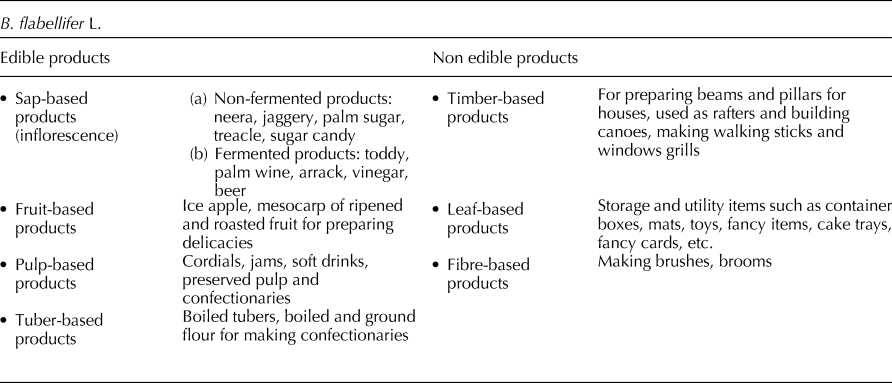
Palmyrah is a multipurpose tree and is often stated as ‘tree with 800 uses’ with wide applications in food, beverage and fibre industries (Arulraj and Jerard, Reference Arulraj, Jerard and Peter2008). Every part of the tree has one or more uses. Palmyrah palm is a source of many raw materials for household articles, thereby generating source for income and employment. They also serve to meet daily consumption needs of the local people (Chandrasiri, Reference Chandrasiri1997). The main product is the sweet sap (neera), obtained from tapping the inflorescences. Neera is usually consumed as such or processed further into value-added natural products such as palm sugar and jaggery (unfermented) and toddy (the fermented product). Fermentation of fresh sap initially turns into palm wine and further into vinegar (Saidi et al., Reference Saidi, Efendi, Azara and Hudi2018).
Other wide array of nutritive and value-added products made from palmyrah include treacle (highly concentrated palm sap), flour (crushed and powdered young shoot), vinegar (fermented product), palm toffee, palm cola (aerated soft drink), palm pickle, etc. (Mani et al., Reference Mani, Krishna and Dutta2018). The mesocarp of the ripened fruits and the fleshy cotyledon of germinating nuts are other edible products obtained from palmyrah. The major uses of each part of the tree (Table 1) are described below.
Commercial products prepared from different parts of B. flabellifer

Trunk
Depending on the size, texture and condition, the trunk of the palmyrah tree is used as wood (Bhaskar, Reference Bhaskar2017) for construction and furniture purposes. It is strong, cylindrical and black in colour growing to a height of 25–30 m with a trunk diameter of approximately 1 m (Davis and Johnson, Reference Davis and Johnson1987). The black timber is hard, heavy and durable making it an ideal raw material for constructing wharf pilings as pillars, beams and rafters (Kalarani and Annathurai, Reference Kalarani and Annathurai1991). The wood is used for making walking sticks and windows grills (Bhaskar, Reference Bhaskar2017). The palm heart or palm cabbage (tender growing point of the tree) is sweet and edible (Davis and Johnson, Reference Davis and Johnson1987). In Cambodia, the trunks are also used to build canoes (Jana and Jana, Reference Jana and Jana2017). They are planted to delimit fields in Cambodia and Myanmar (Flach and Paisooksantivatana, Reference Flach, Paisooksantivatana, Flach and Rumawas1996). The mature trunks of the Palmyrah palm are used as water pipes and troughs in traditional irrigation systems in Kerala (Palakkad district) (Ramachandran et al., Reference Ramachandran, Swarupanandan and Renuka2004).
Inflorescence
The sweet nutritious sap tapped from the inflorescence of palmyrah palm (neera) is used as drinks in India (especially in Kerala and Tamil Nadu states), since time immemorial. Neera is nutritionally rich and contains minerals such as iron, calcium and phosphorus, and vitamins such as thiamine, riboflavin, nicotinic acid, methyl nicotinamide and ascorbic acid (Chaurasiya et al., Reference Chaurasiya, Chakraborty and Saha2014). The drink holds high nutrient value (Bhaskar, Reference Bhaskar2017), due to its ability to reduce body heat or high temperature (Vengaiah et al., Reference Vengaiah, Ravindrababu, Murthy and Prasad2013). The tree sap is endowed with laxative and cooling properties (George et al., Reference George, Venkataramana, Karun and Rajesh2008) and is helpful in controlling gastric troubles and ulcers (Jerry, Reference Jerry2018). It is also used as a sweetener for diabetic patients (Yoshikawa et al., Reference Yoshikawa, Xu, Morikawa, Pongpiriyadacha, Nakamura, Asao, Kumahara and Matsuda2007).
The jaggery prepared from palmyrah (containing 65–85% sucrose and 5–15% reducing sugars) is used for preparing sweet confectionary items and is used in ayurvedic or traditional medicines (Vengaiah et al., Reference Vengaiah, Ravindrababu, Murthy and Prasad2013). Moreover, the characteristic flavour and aroma of the palm sugar make it a special flavouring and sweetening agent in a variety of Indian sweet and savoury dishes.
Fruit
Apart from toddy and neera, fruits are the next source for income generation from the palmyrah trees. The fruits are large and fibrous which enclose seeds. A single tree normally yields 50–300 fruits (average diameter of 4–8 in.) (Bhaskar, Reference Bhaskar2017) with brown to black coloured or red coloured epicarp (Kurian and Peter, Reference Kurian, Peter and Peter2007). Four types of fruits (one, two, three and four-seeded) are observed in palmyrah palms (George and Karun, Reference George and Karun2011). In normal cases, a single fruit enclose one to three jelly sockets whereas in rare cases a maximum of up to five sockets was also reported (Bhaskar, Reference Bhaskar2017). The sockets of young fruits contain the kernel which is soft as jelly and translucent-like ice with a sweet watery liquid (ice apple) (Ponnuswami, Reference Ponnuswami2016) and is also known as ‘Nungu’ in Tamil (George et al., Reference George, Venkataramana, Karun and Rajesh2008; Ponnuswami, Reference Ponnuswami2016).
The mesocarp of the ripened fruits are sweet, rich in carotenoids and are used for the preparation of jelly, cordials, ice cream, cakes, jams, beverages and toffee (Ariyasena et al., Reference Ariyasena, Jansz and Abeysekera2001; Chakraborty et al., Reference Chakraborty, Chaurasiya and Saha2011). The germinated nuts (palmyrah sprouts) with enlarged fleshy embryos are cooked and consumed as vegetables (Kommu et al., Reference Kommu, Chilukaa, Shankar, Matsyagiri, Shankar and Sandhya2011).
Leaf
Palmyrah tree leaves have great ecological, economic, social and cultural importance since time immemorial (Bhaskar, Reference Bhaskar2017). The leaves are used for thatching houses and fencing. In ancient days, palm leaves were processed and used for writing manuscripts (palm-leaf manuscript) and historical records (Kumar et al., Reference Kumar, Sreekumar and Athvankar2009; Jana and Jana, Reference Jana and Jana2017). The matured palm leaves are generally used for making daily household items such as mats, hats, baskets, fans, umbrellas, brushes, sandals, playing kits, etc. (Bhaskar, Reference Bhaskar2017). Petioles are often used as poles for fencing or as firewood and can be split into fibres for weaving and matting. The natural fibre obtained from the leaves serves as a basic raw material for making strings, straps and ropes (Kora, Reference Kora2019). The dried leaves after using for thatching and fencing is used as organic manure (Srivastava et al., Reference Srivastava, Bishnoi and Sarkar2017) for reclaiming soil fertility.
Medicinal value and uses
Palmyrah has great medicinal value as various parts of the tree are endowed with a broad spectrum of antimicrobial, antioxidant, diuretic, wound healing, immunomodulatory and antimalarial properties (Jamkhande et al., Reference Jamkhande, Suryawanshi, Kaylankar and Patwekar2016). Borassosides and dioscin (spirostane-type steroid saponins) are found in male inflorescences (Yoshikawa et al., Reference Yoshikawa, Xu, Morikawa, Pongpiriyadacha, Nakamura, Asao, Kumahara and Matsuda2007; Sandhya et al., Reference Sandhya, Sudhakar, Banji and Rao2010). The male inflorescence also shows significant anti-inflammatory activity. B. flabellifer contains gums, albuminoids, fats with high concentrations of vitamins A and C (Nadkarni, Reference Nadkarni2002; Jamkhande et al., Reference Jamkhande, Suryawanshi, Kaylankar and Patwekar2016). The seeds are used in the Siddha system of medicine for treating cough and pulmonary affections (Ram et al., Reference Ram, Joseph, Balachandar and Singh2009). The ash of dry spadix has antacid and antibilious properties (Khare, Reference Khare and Khare2007).
It is also used for the treatment of dysentery and gonorrhoea (Jamkhande et al., Reference Jamkhande, Suryawanshi, Kaylankar and Patwekar2016). The low glycemic index of the palm sugar also helps in reducing obesity and diabetes (Jerry, Reference Jerry2018). It also serves as a healthy and excellent substitute for artificial sugar and is used in herbal and ayurvedic medicines. The ash of the spadix is used for relieving acidity, heartburn, enlarged spleen and bilious fever (Mohan et al., Reference Mohan, Soundarya, Kumar, Kumar, Sharathnath and Narender2016). The fresh sap is also reported to have cooling, antiphlegmatic, diuretic, laxative and anti-inflammatory properties (Khare, Reference Khare and Khare2007; Jerry, Reference Jerry2018). It is used as a supplement to combat iron and vitamin deficiency, aids in improving appetite and digestion and acts as a good tonic to asthmatic, anaemic and leprosy patients (Vengaiah et al., Reference Vengaiah, Murthy, Sattiraju and Maheswarappa2017).
Problems associated with palmyrah cultivation
Despite its multivariate utility, the major impediment faced by the palmyrah growers is mainly attributed to its prolonged juvenility, sexual dimorphism, stature of the tree and labour problems associated with tree climbing and tapping. The major constraints in establishing a productive plantation of palmyrah palm is mainly due to the following facts.
Slow growing nature and long juvenile phase
Palmyrah is a slow-growing tree that takes 12–15 years (Kovoor, Reference Kovoor1983; George et al., Reference George, Karun, Manimekalai, Rajesh and Remya2007; Raju and Reji, Reference Raju and Reji2015) to 20 years (Pipatchartlearnwong et al., Reference Pipatchartlearnwong, Swatdipong and Vuttipongchaikij2017b) for attaining sexual maturity and initiate flowering. Thus, establishment of a proper revenue generating palmyrah plantation thus takes a long time.
Dioecious nature and associated problems in sex determination
Palmyrah palms are dioecious with separate male and female trees. A lack of a clear cut morphological character or identification of a specific molecular marker tightly associated with sex is not reported in palmyrah. Early identification of sex of the palm at the seedling stage would aid in the breeding and crop improvement of palmyrah palm (Ponnuswami et al., Reference Ponnuswami, Jagadeesan, Kumar, Prabhu and Makesh2008; Vinayagam et al., Reference Vinayagam, Dhandapani and Raman2009) and planting more female trees while establishing plantations.
The stature of the tree and labour associated problems
The hardy, irregular and tall growth habit of the trunk and climbing two times a day to tap and collect the sap makes tree climbing a risky job (Ponnuswami et al., Reference Ponnuswami, Jagadeesan, Kumar, Prabhu and Makesh2008; Vinayagam et al., Reference Vinayagam, Dhandapani and Raman2009; Ponnuswami, Reference Ponnuswami2010). This risky nature associated with tree climbing resulted in the gradual decline in the number of tree climbers (Ponnuswami et al., Reference Ponnuswami, Jagadeesan, Kumar, Prabhu and Makesh2008; Vinayagam et al., Reference Vinayagam, Dhandapani and Raman2009) as they moved to other less risky jobs. Moreover, the limited number and increased daily wages of skilled climbers also posed serious threat to tapping activities in palmyrah plantations.
Genetic diversity of palmyrah palms as assessed by molecular and morphological markers
Understanding the genetic diversity existing in palmyrah populations is essential for the efficient management of germplasm in a breeding programme and also for crop improvement activities. In India, palmyrah germplasm collections are being maintained at Agricultural College and Research Institute (AC&RI), Killikulam of Tamil Nadu Agricultural University (TNAU) (Tamil Nadu) and Horticultural Research Station (HRS) of Dr YSR Horticultural University, Pandirimamidi (Andhra Pradesh), Central Plantation Crops Research Institute (CPCRI), Kasargod (Kerala) (George et al., Reference George, Venkataramana, Nainar, Rajesh and Karun2016). To date, the genetic diversity analysis of palmyrah genotypes was carried out using morphological, dominant [random-amplified polymorphic DNA (RAPD), inter-simple sequence repeat (ISSR) or a combination of both] and co-dominant [expressed sequence tag-derived SSR (EST-SSR) and genomic SSR (gSSR)] molecular markers.
Random-amplified polymorphic DNA (RAPD) and inter-simple sequence repeat (ISSR) markers
Ponnuswami et al. (Reference Ponnuswami, Jagadeesan, Kumar, Prabhu and Makesh2008) analysed the genetic relationship and diversity of 20 palmyrah accessions collected from field gene bank at AC&RI, Killikulam using eight RAPD markers. Cluster analysis revealed that these markers were successful in differentiating the entire accessions based on sex (male and female), stature (tall and dwarf) and yield (high yielding).
Ten polymorphic RAPD markers were employed for estimating the genetic relationship of 96 palmyrah palms, consisting of 24 indigenous accessions from Tamil Nadu and Andhra Pradesh (George et al., Reference George, Venkataramana, Nainar, Rajesh and Karun2016). UPGMA (unweighted pair group method with arithmetic mean) grouped all the accessions into two major clusters with a similarity value (ranging from 0.96 to 0.782), indicating the existence of narrow genetic diversity within the analysed populations. The authors also claimed that collecting accessions from different agroecological regions would help in increasing the genetic diversity for future conservation efforts in palmyrah.
Molecular profiling and cluster analysis of 20 palmyrah accessions (collected from the field gene bank at AC&RI, Killikulam using 21 ISSR markers grouped the accessions into two major clusters (Vinayagam et al., Reference Vinayagam, Dhandapani and Raman2009). UPGMA-based cluster analysis further resolved the entire accessions into four different clusters based on stature, sex and high neera yielding types. PCA (principal component analysis) based on ISSR data revealed a grouping pattern similar to the results of cluster analysis. This study also revealed the existence of more genetic variation among tall accessions than dwarf accessions.
Ponnuswami (Reference Ponnuswami2010) utilized eight RAPD and 21 ISSR markers for estimating the genetic variation existing in 20 palmyrah accessions collected from AC&RI, Killikulam. UPGMA cluster analysis based on RAPD markers grouped the entire accessions into four different clusters based on morphological and yield related traits (stature, sex and high neera yielding types). The distance similarity values among the accessions ranged from 71.6 to 95.7%. However, cluster analysis and PCA based on ISSR data grouped the entire accessions into two major clusters based on morphological similarities (sex and stature). This study revealed the moderate efficiency of RAPD and ISSR markers in distinguishing palmyrah accessions.
Estimation of genetic diversity of 16 palmyrah accessions from Tamil Nadu using 15 RAPD markers revealed the existence of high-genetic variability among male and female trees (Raju and Reji, Reference Raju and Reji2015). UPGMA cluster analysis based on Jaccard's similarity coefficient grouped the accessions separately into two major clusters. The study also indicated the existence of moderately high-genetic diversity among the analysed palmyrah populations.
Simple sequence repeat (SSR) markers
Pipatchartlearnwong et al. (Reference Pipatchartlearnwong, Swatdipong, Vuttipongchaikij and Apisitwanich2017a) analysed the cross-genera transferability of molecular markers (gSSR and EST-SSRs) derived from oil palm for estimating the diversity of Thailand palmyrah palm populations. Out of the 545 EST-SSR and gSSR markers used in the study, 317 were amplifiable of which only 19 pairs were polymorphic. Cluster analysis based on the genotype data of 164 samples from 12 palmyrah populations using 19 SSR markers separated the entire palm populations into two clades viz., north-eastern and southern central regions, based on the place of collection.
Pipatchartlearnwong et al. (Reference Pipatchartlearnwong, Swatdipong and Vuttipongchaikij2017b) utilized 17 EST-SSR and 12 gSSR markers for estimating the genetic diversity of 230 B. flabellifer accessions from Thailand. Cluster analysis showed clear separation of accessions into two different clusters with cluster I accommodating accessions from southern Thailand and cluster II containing accessions from the northeastern region. The central region contained a mixed population of both the regions with a minimum number of founders ranging from three to four individuals per group.
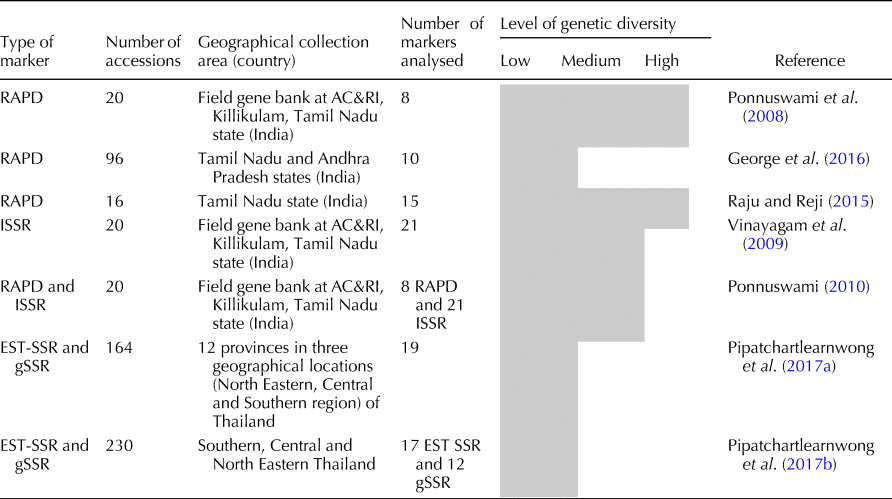
The genetic diversity analysis of Borassus samples reported from India (Ponnuswami et al., Reference Ponnuswami, Jagadeesan, Kumar, Prabhu and Makesh2008; Vinayagam et al., Reference Vinayagam, Dhandapani and Raman2009; Ponnuswami, Reference Ponnuswami2010; Raju and Reji, Reference Raju and Reji2015; George et al., Reference George, Venkataramana, Nainar, Rajesh and Karun2016) and Thailand (Pipatchartlearnwong et al., Reference Pipatchartlearnwong, Swatdipong, Vuttipongchaikij and Apisitwanich2017a, Reference Pipatchartlearnwong, Swatdipong and Vuttipongchaikijb) differed in the types of molecular markers used for the analysis. Dominant markers (RAPD, ISSR or their combinations) were used for characterizing Indian accessions, whereas co-dominant markers (EST-SSR and gSSR markers) were employed for characterizing populations from Thailand. Hence, low to high level of genetic diversity (Table 2) detected in palmyrah genotypes is attributed to the variation in the number of samples analysed, number and type of molecular markers used, sampling locations covered in the study and the geographical distance represented in respective samples. The low level of genetic diversity also holds special significance owing to the dioecious and cross pollination nature of palmyrah. Most of the reports are based on germplasm collections maintained at palmyrah research centres (George et al., Reference George, Venkataramana, Nainar, Rajesh and Karun2016) and or even on limited to similar set of germplasm collections (Ponnuswami et al., Reference Ponnuswami, Jagadeesan, Kumar, Prabhu and Makesh2008; Vinayagam et al., Reference Vinayagam, Dhandapani and Raman2009; Ponnuswami, Reference Ponnuswami2010). Hence, inclusion of more samples from broader geographical areas and subsequent analysis using multitude of molecular markers might help in understanding the pattern of gene flow and genetic structure within and between palmyrah populations. Such an approach might aid in the identification of elite genotypes and accelerate future conservation efforts in palmyrah.
Level of genetic diversity in B. flabellifer accessions as revealed by molecular marker analysis

Morphological and multivariate analysis
The genotypic variation and hierarchical clustering analysis of 48 elite genotypes (collected from different geographical locations of India) revealed significant differences in morphological, fruit and seed traits (Ponnuswami and Chitra, Reference Ponnuswami and Chitra2011a). Fruit weight showed highest variability followed by neera yield and tree height. Multivariate hierarchical cluster analysis revealed a clustering pattern based on their degree of similarity in morphological, fruit, seed and pooled traits.
The analysis of fruit characters of 129 genotypes collected from diverse regions of India (Ponnuswami and Chitra, Reference Ponnuswami and Chitra2011b) revealed the existence of high variability for fruit weight and weight of shreds and moderate level of variability for the weight of seeds. Other fruit characters (fruit length, fruit diameter, length of seed, circumference of seed and weight of flesh) exhibited low level of variability. The significant and positive correlation observed for eight fruit characters (fruit weight, fruit length, fruit diameter, weight of seed, length of seed, the circumference of the seed, the weight of flesh and weight of shreds) revealed the possibility of exploiting simultaneous selection for all these traits in palmyrah. The study also concluded that all other characters except for seed weight were also found to be appropriate for further crop improvement in palmyrah through selection.
Investigations on the morphological (tree characteristics and leaf characteristics) and yield traits of 22 palmyrah genotypes collected from different locations of Bihar showed high degree of variability in plant height and yield parameters (Kumari et al., Reference Kumari, Rani, Sengupta, Aftab, Kumari and Aman2020). The height of the palms ranged from 7.10 to 22.50 m with an average value of 15.22 m. The values for trunk girth ranged from 137 to 180 cm with the number of bunches varied from 7 to 34 bunches/tree. Wide variation in fruit yield was observed and it ranged from 84 to 480 fruits/tree. Palmyrah samples collected from Bhagalpur district and its neighbouring areas showed great variation in tree morphology and yield potential.
Molecular markers for early sex determination in palmyrah
To date, there have been only two published reports (George et al., Reference George, Karun, Manimekalai, Rajesh and Remya2007; Pipatchartlearnwong et al., Reference Pipatchartlearnwong, Juntawong, Wonnapinij, Apisitwanich and Vuttipongchaikij2019) describing attempts made on the identification and development of gender-specific molecular markers in palmyrah. Though these studies could identify sex-specific amplicons in palmyrah, the possibility of converting it to a robust, co-dominant and reproducible marker for the precise identification of sex, when screened in a diverse array of male and female trees was not materialized.
With an objective to identify sex-specific bands in palmyrah, George et al. (Reference George, Karun, Manimekalai, Rajesh and Remya2007) analysed a set of 60 samples (30 male and 30 female) from South Indian states (Kerala, Karnataka and Tamil Nadu) of India with a representation of 10 samples per state for bulk segregant analysis. Screening of male and female bulk samples using 180 RAPD primers resulted in the identification of three markers (OPBE12, OPBA13 and OPA06) generating sex-specific bands in sex-pooled samples. Among these, the RAPD primer (OPA06) produced a male-specific amplicon (600 bp). The specificity of RAPD marker (OPA06600) was further confirmed by screening the marker in entire DNA samples (both male and female trees).
The identified male-specific RAPD marker (OPA06600) was employed for screening one monoecious palm and its seven progenies, staminate and pistillate palms (George et al., Reference George, Venkataramana, Karun and Rajesh2008). The analysis resulted in the identification of one progeny as possibly female and the rest as either monoecious or males.
George and Karun (Reference George and Karun2011) further utilized the early sex determination capabilities of the male-specific RAPD marker (OPA06600; George et al., Reference George, Karun, Manimekalai, Rajesh and Remya2007) for determining the seed sex ratio of fruits bearing a variable number of seeds (one-, two- and three-seeded fruits). The male to female (M:F) ratio of the seedlings ranged from 57:43 (one seeded), 35:65 (two seeded) and 61:39 (three seeded) with no correlation between the number of seeds in fruit and sex of the seedlings raised from them. The overall ratio of M:F was 52:48, almost similar to the 1:1 ratio. A female-biased sex ratio (M:F) in two-seeded fruits (35:65) was also identified in the study.
Pipatchartlearnwong et al. (Reference Pipatchartlearnwong, Juntawong, Wonnapinij, Apisitwanich and Vuttipongchaikij2019) utilized a wide array of molecular techniques (polymerase chain reaction-based DNA fingerprinting, suppression subtractive hybridization (SSH) and transcriptome sequencing) for developing sex-specific markers in palmyrah. The DNA-fingerprinting techniques [RAPD, amplified fragment length polymorphism, intron length polymorphism, SCoT (start codon targeted polymorphism), modified SCoT and SSR] encompassing 1204 primer pairs were used for profiling males and females trees. Although, extensive cloning and screening of SSH libraries and de novo transcriptome sequencing of male and female cDNA identified sex-specific and differential-expressed transcripts, it could not yield a robust sex-linked marker. The complexity in identifying sex-linked markers employing different strategies suggested utilizing genomic-based approaches for future attempts aimed at developing sex-specific markers in palmyrah palm.
Released varieties
Two varieties (black and red skinned) of palmyrah palms were identified in Sri Lanka based on the fruit skin pigmentation (Ponnuswami, Reference Ponnuswami2016). Black-skinned fruits have comparatively less red pigment on their skin. Red-skinned variety yields more number of fruits and nut numbers per tree and are rich in amino acids, alkaloids and minerals.
So far, there has been only one improved variety of palmyrah (SVPR 1) reported from the Palmyrah Research Station, Srivilliputhur (TNAU) (Sankaralingam et al., Reference Sankaralingam, Hemalatha and Ali1999; Ponnuswami, Reference Ponnuswami2016). The female palm yields 140–150 fruits annually and 298 litres of neera (in a tapping duration of 90–97 d) (Sankaralingam et al., Reference Sankaralingam, Hemalatha and Ali1999; Pareek and Sharma, Reference Pareek and Sharma2017).
Research gaps and future prospects
Loss of habitat is one of the major reasons for the decline in the number of palmyrah trees. This is mainly due to the tendency of farmers to cut down trees in their farm lands for expanding their agricultural areas and construction activities (Bhaskar, Reference Bhaskar2017). The tall stature of the tree along with the availability of the limited number of skilled tree climbers has also led to this drastic situation. Exploration of more palm-growing areas for the identification of high-yielding dwarf palms along with mechanization in tapping and harvesting of fruits might help in preventing the intentional destruction of palmyrah trees from agricultural lands. The existence of low-genetic diversity in Indian palmyrah genotypes also pointed out the necessity for collecting and characterizing accessions from broader agrogeological locations (George et al., Reference George, Venkataramana, Nainar, Rajesh and Karun2016) for adopting proper management and conservation strategies in palmyrah. Other major research areas that require significant scientific attention include the development of sex-specific markers and high post-harvest quality measures. Hence, integrated research activities focusing on genomics, transcriptomics and molecular breeding approaches (for early sex detection, identification of dwarf, high neera yielding and early fruiting varieties) are recommended for future research activities aiming at the crop improvement of palmyrah.
Acknowledgements
The authors gratefully acknowledge the Council of Scientific & Industrial Research (CSIR), New Delhi, for providing Research Associateship (CSIR-RA) to S. Siju [Grant No. 09/592(0028) 2K18-EMR1].