Introduction
Aflatoxins are toxic metabolites of Aspergillus that can occur in animal feed and human food (Akinmusire et al., Reference Akinmusire, El-Yuguda, Musa, Oyedele, Sulyok, Somorin, Ezekiel and Krska2019; Guerre, Reference Guerre2016; Morrison et al., Reference Morrison, Ledoux, Chester and Samuels2017). More than 20 aflatoxins have been identified: aflatoxin B1, B2, G1, G2, and M1 are class 1 carcinogens according to the Agency of International Research on Cancer (Marchese et al., Reference Marchese, Polo, Ariano, Velotto, Costantini and Severino2018). Among these five toxins, aflatoxin B1 (AfB1) is the most prevalent and toxic, and is the biosynthetic precursor of the other aflatoxins (Rejeb et al., Reference Rejeb, Antonissen, De Boevre, Detavernier, Van de Velde, De Saeger, Ducatelle, Hadj Ayed and Ghorbal2019; Sadia et al., Reference Sadia, Jabbar, Deng, Hussain, Riffat, Naveed and Arif2012). Many physical, chemical, and biological measures have been proposed and studied for aflatoxin detoxification; adding clay minerals into animal feed is recognized as one of the most practical approaches for aflatoxin control. The detoxification is achieved via adsorption of aflatoxin by argillaceous clays (Huwing et al., Reference Huwing, Freimurd, Kappeli and Dulter2001; Kang et al., Reference Kang, Ge, Hu, Goikavi, Waigi, Gao and Ling2016; Pasha et al., Reference Pasha, Farooq, Khattak, Jabbar and Khan2007; Wang et al., Reference Wang, Miao, Sun and Zheng2018). Multiple adsorption experiments have indicated that smectites show significant adsorption capacity for aflatoxin and can adsorb up to 20% aflatoxin by mass (Deng et al., Reference Deng, Liu, Velazquez and Dixon2012).
Aflatoxin is adsorbed at hydrophobic sites in the interlayer of smectite through ion-dipole interaction and H bonding (Barrientos-Velazquez et al., Reference Barrientos-Velazquez, Cardona, Liu, Phillips and Deng2016b; Deng et al., Reference Deng, Velazquez, Billes and Dixon2010). Natural smectites are effective binders for aflatoxin in aqueous solutions but have limitations in the in situ gut environment due to interference and competition of biomolecules. A large mismatch between laboratory-measured adsorption capacity and the control have been reported through feeding trials (Barrientos-Velázquez et al., Reference Barrientos-Velázquez, Arteaga, Dixon and Deng2016a; Jaynes et al., Reference Jaynes, Zartman and Hudnall2007). Full recovery from aflatoxicosis has not been achieved in animal-feeding trials (Barrientos-Velazquez & Deng, Reference Barrientos-Velazquez and Deng2020). The underperformance of smectites in feeding trials is attributed partially to the complex compositions of the gastrointestinal fluids (Barrientos-Velazquez & Deng, Reference Barrientos-Velazquez and Deng2020). The gut contains numerous biomolecules including proteins and vitamins with variable pH at different tract locations. Protein molecules can access the interlayer space of smectite and block the reaction sites for aflatoxin adsorption (Barrientos-Velázquez et al., Reference Barrientos-Velázquez, Arteaga, Dixon and Deng2016a). Pepsin is considered as the major competitor of AfB1 for adsorption as it can replace the exchange cations and block hydrophobic sites in the interlayer (Barrientos-Velázquez et al., Reference Barrientos-Velázquez, Arteaga, Dixon and Deng2016a). To enhance smectite effectiveness in in situ gut conditions, the selectivity of smectites for AfB1 needs to be improved. The general goal of the present study was to enhance the AfB1 adsorption and selectivity of smectites in complex gastrointestinal fluid via structural or surface modifications.
Many clay-modification methods have been developed to enhance their effectiveness as catalysts or as adsorbents (Daković et al., Reference Daković, Kragović, Rottinghaus, Sekulić, Milićević, Milonjić and Zarić2010; Marković et al., Reference Marković, Daković, Rottinghaus, Kragović, Petković, Krajišnik, Milić, Mercurio and de Gennaro2017; Rejeb et al., Reference Rejeb, Antonissen, De Boevre, Detavernier, Van de Velde, De Saeger, Ducatelle, Hadj Ayed and Ghorbal2019). Acid activation, specific cation saturation, intercalation of large organic molecules, and pillaring are examples of these modifications (Huang et al., Reference Huang, Zhang and Zhu2013). Pillaring in smectite increases its basal spacing and surface area and induces molecular sieve-like properties (Kloprogge et al., Reference Kloprogge, Duong and Frost2005; Marković et al., Reference Marković, Daković, Rottinghaus, Kragović, Petković, Krajišnik, Milić, Mercurio and de Gennaro2017; Tomul & Balci, Reference Tomul and Balci2008). Pillared smectite with metal polycations were reported to increase adsorption of aflatoxin in water (Zeng et al., Reference Zeng, Wang, Peng, Geng, Chen and Li2013) but the selectivity of the pillared clays for AfB1 in gut fluid has not been evaluated; whether heating the pillared clays can further enhance their efficiency in binding aflatoxins is also unknown.
Cation-exchange capacity, layer-charge density, and the types of cations at exchange sites have significant effects on the ability of smectite to adsorb AfB1 (Deng et al., Reference Deng, Liu, Velazquez and Dixon2012; Gan et al., Reference Gan, Hang, Huang and Deng2019). Exchange cations in smectite play a determinative role in its adsorption ability for AfB1 (Daković et al., Reference Daković, Matijašević, Rottinghaus, Ledoux, Butkeraitis and Sekulić2008; Tong et al., Reference Tong, Yulong, Peng and Zirong2005). Divalent cations, namely Ca, Mg, and Ba, exhibit greater affinity for and adsorption of aflatoxin compared to the monovalent cations K, Na, and Li (Deng et al., Reference Deng, Liu, Barrientos Velázquez, Szczerba and Dixon2014). Heating the clays after exchange of various cations alters the structure as some cations can migrate into the octahedral sites of the 2:1 layers (Nones et al., Reference Nones, Nones, Riella, Poli, Trentin and Kuhnen2015; Toor et al., Reference Toor, Jin, Dai and Vimonses2015; Zivica & Palou, Reference Zivica and Palou2015). The heat treatments led to variation in charge density, surface area, interlayer water, and pore volume (Gan et al., Reference Gan, Hang, Huang and Deng2019; Heller-Kallai, Reference Heller-Kallai2013; Noyan et al., Reference Noyan, Önal and Sarkaya2007) in smectites and, correspondingly, their aflatoxin adsorption (Nones et al., Reference Nones, Nones, Riella, Poli, Trentin and Kuhnen2015, Reference Nones, Nones, Poli, Trentin, Riella and Kuhnen2016). How heating smectite affects its adsorption of AfB1 in the presence of other biological compounds is unclear.
The specific objectives of the current study were: (1) to evaluate the stability of smectite after pillaring and cation saturation with and without heating; and (2) to evaluate the effectiveness of the modified smectites in improving AfB1 adsorption in simulated gastric fluid.
Materials and Methods
Two approaches were used to modify the smectite: one by pillaring a smectite with Al or Al-Fe polycations, and the other by saturating the smectite with Ca, Mg, Zn, or Li. Aflatoxin B1 can access the interlayer space of smectite and, therefore, the present authors have hypothesized that expanding and stabilizing the smectite interlayer would accommodate more AfB1 molecules. To optimize the smectite structures to enhance AfB1 selectivity over pepsin, pillaring of smectites using polycations was proposed. The pillared smectites were heated at elevated temperatures to modify further their charge-density and surface properties. As saturation with various cations can change the interlayer environment and subsequent heating results in reduction of layer charge, it is proposed here that exchanging the smectite interlayer with a specific cation and heating at selected temperatures may increase the hydrophobic domains for AfB1 adsorption and thus improve adsorption capacity and selectivity for aflatoxin.
Pillaring in Smectite
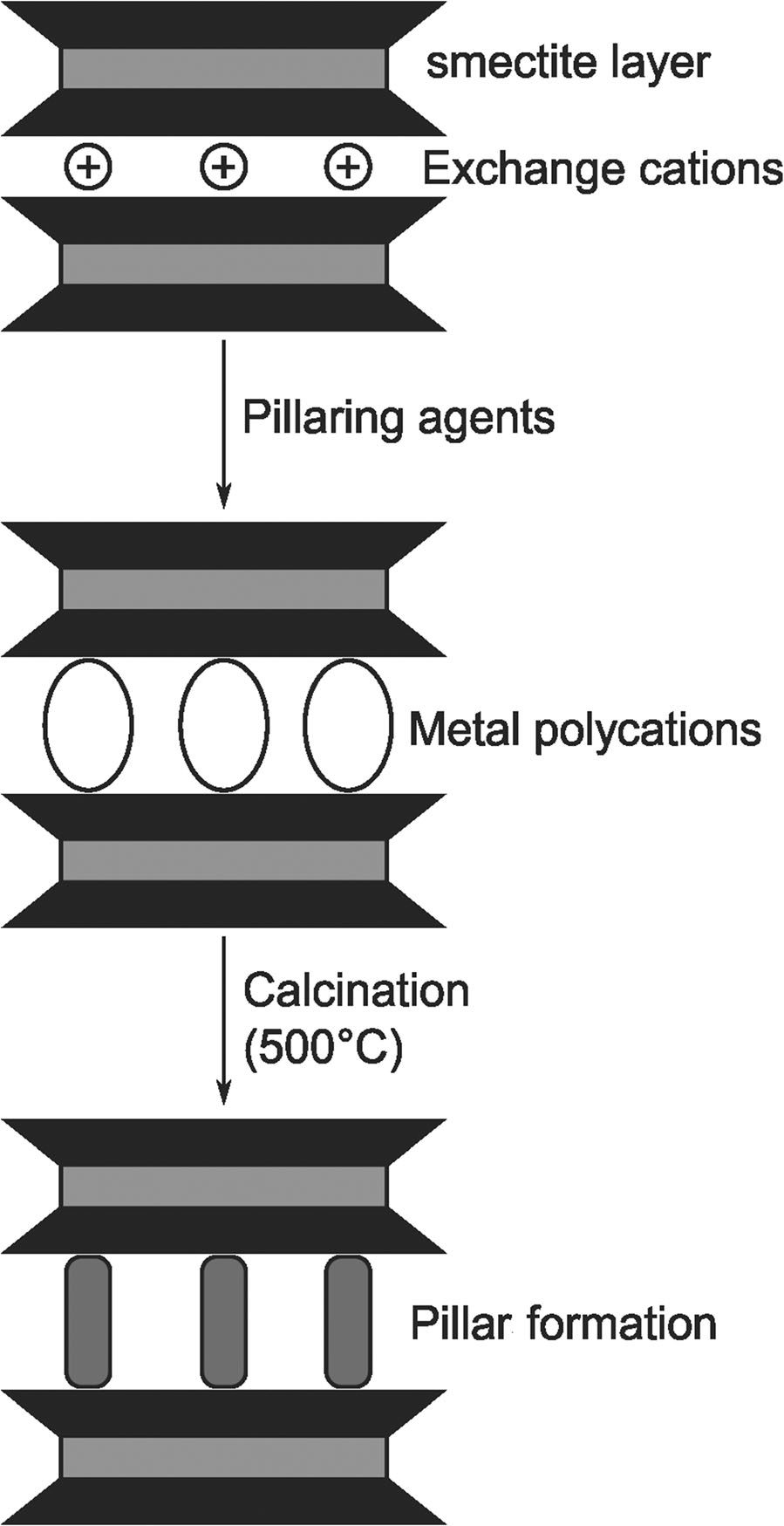
A crystalline smectite from Bhimber, Pakistan, was fractionated to obtain <2 μm particles (Deng et al., Reference Deng, Dixon and White2006). Montmorillonite was the only or dominant mineral in the clay fraction. The smectite was pillared with Al and Al-Fe polycations following methods described by Kaloidas et al. (Reference Kaloidas, Koufopanos, Gangas and Papayannakos1995), Gil et al. (Reference Gil, Gandia and Vicente2000), Vicente et al. (Reference Vicente, Belver, Trujillano, Rives, Álvarez, Lambert, Korili, Gandιa and Gil2004), and Mojović et al. (Reference Mojović, Banković, Milutinović-Nikolić, Dostanić, Jović-Jovičić and Jovanović2009). In brief, the solutions of 0.18 mol L–1 AlCl3, 0.02 mol L–1 FeCl3, and 0.2 mol L–1 NaOH were prepared using chemicals purchased from Sigma-Aldrich, Inc. (St. Louis, Missouri, USA). For Al pillaring, only Al solution was used while for Al-Fe pillaring, the Al and Fe solutions were mixed in an appropriate ratio to reach a final atomic ratio of 5.0% of the active Fe metal (AMRFe) and total metal concentration of 0.06 mol L–1 in the Al-Fe solution. Both pillaring solutions were hydrolyzed by adding NaOH solution dropwise at 70°C followed by ageing with constant shaking for 2 h. The pillaring solutions having pH 3.8 were added to pre-weighed smectites, maintaining a metal/clay ratio of 3.8 mol kg–1 dry clay. The dispersions were shaken for 24 h, washed with distilled deionized water twice to remove interstitial cations, and dried at 30°C. A portion of the dried pillared clay was heated at 500°C for 2 h as a calcination treatment. A schematic representation of pillaring in smectite interlayers is shown in Fig. 1.
Schematic representation of pillaring in smectite

Modifying the Interlayer Environment of Smectite by Means of Various Exchange Cations
The freeze-dried Na-saturated clay was washed three times with solutions of 0.5 M CaCl2, MgCl2, or ZnSO4, or 1 M LiNO3, in order to achieve saturation with Ca, Mg, Zn, or Li, respectively. The clay was washed with distilled, deionized water to remove the interstitial solution and dried at 30°C (Barrientos-Velazquez et al., Reference Barrientos-Velazquez, Cardona, Liu, Phillips and Deng2016b). A portion of each cation-exchanged clay was heat treated at 200°C, and a portion at 400°C, to determine the structure stability of various cation saturations under heat treatment (Chorom & Rengasamy, Reference Chorom and Rengasamy1996).
Characterization of Pillared and Cation-exchanged Smectites
All the clays modified by pillaring and cation exchange including various heat treatments were analyzed by X-ray diffraction (XRD) and Fourier-transform infrared (FTIR) spectroscopy. For XRD, 2 mg of clay was dispersed in 1 mL of distilled deionized water by sonication, and the dispersion was transferred to a glass slide and air-dried overnight. The XRD was measured over the range 2–45°2θ with a step size of 0.05°2θ and a dwell time of 5 s at each step on a D8 Advance Bruker diffractometer with CuKα radiation source and Sol-X detector (Bruker AXS GmbH, Karlsruhe, Germany).
For FTIR analysis, each clay dispersion was air-dried on a ZnS disc, positioned in a dewar accessory, and scanned under N2 purging aimed at reducing CO2 and moisture interference. The spectra were recorded in transmission mode on a Perkin-Elmer Spectrum 100 FTIR spectrometer (Perkin Elmer, Waltham, Massachusetts, USA) with 2 cm–1 resolution and 32 scans for each spectrum.
Preparation of Simulating Gastric Fluid
The gastrointestinal fluid simulant was synthesized by adding 312 mg of pepsin, 125 mg of citric acid, 125 mg of malic acid, 125 μL of acetic acid, and 105 μL of lactic acid in 250 mL of distilled, deionized water, and mixed thoroughly by stirring (Barrientos-Velázquez et al., Reference Barrientos-Velázquez, Arteaga, Dixon and Deng2016a; Lemke et al., Reference Lemke, Ottinger, Mayura, Ake, Pimpukdee, Wang and Phillips2001). All the chemicals were purchased from Sigma-Aldrich. The solution was filtered through Whatman No. 42 filter paper and centrifuged at 4380×g for 30 min with an IEC PR-7000 centrifuge (International Equipment Company, Needham Heights, Massachusetts, USA) to remove any undissolved pepsin.
Aflatoxin Adsorption in Water and Simulated Gastric Fluid
A 1000 mg L–1 AfB1/acetonitrile stock solution was prepared by dissolving either 5 or 10 mg of AfB1 (Sigma-Aldrich) in a corresponding volume of acetonitrile. The stock solution was diluted with either distilled deionized water or the gastric fluid simulant to obtain solutions of 4 mg L–1 AfB1 in water and simulated gastric fluid, respectively. Aflatoxin B1 adsorption from a single concentration of 4 mg L–1 of AfB1 in water and simulated gastric fluid was quantified to select the promising treatments among the pillaring, cation exchange, and heating treatments of modified clays. 100 μg of clay was added to a 5 mL of 4 mg L–1 AfB1 solution in distilled deionized water or simulated gastric fluid and equilibrated overnight at 37°C with three replications. The suspension was centrifuged at 4380×g for 1 h and AfB1 in the supernatant was measured at 365 nm using a Beckman Coulter DU800 UV-spectrophotometer (Beckman Coulter Inc., Brea, California, USA) (Barrientos-Velázquez et al., Reference Barrientos-Velázquez, Arteaga, Dixon and Deng2016a; Kannewischer et al., Reference Kannewischer, Arvide, White and Dixon2006). The difference in the amount applied vs. in the supernatant was attributed to adsorption.
Aflatoxin Adsorption Isotherm
Based on the screening results of the single-concentration adsorption, AfB1 adsorption isotherms were conducted in duplicate for the pillared smectites and two selected cation-exchanged smectites before and after the heat treatment to evaluate further their maximum adsorption capacity and selectivity. Aflatoxin B1 concentrations of 0, 2, 4, 6, and 8 mg L–1 corresponding to 0, 6.4, 12.8, 19.2, and 25.6 micromoles L–1, respectively, were prepared in water. From the 2 mg mL–1 clay dispersion in water, 50 μL was added in 5 mL of AfB1 standard solutions, allowed to equilibrate overnight at 37°C, and centrifuged at 6850×g for 1 h. The supernatant was decanted and analyzed for AfB1 (Kannewischer et al., Reference Kannewischer, Arvide, White and Dixon2006). The isotherms were fitted to the Langmuir equation (Eq. 1) to determine the adsorption parameters.

Equation 1 was rearranged in linear form:

where X is sorption of AfB1 by clay (g kg–1 clay), Cw is AfB1 concentration in the solution at equilibrium (mg L–1), K is the constant related to binding strength (when Cw = 1/K, X = b/2 or half of the sites on the clays are filled with AfB1), and b is the maximum adsorption capacity (Q max) (g of aflatoxin kg–1 clay).
Statistical Analysis
Aflatoxin B1 adsorption in pillared smectite and/or cation-saturated smectite heated at different temperatures in two equilibrium fluids was analyzed by three-way analysis of variance and the treatment means were compared using Tukey’s HSD test at p < 0.05.
Results
Characteristics of Pillared Clays
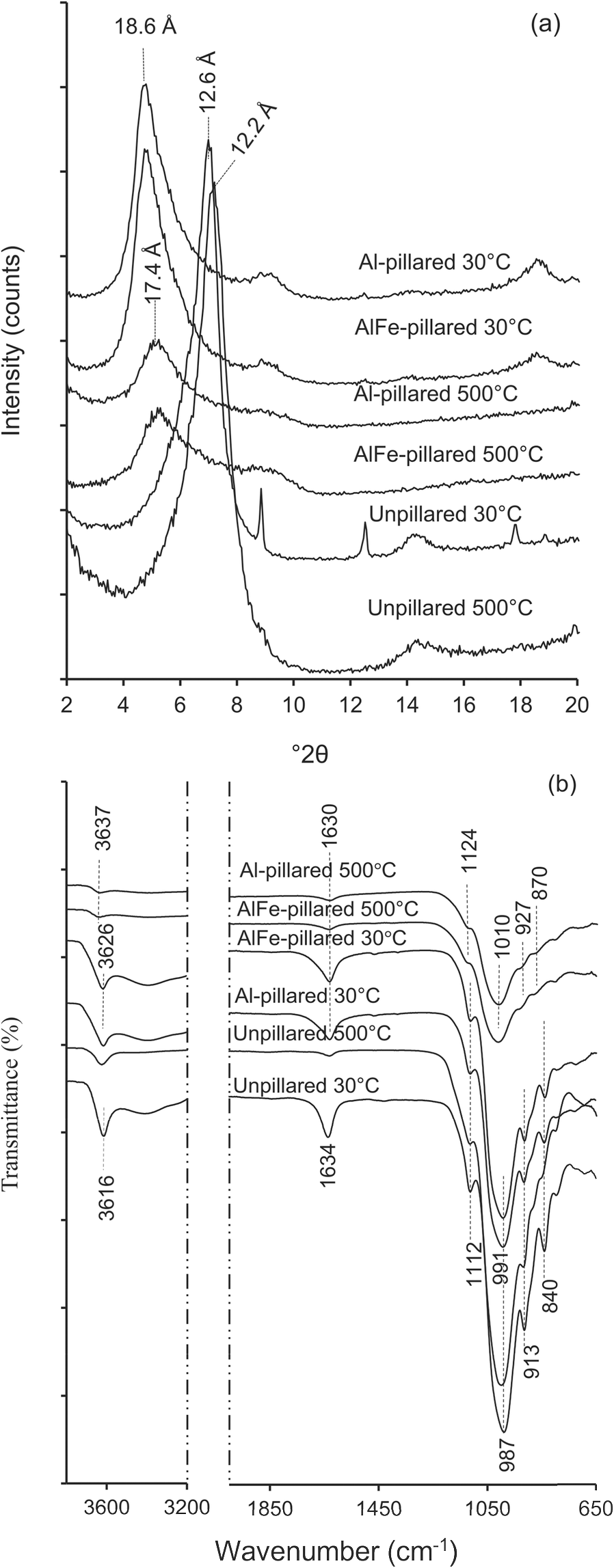
The XRD and FTIR analyses indicated that pillaring of smectite was achieved with both Al and Al-Fe polycations and the pillared smectite was stable to the 500°C heat treatment. The intercalation of Al and Al-Fe polycations expanded the basal spacing of the smectite from 12.6 Å to similar values of 18.6 Å (Fig. 2a). The 500°C heat treatment shifted the basal spacing of both pillared smectite from 18.6 Å to 17.4 Å but broadened the peak width and reduced peak intensity. The decrease in intensity and increase in width of the peak may suggest a reduced crystallinity of the pillared clays that had gone through the heat treatments (Moreno et al., Reference Moreno, Kou, Molina and Poncelet1999; Taguchi & Schüth, Reference Taguchi and Schüth2005).
a XRD patterns and b FTIR spectra of clays upon intercalation of metal polycations and subsequent heat treatments

The Si–O stretching band at 987 cm–1 in unmodified smectite shifted to 991 cm–1 upon pillaring and to 1010 cm–1 upon heating pillared smectite (Fig. 2b). Similarly, the bands at 840, 913, and 1112 cm–1 shifted progressively to higher wavenumbers upon pillaring and subsequent heating. The IR bands associated with adsorbed water in the interlayers at 3410 cm–1 and 1634 cm–1 reduced in intensity suggesting water loss upon heating (Besson & Drits, Reference Besson and Drits1997; Rejeb et al., Reference Rejeb, Antonissen, De Boevre, Detavernier, Van de Velde, De Saeger, Ducatelle, Hadj Ayed and Ghorbal2019). The intensity of the IR band at 3616 cm–1 associated with Al–OH stretching was also reduced as a wider band at 3626 cm–1 formed in pillared clays and further shifted to 3637 cm–1 upon heat treatments of pillared clays (Farmer, Reference Farmer1974). The IR vibration at 1112 cm–1 moved to 1125 cm–1 in pillared clays with heating and is associated with in-plane vibrational movement in the Si–O stretch region. The new bands at 870 cm–1 formed in heated pillared clays suggested bonding between the tetrahedral sheet and intercalated pillaring ions.
Characteristics of Cation-exchanged Smectite before and after Heating
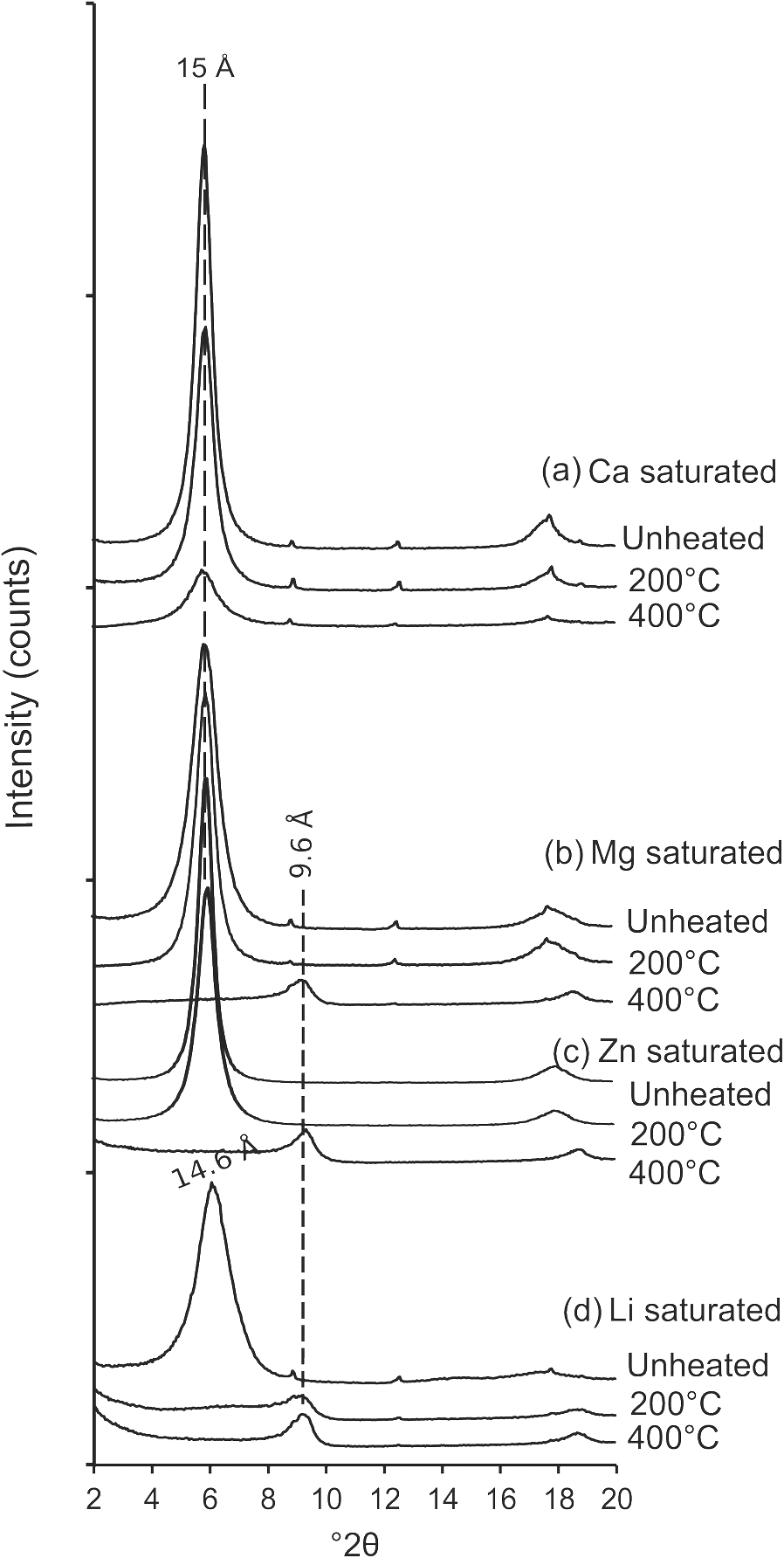
Saturating the smectite with Mg and Zn resulted in a 15 Å basal spacing and this basal spacing remained unchanged when the Mg- and Zn-saturated smectites were heated to 200°C and then cooled to room temperature. These smectites collapsed to 9.6 Å after heating at 400°C (Fig. 3) and did not return to their initial 15 Å basal spacing. For lithium-saturated smectite, the 14.6 Å peak collapsed to 9.6 Å after heating at 200°C while in the case of calcium saturation, the 15 Å peak was stable up to 400°C. The basal spacing responses to heating suggested that water molecules could still access the interlayer gallery in the Mg- and Zn-saturated smectite after 200°C heating and in the Ca-saturated smectite even after 400°C heating, but water cannot access the interlayer of the Li-saturated smectite after 200°C heating. The d spacing changes suggested that Mg, Zn, and Li could migrate to the empty octahedral sites in the smectite but Ca could not during the heating. Lithium, having a smaller cationic radius, could not resist the heat effect, and the migration occurred at 200°C (Jaynes & Bigham, Reference Jaynes and Bigham1987) while the migration of Mg and Zn required a higher temperature. The XRD peak intensity decreased with the heat effect and subsequent broadening of peaks occurred in calcium-saturated smectite, which indicated loss of structure crystallinity upon heating (Calvet & Prost, Reference Calvet and Prost1971; Tlili et al., Reference Tlili, Saidi, Fourati, Ammar and Jamoussi2012).
XRD patterns of smectite saturated with Li, Mg, Zn, or Ca before and after heating for 2 h at 200 and 400°C

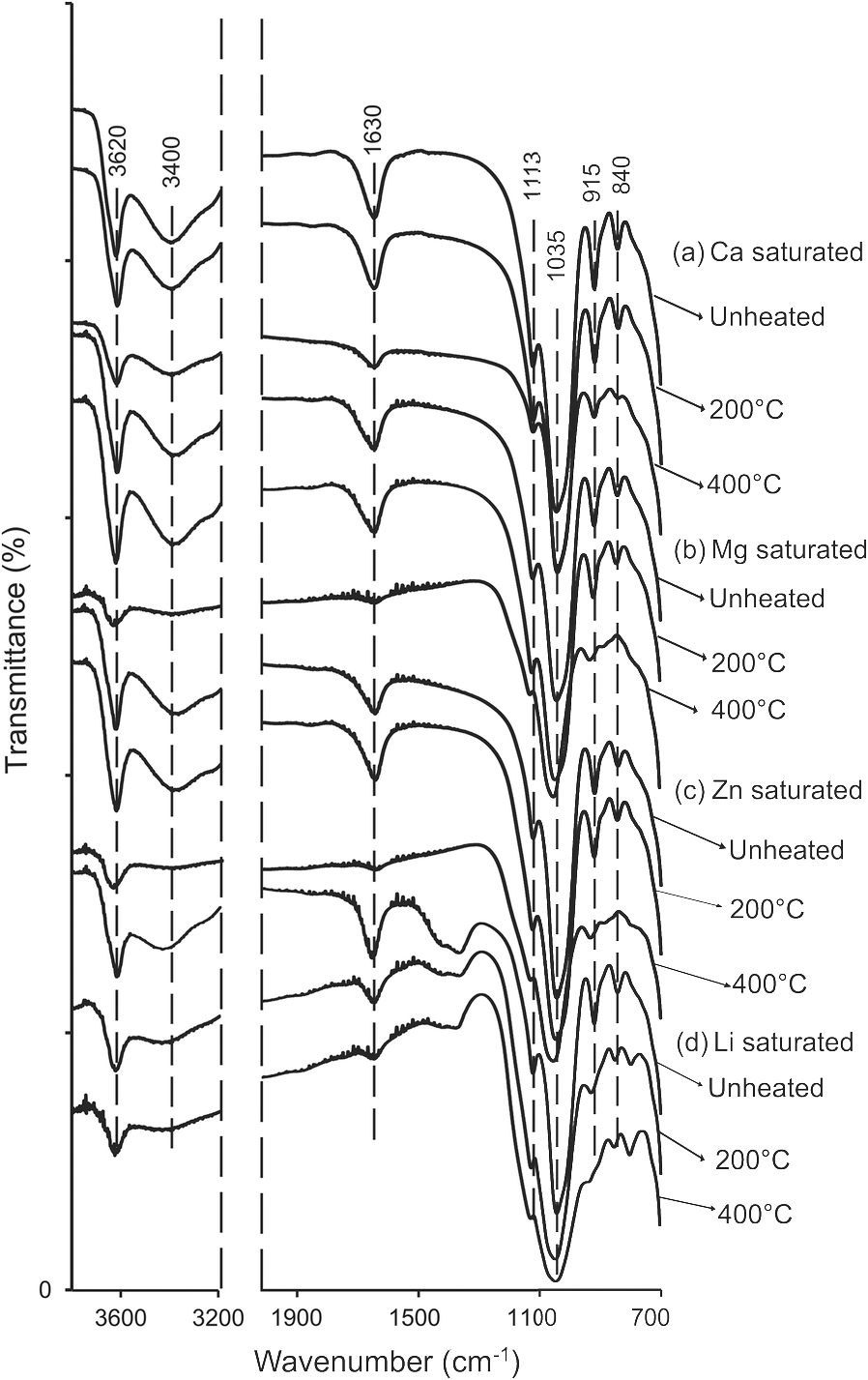
The shift in IR band positions under saturation with different cations occurred only after heating at 200°C and 400°C and was constant irrespective of the cation on exchange sites. The shifts were associated with the heat effect rather than with the choice of cation (Fig. 4). The IR band position at 1035 cm–1 associated with out-of-plane Si–O stretching vibrations shifted to 1040 cm–1 upon heating at 400°C with Li and Ca saturation and to 1050 cm–1 in Mg- and Zn-saturated clays. In-plane stretching of Si–O resulted in a reflection at 1113 cm–1 which was shifted to 1121 cm–1 after heating at 400°C. The shifting of bands in the Si–O stretching region was due to the formation of new bonds between the tetrahedral-sheet and interlayer cations after loss of water molecules (Chorom & Rengasamy, Reference Chorom and Rengasamy1996; Kloprogge et al., Reference Kloprogge, Booy, Jansen and Geus1994).
IR spectra of smectite saturated with various cations and heated for 2 h

Aflatoxin Adsorption by Pillared Smectites
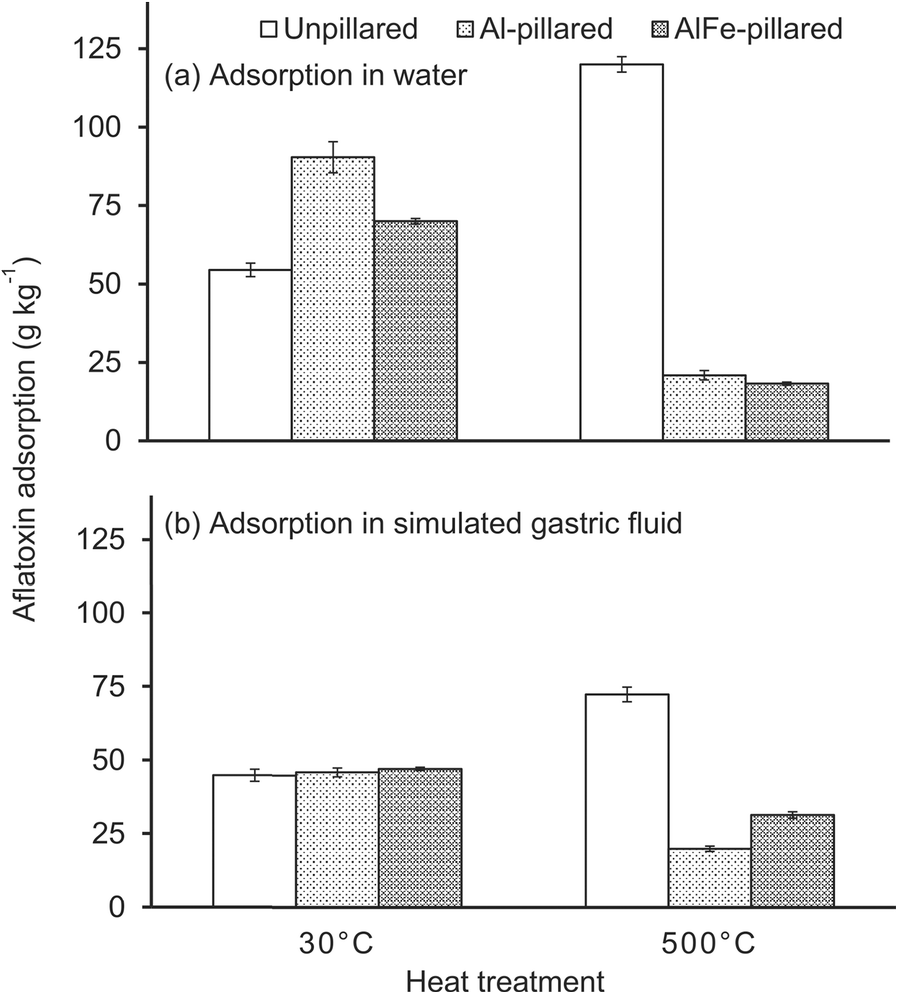
A single-point (4 mg L–1) aflatoxin adsorption experiment indicated that the interaction of three main factors, i.e. the type of pillaring, the heat treatment, and fluid type, was significant (F 330, p < 0.0001) (Fig. 5). Pillaring in smectite resulted in greater adsorption in aqueous solution but was on a par with unpillared smectite when the solution was simulated gastric fluid. Heat treatment increased AfB1 adsorption in unpillared smectite but not in the pillared smectites irrespective of the fluid type or the pillaring cation type. When aflatoxin adsorption was conducted in the absence of gastrointestinal compounds, the unpillared smectite heated at 500°C had the greatest mean adsorption of 120 g kg–1, followed by the unheated Al-pillared of 90.4 g kg–1, and the unpillared smectite heated at 500°C in simulated gastric fluid, 70.8 g kg–1. Both the unheated Al and Al-Fe pillared smectites had significantly greater adsorption in aqueous solution than unpillared smectite. Aflatoxin adsorption reduced in the pillared smectites and increased in unpillared smectites with heat treatment in each fluid type. A non-significant variation occurred among the two types of pillared and unpillared smectites without heat treatments when adsorption was carried out in simulated gastric fluid. The lesser adsorption in simulated gastric fluid over water may be attributed to the lower pH of 3.4 compared to 5.5 in aqueous suspensions and to pepsin interference. Apparently, pillaring with Al had a nominal advantage, while heating the natural smectite at 500°C had greater adsorption in aqueous suspension and the difference was maintained in gastric fluid also. When the same smectite had been heated at 500°C, the pillared smectite showed least adsorption in both the simple aqueous and in the simulated gastric fluids.
Adsorption of aflatoxin B1 by pillared smectites from a single initial concentration of 4 mg L–1 aflatoxin B1 from aqueous solution and from simulated gastric fluids

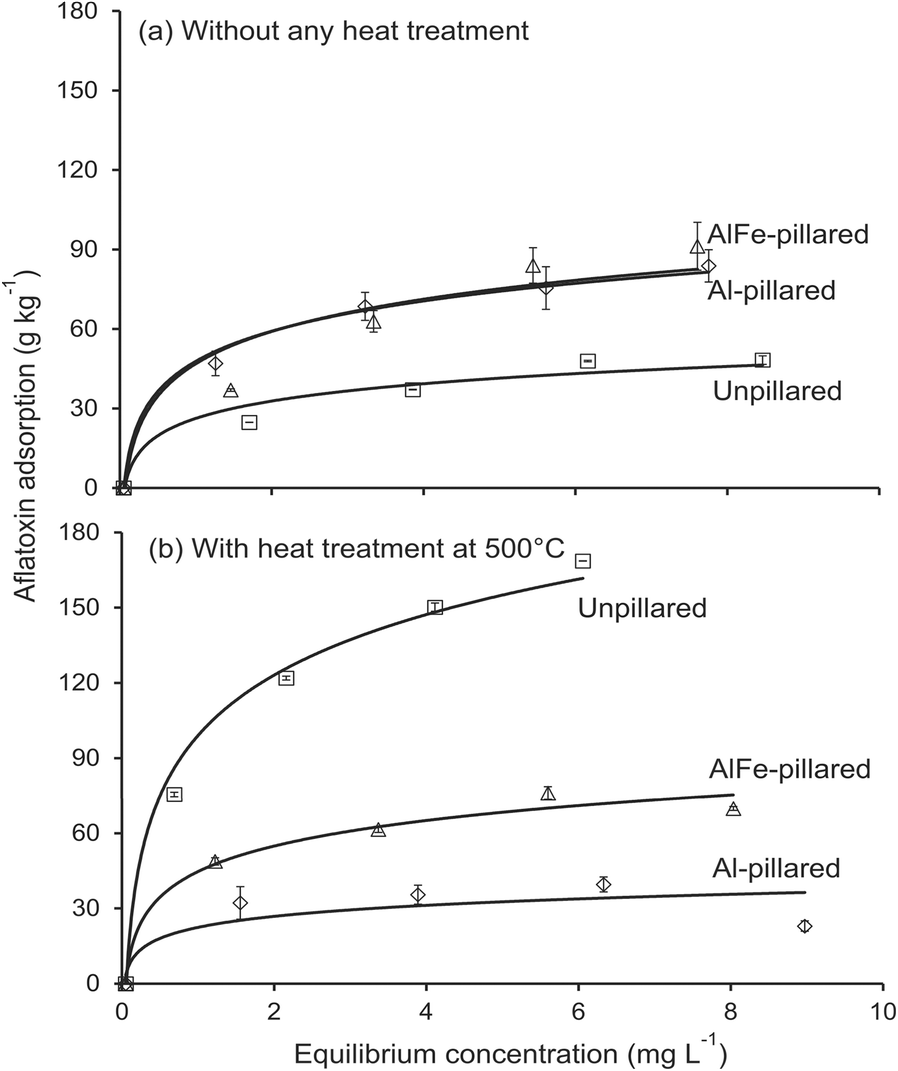
Aflatoxin adsorption isotherms on pillared smectites.
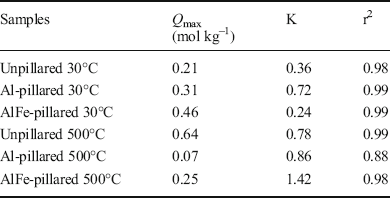
The isothermal adsorption of AfB1 by the pillared and heat-treated smectite appeared to vary with treatments (Fig. 6). Each pillared smectite initially showed a significant increase and steeper slope (in terms of adsorption) than natural smectite where no heat treatment was carried out. In the case of heat treatment at 500°C, the natural smectite initially showed a steep increase in the isotherm and the steepest slope. Overall, the adsorption isotherms had an L2 shape as described by Grant and Phillips (Reference Grant and Phillips1998). The Langmuir equation fitted the adsorption isotherms well (Table 1). The maximum AfB1 adsorption capacity (Q max) varied, and was maximum in the case of natural smectite after heating at 500°C; and the value 0.64 mol kg–1 (20% w/w) matched the maximum adsorption reported so far (Deng et al., Reference Deng, Liu, Velazquez and Dixon2012). The Q max reduced by heating in the case of pillared smectite and increased in the case of natural smectite. The adsorption strength increased nearly twofold by heating at 500°C in the case of the Al-Fe pillared smectite.
Aflatoxin B1 adsorption isotherms on smectites before and after pillaring and heating treatments

Langmuir model-fitted parameters for aflatoxin B1 adsorption in pillared smectites

Q max maximum adsorption capacity, K maximum binding strength, and r 2 correction coefficient
Aflatoxin Adsorption by Smectites Saturated with Various Cations
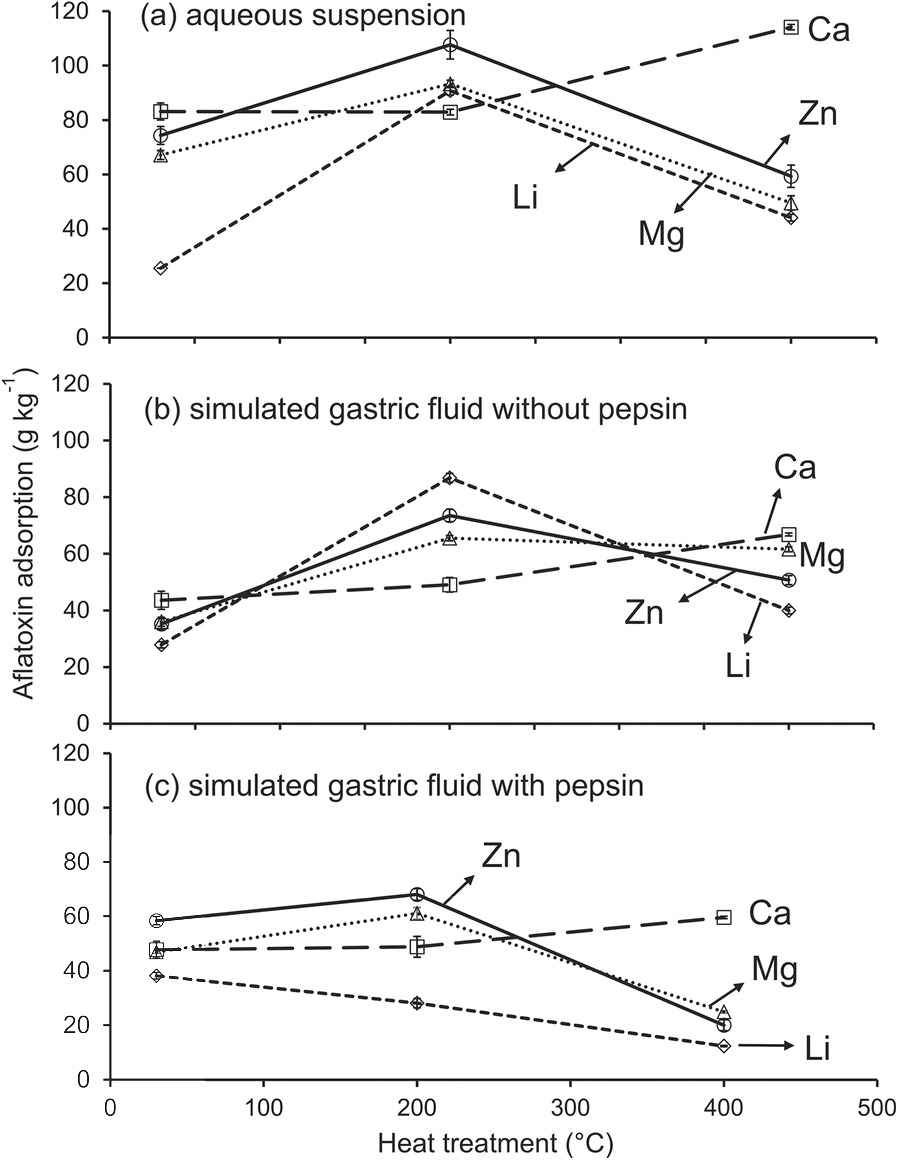
The interactive effect of the cation, heat treatment, and the equilibrium fluid type was significant (F 73.5, p < 0.0001) for adsorption of AfB1 at a single concentration of 4 mg L–1. Mean AfB1 adsorption ranged from 12.4 to 114.1 g kg–1 among cation-exchanged smectites (Fig. 7). The Ca-saturated smectite showed the greatest adsorption followed by Zn- and Mg-exchanged smectites. Heating the smectites at 200°C resulted in greater AfB1 adsorption for Li-, Mg-, and Zn-saturated smectites but at 400°C reduced their efficacy in binding AfB1. Heating Ca-smectite at 400°C and Zn- and Mg-smectites at 200°C resulted in greater AfB1 adsorption in aqueous suspension and also increased aflatoxin selectivity over pepsin in simulated gastric fluid. The greatest adsorption (114.3 g kg–1) was obtained when Ca smectite was heated at 400°C, followed by Zn-smectite heated at 200°C. In the simulated gastric fluid with pepsin excluded, Li saturation and subsequent heat treatment at 200°C resulted in the maximum adsorption. A decline in AfB1 adsorption occurred after heating at 400°C for all cation saturations except Ca, which may be related to degeneration of the structure and charge reduction. In the simulated gastric fluid containing pepsin, the 200°C heated Zn-smectite had the maximal aflatoxin adsorption of 68.0 g kg–1.
Aflatoxin adsorption by smectites from 4 mg L–1 aflatoxin B1 after cation saturation and heating in three fluids: a aqueous solution; b simulated gastric fluid without pepsin; and c simulated gastric fluid with pepsin

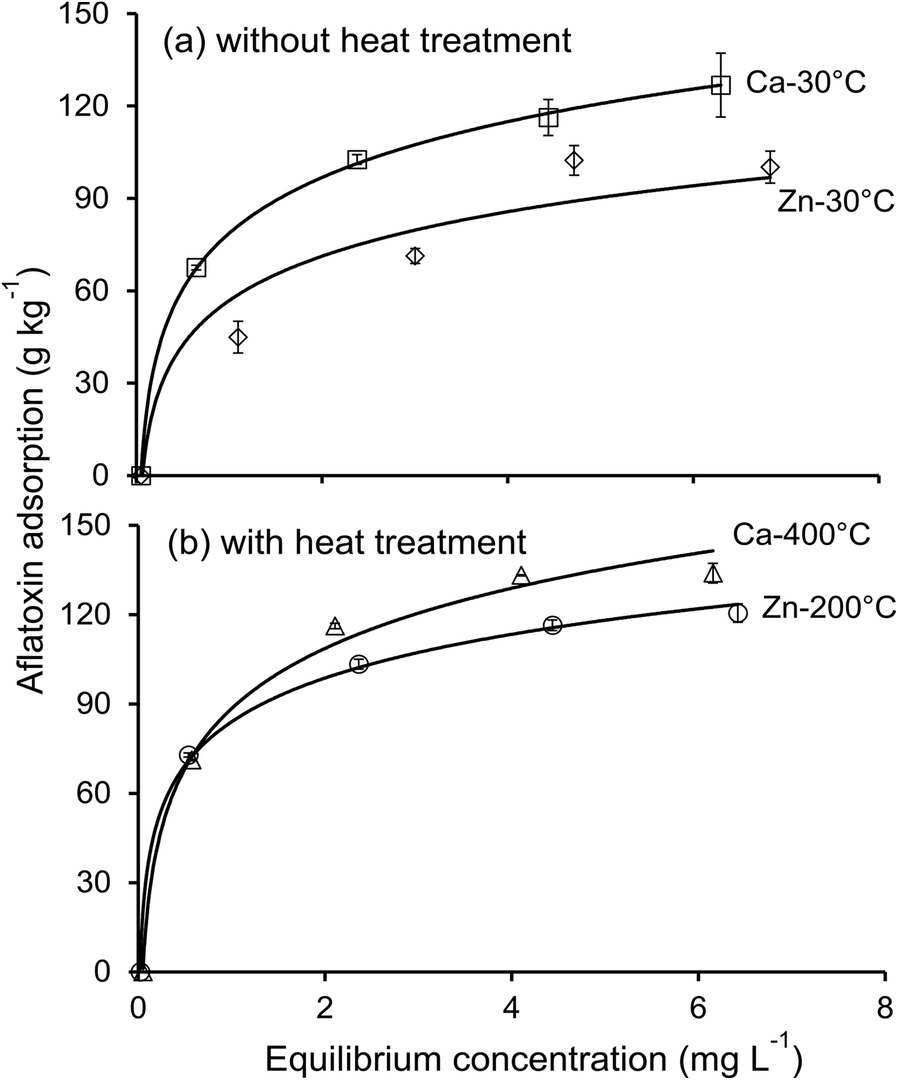
Aflatoxin isotherms and adsorption capacity of cation-exchanged smectites.
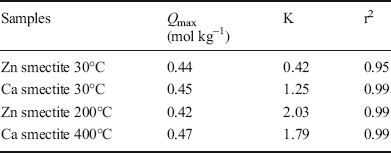
The exchange cation type or the heat treatment afterwards had little effect on maximum adsorption capacity (Table 2, Fig. 8). The heat treatment, however, caused the initial adsorption isotherm slope, an indication of binding strength, to increase. The natural smectite showed maximum AfB1 adsorption of 0.2 mol kg–1 which increased twofold with Ca and Zn saturation (Table 1). Though the additional heat treatment had no effect on Q max, it increased the maximum binding strength substantially. The increased adsorption by cation exchange is greater than the criterion (0.3 mol kg–1) of an effective adsorbent set by Dixon et al. (Reference Dixon, Kannewischer, Arvide and Velazquez2008).
Langmuir model-fitted parameters for aflatoxin B1 adsorption in selected cation exchanged smectites

Q max maximum adsorption capacity, K maximum binding strength, and r 2 correction coefficient
Aflatoxin B1 adsorption isotherms for Ca- and Zn-saturated smectites after heating

Discussion
Efficiency of Pillaring in Enhancing the Adsorption for Aflatoxin B1 by Smectite
Pillaring of smectite at room temperature increased adsorption of AfB1 in a simple aqueous solution, but did not increase the selectivity of smectite for AfB1 in the gastric fluid (Fig. 5). The relatively significant adsorption of AfB1 by the pillared smectite was associated with the expansion of the interlayer space as illustrated in Fig. 1 and confirmed by the XRD results (Fig. 2a). Several other studies also reported an increase in aflatoxin adsorption in pillared smectites over unmodified smectite (Lothenbach et al., Reference Lothenbach, Furrer and Schulin1997; Phillips et al., Reference Phillips, Sarr and Grant1995; Vicente et al., Reference Vicente, Belver, Trujillano, Rives, Álvarez, Lambert, Korili, Gandιa and Gil2004; Zeng et al., Reference Zeng, Wang, Peng, Geng, Chen and Li2013). All of those results were obtained using simple aqueous solutions, however, not gastric fluids. The AfB1 adsorption enhancement effect of pillaring smectite was masked by gastric fluid (Fig.5, lower left). The simulated gastric fluid contained multiple biomolecules, and pepsin was a main biomolecule interfering with AfB1 adsorption by smectite (Barrientos-Velazquez & Deng, Reference Barrientos-Velazquez and Deng2020; Jaynes et al., Reference Jaynes, Zartman and Hudnall2007). Pillaring of smectite was expected to limit access of the large protein molecules into the interlayer space. The small or negligible effects of pillaring on AfB1 adsorption in the simulated gastric fluid suggested that the small organic acids in the gastric fluid interacted with the pillaring polycations and made the interlayer environment less favorable for AfB1 adsorption.
Heating the pillared smectite was expected to might further enhance the stability of the porous interlayer structure of the pillared smectites and, therefore, enhance their adsorption of aflatoxin. The FTIR data (Fig. 3) suggested that the dehydration and dehydroxylation of interlayer water and pillars upon the 500°C heat treatment resulted in strong bonding of pillaring polycations to the tetrahedral sheet (Sergio et al., Reference Sergio, Musso, Medina and Diano2006; Yuan et al., Reference Yuan, Annabi-Bergaya, Tao, Fan, Liu, Zhu, He and Chen2008). These changes caused the reduction in the number of binding sites for AfB1 molecules in both the simple aqueous solution and the gastric fluid simulant. Reduced AfB1 adsorption after heating at 500°C and the lack of increment in selecting aflatoxin in gastric fluid suggested that heating at such high temperature was not optimal in terms of modifying smectite as aflatoxin binders. Further optimization of the pillaring is still needed.
Efficiency of Cation Exchange and Heating in Enhancing the Adsorption by Smectite of Aflatoxin B1
Both consistency and discrepancies were observed on the effects of exchange cations in the present study compared to those reported in the literature. Bonding between interlayer cations and two carbonyl oxygens is a major mechanism of aflatoxin binding with smectite (Deng & Szczerba, Reference Deng and Szczerba2011), and thus the adsorption and affinity of aflatoxin depends on exchange cations (Daković et al., Reference Daković, Matijašević, Rottinghaus, Ledoux, Butkeraitis and Sekulić2008; Deng et al., Reference Deng, Liu, Velazquez and Dixon2012). Smectite with Ca saturation adsorbed more AfB1 than those saturated with Zn and Mg. The greater adsorption by Ca-smectite could be related to a lower hydration energy of Ca than those of Mg and Zn. The increase in adsorption of cation-exchanged smectite upon heating was related to charge reduction (Chorom & Rengasamy, Reference Chorom and Rengasamy1996; Madejová et al., Reference Madejová, Pálková and Komadel2006). Reduced aflatoxin adsorption by heating of natural bentonite was also reported (Nones et al., Reference Nones, Nones, Poli, Trentin, Riella and Kuhnen2016). The maximum AfB1 adsorption was increased tenfold in Ca-saturated smectite and heated over the natural smectite (Gan et al., Reference Gan, Hang, Huang and Deng2019). The decline in AfB1 adsorption after heating at 400°C in all cation saturations except with Ca was related to interlayer collapse as identified by XRD. Smectites have been reported to have an optimal charge density range for aflatoxin adsorption, the corresponding cation exchange capacity was between 80 and 110 cmol/kg. Reducing the charge density below the optimal range decreased AfB1 adsorption (Deng et al., Reference Deng, Liu, Velazquez and Dixon2012). The results observed in the current study suggested that saturating the smectite with Li, Mg, or Zn, and then heating Li-smectite at 200°C or Mg- or Zn-smectite at 400°C induced too much charge reduction of the smectite due to the migration of the cations into the octahedral sites. On the other hand, heating Mg- and Zn-smectite at 200°C caused only partial migration of the respective cation into the octahedral sites and induced greater AfB1 adsorption irrespective of fluid type over unheated cation-exchanged smectites. The greatest AfB1 adsorption of the 400°C heated Ca-smectite suggested that there were other structural or surface property changes on the smectite as Ca cannot occupy the octahedral sites.
Pepsin is a major interfering compound in aflatoxin adsorption as pepsin intercalated into the smectite interlayer at the expense of exchange cations according to Barrientos-Velázquez et al., (Reference Barrientos-Velázquez, Arteaga, Dixon and Deng2016a) and Barrientos-Velazquez and Deng (Reference Barrientos-Velazquez and Deng2020). Those authors reported that the Ca- and Ba-smectite had greater maximum adsorption than Na-saturated smectite in water but the adsorption declined and the initial saturating cation effect diminished in simulated gastric fluid (Barrientos-Velázquez et al., Reference Barrientos-Velázquez, Arteaga, Dixon and Deng2016a). In the present study, smectites saturated with divalent cations Ca, Zn, or Mg adsorbed more aflatoxin than the Li-smectite in simulated gastric fluid. This could be associated with greater hydration energy and strong bonding of these cations to the clay surface (Deng et al., Reference Deng, Velazquez, Billes and Dixon2010; Deng & Szczerba, Reference Deng and Szczerba2011). AfB1 adsorption by cation-exchanged smectites was observed to decline in simulated gastric fluid with and without pepsin. Though heating the Li-, Mg-, Zn-smectites at 200°C and Ca-smectite at 400°C enhanced their binding capacity for AfB1 in simple aqueous solutions, no improvement was observed in the presence of small organic acids or of pepsin in simulated gastric fluid. The increase in AfB1 adsorption in simple aqueous solution was related to charge reduction and favorable interlayer environment for aflatoxin binding. Likewise, heating also increased the affinity of AfB1 to smectite/clay that may have helped in greater adsorption of AfB1 over unheated cation-exchanged smectites in different fluid types.
Conclusions
Smectites modified by pillaring with Al and Al-Fe polycations enhanced maximum adsorption of AfB1 from aqueous suspensions through expansion in interlayer spaces, but the selective adsorption of aflatoxin over pepsin in simulated gastric fluid was not improved, which was probably due to the interference of simple organic acids that resulted in a less favorable interlayer environment for aflatoxin binding. Heating the pillared smectite reduced the binding ability of pillared clays in both simple aqueous solution and simulated gastric fluid due to strong bonding of pillars and exchange cations to clay upon dehydration and dehydroxylation leaving fewer binding sites for AfB1. Smectites saturated with Ca, Mg, or Zn cations had greater AfB1 adsorption compared to Li-exchanged smectite and was related to the divalent nature of the exchange cations. Heating increased selectivity for the adsorption of AfB1 over pepsin from simulated gastric fluid due to charge reduction and increase in hydrophobicity of the interlayer. Pillaring was effective without heating in aqueous suspensions only while smectites exchanged with Ca and Zn and heating effectively increased AfB1 adsorption from both aqueous suspensions and simulated gastric fluid.
ACKNOWLEDGMENTS
The present study was carried out during a student-exchange program funded by the Higher Education Commission of Pakistan.
Funding
Funding sources are as stated in the Acknowledgments.
Compliance with ethical statements
Conflict of Interest
The authors declare that they have no conflict of interest.